
Dental Simulator Market Demand, Trends & Forecast by 2034
Dental Simulator Market Size and Forecasts (2021–2034), Global and Regional Share, Trends, and Growth Opportunity Analysis Report Coverage : by Type (Virtual Simulators, Physical Simulators); Application (Dental Training and Education, Research and Development); End-User (Dental Schools and Universities, Hospitals and Clinics, Private Practices); and Geography (North America, Europe, Asia Pacific, and South and Central America)
- Status : Data Released
- Report Code : TIPRE00040640
- Category : Life Sciences
- No. of Pages : 150
- Available Report Formats :


- Last update date : September 07, 2026


2025 Market Size
US$ 533.03 Mn
Base year value
2034 Forecast
US$ 971.13 Mn
Projected by 2034
CAGR 2026-2034
7.79 %
Growth rate
Addressable Market
US$ 7,112.16 Mn
(2026-2034)
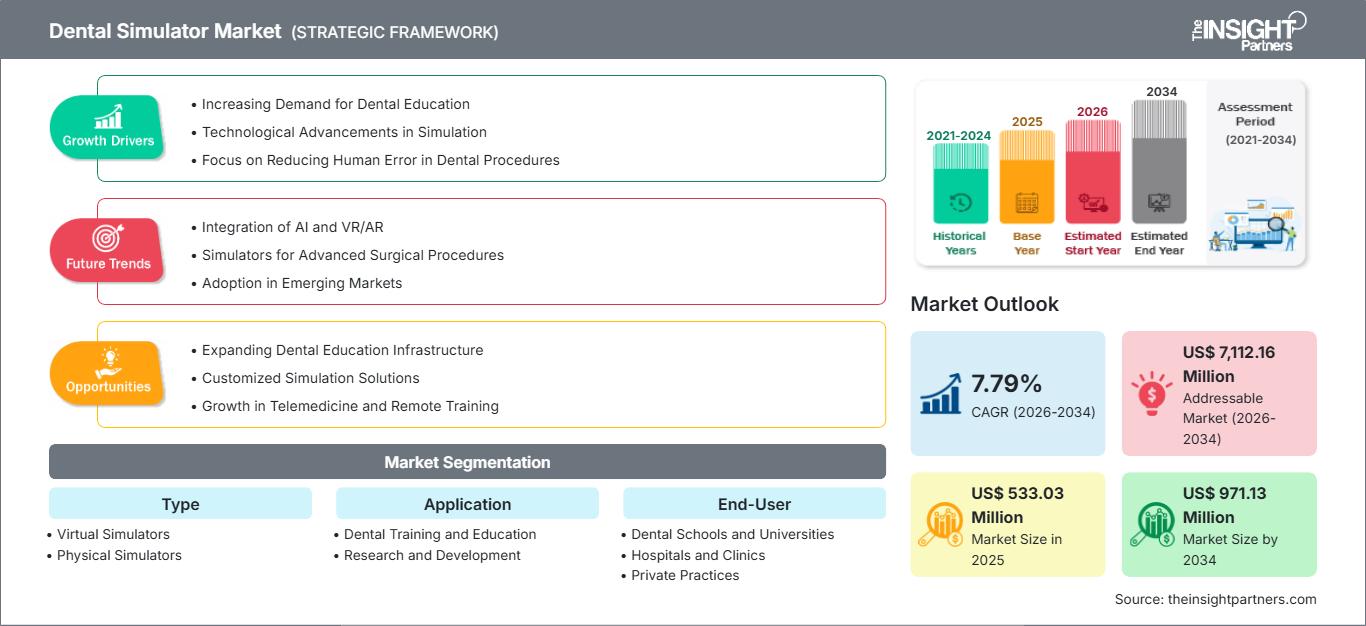
The Dental Simulator Market is valued at US$ 533.03 Million in 2025 and is projected to reach US$ 971.13 Million by 2034, registering a CAGR of 7.79% from 2026 to 2034. The market includes various simulation technologies deployed for learning within dentistry, training skills, conducting research, and practicing dentistry, where buying considerations become more realistic, evaluative, interoperable, cost-effective, and training-capable.
North America continues to be a structurally important region for adoption, thanks to strong dental education infrastructures, competency-based programs, and periodic investments in simulation labs. The Dental Simulator Market Size in the region is driven by demand for high-fidelity training, legacy system replacements, and digital assessments for practical education. The region's CAGR is estimated between 8.5% and 9.1% until 2034.
Dental Simulator Market Assessment and Insights
- North America: The region is expected to command a 38–41% share in 2025 and grow at a CAGR of 8.5–9.1% during 2026–2034, supported by mature dental schools, replacement cycles, and premium simulation adoption.
- US: The U.S. is expected to represent 80–84% of North American revenue in 2025 and expand at a CAGR of 8.5–9.0%, supported by established simulation laboratories and education investment.
- Europe: Europe is projected to hold a 28–30% share in 2025 and grow at a CAGR of 8.8–9.3%, with Germany, the UK, France, Italy, and Spain providing established academic and clinical demand.
- Asia Pacific: Asia Pacific is estimated at a 22–24% share in 2025 and is projected to grow at a CAGR of 9.8–10.6%, led by China, India, Japan, South Korea, and Australia as education capacity expands.
- Largest Segment: Physical Simulators are estimated at a 55–59% market share in 2025, with a CAGR of 7.1–7.7%, reflecting continued demand for realistic workstation and manikin-based instruction.
- High Growth Segment: Virtual Simulators represent an estimated 41–45% share in 2025 and are projected to grow at a CAGR of 8.5–9.2%, benefiting from immersive and haptic technologies.
- Key companies analyzed in detail: KaVo Dental, 3D Systems, SIMTICS, Anatomage, Dentsply Sirona, Vatech, Amann Girrbach, Aseptico, Planmeca, and Ortho2.
Source: The Insight Partners' analysis based on proprietary research, government publications, company annual reports, investor presentations, industry databases, and expert interviews.
Simulation technology in dentistry is moving away from stationary manikins to a holistic environment that integrates physical anatomy, imaging, haptics, visualization, and assessment. The production dynamics are now shifting towards modular designs that enable configurations according to the curriculum requirements and updates without the need to replace the entire workstation. The competition in suppliers is now based on ergonomics, durability, software compatibility, instrumentation, and learning metrics. For example, KaVo's simulation units focus on realistic working conditions and customizable patient simulators.
The demand is also shifting towards the modernization of institutions and not just the purchase of the first set of equipment. New markets present an opportunity to develop new laboratory capacity while developed markets provide opportunities for replacement and software upgrade. The regulatory push on competence, patient safety, and structured clinical assessment also encourages simulation-based learning. The WHO's global oral health agenda focuses on workforce development, research, digital innovations, and oral health integration into health systems.
Dental Simulator Market Report Scope
| Report Attribute | Details |
|---|---|
| Market size in 2025 | US$ 533.03 Million |
| Market Size by 2034 | US$ 971.13 Million |
| Global CAGR (2026 - 2034) | 7.79% |
| Historical Data | 2021-2024 |
| Forecast period | 2026-2034 |
Dental Simulator Market Analysis
The Dental Simulator Market will grow on the back of the requirement to build up proficiency in advance of working directly with patients. Simulators are widely used by dental schools to repeat procedures, evaluate technique, and create uniform learning standards across different classes. Ecosystem members include simulator manufacturers, haptic device vendors, software companies, imaging companies, content creators, universities, hospitals, and distributors. Hardware still plays an important role since physical workstations and manikins offer the essential tactile base necessary for pre-clinical training, while software adds procedural databases, scoring, analysis, and remote accessibility. Data on predoctoral dental training in the United States suggests that 27,920 students are registered for programs at this stage during 2024-2025 academic year.
Trends in supplies are leaning more toward the provision of complete software-hardware platforms rather than separate products. It is possible to offer differentiation via modularity of workstations, cloud evaluation capabilities, haptics, and compatibility with digital dentistry. Service level agreement becomes an important part of the value chain, along with faculty training, updates of content, calibration, and technical assistance. In addition to the potential for earning ongoing income once capital expenses are made, this will reduce the likelihood of institutions regarding simulators as inflexible lab equipment. Even the virtual platform could result in greater use by facilitating training beyond the simulation rooms.
Dental Simulator Market Report shows a fragmented market structure where established dental equipment manufacturers compete against simulation and software specialists. The competitors Dentsply Sirona and KaVo Dental have broad ranges of dental education products, whereas 3D Systems has haptic technology which is employed in virtual dental simulation. Anatomage and SIMTICS offer digitally-enabled education. Planmeca, Vatech, Amann Girrbach, Aseptico, and Ortho2 add further reach to the competitive landscape.
Increasingly, investments are being made towards interoperability and measurable educational impact. One of these investments is Virteasy Dental's use of 3D Systems haptics technology, with over 30,000 students reportedly trained via this solution. These implementations show that purchasing decisions are increasingly based not only on physical realism but also on haptic realism, scalability of the content, analytic capabilities, and usability at an institutional level. Competition will be determined by installed base, curriculum fit, geographic reach, customer service, and interoperability with digital dentistry ecosystem.
● REPORT CUSTOMIZATION
Tailor This Report To Align With Your Specific Business Requirements
This report can be customized to align precisely with your business objectives, scope, and target markets. Customization options include tailored segmentation, geography, competitive analysis, and strategic insights to support informed decision-making.
Customize This Report →WHAT YOU CAN ADJUST
- ● Segmentations
- ● Geography
- ● Competitive Analysis
- ● Language Preferences
Dental Simulator Market: Strategic Insights
Regional Insights
North America Dental Simulator Market
The Dental Simulator Market Share in North America is expected to be valued between 38–41% in 2025 and is anticipated to grow at a CAGR between 8.5–9.1% from 2024–2034. The market has an established infrastructure for dental education programs, good acceptance of technology, and recurrent investments for upgrading simulation labs. The major demand contributor will remain the United States, whereas Canada will contribute via its universities.
Dental Simulator Market in North America is becoming more affected by competency assessment, haptics technology, and the replacement of outdated mechanical technologies. There are considerations made in terms of total life cycle cost, ease-of-use by faculty, analysis, and integration into curriculum. The USA has a significant number of accredited educational programs, with 73 predoctoral programs and 27,920 students for 2024–2025 period.
U.S. Dental Simulator Market
U.S. contribution towards North American revenues in 2025 is expected to be in the range of 80%-84%, with a compound annual growth rate of 8.5%-9.0% during 2026-2034. Key drivers include the use of dental simulation in institutions such as dental schools, hospitals, and advanced training facilities, which provide repeatable learning experiences prior to clinical involvement.
The presence of the companies is wide-ranging and includes equipment makers and digital solutions specialists. Current application trends in the market are focusing on haptics, virtual procedure libraries, competency evaluation, and integration into clinical workflows. CODA statistics show that simulation is currently being employed in progression and competence evaluation.
Europe Dental Simulator Market
The European market share is expected to be around 28–30% in 2025 and has an anticipated CAGR of 8.8–9.3%. Germany is rich in manufacturing facilities and educational resources, whereas the UK enjoys established training programs in its universities. France, Italy, and Spain provide demand due to modernization of their universities and ongoing professional education.
Germany has an advantage due to advanced production and education of dental equipment. In the UK, there is emphasis on clinical competency training within the universities. France is poised to experience relatively high growth, whereas Italy and Spain are known for their demand through universities and private sectors. Systems combining physical reality and digital simulation are increasingly popular in Europe.
APAC Dental Simulator Market
APAC holds 22%-24% in 2025, and the growth rate is forecast to be 9.8%-10.6%, which makes it the most rapid growing market. In APAC, China is the largest country by scale, Japan and South Korea are characterized by maturity in technological terms, and there is institutional demand for India and Australia.
China and India are increasing their dental education capacity, whereas Japan and South Korea place increased focus on digital simulation, and Australia can rely on existing universities. WHO has formulated a strategy in Southeast Asia till 2030, in which oral health workforce, research, and innovation have been emphasized.
Middle East & Africa Dental Simulator Market
Middle East & Africa is expected to grow at a CAGR of 9.0–9.8% through 2034. Saudi Arabia and the UAE are leading demand centers, supported by healthcare diversification, new education infrastructure, and investment in advanced clinical training. South Africa remains an important academic market, while the rest of MEA develops from a smaller installed base.
Earnings from energy in the Gulf countries provide funds for setting up capital intensive infrastructure for health care and education, thus providing access to modern facilities for simulations. Saudi Arabia and the UAE have been relying on international educational partnerships, while South Africa has been using existing academic facilities. The requirements of rest-of-MEA are more dependent on infrastructure constraints.
Segmentation Analysis
Type
Type segmentation distinguishes physical and virtual learning environments. The Dental Simulator Market scope increasingly includes systems that combine physical anatomy with digital visualization and haptic interaction. Physical Simulators are expected to grow at a CAGR of 7.1–7.7%, while Virtual Simulators are projected to expand at 8.5–9.2%, reflecting stronger technology-led adoption.
- Virtual Simulators: Provide repeatable digital procedures, immersive visualization, haptic feedback, and automated assessment. Demand is strongest where institutions seek scalable content, measurable performance, and flexible access without consuming physical materials.
- Physical Simulators: Include patient mannequins, phantom heads, dental workstations, and realistic instruments. They remain strategically important because tactile positioning and conventional clinical workflows are difficult to reproduce completely through software.
Application
Application demand is concentrated in education but is expanding toward research-oriented use. Dental Training and Education is projected to grow at a CAGR of 7.5–8.0%, while Research and Development is expected to expand at 8.3–8.9%. Research adoption benefits from simulation's ability to test procedures, materials, and workflows under controlled conditions.
- Dental Training and Education: Represents the core use case, enabling repeated procedural practice, structured assessment, and safer transitions from preclinical instruction to patient care across undergraduate and postgraduate programs.
- Research and Development: Supports testing of new procedures, digital workflows, instruments, and educational methodologies. Its strategic role increases as developers require reproducible environments for evaluating emerging dental technologies.
End-User
End-User purchasing varies according to utilization intensity, budget structure, and training requirements. Dental Schools and Universities are projected to grow at 7.3–7.9%, Hospitals and Clinics at 8.0–8.7%, and Private Practices at 8.3–9.0%. Institutions remain the core purchasers, while clinical users offer faster adoption potential as compact systems become more accessible.
- Dental Schools and Universities: Require high-capacity installations, standardized curricula, faculty assessment tools, and durable workstations. Procurement is generally centralized and influenced by student capacity, accreditation expectations, laboratory design, and long-term maintenance.
- Hospitals and Clinics: Use simulators for continuing education, specialty training, procedural rehearsal, and workforce standardization. Demand favors compact systems, reusable digital content, and measurable performance data that can fit within clinical operations.
- Private Practices: Represent a smaller but increasingly relevant buyer group. Adoption centers on clinician upskilling, new-procedure training, staff education, and portable digital platforms that minimize space requirements and operational disruption.
Opportunity Snapshot
| End-User | Revenue Contribution (High/Medium/Low) | Trend Tag (MAX 2 words) | Adoption Stage (Emerging/Scaling/Mature) |
|---|---|---|---|
| Dental Schools and Universities | High | Competency Labs | Mature |
| Hospitals and Clinics | Medium | Clinical Upskilling | Scaling |
| Private Practices | Low | Portable Training | Emerging |
Dental Simulator Market Growth Drivers and Impact Analysis
Expansion of Competency-Based Dental Education
The use of competence-based learning is boosting the importance of standardized practice environments due to the need by the educators for reliable ways to assess the procedural performance of the learners prior to the application to real patients. Simulation offers repetition of practices, manageable levels of difficulty, scoring, and corrective actions in an effort to minimize the reliance on the unpredictable availability of patients. Information on the accreditation statistics of the U.S. reveals that simulation technology is already in use as an assessment tool in dental schools, whereas the number of predoctoral enrollment in total has been 27,920 in 2024–2025. It generates a constant need for the systems that will allow handling several cohorts and incorporating assessment in the curriculum. The commercial benefit goes beyond the equipment since schools increasingly demand faculty dashboards, procedure databases, updates, calibration, and technical support.
Rising Need to Reduce Training Risk and Material Dependence
Since safety in dentistry is paramount, the case for preclinical simulations before treating patients is stronger still. Clinical skills depend on accuracy and familiarity with instruments, but traditional methods of teaching may involve using throwaway teeth and other extracted tissues that lack the capacity to be standardized through repetition. Physical and virtual simulators enable an effective method of practicing safely without risking patient lives due to lack of polished techniques. Research into the effectiveness of dental simulation technology based on mixed reality highlights the use of haptic devices in carrying out tooth preparation exercises with both virtual and tangible interaction with anatomy. The benefits of such a solution include safer development of skills and standardization, in addition to saving scarce training materials.
Integration of Simulation With Digital Dentistry Workflows
Advancements in digital dentistry are impacting the design and integration of simulation systems. Increasingly, imaging, 3D visualization, CAD/CAM, haptics, cloud computing, and analytics technologies are working in combination rather than separately. This is creating need for simulation systems that can ingest digital anatomy, perform realistic procedures, measure and evaluate performances, and link assessment outcomes with educational management systems. In terms of business impact, there will be a gradual move away from standalone purchases of simulation devices towards integrated systems and services. Dentsply Sirona claims that it has sold over 2,000 units of simulation systems over the last decade to show how scalability in an institutional setting is important. At the same time, 3D Systems' haptics technology showcases how tactile interface can extend digital simulation technology beyond visual fidelity.
Dental Simulator Market Future Trends
AI-Assisted Performance Assessment
Dental Simulator Market trends are likely to move toward AI-assisted assessment that evaluates procedural accuracy, instrument movement, preparation quality, timing, and sequence adherence. Instead of relying primarily on instructor observation, future platforms can combine sensor data, haptic signals, imaging, and procedure logs to generate standardized performance profiles. This can support personalized remediation by identifying specific technical weaknesses rather than simply recording pass or fail outcomes. AI-based assessment also offers institutions a mechanism to compare performance across cohorts, campuses, and course modules. As digital dentistry produces larger volumes of structured training data, simulation vendors are positioned to develop analytics layers that become central to curriculum management. The resulting competitive advantage will depend less on visual realism alone and more on validated assessment models, transparent scoring, faculty controls, and secure handling of learner data.
Hybrid Physical-Digital Simulation Environments
Future platforms are expected to combine physical manikins and instruments with virtual anatomy, mixed reality, and haptic feedback. This hybrid model addresses a central limitation of purely virtual systems by retaining physical posture, hand positioning, instrument handling, and ergonomic routines while adding digitally variable anatomy and procedures. It also reduces the need to maintain extensive inventories of physical tooth models for every learning scenario. Research has already demonstrated mixed-reality and haptic approaches for tooth preparation, indicating technical feasibility for combined environments. Over time, modular hybrid systems could allow institutions to change software cases without replacing core hardware. This architecture may improve asset utilization and extend equipment lifecycles while enabling progressively sophisticated training modules for restorative, prosthodontic, surgical, and other specialized procedures.
Dental Simulator Market Opportunities
Scalable Simulation-as-a-Service Models
Institutions in emerging markets may prefer subscription, leasing, or managed-service models that reduce upfront capital requirements and simplify technology maintenance. Such structures can bundle hardware access with software libraries, content updates, calibration, technical support, and faculty training. This approach is particularly relevant for dental colleges expanding capacity but lacking dedicated engineering teams. Vendors can also create tiered packages that allow customers to begin with core physical simulation and progressively add virtual modules, analytics, and haptics. Dental Simulator Market Forecasts indicate a multi-year expansion opportunity, making lifecycle-based revenue models strategically attractive. Providers that standardize installation and remote support can serve geographically dispersed institutions while reducing deployment complexity. The opportunity is strongest where procurement committees evaluate total cost of ownership rather than initial equipment price alone.
Localized Content for Emerging Dental Education Markets
A second opportunity lies in adapting simulation content to local curricula, languages, clinical protocols, and institutional assessment frameworks. Asia Pacific, the Middle East, and parts of Africa are expanding dental education capacity, but imported platforms may not always align with local teaching sequences or faculty requirements. Localized content can improve usability while creating defensible relationships with universities and training networks. Vendors can partner with academic institutions to build procedure libraries, assessment rubrics, and specialty modules reflecting regional education needs. Content localization also supports broader deployment of virtual systems because digital modules can be distributed without replicating physical laboratory infrastructure. The commercial model can combine platform licensing with recurring content subscriptions, creating a scalable route into markets where capital budgets vary substantially between public universities, private colleges, hospitals, and professional training centers.
Recent Developments
- June 2026: Planmeca Oy introduced the Pro40 and Pro50 S dental units, emphasizing digital intelligence, connectivity, ergonomics, and infection-control functionality. The launch reflects continued integration of digitally enabled workflows into contemporary dental environments and supports the broader movement toward connected equipment architectures that can serve both clinical and educational settings.
- May 2026: Dentsply Sirona Inc. announced its 2026 DS World education program with more than 60 hands-on clinical training sessions and up to 15 continuing-education credits. The initiative illustrates the company's continued emphasis on immersive education, practical training, connected dentistry, and skills development across the professional dental ecosystem.
- May 2025: 3D Systems, Inc. highlighted its Virteasy Dental collaboration, in which Touch and Touch X haptic devices support realistic virtual dental training. The company reported that more than 30,000 students had trained on Virteasy Dental, demonstrating continued commercialization of tactile feedback for scalable digital dental education.
Frequently Asked Questions

- Comprehensive Market Sizing and Forecast Analysis
- Detailed Segmentation Analysis
- In-Depth Market Dynamics Assessment
- Regional and Country-Level Insights
- Competitive Landscape and Company Benchmarking
- Strategic Business Intelligence
Recent Reports
Testimonials

The Insight Partners' SCADA System Market report is comprehensive, with valuable insights on current trends and future forecasts. The team was highly professional, responsive, and supportive throughout. We are very satisfied and highly recommend their services.
RAN KEDEM Partner, Reali Technologies LTDs
I requested a report on a very specific software market and the team produced the report in a few days. The information was very relevant and well presented. I then requested some changes and additions to the report. The team was again very responsive and I got the final report in less than a week.
JEAN-HERVE JENN Chairman, Future Analytica
We worked with The Insight Partners for an important market study and forecast. They gave us clear insights into opportunities and risks, which helped shape our plans. Their research was easy to use and based on solid data. It helped us make smart, confident decisions. We highly recommend them.
PIYUSH NAGPAL Sr. Vice President, High Beam Global
The Insight Partners delivered insightful, well-structured market research with strong domain expertise. Their team was professional and responsive throughout. The user-friendly website made accessing industry reports seamless. We highly recommend them for reliable, high-quality research services
YUKIHIKO ADACHI CEO, Deep Blue, LLC.
This is the first time I have purchased a market report from The Insight Partners.While I was unsure at first, I visited their web site and felt more comfortable to take the risk and purchase a market report.I am completely satisfied with the quality of the report and customer service. I had several questions and comments with the initial report, but after a couple of dialogs over email with their analyst I believe I have a report that I can use as input to our strategic planning process.Thank you so much for taking the extra time and making this a positive experience.I will definitely recommend your service to others and you will be my first call when we need further market data.
JOHN SUZUKI President and Chief Executive Officer, Board Director, BK Technologies
I wish to appreciate your support and the professionalism you displayed in the course of attending to my request for information regarding to infectious disease IVD market in Nigeria. I appreciate your patience, your guidance, and the fact that you were willing to offer a discount, which eventually made it possible for us to close a deal. I look forward to engaging The Insight Partners in the future, all thanks to the impression you have created in me as a result of this first encounter.
DR CHIJIOKE ONYIA MANAGING DIRECTOR, PineCrest Healthcare Ltd.Reason to Buy
- Informed Decision-Making
- Understanding Market Dynamics
- Competitive Analysis
- Identifying Emerging Markets
- Customer Insights
- Market Forecasts
- Risk Mitigation
- Boosting Operational Efficiency
- Strategic Planning
- Investment Justification
- Tracking Industry Innovations
- Aligning with Regulatory Trends





 Get Free Sample for