
Dental Sutures Market Size, Growth, Trends & Demand by 2034
Dental Sutures Market Size and Forecasts (2021 - 2034), Global and Regional Share, Trends, and Growth Opportunity Analysis Report Coverage : by Material (Synthetic and Natural); Type (Absorbable and Non-absorbable); End user (Hospitals and Dental Clinics); and Geography (North America, Europe, Asia Pacific, and South and Central America)
- Status : Data Released
- Report Code : TIPRE00040889
- Category : Life Sciences
- No. of Pages : 150
- Available Report Formats :


- Last update date : September 08, 2026


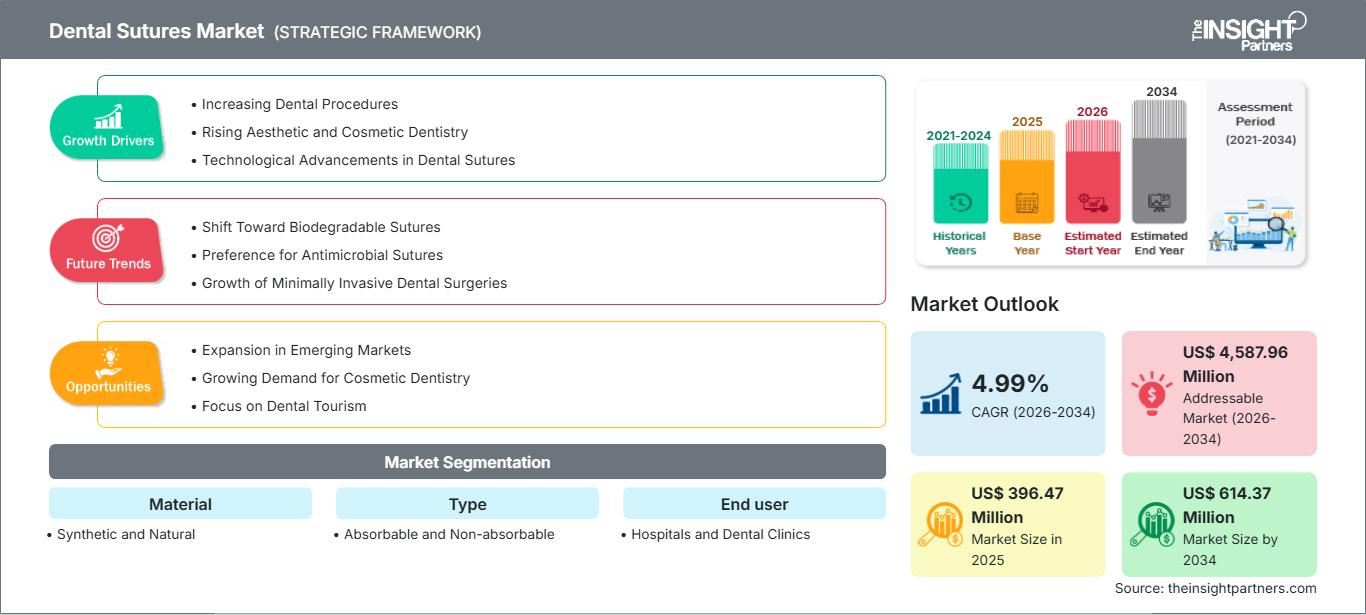
2025 Market Size
US$ 396.47 Mn
Base year value
2034 Forecast
US$ 614.37 Mn
Projected by 2034
CAGR 2026-2034
4.99 %
Growth rate
Addressable Market
US$ 4,587.96 Mn
(2026-2034)
The Dental Sutures Market is valued at US$ 396.47 Million in 2025 and is projected to reach US$ 614.37 Million by 2034, registering a CAGR of 4.99% during 2026–2034. This market encompasses suture devices and methods used in approximating soft tissues following dental surgery procedures wherein the factors affecting demand would involve frequency of procedures, nature of materials used, sterilization of infection, and innovations in wound closure technologies in hospitals and dental care centers.
North America will remain stable in terms of Dental Sutures Market Size given its number of dental facilities, rate of procedures, and spending in oral health care. The region is expected to demonstrate a CAGR of 4.5% to 5.2% between 2024 and 2034 due to practice standardization, efficient distribution, and ease of handling.
Dental Sutures Market Assessment and Insights
- North America: North America represents a leading regional market, with a 2025 share of 28–32% and a CAGR of 4.5–5.2% between 2026–2034. Mature dental infrastructure, procedural volumes, and established medical-device distribution underpin resilient demand.
- US: The US accounts for 62–66% of North American demand in 2025 and is expected to grow at a 4.4–5.1% CAGR during 2026–2034, supported by high dental expenditure and specialist care.
- Europe: Europe holds a 24–28% share in 2025 and is projected to expand at 4.2–4.9% through 2034. Germany, the UK, France, Italy, and Spain provide broad clinical coverage, regulatory consistency, and established dental-device procurement channels.
- Asia Pacific: Asia Pacific captures a 30–34% share in 2025 and is expected to grow at 5.8–6.6% during 2026–2034. China, Japan, South Korea, India, and Australia combine expanding dental capacity with improving access to specialist procedures.
- Largest Segment: Absorbable sutures are estimated to command a 55–60% market share in 2025, with a 5.1–5.8% CAGR through 2034, reflecting convenience in postoperative management.
- High Growth Segment: Synthetic materials represent an estimated 58–63% share in 2025 and are projected to grow at 5.3–6.0% during 2026–2034, supported by consistency and engineered performance.
- Key companies analyzed in detail: Zimmer Biomet Holdings, Inc.; Johnson & Johnson; Medtronic plc; DENTSPLY SIRONA Inc.; B. Braun SE; KLS Martin Group; Materialise NV; Ethicon, Inc.; Crosstex International; Smith+Nephew plc.
Source: The Insight Partners' analysis based on proprietary research, government publications, company annual reports, investor presentations, industry databases, and expert interviews.
There has been movement within the product profile towards engineered polymers, monofilament designs, superior needle construction and known tensile characteristics. Increasing differentiation will be based upon handling qualities, knot tying ability, absorption properties, packaging and configuration. The manufacturing process continues to be driven by polymer availability, needle metallurgy, sterilization processes, quality systems and packaging control. Manufacturing consistency is thus key competitive issue for those supplying the dental market.
Market growth over the forecast period can be expected to move beyond existing Western markets into the Asia Pacific and certain Middle Eastern nations. Marketing effort will focus on localized distribution, regulatory approval, clinician education and specialized products for the dental ambulatory setting. The global policy issue is that of oral health, which is estimated to impact some 3.7 billion individuals according to the World Health Organization.
Dental Sutures Market Report Scope
| Report Attribute | Details |
|---|---|
| Market size in 2025 | US$ 396.47 Million |
| Market Size by 2034 | US$ 614.37 Million |
| Global CAGR (2026 - 2034) | 4.99% |
| Historical Data | 2021-2024 |
| Forecast period | 2026-2034 |
Dental Sutures Market Analysis
The growth of the Dental Sutures Market is driven by the requirement for dental restorative procedures, periodontal surgery, implantation, extraction, and other oral surgeries. There is a huge clinical base for these procedures due to high burden of oral health, as reported by WHO that about 3.7 billion patients suffer from oral diseases, while there are 1 billion cases of periodontal disease in the world.
The value chain starts from the supply of polymer and fiber raw materials, includes needles, suture assemblies, sterilization companies, distributors, dental purchasing organizations, hospitals, and clinics. Increasingly often synthetic polymers are used due to their controlled absorbency and standardized manufacturing process, while natural fibers are still in demand in cases where there is a need in handling skills. It is necessary to emphasize that sterility and lot traceability are important due to the fact that dental sutures are provided as single-use medical products.
Competitive Dental Sutures Market report reveals that the market is structured competitively on the basis of wide surgical portfolios, specialization in dentistry, distribution channels, and reliable products, rather than price alone. Johnson & Johnson and Ethicon have retained expertise in sutures, whereas Medtronic, B. Braun SE, Smith+Nephew plc, and Zimmer Biomet Holdings, Inc. have additional expertise in wound closure and surgery. DENTSPLY SIRONA Inc. has wide dental-channel reach, while KLS Martin Group and Crosstex International have clinical specializations.
Strategic positioning is increasingly becoming a mix of both portfolio breadth and innovation. Companies can improve margins with innovative needles, optimized polymer formulations, knotless configurations, procedure-specific kits, and procurement linkages. The 2026 restructuring plan of DENTSPLY SIRONA Inc., allocating approximately US$120 million every year to innovation and education, reflects the increased emphasis on technology and clinical capabilities by dental companies. Materialise NV has digital manufacturing experience, while Ethicon, Inc. and Medtronic plc have large infrastructure for surgical innovation.
● REPORT CUSTOMIZATION
Tailor This Report To Align With Your Specific Business Requirements
This report can be customized to align precisely with your business objectives, scope, and target markets. Customization options include tailored segmentation, geography, competitive analysis, and strategic insights to support informed decision-making.
Customize This Report →WHAT YOU CAN ADJUST
- ● Segmentations
- ● Geography
- ● Competitive Analysis
- ● Language Preferences
Dental Sutures Market: Strategic Insights
Regional Insights
North America Dental Sutures Market
North America comprises 28-32% of the Dental Sutures Market Share for 2025 and has a compound annual growth rate of 4.5-5.2%. The United States is the major nation in this segment, with heavy dental expenditure, specialty oral surgery, implantology, periodontics, and a proven system of hospital procurement. Canada provides the market for the same reasons, including both public and private dental infrastructure.
Standardization in the clinical setting is oriented towards sterile and predictable products with proven track record and efficient packaging. This region allows for premiumization due to the opportunity to judge products not by their cost but also on the basis of needle sharpness, tissue compatibility, handling, absorption characteristics, and packaging efficiency. Dental expenditure in the United States amounted to US$189 billion in 2024.
U.S. Dental Sutures Market
The US holds 62-66% share of North American demand in 2025 and is projected to grow at a CAGR of 4.4-5.1%. Factors such as high dental expenditure, presence of specialists, periodontal treatments, implants, and outpatients enable repeated sales of sutures. Johnson & Johnson, Medtronic plc, Zimmer Biomet Holdings, Inc., DENTSPLY SIRONA Inc., and Ethicon, Inc. possess significant commercial presence in related clinical sectors.
There has been an increasing trend towards usage of absorbable sutures made up of synthetic material where postoperative removal is not possible, and non-absorbable sutures play an important role where mechanical assistance is required. Although private dental clinics continue to buy sutures, hospitals and oral surgery centers contribute towards the high end uses of these devices. The US dental environment also enjoys the advantage of well-established distribution channels and training among dentists.
Europe Dental Sutures Market
Europe represents 24–28% market share for 2025 and is expected to achieve growth of 4.2–4.9% CAGR from 2025 until 2034; Germany leads demand in the region. UK, German, French, Italian, and Spanish suppliers jointly deliver a wide spectrum of dental care in hospitals, specialist clinics, implantology, and oral surgery. Regulations in the region favor proven quality and traceability.
The UK has developed dental care in both private and public sectors, where demand lies in routine oral surgery, periodontal therapy, and special procedures. Germany benefits from a large dental-care infrastructure alongside effective production and acquisition of medical devices. France, Italy, and Spain deliver sufficient network of clinics and growing amount of specialized procedures. Europe is becoming more oriented toward purchasing decisions, which consider the following factors: clinical performance, sterilized packaging, supplier reputation, and overall cost of procedures.
APAC Dental Sutures Market
Asia Pacific holds 30–34% of 2025 demand and is expected to expand at a 5.8–6.6% CAGR. China is the leading market, followed by Japan, South Korea, India, and Australia. Expanding dental infrastructure, urbanization, specialist training, and broader access to implant and periodontal procedures support regional consumption.
Increasing capabilities in industry and improved infrastructure for healthcare are bolstering supply chains locally. India and China offer benefits in terms of manufacturing, while Japan, South Korea, and Australia offer clinical applications. Focus on oral health care by the government and increased private dental clinics offer chances for providers who offer sterile standardized products with competitive total cost.
Middle East & Africa Dental Sutures Market
The Middle East & Africa market is expected to show a CAGR of 4.0-4.7% up to 2034, where Saudi Arabia is one of the top Gulf markets. Infrastructure in UAE is favorable for medical tourism while South Africa has established its private dental sector. Rest of MEA is quite fragmented and access depends on the countries.
Healthcare infrastructure investments, development of private hospitals and specialist care facilities will aid in gradual adoption. While healthcare investments and advanced surgical infrastructure in Gulf markets may prove beneficial for premium sterile products, African markets will be more cost-sensitive. Oil & Gas earnings in major Gulf countries indirectly drive investments in healthcare infrastructure development while urbanization drives demand for oral and surgical care.
Segmentation Analysis
Material
Material selection influences absorption behavior, tissue response, handling, and procurement economics. Synthetic products are projected to record a 5.3–6.0% CAGR during 2026–2034, while natural materials are expected to expand at 3.7–4.5%. The Dental Sutures Market scope increasingly favors engineered materials where predictable performance and standardized manufacturing are priorities.
- Synthetic: Synthetic sutures provide controlled physical properties, consistent manufacturing, and multiple absorption profiles. Demand is strongest where clinicians prioritize predictable handling, tensile retention, and standardized sterile packaging across recurring procedures.
- Natural: Natural sutures retain relevance because of established clinical familiarity and selected tissue-approximation applications. Their continued use is supported by clinician preference, procedural tradition, and availability through established dental distribution channels.
Type
Type segmentation reflects postoperative management requirements and the duration of mechanical support needed at the wound site. Absorbable products are expected to grow at a 5.1–5.8% CAGR during 2026–2034, while non-absorbable products are projected at 4.1–4.8%.
- Absorbable: Absorbable products are favored where suture removal would add inconvenience or require follow-up intervention. Their importance increases in procedures where controlled degradation can align with normal tissue healing.
- Non-absorbable: Non-absorbable products remain important when prolonged tensile support, visibility, or clinician control is required. Their use persists across selected oral-surgical and periodontal procedures requiring durable closure.
End user
End user dynamics are shaped by procedure volumes, purchasing structures, clinician specialization, and facility sterilization protocols. Hospitals are projected to grow at a 4.6–5.3% CAGR during 2026–2034, while dental clinics are expected to expand at 5.2–6.0%, reflecting outpatient procedure growth.
- Hospitals: Hospitals provide demand for sutures across oral surgery, trauma-related dental procedures, oncology-related interventions, and complex periodontal cases. Centralized procurement favors validated products, dependable supply, and broad catalog coverage.
- Dental Clinics: Dental clinics represent an increasingly important purchasing channel as implantology, periodontal therapy, extraction, and minor oral surgery shift toward outpatient settings. Convenient packaging and predictable handling support recurring replenishment.
Opportunity Snapshot
| End user | Revenue Contribution (High/Medium/Low) | Trend Tag (MAX 2 words, specific) | Adoption Stage (Emerging/Scaling/Mature) |
|---|---|---|---|
| Hospitals | High | Central Procurement | Mature |
| Dental Clinics | High | Implant Closure | Scaling |
Dental Sutures Market Growth Drivers and Impact Analysis
Expansion of oral and periodontal treatment volumes
A large and persistent burden of oral disease creates a broad procedural base for tissue-closure products. WHO reports nearly 3.7 billion people affected by oral diseases and more than 1 billion cases of severe periodontal disease, demonstrating the scale of conditions that can require surgical or periodontal intervention. As treatment access improves, procedure mix can shift toward restorative, implant, extraction, and periodontal services that consume sterile sutures. The market impact is strongest where previously underserved populations gain access to formal dental care. Manufacturers can therefore benefit from regional expansion without relying solely on replacement demand. Distribution density, clinician training, and affordability become decisive variables because higher disease prevalence does not automatically translate into equivalent procedural utilization across countries.
Preference for predictable synthetic closure materials
Synthetic materials are gaining strategic importance because manufacturers can engineer tensile behavior, absorption profiles, filament characteristics, and handling properties more consistently than naturally derived alternatives. For dental clinicians, predictable needle penetration, knot security, tissue approximation, and degradation behavior can reduce procedural variability. The commercial impact extends across procurement because standardized synthetic products can simplify inventory management and enable repeat purchasing across multiple procedures. Medtronic's portfolio illustrates the broader direction, spanning absorbable and non-absorbable products with differentiated handling characteristics. As providers become more attentive to reproducibility and workflow efficiency, suppliers that combine material consistency with reliable sterile packaging can gain preference even when lower-cost alternatives remain available.
Growth of outpatient and specialist dental procedures
Dental care is increasingly organized around outpatient clinics, specialist centers, and ambulatory procedures, creating recurring demand for compact sterile closure products. Implant placement, periodontal surgery, extraction, soft-tissue procedures, and selected oral-maxillofacial interventions can require sutures without the infrastructure of a major inpatient hospital. This transition broadens the purchasing base and increases the importance of distributor reach, convenient packaging, and procedure-specific assortments. The US illustrates the commercial scale of the underlying ecosystem, with national dental expenditures reaching US$189 billion in 2024. For manufacturers, outpatient expansion creates opportunities to build direct clinic relationships while retaining hospital contracts for higher-acuity cases and centralized purchasing programs.
Dental Sutures Market Future Trends
Procedure-specific and digitally enabled product selection
Dental Sutures Market trends are likely to increasingly reflect procedure-specific product selection supported by digital procurement, clinical education, and data-driven inventory management. Dental groups can use standardized catalogs to align suture characteristics with extraction, implant, periodontal, and oral-surgical workflows. Manufacturers may respond with clearer product architecture, optimized needle-thread combinations, and digital ordering tools that reduce selection errors. Connected procurement platforms can also improve demand forecasting by consolidating usage across multi-site dental organizations. Over time, product differentiation may move beyond material composition toward complete workflow compatibility, including packaging, labeling, tray configuration, and training resources. This transition would favor suppliers capable of combining manufacturing discipline with digital commercial infrastructure while maintaining regulatory documentation and clinical evidence.
Greater adoption of minimally disruptive closure designs
Future product development is likely to emphasize closure designs that simplify placement, reduce unnecessary tissue manipulation, and support efficient postoperative management. Knotless configurations, optimized needle geometry, lower-profile materials, and controlled absorption profiles can address workflow constraints without fundamentally changing established surgical techniques. The direction is visible in adjacent surgical markets, where manufacturers continue developing suture-based fixation and closure technologies with improved deployment characteristics. Smith+Nephew's 2025 Q-FIX KNOTLESS launch demonstrates this broader innovation pathway, although its application is in soft-tissue fixation rather than dentistry. Dental manufacturers can adapt similar engineering principles toward oral procedures, particularly where clinicians value speed, consistency, and reduced follow-up requirements.
Dental Sutures Market Opportunities
Localized manufacturing and distribution in Asia Pacific
Dental Sutures Market Forecasts point toward attractive opportunities for manufacturers that establish localized supply and distribution capabilities across high-growth Asian economies. China and India combine expanding dental infrastructure with significant manufacturing ecosystems, while Japan, South Korea, and Australia provide sophisticated clinical markets. Local registration, distributor partnerships, regional warehousing, and clinician education can reduce procurement friction and improve product availability. Investors should prioritize suppliers with scalable sterilization, quality systems, and polymer-processing capabilities rather than pursuing volume without regulatory readiness. Strategic partnerships with dental groups could further accelerate adoption by creating standardized purchasing programs. The opportunity is particularly relevant for synthetic products, where controlled manufacturing can support consistent performance across multiple product families and procedure categories.
Integrated dental surgery portfolios and procurement partnerships
Another opportunity lies in combining sutures with broader dental and surgical portfolios, allowing suppliers to compete for complete procedure workflows rather than isolated product orders. Companies with established relationships in implants, restorative dentistry, surgical instruments, or infection-control products can use those channels to introduce closure products into existing accounts. DENTSPLY SIRONA's recent emphasis on connected dentistry and expanded distribution relationships illustrates the value of strengthening commercial ecosystems around dental providers. For investors, attractive targets may include manufacturers with differentiated materials, strong regulatory records, or specialized needle technology that can be integrated into larger portfolios. Such combinations can improve channel efficiency while expanding access to dental clinics and specialist centers.
Recent Developments
- August 2026: Johnson & Johnson disclosed changes to its US surgical portfolio, including discontinuation of selected suture products such as certain PERMA-HAND, MONOCRYL, VICRYL, and PDS SKUs, while stating that customer access and product safety remain unchanged during the transition. The portfolio action indicates continued optimization of surgical product ranges and manufacturing priorities.
- July 2025: Smith+Nephew plc launched the Q-FIX KNOTLESS All-Suture Anchor, expanding its suture-based soft-tissue fixation portfolio for shoulder, hip, and foot and ankle procedures. The product uses a suture-lock mechanism and controlled tensioning architecture, reflecting continued investment in suture-enabled technologies emphasizing fixation reliability and procedural efficiency.
- February 2026: DENTSPLY SIRONA Inc. announced a restructuring initiative intended to redirect approximately US$120 million annually toward its Return-to-Growth Action Plan, including accelerated innovation, clinical education, and sales-team education focused on connected dentistry. The company also announced new distribution agreements, reinforcing investment in dental technology and channel reach.
Frequently Asked Questions

- Comprehensive Market Sizing and Forecast Analysis
- Detailed Segmentation Analysis
- In-Depth Market Dynamics Assessment
- Regional and Country-Level Insights
- Competitive Landscape and Company Benchmarking
- Strategic Business Intelligence
Recent Reports
Testimonials

The Insight Partners' SCADA System Market report is comprehensive, with valuable insights on current trends and future forecasts. The team was highly professional, responsive, and supportive throughout. We are very satisfied and highly recommend their services.
RAN KEDEM Partner, Reali Technologies LTDs
I requested a report on a very specific software market and the team produced the report in a few days. The information was very relevant and well presented. I then requested some changes and additions to the report. The team was again very responsive and I got the final report in less than a week.
JEAN-HERVE JENN Chairman, Future Analytica
We worked with The Insight Partners for an important market study and forecast. They gave us clear insights into opportunities and risks, which helped shape our plans. Their research was easy to use and based on solid data. It helped us make smart, confident decisions. We highly recommend them.
PIYUSH NAGPAL Sr. Vice President, High Beam Global
The Insight Partners delivered insightful, well-structured market research with strong domain expertise. Their team was professional and responsive throughout. The user-friendly website made accessing industry reports seamless. We highly recommend them for reliable, high-quality research services
YUKIHIKO ADACHI CEO, Deep Blue, LLC.
This is the first time I have purchased a market report from The Insight Partners.While I was unsure at first, I visited their web site and felt more comfortable to take the risk and purchase a market report.I am completely satisfied with the quality of the report and customer service. I had several questions and comments with the initial report, but after a couple of dialogs over email with their analyst I believe I have a report that I can use as input to our strategic planning process.Thank you so much for taking the extra time and making this a positive experience.I will definitely recommend your service to others and you will be my first call when we need further market data.
JOHN SUZUKI President and Chief Executive Officer, Board Director, BK Technologies
I wish to appreciate your support and the professionalism you displayed in the course of attending to my request for information regarding to infectious disease IVD market in Nigeria. I appreciate your patience, your guidance, and the fact that you were willing to offer a discount, which eventually made it possible for us to close a deal. I look forward to engaging The Insight Partners in the future, all thanks to the impression you have created in me as a result of this first encounter.
DR CHIJIOKE ONYIA MANAGING DIRECTOR, PineCrest Healthcare Ltd.Reason to Buy
- Informed Decision-Making
- Understanding Market Dynamics
- Competitive Analysis
- Identifying Emerging Markets
- Customer Insights
- Market Forecasts
- Risk Mitigation
- Boosting Operational Efficiency
- Strategic Planning
- Investment Justification
- Tracking Industry Innovations
- Aligning with Regulatory Trends





 Get Free Sample for