
Dental Vibrators Market Size, Trends & Growth by 2034
Coverage: By Type (Analog, Digital); Application (Dental clinic, Hospital, Other) , and Geography (North America, Europe, Asia Pacific, and South and Central America)
- Status : Data Released
- Report Code : TIPRE00018039
- Category : Life Sciences
- No. of Pages : 150
- Available Report Formats :


- Last update date : September 07, 2026


2025 Market Size
US$ 262.87 Mn
Base year value
2034 Forecast
US$ 492.38 Mn
Projected by 2034
CAGR 2026-2034
7.22 %
Growth rate
Addressable Market
US$ 3,407.02 Mn
(2026-2034)
The Dental Vibrators Market reached US$ 262.87 Million in 2025 and is projected to reach US$ 492.38 Million by 2034, registering a CAGR of 7.22% during 2026–2034. The market covers equipment that helps in minimizing air entrapment and achieving uniformity in the preparation of dental material, especially in the case of restorative and laboratory procedures.
North America still offers structural attractiveness due to dental practice consolidation, laboratory outsourcing, and equipment replacement schedules. The factors that affect the Dental Vibrators Market Size include investment in equipment that meets infection-control compliance standards, efficiency in work process, and technology adoption in practices. Growth can be aided by existing distribution channels and purchasing power of organized dental practices and laboratories.
Dental Vibrators Market Assessment and Insights
- North America: The region combines established dental infrastructure with equipment replacement demand and laboratory modernization. Share in 2025 is estimated at 31–35%, with CAGR between 2026–2034 of 6.8–7.5%, supported by organized purchasing and technology-oriented practices.
- US: The US represents the largest North American country market, supported by practice consolidation, laboratory digitization, and broad distributor coverage. Share in 2025 is estimated at 74–78% of North America, with CAGR of 6.9–7.6%.
- Europe: Germany, the UK, France, Italy, and Spain form the principal demand base. Share in 2025 is estimated at 27–31%, while CAGR between 2026–2034 is expected at 6.4–7.1%, reflecting laboratory modernization and equipment replacement.
- Asia Pacific: China, Japan, South Korea, India, and Australia underpin regional demand, with China leading scale. Share in 2025 is estimated at 24–28%, and CAGR between 2026–2034 at 8.0–8.8%, supported by expanding dental capacity.
- Largest Segment: Digital equipment leads the type structure, with a market share of 54–58% in 2025 and CAGR of 7.5–8.1% through 2034, reflecting precision and workflow repeatability.
- High Growth Segment: Hospital applications represent the faster-expanding application segment, with a market share of 34–38% in 2025 and CAGR of 7.7–8.4%, supported by institutional procurement.
- Key companies analyzed in detail: Patterson Dental Supply, Inc.; Buffalo Dental Manufacturing Co., Inc.; Henry Schein, Inc.; Treedental; Renfert GmbH; DENSTAR Co., Ltd.; Dentalfarm S.r.l.; Aixin Medical Equipment Co., Ltd.; Ivoclar Vivadent AG; SCHULER-DENTAL GmbH.
Source: The Insight Partners' analysis based on proprietary research, government publications, company annual reports, investor presentations, industry databases, and expert interviews.
The Dental Vibrators market has progressed from basic benchtop mechanical vibrators to devices that emphasize stability of oscillation, compact design, reduced noise levels during operation, and improved handling features. The use of analog devices is appropriate where simplicity of control and relatively low cost of acquisition is required, whereas digital vibrators have more advanced features like electronic speed regulation and reproducible settings during operation. The production of vibrators would require considerations of motor reliability, consistency of vibrations, parts availability, and ergonomic design of the housing.
In terms of the future, the emerging dental infrastructure in Asia Pacific and certain Middle Eastern markets would increase the potential number of installations. There would be preference for compact designs for use in small clinics and laboratories, whereas mature markets would benefit from replacement and optimization of the processes. Requirements for electrical safety, reliability of the equipment, infection control practices, and sustainability of healthcare operations would motivate manufacturers to enhance material quality, servicing capacity, documentation, and energy efficiency of devices. Such trends would not preclude economical analog designs.
Dental Vibrators Market Report Scope
| Report Attribute | Details |
|---|---|
| Market size in 2025 | US$ 262.87 Million |
| Market Size by 2034 | US$ 492.38 Million |
| Global CAGR (2026 - 2034) | 7.22% |
| Historical Data | 2021-2024 |
| Forecast period | 2026-2034 |
Dental Vibrators Market Analysis
Growth of the Dental Vibrators Market depends on the increasing need for controlled material handling in dental clinics and laboratories, where entrapped air may affect casts, impressions, and associated restorative procedures. The value chain consists of motor and control component suppliers, equipment manufacturers, distributors, dental laboratories, clinics, and hospitals. Buyers weigh factors such as vibration uniformity, platform area, noise level, maintenance needs, warranty and pricing when making purchases.
Supply of the equipment is not too complicated since its construction is simpler compared to imaging or CAD/CAM devices. Still, the quality of motors, electronics, isolation elements, and enclosures impacts reliability and total cost of ownership. Professional distributors help cut down purchasing obstacles by offering packages with equipment and laboratory materials, whereas specialized manufacturers offer compactness, functionality, and regional responsiveness.
From the Dental Vibrators Market Report, the competition is characterized as being fragmented, with the coexistence of both large distributors of dental equipment and producers of specialized laboratory and practice equipment. Henry Schein, Inc. and Patterson Dental Supply, Inc. have advantages in terms of extensive client base and equipment portfolio, while Renfert GmbH, Dentalfarm S.r.l., DENSTAR Co., Ltd., and Aixin Medical Equipment Co., Ltd. operate in a more specialized manner.
Competitive positioning is expected to be based increasingly on the factors such as reliability, geographical distribution, availability of replacement parts, and compatibility with changing laboratory processes. The company Ivoclar Vivadent AG may exploit its comprehensive restorative platform, while Buffalo Dental Manufacturing Co., Inc., SCHULER-DENTAL GmbH, Treedental, and other specialists may focus on product specialization. Thus, investments will likely be targeted at electronics and manufacturing technology, channel development, and services.
● REPORT CUSTOMIZATION
Tailor This Report To Align With Your Specific Business Requirements
This report can be customized to align precisely with your business objectives, scope, and target markets. Customization options include tailored segmentation, geography, competitive analysis, and strategic insights to support informed decision-making.
Customize This Report →WHAT YOU CAN ADJUST
- ● Segmentations
- ● Geography
- ● Competitive Analysis
- ● Language Preferences
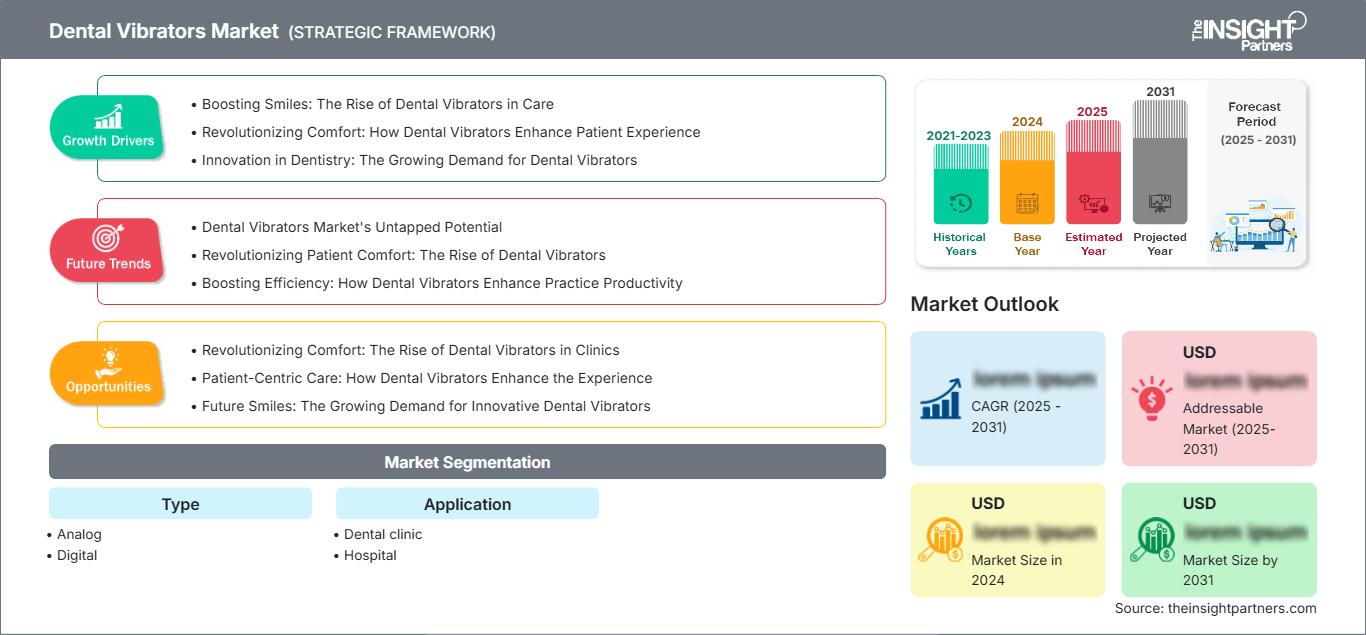
Dental Vibrators Market: Strategic Insights
Regional Insights
North America Dental Vibrators Market
North America has an estimated Dental Vibrators Market share of 31–35% in 2025 and is expected to grow at a rate of 6.8–7.5% CAGR in 2026–2034. The region boasts significant spending on dentistry, well-developed networks of laboratories, and high frequency of replacement of aging equipment. Consolidation of dental practices is conducive to standardization of purchases, whereas distributors will be able to offer laboratory equipment along with other products and services.
US leads the regional market, thanks to numerous installed dental practices and laboratories, high purchasing capabilities, and developed network of distributors. Canada makes its contribution through private dental practices, laboratories, and institutions. Demand is especially stable in regions where vibrators are employed in restorative, prosthetic, and laboratory processes. Selection of products is focused on their digital control systems, small footprint, noise reduction, and easy maintenance, as well as analog equipment.
U.S. Dental Vibrators Market
United States constitutes about 74-78% of demand in North America in 2025, with the growth rate estimated at 6.9-7.6% CAGR up to 2034. The country’s size depends on the availability of extensive dental service, advanced laboratories, and good relations with distributors. Equipment, materials, and services are provided by Patterson Dental Supply, Inc. and Henry Schein, Inc., while laboratory specific suppliers fill in the rest of the needs.
Applications span across dental facilities and hospitals, with dental facilities usually concentrating on small size of the equipment and simple operations. Hospitals often have preferences for purchasing, documentation, and service. Activity in laboratories creates an additional need for the product due to vibrations and their effect on the material processing. Replacement purchase is likely to play an important role due to lifecycle versus purchase cost comparison.
Europe Dental Vibrators Market
Europe had a Dental Vibrators Market share of around 27–31% in 2025 and is expected to grow at a CAGR of 6.4–7.1% during 2025–2034, with Germany being the leading regional market. Favorable factors for this market include mature dental laboratories, established production capabilities, and replacements-driven purchasing. The UK, Germany, France, Italy, and Spain focus more and more on equipment that is reliable, ergonomic, comes with adequate service and integrates into their workflows.
Germany dominates this market owing to a well-established ecosystem of dental technologies and laboratories. The UK relies on efficiency in clinics and outsourcing from laboratories, whereas France and Italy have well-established dental practices and dental technicians as demand sources. Spain is characterized by growing private dental services and modernization. Manufacturers in these markets compete mainly based on build quality, compactness, accuracy of controls and availability rather than feature proliferation.
APAC Dental Vibrators Market
APAC made up about 24% to 28% of world demand in 2025 and is expected to record a CAGR growth of 8.0% to 8.8%, the highest among all major regions. China leads in regional scale, followed by Japan, South Korea, India, and Australia. The growing dental capabilities, laboratory advancement, urbanization, and equipment availability encourage adoption.
China is the strongest manufacturing region combined with growing dental capabilities, while Japan and South Korea focus on precision and laboratory practices. There is immense long-term opportunity for India as dental service capabilities grow and mature private dental practices in Australia. Industrialization, better distribution, and healthcare advancement initiatives encourage regional adoption, as demand includes efficient analog equipment and advanced digital solutions.
Middle East & Africa Dental Vibrators Market
MEA/Africa has less demand, but it is increasingly driven by investment in private healthcare facilities, dentistry, and the modernization of hospitals. Saudi Arabia and the United Arab Emirates are major purchasers in the region, while South Africa continues to be the main market in Sub-Saharan Africa. The market is projected to grow at 6.1-6.9% CAGR until 2034.
Healthcare infrastructure investment and increased use of private facilities in Saudi Arabia, as well as the presence of advanced clinics and medical tourists in the UAE, are the main drivers in this region. South Africa offers a strong base for laboratories and dental services. RoMEA customers have high price sensitivity, which justifies durable analog equipment.
Segmentation Analysis
Type
The Type segment defines the technological configuration of equipment and is expected to expand at 7.1–7.8% CAGR during 2026–2034. The Dental Vibrators Market scope increasingly favors electronically controlled systems because users value repeatable vibration and easier adjustment, although analog units retain relevance where affordability and simple operation dominate purchasing decisions.
- Analog: Analog vibrators retain a meaningful installed base because mechanical controls are familiar, acquisition costs are generally lower, and maintenance requirements can be straightforward. They remain strategically relevant for cost-conscious clinics and laboratories.
- Digital: Digital vibrators increasingly attract professional buyers seeking repeatable settings, improved control, and operational consistency. Their positioning aligns with modern laboratory workflows where process standardization and user convenience increasingly influence equipment selection.
Application
The Application segment is projected to grow at 7.0–7.7% CAGR through 2034, supported by continuing use across clinical and institutional settings. Hospitals can generate stronger replacement demand where procurement emphasizes standardized equipment, while clinics benefit from compact solutions and flexible workflow integration.
- Dental clinic: Clinics represent a broad installed base because vibrators support routine material handling and laboratory-adjacent procedures. Demand centers on compact dimensions, dependable operation, simple controls, and equipment that fits limited workspace.
- Hospital: Hospitals require equipment that supports standardized procurement, maintenance documentation, and operational continuity. Institutional demand can favor durable construction, service availability, and digital controls where multiple operators need consistent settings.
Opportunity Snapshot
| Application | Revenue Contribution | Trend Tag | Adoption Stage |
|---|---|---|---|
| Dental clinic | High | Compact Units | Mature |
| Hospital | Medium | Digital Control | Scaling |
Dental Vibrators Market Growth Drivers and Impact Analysis
Rising dental procedure volumes and laboratory throughput
The global burden of oral disease creates a broad underlying requirement for restorative and preventive dental services. WHO has reported untreated caries in permanent teeth affecting about 2.3 billion people, while periodontal diseases affect roughly 796 million people, demonstrating the scale of potential clinical activity. Higher procedure volumes increase utilization of material preparation and laboratory workflows in which vibration equipment can improve handling consistency. For manufacturers, this translates into a wider replacement and first-time purchase base across clinics and laboratories. The effect is strongest where dental service capacity is expanding, because equipment purchases accompany new treatment rooms, laboratories, and institutional facilities rather than relying solely on replacement cycles.
Preference for controlled and repeatable material preparation
Dental laboratories increasingly prioritize repeatability because inconsistent material handling can increase rework, waste, and technician time. Digital controls can address this need by allowing operators to establish more consistent operating conditions than purely mechanical adjustment. The commercial impact extends beyond the vibrator itself because buyers increasingly evaluate equipment according to its contribution to total workflow reliability. Manufacturers that combine stable vibration with ergonomic platforms, low noise, easy cleaning, and dependable controls can differentiate within a relatively standardized product category. This dynamic also encourages distributors to present digital models as productivity equipment rather than simple laboratory accessories. As purchasing decisions become more lifecycle-oriented, reliability and process consistency can carry greater weight than the lowest initial acquisition price.
Expansion of organized dental procurement and distribution networks
Consolidation among dental practices, laboratory groups, and healthcare institutions can shift purchasing toward standardized equipment specifications and approved supplier relationships. Large distributors can support this transition by combining product availability, financing, maintenance, technical assistance, and consumables under established accounts. The resulting market impact is a lower procurement barrier for established brands and a greater need for specialist manufacturers to maintain strong channel partnerships. Smaller producers can compete by supplying differentiated designs, regional configurations, or laboratory-focused products, while distributors can widen reach without developing manufacturing capabilities themselves. This channel structure also improves replacement visibility because service organizations can identify equipment nearing the end of its useful life and connect replacement decisions with broader practice modernization projects.
Dental Vibrators Market Future Trends
Sensor-assisted vibration control and connected diagnostics
Future products in the Dental Vibrators Market are likely to incorporate more sophisticated electronic monitoring to stabilize vibration amplitude and identify abnormal motor behavior before equipment failure. Rather than relying solely on operator perception, sensor-assisted systems could provide repeatable operating profiles, maintenance alerts, and simplified troubleshooting. Connected functionality may remain limited in entry-level products because the equipment itself is relatively simple, but premium clinical and laboratory systems can justify additional electronics where uptime has greater economic value. Manufacturers should therefore distinguish between useful digitalization and feature inflation. The most commercially viable designs will likely prioritize precise control, straightforward interfaces, service diagnostics, and durable components. Over time, these capabilities could create clearer differentiation between commodity analog equipment and higher-value digital platforms without eliminating the established low-cost segment.
Modular equipment designed for smaller clinical footprints
Space efficiency is likely to become increasingly important as dental clinics seek to add capabilities without expanding physical premises. Future vibrators can respond through smaller footprints, modular platforms, easier storage, and designs that can move between workstations. This direction is particularly relevant to multi-purpose clinics and emerging markets where treatment rooms may accommodate several devices. Modular construction can also simplify servicing because replaceable controls, motors, and vibration components reduce the need to retire entire units after localized failures. Manufacturers may increasingly design products around common electrical architectures and interchangeable components, improving supply flexibility across countries. Such standardization could lower inventory complexity for distributors while enabling manufacturers to serve multiple regional configurations with fewer core product platforms.
Dental Vibrators Market Opportunities
Premiumization through laboratory workflow integration
Manufacturers can pursue higher-value opportunities by positioning vibrators as components of broader laboratory workflows rather than isolated devices. Integration with mixing equipment, casting systems, workstations, and laboratory service packages can increase account value and reduce price-only comparisons. Companies with established restorative or laboratory portfolios can bundle equipment with consumables, training, preventive maintenance, and replacement programs. Specialists can take a narrower approach by developing application-specific platforms for prosthetics, casting, or restorative material handling. The Dental Vibrators Market Forecast is particularly relevant in mature markets where basic vibrator penetration is already high and replacement buyers require a measurable reason to upgrade. Product demonstrations, lifecycle-cost analysis, and service guarantees can help suppliers justify premium configurations while preserving lower-priced analog offerings for budget-sensitive accounts.
Localized manufacturing and channel expansion in emerging markets
Emerging markets offer opportunities for suppliers that can align product configuration, pricing, service coverage, and distribution with local purchasing conditions. Local assembly or regional sourcing can reduce logistics exposure and improve responsiveness, particularly where import costs materially affect final equipment prices. Partnerships with dental distributors, laboratory suppliers, and training institutions can build awareness without requiring extensive direct sales infrastructure. India, China, Southeast Asia, and selected Middle Eastern markets provide distinct entry points because their dental sectors combine capacity expansion with varied purchasing preferences. Suppliers should segment portfolios rather than use a single global specification, offering durable analog products alongside progressively upgraded digital models. Service availability will remain critical because equipment downtime can outweigh modest acquisition savings for professional users.
Recent Developments
- February 2026: Renfert GmbH introduced the “Control tip” nozzle for precision sandblasting, emphasizing greater process reliability in dental surface conditioning. The launch demonstrates the company’s continuing focus on equipment precision and workflow control within dental technology. While not a vibrator launch, the development reflects broader investment in controlled laboratory processes and complements Renfert’s established equipment portfolio.
- January 2026: Ivoclar Vivadent AG introduced Adhese 2, a universal adhesive combining light- and dual-curing capabilities and enabling direct dual-cure application through the VivaPen system without a separate activator. The launch reflects continuing emphasis on simplifying clinical workflows, reducing procedural steps, and improving material-handling flexibility.
- February 2026: Henry Schein, Inc. reported 2025 full-year sales of US$13.2 billion and highlighted strong performance across global equipment, specialty products, and technology businesses. The company also introduced 2026 guidance calling for total sales growth of 3–5%, indicating continued investment and demand across dental equipment and technology channels..
Frequently Asked Questions

- Comprehensive Market Sizing and Forecast Analysis
- Detailed Segmentation Analysis
- In-Depth Market Dynamics Assessment
- Regional and Country-Level Insights
- Competitive Landscape and Company Benchmarking
- Strategic Business Intelligence
Recent Reports
Testimonials

The Insight Partners' SCADA System Market report is comprehensive, with valuable insights on current trends and future forecasts. The team was highly professional, responsive, and supportive throughout. We are very satisfied and highly recommend their services.
RAN KEDEM Partner, Reali Technologies LTDs
I requested a report on a very specific software market and the team produced the report in a few days. The information was very relevant and well presented. I then requested some changes and additions to the report. The team was again very responsive and I got the final report in less than a week.
JEAN-HERVE JENN Chairman, Future Analytica
We worked with The Insight Partners for an important market study and forecast. They gave us clear insights into opportunities and risks, which helped shape our plans. Their research was easy to use and based on solid data. It helped us make smart, confident decisions. We highly recommend them.
PIYUSH NAGPAL Sr. Vice President, High Beam Global
The Insight Partners delivered insightful, well-structured market research with strong domain expertise. Their team was professional and responsive throughout. The user-friendly website made accessing industry reports seamless. We highly recommend them for reliable, high-quality research services
YUKIHIKO ADACHI CEO, Deep Blue, LLC.
This is the first time I have purchased a market report from The Insight Partners.While I was unsure at first, I visited their web site and felt more comfortable to take the risk and purchase a market report.I am completely satisfied with the quality of the report and customer service. I had several questions and comments with the initial report, but after a couple of dialogs over email with their analyst I believe I have a report that I can use as input to our strategic planning process.Thank you so much for taking the extra time and making this a positive experience.I will definitely recommend your service to others and you will be my first call when we need further market data.
JOHN SUZUKI President and Chief Executive Officer, Board Director, BK Technologies
I wish to appreciate your support and the professionalism you displayed in the course of attending to my request for information regarding to infectious disease IVD market in Nigeria. I appreciate your patience, your guidance, and the fact that you were willing to offer a discount, which eventually made it possible for us to close a deal. I look forward to engaging The Insight Partners in the future, all thanks to the impression you have created in me as a result of this first encounter.
DR CHIJIOKE ONYIA MANAGING DIRECTOR, PineCrest Healthcare Ltd.Reason to Buy
- Informed Decision-Making
- Understanding Market Dynamics
- Competitive Analysis
- Identifying Emerging Markets
- Customer Insights
- Market Forecasts
- Risk Mitigation
- Boosting Operational Efficiency
- Strategic Planning
- Investment Justification
- Tracking Industry Innovations
- Aligning with Regulatory Trends





 Get Free Sample for