
Dental Wax Knives Market Size, Trends & Demand by 2034
Coverage: By Type (Electric, Manual, Others); Application (Dental clinic, Hospital, Others) , and Geography (North America, Europe, Asia Pacific, and South and Central America)
- Status : Data Released
- Report Code : TIPRE00018040
- Category : Life Sciences
- No. of Pages : 150
- Available Report Formats :


- Last update date : September 07, 2026


2025 Market Size
US$ 158.35 Mn
Base year value
2034 Forecast
US$ 307.5 Mn
Projected by 2034
CAGR 2026-2034
7.65 %
Growth rate
Addressable Market
US$ 2,097.82 Mn
(2026-2034)
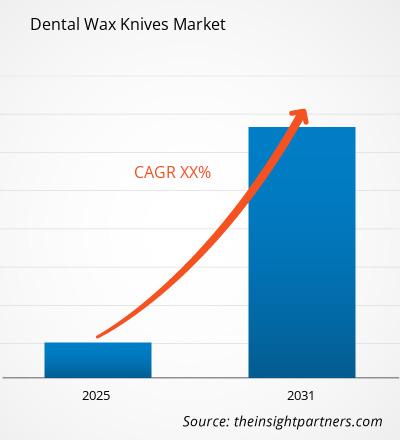
The Dental Wax Knives Market is valued at US$ 158.35 Million in 2025 and is projected to reach US$ 307.5 Million by 2034, registering a CAGR of 7.65% during 2026–2034. The market comprises both electric and manual wax knives, which are employed within dental clinics and hospitals. The demand depends on restorative and prosthodontic procedures, lab automation, ergonomics of laboratory technicians, as well as the continued use of wax modeling processes despite increasing digitalization of dental laboratories.
In North America, the Dental Wax Knives Market Size is expected to experience expansion due to the needs for replacement, modernization of laboratories, and increased usage of temperature-controlled instruments. The North American Market is forecasted to record a CAGR of 7.4–7.9% from 2026 to 2034.
Dental Wax Knives Market Assessment and Insights
- North America: North America is expected to represent a 34–38% share in 2025, supported by established laboratory infrastructure, replacement purchasing, and specialist instrument distribution. The regional market is projected to grow at a CAGR of 7.4–7.9% between 2026–2034.
- US: The US is estimated to account for 72–76% of North America's 2025 market, benefiting from extensive dental laboratory capacity, institutional procurement, and strong availability of specialist equipment. Growth is expected at a CAGR of 7.5–8.0% during 2026–2034.
- Europe: Europe is estimated to hold a 29–33% share in 2025 and expand at a CAGR of 7.0–7.5% during 2026–2034. Germany, the UK, France, Italy, and Spain remain important markets because of established dental technology ecosystems and technician-intensive restorative workflows.
- Asia Pacific: Asia Pacific is estimated at a 23–27% share in 2025 and is projected to grow at a CAGR of 8.0–8.6% during 2026–2034. China, Japan, South Korea, and India provide the strongest expansion opportunities as laboratory capacity and professional training infrastructure develop.
- Largest Segment: Manual type is estimated to hold a 52–56% market share in 2025, reflecting broad installed usage and affordability, while its CAGR is projected at 6.8–7.3% between 2026–2034.
- High Growth Segment: Electric type is estimated to account for a 40–44% market share in 2025 and is projected to record an 8.8–9.6% CAGR during 2026–2034 as temperature control gains importance.
- Key companies analyzed in detail: DENSTAR Co., Ltd.; Dentalfarm S.r.l.; Kerr Corporation; Otto Leibinger GmbH; Kemdent; Renfert GmbH; SCHULER-DENTAL GmbH & Co. KG; Song Young International Co., Ltd.; TOC Dental; Blue Dolphin Products.
Source: The Insight Partners' analysis based on proprietary research, government publications, company annual reports, investor presentations, industry databases, and expert interviews.
Modeling apparatus have developed from simple manual heating tools to more advanced electrical versions that offer consistent temperature settings and better ergonomic designs. Modern solutions feature insulated grips, replaceable tips, compact design, quick heat up, and multi-handpieces models. The manufacturing is scattered among specialized dental instrument makers, with product differentiation based on quality, reliability, serviceability, and compatibility with proven laboratory procedures.
The further development may be expected to focus on the developing dental production facilities in Asia and in certain countries of the Middle East, as modernization of laboratories broadens the customer scope. It will be wise to invest in companies providing robust instruments with local distribution and training. Electrical safety, materials quality, and equipment reliability standards will help to develop standardized products, while increasing interest in digital dentistry will urge manufacturers to market wax knives as supplementary devices.
Dental Wax Knives Market Report Scope
| Report Attribute | Details |
|---|---|
| Market size in 2025 | US$ 158.35 Million |
| Market Size by 2034 | US$ 307.5 Million |
| Global CAGR (2026 - 2034) | 7.65% |
| Historical Data | 2021-2024 |
| Forecast period | 2026-2034 |
Dental Wax Knives Market Analysis
Demand is inherently tied to restorative, prosthodontic, and laboratory processes where wax is still utilized for pattern forming, shaping, modeling, and training. Dental Wax Knives Market Growth is therefore dependent not only on volumes of procedures but also on labor efficiency, replacement cycles, ergonomics of instruments and installed base of laboratory equipment. Controlled heating in electric systems is increasingly relevant since it may help to minimize rework and improve repeatability.
The market ecosystem comprises specialist producers, dental distributors, laboratories, clinics, hospitals, educational organizations and component manufacturers. Production economy is in favor of established producers with reliable heating elements, sturdy handles, interchangeable tips and good quality control. Manual instruments still have the significant cost advantage whereas electric instruments are more sophisticated products requiring component engineering and after sales service. Distributors continue to play a crucial role in fragmented markets where purchases are done via dental-equipment distribution channel.
The competitive positioning of products is becoming more reliant on the breadth of a product portfolio than individual instrument sales. According to the Dental Wax Knives Market Report, companies which can integrate hand instruments, laboratory instruments, accessories, and consumables will have better account penetration and provide repeat purchase opportunities. This is illustrated through the differentiation in the electric and manual instrument portfolio by Renfert GmbH and SCHULER-DENTAL GmbH & Co. KG and dental laboratory equipment by DENSTAR Co., Ltd.
Kerr Corporation, Dentalfarm S.r.l., Otto Leibinger GmbH, Kemdent, Song Young International Co., Ltd., TOC Dental, and Blue Dolphin Products serve different segments in professional instruments, laboratory materials, and distribution. The investment focus will be on temperature control technologies, ergonomic design, replaceable accessories, and efficient production processes. Future strategic positioning will require a combination of premium functions and cost-effectiveness in both developed and emerging dental markets.
● REPORT CUSTOMIZATION
Tailor This Report To Align With Your Specific Business Requirements
This report can be customized to align precisely with your business objectives, scope, and target markets. Customization options include tailored segmentation, geography, competitive analysis, and strategic insights to support informed decision-making.
Customize This Report →WHAT YOU CAN ADJUST
- ● Segmentations
- ● Geography
- ● Competitive Analysis
- ● Language Preferences
Dental Wax Knives Market: Strategic Insights

Regional Insights
North America Dental Wax Knives Market
North America is projected to hold 34–38% of the Dental Wax Knives Market share in 2025 and to grow at CAGRs of 7.4–7.9% until 2034. The region is favored by advanced networks of dental laboratories, existing prosthodontics procedures, replacement purchases, and good distribution of specialists. Dominant regional demand comes from the US, whereas Canada and Mexico are small yet important markets.
Market dynamics are driven by technician efficiency requirements and growing desire to use controlled heating to ensure repeatability in wax sculpting. In addition, dental laboratories assess the equipment for its longevity, temperature consistency, comfortable operation, and the availability of replacement tips. Hospitals and large clinics are additional sources of demand, though specialist laboratories remain key buyers. This enables North American companies to realize their potential in terms of quality equipment, service contracts, technical support, and unique electric systems.
U.S. Dental Wax Knives Market
The USA has been estimated to account for 72%–76% of the market share in North America in 2025 and to experience a growth rate of 7.5%–8.0% CAGR up to 2034 due to its strong dental laboratories' infrastructure, already formed purchase channels, and persisting demand for the restorative and prosthetic procedures. The application demand varies between clinics, hospitals, and laboratories.
The established dental product vendors, such as Kerr Corporation, have an advantage due to the wide professional distribution network, while the specialty manufacturers compete through laboratory oriented instruments and accessories. More and more often ergonomic considerations, heat uniformity, replacements, and compatibility with existing laboratory benches become important factors in the purchase decision-making process. The clinics are likely to prefer versatile equipment for routine modeling, whereas hospitals and larger laboratories prioritize reliability and efficiency of purchase.
Europe Dental Wax Knives Market
Europe is estimated to hold a 29–33% of the Dental Wax Knives Market share in 2025 and is projected to grow at a CAGR of 7.0–7.5% through 2034. Germany leads the regional opportunity, followed by the UK, France, Italy, and Spain, supported by established dental laboratories and professional instrument manufacturing capabilities.
Demand is driven by availability of private clinics, laboratories, and specialty distributors, with buying behavior being influenced by durability and efficiency. Germany boasts of a well-developed system of dental technology manufacturers and laboratories, thereby contributing to preference for premium instruments and specialization. Diverse demand in France, Italy, and Spain is driven by the activities of laboratories and clinics, with manual instruments retaining versatility while electric instruments benefit from technicians' efficiency being highly important. European manufacturers concentrate their efforts on precise temperature control, serviceability, and ergonomics. Availability of laboratories ensures stable demand for replacement of instruments, and development of digital technologies presents additional opportunities for wax modeling machines.
APAC Dental Wax Knives Market
APAC is estimated to account for 23–27% of the 2025 market and is expected to register an 8.0–8.6% CAGR through 2034. China is the leading country, followed by Japan, South Korea, India, and Australia. Industrial expansion and dental laboratory development support equipment demand.
While China and South Korea have the ability to manufacture and adopt dental technology, Japan focuses on precision and professionalism. India is known for its emerging laboratories, whereas Australia has an advanced market. There are several policies that favor healthcare development, professional development, and local manufacturing of special equipment. Laboratory outsourcing and increasing the number of technicians help the adoption of small electric machines, even though manual machines are still relevant due to their low price.
Middle East & Africa Dental Wax Knives Market
Middle East and Africa demand is developing from a smaller base, with Saudi Arabia, the UAE, and South Africa representing important markets. The regional CAGR is estimated at 6.4–7.2% through 2034, with Saudi Arabia positioned as the leading opportunity because of healthcare infrastructure investment.
The advantages of the UAE include private healthcare growth and its status as a regional logistics hub, whereas South Africa is noted for having a more mature professional market. Demand from Rest of MEA region will be contingent upon factors such as distributors’ penetration, import costs, access to technicians, and laboratory investments. Infrastructure initiatives and economic diversification efforts may help with procurement, but manufacturers will have to deal with longer distribution networks, coverage, and pricing sensitivities. Energy-efficient compact equipment could become a consideration.
Segmentation Analysis
Type
Type segmentation distinguishes electric and manual instruments according to heating mechanism, operator control, workflow requirements, and acquisition economics. Dental Wax Knives Market scope is increasingly influenced by the transition toward controlled heating, although manual tools remain important because of their simplicity, portability, low maintenance requirements, and familiarity among technicians. The type segment is projected to expand at a CAGR of 7.2–7.8% during 2026–2034.
- Electric: Electric models occupy an increasingly important position where technicians require controlled temperatures, rapid heat-up, repeatable handling, and reduced interruption during detailed wax modeling. Their strategic importance rises as laboratories prioritize consistency and ergonomics.
- Manual: Manual knives remain widely used because they require limited infrastructure and provide direct tactile control. Their affordability and straightforward maintenance support demand among smaller laboratories, educational settings, clinics, and cost-sensitive buyers.
Application
Application segmentation covers dental clinics and hospitals, with purchasing determined by procedure mix, equipment standardization, laboratory integration, and procurement structure. Dental Wax Knives Market adoption within this segment remains connected to restorative and prosthetic workflows, while larger institutions increasingly evaluate equipment through lifecycle cost and operational consistency. The application segment is projected to register a CAGR of 7.4–8.0% during 2026–2034.
- Dental clinic: Dental clinics provide recurring demand where clinicians and technicians perform wax modeling, provisional work, diagnostic procedures, or laboratory preparation internally. Compact instruments and dependable replacement accessories are strategically relevant.
- Hospital: Hospitals generally favor standardized equipment with reliable operation, procurement support, and service availability. Demand can increase where dental departments support complex restorative, prosthodontic, maxillofacial, or teaching activities requiring controlled laboratory preparation.
Opportunity Snapshot
| Application | Revenue Contribution | Trend Tag | Adoption Stage |
|---|---|---|---|
| Dental clinic | High | Clinic Workflow | Mature |
| Hospital | Medium | Institutional Procurement | Scaling |
Dental Wax Knives Market Growth Drivers and Impact Analysis
Rising Demand for Precision in Dental Laboratory Workflows
Increasing emphasis on reproducibility in restorative and prosthetic fabrication is strengthening the value proposition of controlled wax manipulation. Technicians working on detailed contours benefit from stable heating and predictable material response, particularly when multiple adjustments are required before casting or subsequent production stages. The commercial impact is a gradual shift toward instruments that reduce variability rather than simply provide heat. Suppliers can capture this demand by improving temperature regulation, tip design, handpiece insulation, and maintenance access. The effect extends beyond premium products because even cost-conscious laboratories increasingly compare instruments according to workflow interruptions and replacement frequency. Manufacturers that demonstrate measurable usability benefits can therefore differentiate products without relying solely on higher heating capacity or expanded accessory catalogs.
Technician Ergonomics and Longer Laboratory Operating Cycles
Ergonomic requirements are becoming more important as dental laboratories manage concentrated manual work and longer production schedules. Lightweight handpieces, insulated grips, accessible controls, and interchangeable tips can reduce unnecessary hand movement and simplify repeated modeling tasks. This driver affects both product design and purchasing criteria because buyers increasingly evaluate comfort alongside durability and price. Electric instruments are particularly positioned to benefit where temperature can be adjusted without repeatedly reheating a separate tool. Manufacturers can respond through balanced handpiece geometry, compact control units, low surface temperatures, and simplified accessory storage. The commercial impact is likely to appear through premiumization within established laboratories and gradual upgrading among smaller practices. Vendors that combine ergonomic improvements with reliable serviceability can improve replacement conversion without fundamentally changing established wax-based techniques.
Expansion of Dental Laboratory Capacity in Emerging Economies
Growing laboratory capacity across Asia and selected Middle Eastern markets is widening the customer base for professional modeling instruments. New laboratories require foundational tools before adopting more advanced production systems, making manual knives and entry-level electric units relevant during initial equipment procurement. The market impact is strongest where technician training, dental education, and outsourcing activity develop simultaneously. Suppliers can address these markets through compact systems, modular accessories, localized distribution, and training-oriented product support. Price architecture will remain important because purchasing budgets differ substantially from mature markets. However, broader availability of professional dental equipment can gradually shift purchasing from generic instruments toward specialized products offering greater consistency. This expansion creates opportunities for manufacturers that can combine standardized quality with regional service and channel capabilities.
Dental Wax Knives Market Future Trends
Hybrid Wax and Digital Modeling Workflows
Dental laboratories are likely to adopt hybrid workflows in which physical wax modeling remains useful for selected tasks while scanning, computer-aided design, and additive manufacturing handle other stages. This will not eliminate conventional instruments because technicians may continue using wax for diagnostic prototypes, training, corrections, characterization, and specialized laboratory procedures. Instead, equipment selection will increasingly reflect interoperability with broader workflow requirements. Future electric knives may emphasize compact controls, interchangeable tips, programmable temperatures, and easier integration into organized workstations. Manufacturers that position instruments as complementary tools rather than alternatives to digital production can preserve relevance as laboratories modernize. The Dental Wax Knives Market Trends also creates demand for educational content and technician training that explains when physical modeling offers practical advantages within digitally enabled production environments.
Data-Informed Instrument Design and Maintenance
Future product development is likely to use usage feedback, service records, and customer preference data to refine heating systems and ergonomic components. Manufacturers can identify common replacement points, preferred operating temperatures, tip configurations, and failure modes, allowing subsequent generations to address practical technician requirements. Digital documentation may also improve maintenance scheduling and spare-part availability without requiring complex connectivity in the instrument itself. For buyers, the benefit will be more predictable ownership costs and easier standardization across laboratory workstations. Suppliers may increasingly differentiate through lifecycle support, modular replacement components, and documented performance characteristics. Such approaches can strengthen customer retention because purchasing decisions become linked to total operating experience rather than initial equipment price. The trend is especially relevant for specialist manufacturers competing against lower-cost generic instruments.
Dental Wax Knives Market Opportunities
Localized Distribution and Training Partnerships
Suppliers can pursue expansion by establishing regional partnerships with dental distributors, laboratory associations, technical schools, and professional training centers. This approach is particularly relevant in APAC and MEA, where product awareness and technician familiarity can vary considerably between markets. Demonstration programs can show the practical differences between manual and electric instruments while reducing uncertainty around temperature control, tip selection, and maintenance. Manufacturers can also bundle starter kits with training materials, spare tips, and service support. Such programs create an opportunity to build brand preference before laboratories reach larger equipment procurement cycles. The strongest models will combine local inventory with technical assistance, enabling suppliers to shorten delivery times and address service concerns that otherwise encourage buyers to choose generic or locally sourced alternatives.
Modular Premium Systems for Established Laboratories
In the Dental Wax Knives Market Forecast, established laboratories represent an opportunity for suppliers to develop modular systems that allow buyers to upgrade capability without replacing an entire workstation. A control unit supporting multiple handpieces, interchangeable tips, temperature presets, and scalable accessories can address different modeling requirements while improving equipment utilization. This structure can also create recurring revenue through replacement handpieces, specialized tips, and maintenance components. Premium systems should emphasize measurable workflow advantages, including rapid heat-up, stable temperature, ergonomic handling, and simplified cleaning. Vendors can target laboratories with high technician utilization where small improvements in handling time can influence productivity. A modular architecture also allows manufacturers to serve different budget tiers while retaining a common platform. This can strengthen product families and reduce manufacturing complexity across regional markets.
Recent Developments
- April 2026: Renfert GmbH introduced a specialized polishing paste for 3D-printed dental materials, complemented by a polishing kit intended to support a structured finishing workflow. Although the development is outside wax knives, it reinforces the company's broader move toward integrated dental laboratory workflows and equipment supporting digitally produced restorations.
- February 2026: Renfert GmbH announced its Control tip nozzle for sandblasting, emphasizing greater process reliability during surface conditioning. The launch demonstrates continued investment in precision-oriented laboratory equipment and complements the company's existing portfolio of modeling and wax-processing products.
- July 2025: Kerr Corporation announced next-generation elements Connect and Apex Connect products as a complete shaping solution. The development reflects continued investment in integrated dental workflow technologies and illustrates how established dental suppliers are broadening their product ecosystems around controlled, efficient clinical procedures.
Frequently Asked Questions

- Comprehensive Market Sizing and Forecast Analysis
- Detailed Segmentation Analysis
- In-Depth Market Dynamics Assessment
- Regional and Country-Level Insights
- Competitive Landscape and Company Benchmarking
- Strategic Business Intelligence
Recent Reports
Testimonials

The Insight Partners provided valuable market intelligence that supported our global go-to-market strategy. Their team was professional, responsive, and attentive to our feedback, providing thoughtful analysis and helpful methodological clarifications throughout the project.
Junmo Kim Chief Financial Officer (CFO), Enertech Co., Ltd.
The Insight Partners' SCADA System Market report is comprehensive, with valuable insights on current trends and future forecasts. The team was highly professional, responsive, and supportive throughout. We are very satisfied and highly recommend their services.
RAN KEDEM Partner, Reali Technologies LTDs
I requested a report on a very specific software market and the team produced the report in a few days. The information was very relevant and well presented. I then requested some changes and additions to the report. The team was again very responsive and I got the final report in less than a week.
JEAN-HERVE JENN Chairman, Future Analytica
We worked with The Insight Partners for an important market study and forecast. They gave us clear insights into opportunities and risks, which helped shape our plans. Their research was easy to use and based on solid data. It helped us make smart, confident decisions. We highly recommend them.
PIYUSH NAGPAL Sr. Vice President, High Beam Global
The Insight Partners delivered insightful, well-structured market research with strong domain expertise. Their team was professional and responsive throughout. The user-friendly website made accessing industry reports seamless. We highly recommend them for reliable, high-quality research services
YUKIHIKO ADACHI CEO, Deep Blue, LLC.
This is the first time I have purchased a market report from The Insight Partners.While I was unsure at first, I visited their web site and felt more comfortable to take the risk and purchase a market report.I am completely satisfied with the quality of the report and customer service. I had several questions and comments with the initial report, but after a couple of dialogs over email with their analyst I believe I have a report that I can use as input to our strategic planning process.Thank you so much for taking the extra time and making this a positive experience.I will definitely recommend your service to others and you will be my first call when we need further market data.
JOHN SUZUKI President and Chief Executive Officer, Board Director, BK Technologies
I wish to appreciate your support and the professionalism you displayed in the course of attending to my request for information regarding to infectious disease IVD market in Nigeria. I appreciate your patience, your guidance, and the fact that you were willing to offer a discount, which eventually made it possible for us to close a deal. I look forward to engaging The Insight Partners in the future, all thanks to the impression you have created in me as a result of this first encounter.
DR CHIJIOKE ONYIA MANAGING DIRECTOR, PineCrest Healthcare Ltd.Reason to Buy
- Informed Decision-Making
- Understanding Market Dynamics
- Competitive Analysis
- Identifying Emerging Markets
- Customer Insights
- Market Forecasts
- Risk Mitigation
- Boosting Operational Efficiency
- Strategic Planning
- Investment Justification
- Tracking Industry Innovations
- Aligning with Regulatory Trends





 Get Free Sample for