
Denture Market Growth, Share & Trends by 2034
Coverage: By Type (Complete, Partial); Material (Metallic, Porcelain, Acrylic); Usage (Removable, Fixed); Application (Repair Broken Teeth, Implanted Teeth, Other); End User (Hospitals, Dental Clinics), and Geography (North America, Europe, Asia Pacific, and South and Central America)
- Status : Data Released
- Report Code : TIPRE00018293
- Category : Life Sciences
- No. of Pages : 150
- Available Report Formats :


- Last update date : September 07, 2026


2025 Market Size
US$ 2.48 Bn
Base year value
2034 Forecast
US$ 3.9 Bn
Projected by 2034
CAGR 2026-2034
5.15 %
Growth rate
Addressable Market
US$ 28.93 Bn
(2026-2034)
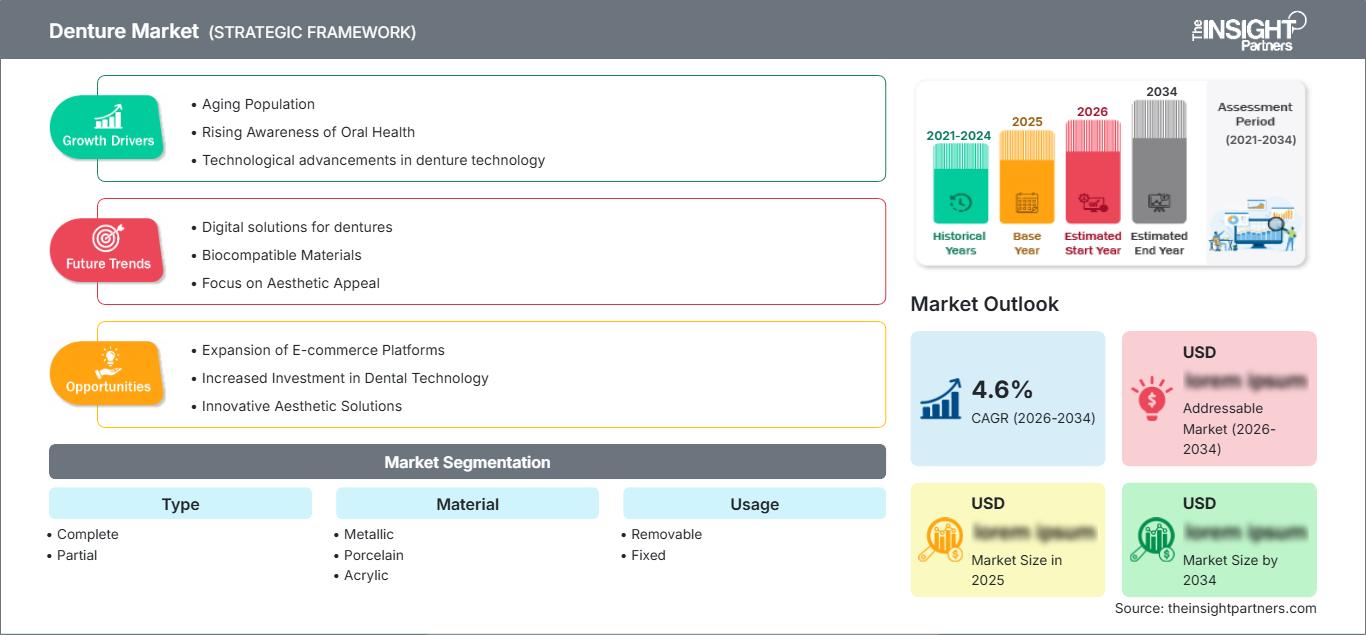
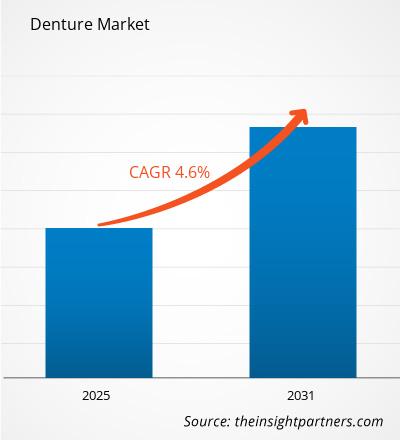
The Denture Market is projected to expand from US$ 2.48 Billion in 2025 to US$ 3.9 Billion by 2034, registering a CAGR of 5.15% from 2026 to 2034. Demands are fueled by continuous tooth loss, increased availability of prosthodontic treatments, and increasing use of removable prosthetics that are digitally designed. The development of products is now concentrating more on fit, aesthetics, longevity, and efficiency of laboratory operations.
The North American market will be growing at a rate of 5.4% – 5.9% CAGR until 2034. This growth in demand is driven by an aging population, existing prosthodontic framework, and greater availability of digitally manufactured prosthetic devices. The Denture Market Size is affected by replacement cycle, insurance-based dental treatment, expansion of dental services organizations, and increasing consumer preference for aesthetically appealing dentures with better retention and functionality.
Denture Market Assessment and Insights
- North America: The region is expected to hold a 32–36% share in 2025, supported by mature prosthodontic infrastructure and established laboratory networks, while growing at a 5.4–5.9% CAGR between 2026–2034 as digital fabrication expands.
- US: The US represents approximately 72–76% of North America's 2025 share, with a 5.5–6.0% CAGR between 2026–2034, reflecting aging demographics, restorative treatment demand, and expanding dental service networks.
- Europe: Europe is estimated at a 27–31% share in 2025 and a 4.9–5.4% CAGR between 2026–2034, led by Germany, the UK, France, Italy, and Spain, where laboratory capabilities and prosthodontic access remain comparatively developed.
- Asia Pacific: Asia Pacific accounts for an estimated 25–29% share in 2025, with a 5.9–6.5% CAGR between 2026–2034, led by China, Japan, South Korea, India, and Australia amid expanding dental infrastructure.
- Largest Segment: Complete dentures represent an estimated 56–60% market share in 2025, with a 5.0–5.6% CAGR between 2026–2034, reflecting persistent full-tooth-loss treatment requirements.
- High Growth Segment: Fixed usage is estimated at a 31–35% market share in 2025, expanding at a 6.4–7.1% CAGR between 2026–2034 as implant-supported prosthetic solutions gain clinical acceptance.
- Key companies analyzed in detail: Dentsply Sirona Inc., Ivoclar Vivadent AG, Patterson Dental Supply, Inc., SHOFU INC., GC Corporation, TP Orthodontics, Inc., COLTENE Holding AG, HOLMES DENTAL, Zimmer Biomet Holdings, Inc., and Kulzer GmbH.
Source: The Insight Partners' analysis based on proprietary research, government publications, company annual reports, investor presentations, industry databases, and expert interviews.
Production has been moving away from traditional flasking and hand-finishing to CAD/CAM design and milling as well as additive manufacturing, even as traditional acrylic production retains significance due to clinical familiarity and reparable properties. Workflow in denture production is being increasingly digitalized, and monolithic denture systems simplify workflow in production processes, as the Denture Market demonstrates an environment in which traditional technologies work alongside automated production technologies and materials and laboratory services.
Further development of the Denture Market will likely occur across the whole range of developing Asian markets in which improved dental infrastructure and increased healthcare spending make it possible to provide prosthetic treatment. Regulations aimed at ensuring material safety, traceability, and production processes should play into the hands of manufacturers with proven workflows. Investments will be made in digital production ecosystems, material science, and technician training, making it possible for manufacturers to compete based on their workflow efficiency and not just product availability.
Denture Market Report Scope
| Report Attribute | Details |
|---|---|
| Market size in 2025 | US$ 2.48 Billion |
| Market Size by 2034 | US$ 3.9 Billion |
| Global CAGR (2026 - 2034) | 5.15% |
| Historical Data | 2021-2024 |
| Forecast period | 2026-2034 |
Denture Market Analysis
Demand is intrinsically associated with tooth loss, aging, periodontal disorders, untreated cavities, and availability of restorative procedures. According to WHO, complete tooth loss impacts close to 7% of the population aged 20 years and above worldwide and around 23% of the population aged 60 years and above. These factors generate a long-lasting clinical requirement for replacement. Therefore, Denture Market growth trend is driven by demand as well as treatment availability.
The value chain includes dental materials suppliers, dentures producers, dental labs, healthcare professionals, distributors, and patients. Acrylic, polymers, metals, ceramics, teeth, impression material, and computer-aided design software are sourced via certain channels of distribution. Manufacturing cost structure depends on the amount of materials used, labor costs of technicians, equipment amortization, time of turnover, and remake costs. Digital manufacturing may help cut down repetitive manual labor, although traditional manufacturing remains strong in cases where there is a high cost of machinery or lack of digital skills.
Nowadays, the competition centers on the process integration instead of the product. Dentsply Sirona Inc. integrates restorative solutions and digital technology, while Ivoclar Vivadent AG stresses on the focus on digitally produced prosthetic materials and systems. Patterson Dental Supply, Inc. enjoys an advantage in the reach of distribution, while SHOFU INC., GC Corporation, and COLTENE Holding AG maintain their positions as suppliers of different dental materials and products.
Strategic investments today are made in digital dentures, validated print materials, CAD/CAM technologies, and customization options. TP Orthodontics, Inc., HOLMES DENTAL, Zimmer Biomet Holdings, Inc., and Kulzer GmbH provide specific value to the market through their expertise in orthodontic, prosthetic, implant-related, or laboratory solutions. Suppliers will be expected to differentiate themselves based on their manufacturing capability, clinical performance, distributors' presence, workflow integration, and support. Therefore, Denture Market report is inclined towards providers that can deliver both performance and scalability in manufacturing.
● REPORT CUSTOMIZATION
Tailor This Report To Align With Your Specific Business Requirements
This report can be customized to align precisely with your business objectives, scope, and target markets. Customization options include tailored segmentation, geography, competitive analysis, and strategic insights to support informed decision-making.
Customize This Report →WHAT YOU CAN ADJUST
- ● Segmentations
- ● Geography
- ● Competitive Analysis
- ● Language Preferences
Denture Market: Strategic Insights
Regional Insights
North America Denture Market
The North American region is expected to hold a 32-36% Denture Market share in 2025, registering a 5.4-5.9% CAGR between 2025 and 2034. Dominated by the US, the region features high presence of dental labs, insurance participation, dental services organization, and access to restorative dentures. The other country contributing to demand in the region is Canada, which offers technologically advanced demand base for digital dentures due to its need for relining and repairs.
Factors influencing the growth of this region include aging population and replacement requirement of dentures of patients requiring periodical relining or replacement. Digital denture technology is increasingly becoming relevant as laboratories are able to create standard design while cutting down on repetition in the manufacturing process. Premium aesthetics of the patient also drive investments in better tooth library, base material, retention method, and personalization processes.
U.S. Denture Market
The USA constitutes approximately 72-76% of the total North American share for the year 2025 and will be expanding at a CAGR of 5.5-6.0%. Demand is driven by the availability of high levels of dental laboratory capacity, the consolidation of dental service organizations, insurance-based dental care, and a sizable presence of restorative practices. Dentsply Sirona Inc. and Patterson Dental Supply, Inc., among others, enjoy high commercial visibility.
Applications include demands for full and partial prosthesis, repair, implants' restoration, and replacement of appliances. Digital impressions along with manufacturing through laboratories are increasingly being used by dental practices for better results and faster turnaround. Patient preference for aesthetics has been driving more and more use of advanced materials such as acrylics, ceramics, and polymers. Cost considerations related to treatment and equipment remain key purchase drivers.
Europe Denture Market
The share of Europe in 2025 will be about 27–31%, with a projected 4.9–5.4% CAGR due to a market led by Germany. Demand in the UK will be bolstered by well-developed laboratory infrastructure and public and private dental care. Germany features state-of-the-art manufacturing facilities for dentures coupled with well-trained technicians and digital manufacturing processes for prosthetics.
Demand in France is driven by aging population needs for restorations. In Italy and Spain, volume will be supplemented by private practices and laboratories. In Europe, the factors affecting purchasing decisions include materials compliance, traceability, and quality manufacturing. Digital denture manufacturing is slowly increasing especially when laboratories are capable of making investments to achieve higher throughput. Hence, Europe features well-established replacement demand and modest digital denture manufacturing integration, thus generating steady but moderate growth.
APAC Denture Market
The market for APAC region will stand at 25-29% by 2025 and will exhibit a CAGR of 5.9-6.5%. China leads the demand in the region. Japan and South Korea have advanced dental systems along with laboratory systems, whereas India is increasing its reach through private practices and laboratories.
The contribution from Australia comes in form of its existing restorative practices, while China and India offer huge volume potential in long term. The industrial growth, professional training of technicians, digital manufacturing facilities and health care infrastructure aid in adoption of the technology. Efforts to improve access to oral health care will add to its reach.
Middle East & Africa Denture Market
MEA is forecasted to experience CAGR of 5.2%-5.8%, driven by Saudi Arabia and helped by UAE and South Africa. Investments in dental infrastructure, growth of private healthcare and specialization clinics will facilitate access to restorative treatments in large urban areas.
In Saudi Arabia, there is a modernization of healthcare sector. In UAE, there is focus on technological private healthcare. South Africa has a relatively well-developed dental sector, even though it still suffers from affordability problems. Other MEA countries have more fragmented market, as the infrastructure and specialization vary greatly. Energy sector wealth and investments in health infrastructure may help some countries in developing premium dental sector.
Segmentation Analysis
Type
Type is divided into Complete and Partial. The segment is projected to grow at a 5.0–5.6% CAGR from 2026–2034. Complete products retain a larger demand base because total tooth loss requires broader prosthetic replacement, while partial solutions address localized tooth loss and preservation of remaining dentition. The Denture Market scope therefore spans both replacement intensity and clinical customization.
- Complete: Complete dentures remain strategically important where extensive tooth loss requires full-arch restoration. Demand emphasizes retention, aesthetics, speech, mastication, and affordability, with digital design improving reproducibility and personalization.
- Partial: Partial dentures serve patients retaining natural teeth and require careful adaptation around existing structures. Demand is supported by flexible treatment planning, repairability, and material options suited to varied clinical conditions.
Material
Material includes Metallic, Porcelain, and Acrylic, with the segment expected to expand at a 5.3–5.9% CAGR from 2026–2034. Material selection depends on strength, aesthetics, weight, biocompatibility, processing requirements, and cost. Acrylic remains central to removable prosthetics, while alternative materials support specialized performance and aesthetic needs.
- Metallic: Metallic materials remain relevant where structural strength and dimensional stability are priorities. Their role is particularly important in frameworks and components requiring durability, although aesthetics and manufacturing complexity can influence selection.
- Porcelain: Porcelain is valued for established aesthetic characteristics and natural-looking tooth appearance. Its strategic relevance persists in premium prosthetic applications where color stability, surface characteristics, and visual integration influence patient acceptance.
- Acrylic: Acrylic materials provide versatile processing, repairability, and broad clinical familiarity. Their compatibility with conventional and digital workflows makes them central to scalable denture fabrication and continuing replacement demand.
Usage
Usage comprises Removable and Fixed, with the segment forecast to grow at a 5.8–6.4% CAGR from 2026–2034. Removable products retain broad utilization, while fixed solutions benefit from implant-supported rehabilitation and increasing preference for stability. This category captures an important shift in treatment objectives from basic replacement toward functional integration.
- Removable: Removable dentures remain widely used because they offer comparatively accessible treatment, straightforward maintenance, and adaptable replacement. Their market position is reinforced by broad laboratory familiarity and suitability for extensive tooth loss.
- Fixed: Fixed prosthetic solutions gain strategic importance where patients prioritize stability and function. Their adoption is associated with implant-supported rehabilitation, greater treatment customization, and clinical demand for solutions that reduce appliance movement.
Application
Application covers Repair Broken Teeth, Implanted Teeth, and Other, with the segment expected to advance at a 5.1–5.8% CAGR from 2026–2034. Application dynamics depend on treatment complexity, patient age, clinical preference, and the availability of implant and restorative infrastructure. Increasingly, digital workflows connect diagnosis with prosthetic planning.
- Repair Broken Teeth: Repair applications address localized structural damage and extend the functional life of existing prostheses. Demand benefits from cost-conscious treatment decisions and laboratory capabilities supporting rapid adjustment or restoration.
- Implanted Teeth: Implant-related applications support higher-value rehabilitation where stability and retention are prioritized. Their strategic importance increases as implant infrastructure expands and clinicians integrate prosthetic planning earlier within comprehensive treatment pathways.
- Other: This category encompasses applications outside the principal repair and implant-related indications. Demand remains clinically diverse, reflecting individualized treatment planning, replacement needs, temporary requirements, and specialized prosthodontic circumstances.
Opportunity Snapshot
| Application | Revenue Contribution (High/Medium/Low) | Trend Tag | Adoption Stage |
| Repair Broken Teeth | Medium | Rapid Repair | Mature |
| Implanted Teeth | High | Implant Support | Scaling |
| Other | Low | Custom Cases | Emerging |
Denture Market Growth Drivers and Impact Analysis
Ageing Populations and Persistent Edentulism
Population ageing creates a durable clinical base for prosthetic treatment because tooth loss becomes more prevalent across older age groups. WHO identifies complete tooth loss as affecting almost 7% of adults aged 20 years and older globally, increasing to about 23% among people aged 60 years and older. The implication for manufacturers is sustained replacement demand rather than a short-lived consumption cycle. Aging populations also increase requirements for relining, repair, replacement, and personalized fit. Suppliers that provide durable materials and efficient laboratory workflows can capture recurring demand throughout the appliance lifecycle. Regional differences in healthcare access remain important, because demographic need does not automatically translate into treatment volume where affordability, insurance coverage, or technician capacity is constrained.
Digital Fabrication Improves Laboratory Productivity
Digital dentistry is changing the economics of denture production by reducing repetitive manual steps and enabling standardized design files to move between clinics, laboratories, and manufacturing systems. CAD/CAM milling and additive printing can improve consistency, support digital record retention, and facilitate replacement of previously fabricated appliances. The impact extends beyond equipment sales because compatible materials, software, training, and maintenance become recurring elements of the purchasing decision. Digital systems can also make distributed production more practical, allowing laboratories to centralize complex design activities while practices capture scans locally. As adoption expands, manufacturers with validated material libraries and interoperable workflows can strengthen customer retention. The commercial opportunity therefore increasingly depends on ecosystem compatibility rather than isolated hardware performance.
Demand for Better Fit, Aesthetics, and Patient Comfort
Patients increasingly evaluate prostheses on appearance, comfort, speech, stability, and perceived naturalness rather than basic functionality alone. This raises the importance of tooth morphology, gingival characterization, surface finish, base strength, and retention. Manufacturers respond by developing broader shade selections, improved polymer formulations, and more precise production processes. Clinical teams also benefit when digital records allow repeated fabrication with fewer variations between appliances. The commercial effect is a gradual shift toward value differentiation, particularly in developed markets where patients may accept premium pricing for improved outcomes. Suppliers that can demonstrate reliable fit and aesthetic consistency can compete through clinical performance instead of price alone. This dynamic encourages investment in materials science, digital workflows, and technician training across the broader prosthetic ecosystem.
Denture Market Future Trends
Personalized Digital Denture Production
Personalized digital dentures are likely to move from specialized laboratory workflows toward broader routine adoption as material libraries, scanning systems, and production equipment become more interoperable. Future systems will increasingly combine facial information, archived patient records, tooth libraries, and automated design recommendations to create individualized appliances. Artificial intelligence may support repetitive design tasks, while technicians retain responsibility for clinical judgment and final validation. Monolithic materials and one-piece printing approaches can further reduce assembly requirements. The resulting model is likely to emphasize repeatability, faster remake production, and more consistent patient-specific outcomes. Over time, customization may become an expected feature rather than a premium differentiator, especially in technologically mature markets. These developments will shape Denture Market trends by shifting competition toward software-enabled production ecosystems and validated digital materials.
Integrated Clinical-to-Laboratory Workflows
The next phase of digital prosthetics is likely to connect clinical scanning, prescription management, laboratory design, production, quality control, and patient records within unified workflows. Such integration can reduce manual data transfers and improve communication when adjustments are required. Cloud-based platforms may allow laboratories to coordinate production across multiple locations while maintaining standardized design parameters. Manufacturers can benefit by offering validated combinations of scanners, software, printers, milling systems, and materials rather than standalone products. Over the forecast period, interoperability should become increasingly important as buyers seek to avoid technology silos and duplicated investments. Regulatory documentation and traceability will also gain importance as digital workflows expand. This evolution can make production more scalable while preserving technician oversight for complex clinical cases.
Denture Market Opportunities
Expansion of Digital Prosthetic Production in Emerging Markets
Emerging markets provide an opportunity to establish digital denture infrastructure alongside expanding private dental care rather than replacing large legacy systems. Manufacturers can target regional laboratories with modular scanners, compact printers, compatible materials, and training packages designed around manageable capital requirements. Localized service networks are important because equipment downtime can undermine the economic case for digital adoption. Partnerships with dental schools, laboratory associations, and distributors can accelerate technician education and establish standardized workflows. Suppliers should also adapt product portfolios to local affordability requirements while maintaining validated quality. The Denture Market Forecasts indicate that emerging regions can contribute disproportionately to incremental volume when access improves, making scalable production models particularly relevant for companies seeking geographic diversification without relying exclusively on premium pricing.
Premium Materials and Implant-Supported Prosthetic Ecosystems
Investment opportunities extend beyond basic appliances into premium materials and integrated implant-supported workflows. Suppliers can develop differentiated polymers, enhanced acrylic systems, digital denture teeth, retention components, and finishing solutions that address comfort and long-term durability. Implant-supported applications create opportunities for coordinated planning between implant manufacturers, prosthetic material suppliers, laboratories, and clinicians. Commercial strategies should emphasize validated workflows, technician education, and evidence supporting material performance rather than relying solely on product novelty. Companies can also pursue selective partnerships with dental service organizations and laboratory groups to accelerate standardized adoption. As treatment expectations rise, premiumization may create attractive value pools in markets where patients have greater purchasing power and clinicians are equipped to deliver more complex rehabilitation.
Recent Developments
- June 2026: Dentsply Sirona Inc. expanded its digital denture ecosystem through validation of Lucitone Digital Print Denture resins for one-piece production on HeyGears’ UltraCraft Multi-Material Fusion DLP printer. The collaboration removes the need to bond separately printed denture teeth to the base, creating a more streamlined production pathway for digitally manufactured dentures.
- June 2026: Ivoclar Vivadent AG introduced additional gingiva and tooth shades across its denture portfolio, including Ivotion and related base materials. The expansion addresses demand for more individualized prosthetic aesthetics and provides laboratories with additional options for matching patient-specific gingival characteristics, age-related appearance, and personal preferences.
- December 2025: GC Corporation announced the launch of COE-SOFT PRINT through GC America and Aspen Dental, introducing a soft denture liner designed specifically for digitally printed dentures. The development connects conventional patient comfort requirements with digital production workflows and illustrates increasing collaboration between dental material suppliers and large clinical networks.
Frequently Asked Questions

- Comprehensive Market Sizing and Forecast Analysis
- Detailed Segmentation Analysis
- In-Depth Market Dynamics Assessment
- Regional and Country-Level Insights
- Competitive Landscape and Company Benchmarking
- Strategic Business Intelligence
Recent Reports
Testimonials

The Insight Partners provided valuable market intelligence that supported our global go-to-market strategy. Their team was professional, responsive, and attentive to our feedback, providing thoughtful analysis and helpful methodological clarifications throughout the project.
Junmo Kim Chief Financial Officer (CFO), Enertech Co., Ltd.
The Insight Partners' SCADA System Market report is comprehensive, with valuable insights on current trends and future forecasts. The team was highly professional, responsive, and supportive throughout. We are very satisfied and highly recommend their services.
RAN KEDEM Partner, Reali Technologies LTDs
I requested a report on a very specific software market and the team produced the report in a few days. The information was very relevant and well presented. I then requested some changes and additions to the report. The team was again very responsive and I got the final report in less than a week.
JEAN-HERVE JENN Chairman, Future Analytica
We worked with The Insight Partners for an important market study and forecast. They gave us clear insights into opportunities and risks, which helped shape our plans. Their research was easy to use and based on solid data. It helped us make smart, confident decisions. We highly recommend them.
PIYUSH NAGPAL Sr. Vice President, High Beam Global
The Insight Partners delivered insightful, well-structured market research with strong domain expertise. Their team was professional and responsive throughout. The user-friendly website made accessing industry reports seamless. We highly recommend them for reliable, high-quality research services
YUKIHIKO ADACHI CEO, Deep Blue, LLC.
This is the first time I have purchased a market report from The Insight Partners.While I was unsure at first, I visited their web site and felt more comfortable to take the risk and purchase a market report.I am completely satisfied with the quality of the report and customer service. I had several questions and comments with the initial report, but after a couple of dialogs over email with their analyst I believe I have a report that I can use as input to our strategic planning process.Thank you so much for taking the extra time and making this a positive experience.I will definitely recommend your service to others and you will be my first call when we need further market data.
JOHN SUZUKI President and Chief Executive Officer, Board Director, BK Technologies
I wish to appreciate your support and the professionalism you displayed in the course of attending to my request for information regarding to infectious disease IVD market in Nigeria. I appreciate your patience, your guidance, and the fact that you were willing to offer a discount, which eventually made it possible for us to close a deal. I look forward to engaging The Insight Partners in the future, all thanks to the impression you have created in me as a result of this first encounter.
DR CHIJIOKE ONYIA MANAGING DIRECTOR, PineCrest Healthcare Ltd.Reason to Buy
- Informed Decision-Making
- Understanding Market Dynamics
- Competitive Analysis
- Identifying Emerging Markets
- Customer Insights
- Market Forecasts
- Risk Mitigation
- Boosting Operational Efficiency
- Strategic Planning
- Investment Justification
- Tracking Industry Innovations
- Aligning with Regulatory Trends





 Get Free Sample for