
Dicamba Herbicide Market Size, Share & Trends by 2034
Coverage: by Physical Form (Liquid, Dry); Time of Application (Post-Emergence, Pre-Emergence); Crop Type (Cereals and Grains, Oilseeds and Pulses, Pastures and Forage Crops); Formulation (Salt, Acid) , and Geography (North America, Europe, Asia Pacific, and South and Central America)
- Status : Data Released
- Report Code : TIPRE00010371
- Category : Chemicals and Materials
- No. of Pages : 150
- Available Report Formats :


- Last update date : July 21, 2026


2025 Market Size
US$ 676.30 Mn
Base year value
2034 Forecast
US$ 1,283.75 Mn
Projected by 2034
CAGR 2026-2034
7.38 %
Growth rate
Addressable Market
US$ 8,837.17 Mn
(2026-2034)
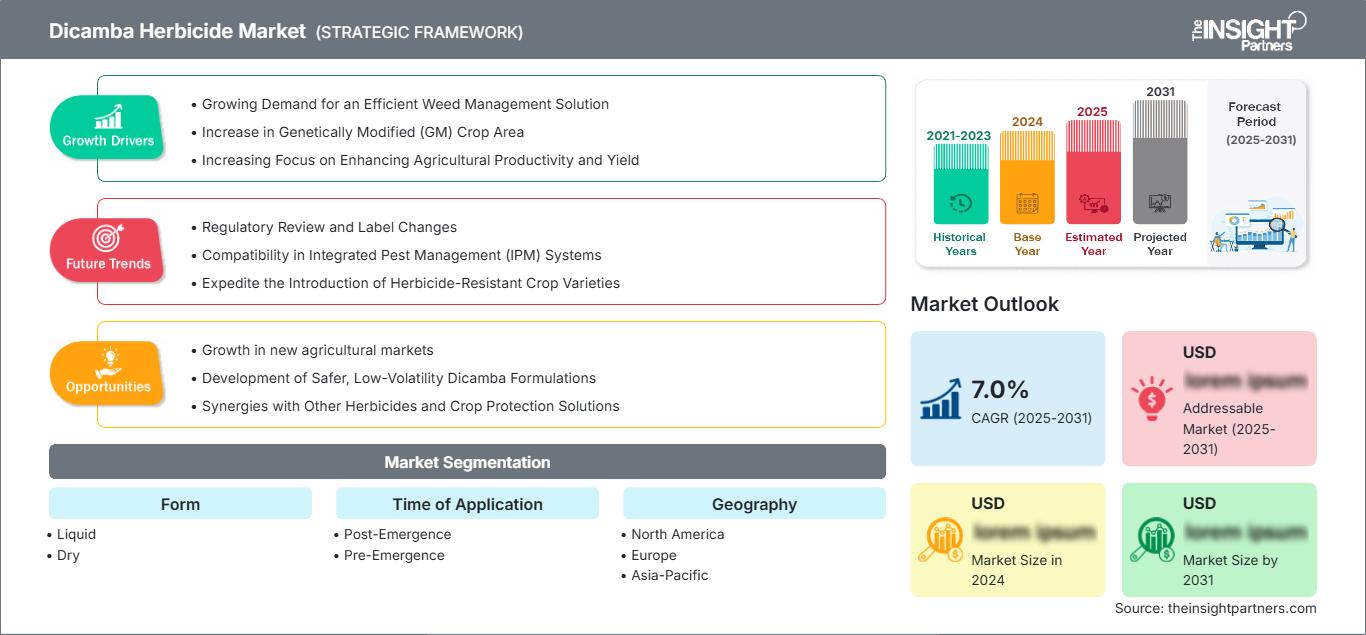
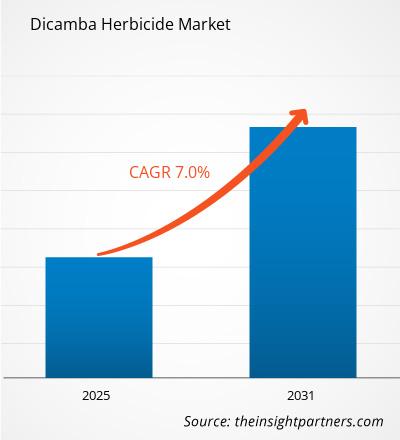
The Dicamba Herbicide Market size was valued at US$ 676.30 Million in 2025 and is projected to reach US$ 1,283.75 Million by 2034, registering a CAGR of 7.38% during 2026–2034. Demand is tied to the broadleaf weed management on soybeans, cotton, corn, cereals, pastures, and non-crop areas, while the constantly changing use regulations are influencing the development of formulations and channels.
North America continues to dominate as the main market for demand, with a CAGR estimated at 6.6-7.6% due to increasing weed resistance to herbicides and extensive row crop production. Dicamba Herbicide Market size expectations in North America are driven by the availability of dicamba-resistant soybean and cotton acreage, better label compliance, and investments into low volatility formulations.
Dicamba Herbicide Market Assessment and Insights
- North America: Dicamba Herbicide Market Share in 2025 of 42–46% and CAGR between 6.6–7.6%. Demand is supported by soybean, cotton, corn, and pasture programs, with stewardship rules driving formulation upgrades.
- US: Share in 2025 of 78–82% of North America and CAGR between 6.7–7.7%. Dicamba-tolerant crop systems and resistant broadleaf weeds sustain post-emergence demand.
- Europe: Share in 2025 of 18–22% and CAGR between 5.0–6.0%. Germany, France, Spain, and the UK lead selective use across cereals, maize, pasture, and non-crop vegetation management.
- Asia Pacific: Share in 2025 of 20–24% and CAGR between 8.0–9.0%. China, India, Australia, and Japan support growth through crop intensification, herbicide adoption, and precision spraying expansion.
- Largest Segment: Liquid form with market share of 60–64% in 2025 and CAGR of 7.1–8.1% during 2026–2034, supported by mixing convenience and spray compatibility.
- High Growth Segment: Post-Emergence application with market share of 66–70% in 2025 and CAGR of 7.8–8.8% during 2026–2034, driven by in-season weed escapes.
- Key companies analyzed in detail: Albaugh, LLC, BASF SE, Bayer CropScience AG, Corteva Agriscience LLC, Helena Agri-Enterprises, LLC, Bayer AG, Nufarm Limited, Syngenta AG, The Andersons, Inc., Dow Inc.
Source: The Insight Partners' analysis based on proprietary research, government publications, company annual reports, investor presentations, industry databases, and expert interviews.
Development of the market is influenced by low volatility chemistry, application limitations and data-driven stewardship. Dicamba has been repositioned from extensive conventional uses into controlled programs for resistance weeds control and crop traits system. The new manufacturing processes are focused on the formulation stability, adjuvant pack in accordance with labeling requirements, and consistent supply through agricultural retailers. Also the producers are developing liquid and dry formulations according to the equipment used, climate, growing seasons and applicator training in regions of sensitivity cropping.
The most promising future belongs to farmers who have problems with herbicide-resistant Palmer amaranth, waterhemp, kochia and other broadleaf weeds. New demand is formed in Asia-Pacific, Latin farming systems, as well as some countries of Middle East and Africa due to increased crop density and improved application services. The positive regulatory trends will favor the products with drift reduction proof, applicator training, integrated weed management program and field record transparency.
Dicamba Herbicide Market Report Scope
| Report Attribute | Details |
|---|---|
| Market size in 2025 | US$ 676.30 Million |
| Market Size by 2034 | US$ 1,283.75 Million |
| Global CAGR (2026 - 2034) | 7.38% |
| Historical Data | 2021-2024 |
| Forecast period | 2026-2034 |
Dicamba Herbicide Market Analysis
The Dicamba Herbicide Market growth depends on increasing resistance to glyphosate and a requirement for other synthetic auxins as an alternative in row crops. Dicamba helps farmers preserve yield potential when resistant weeds consume soil moisture, light, and nutrients. The value chain consists of active ingredients producers, formulators, seed-trait suppliers, distributors, retailers, custom applicators, and farm cooperatives influencing proper usage of the product.
Supply is still vulnerable to the impact of regulatory approvals and changes to labels as well as the seasonality factor. According to the U.S. Environmental Protection Agency, dicamba is being used in corn, cotton, fallow, pasture, sorghum, soybean, sugarcane, wheat, turf, right-of-ways, and non-agriculture lands. Such variety of uses provides resilience of demand, but requires investments in formulation, buffers, education, and control of application timing.
The Dicamba Herbicides Market Report reveals competitive focus around regulatory preparedness, trait-based systems, distribution channels, and stewardship credentials. In the area of over-the-top dicamba herbicide usage, BASF SE, Bayer CropScience AG, Bayer AG, and Syngenta AG remain prominent, whereas Albaugh, LLC, Nufarm Limited, Helena Agri-Enterprises, LLC, Corteva Agriscience LLC, The Andersons, Inc., and Dow Inc. are associated with comprehensive crop protection range.
Future investments would be aimed at development of lower volatility formulations, digital compliance labels, tank mix capabilities, and applicator training. Positioning would depend more on demonstrating field efficacy while minimizing off-target exposure. Firms offering product efficacy along with transparency, retail backing, and regional agronomy would be more likely to protect market share under increasing regulation, increased diversity of growers' weed control practices, and distributors’ preference for minimizing complaints, risks of crop damage, and uncertainties of operations.
● REPORT CUSTOMIZATION
Tailor This Report To Align With Your Specific Business Requirements
This report can be customized to align precisely with your business objectives, scope, and target markets. Customization options include tailored segmentation, geography, competitive analysis, and strategic insights to support informed decision-making.
Customize This Report →WHAT YOU CAN ADJUST
- ● Segmentations
- ● Geography
- ● Competitive Analysis
- ● Language Preferences
Dicamba Herbicide Market: Strategic Insights
Regional Insights
North America Dicamba Herbicide Market
North America held 42–46% of global revenue in 2025 and is expected to grow at a 6.6–7.6% CAGR through 2034. The Dicamba Herbicide Market share position reflects large soybean and cotton acreage, established crop protection retail networks, and persistent resistant broadleaf weed pressure. EPA actions on over-the-top uses also keep label compliance central to market access.
Regional demand is reinforced by conservation tillage, diversified herbicide rotations, and precision spraying investments. Growers increasingly seek tools that control weeds missed by glyphosate-based programs while preserving crop yield. Supplier success depends on formulation stability, volatility reduction, applicator training, and state-level registration alignment, particularly for soybean and cotton programs that require post-emergence flexibility, predictable application windows, and reliable retail guidance during compressed spraying seasons.
U.S. Dicamba Herbicide Market Market
The United States represented 78–82% of North American revenue in 2025 and is forecast to record a 6.7–7.7% CAGR. Demand is concentrated in soybean, cotton, corn, pasture, and fallow systems where broadleaf weeds challenge yield protection. Company presence is strong through Bayer CropScience AG, BASF SE, Syngenta AG, Albaugh, LLC, and Helena Agri-Enterprises, LLC.
Application trends are increasingly shaped by stewardship requirements, including buffers, weather conditions, approved adjuvants, and applicator training. Post-emergence use remains strategically important because growers need in-season rescue options when weed flushes occur after planting. Retailers and custom applicators influence product choice by translating label rules into practical field programs that reduce drift, crop injury concerns, recordkeeping gaps, and disputes with neighboring farms or specialty crop producers.
Europe Dicamba Herbicide Market Market
Europe accounted for 18–22% of global revenue in 2025 and is projected to expand at a 5.0–6.0% CAGR. Germany is the leading country, supported by structured cereal, maize, pasture, and non-crop vegetation programs. Regional demand is more selective than North America because pesticide regulation, environmental assessment, and application windows are comparatively stringent.
The UK market is shaped by cereal weed programs, stewardship-led chemical use, and vegetation management across industrial and transport corridors. Germany benefits from advanced farm services and precision equipment adoption. France, Italy, and Spain contribute demand through mixed crop systems, maize cultivation, pasture care, and targeted non-crop applications where broadleaf control must comply with national pesticide rules, water protection priorities, and residue management expectations.
APAC Dicamba Herbicide Market Market
Asia Pacific held 20–24% of global revenue in 2025 and is expected to grow at an 8.0–9.0% CAGR. China leads regional demand through large crop acreage, agrochemical production capacity, and modernization of crop protection practices. India, Australia, Japan, and South Korea add growth through weed management needs, mechanized spraying, and higher farm productivity targets.
Policy drivers include food security priorities, improved extension services, and investment in precision agriculture. Australia remains important for resistant weed management in broadacre farming, while India’s adoption is linked to rising herbicide use in labor-constrained regions. Suppliers must adapt packaging, training, and formulations to smallholder and commercial farm structures, with emphasis on safe handling, spray calibration, and farmer education.
Middle East & Africa Dicamba Herbicide Market Market
The Middle East & Africa market is forecast to grow at a 5.6–6.6% CAGR through 2034. South Africa is the leading country due to commercial agriculture, maize systems, pasture management, and structured crop input distribution. Saudi Arabia and the UAE support demand through landscaping, rights-of-way, and controlled agricultural projects.
Energy, logistics, and infrastructure corridors create selective non-crop vegetation management needs across the region. Water scarcity and heat conditions require careful timing and application controls. Rest of MEA demand remains fragmented, but modernization of farm services and input distribution can gradually improve access to regulated herbicide programs, especially where commercial maize, pasture, and plantation systems require consistent broadleaf suppression.
Segmentation Analysis
Form
The Form segment is expected to grow at a 7.0–8.0% CAGR during 2026–2034. The Dicamba Herbicide Market scope covers products supplied as liquid concentrates, soluble liquids, granules, dry flowables, and wettable powders, but commercial demand is concentrated in forms that simplify handling, dosage accuracy, tank mixing, compatibility with modern sprayers, and distribution through agricultural retail channels.
- Liquid: Liquid formulations hold the strongest position because they integrate easily with ground sprayers, tank mixes, and retailer blending services. Their practical handling profile supports broad use across commercial row-crop programs.
- Dry: Dry formulations remain strategically relevant where storage stability, transport efficiency, and controlled dosing are priorities. Adoption is supported by professional applicators and users seeking flexible inventory management.
Time of Application
The Time of Application segment is projected to grow at a 7.3–8.3% CAGR through 2034. Application timing determines weed-control efficacy, compliance risk, and crop safety. Post-emergence programs dominate where growers address escapes after crop establishment, while pre-emergence use remains important for early-season residual control, resistance management, and reducing pressure on later spray windows.
- Post-Emergence: Post-emergence applications dominate because they address actively growing broadleaf weeds and provide in-season flexibility. Demand is highest where resistant weeds emerge unevenly after planting.
- Pre-Emergence: Pre-emergence programs help reduce early weed pressure before crop competition intensifies. Their strategic value increases when growers rotate modes of action to delay resistance development.
Opportunity Snapshot
| Segment Name | Revenue Contribution | Trend Tag | Adoption Stage |
| Post-Emergence | High | Rescue Sprays | Mature |
| Pre-Emergence | Medium | Residual Control | Scaling |
Dicamba Herbicide Market Growth Drivers and Impact Analysis
Rising Herbicide-Resistant Broadleaf Weed Pressure
One of the main factors that has been fuelling the expansion of the dicamba herbicide market around the world is the rise in the number of herbicide-resistant broadleaf weeds. The repeated use of herbicides whose mode of action was mono for many years has led to the emergence of weed species that are more resistant and harder to eradicate. Some of the resistant weed species that have been spreading over major agriculture areas include Palmer amaranth, waterhemp, kochia, marestail, giant ragweed, and common ragweed. This has made the traditional weed eradication techniques less effective, thus posing threats to the yield from the crops. Growers have resorted to using multiple mode of action herbicides in order to deal with resistant weeds, and dicamba is used as a major component for broadleaf weed eradication. There are more than hundreds of cases of herbicide-resistant weeds reported by the International Herbicide-Resistant Weed Database. Resistant weed species in soybean, cotton, corn, cereals, and pasture systems compete for nutrients, moisture, sunlight, and space. This growing challenge supports sustained demand for dicamba in pre-plant, pre-emergence, and post-emergence weed management programs while also driving investment in agronomic consulting, field scouting, resistance monitoring, digital weed mapping, precision application technologies, and customized crop protection strategies that improve long-term farm productivity and profitability.
Expansion of Dicamba-Tolerant Crop Systems
The development of dicamba tolerant crop systems has greatly expanded the commercial opportunities for dicamba herbicides through offering a means of selective weed control using post-emergence applications of dicamba in suitable soybean and cotton varieties without harming the crop in accordance with recommended labeling directions. This herbicide-tolerant system increases operational flexibility for the farmer and improves the effectiveness of weed management in difficult to control resistant broadleaves which affect crop competitiveness. There are a number of factors that continue to influence adoption such as local weed pressure, certified seeds availability, regulatory approval, producer confidence, production economics, environmental conditions, and trained applicators. Where there is herbicide resistance prevalence, there is an opportunity to offer producers another solution in managing their weeds while protecting crop yield. Commercial opportunities extend beyond the sale of herbicides since seed developers, biotechnology companies, crop protection companies, distributors, retailers, agricultural coops, equipment makers and applicators are all part of the same value chain. Companies who are able to bring together seeds technology, herbicide formulations, precision agriculture technology, expertise, stewardship program and agronomy technology will be better equipped to develop customer loyalty and market penetration.
Improved Formulations and Application Stewardship
Stewardship has become a market-enabling competency, not an afterthought regulatory requirement. Volatile chemical formulae, drift reduction agents, pH buffer technology, downwind buffers, and weather-based regulations are influencing the design and implementation of new products. The EPA has been stressing ecosystem risk management of non-target terrestrial plants. Off-target drift becomes essential to any future approval. It affects the marketplace through creating a need for products with labeling, applicator training, digital decision support, and retailer validation. Producers who minimize operational uncertainty for the grower and the retailer create better adoption and minimize liability issues in their products.
Dicamba Herbicide Market Future Trends
Precision Spraying and Digital Stewardship Platforms
The Dicamba Herbicide Market Trends include the development of digital systems that can inform timing of spraying, nozzle choice, buffer zone, weather conditions, and documentation. Digital spraying technology could cut down on product waste and provide more reliable weed control through field zones that have been tested for pressure. In the forecast period, retailers and sprayers are likely to incorporate label intelligence into their farm management systems, particularly in areas where there is stringent legislation regarding volatility and drift. Insurance, traceability, and sustainability will also contribute to the adoption of such solutions. Formulators that align their products with digital stewardship will enjoy a competitive edge since growers demand proof of proper use.
Stacked Weed-Control Programs and Rotation Strategies
Upcoming weed management programs will be built around stacks of technologies that use dicamba in combination with residual herbicides, other post-emergent herbicides, cover crops, and mechanical tillage operations. This will be fueled by issues related to resistance, environmental regulation, and the necessity to maintain herbicide efficacy for several growing seasons. It will be important for suppliers to present dicamba as an element of an integrated program rather than a single tool. Product development efforts may focus on mixing capability with other chemicals, crop traits, and regional agronomy. Those growers who alternate their modes of actions can increase field efficacy and extend product life at the same time.
Dicamba Herbicide Market Opportunities
Growth in Asia Pacific Commercial Farming
Asia Pacific offers action-oriented opportunities as commercial farms, cooperatives, and input retailers expand herbicide programs to manage labor shortages and improve productivity. China and Australia already support advanced crop protection practices, while India presents longer-term potential as mechanized spraying and advisory services expand. Dicamba Herbicide Market Forecasts favor suppliers that provide localized labels, smaller pack sizes, training, and reliable distribution. Investment priorities include retailer education, residue-aware stewardship, and partnerships with precision equipment providers. Companies that adapt formulations to regional climates and crop calendars can convert rising awareness into repeat demand while avoiding misuse that could trigger regulatory pushback or reputational risk.
Stewardship-Led Product Differentiation
Stewardship-led differentiation creates opportunity for manufacturers to compete beyond price. Growers and retailers need confidence that products can deliver broadleaf control while meeting increasingly complex use requirements. Companies can invest in applicator certification, field demonstrations, volatility testing, label support, and digital compliance records. These services reduce uncertainty for customers and can justify stronger channel loyalty. The opportunity is especially relevant in North America and Europe, where non-target crop concerns and environmental assessment standards affect market access. Suppliers that build trust with regulators, farm advisers, and applicators can protect demand even when public scrutiny around dicamba remains high and approval cycles remain unpredictable.
Recent Developments
- Mrach 2026: ADAMA US has launched Dicamba 4L DGA, a broadleaf herbicide aimed at enhancing weed control in key row crops. Utilizing dicamba chemistry and DGA technology, it promises consistent performance while minimizing volatility and off-target movement. This herbicide is critical for burndown and early-season weed management, particularly effective against difficult broadleaf weeds like pigweed, marestail, and kochia.
- February 2026: The EPA has approved three dicamba-based herbicides—Engenia (BASF), Stryax (Bayer), and Tavium (Syngenta)—for over-the-top use on genetically modified soybeans and cotton for two growing seasons. This decision follows a complicated regulatory history marked by federal court bans in 2020 and 2024, which restricted use in the 2025 growing season.
Frequently Asked Questions

- Comprehensive Market Sizing and Forecast Analysis
- Detailed Segmentation Analysis
- In-Depth Market Dynamics Assessment
- Regional and Country-Level Insights
- Competitive Landscape and Company Benchmarking
- Strategic Business Intelligence
Recent Reports
Testimonials

The Insight Partners' SCADA System Market report is comprehensive, with valuable insights on current trends and future forecasts. The team was highly professional, responsive, and supportive throughout. We are very satisfied and highly recommend their services.
RAN KEDEM Partner, Reali Technologies LTDs
I requested a report on a very specific software market and the team produced the report in a few days. The information was very relevant and well presented. I then requested some changes and additions to the report. The team was again very responsive and I got the final report in less than a week.
JEAN-HERVE JENN Chairman, Future Analytica
We worked with The Insight Partners for an important market study and forecast. They gave us clear insights into opportunities and risks, which helped shape our plans. Their research was easy to use and based on solid data. It helped us make smart, confident decisions. We highly recommend them.
PIYUSH NAGPAL Sr. Vice President, High Beam Global
The Insight Partners delivered insightful, well-structured market research with strong domain expertise. Their team was professional and responsive throughout. The user-friendly website made accessing industry reports seamless. We highly recommend them for reliable, high-quality research services
YUKIHIKO ADACHI CEO, Deep Blue, LLC.
This is the first time I have purchased a market report from The Insight Partners.While I was unsure at first, I visited their web site and felt more comfortable to take the risk and purchase a market report.I am completely satisfied with the quality of the report and customer service. I had several questions and comments with the initial report, but after a couple of dialogs over email with their analyst I believe I have a report that I can use as input to our strategic planning process.Thank you so much for taking the extra time and making this a positive experience.I will definitely recommend your service to others and you will be my first call when we need further market data.
JOHN SUZUKI President and Chief Executive Officer, Board Director, BK Technologies
I wish to appreciate your support and the professionalism you displayed in the course of attending to my request for information regarding to infectious disease IVD market in Nigeria. I appreciate your patience, your guidance, and the fact that you were willing to offer a discount, which eventually made it possible for us to close a deal. I look forward to engaging The Insight Partners in the future, all thanks to the impression you have created in me as a result of this first encounter.
DR CHIJIOKE ONYIA MANAGING DIRECTOR, PineCrest Healthcare Ltd.Reason to Buy
- Informed Decision-Making
- Understanding Market Dynamics
- Competitive Analysis
- Identifying Emerging Markets
- Customer Insights
- Market Forecasts
- Risk Mitigation
- Boosting Operational Efficiency
- Strategic Planning
- Investment Justification
- Tracking Industry Innovations
- Aligning with Regulatory Trends





 Get Free Sample for