
Digital Denture Market Size, Growth & Trends by 2034
Digital Denture Market Size and Forecasts (2021 - 2034), Global and Regional Share, Trends, and Growth Opportunity Analysis Report Coverage : by Type (Complete Denture, Partial Denture); Tools (Equipment, Software); Usability (Removable Denture, Fixed Denture); Material (Resins, Plastics); and Geography (North America, Europe, Asia Pacific, and South and Central America)
- Status : Data Released
- Report Code : TIPRE00040747
- Category : Life Sciences
- No. of Pages : 150
- Available Report Formats :


- Last update date : July 08, 2026


2025 Market Size
US$ 1.54 Bn
Base year value
2034 Forecast
US$ 3.09 Bn
Projected by 2034
CAGR 2026-2034
8.06 %
Growth rate
Addressable Market
US$ 20.83 Bn
(2026-2034)
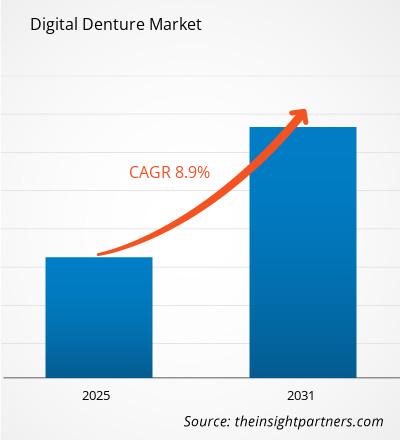
The Digital Denture Market is advancing rapidly as dental laboratories and clinics adopt digital workflows to improve prosthetic accuracy, production speed, and patient outcomes. The market is estimated at approximately US$ 1.54 billion in 2025 and is projected to approach US$ 3.09 billion by 2034, reflecting a steady expansion trajectory at a CAGR of around 8.06% during 2026–2034. Increasing integration of CAD/CAM technologies, intraoral scanning, and additive manufacturing continues to reshape denture fabrication processes globally.
North America remains a significant revenue contributor to the Digital Denture Market, supported by strong dental technology adoption and growing demand for customized prosthetic solutions. The regional market is anticipated to expand at an estimated 7.8% CAGR through 2034, driven by an aging population, rising prevalence of edentulism, and increasing investments in digital dentistry infrastructure across dental clinics, laboratories, and specialized prosthodontic centers.
Digital Denture Market Assessment and Insights
- North America: North America accounted for 37–40% share in 2025 and is anticipated to expand at a CAGR of 7.6–8.2% during 2026–2034. Strong adoption of digital dentistry, advanced dental laboratory networks, and increasing demand for personalized prosthetic solutions continue to support regional market leadership.
- U.S.: The U.S. represented 28–31% of the global digital denture market size in 2025 and is projected to register a CAGR of 7.8–8.4% during 2026–2034, supported by expanding digital dental workflows, high adoption of CAD/CAM technologies, and increasing demand for customized dentures.
- Europe: Europe held 27–30% of the digital denture market share in 2025 and is expected to grow at a CAGR of 7.4–8.0% during 2026–2034. Germany, the United Kingdom, France, and Italy remain the leading markets due to established dental technology ecosystems and increasing integration of digital workflows.
- Asia Pacific: Asia Pacific accounted for 22–25% share in 2025 and is forecast to expand at a CAGR of 8.8–9.5% during 2026–2034. China, Japan, South Korea, India, and Australia continue to benefit from expanding dental services and growing investments in advanced dental manufacturing technologies.
- Largest Segment: Type – Complete Denture represented the largest digital denture market segment and is expected to record a CAGR of 7.8–8.4% during 2026–2034, reflecting the growing elderly population and increasing incidence of complete tooth loss.
- Largest Segment: Tools – Equipment represented the largest tools segment and is expected to record a CAGR of 7.7–8.3% during 2026–2034, supported by the widespread use of scanners, milling machines, and 3D printing systems in digital denture manufacturing.
- Largest Segment: Usability – Removable Denture represented the largest usability segment and is expected to record a CAGR of 7.5–8.1% during 2026–2034, driven by cost-effectiveness and broad patient acceptance.
- Largest Segment: Material – Resins represented the largest material segment and are expected to record a CAGR of 8.0–8.6% during 2026–2034, reflecting superior customization capabilities and compatibility with additive manufacturing technologies.
- High Growth Segment: Type – Partial Denture is projected to grow at a CAGR of 8.5–9.2% during 2026–2034, driven by increasing preference for conservative restorative treatment options.
- High Growth Segment: Tools – Software is projected to grow at a CAGR of 9.0–9.8% during 2026–2034, supported by expanding adoption of AI-assisted design platforms and cloud-based digital workflows.
- High Growth Segment: Usability – Fixed Denture is projected to grow at a CAGR of 8.8–9.5% during 2026–2034, driven by rising demand for implant-supported restorative procedures.
- High Growth Segment: Material – Plastics is projected to grow at a CAGR of 8.4–9.1% during 2026–2034, supported by continuous improvements in durability, aesthetics, and manufacturing flexibility.
- Key companies analyzed in detail: Straumann Holding AG; Dentsply Sirona Inc.; 3M Company; Mitsui Chemicals, Inc.; Roland DG Corporation; Align Technology, Inc.; Ivoclar Vivadent AG; Carbon, Inc.; Amann Girrbach AG; VITA Zahnfabrik H. Rauter GmbH & Co. KG.
Source: The Insight Partners' analysis based on proprietary research, government publications, company annual reports, investor presentations, industry databases, and expert interviews.
The Digital Denture Market report has evolved from a niche prosthetic manufacturing segment into a technology-driven ecosystem combining digital scanning, design software, advanced materials, and automated production. Improvements in workflow efficiency have reduced turnaround times while enhancing fit precision, enabling dental professionals to deliver more predictable restorative outcomes.
Market prospects remain favorable as healthcare systems increasingly emphasize patient-centric treatment and workflow optimization. Adoption of cloud-connected dental platforms, digital impression systems, and scalable manufacturing technologies is expected to broaden accessibility, allowing both large laboratory networks and smaller dental practices to participate in the digital denture value chain.
Digital Denture Market Report Scope
| Report Attribute | Details |
|---|---|
| Market size in 2025 | US$ 1.54 Billion |
| Market Size by 2034 | US$ 3.09 Billion |
| Global CAGR (2026 - 2034) | 8.06% |
| Historical Data | 2021-2024 |
| Forecast period | 2026-2034 |
Digital Denture Market Analysis
Demand for digital dentures is being supported by demographic shifts, rising tooth loss prevalence, and increasing patient expectations for personalized dental prosthetics. Digital workflows reduce manual intervention, minimize remakes, and improve consistency across production stages. The ecosystem includes scanner manufacturers, software developers, material suppliers, milling equipment providers, dental laboratories, and clinical service providers working within interconnected treatment pathways.
The value chain continues to become more integrated as digital design platforms communicate directly with manufacturing equipment. This connectivity improves productivity and facilitates large-scale customization. Growing acceptance of chairside dentistry and laboratory automation is further strengthening demand for digitally fabricated dentures across both developed and emerging healthcare markets.
Competition is characterized by technology differentiation, workflow integration, and strategic partnerships. Companies including Straumann, Dentsply Sirona, Align Technology, Ivoclar Vivadent, Roland DG, Carbon, 3M, and Mitsui Chemicals are investing in software ecosystems, digital materials, and manufacturing solutions that enhance treatment efficiency and prosthetic quality.
Investment activity increasingly targets artificial intelligence, cloud-based collaboration platforms, and advanced printable materials. Market participants are focusing on end-to-end digital solutions that combine scanning, design, manufacturing, and clinical support capabilities. Such positioning allows suppliers to establish stronger customer retention while creating recurring revenue opportunities through software subscriptions and material sales.
● REPORT CUSTOMIZATION
Tailor This Report To Align With Your Specific Business Requirements
This report can be customized to align precisely with your business objectives, scope, and target markets. Customization options include tailored segmentation, geography, competitive analysis, and strategic insights to support informed decision-making.
Customize This Report →WHAT YOU CAN ADJUST
- ● Segmentations
- ● Geography
- ● Competitive Analysis
- ● Language Preferences
Digital Denture Market: Strategic Insights

Regional Insights
North America Digital Denture Market
North America accounts for a substantial share of global revenue owing to advanced dental infrastructure, widespread digital dentistry adoption, and favorable reimbursement environments in select treatment categories. The regional market is projected to register a CAGR of approximately 7.8% through 2034. Growing awareness of aesthetic dentistry and increasing demand for efficient prosthetic workflows support sustained technology investments.
Dental laboratories across the region are accelerating automation initiatives to address workforce shortages and improve production consistency. Adoption of intraoral scanners, digital impression systems, and CAD/CAM-based denture manufacturing continues to strengthen the market. Rising expenditure on oral healthcare and technological modernization among clinics further support long-term expansion.
U.S. Digital Denture Market
The United States represents the largest national market within North America and is estimated to account for approximately 72–76% of regional revenue. The market is anticipated to expand at a CAGR of nearly 7.9% through 2034, supported by robust technology penetration and extensive availability of advanced dental services.
Major industry participants maintain strong commercial and research operations across the country, fostering rapid product commercialization. Demand is increasing for digitally designed complete and partial dentures, particularly among aging populations seeking improved comfort and aesthetics. Digital treatment planning, same-day restorative solutions, and growing laboratory automation are contributing to broader adoption across private practices and dental service organizations.
Europe Digital Denture Market
Europe maintains an estimated 24–29% share of the global Digital Denture Market and is expected to grow at approximately 7.4% CAGR over the forecast period. Strong regulatory frameworks, established dental laboratory networks, and high awareness of digital treatment methodologies support continued market development. Germany remains the leading national market due to its advanced dental technology ecosystem and strong manufacturing capabilities.
The UK is witnessing growing adoption of digital denture market workflows as dental practices modernize treatment planning and laboratory collaboration. Increasing use of digital impressions and computer-aided manufacturing technologies is improving efficiency while supporting patient demand for personalized prosthetic solutions.
Germany leads regional adoption through strong investments in dental innovation, precision manufacturing, and laboratory digitization. The presence of advanced dental technology suppliers and a highly developed prosthodontic care ecosystem continues to strengthen market penetration.
France, Italy, and Spain collectively contribute meaningful growth through expanding digital dentistry infrastructure and increasing awareness of digitally fabricated prosthetics. Adoption is being encouraged by clinical efficiency improvements, reduced treatment timelines, and rising demand for aesthetically optimized dental restorations.
APAC Digital Denture Market
Asia-Pacific is emerging as the fastest-growing regional digital denture market and is projected to expand at approximately 9.3% CAGR through 2034. The region currently represents around 22–27% of global revenue and benefits from growing healthcare expenditure, expanding dental tourism, and increasing digitization across dental laboratories.
China leads the regional digital denture market due to large patient volumes, rapid adoption of digital manufacturing technologies, and expanding investments in healthcare modernization. Government initiatives supporting advanced medical technologies are contributing to broader deployment of digital dentistry solutions.
Japan and South Korea continue to drive innovation through sophisticated healthcare systems and strong adoption of precision dental technologies. Meanwhile, India and Australia are witnessing increased investment in CAD/CAM systems, digital impressions, and laboratory automation as clinics seek improved treatment efficiency and scalability.
Middle East & Africa Digital Denture Market
The Middle East & Africa Digital Denture Market is developing steadily, supported by healthcare modernization programs and investments in advanced medical infrastructure. The region is expected to record a CAGR of approximately 7.2% through 2034. Increasing awareness of oral health and expanding access to specialized dental services are creating new opportunities.
The Saudi Arabian digital denture market is the leader owing to transformation programs in the healthcare sector and the increased adoption of innovative dental technologies. Significant investments in healthcare are contributing to improved availability of specialized prosthodontic and digital dentistry services.
The United Arab Emirates continues to be a major center for technology-based dental service companies and medical tourists, whereas South Africa is one of the key markets in Sub-Saharan Africa. In MEA, developments in infrastructure and diversification policies, along with healthcare capacity, drive the adoption of digital denture processes.
Segmentation Analysis
Type
- Complete Denture: Complete dentures account for a significant share of demand due to growing elderly populations and increasing need for full-arch restoration solutions. Digital fabrication improves fit accuracy, treatment predictability, and production efficiency.
- Partial Denture: Partial dentures benefit from digital design flexibility and enhanced customization capabilities. Growing preference for minimally invasive restorative treatments is encouraging adoption across both clinical and laboratory environments.
Tools
- Equipment: Equipment includes scanners, milling systems, and additive manufacturing platforms that enable end-to-end digital workflows. Continuous technological improvements are enhancing throughput, precision, and operational scalability.
- Software: Software solutions support digital design, treatment planning, and workflow management. Increasing integration of AI-assisted design tools is improving productivity while reducing dependence on manual modeling processes.
Usability
- Removable Denture: Removable dentures remain widely utilized due to affordability, clinical familiarity, and suitability for diverse patient populations. Digital production methods improve consistency and reduce adjustment requirements.
- Fixed Denture: Fixed dentures are gaining momentum as patients seek long-term functional and aesthetic outcomes. Digital planning and manufacturing technologies support precise placement and enhanced treatment customization.
Material
- Resins: Resins represent a critical material category due to compatibility with digital manufacturing methods, particularly additive manufacturing. Material innovation continues to improve durability, aesthetics, and biocompatibility.
- Plastics: Plastics remain relevant across various denture applications because of cost efficiency and processing flexibility. Advances in material formulations are expanding performance capabilities and clinical acceptance.
Opportunity Snapshot
| Material | Revenue Contribution | Trend Tag | Adoption Stage |
| Resins | High | 3D Printing | Scaling |
| Plastics | Medium | Cost Efficiency | Mature |
Digital Denture Market Growth Drivers and Impact Analysis
Expansion of Digital Dentistry Infrastructure
Digital dentures are increasingly adopted as dental labs and clinics modernize worldwide. The adoption of new technologies such as intraoral scanning, CAD/CAM, and manufacturing automation is providing practitioners with opportunities to increase predictability and shorten production time.
The effect of these developments on the market is immense, as investments in infrastructure upgrades generate long-term demand for products and services. With the growing need for integrated solutions in dental care, suppliers that can provide them will be able to capture greater market value while improving operational efficiency across the dental care continuum.
Growing Aging Population and Prosthetic Demand
Population aging remains one of the most influential drivers of growth for the Digital Denture Market. Higher life expectancy and increasing incidence of tooth loss are generating sustained demand for restorative dental solutions. Elderly patients increasingly seek dentures that offer improved comfort, functionality, and aesthetics, encouraging the adoption of digitally designed prosthetics.
This demographic trend provides a solid foundation for long-term growth. Digital dentures play an important role in minimizing clinical adjustments and increasing patient satisfaction. This leads to growth in prosthetics treatment volumes, which further drives investment in the digital dentistry value chain.
Advancements in Additive Manufacturing Technologies
The use of additive manufacturing in denture fabrication is being revolutionized through the ability to achieve precision and customization in a repeatable fashion. Advances in printer capabilities, materials, and software have broadened the clinical applications amenable to digital denture fabrication. There is less waste and increased manufacturing flexibility.
There is more than just efficiency gains being achieved through this new technology. With additive manufacturing, scalable customization and decentralized manufacturing are possible. Dental labs can increase their output without compromising denture quality.
Digital Denture Market Future Trends
AI-Assisted Denture Design and Workflow Automation
The incorporation of AI into denture design software represents one of the most significant digital denture market trends, enabling greater automation of complex design workflows and more efficient treatment planning. AI-driven software analyzes patient anatomy, generates design recommendations, and optimizes production processes to improve overall efficiency.
In the future, AI technology will be expected to become a key element of the digital dentistry system. Increased automation will likely lead to lower production costs, greater scalability, and wider adoption among dental laboratories that previously faced resource constraints.
Growth of Cloud-Connected Dental Ecosystems
Cloud-based systems are enabling effective data transfer among the dentist, lab, and manufacturing plant. The digital impressions, treatment plans, and production directives can be transferred in real time.
The future use of connected cloud systems will increase interoperability of dental technology. Providers who have integrated digital systems will have competitive advantages due to workflow management, data-driven decision-making, and scalable service delivery models.
Digital Denture Market Opportunities
Expansion into Emerging Dental Care Markets
Opportunities are expanding across emerging economies due to growing healthcare and dental awareness. Healthcare modernization initiatives have accelerated adoption of advanced dental technologies, while rising disposable incomes are expected to boost premium restorative procedures, strengthening the **digital denture market forecast** and supporting sustained industry growth.
There are several ways to exploit the market, including localized production, partnerships, and professional training. Companies that use these strategies can achieve long-term success in the industry.
Development of Advanced Biocompatible Materials
Material innovation represents a substantial opportunity within the Digital Denture Market. Ongoing research is focused on improving the durability, aesthetics, wear resistance, and biocompatibility of denture materials. Enhanced performance characteristics can increase clinical acceptance and expand the range of digital manufacturing applications.
Companies investing in next-generation resins and polymers will benefit from increased market demand for superior prosthetic solutions. There is potential for recurring earnings through material differentiation via unique consumables in the manufacturing ecosystem.
Recent Developments
- June 2026: Dentsply Sirona and HeyGears announced the successful validation of Lucitone Digital Print Denture resins for one-piece denture production on the new HeyGears UltraCraft Multi-Material Fusion (MMF) DLP 3D printer. This validation provides an efficient production pathway that eliminates the need to bond Lucitone Digital IPN 3D premium denture teeth to the denture base while still delivering the durability, esthetics, and performance clinicians expect from Lucitone materials.
- February 2026: Dentsply Sirona Inc. announced a restructuring initiative intended to generate approximately US$120 million in annualized savings while increasing investment in connected dentistry, innovation programs, clinical education, and digital workflow solutions. The initiative reflects continued strategic emphasis on digitally integrated dental technologies.
- July 2025: 3D Systems announced full commercial release of its NextDent® Jetted Denture Solution for the U.S. market. This first-to-market solution for jetted, monolithic (one-piece) dentures utilizes multiple materials in a single printing process to deliver a durable, long-wear, aesthetically beautiful prosthetic to the patient. This results in a faster, more cost-effective, and highly scalable alternative to traditional denture fabrication, enabling both an outstanding patient experience and a strong return on investment for dental labs that provide these products to dental professionals each day.
Frequently Asked Questions

- Comprehensive Market Sizing and Forecast Analysis
- Detailed Segmentation Analysis
- In-Depth Market Dynamics Assessment
- Regional and Country-Level Insights
- Competitive Landscape and Company Benchmarking
- Strategic Business Intelligence
Recent Reports
Testimonials

The Insight Partners provided valuable market intelligence that supported our global go-to-market strategy. Their team was professional, responsive, and attentive to our feedback, providing thoughtful analysis and helpful methodological clarifications throughout the project.
Junmo Kim Chief Financial Officer (CFO), Enertech Co., Ltd.
The Insight Partners' SCADA System Market report is comprehensive, with valuable insights on current trends and future forecasts. The team was highly professional, responsive, and supportive throughout. We are very satisfied and highly recommend their services.
RAN KEDEM Partner, Reali Technologies LTDs
I requested a report on a very specific software market and the team produced the report in a few days. The information was very relevant and well presented. I then requested some changes and additions to the report. The team was again very responsive and I got the final report in less than a week.
JEAN-HERVE JENN Chairman, Future Analytica
We worked with The Insight Partners for an important market study and forecast. They gave us clear insights into opportunities and risks, which helped shape our plans. Their research was easy to use and based on solid data. It helped us make smart, confident decisions. We highly recommend them.
PIYUSH NAGPAL Sr. Vice President, High Beam Global
The Insight Partners delivered insightful, well-structured market research with strong domain expertise. Their team was professional and responsive throughout. The user-friendly website made accessing industry reports seamless. We highly recommend them for reliable, high-quality research services
YUKIHIKO ADACHI CEO, Deep Blue, LLC.
This is the first time I have purchased a market report from The Insight Partners.While I was unsure at first, I visited their web site and felt more comfortable to take the risk and purchase a market report.I am completely satisfied with the quality of the report and customer service. I had several questions and comments with the initial report, but after a couple of dialogs over email with their analyst I believe I have a report that I can use as input to our strategic planning process.Thank you so much for taking the extra time and making this a positive experience.I will definitely recommend your service to others and you will be my first call when we need further market data.
JOHN SUZUKI President and Chief Executive Officer, Board Director, BK Technologies
I wish to appreciate your support and the professionalism you displayed in the course of attending to my request for information regarding to infectious disease IVD market in Nigeria. I appreciate your patience, your guidance, and the fact that you were willing to offer a discount, which eventually made it possible for us to close a deal. I look forward to engaging The Insight Partners in the future, all thanks to the impression you have created in me as a result of this first encounter.
DR CHIJIOKE ONYIA MANAGING DIRECTOR, PineCrest Healthcare Ltd.Reason to Buy
- Informed Decision-Making
- Understanding Market Dynamics
- Competitive Analysis
- Identifying Emerging Markets
- Customer Insights
- Market Forecasts
- Risk Mitigation
- Boosting Operational Efficiency
- Strategic Planning
- Investment Justification
- Tracking Industry Innovations
- Aligning with Regulatory Trends





 Get Free Sample for