
Digital Key Cabinet Market Size, Share & Forecast by 2034
Digital Key Cabinet Market Size and Forecasts (2021 - 2034), Global and Regional Share, Trends, and Growth Opportunity Analysis Report Coverage : By Offering (Hardware, Software & Services), Application (Commercial, Residential, Government & Military), Capacity (Up to 50 Keys, 51-100 Keys, Above 100 Keys)
- Status : Data Released
- Report Code : TIPRE00039814
- Category : Electronics and Semiconductor
- No. of Pages : 150
- Available Report Formats :


- Last update date : August 04, 2026


2025 Market Size
US$ 164.12 Mn
Base year value
2034 Forecast
US$ 307.66 Mn
Projected by 2034
CAGR 2026-2034
7.23 %
Growth rate
Addressable Market
US$ 2,128.22 Mn
(2026-2034)
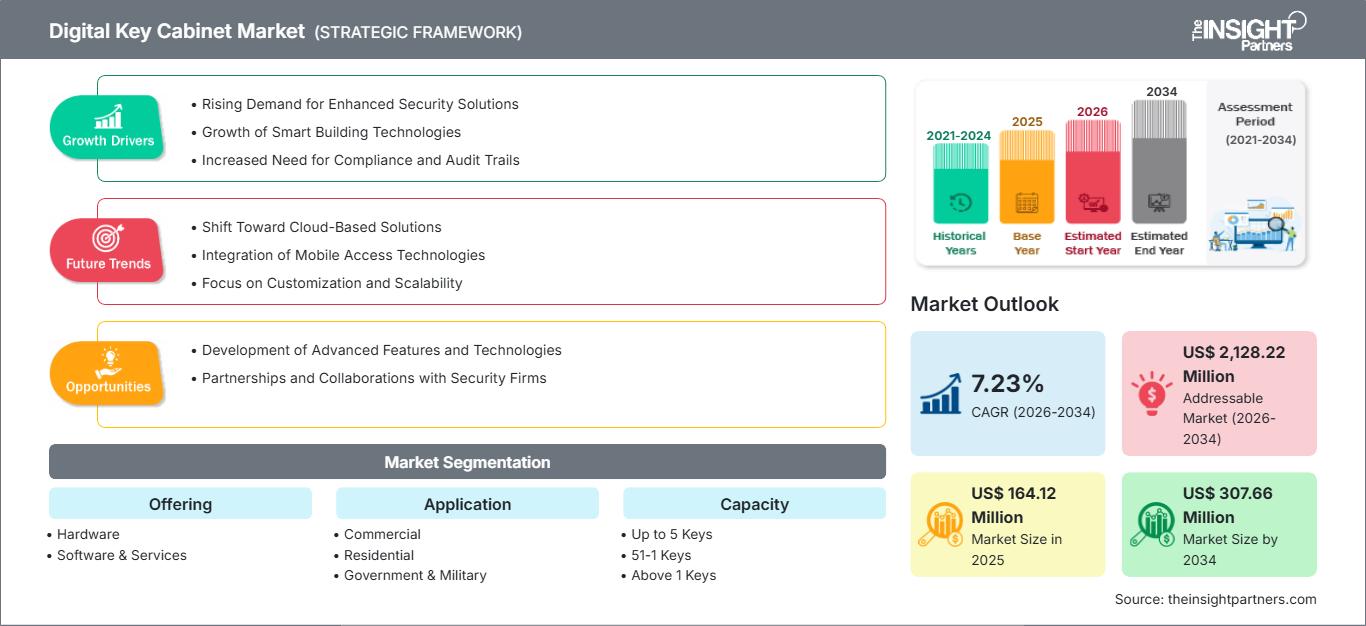
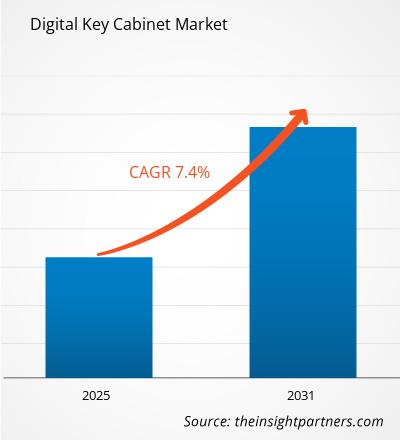
The Digital Key Cabinet Market is forecasted at US$ 164.12 Million in 2025 and is anticipated to reach US$ 307.66 Million in 2034 with a CAGR of 7.23% from 2026-2034. Growth will be driven by controlled custody of physical keys, auditing capabilities, RFID technology, biometric authentication, networking of cabinets and software based reports in commercial buildings, residential places, transportation centers, public places, and military installations.
In North America, the Digital Key Cabinet Market size is forecasted to grow at a CAGR of 6.7-7.4% due to less dependency on manual key logs in property management firms, fleet management firms, hospitals, and agencies. Growth will be driven by cloud-based management systems, audit requirements through insurance companies, multi-site facility operations, and increased adoption of access control systems integrated cabinets.
Digital Key Cabinet Market Assessment and Insights
- North America: The region holds 32–36% share in 2025 and is forecast to grow at a CAGR of 6.7–7.4% during 2026–2034, supported by commercial security upgrades, fleet control, and campus-wide audit compliance.
- US: The country represents 78–82% of North America in 2025 and is projected to grow at a CAGR of 6.8–7.5% during 2026–2034.
- Europe: Europe accounts for 25–29% share in 2025 and is expected to grow at a CAGR of 6.4–7.1% during 2026–2034, led by Germany, the UK, France, Italy, and Spain.
- Asia Pacific: Asia Pacific represents 27–31% share in 2025 and is forecast to grow at a CAGR of 7.8–8.6% during 2026–2034, with China, Japan, South Korea, India, and Australia driving adoption.
- Largest Segment: Hardware holds 56–60% market share in 2025 and is expected to grow at a CAGR of 6.8–7.5% during 2026–2034.
- High Growth Segment: Software & Services holds 40–44% market share in 2025 and is expected to grow at a CAGR of 8.1–8.9% during 2026–2034.
- Key companies analyzed in detail: ASSA ABLOY AB; Carrier Global Corporation; Godrej & Boyce Manufacturing Company Limited; Beijing Landwell Electron Technology Co., Ltd.; KeyGuard UAB; Morse Watchmans Inc.; Creone AB; deister electronic GmbH; Securikey Limited; LOTO Safety Requisites Trading LLC.
Source: The Insight Partners' analysis based on proprietary research, government publications, company annual reports, investor presentations, industry databases, and expert interviews.
The electronic key storage process is evolving from locking boards and manual logs to cabinet solutions that validate users, lock keys, and track all transactions. Hardware continues to be the purchasing foundation as the security of cabinet construction, locking of the key location, resistance to tampering, and power backup make up the system’s reliability. The software aspect is gaining importance as customers are seeking dashboard monitoring, notifications, exception reports, and connectivity with building security systems.
Future trends would be affected by intelligent buildings, facility outsourcing, and the involvement of the government sector. The new locations would consist of hotels, logistics facilities, hospitals, tall residential buildings, and municipality installations where control is critical. Investments would be made in cloud-based software, QR and RFID tagging, biometric authentication, and cabinets for both single buildings and large fleets.
Digital Key Cabinet Market Report Scope
| Report Attribute | Details |
|---|---|
| Market size in 2025 | US$ 164.12 Million |
| Market Size by 2034 | US$ 307.66 Million |
| Global CAGR (2026 - 2034) | 7.23% |
| Historical Data | 2021-2024 |
| Forecast period | 2026-2034 |
Digital Key Cabinet Market Analysis
Needs arise from those settings where key loss creates disturbances, risks of safety and non-compliance. Digital Key Cabinet Market growth is most notable in commercial office buildings, the hospitality industry, healthcare institutions, transport, automotive dealerships, utilities and governmental facilities where access logs are needed along with time stamps and limited key access.
The players in the value chain of this market include makers of metal cabinets, manufacturers of the locking mechanism, manufacturers of RFID and bar code technology, biometric hardware manufacturers, software developers, system integration specialists, distribution companies and security consultancy firms. The supplier power lies with those suppliers whose cabinets are strong, manageable, provide security benefits and support service.
The competitive environment comprises international access control providers along with specialists of key management solutions. Analysis of the Digital Key Cabinet Market report such competitors as ASSA ABLOY AB, Carrier Global Corporation, Morse Watchmans Inc., Creone AB, deister electronic GmbH, and Beijing Landwell Electron Technology Co., Ltd.
Trends in investments include recurring income from software sales, remote diagnostics, mobility of management, and packaging. Positioning has become more focused on channel partnerships, stocking of product by region, and demonstration of how the cabinet helps in reducing losses, time and cost of investigations for customers without giving up the mechanical keys.
● REPORT CUSTOMIZATION
Tailor This Report To Align With Your Specific Business Requirements
This report can be customized to align precisely with your business objectives, scope, and target markets. Customization options include tailored segmentation, geography, competitive analysis, and strategic insights to support informed decision-making.
Customize This Report →WHAT YOU CAN ADJUST
- ● Segmentations
- ● Geography
- ● Competitive Analysis
- ● Language Preferences
Digital Key Cabinet Market: Strategic Insights
Regional Insights
North America Digital Key Cabinet Market
North America holds 32–36% share in 2025 and is projected to grow at a CAGR of 6.7–7.4% during 2026–2034. Digital Key Cabinet Market share is supported by commercial real estate modernization, vehicle fleet accountability, campus security, healthcare access control, and public agency audit requirements.
Requirements for demand include networks that are compatible with access control systems, employee lists, and property management processes. In terms of regions, buyers consider service availability, cyber-secure administration, and scalability of key roles. The major providers of this product are ASSA ABLOY AB, Carrier Global Corporation, Morse Watchmans Inc., KeyGuard UAB, and Securikey Limited.
U.S. Digital Key Cabinet Market
The US accounts for 78–82% of North America in 2025 and is forecast to grow at a CAGR of 6.8–7.5% during 2026–2034. Application trends include multifamily housing, automotive dealerships, K–12 facilities, airports, hospitals, utilities, police departments, and enterprise campuses.
Company presence is strong through domestic specialists and global brands. Morse Watchmans Inc. promotes KeyWatcher Touch, Carrier Global Corporation supports access-control ecosystems, and ASSA ABLOY AB operates through Traka and related platforms. Buyers prioritize audit trails, emergency key access, user permissions, and integration with existing security operations.
Europe Digital Key Cabinet Market
The region accounts for the market share of 25–29% in 2025 and will grow at the CAGR of 6.4–7.1% between 2026 and 2034. Germany holds the lead through its industrial sites, logistics, municipal properties, and automotive infrastructure. The UK boosts demand through property management, education, healthcare, and secure commercial estates.
France, Italy, and Spain are contributing through hotels, public properties, transport operators, and residential developments following controlled key workflows. Procurement is influenced by data protection, building security requirements, and facility outsourcing practices. ASSA ABLOY AB, Creone AB, deister electronic GmbH, Securikey Limited, and KeyGuard UAB have regional product portfolio presence.
APAC Digital Key Cabinet Market
APAC holds a market share of 27-31% in 2025 and is anticipated to register a CAGR of 7.8-8.6% in the period of 2026-2034. China leads the market and is driven by smart buildings, industrial parks, logistics centers, residential developments, and public safety initiatives.
Other countries include Japan, South Korea, India, and Australia due to increased demand from hotel, education, government institutions, fleet yards, and healthcare systems. Policies on digital infrastructure and safe public places encourage market penetration. The key companies like Beijing Landwell Electron Technology Co., Ltd. and Godrej & Boyce Manufacturing Company Limited get regional growth opportunities.
Middle East & Africa Digital Key Cabinet Market
Growth for the Middle East & Africa region is forecasted at a CAGR of 5.9 to 6.7%. Saudi Arabia stands out due to the need for auditable key control for energy assets, airports, hospitality, government buildings, and industrial areas.
The UAE creates demand through smart city initiatives, hotels, logistics operations, and security-conscious installations, whereas South Africa and Rest of MEA use cabinets for applications in mining, utility operations, and infrastructure. Buyers look for durable cabinets, local service, multilingual software, and access history for investigation.
Segmentation Analysis
Offering
The Offering segment is projected to grow at a CAGR of 7.2–7.9% during 2026–2034. Digital Key Cabinet Market scope includes physical cabinets, locking modules, key tags, control boards, embedded firmware, cloud software, installation, maintenance, and integration services. Buyers increasingly evaluate total lifecycle value rather than cabinet price alone.
- Hardware remains the largest offering because cabinets, key receptors, locks, power backup, and touchscreens determine durability, tamper resistance, capacity planning, and basic access reliability.
- Software & Services are expanding as customers require remote administration, audit reporting, user provisioning, alerts, integrations, training, maintenance contracts, and support for multi-location deployments.
Application
The Application segment is estimated to grow at a CAGR of 7.0–7.8% during 2026–2034. Commercial demand dominates because offices, hotels, dealerships, hospitals, warehouses, and campuses manage frequent key handovers. Residential and government users add growth where accountability, emergency access, and contractor tracking are operational priorities.
- Commercial users deploy cabinets to control facility, vehicle, storage, and restricted-area keys while improving shift accountability, reducing missing-key incidents, and accelerating investigations.
- Residential adoption is rising in multifamily, student housing, senior living, and serviced apartments where property teams need secure maintenance access without informal key handoffs.
- Government & Military applications prioritize controlled access, chain-of-custody records, emergency retrieval, and role-based permissions for sensitive buildings, fleets, armories, and infrastructure assets.
Capacity
The Capacity segment is projected to grow at a CAGR of 7.1–7.8% during 2026–2034. Smaller cabinets serve single-site operations, while mid-size and large systems support fleet, campus, and government users. Capacity selection depends on present key volume, expected asset growth, redundancy needs, and whether cabinets must network across locations.
- Up to 50 Keys cabinets fit small offices, retail stores, residential leasing teams, and branch facilities requiring basic accountability with compact installation footprints.
- 51-100 Keys systems suit mid-sized properties, dealerships, schools, and healthcare departments where multiple user groups and higher checkout frequency require stronger administration.
- Above 100 Keys cabinets support campuses, fleets, airports, military sites, and enterprise locations requiring scalable key positions, permissions, reporting, and integration.
Opportunity Snapshot
| Application | Revenue Contribution | Trend Tag | Adoption Stage |
| Commercial | High | Facility Audit | Mature |
| Residential | Medium | Property Access | Scaling |
| Government & Military | Medium | Secure Custody | Scaling |
Digital Key Cabinet Market Growth Drivers and Impact Analysis
Rising Need for Auditable Physical Key Control
Even though cards and mobile technology can be used for entry, organizations still make use of mechanical keys for equipment rooms, cars, houses, utilities, and secure areas. Manual records are hard to check, and lost keys may lead to the installation of new locks, system downtime, or risk exposure. The digital cabinets ensure accountability of custody by connecting each key removal and reinsertion with the authorized user, the time stamp, and the slot where the key was placed. The largest market impact will be seen in places where the organization operates around the clock, utilizes contractors, or deals with regulated areas.
Growth of Smart Buildings and Integrated Security Platforms
Security operations in facilities are integrating video surveillance, access control, visitor management, and asset tracking. It is a positive situation for the market as the cabinets will be able to exchange user information, generate alarms, and create reports in such systems. Integration will save time on duplicated work and help managers keep a coherent policy of permissions regarding doors, keys, and equipment. It will be more efficient in commercial facilities, campuses, hotels, and hospitals to issue keys only to authorized personnel and spot any discrepancies instantly.
Operational Pressure in Fleet, Hospitality, and Public Facilities
Organizations with high key turnover require coordination challenges on a day-to-day basis in situations where employees, contractors, drivers, guards, or maintenance crews operate assets jointly. Vehicle fleets must know who had which keys, hotels must have rapid room and service access, and publicly owned facilities require emergency key retrieval without loss of control. Digital key cabinets help decrease queue times, avoid key removal by unauthorized personnel, and conduct shift changes with clear visibility. The result will be increased efficiency of the use of vehicles and space, decreased cost of replacements, and faster responses to incidents.
Digital Key Cabinet Market Future Trends
Cloud Administration and AI-Assisted Exception Monitoring
Digital Key Cabinet Market trends are moving toward cloud dashboards that identify abnormal checkout patterns, overdue returns, unauthorized attempts, and repeated exception events across sites. AI-assisted monitoring will not replace access rules, but it can help security teams prioritize investigations and adjust permissions. Future systems will combine cabinet telemetry, user behavior, mobile alerts, and audit analytics to reduce manual review. Vendors able to offer explainable alerts, secure hosting, and configurable escalation paths can increase software value while supporting customers that manage hundreds of keys across distributed properties.
Hybrid Credentialing for Keys, Assets, and Mobile Users
Future cabinets will increasingly manage more than keys by combining key fobs, equipment lockers, QR identifiers, mobile credentials, and biometric verification. This hybrid approach reflects how facilities operate, with staff moving between vehicles, rooms, tools, and restricted equipment. Vendors will design modular platforms that let customers start with key control and expand into asset custody without replacing the core system. The trend favors flexible software licensing, interoperable identity databases, and cabinet designs that support mixed storage formats for commercial, residential, and government users.
Digital Key Cabinet Market Opportunities
Multifamily and Student Housing Key Modernization
Digital Key Cabinet Market Forecasts point to multifamily and student housing as a practical investment opportunity because managers still handle maintenance keys, master keys, vacant-unit access, and contractor visits. Vendors can package mid-capacity cabinets, mobile administration, QR-tagged keys, and leasing-office workflows for property groups seeking rapid deployment. Partnerships with property technology installers can reduce sales friction and improve service coverage. The strongest value proposition is not only security, but also fewer emergency lock changes, faster maintenance dispatch, and clearer accountability when residents report access incidents.
Managed Services for Distributed Commercial Sites
Retail chains, service depots, clinics, and regional offices need consistent key policies but often lack specialist security staff at every location. This creates an opportunity for managed services covering cabinet monitoring, user provisioning, reporting, maintenance, and periodic audit support. Manufacturers and integrators can convert one-time hardware sales into recurring revenue by offering standardized service tiers. Customers benefit from predictable operating costs and faster troubleshooting, while vendors gain longer account relationships. Success depends on cyber-secure remote access, clear service-level commitments, and channel partners capable of onsite support.
Recent Developments
- February 2026: Traka launched the Traka Touch Core electronic key cabinet, expanding access to professional-grade key management solutions for small and mid-sized organizations and multi-site operations. The compact, standalone system provides secure access control, automated key tracking, and tamper-proof audit trails for up to 20 keys using Traka’s iFob technology. Designed for easy deployment without complex IT integration, Touch Core helps organizations improve accountability, reduce key-related risks, and enhance operational efficiency, while offering upgrade options for network connectivity, centralized management, and access control integrations as business needs grow.
- June 2024: Traka, an ASSA ABLOY company, received the prestigious 2024 Red Dot Award for Product Design for its Traka Touch Pro series of intelligent electronic key management cabinets. The award recognized the product’s innovative design, combining enhanced security, modularity, sustainability, and user-friendly operation. The Touch Pro series features a modern cabinet design with improved storage capacity, flexible installation options, durable construction, touchscreen-based access control, and electronic auditing capabilities for managing keys and access assets. The recognition strengthens Traka’s position in the market by highlighting advancements in secure asset management, operational accountability, and smart access control solutions.
- October 2023: Traka, an ASSA ABLOY company, launched the Traka LT electronic key management cabinet with the Traka GO mobile app, introducing a cost-effective smart key control solution for residential property management. Designed for multi-family communities, the system enables secure storage, controlled access, and real-time tracking of shared keys through mobile credentials, QR/NFC key identification, and digital audit trails. The solution allows property managers to monitor key usage, manage permissions, receive notifications for overdue returns, and improve accountability while reducing risks associated with lost or unmanaged physical keys. The launch expands Traka’s presence in the market by bringing intelligent key management capabilities to residential applications with a more accessible and mobile-first approach.
Frequently Asked Questions

- Comprehensive Market Sizing and Forecast Analysis
- Detailed Segmentation Analysis
- In-Depth Market Dynamics Assessment
- Regional and Country-Level Insights
- Competitive Landscape and Company Benchmarking
- Strategic Business Intelligence
Recent Reports
Testimonials

The Insight Partners' SCADA System Market report is comprehensive, with valuable insights on current trends and future forecasts. The team was highly professional, responsive, and supportive throughout. We are very satisfied and highly recommend their services.
RAN KEDEM Partner, Reali Technologies LTDs
I requested a report on a very specific software market and the team produced the report in a few days. The information was very relevant and well presented. I then requested some changes and additions to the report. The team was again very responsive and I got the final report in less than a week.
JEAN-HERVE JENN Chairman, Future Analytica
We worked with The Insight Partners for an important market study and forecast. They gave us clear insights into opportunities and risks, which helped shape our plans. Their research was easy to use and based on solid data. It helped us make smart, confident decisions. We highly recommend them.
PIYUSH NAGPAL Sr. Vice President, High Beam Global
The Insight Partners delivered insightful, well-structured market research with strong domain expertise. Their team was professional and responsive throughout. The user-friendly website made accessing industry reports seamless. We highly recommend them for reliable, high-quality research services
YUKIHIKO ADACHI CEO, Deep Blue, LLC.
This is the first time I have purchased a market report from The Insight Partners.While I was unsure at first, I visited their web site and felt more comfortable to take the risk and purchase a market report.I am completely satisfied with the quality of the report and customer service. I had several questions and comments with the initial report, but after a couple of dialogs over email with their analyst I believe I have a report that I can use as input to our strategic planning process.Thank you so much for taking the extra time and making this a positive experience.I will definitely recommend your service to others and you will be my first call when we need further market data.
JOHN SUZUKI President and Chief Executive Officer, Board Director, BK Technologies
I wish to appreciate your support and the professionalism you displayed in the course of attending to my request for information regarding to infectious disease IVD market in Nigeria. I appreciate your patience, your guidance, and the fact that you were willing to offer a discount, which eventually made it possible for us to close a deal. I look forward to engaging The Insight Partners in the future, all thanks to the impression you have created in me as a result of this first encounter.
DR CHIJIOKE ONYIA MANAGING DIRECTOR, PineCrest Healthcare Ltd.Reason to Buy
- Informed Decision-Making
- Understanding Market Dynamics
- Competitive Analysis
- Identifying Emerging Markets
- Customer Insights
- Market Forecasts
- Risk Mitigation
- Boosting Operational Efficiency
- Strategic Planning
- Investment Justification
- Tracking Industry Innovations
- Aligning with Regulatory Trends





 Get Free Sample for