
Digital Pen Market Size, Share, Demand & Growth Opportunities by 2034
Coverage: By Platform (Android, iOS, and Windows); Technology (Electro Magnetic Resonance (EMR) Technology, Active ElectroStatic (AES) Technology, DuoSense Technology, and Bluetooth); Compatible Devices (Tablets, Smartphones, and PC/Laptops) End-User (Digital Learning, Creative Art & Design, Photo, Video and Music Editing, and Gesture Recognition & Communication), and Geography (North America, Europe, Asia Pacific, and South and Central America)
- Status : Data Released
- Report Code : TIPRE00003451
- Category : Electronics and Semiconductor
- No. of Pages : 150
- Available Report Formats :


- Last update date : August 05, 2026


2025 Market Size
US$ 4,034.53 Mn
Base year value
2034 Forecast
US$ 9,813.45 Mn
Projected by 2034
CAGR 2026-2034
10.38 %
Growth rate
Addressable Market
US$ 61,448.86 Mn
(2026-2034)
The Digital Pen Market size was anticipated to achieve US$ 4,034.53 million in 2025 and further is expected to reach up to US$ 9,813.45 million by 2034 growing at a CAGR of 8.13% during 2026-2034 due to factors such as demand for stylus enabled tablets, 2-in-1s, digitized learning, clinical documentation, workflow, creative and paperless process in enterprises requiring handwriting capture, latency, and compatibility with devices.
North America continues to be a structurally significant market for demand generation through device lifecycle management in enterprises, investment in digital education initiatives, and clinical mobility programs. Growth in the regional Digital Pen Market is expected to record at a CAGR of 7.6-8.2% during 2026-2034 driven by increasing adoption of active styluses in tablets, Windows convertibles, and healthcare documentation systems.
Digital Pen Market Assessment and Insights
- North America accounted for 34–36% Digital Pen Market share in 2025 and is projected to grow at a 7.6–8.2% CAGR between 2026–2034, led by hybrid work, school tablet fleets, and healthcare documentation demand.
- US represented 78–82% of North America in 2025 and is expected to grow at a 7.7–8.3% CAGR between 2026–2034, supported by premium device ecosystems.
- Europe held 24–26% share in 2025 and is forecast to post a 7.1–7.8% CAGR between 2026–2034, with Germany, the UK, and France leading enterprise and education uptake.
- Asia Pacific captured 27–29% share in 2025 and is projected to grow at an 8.8–9.6% CAGR between 2026–2034, driven by China, Japan, South Korea, India, and Australia.
- Largest Segment Handwriting held 68–72% market share in 2025 and is expected to grow at an 8.0–8.6% CAGR during 2026–2034, reflecting mainstream note-taking and annotation use.
- High Growth Segment Active type held 60–64% market share in 2025 and is forecast to expand at an 8.9–9.7% CAGR during 2026–2034, due to pressure sensitivity and palm rejection.
- Key companies analyzed in detail: Adonit Co., Ltd.; Apple Inc.; Dell Technologies Inc.; HP Inc.; Lenovo Group Limited; Microsoft Corporation; Samsung Electronics Co., Ltd.; STAEDTLER Mars GmbH & Co. KG; Wacom Co., Ltd.; XPPen Technology Co.
Source: The Insight Partners' analysis based on proprietary research, government publications, company annual reports, investor presentations, industry databases, and expert interviews.
The process of technology migration is taking the digital pen from basic capacitive pen accessories to an active input tool having tilt detection, pressure levels, wireless charging, and handwriting to text workflow. Production dynamics have changed in that OEMs now coordinate their pen controllers, display digitizer, replacement tips, and included software. The market is increasingly becoming less about accessories and more about platforms, with value placed on precision, latency, interoperability, and workflow.
The trend of procurement during the forecast period will widen in sectors like education, healthcare, design, engineering, and field services. Geographical areas not covered before will have cheaper Android tablets, educational digital programs, and local eCommerce sites. Regulations in favor of electronic documentation, accessibility, and paperless management will increase use of the product, and component standardization might make replacement cheaper for enterprises.
Digital Pen Market Report Scope
| Report Attribute | Details |
|---|---|
| Market size in 2025 | US$ 4,034.53 Million |
| Market Size by 2034 | US$ 9,813.45 Million |
| Global CAGR (2026 - 2034) | 10.38% |
| Historical Data | 2021-2024 |
| Forecast period | 2026-2034 |
Digital Pen Market Analysis
Digital Pen Market Growth Drivers are Education Digitization, Record Capturing in Health Care, Creative Content Creation, and Annotations in Enterprises. User behavior has developed resilience because people are now expecting smooth handwriting, pairing, and synchronization from their tablets, PC’s, and smartphones.
Market participants include display panel manufacturers, sensor providers, pen tip material producers, devices OEMs, OS owners, software platforms, distributors, and institutionals. Market supply relies on controllers, battery quality, Bluetooth functionality, and firmware updates, giving vertical integration an edge for premium products.
As per the analysis of the Digital Pen Market, there is a competitive industry that is segmented into ecosystem providers and specialized pen manufacturers. Apple Inc., Microsoft Corporation, Samsung Electronics Co., Ltd., Lenovo Group Limited, Dell Technologies Inc., and HP Inc. emphasize bundling and software continuum, while Wacom Co., Ltd., Adonit Co., Ltd., STAEDTLER Mars GmbH & Co. KG, and XPPen Technology Co. target precise professionals.
There is an increase in investment in the area of low latency chipset technology, rechargeable pens, nib program replaceable pens, classroom kits, and professional creativity kits. Positioning strategy now requires compatibility, application development, channel distribution, and post-sale accessories, as consumables add to revenues post-device purchase.
● REPORT CUSTOMIZATION
Tailor This Report To Align With Your Specific Business Requirements
This report can be customized to align precisely with your business objectives, scope, and target markets. Customization options include tailored segmentation, geography, competitive analysis, and strategic insights to support informed decision-making.
Customize This Report →WHAT YOU CAN ADJUST
- ● Segmentations
- ● Geography
- ● Competitive Analysis
- ● Language Preferences
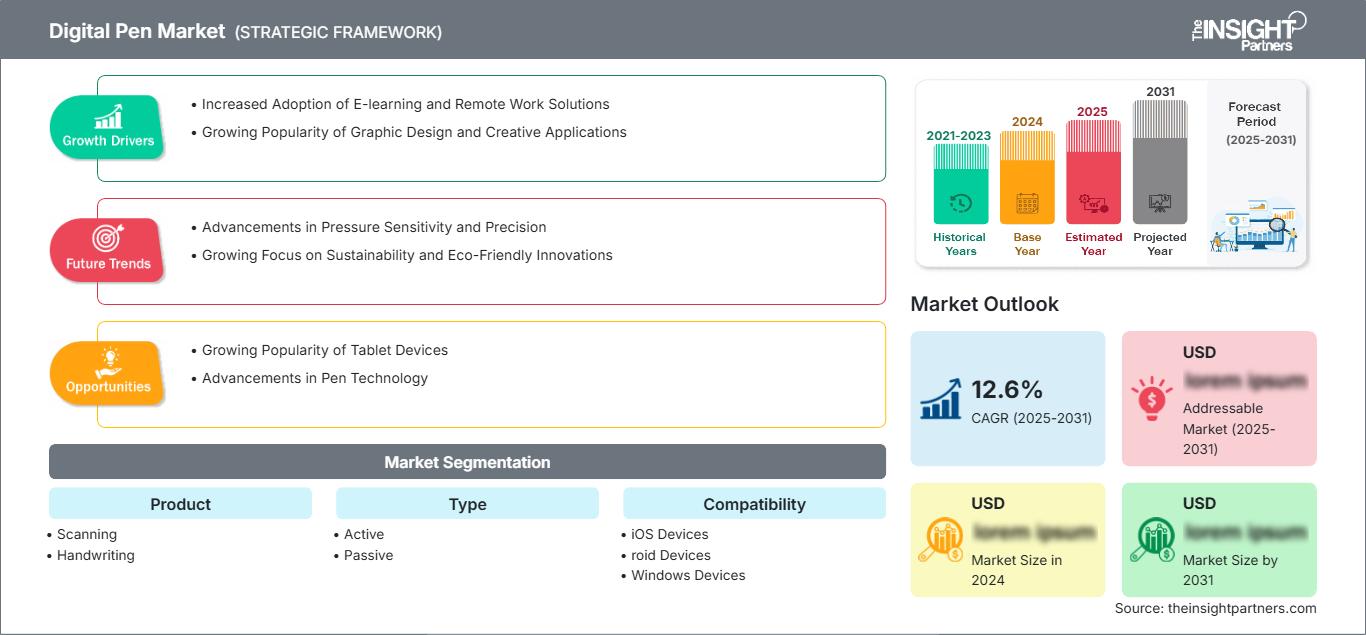
Digital Pen Market: Strategic Insights
Regional Insights
North America Digital Pen Market
The North American region had a market share of 34-36% in the Digital Pen Market in 2025 and will witness growth at a rate of 7.6–8.2% CAGR. School tablet renewal cycles, digital documentation practices in health care, and Windows convertible usage drive the premium stylus market.
Compatibility, security, and lifecycle cost are the key drivers that make the use of active branded pens favorable among regional consumers. Digital ink is being used by universities, hospitals, architectural studios, and work-from-home employees for various purposes.
U.S. Digital Pen Market
The US accounted for 78-82% of North America in 2025, and its growth rate is expected to be between 7.7% and 8.3% CAGR. The major markets for demand are iOS, Windows, and Android environments with wide application in education, health care, design, legal documentation, and productivity applications for executives.
The firms in the market are wide-ranging, including Apple Inc., Microsoft Corporation, Dell Technologies Inc., HP Inc., Samsung Electronics Co., Ltd., Lenovo Group Limited, Wacom Co., Ltd., and Adonit Co., Ltd. Applications include annotation, drawing, signature, lesson planning, and clinical notes taking.
Europe Digital Pen Market
Europe accounted for 24–26% share in 2025 and is projected to grow at a 7.1–7.8% CAGR. Germany is the leading country, supported by industrial design, engineering, vocational education, and medical documentation use cases.
The UK benefits from higher education technology spending and hybrid workplace adoption, while France shows steady demand in creative education and public administration digitization. Italy and Spain are expanding through small business tablet use, digital signatures, and design applications, especially where cost-effective active pens improve workflow precision.
APAC Digital Pen Market
APAC's share was estimated at 27-29%, and the region will grow at a CAGR of 8.8-9.6%, becoming the fastest growing region in the market. Device manufacturing capabilities in China lead the way, whereas premium pen-enabled devices are developed in Japan and South Korea.
Demand from India and Australia is generated by the use of educational technology, e-government initiatives, and professional tablets. Digital classrooms, local electronics manufacturing, and healthcare digitalization are creating new opportunities.
Middle East & Africa Digital Pen Market
Middle East & Africa is projected to grow at a 7.4–8.1% CAGR, led by the UAE, Saudi Arabia, and South Africa. Smart education, healthcare modernization, and public sector digital services are supporting early-stage adoption.
Energy, infrastructure, and construction projects create demand for field annotation, inspection forms, and design review on tablets. Rest of MEA remains price-sensitive, but institutional procurement and cloud documentation are gradually improving penetration.
Segmentation Analysis
Platform
The platform segment is projected to grow at a CAGR of 7.8–8.6% during 2026–2034, driven by cross-platform compatibility and increasing integration with operating systems. The Digital Pen Market scope across platforms continues to expand as manufacturers focus on seamless interoperability and user experience enhancements.
- Android: Widely adopted due to large device ecosystem and affordability, supporting mass-market penetration and enabling stylus usage across smartphones and tablets with diverse application support.
- iOS: Premium segment with strong ecosystem integration, offering advanced stylus features and optimized performance for creative and professional applications.
- Windows: Dominant in enterprise and productivity applications, enabling seamless integration with business tools and digital documentation workflows.
Technology
The technology segment is expected to grow at a CAGR of 8.2–9.0% driven by continuous advancements in precision and responsiveness. Increasing adoption of advanced technologies enhances performance and user experience across applications.
- Electro Magnetic Resonance (EMR) Technology: Provides high precision and battery-free operation, making it ideal for professional and creative applications requiring accuracy.
- Active ElectroStatic (AES) Technology: Offers compatibility with multiple devices and improved pressure sensitivity, supporting widespread adoption in consumer electronics.
- DuoSense Technology: Combines multiple sensing mechanisms to enhance accuracy and responsiveness, catering to advanced user requirements.
- Bluetooth: Enables wireless connectivity and additional functionalities such as gesture control and remote operation.
Compatible Devices
The compatible devices segment is projected to grow at a CAGR of 8.0–8.8% driven by increasing penetration of stylus-enabled hardware. Device manufacturers continue to integrate stylus support to enhance user experience.
- Tablets: Largest segment due to widespread adoption in education and creative industries, offering optimal screen size and performance for stylus usage.
- Smartphones: Growing adoption driven by premium device features and increasing demand for productivity tools.
- PC/Laptops: Strong demand in enterprise and professional applications, supporting digital documentation and design workflows.
End-User
The end-user segment is expected to grow at a CAGR of 8.5–9.3% driven by diverse application areas and increasing digitalization. Expanding use cases across industries support steady growth.
- Digital Learning: High adoption in education sector, enabling interactive and paperless learning environments.
- Creative Art & Design: Fastest-growing segment driven by increasing demand for digital content creation tools.
- Photo, Video and Music Editing: Supports precision editing and enhances productivity for creative professionals.
- Gesture Recognition & Communication: Emerging applications leveraging stylus input for advanced interaction and communication.
Opportunity Snapshot
| End Users | Revenue Contribution | Trend Tag | Adoption Stage | ||
| Digital Learning | High | EdTech Growth | Mature | ||
| Creative Art & Design | High | Content Boom | Scaling | ||
| Photo, Video and Music Editing | Medium | Pro Editing | Scaling | ||
| Gesture Recognition & Communication | Low | Gesture AI | Emerging |
Digital Pen Market Growth Drivers and Impact Analysis
Rising Pen-Enabled Device Installed Base
Tablets with styluses, 2-in-1 systems, and high-end handsets are expanding the potential user base for digital pens. In particular, device vendors now see the value in emphasizing pen functionality as a productivity benefit, not a specialty feature, helping to drive bundling and replace cycles. The effect can be seen in educational deployments, enterprise collaboration, and creative processes, where pen-driven annotation, sketching, and signatures eliminate the need for paper. Aging devices offer a stream of replacements for pens, nibs, chargers, and updates.
Paperless Workflows in Regulated Sectors
In healthcare, legal, banking, insurance, and public sector businesses, digital ink usage is rising in order to capture signatures, annotations, and fill forms in secure systems. The reason is that digital pens can be auditable since handwritten input can be correlated with timestamps, user identity, and document history. The largest effect on the market is seen when compliance teams look for quick approvals without giving up their handwriting practices.
Growth of Digital Learning and Creative Production
Digital pens are used by schools, universities, design studios, individuals and even online tutors in combining their handwritten notes, diagrams and illustrations with screen sharing. However, it is not only the penetration of devices that drives the process but also how software works, since learning management systems, note taking applications and collaboration tools are more and more supporting the use of digital ink. It results in better involvement and provides practical grounds for purchasing more efficient pens.
Digital Pen Market Future Trends
AI-Assisted Handwriting and Workflow Automation
Digital Pen Market trends will gradually evolve to focus on AI-enabled capture of handwriting transformed into organized notes, tasks, forms, and searchable documents. In the future, pens with accompanying software will not only focus on transcribing but also make context-based suggestions, generate summary notes of meetings, clean up drawings, and automatically route documents. The result will be increased switching costs of users who are integrated into a particular ecosystem as well as an increase in the significance of software collaborations.
Sustainable Materials and Modular Accessory Design
Environmental criteria are expected to influence procurement as schools, public agencies, and enterprises examine accessory lifecycles. Manufacturers are likely to expand replaceable tips, rechargeable batteries, recycled packaging, and repair-oriented designs that reduce waste. Modular accessories can also improve total cost of ownership because institutions can replace nibs, batteries, or charging parts without discarding the full pen. This trend may favor brands with transparent materials sourcing, long support windows, and standardized consumable programs.
Digital Pen Market Opportunities
Institutional Bundles for Education and Healthcare
Digital Pen Market Forecasts indicate attractive opportunities in institution-specific bundles that combine devices, pens, charging, replacement tips, management software, and service support. Education buyers need durable classroom kits, while hospitals require secure documentation workflows and cleanable accessories. Vendors can improve win rates by offering predictable replacement cycles, training, device management, and multi-year pricing. The opportunity is action-oriented because procurement teams often prefer complete solutions that reduce integration risk and simplify support across large user groups. Additionally, centralized deployment capabilities, inventory tracking, and remote software updates can help institutions maintain consistent performance while reducing administrative workload. Educational institutions also value solutions that integrate seamlessly with learning management systems, enabling teachers to distribute and evaluate digital assignments efficiently. Healthcare providers, meanwhile, prioritize compliance with data security regulations, reliable synchronization with electronic health record systems, and accessories designed for frequent sanitization. Comprehensive after-sales support, user onboarding sessions, and dedicated technical assistance can strengthen customer confidence, encourage long-term contracts, and create recurring revenue opportunities through maintenance, upgrades, and replacement programs.
Cross-Platform Pens for Emerging Markets
Emerging markets present opportunities for affordable pens that work across Android tablets, Windows laptops, and selected smartphones. Buyers in India, Southeast Asia, Africa, and Latin America often manage mixed device fleets, so broad compatibility can matter more than premium ecosystem lock-in. Vendors can invest in regional distribution, localized app partnerships, and replacement-tip availability to strengthen adoption. Pricing discipline, warranty clarity, and education-focused channel programs will be essential to convert interest into repeatable institutional and consumer demand. Growing investments in digital education initiatives, remote learning, and small business digitization are also increasing the need for reliable and cost-effective input devices. Manufacturers that provide multilingual user interfaces, localized customer support, and easy access to spare parts can improve customer satisfaction and strengthen brand loyalty. Collaboration with local distributors, educational organizations, and technology resellers can further expand market reach while addressing regional purchasing preferences. Flexible pricing models, promotional bundles, and financing options may also encourage adoption among budget-conscious institutions, professionals, and first-time consumers seeking dependable digital writing solutions.
Recent Developments
- May 2026: Wacom introduced the Art Pen 2, a next-generation digital stylus featuring 360-degree barrel rotation, 8,192 pressure sensitivity levels, and tilt support for enhanced artistic precision. The pen also includes new interchangeable nib options and compatibility with select Wacom pen displays and tablets, expanding creative capabilities for digital artists and design professionals.
- September 2025: Montblanc introduced the Digital Paper and Digital Pen, expanding into premium digital writing solutions. The e-ink notebook features a paper-like display for notetaking, sketching, and document annotation, while the digital pen offers interchangeable tips for varied writing textures. The ecosystem also supports cloud synchronization, targeting professionals and creative users seeking a luxury digital writing experience.
- January 2025: Nuwa showcased its AI-powered smart ballpoint pen at CES 2025, featuring computer vision and motion sensors that digitize handwriting on any paper in real time. Compatible with standard D1 ink cartridges, the pen synchronizes handwritten notes with a companion app, enabling searchable digital records while preserving the experience of traditional handwriting.
Frequently Asked Questions

- Comprehensive Market Sizing and Forecast Analysis
- Detailed Segmentation Analysis
- In-Depth Market Dynamics Assessment
- Regional and Country-Level Insights
- Competitive Landscape and Company Benchmarking
- Strategic Business Intelligence
Recent Reports
Testimonials

The Insight Partners' SCADA System Market report is comprehensive, with valuable insights on current trends and future forecasts. The team was highly professional, responsive, and supportive throughout. We are very satisfied and highly recommend their services.
RAN KEDEM Partner, Reali Technologies LTDs
I requested a report on a very specific software market and the team produced the report in a few days. The information was very relevant and well presented. I then requested some changes and additions to the report. The team was again very responsive and I got the final report in less than a week.
JEAN-HERVE JENN Chairman, Future Analytica
We worked with The Insight Partners for an important market study and forecast. They gave us clear insights into opportunities and risks, which helped shape our plans. Their research was easy to use and based on solid data. It helped us make smart, confident decisions. We highly recommend them.
PIYUSH NAGPAL Sr. Vice President, High Beam Global
The Insight Partners delivered insightful, well-structured market research with strong domain expertise. Their team was professional and responsive throughout. The user-friendly website made accessing industry reports seamless. We highly recommend them for reliable, high-quality research services
YUKIHIKO ADACHI CEO, Deep Blue, LLC.
This is the first time I have purchased a market report from The Insight Partners.While I was unsure at first, I visited their web site and felt more comfortable to take the risk and purchase a market report.I am completely satisfied with the quality of the report and customer service. I had several questions and comments with the initial report, but after a couple of dialogs over email with their analyst I believe I have a report that I can use as input to our strategic planning process.Thank you so much for taking the extra time and making this a positive experience.I will definitely recommend your service to others and you will be my first call when we need further market data.
JOHN SUZUKI President and Chief Executive Officer, Board Director, BK Technologies
I wish to appreciate your support and the professionalism you displayed in the course of attending to my request for information regarding to infectious disease IVD market in Nigeria. I appreciate your patience, your guidance, and the fact that you were willing to offer a discount, which eventually made it possible for us to close a deal. I look forward to engaging The Insight Partners in the future, all thanks to the impression you have created in me as a result of this first encounter.
DR CHIJIOKE ONYIA MANAGING DIRECTOR, PineCrest Healthcare Ltd.Reason to Buy
- Informed Decision-Making
- Understanding Market Dynamics
- Competitive Analysis
- Identifying Emerging Markets
- Customer Insights
- Market Forecasts
- Risk Mitigation
- Boosting Operational Efficiency
- Strategic Planning
- Investment Justification
- Tracking Industry Innovations
- Aligning with Regulatory Trends





 Get Free Sample for