
Digital Signage Hardware Market Share, Growth & Forecast by 2034
Coverage: by Type (Displays, Media Players, Projectors, Others); Product (Video Wall, Standalone Display); Resolution (HD, 4K, 8K, Others); Vertical (Commercial, Infrastructural, Industrial, Institutional) , and Geography (North America, Europe, Asia Pacific, and South and Central America)
- Status : Data Released
- Report Code : TIPRE00011182
- Category : Electronics and Semiconductor
- No. of Pages : 150
- Available Report Formats :


- Last update date : August 10, 2026


2025 Market Size
US$ 21.99 Bn
Base year value
2034 Forecast
US$ 29.6 Bn
Projected by 2034
CAGR 2026-2034
3.36 %
Growth rate
Addressable Market
US$ 234.32 Bn
(2026-2034)
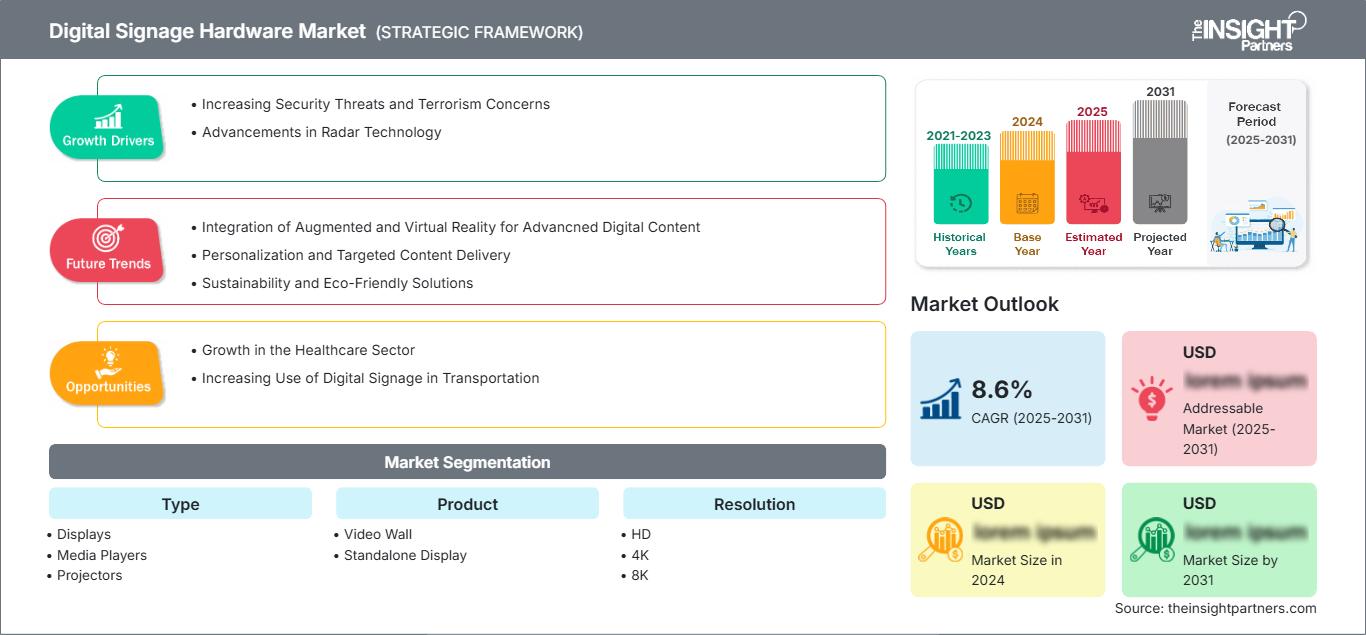
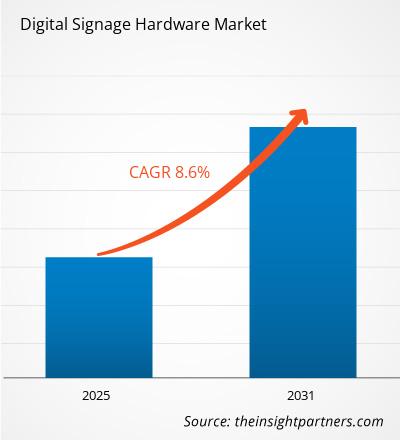
The global Digital Signage Hardware market was valued at US$ 21.99 billion in 2025 and is expected to reach US$ 29.6 billion by 2034; it is estimated to record a CAGR of 3.36% during 2026-2034.
Digital Signage Hardware Market Assessment and Insights
- North America: North America held a 32–35% share in 2025 and is growing at a 3.4–4.1% CAGR between 2026–2034, supported by retail media networks, airports, sports venues, and enterprise communication upgrades.
- US: The US represented 78–82% of North America in 2025 and is growing at a 3.5–4.2% CAGR between 2026–2034, led by retail, QSR, corporate, and transportation deployments.
- Europe: Europe accounted for a 24–27% share in 2025 and is growing at a 3.0–3.7% CAGR between 2026–2034, with the UK, Germany, France, Italy, and Spain leading installations.
- Asia Pacific: Asia Pacific held a 27–30% share in 2025 and is growing at a 4.4–5.2% CAGR between 2026–2034, driven by China, Japan, South Korea, India, and Australia.
- Largest Segment: Displays led with a 63–67% market share in 2025 and a 3.6–4.3% CAGR between 2026–2034, reflecting continued refresh of commercial LCD, LED, and OLED panels.
- High Growth Segment: 8K held a 6–9% market share in 2025 and is growing at a 7.2–8.6% CAGR between 2026–2034 as premium venues adopt ultra-high-resolution signage.
- Key companies analyzed in detail: Daktronics, Inc., BrightSign, LLC, Cisco Systems, Inc., Intel Corporation, Keywest Technology, Inc., LG Electronics Inc., Microsoft Corporation, Sharp Imaging and Information Company of America, Panasonic Holdings Corporation, and Samsung Electronics Co., Ltd.
Source: The Insight Partners' analysis based on proprietary research, government publications, company annual reports, investor presentations, industry databases, and expert interviews.
Commercial display technology is evolving from standalone screens to interconnected visual ecosystems using embedded processors, specialized media players, and network monitoring of devices. The Digital Signage Hardware Market is driven by slim bezels, direct view LED walls, brighter outdoor displays, 4K becoming mainstream, and the early use of 8K in premium environments. Manufacturing factors becoming more important are panel supply, semiconductor components, energy efficiency designs, ruggedized designs, and an integrator's capacity to scale up installations of equipment in multiple physical locations.
The demand will grow going forward on account of omnichannel retailing, smart city communications, transport infrastructure development, and workplace experience innovations. New markets will adopt outdoor LED screens, way-finding screens in airports, and shopping mall signs as cities develop more infrastructures. Regulatory tailwinds include accessibility, public safety, energy performance, and advertisement’s migration from unmeasurable traditional media to digital out-of-home network.
Digital Signage Hardware Market Report Scope
| Report Attribute | Details |
|---|---|
| Market size in 2025 | US$ 21.99 Billion |
| Market Size by 2034 | US$ 29.6 Billion |
| Global CAGR (2026 - 2034) | 3.36% |
| Historical Data | 2021-2024 |
| Forecast period | 2026-2034 |
Digital Signage Hardware Market Analysis
Drivers of growth within the Digital Signage Hardware Market are the shift of enterprises from static signs to programmable displays that can be used to communicate pricing, navigation, safety information, advertising, and operational information in real-time. Retailers and fast food restaurants favor menu boards and promotional displays, whereas transport hubs use high-brightness and on all the time displays. The market is positively affected if hardware can reduce downtime, reduce maintenance requirements, and work nonstop without any degradation of the displayed content.
Market participants comprise display manufacturers, media player manufactures, semiconductor suppliers, AV integration firms, network providers, cloud platforms, content management software solutions, and facility operators. Supply side considerations demonstrate the benefits of vendors that provide strong display panels, integrated computer processing capability, certified media play-back ability, device protection and diagnostics services. Industry insight provided by AVIXA focus on intelligent, environmentally friendly, and interactive display systems, whereas the recovery of IATA air traffic creates demand for passenger information and retail media in airports.
Competitiveness highlighted in the Digital Signage Hardware market report is characterized by based on panel technology, system on chip capabilities, system reliability, wide range of channels, and specific hardware solutions per verticals. Competition is provided by Samsung Electronics Co., Ltd. and LG Electronics Inc. via commercial displays and LED walls, and BrightSign, LLC by improving reliability of media players. Edge compute, device management and connected signage technologies are shaped by Intel Corporation and Microsoft Corporation.
Importance is attributed to Daktronics, Inc. for large-format LED displays and stadiums. Panasonic Holdings Corporation, Sharp Imaging and Information Company of America, Cisco Systems, Inc., and Keywest Technology, Inc. are responsible for displays, collaborative networking, media distribution and content playback. Investment trends focus on energy-efficient LED lighting, 24/7 panels, operating system integration, ruggedized outdoor signage, and serviceable modular video walls.
● REPORT CUSTOMIZATION
Tailor This Report To Align With Your Specific Business Requirements
This report can be customized to align precisely with your business objectives, scope, and target markets. Customization options include tailored segmentation, geography, competitive analysis, and strategic insights to support informed decision-making.
Customize This Report →WHAT YOU CAN ADJUST
- ● Segmentations
- ● Geography
- ● Competitive Analysis
- ● Language Preferences
Digital Signage Hardware Market: Strategic Insights
Regional Insights
North America Digital Signage Hardware Market
North America accounted for a 32–35% share in 2025 and is expected to grow at a 3.4–4.1% CAGR during 2026–2034. Digital Signage Hardware Market share is supported by retail media networks, airport modernization, stadium display upgrades, and corporate campus communication systems. Hardware replacement is moving toward 4K panels, direct-view LED video walls, and system-on-chip screens.
Structural factors encompass high levels of spending on advertisements, presence of national retail chains, maturity of AV integration channels, and public communication about safety. In terms of regional demand, the United States is leading the way, while Canada is contributing through applications in transport, finance, education, and healthcare sectors. Among other regional players of importance in this segment are Samsung Electronics Co., Ltd., LG Electronics Inc., BrightSign, LLC, Daktronics, Inc., Intel Corporation, Microsoft Corporation, and Cisco Systems, Inc.
U.S. Digital Signage Hardware Market
The USA accounted for 78–82% of North America in 2025 and is experiencing a CAGR of 3.5–4.2% during 2026–2034. The need arises due to effective utilization of these technologies in retail media, quick service restaurant, airports, higher education, healthcare institutions, casino entertainment, and sports arena. In terms of applications, there is an increased preference for video walls, drive through menu board, wayfinding display, and enterprise communication.
Companies include Daktronics, Inc., BrightSign, LLC, Cisco Systems, Inc., Intel Corporation, Keywest Technology, Inc., LG Electronics Inc., Microsoft Corporation, Panasonic Holdings Corporation, Sharp Imaging and Information Company of America, and Samsung Electronics Co., Ltd. Uptime, brightness consistency, remote device management, security updates, and compatibility with the existing content-management systems hardware are the factors considered by the buyers.
Europe Digital Signage Hardware Market
Market share of Europe was estimated between 24% and 27% in 2025, and the region is projected to see growth with CAGR of 3.0% - 3.7% during the period from 2026 till 2034. United Kingdom stands out in terms of replacement of retail, transport, and corporate signage due to digital-out-of-home solutions and development of rail stations. Germany comes next because of automotive retailing, industrial campuses, trade centers, and energy efficient commercial displays.
France, Italy, and Spain generate demand from shopping malls, airports, hotels, museums, and city signage. Performance demands related to energy efficiency, accessibility, and improvement of the infrastructure of public transport are in favor of energy efficient hardware and its lifecycle extension. Competitive analysis reveals such companies as LG Electronics Inc., Samsung Electronics Co., Ltd., Panasonic Holdings Corporation, Sharp Imaging and Information Company of America, BrightSign, LLC, Intel Corporation, and Cisco Systems, Inc.
APAC Digital Signage Hardware Market
APAC had a market share of 27-30% in 2025 and is expected to grow at a CAGR of 4.4-5.2% between 2026 and 2034. China dominates due to retail modernization, metro transport systems, airport infrastructure, and large-scale display production in the country, with Japan and South Korea adding premium displays with high-quality 4K/OLED/LED screens.
Growth is fostered in India and Australia through shopping complexes, smart cities, quick-service restaurants, educational facilities, and public communications. The factors for growth include urban transport systems, tourism facilities, manufacturing benefits in electronics, and digital public services communication. The competition between hardware suppliers is based on performance price, brightness levels, longevity, service, and multilingual content processing capacity.
Middle East & Africa Digital Signage Hardware Market
The Middle East and Africa region will record growth between a 4.0-4.9% CAGR from 2026-2034. Saudi Arabia will drive the market growth through airports, stadiums, giga projects, retail areas, and tourism-related facilities while the UAE will be driving the growth for premium shopping centers, hospitality, aviation, and outdoor LED advertising networks.
Demand for South Africa and Rest of MEA is linked to banking, telecommunications retailing, transport terminals, gasoline stations, and communications in public utilities. The factors affecting hardware choice include energy source, heat resistance, serviceability, and dust resistance. Companies providing displays that are tough enough, along with modularity, LED display cases, remote controls, and local servicing, will be effective in both premium and budget segments.
Segmentation Analysis
Type
The Type segment is forecast to grow at a 3.5–4.2% CAGR during 2026–2034. Digital Signage Hardware Market scope by type reflects the role of displays as the visible investment anchor, while media players and projectors support playback flexibility and specialized environments. Buyers increasingly prefer integrated display-plus-compute designs where reliability, security updates, and simplified installation reduce lifecycle operating costs.
- Displays: Displays dominate spending because commercial LCD, LED, and OLED screens form the main visual interface across retail, transport, corporate, education, healthcare, and public infrastructure networks.
- Media Players: Media players remain strategically important where enterprises need secure playback, content scheduling, device monitoring, and compatibility with multiple content-management platforms across distributed screen estates.
- Projectors: Projectors serve specialized uses in museums, events, immersive rooms, and temporary venues where large-format visuals, flexible throw distance, and installation adaptability outweigh always-on display requirements.
Product
The Product segment in the Digital Signage Hardware Market is projected to grow at a 3.7–4.5% CAGR during 2026–2034. Video walls are gaining relevance in command centers, premium retail, airports, and stadiums where visual impact and modular scalability matter. Standalone displays remain broad-based because they support menu boards, information screens, corporate notices, and smaller-format advertising with lower installation complexity.
- Video Wall: Video walls gain strategic importance in high-traffic venues because seamless visuals, modular serviceability, and large viewing areas improve brand presence, wayfinding, and command-center awareness.
- Standalone Display: Standalone displays maintain broad adoption because they are easier to deploy, replace, and standardize across restaurants, stores, offices, clinics, schools, and transport facilities.
Resolution
The Resolution segment in the Digital Signage Hardware Market is projected to grow at a 4.1–5.0% CAGR during 2026–2034. HD remains relevant for cost-sensitive and smaller-screen deployments, but 4K is becoming the commercial baseline for premium messaging. 8K is still limited, yet it is expanding in flagship retail, broadcast-adjacent venues, simulation, and large-format applications requiring closer viewing and higher detail.
- HD: HD displays retain demand in price-sensitive installations, smaller screens, back-office messaging, and legacy replacement projects where content complexity and viewing distance do not require ultra-high resolution.
- 4K: 4K is the preferred resolution for modern commercial signage because it balances image clarity, panel availability, content compatibility, and cost across retail, transport, and corporate deployments.
- 8K: 8K is strategically important for premium experiences, flagship video walls, showrooms, control rooms, and venues where close viewing requires exceptional detail and future-ready hardware.
Vertical
The Vertical segment in the Digital Signage Hardware Market is projected to grow at a 3.8–4.7% CAGR during 2026–2034. Commercial applications account for the largest installed base, while infrastructure projects create durable demand for high-brightness and rugged displays. Industrial and institutional buyers prioritize safety messaging, operational visibility, campus communications, and standardized hardware that can be managed remotely across facilities.
- Commercial: Commercial demand is led by retail, hospitality, restaurants, entertainment, banking, and corporate spaces where signage supports advertising, customer engagement, wayfinding, and real-time communication.
- Infrastructural: Infrastructural deployments include airports, rail, metros, highways, smart cities, and public venues that require durable screens for passenger information, safety alerts, and civic messaging.
- Industrial: Industrial use cases center on production dashboards, safety instructions, workforce communication, and logistics visibility, making rugged hardware, network reliability, and device uptime essential.
- Institutional: Institutional adoption spans education, healthcare, government, and cultural facilities where displays support navigation, emergency messaging, event schedules, patient information, and campus-wide announcements.
Opportunity Snapshot
| Vertical | Revenue Contribution | Trend Tag | Adoption Stage |
| Commercial | High | Retail Media | Mature |
| Infrastructural | Medium | Transit Screens | Scaling |
| Industrial | Low | Safety Displays | Emerging |
| Institutional | Medium | Campus Alerts | Scaling |
Digital Signage Hardware Market Growth Drivers and Impact Analysis
Retail Media Networks Increase Screen Density
There is a trend towards converting retail stores to media spaces, making demands for commercial displays, video walls, and media players that can play frequent campaigns without any down time. This phenomenon has had a big effect on the grocery, convenience, pharmacy, apparel, and quick service restaurant sectors, which have benefited from screen networks that allow promotions, changes to menus, loyalty communications, and advertising funded by suppliers. The choice of hardware today includes factors such as brightness, viewing angles, duty cycles, thermal management, and remote monitoring capabilities, beyond just the initial costs of the screen.
Transportation and Smart-City Projects Require Durable Displays
The demand for hardware that can provide live updates in conditions of heavy use and challenging environments is essential for airports, rail stations, metros, bus stations, highways, and city centers. The need for high-brightness displays, LED cabinets for outdoor use, durable hardware, and dual media playback is driven by passenger retrieval needs, urban transit growth, and public safety communications. The market effect is demonstrated through increased purchase cycles, greater needs for uptime, and the preference for suppliers who can offer service and modular repair networks. The demand for energy efficiency from the infrastructure procurers of screens comes from higher costs of operations.
Resolution Upgrades Lift Premium Hardware Demand
Companies are moving away from old technology of HD and full HD towards 4K and selective 8K display due to increased demands of content quality, viewing distance and branding requirements. This upgrade is advantageous for display companies, LED screen companies, graphic processing chips and media players companies that can manage the high bitrate content effectively. The advantage of this move is not only limited to luxury venues as the 4K displays are becoming a norm in mainstream retail, corporate, educational and hospitality settings. Better resolution also means the need for better calibration, thermal regulation, storage and content management practices.
Digital Signage Hardware Market Future Trends
System-on-Chip Displays Reduce External Hardware Complexity
Digital Signage Hardware Market trends point toward wider use of system-on-chip displays that combine screen, processing, security, and content playback in a single commercial device. This approach reduces external boxes, cabling, power points, and maintenance visits, which matters for retailers and enterprises managing hundreds of locations. Future adoption will depend on operating-system openness, certified software partnerships, update policies, and processing capacity for richer content. The trend will not eliminate standalone media players, but it will change purchasing decisions by making embedded performance a core hardware specification. Vendors that balance simplicity with enterprise-grade manageability should gain preference in scaled deployments.
Energy-Efficient LED and Modular Serviceability Advance
Energy performance will become a stronger purchasing criterion as screen estates expand and sustainability reporting becomes more formal. Future LED and LCD systems will be assessed on brightness per watt, standby behavior, heat output, repairability, and expected operating life. Modular serviceability will matter because venue owners want to replace cabinets, power supplies, and modules without dismantling complete installations. This trend supports premium suppliers that can document lower lifecycle costs rather than only lower acquisition prices. It also favors remote monitoring, predictive maintenance, and standardized spare-part programs that reduce downtime for public venues, transport networks, and retail media operators.
Digital Signage Hardware Market Opportunities
Integrated Hardware Bundles for Mid-Market Networks
Digital Signage Hardware Market Forecasts indicate opportunity in bundled hardware programs for regional retailers, restaurants, clinics, schools, and business campuses that lack large AV teams. Providers can combine commercial displays, mounts, media players, warranty coverage, device setup, and remote monitoring into standardized packages. This opportunity is action-oriented because mid-market buyers often delay deployment when procurement, compatibility, and maintenance appear complex. Vendors should prioritize pre-certified configurations, predictable pricing, easy replacement paths, and channel support through integrators or managed-service partners. The strongest models will reduce installation risk and convert one-off screen purchases into repeatable network expansion programs.
Outdoor LED Networks for Retail, Transit, and Venues
Outdoor LED networks create investment potential where advertising, wayfinding, public information, and venue experience overlap. Retail parks, stadiums, airports, campuses, fuel stations, and transit corridors need hardware that can withstand sunlight, heat, moisture, vibration, and continuous operation. Suppliers can differentiate through weatherproof cabinets, front-service access, brightness control, energy management, and remote fault detection. The opportunity also extends to financing and maintenance models because large-format outdoor systems require higher initial investment and reliable service capacity. Partnerships with media owners, municipalities, venue operators, and AV integrators can accelerate deployment while improving utilization of screen assets.
Recent Developments
- April 2026: Samsung Electronics expanded its Spatial Signage portfolio with the global launch of a 32-inch glasses-free 3D commercial display (SMHX model), designed for retail shelves, counters, hospitality, education, entertainment, and public spaces. The compact display utilizes Samsung’s patented 3D Plate technology to deliver immersive 360-degree 3D visuals without requiring special glasses, while maintaining a slim 49.4 mm profile, Full HD (1080 × 1920) resolution, and VESA mount compatibility. Samsung also enhanced its Samsung VXT cloud-based digital signage platform with AI Studio, Smart Download, and advanced content management capabilities to simplify 3D content creation and remote display management across commercial environments.
- January 2026: signageOS launched Supra, a next-generation software-based digital signage technology that enables advanced interactive experiences on existing display networks without requiring hardware replacements. Leveraging patent-pending local rendering technology, Supra renders applications on a local server and streams optimized content to connected displays, supporting 3D graphics, AI-powered applications, multi-stream video playback, and modern Chromium-based web compatibility. The platform extends the lifespan of existing displays by 2–5 years, eliminates the need for dedicated media players, reduces deployment costs, and improves performance, security, and scalability across digital signage and kiosk environments.
- January 2026: ScreenCloud introduced advanced Remote Device Management (RDM) capabilities for the Amazon Signage Stick by integrating Amazon’s new Remote Management API. The update enables IT teams to remotely control and monitor digital signage devices through the ScreenCloud Studio dashboard, with features including power and reboot control, real-time screenshot capture, application cache clearing, player restarts, CPU/GPU temperature monitoring, HDMI status verification, and remote troubleshooting. The integration enhances operational efficiency, reduces on-site maintenance requirements, and simplifies large-scale enterprise digital signage deployments.
Frequently Asked Questions

- Comprehensive Market Sizing and Forecast Analysis
- Detailed Segmentation Analysis
- In-Depth Market Dynamics Assessment
- Regional and Country-Level Insights
- Competitive Landscape and Company Benchmarking
- Strategic Business Intelligence
Recent Reports
Testimonials

The Insight Partners' SCADA System Market report is comprehensive, with valuable insights on current trends and future forecasts. The team was highly professional, responsive, and supportive throughout. We are very satisfied and highly recommend their services.
RAN KEDEM Partner, Reali Technologies LTDs
I requested a report on a very specific software market and the team produced the report in a few days. The information was very relevant and well presented. I then requested some changes and additions to the report. The team was again very responsive and I got the final report in less than a week.
JEAN-HERVE JENN Chairman, Future Analytica
We worked with The Insight Partners for an important market study and forecast. They gave us clear insights into opportunities and risks, which helped shape our plans. Their research was easy to use and based on solid data. It helped us make smart, confident decisions. We highly recommend them.
PIYUSH NAGPAL Sr. Vice President, High Beam Global
The Insight Partners delivered insightful, well-structured market research with strong domain expertise. Their team was professional and responsive throughout. The user-friendly website made accessing industry reports seamless. We highly recommend them for reliable, high-quality research services
YUKIHIKO ADACHI CEO, Deep Blue, LLC.
This is the first time I have purchased a market report from The Insight Partners.While I was unsure at first, I visited their web site and felt more comfortable to take the risk and purchase a market report.I am completely satisfied with the quality of the report and customer service. I had several questions and comments with the initial report, but after a couple of dialogs over email with their analyst I believe I have a report that I can use as input to our strategic planning process.Thank you so much for taking the extra time and making this a positive experience.I will definitely recommend your service to others and you will be my first call when we need further market data.
JOHN SUZUKI President and Chief Executive Officer, Board Director, BK Technologies
I wish to appreciate your support and the professionalism you displayed in the course of attending to my request for information regarding to infectious disease IVD market in Nigeria. I appreciate your patience, your guidance, and the fact that you were willing to offer a discount, which eventually made it possible for us to close a deal. I look forward to engaging The Insight Partners in the future, all thanks to the impression you have created in me as a result of this first encounter.
DR CHIJIOKE ONYIA MANAGING DIRECTOR, PineCrest Healthcare Ltd.Reason to Buy
- Informed Decision-Making
- Understanding Market Dynamics
- Competitive Analysis
- Identifying Emerging Markets
- Customer Insights
- Market Forecasts
- Risk Mitigation
- Boosting Operational Efficiency
- Strategic Planning
- Investment Justification
- Tracking Industry Innovations
- Aligning with Regulatory Trends





 Get Free Sample for