
Diketene Derivatives Market Growth, Demand & Size by 2034
Coverage: By Product Type (Diketene Esters, Arylamides, Alkylamides, Dihydroacetic Acid (DHS), Others); Application (Agrochemicals, Pharmaceuticals and Nutraceuticals, Pigments and Dyes, Others), and Geography (North America, Europe, Asia Pacific, and South and Central America)
- Status : Data Released
- Report Code : TIPRE00016169
- Category : Chemicals and Materials
- No. of Pages : 150
- Available Report Formats :


- Last update date : July 22, 2026


2025 Market Size
US$ 3.76 Bn
Base year value
2034 Forecast
US$ 4.73 Bn
Projected by 2034
CAGR 2026-2034
2.59 %
Growth rate
Addressable Market
US$ 38.54 Bn
(2026-2034)
The Diketene Derivatives Market was valued at US$ 3.76 Billion in 2025 and is projected to reach US$ 4.73 Billion by 2034, registering a CAGR of 2.59% during 2026–2034. The market is supported by sustained demand from agrochemical intermediates, pharmaceutical synthesis, pigments, dyes, and specialty chemical manufacturing. Continued development of crop protection products and specialty formulations is expected to maintain stable consumption patterns across major industrial economies throughout the forecast period.
Supported by a mature chemical manufacturing ecosystem, North America remains an important consumption center for diketene-based intermediates. The Diketene Derivatives Market size across the region benefits from pharmaceutical innovation, specialty chemical production, and agricultural technology investments. Regional expansion is estimated within a CAGR range of 2.1–2.7% from 2026 to 2034, supported by regulatory-compliant production systems and demand for high-value chemical intermediates.
Diketene Derivatives Market Assessment and Insights
- North America: Share in 2025 is estimated at 26–30%, supported by pharmaceutical manufacturing, crop protection innovation, and specialty chemical demand. The region is projected to grow at a CAGR between 2.1–2.7% during 2026–2034.
- US: The country accounts for 74–78% of North American demand in 2025, supported by advanced pharmaceutical and specialty chemical industries, with CAGR between 2.2–2.8% during 2026–2034.
- Europe: Holding an estimated 29–33% share in 2025, Europe is led by Germany, France, Italy, and the United Kingdom. The region is projected to expand at a CAGR between 2.0–2.6% during 2026–2034.
- Asia Pacific: Representing 31–35% share in 2025, the region is driven by China, Japan, India, and South Korea. CAGR is expected between 2.8–3.5% during 2026–2034.
- Largest Segment: Agrochemicals account for 38–42% market share in 2025, owing to the extensive use of diketene derivatives in herbicide and pesticide synthesis. CAGR is estimated at 2.4–3.0%.
- High Growth Segment: Pharmaceuticals and Nutraceuticals represent 28–32% share in 2025 and are expected to grow at a CAGR between 3.0–3.7% through 2034.
- Key companies analyzed in detail: Lonza Group AG, Teijin Frontier Co., Ltd., Celanese Corporation, Eastman Chemical Company, UBE Corporation, Synthetic Chemical Industry Co., Ltd., Toronto Research Chemicals Inc., Mitsuboshi Chemical Co., Ltd., Daicel Corporation, Laxmi Organic Industries Ltd.
Source: The Insight Partners' analysis based on proprietary research, government publications, company annual reports, investor presentations, industry databases, and expert interviews.
Improvements in technologies related to chemical processing have resulted in enhanced yields in terms of efficiency and quality of diketene derivatives. Process optimization, purification of products, and meeting regulatory requirements have become more prominent for producers of diketene derivatives to meet industrial and pharmaceutical needs. Increasing demands of specialty intermediates for active ingredient formation, performance chemicals, and coloring agents are still affecting production approaches. More automation in process control systems is helping to improve production approaches and cost control.
Future trends suggest that investments will be growing in Asian and selective Middle Eastern chemical production centers. The needs of increased agricultural production, growth of the pharmaceutical industry, and increasing demands for specialty pigments will keep the consumption rates growing. Emphasis on safe handling of chemicals and better manufacturing practices may help to motivate modernization efforts.
Diketene Derivatives Market Report Scope
| Report Attribute | Details |
|---|---|
| Market size in 2025 | US$ 3.76 Billion |
| Market Size by 2034 | US$ 4.73 Billion |
| Global CAGR (2026 - 2034) | 2.59% |
| Historical Data | 2021-2024 |
| Forecast period | 2026-2034 |
Diketene Derivatives Market Analysis
The Diketene Derivatives Market growth outlook remains linked to expanding downstream demand across agrochemicals, pharmaceuticals, and specialty chemicals. Diketene derivatives function as important intermediates in the production of pesticides, herbicides, vitamins, active pharmaceutical ingredients, and industrial colorants. Rising global food security requirements continue encouraging innovation in crop protection products, thereby sustaining demand for diketene-based compounds. Simultaneously, pharmaceutical manufacturers increasingly utilize specialized intermediates to support synthesis efficiency and product quality.
The value chain includes feedstock suppliers, diketene manufacturers, derivative producers, formulation specialists, industrial processors, and end-use manufacturers. Supply dynamics are influenced by raw material availability, environmental regulations, production economics, and regional manufacturing concentration. Companies are increasingly prioritizing process reliability and long-term customer agreements to ensure consistent supply across multiple industrial sectors.
The competitive environment reflected in the Diketene Derivatives Market analysis is characterized by technical expertise, manufacturing scale, and regulatory compliance capabilities. Market participants compete through product quality, application development support, and production efficiency. Strategic positioning increasingly depends on an organization’s ability to support pharmaceutical, agrochemical, and specialty chemical customers with consistent product specifications and global distribution capabilities.
Major participants, including Lonza Group AG, Eastman Chemical Company, UBE Corporation, Daicel Corporation, and Celanese Corporation, continue emphasizing specialty chemical development and process innovation. Meanwhile, Toronto Research Chemicals Inc., Mitsuboshi Chemical Co., Ltd., and Synthetic Chemical Industry Co., Ltd. maintain strong positions in selected applications through product specialization. Investment activity remains focused on operational efficiency, sustainability initiatives, and enhanced customer support services.
● REPORT CUSTOMIZATION
Tailor This Report To Align With Your Specific Business Requirements
This report can be customized to align precisely with your business objectives, scope, and target markets. Customization options include tailored segmentation, geography, competitive analysis, and strategic insights to support informed decision-making.
Customize This Report →WHAT YOU CAN ADJUST
- ● Segmentations
- ● Geography
- ● Competitive Analysis
- ● Language Preferences
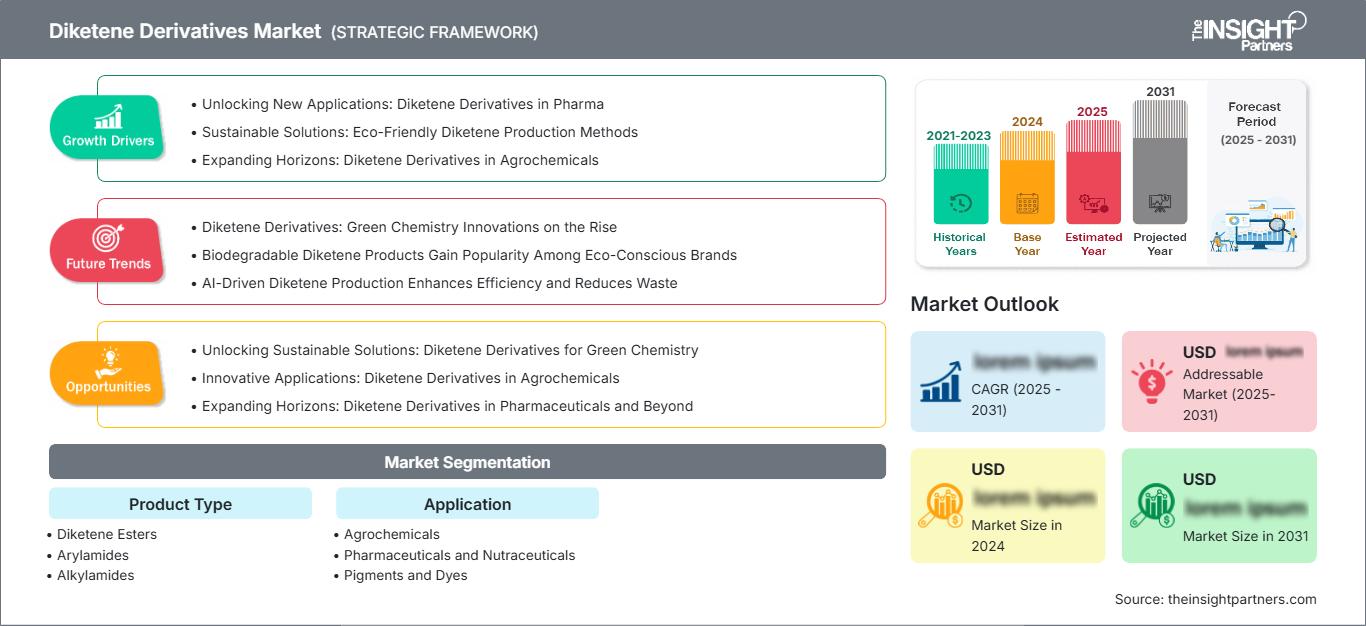
Diketene Derivatives Market: Strategic Insights
Regional Insights
North America Diketene Derivatives Market
North America accounted for an estimated 26–30% share of global Diketene Derivatives Market demand in 2025 and is projected to expand at a CAGR of 2.1–2.7% through 2034. Regional growth is supported by the presence of advanced pharmaceutical manufacturing facilities, established chemical production infrastructure, and significant investment in agricultural technologies. Demand remains particularly strong for diketene derivatives used in specialty intermediates, active ingredient synthesis, and high-performance chemical applications.
Advantages include stable regulation systems, developed logistics and infrastructure, and advanced R&D potential. The area enjoys innovations related to crop protection in favor of industry use, along with increasing demand for pharmaceuticals that have to be produced with high-purity intermediates due to complicated synthesis. Canada is represented by its special chemicals production and agricultural sector use, while Mexico shows an increase in the number of players in the field of industrial chemicals processing.
U.S. Diketene Derivatives Market
The United States represents approximately 74–78% of the North American Diketene Derivatives Market demand in 2025 and remains the dominant country market within the region. Consumption is supported by a well-developed pharmaceutical sector, agricultural technology advancements, and extensive specialty chemical manufacturing activity. The market is estimated to grow at a CAGR of 2.2–2.8% through 2034, supported by steady industrial demand and ongoing product development activities.
The Diketene Derivatives Market share in the country remains influenced by demand for crop protection ingredients, pharmaceutical intermediates, and specialty pigments. Major manufacturers, research institutions, and industrial customers contribute to a robust innovation ecosystem. Increasing emphasis on supply chain resilience, domestic manufacturing capabilities, and regulatory compliance continues shaping procurement strategies. Long-term opportunities are supported by investments in advanced synthesis technologies and high-value chemical production applications across diverse industrial sectors.
Europe Diketene Derivatives Market
Europe held an estimated 29–33% share of global revenue in 2025 and is expected to expand at a CAGR of 2.0–2.6% through 2034. Germany remains the leading regional market due to its advanced specialty chemical industry, strong industrial base, and extensive expertise in chemical process development. The country benefits from integrated production networks and a substantial downstream manufacturing ecosystem utilizing diketene-based intermediates.
The United Kingdom maintains a stable demand through pharmaceutical research and specialty chemical manufacturing. France supports consumption through agrochemical and industrial chemical applications, while Italy contributes through specialty manufacturing and formulation activities. Spain continues benefiting from expanding agricultural value chains and industrial chemical demand. Environmental compliance requirements and sustainability initiatives across the European Union are encouraging process improvements and operational modernization, helping preserve the region's position as a major production and consumption hub.
APAC Diketene Derivatives Market
Asia Pacific represented 22–26% of global market revenue in 2025 and is expected to expand at a Asia Pacific represents the largest regional market with an estimated 31–35% share in 2025 and a projected CAGR of 2.8–3.5% through 2034. China remains the leading market due to its extensive chemical manufacturing capacity, while Japan continues to contribute through advanced specialty chemical production.
India, South Korea, and Australia are also supporting regional growth through rising agricultural demand, pharmaceutical expansion, and investments in industrial manufacturing infrastructure. Government initiatives supporting domestic production capabilities are expected to strengthen market development.
Middle East & Africa Diketene Derivatives Market
The Middle East & Africa market remains comparatively smaller but continues to develop steadily, with CAGR estimated at 2.3–2.9% during the forecast period. Saudi Arabia and the United Arab Emirates are benefiting from broader industrial diversification and chemical sector investments.
South Africa remains an important contributor due to established industrial activity and agricultural requirements. The wider region is increasingly investing in manufacturing infrastructure and downstream chemical processing capabilities, supporting gradual demand expansion.
Segmentation Analysis
Product Type
The Diketene Derivatives Market scope across product types is shaped by the diversity of downstream industrial applications and the ability of specific derivatives to serve as critical intermediates in chemical synthesis. Manufacturers increasingly focus on product consistency, purity enhancement, and process efficiency to meet pharmaceutical and agrochemical specifications. Demand remains supported by broad utilization across specialty chemicals, crop protection products, and industrial formulations. The main segment is projected to grow at a CAGR of 2.4–3.0% during 2026–2034, supported by stable industrial demand and continuing process innovation.
- Diketene Esters: Widely utilized as versatile intermediates in pharmaceutical and agrochemical synthesis. Their established performance characteristics and compatibility with multiple production pathways support consistent demand across industrial manufacturing operations.
- Arylamides: Important in specialty chemical applications requiring controlled reaction performance and product stability. Demand benefits from usage in high-value formulations and fine chemical manufacturing activities.
- Alkylamides: Utilized in chemical synthesis processes where functional versatility and process efficiency are important. Growing adoption in selected industrial formulations contributes to their strategic relevance within the market.
- Dihydroacetic Acid: Maintains significance due to applications in preservatives, specialty formulations, and industrial chemical processing. Regulatory acceptance and broad utility support sustained commercial importance across multiple industries.
Application
Applications remain the primary source of market value generation, with varying demand patterns reflecting the strength of agriculture, healthcare, and industrial manufacturing sectors. The segment is expected to expand at a CAGR of 2.6–3.2% during the forecast period. Continuous development of crop protection solutions, pharmaceutical ingredients, and high-performance colorants is expected to sustain consumption. Companies continue investing in application-oriented product development to improve performance, production efficiency, and regulatory compliance within end-use industries.
- Agrochemicals: Represent the largest application category due to extensive utilization in herbicide, pesticide, and crop protection intermediate production. Global agricultural productivity requirements continue to support long-term strategic importance.
- Pharmaceuticals and Nutraceuticals: Increasing demand for active ingredient synthesis, specialty intermediates, and healthcare product innovation supports strong adoption. Regulatory compliance requirements elevate the value of quality-controlled diketene derivative products.
- Pigments and Dyes: Maintains relevance through use in industrial colorants, coatings, specialty pigments, and performance chemicals. Product quality requirements and manufacturing efficiency continue to support steady demand.
Opportunity Snapshot
| Application | Revenue Contribution | Trend Tag | Adoption Stage |
| Agrochemicals | High | Crop Protection | Mature |
| Pharmaceuticals and Nutraceuticals | Medium | API Synthesis | Scaling |
| Pigments and Dyes | Medium | Specialty Colorants | Mature |
Diketene Derivatives Market Growth Drivers and Impact Analysis
Expanding Need for Advanced Crop Protection Chemicals
The global agriculture sector still struggles with issues related to increasing population, climate change, and restricted land use, which contribute to the development of highly effective crop protectants made using special intermediates. Diketene derivatives are used to synthesize herbicides, pesticides, and other agrochemical active substances; thus, agricultural demands become one of the main drivers of the market. The agricultural practices of both developed and developing countries focus on yield improvement and product quality enhancement. As a result, the development of innovative agricultural chemistry leads to increasing demands for special chemical formulations and, consequently, to the consistent development of the market and strengthening of the supplier-formulator cooperation.
Growth in Pharmaceutical and Nutraceutical Manufacturing
Use of high-purity intermediates in the pharmaceutical industry is on the rise as the industry increases the efficiencies of synthesis, consistency of products, and ensures regulatory requirements are met. The derivatives of diketene facilitate the manufacture of different pharmaceutical products and specialty products in the manufacturing process. Increased spending on health care, an aging population and the development of therapeutic products help maintain constant consumption rates. There is also increased spending by the nutraceutical industry in functional ingredients and specialty products, which require quality raw materials. Manufacturers who can deliver quality standards will be favored with increased demand for traceable and quality chemical intermediates.
Rising Demand for Specialty Chemicals and Industrial Formulations
Performance-based intermediates are increasingly demanded by specialty chemical manufacturers due to their reaction consistency and the complexity of product formation through intermediates. The uses of diketene derivatives are extensive in such fields as colorants, coatings, additives, research chemicals, and other advanced industrial compounds. Development in building materials, packaging, automotive coatings, and industrial manufacturing creates an indirect demand for specialty chemicals. Efficiency and quality of processes and products are becoming key priorities for manufacturers, which increases the relevance of reliable intermediates. Suppliers providing good quality products and application support are reinforcing business relations in various industries. Industrial upgrading and demand for high-quality chemical products will positively affect market use in the future.
Diketene Derivatives Market Future Trends
Transition Toward Higher Value Specialty Intermediates
The Diketene Derivatives Market trends increasingly indicate movement toward higher-value specialty applications rather than volume-driven commodity consumption. Pharmaceutical-grade intermediates, high-level agrochemical ingredients, and custom-made specialty chemicals are anticipated to take priority among producers because of the potential for increased margins. Investments in processes and technologies associated with improving the quality of the product and developing applications will become increasingly important as clients demand better performance features. As industrial purchasers focus on purity and consistency, producers with highly sophisticated manufacturing skills may be in a position to establish an edge over their competitors.
Increasing Adoption of Sustainable Manufacturing Practices
Sustainability aspects have become increasingly important for making decisions about chemical production. Chemical producers should be encouraged to allocate resources into investments that help to enhance production processes through environmentally friendly technologies, efficiency of resource utilization, and minimizing wastes in order to ensure environmental sustainability and competitiveness. The regulatory systems of major industrial countries will keep promoting more efficient production of chemicals and greater transparency. Purchasers will start evaluating vendors according to their environmental performance and sustainability. This aspect will most probably play an important role when making procurement decisions in the fields of pharmaceuticals, agrochemicals, and specialty chemicals.
Diketene Derivatives Market Opportunities
Expansion of Pharmaceutical Intermediate Manufacturing in Asia
Pharmaceutical production capabilities are expanding across India, China, and selected Southeast Asian economies as companies seek cost efficiencies, supply-chain diversification, and proximity to growing healthcare demand. This transition creates opportunities for producers of diketene-based intermediates used in active pharmaceutical ingredient synthesis and specialty chemical processes. Investment in regional production facilities, technical service centers, and long-term supply agreements may enable market participants to strengthen customer relationships and improve operational resilience. Growing regulatory alignment with international quality standards further supports commercialization opportunities. The long-term outlook remains favorable as healthcare innovation, domestic pharmaceutical manufacturing initiatives, and increasing demand for specialized chemical intermediates continue shaping industrial procurement strategies. According to current Diketene Derivatives Market Forecasts, Asia is expected to remain the most attractive destination for future capacity optimization and customer expansion initiatives.
Development of High-Purity Specialty Product Portfolios
Manufacturers have an opportunity to differentiate themselves through the development of higher-purity diketene derivative products tailored to pharmaceutical, nutraceutical, and advanced specialty chemical applications. Customers increasingly prioritize traceability, consistent specifications, and dependable regulatory compliance, creating demand for premium-grade offerings. Strategic investment in process optimization, analytical capabilities, and technical support services may help suppliers capture greater value across specialized end-use markets. Product innovation focused on improving reaction efficiency and reducing downstream processing complexity can further strengthen competitive positioning. Organizations capable of providing customized solutions and application expertise are likely to establish stronger long-term partnerships with industrial users. These factors support opportunities for enhanced profitability, portfolio diversification, and sustainable market participation throughout the forecast period.
Recent Developments
- December 2025: India's Laxmi Organics Industries Ltd. has announced a price increase for several products due to a rise in acetic acid costs. Effective immediately, acetic anhydride prices will rise by Rupee 5/kg, reaching approximately Rupee 59-60/kg, while ethyl acetate will increase by Rupee 6/kg, now priced at Rupee 69-70/kg. Additionally, n-propyl acetate and n-butyl acetate will see increases of Rupee 4/kg and Rupee 3/kg, respectively, and acetaldehyde will rise by Rupee 2/kg.
- April 2024: Jubilant Ingrevia has opened a new facility for Diketene Derivatives in Gajraula, Uttar Pradesh, increasing production capacity by 2,000 tonnes per annum. This expansion aims to penetrate new markets in the US and EU, emphasizing growth in specialty chemicals. The facility indicates a strategic shift towards downstream derivatives, with plans for introducing additional products in this segment.
Frequently Asked Questions

- Comprehensive Market Sizing and Forecast Analysis
- Detailed Segmentation Analysis
- In-Depth Market Dynamics Assessment
- Regional and Country-Level Insights
- Competitive Landscape and Company Benchmarking
- Strategic Business Intelligence
Recent Reports
Testimonials

The Insight Partners provided valuable market intelligence that supported our global go-to-market strategy. Their team was professional, responsive, and attentive to our feedback, providing thoughtful analysis and helpful methodological clarifications throughout the project.
Junmo Kim Chief Financial Officer (CFO), Enertech Co., Ltd.
The Insight Partners' SCADA System Market report is comprehensive, with valuable insights on current trends and future forecasts. The team was highly professional, responsive, and supportive throughout. We are very satisfied and highly recommend their services.
RAN KEDEM Partner, Reali Technologies LTDs
I requested a report on a very specific software market and the team produced the report in a few days. The information was very relevant and well presented. I then requested some changes and additions to the report. The team was again very responsive and I got the final report in less than a week.
JEAN-HERVE JENN Chairman, Future Analytica
We worked with The Insight Partners for an important market study and forecast. They gave us clear insights into opportunities and risks, which helped shape our plans. Their research was easy to use and based on solid data. It helped us make smart, confident decisions. We highly recommend them.
PIYUSH NAGPAL Sr. Vice President, High Beam Global
The Insight Partners delivered insightful, well-structured market research with strong domain expertise. Their team was professional and responsive throughout. The user-friendly website made accessing industry reports seamless. We highly recommend them for reliable, high-quality research services
YUKIHIKO ADACHI CEO, Deep Blue, LLC.
This is the first time I have purchased a market report from The Insight Partners.While I was unsure at first, I visited their web site and felt more comfortable to take the risk and purchase a market report.I am completely satisfied with the quality of the report and customer service. I had several questions and comments with the initial report, but after a couple of dialogs over email with their analyst I believe I have a report that I can use as input to our strategic planning process.Thank you so much for taking the extra time and making this a positive experience.I will definitely recommend your service to others and you will be my first call when we need further market data.
JOHN SUZUKI President and Chief Executive Officer, Board Director, BK Technologies
I wish to appreciate your support and the professionalism you displayed in the course of attending to my request for information regarding to infectious disease IVD market in Nigeria. I appreciate your patience, your guidance, and the fact that you were willing to offer a discount, which eventually made it possible for us to close a deal. I look forward to engaging The Insight Partners in the future, all thanks to the impression you have created in me as a result of this first encounter.
DR CHIJIOKE ONYIA MANAGING DIRECTOR, PineCrest Healthcare Ltd.Reason to Buy
- Informed Decision-Making
- Understanding Market Dynamics
- Competitive Analysis
- Identifying Emerging Markets
- Customer Insights
- Market Forecasts
- Risk Mitigation
- Boosting Operational Efficiency
- Strategic Planning
- Investment Justification
- Tracking Industry Innovations
- Aligning with Regulatory Trends





 Get Free Sample for