
Dimer Acid Market Growth, Trends & Demand by 2034
Coverage: by Application (Nonreactive Polyamide Resins, Reactive Polyamide Resins, Oilfield Chemicals, Others); Product Type (Standard, Distilled, Distilled and hydrogenated) , and Geography (North America, Europe, Asia Pacific, and South and Central America)
- Status : Data Released
- Report Code : TIPRE00010180
- Category : Chemicals and Materials
- No. of Pages : 150
- Available Report Formats :


- Last update date : July 22, 2026


2025 Market Size
US$ 829.21 Mn
Base year value
2034 Forecast
US$ 1,241.15 Mn
Projected by 2034
CAGR 2026-2034
4.58 %
Growth rate
Addressable Market
US$ 9,398.30 Mn
(2026-2034)
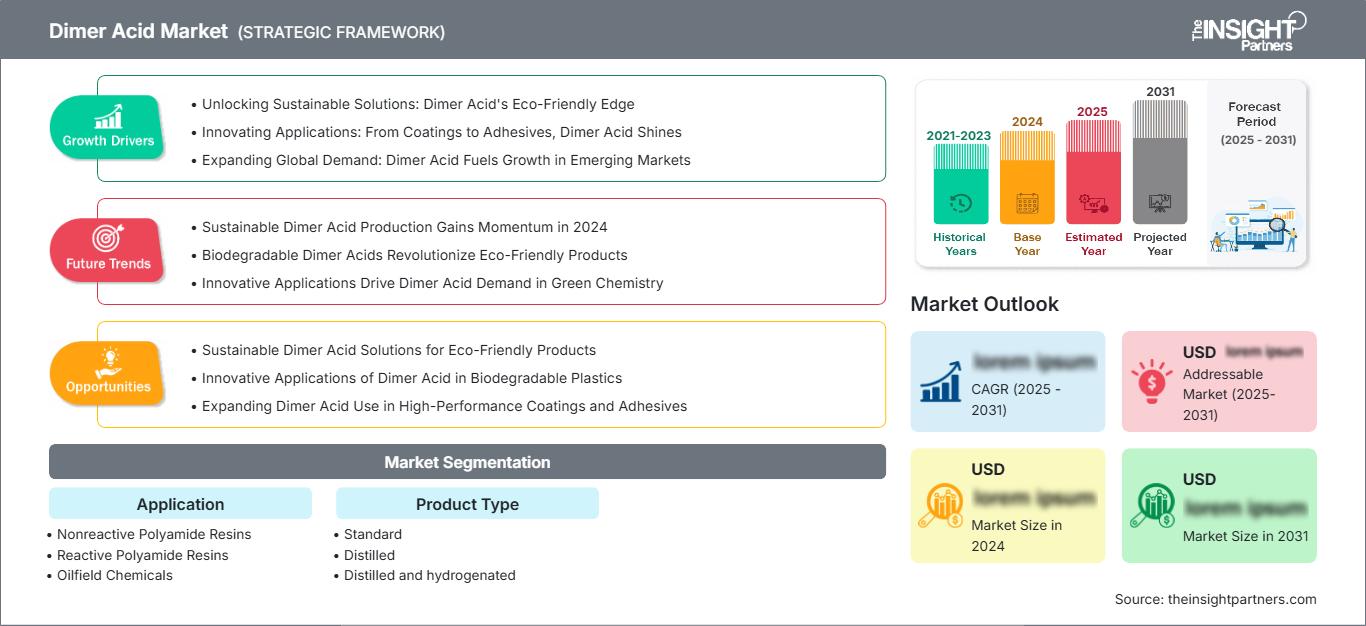
The dimer acid Market was valued at US$ 829.21 Million in 2025 and is projected to reach US$ 1,241.15 Million by 2034, registering a CAGR of 4.58% during 2026–2034. Demand is supported by wider use of dimerized fatty acids in polyamide resins, oilfield formulations, coatings, inks, adhesives, lubricants, and specialty chemical systems where flexibility, hydrophobicity, adhesion, and thermal resistance remain critical performance requirements.
North America remains a technically mature market where the dimer acid Market size outlook is shaped by adhesive formulation, protective coatings, specialty lubricants, and oilfield chemical demand. The region is estimated to grow at a 4.1–4.9% CAGR during 2026–2034, supported by strong chemical manufacturing infrastructure, bio-based feedstock adoption, and continuing investment in high-performance polyamide resin systems for packaging, automotive, industrial, and construction applications.
Dimer Acid Market Assessment and Insights
- North America: Share in 2025 of 24–27% and CAGR between 4.1–4.9%. Specialty adhesives, coatings, and oilfield chemistry support stable consumption, while domestic formulators prioritize bio-based inputs and high-purity grades.
- US: Share in 2025 of 78–82% of North America and CAGR between 4.2–5.0%. Demand is led by polyamide hot-melt adhesives, protective coatings, and energy-sector chemical formulations.
- Europe: Share in 2025 of 21–24% and CAGR between 3.8–4.6%. Germany, the UK, France, Italy, and Belgium lead demand through oleochemical processing, coatings, and sustainable formulation activity.
- Asia Pacific: Share in 2025 of 45–49% and CAGR between 5.0–5.8%. China, India, Japan, and South Korea anchor consumption through adhesives, inks, industrial coatings, and expanding specialty chemical production.
- Largest Segment: Nonreactive Polyamide Resins held market share of 42–46% in 2025 and CAGR of 4.2–5.0% during 2026–2034, supported by packaging, printing ink, and adhesive demand.
- High Growth Segment: Oilfield Chemicals held market share of 14–18% in 2025 and CAGR of 5.2–6.0% during 2026–2034, aided by corrosion inhibition and drilling-fluid applications.
- Key companies analyzed in detail: Anqing Hongyu Chemical Co., Ltd., Kraton Corporation, Aturex Group, BASF SE, Croda International Plc, Florachem Corporation, Harima Chemicals Group, Inc., Jiangsu Yonglin Oleochemical Co., Ltd., Oleon NV, Shandong Huijin Chemical Co., Ltd.
Source: The Insight Partners' analysis based on proprietary research, government publications, company annual reports, investor presentations, industry databases, and expert interviews.
Production has evolved from basic dimerized fatty acid production to more specialized grades with better control over color, viscosity, and monomers. Producers are upgrading distillation, hydrogenation, and feedstock processes in order to cater to applications such as adhesives, coatings, and epoxy curing, where consistency is paramount. Oleochemicals have benefited from the renewable oleochemical positioning; however, the availability of tall oil fatty acid and vegetable oils still affects procurement and margins.
The future of this industry will see growth being driven by manufacturing bases in Asia Pacific, specialty chemical manufacturing sites in North America, and sustainable formulation bases in Europe. The investments will be towards production of high purity distilled and hydrogenated grades, polyamide resin intermediates based on customer requirements, and oleochemical sourcing. Growth will be fueled by the regulatory preference for low VOC, bio-derived, and durable formulation components.
Dimer Acid Market Report Scope
| Report Attribute | Details |
|---|---|
| Market size in 2025 | US$ 829.21 Million |
| Market Size by 2034 | US$ 1,241.15 Million |
| Global CAGR (2026 - 2034) | 4.58% |
| Historical Data | 2021-2024 |
| Forecast period | 2026-2034 |
Dimer Acid Market Analysis
Market expansion trajectory for dimer acids is supported by demand for polyamide resins in hot melt adhesives, inks, coatings, and flexible epoxies. Dimer acids have properties of hydrophobicity, adhesion, flexibility, and thermal stability, which make them a desirable product where petrochemical products lack these properties. Availability of raw material from sources such as tall oil fatty acid, oleic acid, and vegetable oils continues to be critical for controlling costs and sustainability.
The chain of activities required for the production of dimer acids includes oleochemical conversion processes, a catalyst-based dimerization process, purification and resin formulation processes. Producers of adhesives use non-reactive polyamide resins in packaging, book binding, and wood applications, whereas reactive polyamides are used for epoxy curing. Oilfield application producers find value in dimer acid products due to their properties.
The current dimer acid market structure is made up of competition between integrated global oleochemical producers and regional players. Competition among companies such as Kraton Corporation, Croda International Plc, BASF SE, Oleon NV, and Florachem Corporation includes factors such as product purity, technical services, and range of applications. Companies such as Anqing Hongyu Chemical Co., Ltd., Jiangsu Yonglin Oleochemical Co., Ltd., Shandong Huijin Chemical Co., Ltd., Aturex Group, and Harima Chemicals Group, Inc., increase Asian market presence.
Current trends indicate that investment in the market focuses on hydrogenated dimer acid, distillation into low color products, and access to renewable sources of raw material. Suppliers are being evaluated based on quality, certification, sustainability, and technical service in addition to price. This makes strategic positioning in the market based on capacity and cooperation with resin suppliers to formulate different chemicals important.
● REPORT CUSTOMIZATION
Tailor This Report To Align With Your Specific Business Requirements
This report can be customized to align precisely with your business objectives, scope, and target markets. Customization options include tailored segmentation, geography, competitive analysis, and strategic insights to support informed decision-making.
Customize This Report →WHAT YOU CAN ADJUST
- ● Segmentations
- ● Geography
- ● Competitive Analysis
- ● Language Preferences
Dimer Acid Market: Strategic Insights
Regional Insights
North America dimer acid Market
North America accounted for 24–27% of global revenue in 2025 and is forecast to grow at a 4.1–4.9% CAGR during 2026–2034. The regional dimer acid Market share is supported by mature adhesives, coatings, lubricants, and oilfield chemical industries. Demand remains strongest where formulators require flexible, hydrophobic, and low-volatility intermediates for durable end products.
Regional users are also increasing interest in renewable-content raw materials and documented supply chains. Polyamide hot-melt adhesives for packaging and assembly remain a key consumption base, while oilfield chemicals provide specialized demand tied to corrosion inhibition and drilling performance. Supplier success in North America depends on technical service, consistent grade quality, and alignment with customer sustainability reporting.
U.S. dimer acid Market Market
The U.S. represented 78–82% of North American revenue in 2025 and is expected to expand at a 4.2–5.0% CAGR. The demand is centered around adhesive formulation, specialty coating, industrial lubricants, and oilfield chemical systems. The domestic consumption is bolstered by the presence of technical resin makers, strong packaging demand downstream, and a sound chemical distribution network for efficient product supply.
Company representation comes in the form of global suppliers supplying the United States with intermediates made using tall oil and vegetable oil. The polyamide resins continue to play a central role in view of the need for the hot melt adhesives to adhere efficiently to paper, plastics, textiles, and metals. The oilfield demand is cyclical but the dimer acid derivatives continue to be significant where corrosion resistance, lubricity, and thermal stability matter.
Europe dimer acid Market Market
Europe held 21–24% share in 2025 and is projected to grow at a 3.8–4.6% CAGR. Germany leads demand through coatings, adhesives, automotive components, and specialty chemical production, supported by its large manufacturing base and focus on high-performance industrial materials. The UK supports formulated adhesive and ink applications, while Belgium benefits from oleochemical activity and regional distribution strength linked to companies such as Oleon NV.
France, Italy, and Spain contribute through packaging, construction coatings, industrial maintenance products, and lubricant additives. European buyers often emphasize low-VOC chemistry, renewable feedstocks, and traceable sourcing, which favors suppliers with strong documentation, regulatory expertise, and technical support capabilities. The region’s growth is moderate compared with emerging markets, but value per unit remains attractive where purity, color stability, performance consistency, and compliance with stringent environmental standards are essential purchasing criteria.
APAC dimer acid Market Market
Asia Pacific accounted for 45–49% of global revenue in 2025 and is expected to grow at a 5.0–5.8% CAGR. China remains the leading country because of its large adhesive, ink, coatings, and resin production capacity, supported by a well-established chemical manufacturing ecosystem and extensive downstream industrial demand. India is expanding through rising packaging consumption, construction activity, and industrial development. At the same time, Japan and South Korea continue to emphasize high-specification specialty materials used in advanced manufacturing and performance applications.
Australia contributes a smaller but stable demand from industrial maintenance, mining, and energy-related formulations. Regional policy support for domestic chemical manufacturing, infrastructure investment, and the adoption of renewable and sustainable raw materials continues to create favorable growth conditions. Competitive intensity remains high because both local Chinese producers and multinational suppliers actively compete to serve customers seeking consistent product quality, supply reliability, price stability, and rapid delivery. In addition, growing demand for environmentally compliant and higher-performance formulations is encouraging ongoing investment in product innovation and production capacity across the region.
Middle East & Africa dimer acid Market Market
Middle East & Africa demand is projected to expand at a 4.4–5.2% CAGR through 2034. Saudi Arabia is the leading market because oilfield chemicals, refinery maintenance, industrial coatings, and infrastructure projects require durable additives and resin systems. The UAE supports specialty construction, marine, and hospitality-related coatings demand, benefiting from ongoing investments in commercial and tourism infrastructure.
South Africa contributes through mining, industrial maintenance, and packaging applications, while the rest of the region remains largely project-driven. Energy sector investment provides a practical route for dimer acid derivatives in corrosion inhibitors, lubricants, and performance-enhancing additives used in demanding operating environments. Adoption across the region continues to depend on the availability of imported specialty chemicals, established distributor networks, and technical support capabilities that can address harsh climatic conditions, equipment reliability requirements, and evolving industrial performance standards.
Segmentation Analysis
Application
The Application segment is expected to grow at a 4.4–5.2% CAGR during 2026–2034. The dimer acid Market scope is anchored in resin chemistry, where dimerized fatty acids improve flexibility, adhesion, water resistance, and thermal behavior. Demand is increasingly application-specific, with customers selecting grades according to color, viscosity, monomer content, and downstream compatibility.
- Nonreactive Polyamide Resins: This sub-segment remains the largest application base, supported by hot-melt adhesives, printing inks, packaging, bookbinding, and woodworking uses where flexibility and adhesion are essential.
- Reactive Polyamide Resins: Reactive grades serve epoxy curing, coatings, sealants, and industrial formulations requiring toughness, chemical resistance, and durability under exposure to moisture, heat, and mechanical stress.
- Oilfield Chemicals: Oilfield formulations use dimer acid derivatives for corrosion inhibition, lubricity, and thermal stability, especially in drilling fluids, production chemicals, and systems operating under harsh subsurface conditions.
Product Type
The Product Type segment is forecast to expand at a 4.3–5.1% CAGR during 2026–2034. Standard grades address cost-sensitive applications, while distilled and hydrogenated products serve customers requiring lower color, improved oxidative stability, and tighter specifications. The market is therefore moving toward differentiated grades rather than commodity-only supply.
- Standard: Standard products serve broad resin, lubricant, and additive applications where balanced cost and functional performance are more important than ultra-low color or high-purity specifications.
- Distilled: Distilled grades provide improved purity, lower monomer content, and better color control, making them strategically important for premium adhesives, inks, coatings, and specialty resin systems.
- Distilled and hydrogenated: Distilled and hydrogenated products address demanding applications requiring oxidative stability, color retention, and consistent performance, particularly in high-value coatings, lubricants, and specialty intermediates.
Opportunity Snapshot
| Segment Name | Revenue Contribution | Trend Tag | Adoption Stage |
| Nonreactive Polyamide Resins | High | Hot Melts | Mature |
| Reactive Polyamide Resins | Medium | Epoxy Curing | Scaling |
| Oilfield Chemicals | Medium | Corrosion Control | Scaling |
Dimer Acid Market Growth Drivers and Impact Analysis
Rising Demand for Polyamide Resin Intermediates
Polyamide resins are expected to be the greatest demand driver since dimer acid chemistry is transformed into a flexible, sticky, and chemical resistant product through it. Hot-melt adhesives, which are used in the packaging industry, in bookbinding, in furniture making, in footwear, and in automotive assembly, need resins that can bond different substrates while still being tough in heat and motion. Reactive polyamides are used to increase the flexibility and protection from corrosion in epoxies used in protective coatings. The demand driver will have a direct impact on companies that manufacture resins consistently in terms of their acid value, color, and viscosity.
Shift Toward Renewable and Lower-VOC Formulation Inputs
Intermediates from oleochemicals have become important in coatings, adhesives, and lubricants, as formulators try to meet sustainability objectives and emissions expectations. Intermediates based on dimer acid from tall oil fatty acid and vegetable oils allow the customer to use renewable carbon without sacrificing technical properties. The effect is most pronounced when the use of such intermediates does not impair adhesion, elasticity, hydrophobicity, or durability. Formulators that are able to prove their traceability and environmentally friendly practices will be able to justify higher prices for their products.
Oilfield Chemical Need for Durable Additives
Oilfield applications represent an opportunity for more targeted growth due to the requirement of chemicals that can withstand heat, salt, pressure, and corrosive liquids. The derivatives of dimer acid are used as corrosion inhibitors, lubricity agents, emulsifiers, and drilling fluid additives due to their hydrophobic nature and thermal stability. Though the oil and gas industry is characterized by ups and downs, complicated drilling processes and mature fields still need to use chemicals of a better quality. The producers who are able to offer customized grades for oilfield formulators have a good chance to generate healthy profit margins.
Dimer Acid Market Future Trends
Greater Use of Distilled and Hydrogenated Grades
Emerging dimer acid Market trends indicate stronger preference for distilled and hydrogenated grades as formulators pursue lower color, better oxidative stability, and narrower specification windows. Premium coatings, inks, lubricants, and reactive resin systems are less tolerant of impurities that affect appearance, odor, viscosity, or long-term durability. This trend should encourage producers to invest in purification, hydrogenation, quality analytics, and application laboratories. Buyers may increasingly qualify suppliers based on batch consistency and technical documentation rather than availability alone. Over time, higher-value grades are likely to lift average selling prices and reduce exposure to commodity-grade competition.
Application-Specific Resin Collaboration
The future competition is expected to shift towards co-development of application technologies by dimer acid vendors, resin makers, and downstream formulators. More and more customers of adhesive, coating, and oil field industries demand intermediates that are developed to improve substrate adhesion, fast curing, low-temperature flexibility, or corrosion resistance. It means that the firms that have the ability to provide technical services and quickly customize products for customers will be favored. However, standard products will still be relevant; nevertheless, specialized resin platforms will help generate customer loyalty and higher profitability.
Dimer Acid Market Opportunities
Bio-Based Adhesive Platforms for Packaging and Assembly
Packaging, furniture, footwear, and automotive assembly markets offer investment opportunities for suppliers that help formulators design higher renewable-content adhesive platforms. Polyamide hot-melt systems already depend on dimer acid chemistry for flexibility and substrate compatibility, making them practical candidates for sustainability-led reformulation. Companies can capture value by pairing stable feedstock sourcing with technical support for adhesion, open time, heat resistance, and processing behavior. Long-term dimer acid Market Forecasts favor suppliers that can document renewable content without increasing formulation risk. Commercial success will depend on joint qualification programs with adhesive producers, converters, and brand owners seeking measurable material improvements.
Specialty Oilfield Formulations in Harsh Operating Environments
Oilfield chemicals create targeted opportunities where conventional additives underperform in high-temperature, high-salinity, and corrosive conditions. Dimer acid derivatives can support corrosion inhibition, lubricity, emulsification, and fluid stability, particularly in complex wells and mature-field production. Suppliers can strengthen positioning by developing grades compatible with regional crude characteristics, water chemistry, and environmental requirements. Partnerships with oilfield service companies and chemical blenders can convert technical performance into recurring demand. While this opportunity is linked to energy-sector spending cycles, it offers attractive margins and diversification for producers that can deliver consistent, application-tested specialty intermediates.
Recent Developments
- April 2025: Epax, based in Aalesund, Norway, has launched Epax Evolve 05, claimed to be the first commercially available very long chain polyunsaturated fatty acid (VLC-PUFA). The company asserts that this omega-3 fatty acid may support healthy aging, with preclinical studies suggesting benefits for sight and highlighting that depletion could negatively impact bone mineral density and muscle strength.
- April 2025: Nippon Yuka Kogyo Co., Ltd. announced the upcoming release of BioxiGuard, Japan's first antioxidant specifically designed for marine biodiesel fuel, available from August 10.rs.
Frequently Asked Questions

- Comprehensive Market Sizing and Forecast Analysis
- Detailed Segmentation Analysis
- In-Depth Market Dynamics Assessment
- Regional and Country-Level Insights
- Competitive Landscape and Company Benchmarking
- Strategic Business Intelligence
Recent Reports
Testimonials

The Insight Partners' SCADA System Market report is comprehensive, with valuable insights on current trends and future forecasts. The team was highly professional, responsive, and supportive throughout. We are very satisfied and highly recommend their services.
RAN KEDEM Partner, Reali Technologies LTDs
I requested a report on a very specific software market and the team produced the report in a few days. The information was very relevant and well presented. I then requested some changes and additions to the report. The team was again very responsive and I got the final report in less than a week.
JEAN-HERVE JENN Chairman, Future Analytica
We worked with The Insight Partners for an important market study and forecast. They gave us clear insights into opportunities and risks, which helped shape our plans. Their research was easy to use and based on solid data. It helped us make smart, confident decisions. We highly recommend them.
PIYUSH NAGPAL Sr. Vice President, High Beam Global
The Insight Partners delivered insightful, well-structured market research with strong domain expertise. Their team was professional and responsive throughout. The user-friendly website made accessing industry reports seamless. We highly recommend them for reliable, high-quality research services
YUKIHIKO ADACHI CEO, Deep Blue, LLC.
This is the first time I have purchased a market report from The Insight Partners.While I was unsure at first, I visited their web site and felt more comfortable to take the risk and purchase a market report.I am completely satisfied with the quality of the report and customer service. I had several questions and comments with the initial report, but after a couple of dialogs over email with their analyst I believe I have a report that I can use as input to our strategic planning process.Thank you so much for taking the extra time and making this a positive experience.I will definitely recommend your service to others and you will be my first call when we need further market data.
JOHN SUZUKI President and Chief Executive Officer, Board Director, BK Technologies
I wish to appreciate your support and the professionalism you displayed in the course of attending to my request for information regarding to infectious disease IVD market in Nigeria. I appreciate your patience, your guidance, and the fact that you were willing to offer a discount, which eventually made it possible for us to close a deal. I look forward to engaging The Insight Partners in the future, all thanks to the impression you have created in me as a result of this first encounter.
DR CHIJIOKE ONYIA MANAGING DIRECTOR, PineCrest Healthcare Ltd.Reason to Buy
- Informed Decision-Making
- Understanding Market Dynamics
- Competitive Analysis
- Identifying Emerging Markets
- Customer Insights
- Market Forecasts
- Risk Mitigation
- Boosting Operational Efficiency
- Strategic Planning
- Investment Justification
- Tracking Industry Innovations
- Aligning with Regulatory Trends





 Get Free Sample for