
Dimethylamine Market Growth, Demand & Size by 2034
Coverage: By Grade (Anhydrous, Aqueous); Application (Agriculture, Pharmaceuticals, Textiles, Rubber); , and Geography (North America, Europe, Asia Pacific, and South and Central America)
- Status : Data Released
- Report Code : TIPRE00017974
- Category : Chemicals and Materials
- No. of Pages : 150
- Available Report Formats :


- Last update date : September 22, 2026


2025 Market Size
US$ 833.58 Mn
Base year value
2034 Forecast
US$ 1,451.97 Mn
Projected by 2034
CAGR 2026-2034
6.36 %
Growth rate
Addressable Market
US$ 10,341.20 Mn
(2026-2034)
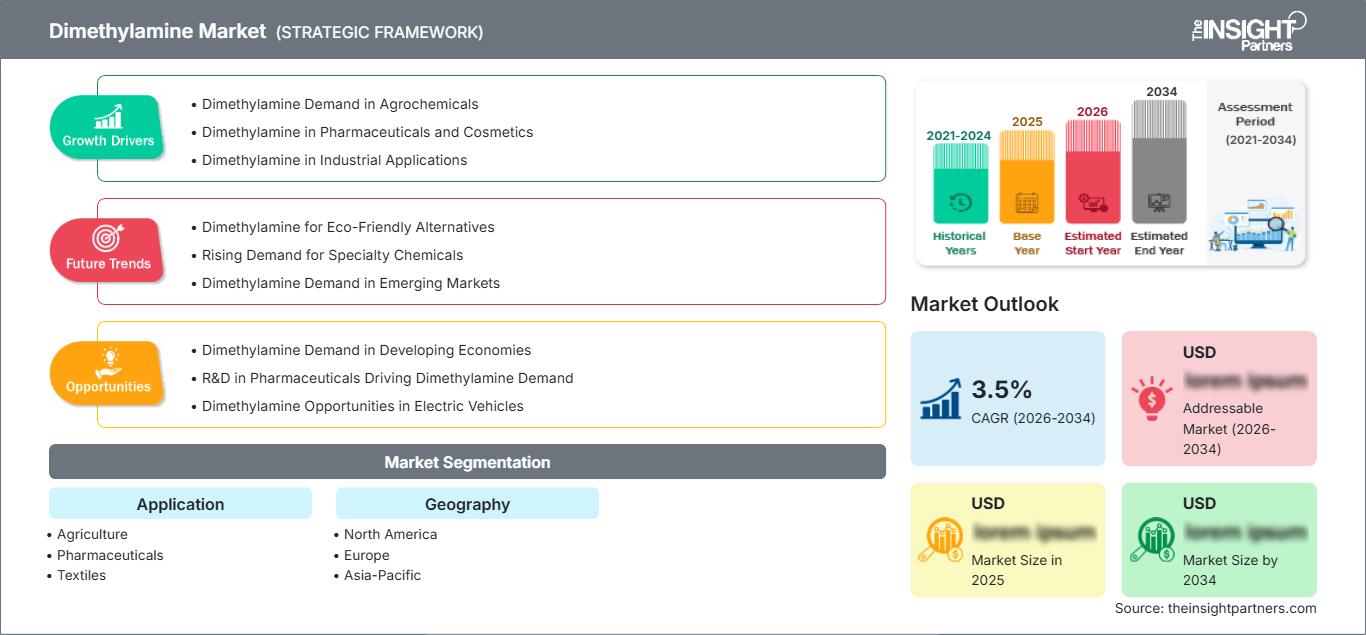
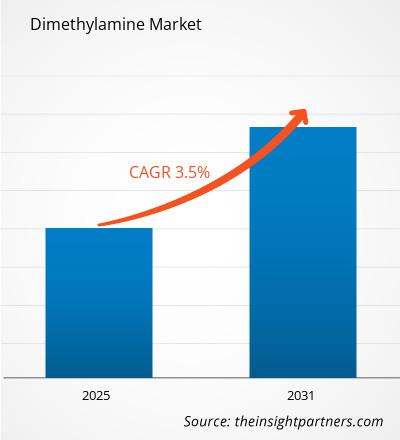
The Dimethylamine market size was valued at US$ 833.58 Million in 2025 and is projected to reach US$ 1,451.97 Million by 2034, reflecting a CAGR of 6.36% during 2026–2034. Expansion across agricultural chemicals, pharmaceutical intermediates, textile processing, and rubber chemicals is supporting sustained consumption. Demand is also being shaped by the availability of anhydrous and aqueous grades, with manufacturers balancing purity, handling requirements, logistics, and application-specific formulation needs across regional customer bases.
North America is positioned for steady expansion, supported by pharmaceutical synthesis, crop protection production, and established chemical manufacturing infrastructure. A modeled CAGR range of 5.4–6.1% for 2026–2034 reflects replacement demand, reliable domestic supply, and continued consumption of methylamine derivatives. The Dimethylamine size outlook is supported by dependable regional demand.
Dimethylamine Market Assessment and Insights
- North America: North America represented a modeled 23–27% Dimethylamine Market share in 2025 and is expected to expand at a 5.4–6.1% CAGR during 2026–2034, supported by pharmaceuticals, crop protection, and chemical manufacturing.
- U.S.: The U.S. accounted for 72–76% of North American demand in 2025 and is projected to grow at a 5.3–6.0% CAGR during 2026–2034, led by pharmaceutical and agrochemical synthesis.
- Europe: Europe held a modeled 19–23% share in 2025 and is forecast to grow at a 4.8–5.5% CAGR through 2034, led by Germany, France, Italy, the UK, and Spain.
- Asia Pacific: Asia Pacific represented a modeled 38–42% share in 2025 and is projected to grow at a 7.0–7.7% CAGR during 2026–2034, led by China, India, Japan, and South Korea.
- Largest Segment: Aqueous grade held a modeled 58–62% market share in 2025 and is projected to grow at a 5.9–6.5% CAGR during 2026–2034, supported by handling advantages.
- High Growth Segment: Pharmaceuticals represented a modeled 22–26% market share in 2025 and is projected to grow at a 7.0–7.8% CAGR through 2034, reflecting intermediate demand.
- Key companies analyzed in detail: Mitsubishi Gas Chemical Company, Inc.; Merck KGaA; Eastman Chemical Company; BASF SE; Balchem Corporation; Tokyo Chemical Industry Co., Ltd.; Celanese Corporation; Opsis AB; Alkyl Amines Chemicals Limited; Zhengzhou Meiya Chemical Products Co., Ltd.
Source: The Insight Partners' analysis based on proprietary research, government publications, company annual reports, investor presentations, industry databases, and expert interviews.
Production economics in the Dimethylamine Market are changing as the methylamines industry becomes more efficient at converting methanol and ammonia into purified products and shipping them. In terms of production economics, integrated production will remain an important factor since dimethylamine is part of larger methylamine production processes and related products. The product needs to be handled under pressure in its anhydrous form whereas aqueous solutions are easy to ship. Current supply considerations revolve around having regional inventories, process reliability, quality, and assured deliveries to end users in pharmaceuticals and agrochemicals sectors.
Dimethylamine market forecasts point towards stronger demand in developing manufacturing centers in Asia whereas developed markets will have an emphasis on efficiency and compliance. India has emerged as an important market due to increased local manufacturing of pharmaceuticals and agrochemicals that is driving the demand for amine-based intermediates. China is an important market for regional chemical supply whereas the investments in downstream chemicals in the Middle East region can improve the feedstocks integration process.
Dimethylamine Market Report Scope
| Report Attribute | Details |
|---|---|
| Market size in 2025 | US$ 833.58 Million |
| Market Size by 2034 | US$ 1,451.97 Million |
| Global CAGR (2026 - 2034) | 6.36% |
| Historical Data | 2021-2024 |
| Forecast period | 2026-2034 |
Dimethylamine Market Analysis
Growth of Dimethylamine Market relies upon its transformation from a chemical compound to intermediates used for crop protection, drugs, rubber chemicals, and textiles. Methanol and ammonia are the starting materials which are then processed in order to form catalytic methylamine that is separated, concentrated, stored, and distributed. Customers choose the grade and level of purity based on their process specifications, transportation economics, product specifications, and reaction requirements. Crop applications are favored due to their regular crop protection cycle, whereas pharmaceutical use relies much more on production volume and synthesis processes.
The Dimethylamine Market report shows that feedstocks prices, facility capacity utilization, maintenance schedules, transportation restrictions, and regional trade flows have an impact on supply. Integrated companies with their own methylamine facilities have an advantage of coproduct handling and better operational flexibility. Competitive differentiation strategies include either quality/packaging/technical support/delivery reliability for merchant suppliers or size/availability for integrated companies.
Market Analysis of Dimethylamine includes integrated chemical producers, specialty chemical companies, and lab-based distributors. Some companies included in the dimethylamine market are Eastman Chemical Company, BASF SE, Celanese Corporation, and Mitsubishi Gas Chemical Company, Inc., which operate through existing amine products line and wide customer network. Alkyl Amines Chemicals Limited contributes to the supplier side from India, while Balchem Corporation, Tokyo Chemical Industry Co., Ltd., Merck KGaA, Opsis AB, and Zhengzhou Meiya Chemical Products Co., Ltd. are some companies that meet the specific needs.
Current investment trends in the industry are oriented towards reliability of production, security of supply, and downstream integration more so than volume growth. Pricing trends of major producers reveal how feedstock costs, transportation issues, and conditions of operations affect business terms. Companies that operate through multiple facilities can mitigate risks of disruption of supply for customers. Competitive advantages include proper documentation, hazardous material management, applications support, and ability to provide anhydrous or aqueous grades of product.
● REPORT CUSTOMIZATION
Tailor This Report To Align With Your Specific Business Requirements
This report can be customized to align precisely with your business objectives, scope, and target markets. Customization options include tailored segmentation, geography, competitive analysis, and strategic insights to support informed decision-making.
Customize This Report →WHAT YOU CAN ADJUST
- ● Segmentations
- ● Geography
- ● Competitive Analysis
- ● Language Preferences
Dimethylamine Market: Strategic Insights
Regional Insights
North America Dimethylamine Market
North America accounted for a modeled 23–27% Dimethylamine share in 2025 and is expected to register a 5.4–6.1% CAGR through 2034. The U.S. is a dominant consumer due to the presence of an integrated system of production of pharmaceuticals, agrochemicals, specialty chemicals, and rubber. Demand for this substance is driven by crop protection intermediates and pharmaceutical intermediates, while logistics for the existing chemicals ensure a reliable delivery of aqueous and anhydrous grades.
There are advantages in the supply chain structure that come from the existing methylamine production and distribution networks. The emphasis is on the plant capacity, safe storage, contract reliability, and inventory because logistics are more complicated with the handling of the hazardous gas. Canada plays a part due to specialty chemical consumption, while Mexico is important as the manufacturing country for the supply chain.
U.S. Dimethylamine Market
The U.S. represented a modeled 72–76% share of North American demand in 2025 and is projected to grow at a 5.3–6.0% CAGR through 2034. Pharmaceutical synthesis, crop protection chemicals, and chemical intermediates remain some of the major end-use applications for which the industry has maintained its supply chain.
Major market players in the Dimethylamine Market include companies like Eastman Chemical Company, Celanese Corporation, BASF SE, and Mitsubishi Gas Chemical Company, Inc., who have the right product lines or distribution networks. In cases where easy handling of the substance is required, the aqueous form is expected to do better, while the anhydrous form remains important in controlled synthesis reactions. Issues like regulations, pressure vessel requirements, exposure limits, and logistics in the vicinity will continue influencing buyer choices.
Europe Dimethylamine Market
Europe held a modeled 19–23% share in 2025 and is forecast to expand at a 4.8–5.5% CAGR through 2034. The leader among these countries in chemical manufacturing is Germany, and other European countries contributing to it include the UK, France, Italy, and Spain through their ability to manufacture pharmaceuticals, agricultural chemicals, rubber, and specialty chemicals respectively.
The UK handles the demand of specialty and pharmaceutical chemicals; Germany takes advantage of their clustered chemical industry sectors. France manufactures pharmaceutical and agricultural chemicals, Italy makes specialty and rubber chemicals, while Spain manufactures agricultural and pharmaceutical chemicals. Energy costs, environmental policy, and logistics are still important in purchasing.
APAC Dimethylamine Market
APAC represented a modeled 38–42% Dimethylamine Market in 2025 and is projected to grow at a 7.0–7.7% CAGR through 2034, making it the leading regional market. China is the largest, followed by India, Japan, and South Korea. Australia is small yet still plays a role via specialized chemicals and agriculture.
China has benefited from substantial chemical and agrochemical production, India has increased its significance through pharmaceuticals and crop protection products, Japan focuses on quality-controlled industrial and specialized chemicals, and South Korea has supported its chemical and advanced manufacturing needs. There are ongoing regional initiatives to encourage local chemical production and supply chain resiliency, which are encouraging investment. Expansion of pharmaceutical production, agricultural inputs, and chemical processing should maintain above-global growth.
Middle East & Africa Dimethylamine Market
The Middle East and Africa are expected to record a 5.0–5.8% CAGR through 2034. Saudi Arabia emerges as the leading regional potential due to the existence of integrated petrochemical infrastructure, whereas UAE is supportive of trading and distribution networks. South Africa emerges as a source of diversified demand coming from industrial and agricultural sectors, whereas other MEA countries depend more on imports.
Integration in energy and investments in chemicals would bring improvements in economics of feedstocks and downstream processing. Diversification in the Saudi Arabian industry would bring prospects for intermediates production, whereas logistical advantages in UAE would help in distribution throughout the region. The agriculture and industries in South Africa generate consistent demand, whereas other MEA countries are sensitive to import costs, storage needs, and infrastructure.
Segmentation Analysis
Grade
The Dimethylamine Market scope by grade is shaped by handling requirements, downstream formulation, transport economics, and purity specifications. Aqueous solutions are generally favored where customers prioritize easier storage and dosing, while anhydrous material serves processes requiring concentrated feedstock. The grade segment is projected to expand at a 5.8–6.4% CAGR during 2026–2034 as manufacturers optimize supply formats for different end-use environments.
- Anhydrous: Anhydrous dimethylamine provides concentrated feedstock for controlled synthesis and is important where water-free processing is required. Its handling complexity increases infrastructure and safety requirements.
- Aqueous: Aqueous dimethylamine supports simplified handling, storage, and dosing. Its established availability makes it important across agriculture, pharmaceuticals, textiles, and rubber-processing operations.
Application
Application demand is diversified across agriculture, pharmaceuticals, textiles, and rubber, limiting dependence on a single downstream sector. Pharmaceuticals are projected to record a 7.0–7.8% CAGR during 2026–2034, supported by intermediate synthesis and expanding production capacity in Asia. Broader application diversity improves demand resilience when individual industries experience cyclical changes.
- Agriculture: Agricultural chemicals use dimethylamine-derived intermediates in crop-protection formulations and synthesis chains. Demand follows planted acreage, crop economics, pesticide production, regulatory approvals, and active-ingredient requirements.
- Pharmaceuticals: Pharmaceutical demand is linked to intermediate and active-ingredient synthesis, where consistent purity and dependable supply are critical. Expanding generic-drug manufacturing in Asia supports consumption and supplier qualification.
- Textiles: Textile applications rely on amine-derived intermediates and processing agents. Demand follows synthetic-fiber production, finishing activity, dyeing operations, and regional textile manufacturing concentration, particularly across Asia.
- Rubber: Rubber processing uses amine-derived chemicals in formulations and synthesis. Consumption benefits from tire, automotive component, industrial rubber, and footwear production, with purchasing decisions influenced by consistency and supply reliability.
Opportunity Snapshot
| Application | Revenue Contribution | Trend Tag | Adoption Stage |
| Agriculture | High | Crop Protection | Mature |
| Pharmaceuticals | High | API Synthesis | Scaling |
| Textiles | Medium | Fiber Processing | Mature |
| Rubber | Medium | Rubber Chemicals | Mature |
Dimethylamine Market Growth Drivers and Impact Analysis
Expansion of pharmaceutical and agrochemical manufacturing
The growth in production of pharmaceuticals and agriculture-related chemicals has increased the need for efficient amine intermediates. The dimethylamine molecule is used in the production process of various products, meaning that demand will grow in tandem with the increase in the production of crop protection chemicals and pharmaceuticals. India and China are key players since both nations possess large-scale industries for the manufacture of chemical products and have rapidly growing export-focused manufacturing processes. It applies mainly to companies that have an ability to satisfy requirements of purity and delivery. Mature markets depend more on the replacement, formulation, and synthesis of the product than on the demand.
Increasing demand for integrated and reliable chemical supply
Buyers are increasingly considering supply reliability since disruptions to their supplies of methylamines may impact their manufacturing schedules. Integrated firms will be able to meet this need by coordinating all their activities such as procuring feedstocks, manufacturing methylamines, purifying, storing and distributing them in one coherent system. Inventory centers and diversified transport networks can also minimize their risk of disruptions from manufacturing disruptions, port issues and feedstock supply disruptions. This need will favor firms that have an established manufacturing presence and service support systems. It will also create room for regional manufacturers to enter into value chains that were previously dominated by other firms.
Growth of specialty and high-purity downstream applications
Customer requirements in the fields of pharmaceuticals, specialty chemicals, and advanced formulations are creating a need for increased product consistency and controlled impurities. Higher value creation than mere volume sales is possible in such applications since customers generally require specifications, traceability, consistent batch quality, and technical assistance. Investments in analytical equipment, process control, and application-specific packaging can contribute to increased customer loyalty by companies in this area. High purity demands create qualification barriers that can prevent fast substitution of established suppliers. The growth of pharmaceutical and specialty chemical production in Asia and North America will provide an additional advantage for companies with quality control systems and dependable logistics.
Dimethylamine Market Future Trends
Greater adoption of supply-chain localization
Dimethylamine Market trends are being shaped increasingly by the regionalization of the chemical value chain. Manufacturers in pharmaceuticals and agricultural chemicals are looking for alternative replenishment routes, alternative suppliers, and better availability of strategically essential intermediates on a domestic scale. Such trends will tend to drive manufacturers to develop regional warehousing facilities, qualify alternative logistics routes, and develop better relationships with their customers. Asia will continue to be the primary region of growth in demand; North America and Europe will focus on resilience within existing industrial networks. Qualifications of the suppliers will become increasingly contingent on such criteria as contingency capacity, safe transport, proper documentation, and time of deliveries. In the long run, localization will tend to benefit manufacturers with integrated assets or strong regional distribution networks.
Process efficiency and lower-impact chemical production
Future producers are likely to focus more heavily on energy efficiency, process optimization, emissions control, and resource utilization. Methylamine synthesis requires careful management of feedstocks, heat, separation, and purification, creating opportunities to improve operating efficiency through process control and equipment modernization. Customers with sustainability targets may increasingly evaluate supplier carbon intensity, manufacturing transparency, and environmental management alongside price and quality. These requirements will not eliminate conventional production, but they can influence investment decisions toward efficient assets and lower-loss operations. Producers that combine reliable output with improved energy and resource performance may gain preference in multinational supply contracts. The trend is also relevant to pharmaceutical and specialty chemical customers seeking more transparent supply chains.
Dimethylamine Market Opportunities
Expansion of pharmaceutical-grade supply in Asia
Pharmaceutical manufacturing expansion creates an opportunity for suppliers to build dedicated commercial and technical capabilities around high-quality dimethylamine supply. India, China, Japan, and South Korea provide strong downstream ecosystems, but customer requirements differ by application, purity, documentation, and delivery format. Producers can capture value by establishing local inventories, technical support, validated quality systems, and long-term supply arrangements with pharmaceutical intermediate manufacturers. Dedicated packaging and controlled distribution can also reduce handling concerns for smaller customers. Investment should prioritize locations close to pharmaceutical clusters and logistics infrastructure rather than relying solely on low-cost production. Companies that develop application-specific specifications and responsive customer qualification programs can improve retention and access to higher-value demand.
Regional distribution and supply-security partnerships
Supply-security partnerships offer an opportunity to address the operational complexity associated with transporting hazardous amines. Producers can work with specialized distributors, storage operators, and downstream manufacturers to create regional inventory networks that shorten delivery times and reduce interruption risks. This model is particularly relevant in markets where local production is limited but pharmaceutical, agricultural, textile, or rubber demand is expanding. Strategic partnerships can also improve market entry by providing regulatory knowledge, customer access, and established hazardous-material logistics. Suppliers should prioritize locations with strong ports, industrial storage infrastructure, and dense downstream customer clusters. A balanced model combining direct contracts for large users with distributor coverage for smaller accounts can improve utilization while broadening geographic reach.
Recent Developments
- September 2025: Aarti Drugs Limited commenced commercial production at its new manufacturing facility in Sayakha, Gujarat, with a proposed capacity of 60 metric tonnes per day for Dimethylamine, Monomethylamine, Trimethylamine, and their derivatives. The ₹220 crore facility supports the company's backward-integration strategy and is expected to reduce dependence on external methylamine supplies, strengthen raw-material security, and increase the availability of Dimethylamine for pharmaceutical and specialty chemical applications.
- May 2025: Nouryon introduced Armocare Aqua 12, a non-quaternary hair-conditioning agent based on Brassicamidopropyl Dimethylamine for hair-care formulations. The ingredient delivers conditioning and wet-combing performance while offering a renewable carbon index above 0.9 and ready biodegradability. The launch highlights growing downstream utilization of dimethylamine-derived ingredients in sustainable personal-care formulations and supports demand for dimethylamine derivatives in specialty applications.
Frequently Asked Questions

- Comprehensive Market Sizing and Forecast Analysis
- Detailed Segmentation Analysis
- In-Depth Market Dynamics Assessment
- Regional and Country-Level Insights
- Competitive Landscape and Company Benchmarking
- Strategic Business Intelligence
Recent Reports
Testimonials

The Insight Partners provided valuable market intelligence that supported our global go-to-market strategy. Their team was professional, responsive, and attentive to our feedback, providing thoughtful analysis and helpful methodological clarifications throughout the project.
Junmo Kim Chief Financial Officer (CFO), Enertech Co., Ltd.
The Insight Partners' SCADA System Market report is comprehensive, with valuable insights on current trends and future forecasts. The team was highly professional, responsive, and supportive throughout. We are very satisfied and highly recommend their services.
RAN KEDEM Partner, Reali Technologies LTDs
I requested a report on a very specific software market and the team produced the report in a few days. The information was very relevant and well presented. I then requested some changes and additions to the report. The team was again very responsive and I got the final report in less than a week.
JEAN-HERVE JENN Chairman, Future Analytica
We worked with The Insight Partners for an important market study and forecast. They gave us clear insights into opportunities and risks, which helped shape our plans. Their research was easy to use and based on solid data. It helped us make smart, confident decisions. We highly recommend them.
PIYUSH NAGPAL Sr. Vice President, High Beam Global
The Insight Partners delivered insightful, well-structured market research with strong domain expertise. Their team was professional and responsive throughout. The user-friendly website made accessing industry reports seamless. We highly recommend them for reliable, high-quality research services
YUKIHIKO ADACHI CEO, Deep Blue, LLC.
This is the first time I have purchased a market report from The Insight Partners.While I was unsure at first, I visited their web site and felt more comfortable to take the risk and purchase a market report.I am completely satisfied with the quality of the report and customer service. I had several questions and comments with the initial report, but after a couple of dialogs over email with their analyst I believe I have a report that I can use as input to our strategic planning process.Thank you so much for taking the extra time and making this a positive experience.I will definitely recommend your service to others and you will be my first call when we need further market data.
JOHN SUZUKI President and Chief Executive Officer, Board Director, BK Technologies
I wish to appreciate your support and the professionalism you displayed in the course of attending to my request for information regarding to infectious disease IVD market in Nigeria. I appreciate your patience, your guidance, and the fact that you were willing to offer a discount, which eventually made it possible for us to close a deal. I look forward to engaging The Insight Partners in the future, all thanks to the impression you have created in me as a result of this first encounter.
DR CHIJIOKE ONYIA MANAGING DIRECTOR, PineCrest Healthcare Ltd.Reason to Buy
- Informed Decision-Making
- Understanding Market Dynamics
- Competitive Analysis
- Identifying Emerging Markets
- Customer Insights
- Market Forecasts
- Risk Mitigation
- Boosting Operational Efficiency
- Strategic Planning
- Investment Justification
- Tracking Industry Innovations
- Aligning with Regulatory Trends





 Get Free Sample for