
Discrete Diodes Market Demand, Share & Growth by 2034
Coverage: by Product Type (Power Diodes, Small-signal Diodes, RF Diodes); Application (Commercial, Industrial) , and Geography (North America, Europe, Asia Pacific, and South and Central America)
- Status : Data Released
- Report Code : TIPRE00010963
- Category : Electronics and Semiconductor
- No. of Pages : 150
- Available Report Formats :


- Last update date : August 11, 2026


2025 Market Size
US$ 3.88 Bn
Base year value
2034 Forecast
US$ 5.07 Bn
Projected by 2034
CAGR 2026-2034
3.40 %
Growth rate
Addressable Market
US$ 41.43 Bn
(2026-2034)
The Discrete Diodes Market was worth US$ 3.88 Billion in 2025 and is estimated to reach US$ 5.07 Billion in 2034 with a CAGR of 3.40% between 2026–2034. Applications include power diodes, small-signal diodes, and RF diodes for commercial and industrial electronic applications where rectification, signal switching, surge protection, and high-frequency control continue to be crucial circuit operations.
The Discrete Diodes Market size in North America is forecasted to grow at a CAGR of 2.9-3.5%. Drivers include industrial automation, data center electronics, grid electronics, and automotive electronics, all of which provide opportunities for continued replacement and new design applications. North America enjoys robust distribution networks, defense electronics programs, and favorable local manufacturing incentives for commercial and industrial component usage.
Discrete Diodes Market Assessment and Insights
- North America: The region accounts for 25–29% share in 2025 and grows at a CAGR range of 2.9–3.5% during 2026–2034, supported by industrial controls, aerospace electronics, and power infrastructure upgrades.
- US: The country represents 82–86% of North America in 2025 and grows at a CAGR range of 3.0–3.6% during 2026–2034, led by commercial electronics and industrial automation.
- Europe: Europe holds 21–25% share in 2025 and grows at a CAGR range of 2.6–3.2% during 2026–2034, with Germany, France, the UK, Italy, and Spain leading adoption.
- Asia Pacific: Asia Pacific holds 39–43% share in 2025 and grows at a CAGR range of 3.8–4.6% during 2026–2034, led by China, Japan, South Korea, India, and Taiwan.
- Largest Segment: Power Diodes hold 48–52% market share in 2025 and grow at a CAGR range of 3.2–3.8% during 2026–2034 as power conversion demand expands.
- High Growth Segment: RF Diodes hold 13–17% market share in 2025 and grow at a CAGR range of 4.4–5.2% during 2026–2034 due to radio-frequency switching needs.
- Key companies analyzed in detail: Central Semiconductor Corporation; DACO Semiconductor Co., Ltd.; Diodes Incorporated; EIC Semiconductor Co., Ltd.; Littelfuse, Inc.; MACOM Technology Solutions Holdings, Inc.; Microchip Technology Inc.; SEMIKRON Elektronik GmbH & Co. KG; Semtech Corporation; Vishay Intertechnology, Inc.
Source: The Insight Partners' analysis based on proprietary research, government publications, company annual reports, investor presentations, industry databases, and expert interviews.
Diodes based on discrete technology have gone from generic rectifiers to specialized packages taking into account leakage, recovery time, capacitance, heat dissipation, and board space considerations. Semiconductor producers are improving silicon, silicon carbide, and Schottky solutions for better performance in power supply units, renewable technologies, telecommunication devices, and factory automation systems. Additionally, the manufacturing environment is transitioning from general production to automotive-qualified and industrial lines with wider selection of distributor stock minimizing lead times risks for design engineers.
In the future, diodes will be needed in Asia Pacific manufacturing clusters, North American industrial electronics, and energy efficiency projects in Europe. Government investments in grid infrastructure, local semiconductors, and electrification ensure stable diode consumption even in weak cycles of consumer electronics. Customers will assess diode suppliers not only in terms of qualification level, packages available, surge withstand, and supply reliability but also in their capability to provide components for commercial and industrial applications.
Discrete Diodes Market Report Scope
| Report Attribute | Details |
|---|---|
| Market size in 2025 | US$ 3.88 Billion |
| Market Size by 2034 | US$ 5.07 Billion |
| Global CAGR (2026 - 2034) | 3.40% |
| Historical Data | 2021-2024 |
| Forecast period | 2026-2034 |
Discrete Diodes Market Analysis
The Discrete Diodes Market will be propelled by continued increases in the content of electronics in industrial power systems, commercial devices, telecommunications infrastructure, and automobiles. Diodes are cheap yet essential semiconductors since they help to provide current steering, rectification, electrostatic discharge protection, voltage clamping, and signal detection functionality. In a situation where equipment manufacturers seek to reduce board space and increase switching frequencies, there is need for small form factor packaging, lower forward voltage, lower capacitance, and approved surge protection devices.
The value chain includes suppliers of wafers, assembly and test services, packaging services, catalog suppliers, distributors, EMS companies, and OEM design teams. Supply factors have been more stable than that for advanced logic but still are vulnerable to factory utilization levels, availability of lead frames, package qualification, and correction of inventories in the end-markets. There is optimism in the forecast for semiconductor industry recovery according to World Semiconductor Trade Statistics.
Competitiveness, according to the Discrete Diodes Market report, does not depend on the differentiation of products but rather on the catalog diversity, quality certifications, and application-specific engineering of the products. The companies like Diodes Incorporated and Vishay Intertechnology, Inc. utilize the opportunity of comprehensive portfolios of discrete diodes, whereas Littelfuse, Inc. and Semtech Corporation make use of protection and signal integrity. Central Semiconductor Corporation, DACO Semiconductor Co., Ltd., EIC Semiconductor Co., Ltd., MACOM Technology Solutions Holdings, Inc., Microchip Technology Inc., and SEMIKRON Elektronik GmbH & Co. KG improve specialization.
Development tendencies include high voltage silicon carbide Schottky diodes, qualified TVS for cars, RF switch diodes, and tiny packages suitable for dense PCB. The key strategy factors are distribution, design services, regulatory documents, and alternative sources. Companies with stable product life cycle are able to offer their diodes to industrial platforms since engineers prefer to avoid redesigning low-cost elements, which are critical for protection, converter efficiency, and reliability in the field.
● REPORT CUSTOMIZATION
Tailor This Report To Align With Your Specific Business Requirements
This report can be customized to align precisely with your business objectives, scope, and target markets. Customization options include tailored segmentation, geography, competitive analysis, and strategic insights to support informed decision-making.
Customize This Report →WHAT YOU CAN ADJUST
- ● Segmentations
- ● Geography
- ● Competitive Analysis
- ● Language Preferences
Discrete Diodes Market: Strategic Insights
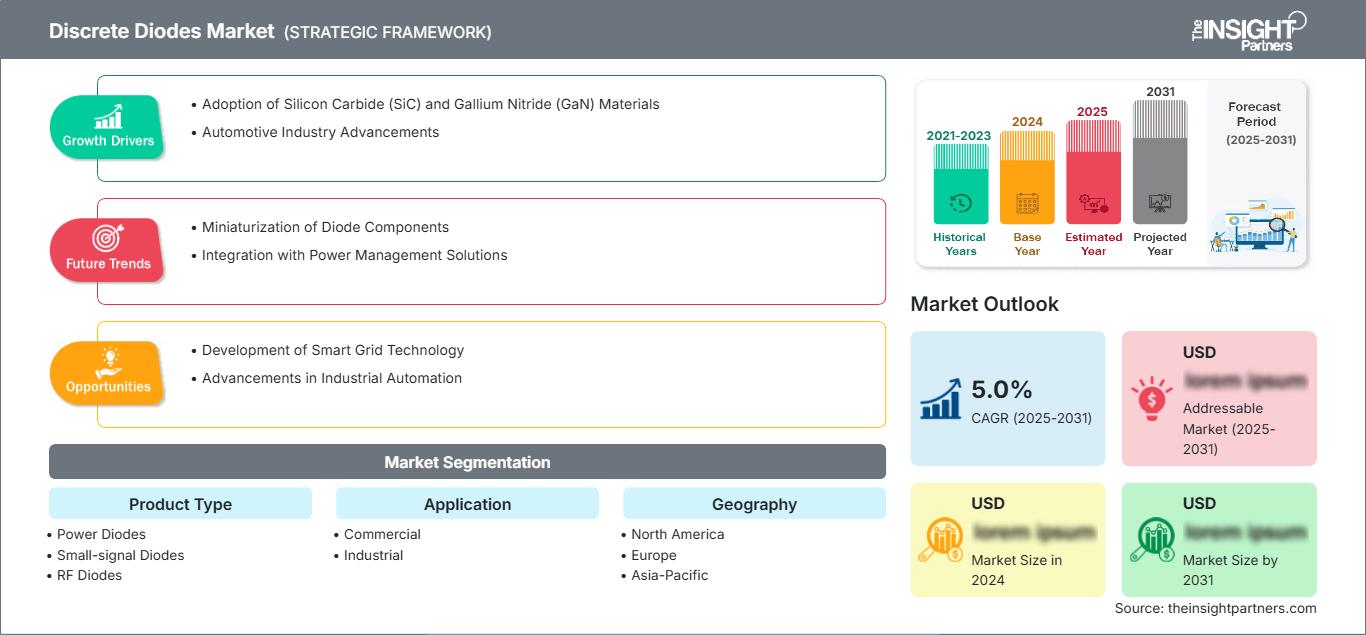
Regional Insights
North America Discrete Diodes Market
North America holds 25–29% share in 2025 and is projected to grow at a CAGR range of 2.9–3.5% during 2026–2034. Discrete Diodes Market share is supported by industrial automation upgrades, aerospace and defense electronics, data center power distribution, commercial building controls, and replacement demand through catalog distributors serving engineers and maintenance buyers.
CHIPS Act incentives for manufacturing, strong EMS demand, and a good installed base of power supply components, telecommunications equipment, and industrial drives are advantages of the region. American and Canadian customers focus on long-term availability of products, RoHS and AEC-Q qualifications, and regular delivery terms. Power diodes are preferable for converters and protection diodes for dense electronics applications.
U.S. Discrete Diodes Market
The U.S. constitutes 82%-86% of North America in 2025 and has a CAGR of 3.0%-3.6% between 2026 and 2034. Applications of the market include industrial controls, commercial IT hardware, aerospace electronics, medical equipment, EV chargers, and data center power supplies which require rectifiers, clamps, switches, and signal conditioners.
Companies present in the market include Diodes Incorporated, Littelfuse, Inc., Vishay Intertechnology, Inc., Semtech Corporation, MACOM Technology Solutions Holdings, Inc., Microchip Technology Inc., and Central Semiconductor Corporation through their design centers, distributors, and application engineering segments. In terms of applications, there is increasing demand for TVS, Schottky, PIN, and Fast Recovery Diodes on smaller boards based on protection and efficiency.
Europe Discrete Diodes Market
Europe holds 21–25% market share in 2025 and has CAGR in the range of 2.6–3.2% for 2026–2034. Germany dominates due to automotive electronics, manufacturing automation, power conversion, and renewable energy requirements that result in consistent demand for skilled power and protection diodes. UK contributes to demand due to aerospace, instrumentation, telecommunication, and defense electronics purchases.
France, Italy, and Spain contribute additional demand due to rail electronics, manufacturing machines, building automation, and energy equipment. Europe places emphasis on certification documents, long qualification period, and supplier consistency. Vishay Intertechnology, Inc., SEMIKRON Elektronik GmbH & Co. KG, Diodes Incorporated, Littelfuse, Inc., and Microchip Technology Inc. will capitalize on distributors catering to industrial and commercial design engineers.
APAC Discrete Diodes Market
The Asia Pacific region captures the 39-43% market share in 2025 and experiences CAGR between 3.8 and 4.6% from 2026 to 2034. Leading countries are China due to electronics assembly, industrial equipment, telecom infrastructure, and electric mobility supply chain. In addition, Japan and South Korea contribute through automotive, robotics, and high-reliability component ecosystems.
Other countries that are involved include India, Taiwan, and Australia, where the involvement is through electronics manufacturing incentives, data infrastructure, renewable energy infrastructure, and commercial equipment manufacturing. The regional semiconductor packaging and industrial automation policies encourage design wins. Cost-sensitive consumers go for standard recovery and small-signal parts, while export-oriented consumers prefer quality and availability of parts.
Middle East & Africa Discrete Diodes Market
Middle East & Africa is expected to experience growth at a CAGR of 2.7%-3.3% over the period of 2026-2034. Saudi Arabia and the United Arab Emirates drive the growth through demand from energy infrastructure, telecom expansion, railways, commercial building construction and industrial automation whereas, South Africa drives growth through repairs, power conversions, mining, and electronics distribution networks.
Rest of MEA demand is driven by grid reliability initiatives, solar plants, connectivity, and import of commercial equipment. Extreme environmental conditions drive demand for rugged protection diodes and high temperature packaging. Growth is aided by the availability of technical documents, distributor stock, and availability of replacements for longevity of infrastructure initiatives.
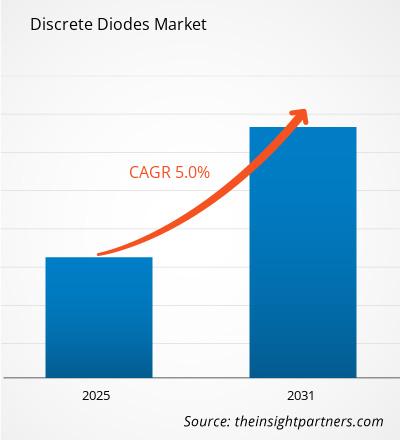
Segmentation Analysis
Product Type
Product Type is projected to grow at a CAGR range of 3.1–3.7% during 2026–2034. The Discrete Diodes Market scope by product type reflects a balance between mature rectification demand and specialized signal requirements. Power diodes anchor revenue through converters and protection circuits, small-signal diodes support switching and logic interfaces, and RF diodes gain importance in communication, test, and sensing equipment.
- Power Diodes: Power diodes serve rectifiers, converters, power supplies, chargers, inverters, and industrial drives where efficiency, surge tolerance, voltage rating, and thermal performance determine product selection.
- Small-signal Diodes: Small-signal diodes address switching, clamping, detection, and logic-level protection in compact commercial boards where low capacitance, fast response, and package availability are decisive.
- RF Diodes: RF diodes support switching, attenuation, detection, and tuning functions in wireless infrastructure, test equipment, radar modules, and communication systems needing predictable high-frequency behavior.
Application
Application is expected to grow at a CAGR range of 3.0–3.6% during 2026–2034. Commercial applications generate high unit demand through IT hardware, telecom equipment, lighting, appliances, and connected devices. Industrial applications provide steadier value because factory automation, drives, power supplies, energy systems, and instrumentation require qualified components with longer life cycles and stronger reliability documentation.
- Commercial: Commercial demand is volume-led, spanning consumer devices, office electronics, communication equipment, chargers, lighting controls, and IT hardware where cost, footprint, and availability influence sourcing.
- Industrial: Industrial users prioritize protection margins, temperature tolerance, long supply continuity, and documented qualification for automation systems, motor drives, power conversion, energy assets, and instrumentation.
Opportunity Snapshot
| Application | Revenue Contribution | Trend Tag | Adoption Stage |
| Commercial | High | Compact Boards | Mature |
| Industrial | Medium | Power Reliability | Scaling |
Discrete Diodes Market Growth Drivers and Impact Analysis
Power Conversion Efficiency Requirements Strengthen Design-In Demand
Industrial and commercial equipment makers are raising efficiency targets as power density increases in chargers, adapters, telecom rectifiers, server power supplies, and factory automation systems. Diodes influence conduction loss, switching recovery, heat generation, and protection margins, making them important even when their unit prices are modest. Silicon carbide Schottky and fast recovery products help designers reduce losses in high-frequency circuits. The market impact is steady design-in activity for power diodes, especially where energy regulations, thermal limits, and smaller enclosures force engineers to replace legacy rectifiers with higher-performance alternatives.
Circuit Protection Needs Rise in Dense Electronic Assemblies
Miniaturized electronics, higher interface speeds, and outdoor connected assets increase exposure to electrostatic discharge, lightning surges, load dumps, and switching transients. TVS and protection diode families reduce failure risk in PoE equipment, communication modules, industrial controllers, and commercial devices. The impact is broader bill-of-material inclusion because protection is often added at multiple ports rather than only at power inputs. Suppliers that offer low-capacitance, high-surge, and automotive-qualified variants can capture more sockets per board while helping OEMs meet IEC and customer reliability requirements.
Industrial Automation and Electrification Expand Long-Life Platforms
Factories, utilities, logistics networks, and building systems are adding sensors, motor drives, controllers, and power electronics to improve uptime and energy use. These platforms often remain in production for many years, which favors diode suppliers that can guarantee continuity and provide complete qualification records. The market impact is less speculative than consumer electronics because industrial buyers value field reliability over rapid product turnover. Demand grows through replacement modules, new automation lines, EV charging hardware, renewable inverters, and control cabinets requiring robust rectification and transient protection.
Discrete Diodes Market Future Trends
Wide-Bandgap Diodes Move into Broader Power Designs
Discrete Diodes Market trends will increasingly reflect adoption of silicon carbide and advanced Schottky designs beyond premium power systems. As switching frequencies rise in industrial supplies, solar inverters, chargers, and data center power stages, engineers will seek lower reverse recovery losses and higher-temperature operation. Wider availability in standard packages should reduce adoption friction. Future competition will center on validated reliability, thermal performance, and package compatibility rather than voltage rating alone, allowing suppliers with strong application support to convert efficiency requirements into repeatable design wins.
RF and Protection Functions Converge in Connected Equipment
Connected commercial and industrial systems will increasingly require both signal integrity and protection within compact layouts. RF diodes, low-capacitance ESD diodes, and PIN diode switches will support wireless modules, instrumentation, radar, and test systems as 5G, private networks, and sensing applications expand. Future demand will reward suppliers that can characterize parasitics, capacitance, insertion loss, and surge behavior clearly. This trend raises the importance of simulation models and evaluation boards because engineers must protect interfaces without degrading high-frequency performance.
Discrete Diodes Market Opportunities
Industrial Power Supply and EV Charging Component Upgrades
Discrete Diodes Market Forecasts support targeted investment in higher-efficiency rectifiers, silicon carbide Schottky diodes, and robust TVS products for industrial power supplies and EV charging hardware. Suppliers should prioritize qualified packages, thermal design guidance, and distributor inventory for repairable infrastructure platforms. The opportunity is attractive because industrial customers redesign slowly but purchase consistently once products are qualified. Manufacturers can also build value through reference designs that combine diodes, MOSFETs, protection devices, and documentation for common converter and charging architectures.
Localized Distribution and Second-Source Assurance
Supply continuity has become a purchasing criterion for even low-cost discrete components after recent semiconductor shortages. Distributors and manufacturers can capture opportunity by maintaining regional stock, publishing lifecycle commitments, and offering pin-compatible alternatives for standard packages. This approach is especially relevant for commercial equipment makers balancing cost and delivery risk. Suppliers that support cross-references, parametric selection, and rapid sample availability can secure preferred vendor status, while OEMs reduce redesign exposure by qualifying multiple diode sources before volume production begins.
Recent Developments
- July 2026: Diodes Incorporated announced that it has entered into a definitive agreement to acquire ElevATE Semiconductor, Inc. in an all-cash transaction valued at US$ 250 million. The acquisition expands Diodes' analog and mixed-signal semiconductor portfolio, strengthens its presence in the automated test equipment (ATE) market, and is expected to be immediately accretive to the company's revenue, gross margin, and earnings per share following the transaction's completion.
- September 2025: Diodes Incorporated, through the Diodes Foundation, partnered with Texas A&M University by contributing US$100,000 to support graduate student research and workforce development in semiconductors. The initiative focuses on chip design, machine learning, and hands-on semiconductor training to strengthen industry-ready talent and bridge academia with the semiconductor sector.
- October 2024: Infineon Technologies introduced the CoolSiC™ Schottky Diode 2000 V G5, the industry's first discrete silicon carbide diode with a 2000 V breakdown voltage, designed for DC link systems up to 1500 VDC. The new diode family offers 10 A to 80 A current ratings in a TO-247PLUS-4-HCC package, enabling higher power density, improved efficiency, and simplified system designs for solar inverters, energy storage systems, and EV charging applications.
Frequently Asked Questions

- Comprehensive Market Sizing and Forecast Analysis
- Detailed Segmentation Analysis
- In-Depth Market Dynamics Assessment
- Regional and Country-Level Insights
- Competitive Landscape and Company Benchmarking
- Strategic Business Intelligence
Recent Reports
Testimonials

The Insight Partners' SCADA System Market report is comprehensive, with valuable insights on current trends and future forecasts. The team was highly professional, responsive, and supportive throughout. We are very satisfied and highly recommend their services.
RAN KEDEM Partner, Reali Technologies LTDs
I requested a report on a very specific software market and the team produced the report in a few days. The information was very relevant and well presented. I then requested some changes and additions to the report. The team was again very responsive and I got the final report in less than a week.
JEAN-HERVE JENN Chairman, Future Analytica
We worked with The Insight Partners for an important market study and forecast. They gave us clear insights into opportunities and risks, which helped shape our plans. Their research was easy to use and based on solid data. It helped us make smart, confident decisions. We highly recommend them.
PIYUSH NAGPAL Sr. Vice President, High Beam Global
The Insight Partners delivered insightful, well-structured market research with strong domain expertise. Their team was professional and responsive throughout. The user-friendly website made accessing industry reports seamless. We highly recommend them for reliable, high-quality research services
YUKIHIKO ADACHI CEO, Deep Blue, LLC.
This is the first time I have purchased a market report from The Insight Partners.While I was unsure at first, I visited their web site and felt more comfortable to take the risk and purchase a market report.I am completely satisfied with the quality of the report and customer service. I had several questions and comments with the initial report, but after a couple of dialogs over email with their analyst I believe I have a report that I can use as input to our strategic planning process.Thank you so much for taking the extra time and making this a positive experience.I will definitely recommend your service to others and you will be my first call when we need further market data.
JOHN SUZUKI President and Chief Executive Officer, Board Director, BK Technologies
I wish to appreciate your support and the professionalism you displayed in the course of attending to my request for information regarding to infectious disease IVD market in Nigeria. I appreciate your patience, your guidance, and the fact that you were willing to offer a discount, which eventually made it possible for us to close a deal. I look forward to engaging The Insight Partners in the future, all thanks to the impression you have created in me as a result of this first encounter.
DR CHIJIOKE ONYIA MANAGING DIRECTOR, PineCrest Healthcare Ltd.Reason to Buy
- Informed Decision-Making
- Understanding Market Dynamics
- Competitive Analysis
- Identifying Emerging Markets
- Customer Insights
- Market Forecasts
- Risk Mitigation
- Boosting Operational Efficiency
- Strategic Planning
- Investment Justification
- Tracking Industry Innovations
- Aligning with Regulatory Trends





 Get Free Sample for