
Disinfectants Market Size, Share & Growth by 2034
Coverage: by Type (Oxidising Disinfectants, Non-Oxidising Disinfectants); Applications (Household, Commercial, Medical, Food and Beverage, Others) , and Geography (North America, Europe, Asia Pacific, and South and Central America)
- Status : Data Released
- Report Code : TIPRE00010181
- Category : Chemicals and Materials
- No. of Pages : 150
- Available Report Formats :


- Last update date : July 28, 2026


2025 Market Size
US$ 37.57 Bn
Base year value
2034 Forecast
US$ 95.99 Bn
Projected by 2034
CAGR 2026-2034
10.99 %
Growth rate
Addressable Market
US$ 590.37 Bn
(2026-2034)
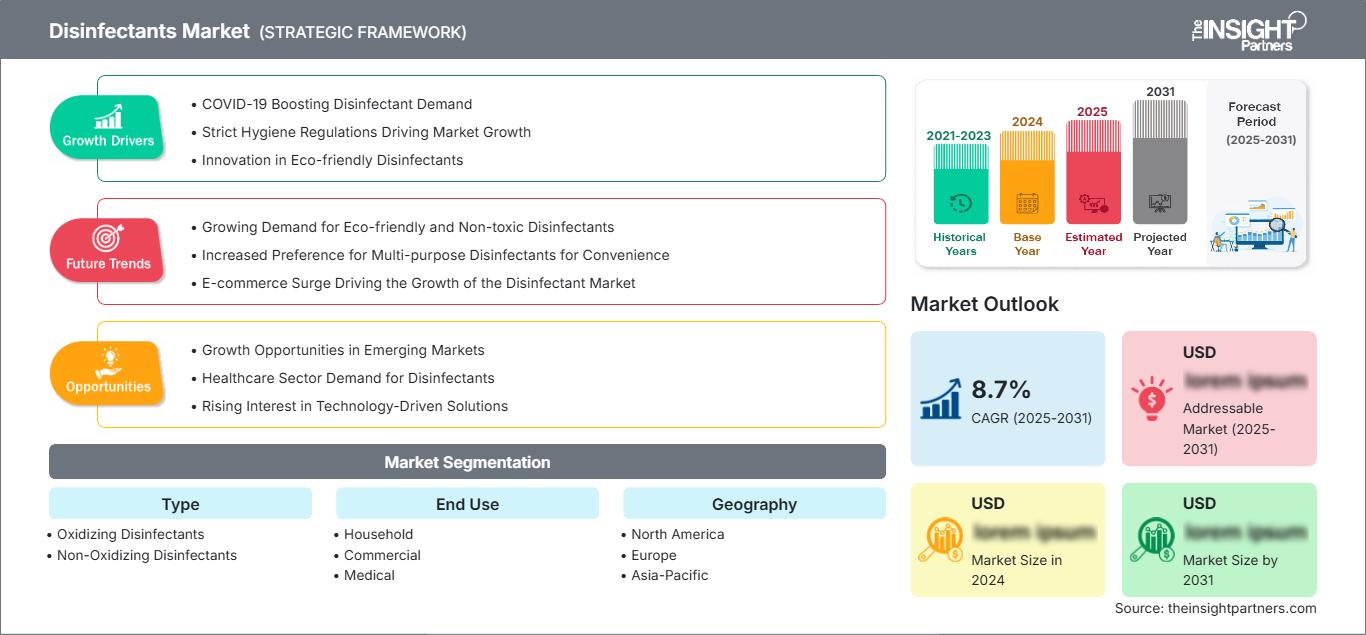
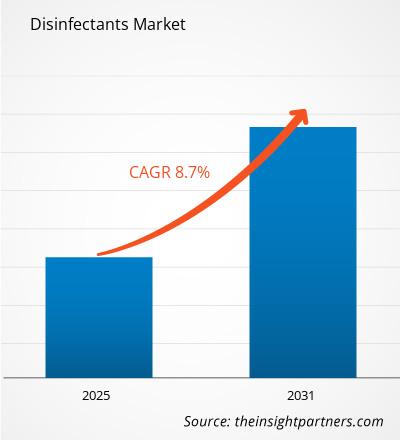
The disinfectants market size was estimated at US$ 37.57 Billion in 2025 and forecasted to grow to US$ 95.99 Billion by 2034, at a CAGR of 10.99%. It continues to thrive due to increasing awareness about hygiene practices, infection prevention policies, and health readiness. The rising number of applications of disinfectants in the healthcare industry, commercial institutions, homes, and food processing sectors will contribute towards their high demand.
In the North American market, the rising demand will be attributed to the strong healthcare infrastructure, higher standards of sanitation, and increased institutional cleaning activities. The size of the Disinfectants Market in the region will benefit from infection prevention initiatives and the use of surface disinfection solutions. Growth in the region is forecasted to be in the range of 9.6% to 10.4% CAGR.
Disinfectants Market Assessment and Insights
- North America: Share in 2025 estimated at 33–37%, supported by strong healthcare expenditures, institutional sanitation standards, and commercial cleaning demand. CAGR between 9.6–10.4% during 2026–2034.
- US: Accounts for 76–80% of North American demand in 2025, driven by healthcare-associated infection control initiatives and extensive commercial adoption. CAGR between 9.8–10.6% during 2026–2034.
- Europe: Holds 24–28% share in 2025, led by Germany, France, the UK, and Italy. Regional demand remains supported by food safety regulations and healthcare sanitation programs. CAGR between 9.3–10.1% during 2026–2034.
- Asia Pacific: Represents 28–32% share in 2025, driven by China, Japan, India, and South Korea. Growing healthcare investment and industrial sanitation needs support CAGR between 11.8–12.6% during 2026–2034.
- Largest Segment: Medical accounts for 34–38% market share in 2025 due to extensive usage in hospitals, clinics, and healthcare facilities. CAGR between 11.5–12.3%.
- High Growth Segment: Food and Beverage represents 16–20% share in 2025 and is projected to expand at a CAGR between 12.1–12.9%.
- Key companies analyzed in detail: 3M Company, Ecolab Inc., S. C. Johnson & Son, Inc., Advanced Sterilization Products, Inc., Metrex Research, LLC, Reckitt Benckiser Group plc, STERIS plc, Tristel plc, Unilever PLC, The Procter & Gamble Company
Source: The Insight Partners' analysis based on proprietary research, government publications, company annual reports, investor presentations, industry databases, and expert interviews.
Changes in infection control methods have played an important role in product development. Increased attention to multi-species efficacy, increased material compatibility, shorter time of use, and increased safety of the users are among the key trends for companies within the market. Expanded production capabilities, innovation of ready-to-use solutions, and development of sustainable chemistry will become a part of the competitive landscape. Digital monitoring devices and hygienic compliance systems will be incorporated into sanitation routines in institutions, helping to better utilize disinfectants.
Future growth will be driven by increased spending on health care infrastructure, food safety measures, and industrial hygiene procedures in emerging markets. Sanitation requirements of regulatory agencies keep becoming stricter in the health care, food processing, and public facilities sectors, making manufacturers promote advanced disinfectants. Increased awareness of preparedness for infectious disease outbreaks, coupled with higher hygiene requirements across industries, is likely to facilitate investment and innovation over the forecast period.
Disinfectants Market Report Scope
| Report Attribute | Details |
|---|---|
| Market size in 2025 | US$ 37.57 Billion |
| Market Size by 2034 | US$ 95.99 Billion |
| Global CAGR (2026 - 2034) | 10.99% |
| Historical Data | 2021-2024 |
| Forecast period | 2026-2034 |
Disinfectants Market Analysis
The disinfectants market growth outlook is buoyed by rising awareness of infection prevention and sanitization management. There will be continuous demand for disinfection solutions globally owing to the growing importance of limiting the spread of pathogens. Hospitals have always been important customers for such products because of the stringent infection control measures, whereas other sectors, such as offices, educational institutes, transport stations, and hospitality establishments, keep increasing their spending on sanitization measures. The rising food safety issues are adding to the consumption from food processing and packaging facilities.
The market environment comprises chemical producers, formulation companies, packaging companies, distributors, institutional buyers, and retailers. The supply factors include the availability of raw materials, regulatory approval conditions, and rising efficiency standards. The producers keep stressing upon formulating products that are stable, efficient, and environmentally friendly.
The level of competition remains high, and the Disinfectants Market report shows a growing emphasis on innovation, collaboration, and portfolio diversification. Companies are making efforts to develop more efficient formulas that effectively address different pathogens without compromising efficiency. The issue of sustainability is also playing a role in driving companies to come up with more environmentally friendly products.
Ecolab Inc., STERIS plc, Reckitt Benckiser Group plc, and 3M Company are the major players that are benefiting from their large-scale distribution channels and know-how in the market. On the other hand, Advanced Sterilization Products, Inc., Tristel plc, Metrex Research, LLC, and The Procter & Gamble Company are making efforts to offer more specialized products for the health care institutions.
● REPORT CUSTOMIZATION
Tailor This Report To Align With Your Specific Business Requirements
This report can be customized to align precisely with your business objectives, scope, and target markets. Customization options include tailored segmentation, geography, competitive analysis, and strategic insights to support informed decision-making.
Customize This Report →WHAT YOU CAN ADJUST
- ● Segmentations
- ● Geography
- ● Competitive Analysis
- ● Language Preferences
Disinfectants Market: Strategic Insights
Regional Insights
<
North America Disinfectants Market
In 2025, North America held a share of about 33-37% in global revenue and is forecasted to expand at a CAGR of 9.6-10.4% till 2034. Demand is driven by strict sanitization rules, high healthcare expenditure, and the implementation of infection prevention programs. Hospitals, nursing homes, food processing units, and commercial establishments continue to adopt effective disinfection practices that boost product sales.
North America is characterized by high quality of healthcare facilities, effective regulation, and high level of awareness about hygiene and safety measures at work places. Institutional users more often apply automation and special formulations to increase efficiency. Investments into healthcare modernization and preparedness for epidemics contribute to growth in market in future.
U.S. Disinfectants Market
The US comprises around 76-80% of the North America’s demand in 2025 and is considered as the largest market in the region. The growth will be driven by robust infrastructure in the healthcare sector, high levels of infection-control standards, and ongoing developments in sanitation products. The market is estimated to grow with the CAGR of 9.8-10.6% over the forecast period.
Disinfectants Market share in the country has gained strength due to the adoption of disinfectants in healthcare, education, office premises and food processing sectors. Key players have a strong presence in the country, ensuring the availability and development of innovative products. The demand for ready-to-use disinfectants and sterilization solutions is on the rise.
Europe Disinfectants Market
Europe was projected to account for 24–28% of the world’s revenue share in 2025 and to grow at a CAGR of 9.3-10.1% during 2024–2034. Germany continues to be the most dominant region due to its advanced healthcare system and regulatory framework, apart from industrialization and good sanitization practices in terms of food safety monitoring.
United Kingdom has substantial demand owing to public health programs and commercial sanitization efforts. The other countries, i.e., France, Italy, and Spain, have their contribution due to the advancement in healthcare programs and sanitation in the food industry. Sustainability and regulatory policies are driving innovation in environmental disinfectants.
APAC Disinfectants Market
The Asia Pacific region accounts for 28-32% of global demand in 2025 and is expected to exhibit the highest regional CAGR at 11.8-12.6% until 2034. China continues to be the leading regional market owing to its extensive healthcare and manufacturing infrastructure.
Indians, Japanese, South Koreans, and Australians are continuing their investments in healthcare facilities, food safety systems, and sanitation facilities. Urbanization and growing healthcare awareness are key drivers of the regional market's growth.
Middle East & Africa Disinfectants Market
The Middle East & Africa market is expected to grow at a CAGR of 10.2–11.0% through 2034. Saudi Arabia and the United Arab Emirates continue investing in healthcare facilities, hospitality infrastructure, and public sanitation initiatives.
South Africa remains a key market due to broad institutional and healthcare demand. Ongoing infrastructure development and rising awareness regarding infection prevention are expected to support wider adoption of disinfectant solutions across the region.
Segmentation Analysis
Type
The disinfectants market scope, based on Types, is continually growing, given the rising emphasis by end-users on effectiveness, efficiency, safety, and compliance with changing sanitation guidelines. In terms of selection, the choice depends on factors such as the pathogenic spectrum, applicability across different surfaces, contact time requirements, and environmental impact. The companies are focusing on developing new formulations that not only enhance the performance but also meet regulatory standards for occupational safety and sustainability. Type-based market segment is expected to grow at a CAGR of 10.4-11.2% in 2026-2034.
- Oxidizing Disinfectants: These products remain widely used due to their broad-spectrum antimicrobial activity and effectiveness against bacteria, viruses, spores, and fungi. Their importance is particularly evident in healthcare facilities, food processing plants, and high-risk sanitation environments.
- Non-Oxidizing Disinfectants: Adoption remains strong across commercial and institutional settings where compatibility with surfaces, ease of application, and long-lasting antimicrobial performance are critical considerations for routine hygiene management programs.
Application
The Application segment represents the primary demand center for disinfectant products, reflecting diverse sanitation requirements across residential, institutional, healthcare, and industrial environments. Increased awareness of infection prevention, public health preparedness, and food safety continues to drive product utilization across all end-use categories. Growing investments in hygiene infrastructure and regulatory compliance programs further support market expansion. The End Use segment is expected to grow at a CAGR of 10.8–11.6% from 2026–2034.
- Household: Consumer demand remains supported by heightened awareness regarding surface hygiene, personal safety, and prevention of infectious disease transmission. Product convenience and multi-surface compatibility continue influencing purchasing decisions.
- Commercial: Offices, educational institutions, hospitality facilities, retail establishments, and transportation hubs increasingly utilize disinfectants to maintain hygiene standards and improve public confidence in shared environments.
- Medical: The largest revenue-generating category, driven by stringent infection-control requirements across hospitals, clinics, laboratories, ambulatory care centers, and long-term healthcare facilities. High-frequency usage sustains strong market demand.
- Food and Beverage: Growing emphasis on food safety management, contamination prevention, and regulatory compliance is increasing disinfectant adoption across processing facilities, packaging operations, storage environments, and foodservice establishments.
Opportunity Snapshot
| Application | Revenue Contribution | Trend Tag | Adoption Stage |
| Household | Medium | Surface Care | Mature |
| Commercial | High | Facility Hygiene | Scaling |
| Medical | High | Infection Control | Mature |
| Food and Beverage | Medium | Food Safety | Scaling |
Disinfectants Market Growth Drivers and Impact Analysis
Stringent Infection Prevention Regulations Across Healthcare Facilities
Healthcare systems worldwide continue strengthening infection prevention requirements to reduce healthcare-associated infections and improve patient safety outcomes. Hospitals, ambulatory surgical centers, diagnostic laboratories, and long-term care facilities increasingly rely on advanced disinfection protocols to maintain compliance with regulatory standards. The World Health Organization has consistently emphasized the importance of environmental hygiene and sanitation in controlling disease transmission. As healthcare infrastructure expands across both developed and emerging economies, procurement of surface disinfectants, instrument disinfectants, and specialized sanitation solutions continues increasing. Greater utilization of high-touch surface disinfection processes and terminal cleaning practices has elevated product consumption volumes. This trend supports steady investment in innovative formulations, broad-spectrum efficacy technologies, and automated disinfection systems designed to improve operational efficiency while maintaining strict microbial control standards.
Growing Food Safety and Processing Hygiene Requirements
Food manufacturers are facing increasing regulatory scrutiny regarding contamination control, operational sanitation, and product safety management. Disinfectants have become essential components of food processing operations, packaging facilities, cold-chain infrastructure, and commercial kitchens. Growing global demand for packaged food products and expanded food export activities are encouraging companies to strengthen sanitation practices throughout production environments. Product manufacturers increasingly utilize specialized disinfectants capable of addressing microbial risks while maintaining compatibility with food-contact surfaces. Enhanced cleaning verification programs and hazard management systems are further supporting demand. The need to minimize operational disruptions associated with contamination incidents has increased investment in effective hygiene programs. Consequently, disinfectant providers continue developing application-specific solutions designed for modern food manufacturing environments and increasingly complex supply chains.
Rising Consumer Awareness of Household and Public Hygiene
Consumer attitudes toward cleanliness and disease prevention have changed substantially in recent years. Households increasingly maintain routine disinfection practices across kitchens, bathrooms, living spaces, and frequently touched surfaces. Public facilities including schools, transportation hubs, retail centers, and entertainment venues have also adopted more structured sanitation protocols. Demand is being supported by greater awareness regarding pathogen transmission and the importance of preventive hygiene measures. Product innovation focused on convenience, multi-surface compatibility, and faster effectiveness continues attracting consumer interest. Manufacturers are expanding portfolios that address both professional and residential applications, creating broader accessibility across markets. The continued normalization of preventive cleaning habits is expected to support long-term demand while encouraging development of safer, more environmentally conscious disinfection products.
Disinfectants Market Future Trends
Expansion of Sustainable and Low-Residue Formulations
The Disinfectants Market trends increasingly reflect demand for products that combine strong antimicrobial performance with improved environmental profiles. Manufacturers are investing in formulations designed to reduce chemical residues, improve biodegradability, and lower environmental impact without compromising efficacy. Institutional buyers are incorporating sustainability criteria into procurement decisions, particularly within healthcare, hospitality, and commercial sectors. Regulatory developments supporting safer chemical usage are also influencing formulation strategies. Future innovation is expected to emphasize eco-conscious active ingredients, reduced packaging waste, and enhanced worker safety. Companies capable of balancing performance requirements with sustainability objectives are likely to strengthen competitive positioning and capture demand from environmentally focused customers.
Integration of Smart Hygiene Monitoring Technologies
Digital transformation is gradually influencing sanitation management practices across institutional and commercial environments. Organizations increasingly utilize connected monitoring systems, compliance-tracking platforms, and automated reporting solutions to improve hygiene program effectiveness. These technologies provide visibility into cleaning frequency, disinfectant usage, and sanitation compliance metrics. Integration of smart systems with facility management operations helps optimize product consumption while improving accountability and operational consistency. Healthcare providers, food manufacturers, and large commercial facilities are expected to increase investment in technology-enabled sanitation programs. This trend may create opportunities for manufacturers to combine disinfectant products with integrated hygiene management solutions and data-driven service offerings.
Disinfectants Market Opportunities
Expansion of Healthcare Infrastructure in Emerging Economies
Investments in healthcare infrastructure across Asia Pacific, Latin America, the Middle East, and Africa are creating substantial opportunities for disinfectant manufacturers. Governments and private healthcare operators continue expanding hospitals, diagnostic centers, outpatient facilities, and long-term care institutions to improve healthcare accessibility. These facilities require comprehensive sanitation programs and infection-control systems that rely heavily on effective disinfectant products. Demand for high-level disinfection solutions, surface sanitation products, and specialized healthcare formulations is expected to increase alongside healthcare capacity expansion. Manufacturers that establish regional production capabilities, localized distribution networks, and technical support services can strengthen market penetration. According to long-term Disinfectants Market Forecasts, healthcare-related demand is expected to remain one of the strongest contributors to future revenue growth, particularly in rapidly developing economies.
Development of Industry-Specific Sanitation Solutions
Significant opportunities exist for companies developing customized disinfection products tailored to specific operational environments. Food processing facilities, transportation systems, educational institutions, hospitality venues, pharmaceutical production sites, and commercial complexes each require unique sanitation solutions based on regulatory obligations and operational conditions. Manufacturers capable of delivering application-specific formulations, compatible dispensing systems, and compliance support services are likely to achieve stronger customer retention. Growing demand for specialized efficacy profiles and faster operational turnaround times further supports innovation. Strategic collaboration with institutional customers can help identify unmet sanitation challenges and support premium product development. These factors create favorable conditions for higher-value solutions that extend beyond traditional commodity disinfectant offerings.
Recent Developments
- June 2026: Clorox Healthcare has announced two new products aimed at improving infection prevention: Clorox Healthcare Quat Alcohol Disinfecting Wipes and Clorox Healthcare HyperOxi Disinfecting Wipes. These products are designed to enhance workflow efficiency and compliance in healthcare settings.
- April 2025: Neogen Corporation has agreed to sell its global cleaners and disinfectants business to Kersia Group for $130 million in cash, plus contingent future considerations. This deal, pending regulatory approval, is anticipated to improve margins and may close in the first quarter of fiscal year 2026. Proceeds will be used to repay $100 million from the company's credit facility, reducing its net leverage ratio by approximately 0.4x.
Frequently Asked Questions

- Comprehensive Market Sizing and Forecast Analysis
- Detailed Segmentation Analysis
- In-Depth Market Dynamics Assessment
- Regional and Country-Level Insights
- Competitive Landscape and Company Benchmarking
- Strategic Business Intelligence
Recent Reports
Testimonials

The Insight Partners' SCADA System Market report is comprehensive, with valuable insights on current trends and future forecasts. The team was highly professional, responsive, and supportive throughout. We are very satisfied and highly recommend their services.
RAN KEDEM Partner, Reali Technologies LTDs
I requested a report on a very specific software market and the team produced the report in a few days. The information was very relevant and well presented. I then requested some changes and additions to the report. The team was again very responsive and I got the final report in less than a week.
JEAN-HERVE JENN Chairman, Future Analytica
We worked with The Insight Partners for an important market study and forecast. They gave us clear insights into opportunities and risks, which helped shape our plans. Their research was easy to use and based on solid data. It helped us make smart, confident decisions. We highly recommend them.
PIYUSH NAGPAL Sr. Vice President, High Beam Global
The Insight Partners delivered insightful, well-structured market research with strong domain expertise. Their team was professional and responsive throughout. The user-friendly website made accessing industry reports seamless. We highly recommend them for reliable, high-quality research services
YUKIHIKO ADACHI CEO, Deep Blue, LLC.
This is the first time I have purchased a market report from The Insight Partners.While I was unsure at first, I visited their web site and felt more comfortable to take the risk and purchase a market report.I am completely satisfied with the quality of the report and customer service. I had several questions and comments with the initial report, but after a couple of dialogs over email with their analyst I believe I have a report that I can use as input to our strategic planning process.Thank you so much for taking the extra time and making this a positive experience.I will definitely recommend your service to others and you will be my first call when we need further market data.
JOHN SUZUKI President and Chief Executive Officer, Board Director, BK Technologies
I wish to appreciate your support and the professionalism you displayed in the course of attending to my request for information regarding to infectious disease IVD market in Nigeria. I appreciate your patience, your guidance, and the fact that you were willing to offer a discount, which eventually made it possible for us to close a deal. I look forward to engaging The Insight Partners in the future, all thanks to the impression you have created in me as a result of this first encounter.
DR CHIJIOKE ONYIA MANAGING DIRECTOR, PineCrest Healthcare Ltd.Reason to Buy
- Informed Decision-Making
- Understanding Market Dynamics
- Competitive Analysis
- Identifying Emerging Markets
- Customer Insights
- Market Forecasts
- Risk Mitigation
- Boosting Operational Efficiency
- Strategic Planning
- Investment Justification
- Tracking Industry Innovations
- Aligning with Regulatory Trends





 Get Free Sample for