Double Wall Jars Market Size & Overview
The double wall jars market was valued at US$ 1.31 Billion in 2025 and is projected to reach US$ 2.40 Billion by 2034, expanding at a CAGR of 6.96% from 2026 to 2034. Growth is supported by rising demand for premium primary packaging, increasing use of protective multi-layer constructions for sensitive formulations, and continued innovation in recyclable and lightweight jar formats. Cosmetic and personal care applications remain important demand centers, while food packaging presents additional opportunities as manufacturers seek durable, visually appealing, and product-protective containers.
North America represents a mature packaging ecosystem supported by established cosmetic brands, specialized packaging suppliers, and sophisticated distribution channels. The regional double wall jars market size is estimated to expand at a CAGR of ~6% through 2034, supported by premium skincare launches, demand for differentiated shelf presentation, and increasing interest in recycled-content packaging. Supplier capabilities in customization, decoration, short production runs, and inventory management also support adoption among established brands and smaller personal care manufacturers.
The demand is focused on applications that require packaging with protective and differentiating functions. Double-wall packaging provides one more layer of protection for the container housing the product, thus allowing manufacturers to develop stronger packaging and improve the shelf presence of products. Cosmetics and other personal care goods often rely on double-wall packaging in the form of jars for creams, balms, powders, lotions, and similar formulations. The value chain covers resin and glass suppliers, jar molders, decoration experts, closure manufacturers, packaging distributors, fillers, and brand owners. The supply chain thus relies on coordinated specifications of materials compatibility, neck finish, liners, closures, decoration, and filling equipment. The supply dynamics in the Double Wall Jars Market is determined by the capabilities to produce two-component and multi-material structures, ensuring consistency of dimensions and appearance. Plastic resin manufacturers enjoy more design flexibility due to the capability of providing various options such as multiple colors, finishing, recyclability, and decoration capabilities with PP and PET. On the other hand, glass jars are still attractive to premium brands looking for weight and tactile experience along with luxury looks. Supplier offerings reflect the growing focus on PCR resins, mono-material constructions, refillability, and decoration options.
This industry comprises of producers, packaging distributors, and specialists focused on distinct areas of the supply chain. Acron Plast Pvt. Ltd. supplies double-wall cosmetic jars in India, while SKS Bottle & Packaging stocks an extensive array of double-wall plastic jars used in packaging and presentations. O.BERK Company supplies double-wall plastic jars in several versions and has diversified its product line towards PCR resins and digital decoration. Rieke specializes in dispensing and closure products, whereas RAEPAK Ltd and The Plastek Group engage in customized packaging solutions. Investments are being made into customization, sustainable materials, and flexibility of production rather than just additional jar capacity. The PCR portfolio of O.BERK shows the practical application of recycled resin within the framework of double-wall jars and even includes PP PCR in several sizes of double-wall jars. Other suppliers focus on mono material PET constructions and refillable systems, suggesting that competitive advantage in the future will be determined by such factors as recyclability, decoration capabilities, minimum order flexibility, and compatibility with high-end formulas.
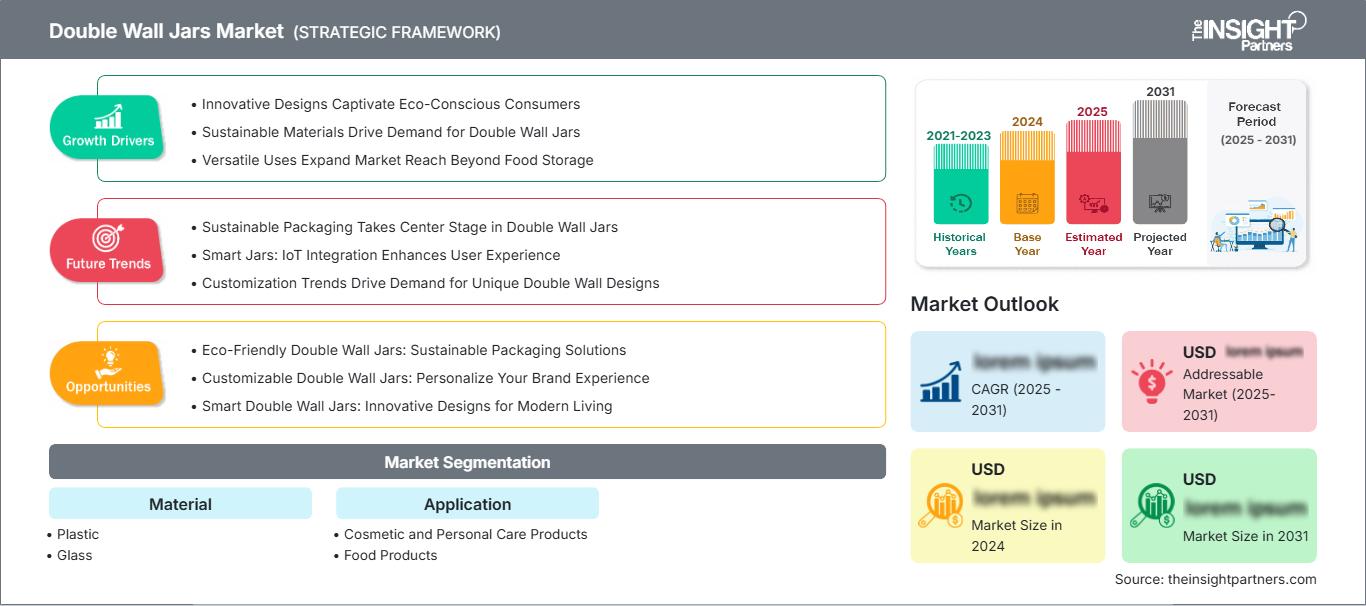
Double Wall Jars Market Assessment and Insights
Regional Outlook
- North America: ~34% of the global market in 2025 | ~6% CAGR through 2034. Market position: North America holds a substantial mature-market position because of its established beauty and personal care packaging ecosystem, broad supplier network, premium product launches, and demand for customizable jars with reliable protection and presentation.
- US: ~78% of North American market revenue in 2025 | ~6% CAGR through 2034. Market position: The US accounts for most North American demand, supported by sophisticated cosmetic packaging channels, contract manufacturers, specialty distributors, and extensive use of premium jars for creams, balms, lotions, and other high-value formulations.
- Europe: ~30% of the global market in 2025 | ~6% CAGR through 2034. Market position: Europe represents a mature packaging market led by Germany, France, Italy, the UK, and Spain, where premium cosmetics, sustainability requirements, refillability, recycled materials, and design-led packaging influence purchasing decisions.
- Asia Pacific: ~28% of the global market in 2025 | ~9% CAGR through 2034. Market position: Asia Pacific is the fastest-growing regional market, supported by expanding beauty consumption, manufacturing capacity, rising domestic brands, and increasing adoption of sophisticated packaging formats. China is the leading country in Asia Pacific.
Segment Outlook
- Plastic: ~78% Share in 2025 | ~7% CAGR through 2034. Market position: Plastic leads because injection-molded formats combine lightweight construction, design flexibility, lower transport burden, decoration options, and scalable manufacturing. Its suitability for personal care formulations and compatibility with recycled-content strategies reinforce its broad adoption.
- Food Products: ~28% Share in 2025 | ~8% CAGR through 2034. Market position: Food Products represent the higher-growth application segment as brands explore rigid premium containers for specialty foods, spreads, confectionery, and other products where product protection, visual presentation, and resealable functionality can support differentiated positioning.
Competitive Coverage
Acron Plast Pvt. Ltd., Citadel Packaging Company, Containers Plus, E.D. Luce Packaging, O.BERK Company, RAEPAK Ltd, Rieke, SKS Bottle & Packaging, Inc., The Plastek Group, United States Plastic Corporation
Methodology
The Insight Partners follows Data Collection & Secondary Research, Primary Research, Data Analysis, and Data Triangulation & Final Review to validate market estimates and insights.
Source: The Insight Partners' analysis based on proprietary research, government publications, company annual reports, investor presentations, industry databases, and expert interviews.
Double Wall Jars Market Trends
Shift Toward Mono-Material and Refillable Jar Architectures
Future packaging development in the Double Wall Jars Market Trends is likely to increasingly focus on reducing material complexity while retaining the visual depth associated with double-wall designs. Mono-material PET and recycled PET solutions demonstrate how manufacturers can integrate inner and outer structures using related material systems. Refillable architectures may also become more relevant for premium skincare, where consumers can retain an outer package while replacing an inner component. This approach changes jar design from a single-use container toward a packaging system involving reusable elements. Suppliers will therefore need to consider material compatibility, disassembly, sealing, filling, and consumer handling during initial product development. These requirements could increase the role of packaging engineering in brand innovation and procurement decisions.
Integration of Decoration With Structural Packaging Design
Decoration is likely to become increasingly integrated into double-wall jar development rather than added after the container is selected. Digital printing, metallization, matte effects, frosting, color matching, and selective surface treatments allow brands to create differentiated appearances without completely redesigning the underlying container. O.BERK's digital printing capability across double-wall jars illustrates this direction, while other suppliers combine multiple surface and color options with established jar architectures. The trend can shorten development cycles for product launches and enable more frequent packaging refreshes. It may also strengthen supplier relationships because brands can consolidate container sourcing and decoration activities through fewer packaging partners.
Double Wall Jars Market Growth Factors
Premiumization of Cosmetic and Personal Care Packaging
Premiumization is increasing the importance of packaging as part of the overall product experience. Double-wall construction gives brands greater freedom to create substantial profiles, contrasting inner and outer colors, decorative surfaces, and premium closures while maintaining practical product containment. Packaging suppliers increasingly market double-wall formats specifically for creams, beauty products, and high-end formulations. This supports demand from brands competing through visual differentiation rather than relying solely on formulation claims. The impact extends across the value chain because premium packaging can require specialized molds, decoration processes, compatible closures, and higher-quality inspection. As brands introduce more differentiated skincare and personal care products, suppliers with design and customization capabilities can capture additional packaging demand.
Expansion of Sustainable Recycled-Content Packaging
Sustainability is changing the specifications considered during jar development. Packaging companies are introducing PCR-compatible double-wall formats, mono-material structures, refillable designs, and recycled PET alternatives. O.BERK's portfolio demonstrates that PCR resin can be incorporated into multiple double-wall jar formats, while Frapak has commercialized a mono-material PET double-wall cosmetic jar. These developments can reduce reliance on conventional virgin materials while maintaining the visual and functional characteristics required by brands. The commercial impact is strongest where packaging buyers have explicit recycled-content or recyclability objectives. Suppliers that can maintain appearance, dimensional stability, and decoration quality when using recycled inputs are positioned to address increasingly specific packaging requirements.
Growth of Flexible and Customizable Packaging Supply Models
Packaging procurement is becoming more flexible as emerging beauty brands, contract manufacturers, and specialty food companies seek lower barriers to launching differentiated products. Stock availability, smaller production runs, custom colors, decoration, and compatible closures can reduce development complexity. O.BERK's digital printing capability for single, double, and thick-wall jars illustrates how decoration technologies can support lower minimums and shorter lead times. Distributors such as SKS also provide broad stock selections, allowing customers to source containers without developing a completely new package. This driver expands the addressable customer base beyond large brands and supports demand for suppliers capable of combining standard products with customization services.
Double Wall Jars Market Opportunities
Develop Sustainable Premium Packaging Platforms
Packaging manufacturers can create commercial opportunities by combining premium double-wall aesthetics with measurable sustainability attributes. Product platforms based on recycled PET, PCR PP, mono-material construction, and refillable inner components can address brands seeking differentiated packaging without abandoning sustainability objectives. The Double Wall Jars Market Forecast opportunity is particularly relevant to skincare and premium personal care, where packaging appearance remains important to purchasing and brand positioning. Suppliers can strengthen these platforms by offering compatible closures, decoration, liners, and filling guidance. Standardized sustainable jar families could also reduce development time because brands could select from established sizes and finishes rather than commission entirely new packaging architectures for every product launch.
Expand Regional Supply and Customization in Asia Pacific
Asia Pacific provides opportunities for suppliers to expand local production, decoration, and distribution capabilities as beauty manufacturing and domestic brands continue to develop. China and India offer large manufacturing ecosystems, while Japan and South Korea provide sophisticated premium beauty demand. Localized production can reduce logistics requirements and shorten development cycles for regional brands. Suppliers can differentiate through modular jar platforms, flexible order quantities, custom colors, recycled-content options, and integrated decoration. This model can serve both established manufacturers and smaller brands that need premium packaging but cannot justify large bespoke tooling programs. Building regional technical and customer-service capabilities can therefore complement conventional capacity expansion.
Segmentation Analysis
Material
Plastic represents the largest material category in the Double Wall Jars Market because manufacturers can produce lightweight, customizable, and scalable containers while integrating decoration, closures, and recycled content. The material is particularly suited to brands requiring varied colors, finishes, shapes, and production volumes. Plastic packaging also supports compatibility with refillable and mono-material concepts. Within this category, Plastic is expected to register a CAGR of ~7% through 2034 as brands balance premium presentation with transportation efficiency and manufacturing flexibility.
- Plastic: Plastic double-wall jars provide lightweight construction, broad molding flexibility, and compatibility with multiple finishes and closure systems. Their combination of durability and customization makes them widely applicable to cosmetic and personal care packaging where appearance and handling performance are important.
- Glass: Glass double-wall jars serve premium positioning where tactile quality, weight, transparency, and a luxurious appearance influence packaging selection. They are particularly relevant to high-value skincare and beauty formulations where packaging contributes materially to brand presentation and perceived product quality.
Application
Application demand is shaped by the formulation characteristics, brand positioning, filling requirements, and consumer expectations associated with each end use in the Double Wall Jars Market. Personal care remains a major demand center because creams, lotions, balms, and related products benefit from substantial packaging and visual differentiation. Food applications are expanding as brands explore rigid premium containers for specialty products. Food Products are expected to register a CAGR of ~8% through 2034, supported by packaging differentiation and product-protection requirements.
- Cosmetic and Personal Care Products: This application emphasizes premium aesthetics, formulation protection, easy dispensing, and compatibility with sophisticated decoration. Double-wall construction is frequently used for creams, moisturizers, balms, masks, and related products where packaging appearance directly supports brand differentiation.
- Food Products: Food applications require suitable product-contact materials, secure closures, hygiene, and protection during storage and distribution. Double-wall formats can support specialty foods and premium products where a substantial container, attractive presentation, and resealable functionality contribute to the overall consumer proposition.
Opportunity Snapshot
| Application | Revenue Contribution | Trend Tag | Adoption Stage |
| Cosmetic and Personal Care Products | High | Premium Skincare | Mature |
| Food Products | Medium | Specialty Foods | Scaling |
Regional Insights
North America Double Wall Jars Market
In 2025, North America contributed around ~34% to the worldwide Double Wall Jars Market Share and will witness growth at a CAGR of ~6% through 2034. This region is characterized by the presence of an existing packaging ecosystem catering to leading cosmetics, personal care, food, and specialty consumer product companies. United States stands out as the main consumer of the product due to high availability of stock jars, contract packaging, customization and decoration, and packaging distributors. Double wall jars are especially significant in applications involving premium creams, balms, lotions, and beauty items because the product appearance and protection contribute towards packaging choice.
The distribution channels in the region are also well-suited for small brands since distributors can offer them ready-to-ship packaging, along with customization and decoration services. In terms of suppliers, SKS Bottle & Packaging provides a variety of double wall plastic jars, while O.BERK supplies various double wall jars with decoration. Moreover, there has been a growing trend towards development of recycled content in this segment with O.BERK having a wide range of double wall jars containing high PCR content.
U.S. Double Wall Jars Market
The US accounted for about 78% of the North American market revenue in 2025 and is estimated to grow at a CAGR of around 6% till 2034. This status derives from the size of the country’s cosmetics and personal care industry, the availability of packaging purchase channels, and the wide supplier coverage. It is possible to buy stock jars and to access custom coloration, closures, decoration, liners, and other packaging elements as well.
US consumers prefer double-wall jars with better looks rather than heavier constructions. O.BERK produces double-wall plastic jars that are used for cosmetics and high-quality products, while SKS supplies bulk double-wall jars of various sizes and neck finishes. Food applications bring additional demand for such structures as well. All these features make the US a key player in the North American packaging market.
Europe Double Wall Jars Market
Europe represented ~30% of the global market in 2025 and is forecast to expand at a CAGR of ~6% through 2034. Germany, France, Italy, the UK, and Spain form important demand centers, with France and Italy particularly associated with premium beauty and cosmetics packaging. The European market is characterized by strong emphasis on product aesthetics, sustainability, packaging functionality, and material efficiency. Suppliers are therefore increasingly developing solutions that retain the premium appearance of double-wall construction while reducing material complexity.
Germany has an advantage in having a strong ecosystem of industry and consumer goods, whereas France has strong demand related to skincare, makeup, and luxury beauty. Italy offers both packaging design competence and large cosmetics manufacturing industry, whereas the UK and Spain add more demand from personal care and consumer goods. Suppliers in Europe are aggressively developing mono-material and recycled-content options. Frapak’s Trento range, for instance, is made of PET or rPET all around the double-wall jar structure and acts as a mono-material option for cosmetics applications.
Therefore, the European competitive landscape is shaped by sustainability, in addition to traditional factors of cost and performance. It becomes necessary for suppliers to be able to work with recycled materials, refills, and efficient decoration without compromising aesthetics and functionality. Companies that can unite engineering, design, and material development competencies will be at an advantage here. Demand from premium skincare and personal care products will continue to be an essential basis, and food applications will add diversification.
APAC Double Wall Jars Market
Asia Pacific region contributed around 28% share to the global Double Wall Jars Market in 2025 and is estimated to grow with a CAGR of ~9% up to 2034, thereby being the fastest growing regional market. Leading country in the Asia Pacific region is China owing to its strong cosmetic manufacturing environment, packaging manufacturing capacities, and the growth of local beauty brands. Countries like Japan and South Korea help in providing advanced formulation and high-end beauty products, while India and Australia offer other potential markets in personal care and specialty consumer goods.
Other reasons for regional growth include the emergence of local packaging suppliers providing customized double wall jars for cosmetics brands. In countries such as China and India, suppliers are increasingly offering multiple materials, finishes, sizes, and decoration possibilities to help local brands to gain access to premium products without necessarily sourcing packaging from foreign locations.
Middle East & Africa Double Wall Jars Market
The Middle East & Africa market is projected to expand at a CAGR of ~7% through 2034. Saudi Arabia and the UAE are important regional centers for premium personal care, beauty retail, and imported consumer products, while South Africa provides a developed packaging and consumer-products base. Demand is influenced by premiumization, expanding modern retail, and the increasing presence of regional and international cosmetic brands.
Saudi Arabia will derive advantage from investment in consumer products and retail development, while the UAE acts as the logistics hub and market for luxury consumers. South Africa is aided in terms of demand through existing manufacturing and packaging capacity. RoMEA is somewhat fragmented with adoption depending on import dependency, capacity to fill locally, and brand penetration. The energy and infrastructure situation impacts manufacturing economics, while regional diversification presents a chance for suppliers with flexible minimum orders and standard packaging.
Double Wall Jars Market Report Scope
| Report Attribute | Details |
|---|---|
| Market size in 2025 | US$ 1.31 Billion |
| Market Size by 2034 | US$ 2.40 Billion |
| Global CAGR (2026 - 2034) | 6.96% |
| Historical Data | 2021-2024 |
| Forecast period | 2026-2034 |
| Segments Covered | Material, Application |
| Region scope | North America, Europe, Asia-Pacific, South and Central America, Middle East and Africa |
Recent Developments
- September 2026: Quadpack Industries S.A. introduced Mahina Tottle, a skincare packaging solution designed to address dosing, product waste, and application challenges. The development reflects continued investment in user-oriented and sustainable beauty packaging and complements the company's broader portfolio of cosmetic jars, refill systems, and customized packaging solutions.
- January 2025: TriMas Packaging, through the Rieke brand, presented sustainable beauty packaging solutions at Paris Packaging Week, including PET jars for hair care applications and advanced color cosmetic packaging. The portfolio demonstrated continued investment in recyclable materials and engineered packaging formats for beauty and personal care applications.
Frequently Asked Questions

Recent Reports






