
Dry Film Market Trends, Size & Growth by 2034
Coverage: by Type (Positive, Negative); Application (Printed Circuit Boards, Microprocessor Unit Packaging, Flexible Printed Circuits, IC Packaging, Others), and Geography (North America, Europe, Asia Pacific, and South and Central America)
- Status : Data Released
- Report Code : TIPRE00013375
- Category : Chemicals and Materials
- No. of Pages : 150
- Available Report Formats :


- Last update date : July 27, 2026


2025 Market Size
US$ 1.42 Bn
Base year value
2034 Forecast
US$ 3.25 Bn
Projected by 2034
CAGR 2026-2034
9.64 %
Growth rate
Addressable Market
US$ 20.82 Bn
(2026-2034)
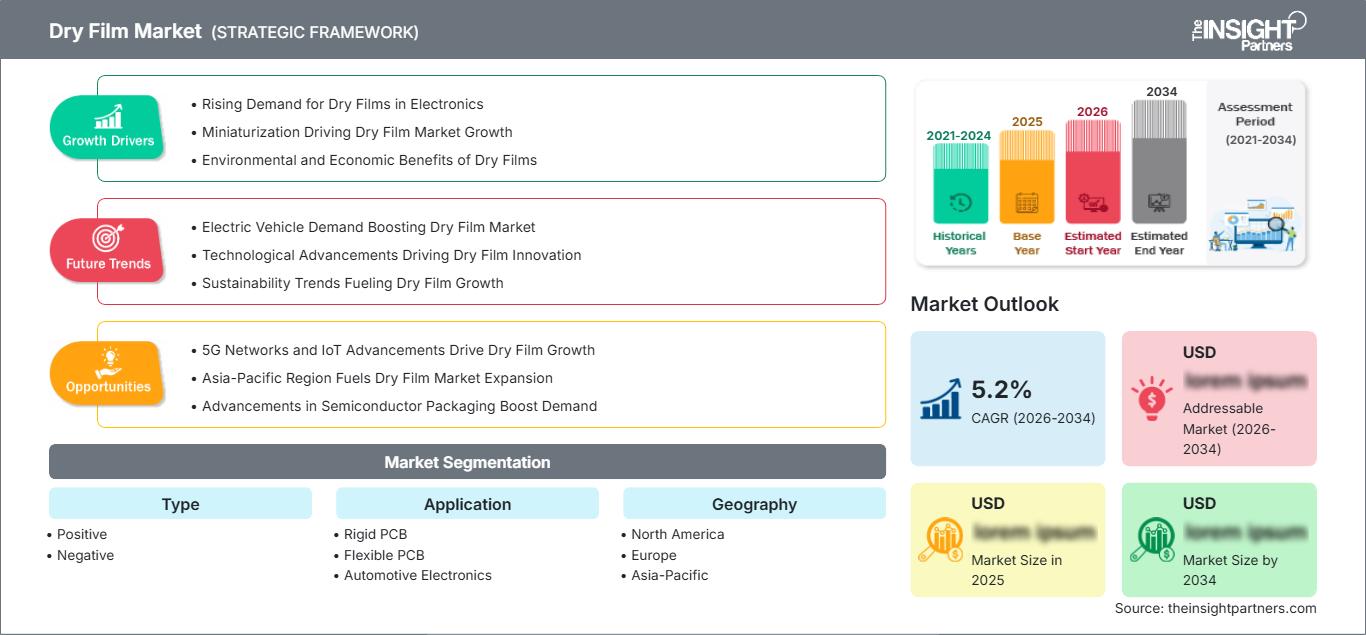
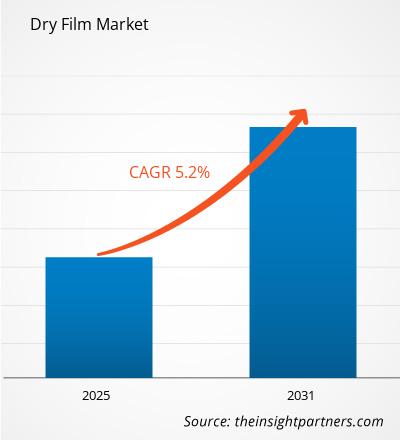
The Dry Film Market size stood at US$ 1.42 Billion in 2025 and expected to grow up to US$ 3.25 Billion by 2034, representing a CAGR of 9.64%. The market is being boosted by the growing demand for advanced electronic devices and increasing manufacture of semiconductors and printed circuit boards (PCB). Growth in automotive electronics, consumer electronics, telecommunication, and industrial automation is driving the global demand for dry films.
North America continues to be an important market owing to investments in semiconductor manufacture and electronics onshoring efforts and advanced PCB manufacturing. The Dry Film Market size in North America is driven by rising demand for efficient circuit design technology and use of electronic systems. Market growth in the region is anticipated to register a CAGR of between 8.4 and 9.2% through 2034.
Dry Film Market Assessment and Insights
- North America: Share in 2025 estimated at 20–24%, supported by semiconductor manufacturing investments, advanced electronics production, and expanding PCB requirements. CAGR between 8.4–9.2% during 2026–2034.
- US: Accounts for 78–82% of North American demand in 2025, driven by semiconductor fabrication investments and electronics manufacturing expansion. CAGR between 8.7–9.5% during 2026–2034.
- Europe: Holds 18–22% Dry Film Market share in 2025, led by Germany, France, Italy, and the UK. Regional demand is supported by industrial electronics and automotive applications. CAGR between 8.0–8.8% during 2026–2034.
- Asia Pacific: Represents 48–52% share in 2025, driven by China, Taiwan, South Korea, Japan, and India. CAGR between 10.5–11.3% during 2026–2034.
- Largest Segment: Rigid PCB accounts for 34–38% market share in 2025 due to extensive utilization in consumer electronics and industrial equipment. CAGR between 9.1–9.9%.
- High Growth Segment: Semiconductors represent 18–22% share in 2025 and are projected to expand at a CAGR between 11.2–12.0%.
- Key companies analyzed in detail: DuPont de Nemours, Inc., Asahi Kasei Corporation, Resonac Corporation, Mitsubishi Paper Mills Limited, Kolon Industries, Inc., Eternal Materials Co., Ltd., Elga Europe S.r.l., Huqiu Imaging (Suzhou) Co., Ltd., Great Eastern Resins Industrial Co., Ltd., Konica Minolta, Inc
Source: The Insight Partners' analysis based on proprietary research, government publications, company annual reports, investor presentations, industry databases, and expert interviews.
Technologies used in manufacturing will advance toward smaller circuit patterns, higher resolution, and more robust process reliability. Manufacturers have been developing more sophisticated photolithography materials to meet their needs for creating more advanced electronics. There is also a trend of greater need for miniaturized products, higher density interconnects, and innovative semiconductor packaging. Increased adoption of automation systems in manufacturing plants is another factor.
Future growth will be driven primarily by Asia Pacific and certain semiconductor manufacturers in North America. Favorable government incentives for domestic electronics manufacturing, growing number of electric vehicles, and development of data infrastructure are creating good environment for the players of the market. Increasing need for products featuring artificial intelligence, high-end computing technology, and telecommunications equipment will ensure steady investments into the industry.
Dry Film Market Report Scope
| Report Attribute | Details |
|---|---|
| Market size in 2025 | US$ 1.42 Billion |
| Market Size by 2034 | US$ 3.25 Billion |
| Global CAGR (2026 - 2034) | 9.64% |
| Historical Data | 2021-2024 |
| Forecast period | 2026-2034 |
Dry Film Market Analysis
The market growth is closely linked to global growth in electronics manufacturing and the increased need for circuit fabrication technology. Dry film products are significant in circuit board manufacturing, semiconductor manufacturing, and electroplating, with imaging capability. Demand is driven by increasing adoption of consumer electronics, electric vehicles, industrial automation machinery, and communication devices.
Key stakeholders include chemical companies, material manufacturers, PCB manufacturers, semiconductor manufacturers, equipment manufacturers, and electronics manufacturers. Dynamics of supply chain are affected by availability of raw materials, advances in technology, and manufacturing base of regions. Increasing importance is being accorded by companies to product quality and technical collaboration with electronics makers.
In terms of the competitive landscape, there is an increasing tendency towards innovations, manufacturing, and diversification of portfolio. Companies involved in the industry make considerable efforts to develop new materials that would be able to facilitate finer circuits and dense electronic constructions. Collaboration between companies in materials and electronics production is also gaining popularity due to the growing demand for the latest technology.
DuPont de Nemours, Inc., Asahi Kasei Corporation, Resonac Corporation, and Eternal Materials Co., Ltd. sustain their competitive advantage due to their R&D activities. Among other market players, such companies as Kolon Industries, Inc., Great Eastern Resins Industrial Co., Ltd., and Mitsubishi Paper Mills Limited invest in improvement of product features and provision of services that meet customers' needs.
● REPORT CUSTOMIZATION
Tailor This Report To Align With Your Specific Business Requirements
This report can be customized to align precisely with your business objectives, scope, and target markets. Customization options include tailored segmentation, geography, competitive analysis, and strategic insights to support informed decision-making.
Customize This Report →WHAT YOU CAN ADJUST
- ● Segmentations
- ● Geography
- ● Competitive Analysis
- ● Language Preferences
Dry Film Market: Strategic Insights
Regional Insights
North America Dry Film Market
North America was projected to hold about 20-24% market revenue share in 2025, which is expected to grow at a CAGR of 8.4-9.2% till 2034. The region boasts of growing investments in semiconductor manufacturing, advanced electronics research and development, as well as industrial policies. The rising importance of resilient supply chains and the expansion of domestic production are boosting demand for dry films used in PCB manufacturing and semiconductor packaging.
Semiconductor manufacturing companies, advanced manufacturing plants, research facilities, and innovative technology companies constitute the electronics industry ecosystem of the region. The government initiatives related to semiconductor manufacturing and advanced manufacturing technologies have opened up further avenues for dry film manufacturers.
U.S. Dry Film Market
The US accounts for 78-82% of the North American market share in 2025 and is considered the greatest contributor to the region's revenues. Development will be stimulated by the capitalization on chip fabrication, electronics manufacturing, and the use of advanced computing systems. The market is anticipated to grow with a CAGR of 8.7-9.5%.
The market in the US is driven by considerable spending on chip fabrications, high-level electronics development, and advanced PCB fabrications. Key technology and semiconductor producers continue to expand their manufacturing capacity within the country. Rising needs for electric vehicles, telecom equipment, and defense electronics will stimulate increased material consumption.
Europe Dry Film Market
Europe’s share of total revenue in 2025 was estimated to be around 18-22%, and the region is forecasted to grow at a CAGR of 8.0-8.8% up to 2034. Germany still leads the way, driven by high levels of electronics development for industrial and automotive use. Germany also invests in semiconductors and electronics innovations.
The UK drives demand by means of electronics that require intensive research, whereas France relies on aerospace and industrial automation uses of electronics. Italy and Spain benefit from growing electronic manufacturing operations along with increased use of advanced control systems. Efforts towards semiconductor development in the region are expected to provide further growth opportunities for dry films suppliers.
APAC Dry Film Market
Asia Pacific represents 48–52% share of global demand in 2025 and is expected to achieve the highest regional CAGR of 10.5–11.3% through 2034. China, Taiwan, Japan, and South Korea remain major electronics manufacturing centers with extensive PCB and semiconductor production capabilities.
India and Southeast Asia are emerging as important manufacturing destinations supported by favorable investment policies and expanding electronics supply chains. Continued industrial development and technology adoption are expected to reinforce regional leadership.
Middle East & Africa Dry Film Market
The Middle East & Africa market is forecast to expand at a CAGR of 8.8–9.6% during the forecast period. Growth is supported by increasing industrial digitalization, electronics assembly investments, and infrastructure modernization initiatives.
The UAE and Saudi Arabia continue investing in technology-focused economic diversification strategies, while South Africa remains an important industrial market. Increasing adoption of advanced electronics across multiple sectors supports future growth opportunities.
Segmentation Analysis
Type
The Dry Film Market scope within the type segment is influenced by evolving requirements for precision imaging, circuit density, manufacturing efficiency, and process reliability across PCB and semiconductor fabrication. Manufacturers are increasingly developing formulations that enable finer line widths, improved adhesion, and enhanced resistance to processing chemicals. As electronics become more compact and sophisticated, demand for advanced dry film materials continues to increase. The Type segment is projected to grow at a CAGR of 9.2–10.0% during 2026–2034, supported by expanding global electronics production and increasing investment in semiconductor manufacturing facilities.
- Positive: Positive dry films are widely utilized in high-resolution circuit fabrication processes where precise pattern transfer and dimensional stability are essential. Their importance continues increasing with growing demand for advanced electronic devices and miniaturized circuit architectures.
- Negative: Negative dry films maintain strong adoption across PCB manufacturing applications due to their processing efficiency, durability, and compatibility with complex production requirements. Their versatility supports usage across multiple electronics manufacturing environments.
Application
Application segments remain the primary drivers of demand, reflecting the growing importance of electronics across consumer, industrial, automotive, and communication sectors. Increasing adoption of high-performance devices, growth in semiconductor fabrication capacity, and the expansion of advanced PCB manufacturing continue stimulating material consumption. Manufacturers are developing application-specific solutions to support emerging technologies and improve production efficiency. The Application segment is expected to expand at a CAGR of 9.8–10.6% during the forecast period.
- Rigid PCB: The largest application category due to extensive deployment in consumer electronics, industrial equipment, networking devices, automotive systems, and communication infrastructure requiring reliable circuit board manufacturing.
- Flexible PCB: Demand is supported by miniaturization trends across wearable electronics, healthcare devices, smartphones, and compact consumer products where flexibility and lightweight performance are important design requirements.
- Automotive Electronics: Increasing integration of advanced driver assistance systems, vehicle electrification technologies, sensors, and infotainment solutions is driving higher utilization of sophisticated circuit manufacturing materials.
- Semiconductors: Fast-growing demand results from expanding global chip production, advanced packaging technologies, and investment in high-performance computing, artificial intelligence, and data center applications.
- Electroplating: Dry film materials play a significant role in electroplating processes requiring precise pattern definition and reliable process control, supporting applications across multiple electronics manufacturing workflows.
Opportunity Snapshot
| Segment Name | Revenue Contribution | Trend Tag | Adoption Stage |
| Rigid PCB | High | HDI Boards | Mature |
| Flexible PCB | Medium | Flexible Devices | Scaling |
| Automotive Electronics | Medium | Vehicle Electronics | Scaling |
| Semiconductors | High | Advanced Packaging | Emerging |
| Electroplating | Medium | Precision Imaging | Mature |
Dry Film Market Growth Drivers and Impact Analysis
Expansion of Global Semiconductor Manufacturing Capacity
The semiconductor industry is ramping up its manufacturing capabilities to meet the rising demands of AI, cloud computing, consumer electronics, automotive, and industrial automation sectors. The dry film continues to play a critical role in several fabrication and packaging operations that require pattern accuracy and process stability. National governments in North America, Europe, and Asia are encouraging domestic semiconductor fabrication through incentive programs and investments to ensure the resilience of their supply chains. The new manufacturing facilities result in steady growth in the need for state-of-the-art dry film products. With the increased complexity in chip architecture, there is a need for materials that can cope with the demands for feature size and processing capability.
Rising Demand for Advanced Printed Circuit Boards
The rising complexity of electronic products has increased the need for sophisticated printed circuit boards that are compact, highly dense, and perform well. The use of dry films is essential for the purpose of accurate imaging of circuits, which is necessary for the manufacturing of modern PCBs. The use of smartphones, networking devices, automated machines, and various medical devices continues to drive demand for dry films. High density interconnect technology and multilayer PCBs are becoming more common and necessitate the use of special processing materials. Demand for PCBs will be bolstered by the trend of connected and intelligent devices. With expanding electronics applications, dry film demand is likely to rise.
Growth of Electric Vehicles and Automotive Electronics
Automotive manufacturers continue increasing electronic content per vehicle through the integration of advanced safety systems, electric powertrains, battery management technologies, connectivity platforms, and digital cockpit solutions. These systems require sophisticated printed circuit boards and semiconductor components that depend on precise manufacturing processes. Dry film products contribute to achieving the accuracy and reliability necessary for automotive-grade electronics. The rapid transition toward electric vehicles is further increasing semiconductor and PCB requirements across the automotive sector. Growing investment in autonomous driving technologies and intelligent transportation systems is also supporting demand. These developments position automotive electronics as a significant growth catalyst for the dry film industry throughout the forecast horizon.
Dry Film Market Future Trends
Increasing Adoption of Advanced Packaging Technologies
The Dry Film Market trends increasingly reflect the industry's transition toward advanced semiconductor packaging architectures designed to improve performance, power efficiency, and component density. The emergence of new technology platforms such as heterogeneous integration, wafer-level packaging, and substrate advancements necessitates accurate material platforms to address increasing complexities in manufacturing processes. Dry film manufacturers are investing in research and development to meet these technical challenges. With advances in technologies such as artificial intelligence, high-performance computing, and new communication technologies, the demand for advanced packaging is expected to increase substantially in the future.
Development of Ultra-Fine Circuit Manufacturing Solutions
Electronics manufacturers are continually pursuing higher circuit density and smaller device footprints. This evolution is driving demand for dry film technologies capable of supporting ultra-fine line widths, enhanced pattern resolution, and superior process stability. Manufacturers increasingly focus on materials that improve production yield while reducing processing challenges associated with miniaturized electronics. The trend is especially important in advanced smartphones, wearable devices, medical electronics, and high-performance computing systems. Continued progress in microelectronics manufacturing is expected to encourage investment in next-generation dry film products engineered for increasingly demanding fabrication requirements.
Dry Film Market Opportunities
Localization of Electronics Manufacturing Supply Chains
Growing efforts by governments and manufacturers to localize semiconductor and electronics production are creating attractive opportunities for dry film suppliers. North America, Europe, India, and Southeast Asia are investing heavily in advanced manufacturing ecosystems to reduce dependence on concentrated supply chains. New PCB fabrication plants, semiconductor packaging facilities, and electronics assembly operations require consistent access to high-performance process materials. Suppliers that establish regional manufacturing, technical service centers, and strategic partnerships can benefit from expanding domestic production initiatives. The increasing emphasis on supply-chain resilience also encourages long-term sourcing agreements and technology collaborations. According to long-term Dry Film Market Forecasts, localization initiatives are expected to remain a major growth catalyst, particularly in regions seeking greater self-sufficiency in electronics manufacturing.
Expansion into Advanced Automotive and AI Electronics
The rapid evolution of automotive electronics and artificial intelligence hardware is creating significant opportunities for dry film manufacturers. Vehicle electrification, autonomous driving technologies, advanced sensors, and intelligent mobility solutions are increasing demand for sophisticated PCB and semiconductor components. Simultaneously, AI servers, high-performance processors, and data-center infrastructure require advanced packaging technologies supported by precision fabrication materials. Dry film suppliers that develop solutions for fine-pitch circuitry, advanced substrates, and next-generation semiconductor packaging are positioned to benefit from these trends. Continued innovation in automotive safety systems, intelligent industrial devices, and machine-learning infrastructure is expected to support long-term demand for specialized material solutions capable of meeting increasingly stringent technical requirements.
Recent Developments
- July 2026: Asahi Kasei has constructed a new slitting facility for SUNFORT dry film photoresist (DFR) at its Tainan site in Taiwan, scheduled to begin commercial operations this month. This facility, representing an investment of around ¥2 billion (approximately $12 million), will enhance capacity by 40% and has the potential to double current production. It is equipped with advanced machinery and adheres to stringent cleanroom standards to meet rising market demand for DFR.
- May 2025: Asahi Kasei has launched the TA Series of Sunfort dry film photoresist, targeting advanced semiconductor packaging for AI servers. This product aims to enhance the company's presence in the expanding market for next-generation chip packaging, offering ultra-high resolution compatible with both conventional stepper and laser direct imaging systems, thereby improving precision in back-end processing.
Frequently Asked Questions

- Comprehensive Market Sizing and Forecast Analysis
- Detailed Segmentation Analysis
- In-Depth Market Dynamics Assessment
- Regional and Country-Level Insights
- Competitive Landscape and Company Benchmarking
- Strategic Business Intelligence
Recent Reports
Testimonials

The Insight Partners provided valuable market intelligence that supported our global go-to-market strategy. Their team was professional, responsive, and attentive to our feedback, providing thoughtful analysis and helpful methodological clarifications throughout the project.
Junmo Kim Chief Financial Officer (CFO), Enertech Co., Ltd.
The Insight Partners' SCADA System Market report is comprehensive, with valuable insights on current trends and future forecasts. The team was highly professional, responsive, and supportive throughout. We are very satisfied and highly recommend their services.
RAN KEDEM Partner, Reali Technologies LTDs
I requested a report on a very specific software market and the team produced the report in a few days. The information was very relevant and well presented. I then requested some changes and additions to the report. The team was again very responsive and I got the final report in less than a week.
JEAN-HERVE JENN Chairman, Future Analytica
We worked with The Insight Partners for an important market study and forecast. They gave us clear insights into opportunities and risks, which helped shape our plans. Their research was easy to use and based on solid data. It helped us make smart, confident decisions. We highly recommend them.
PIYUSH NAGPAL Sr. Vice President, High Beam Global
The Insight Partners delivered insightful, well-structured market research with strong domain expertise. Their team was professional and responsive throughout. The user-friendly website made accessing industry reports seamless. We highly recommend them for reliable, high-quality research services
YUKIHIKO ADACHI CEO, Deep Blue, LLC.
This is the first time I have purchased a market report from The Insight Partners.While I was unsure at first, I visited their web site and felt more comfortable to take the risk and purchase a market report.I am completely satisfied with the quality of the report and customer service. I had several questions and comments with the initial report, but after a couple of dialogs over email with their analyst I believe I have a report that I can use as input to our strategic planning process.Thank you so much for taking the extra time and making this a positive experience.I will definitely recommend your service to others and you will be my first call when we need further market data.
JOHN SUZUKI President and Chief Executive Officer, Board Director, BK Technologies
I wish to appreciate your support and the professionalism you displayed in the course of attending to my request for information regarding to infectious disease IVD market in Nigeria. I appreciate your patience, your guidance, and the fact that you were willing to offer a discount, which eventually made it possible for us to close a deal. I look forward to engaging The Insight Partners in the future, all thanks to the impression you have created in me as a result of this first encounter.
DR CHIJIOKE ONYIA MANAGING DIRECTOR, PineCrest Healthcare Ltd.Reason to Buy
- Informed Decision-Making
- Understanding Market Dynamics
- Competitive Analysis
- Identifying Emerging Markets
- Customer Insights
- Market Forecasts
- Risk Mitigation
- Boosting Operational Efficiency
- Strategic Planning
- Investment Justification
- Tracking Industry Innovations
- Aligning with Regulatory Trends





 Get Free Sample for