
E-series Glycol Ether Market Demand, Share & Growth by 2034
E-series Glycol Ether Market Size and Forecasts (2021 - 2034), Global and Regional Share, Trends, and Growth Opportunity Analysis Report Coverage : by Type (Ethylene Glycol Propyl Ether, Ethylene Glycol Butyl Ether, Ethylene Glycol Butyl Ether Acetate); Molecular Weight (Low Molecular Weight E-Series Glycol Ether and High Molecular Weight E-Series Glycol Ether); Application (Paints and Coatings, Printing Ink, Cleaners, Cosmetics and Personal Care, Pharmaceuticals, Automotive, Chemical Intermediates); and Geography (North America, Europe, Asia Pacific, and South and Central America)
- Status : Data Released
- Report Code : TIPRE00040369
- Category : Chemicals and Materials
- No. of Pages : 150
- Available Report Formats :


- Last update date : August 07, 2026


2025 Market Size
US$ 2.94 Bn
Base year value
2034 Forecast
US$ 3.38 Bn
Projected by 2034
CAGR 2026-2034
1.57 %
Growth rate
Addressable Market
US$ 28.63 Bn
(2026-2034)
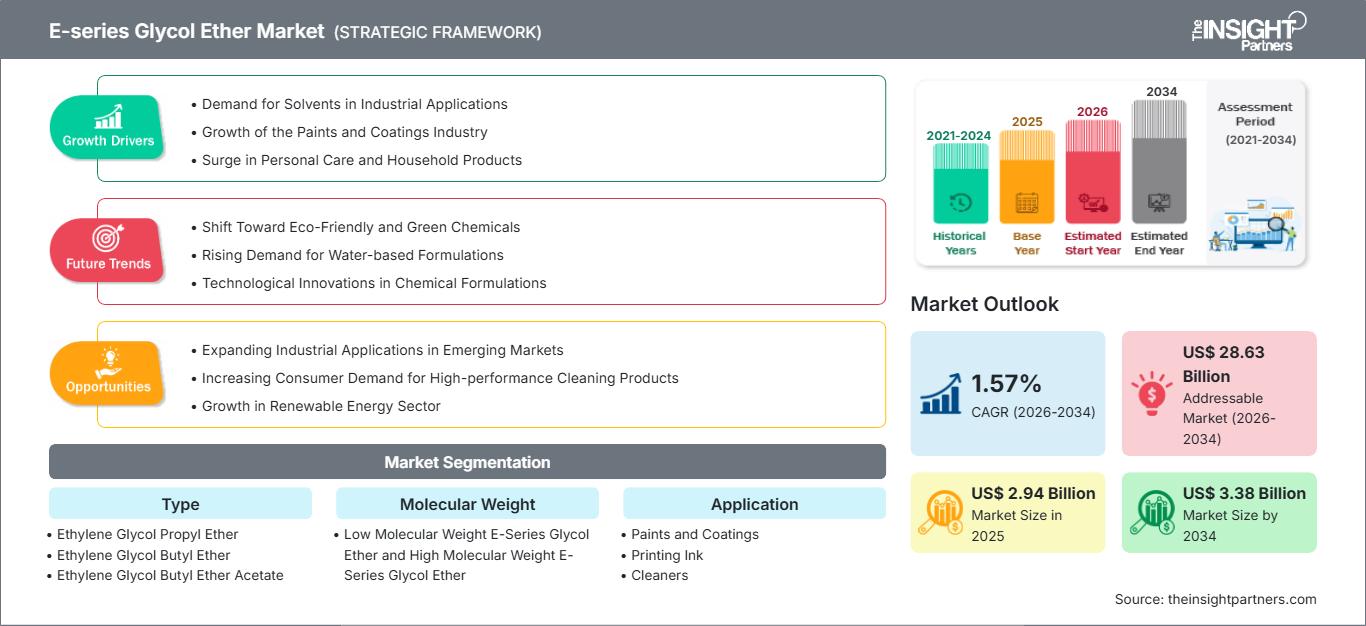
The E-Series Glycol Ether Market was estimated at US$ 2.94 Billion in 2025 and is projected to reach US$ 3.38 Billion by 2034, expanding at a CAGR of 1.57% in the period between 2026 and 2034. The market is poised to play an important role in the specialty solvents industry, thanks to demand for products for applications in paints and coatings, industrial cleaners, printing inks, personal care products, pharmaceuticals processing, and certain automotive applications. Good performance and high formulating capability keep driving the consumption of glycol ethers across the world.
North America continues to be one of the most stable regions on account of diversified industrial activities. The region is expected to show CAGR growth of 1.2% to 1.8% until 2034, owing to well-established production of coatings, maintenance requirements and institutional cleaning needs. The E-Series Glycol Ether Market size across North America is helped by integrated value chains in petrochemicals and advanced manufacturing capabilities along with several solvent manufacturers operating in the region.
E-series Glycol Ether Market Assessment and Insights
- North America: Share in 2025 estimated at 31–35% and growing at a CAGR of 1.2–1.8% during 2026–2034. Demand is supported by coatings manufacturing, industrial maintenance chemicals, and institutional cleaning products.
- US: Share in 2025 estimated at 78–82% of North America and growing at a CAGR of 1.3–1.9% during 2026–2034. Strong domestic production capacity and extensive downstream industrial demand continue to support market stability.
- Europe: Share in 2025 estimated at 26–30% and growing at a CAGR of 1.0–1.6% during 2026–2034. Germany, the UK, and France remain major consuming countries owing to their advanced industrial and specialty chemical sectors.
- Asia Pacific: Share in 2025 estimated at 32–36% and growing at a CAGR of 1.8–2.4% during 2026–2034. China, India, Japan, and South Korea continue to lead regional consumption through manufacturing expansion and coatings demand.
- Largest Segment: Paints and Coatings accounted for 36–40% market share in 2025 and is expected to expand at a CAGR of 1.4–2.0% during 2026–2034 owing to extensive solvent usage in architectural and industrial coating systems.
- High Growth Segment: Pharmaceuticals represented 6–10% market share in 2025 and is forecast to register a CAGR of 2.5–3.2% during 2026–2034, supported by increasing use in specialty formulations and processing applications.
- Key companies analyzed in detail: Dow Inc., LyondellBasell Industries N.V., BASF SE, INEOS Group Holdings S.A., Huntsman Corporation, ANDOH PARACHEMIE CO., LTD., Shell plc, Saudi Basic Industries Corporation (SABIC), Sasol Limited, India Glycols Limited.
Source: The Insight Partners' analysis based on proprietary research, government publications, company annual reports, investor presentations, industry databases, and expert interviews.
The evolution of production economics in the market has been facilitated by the advances in petrochemical integration, efficiencies in the processes and supply chain logistics. The manufacturers are still making investment in process improvements that help in ensuring quality of products, feedstock utilization and environmental performance. Meanwhile, the consumers of these products need solvents that are able to satisfy stringent formulation requirements without sacrificing the efficiency in the process. These conditions have compelled the producers to concentrate on higher quality of their products while remaining competitive from cost perspective.
For the next ten years, the investments are likely to focus on developing manufacturing facilities in Asia and some selected Middle Eastern chemical centers. The regulatory environment that focuses on product stewardship, workplace safety and emissions management is driving some improvements in the production process. Industrializing countries will provide demand growth due to growing production of coatings, chemicals and industrial maintenance.
E-series Glycol Ether Market Report Scope
| Report Attribute | Details |
|---|---|
| Market size in 2025 | US$ 2.94 Billion |
| Market Size by 2034 | US$ 3.38 Billion |
| Global CAGR (2026 - 2034) | 1.57% |
| Historical Data | 2021-2024 |
| Forecast period | 2026-2034 |
E-series Glycol Ether Market Analysis
Fundamentals of demand are still closely related to industrial production, construction, renovations, and cleaning needs of institutions. The development of the E-Series Glycol Ether Market share is also affected by the demand for solvents in architectural and maintenance coatings, printing formulations, and cleaning agents used in industry. As far as the types of the products are concerned, ethylene glycol butyl ether can be highlighted because of its good combination of properties. Given that the industries seek to be more efficient and durable, solvent systems which can ensure high-quality coating and cleaning still matter a lot.
Supply dynamics depend on the supply of ethylene oxide, feedstock dynamics, transportation infrastructure, and the reliability of the production at integrated chemical complexes. Process optimization is also still among priorities of producers aiming to increase production efficiency and reduce disruptions. The mature state of several industries limits fast growth, but replacement needs, industrial maintenance, and formulation changes ensure stable consumption patterns. Demand is expected to be resilient and grow moderately in the long run.
The nature of competition is characterized by the inclusion of multinational firms in the chemical industry with advanced manufacturing capabilities, extensive distribution channels, and rich experience in applications. From the E-Series Glycol Ether Market report, it can be concluded that integrated companies which have sources for obtaining raw materials can better manage costs and ensure availability. Such an aspect is important in industrial developed markets where consumers choose reliable and high-quality products.
Such major players in the market include Dow Inc., BASF SE, LyondellBasell Industries N.V., Shell plc, and Sasol Limited, which are market leaders due to their diversified products and production in different countries. Other competitive players may include INEOS Group Holdings S.A., Huntsman Corporation, Saudi Basic Industries Corporation (SABIC), India Glycols Limited, and ANDOH PARACHEMIE CO., LTD., which are developing their product portfolio and customer relations.
● REPORT CUSTOMIZATION
Tailor This Report To Align With Your Specific Business Requirements
This report can be customized to align precisely with your business objectives, scope, and target markets. Customization options include tailored segmentation, geography, competitive analysis, and strategic insights to support informed decision-making.
Customize This Report →WHAT YOU CAN ADJUST
- ● Segmentations
- ● Geography
- ● Competitive Analysis
- ● Language Preferences
E-series Glycol Ether Market: Strategic Insights
Regional Insights
North America E-Series Glycol Ether Market
In 2025, North America contributed around 31-35% of the global market share and is forecasted to grow at a CAGR of 1.2-1.8% during the period of 2026-2034. The market in this region enjoys a mature chemical manufacturing environment, efficient coatings manufacturing capacity, and regular industrial maintenance operations. Demand for chemicals is high in architectural coatings, industrial coatings, institutional cleaning products, and specialty chemicals.
The leading consumer in this region is the U.S., while Canada contributes towards demand through industrial manufacturing, energy, mining, and construction-based applications. The regulatory focus on the concept of product stewardship and workplace safety keeps on playing an important role in the development of formulations and product selection process. Despite having moderate growth, the market continues experiencing strong demand due to renovation work and other activities.
U.S. E-Series Glycol Ether Market
The United States accounted for about 78%-82% of the North American market in 2025 and is projected to grow at a CAGR of 1.3%-1.9% up to 2034. The market presence of the country is due to huge production of petrochemicals, coatings and diverse range of industrial consumers. Availability of integrated feedstock and production facilities helps in retaining their cost advantages and reliability.
Major market players operate production, distribution and technical service networks in the entire country. Strong demands are anticipated from architectural coatings, industrial cleaners, automotive refinish coatings and chemical intermediates. Investments in infrastructural maintenance, upgrading of manufacturing facilities and building maintenance would ensure stable solvent use despite maturity in some downstream industries.
Europe E-Series Glycol Ether Market
The share of Europe in total world revenues stood at 26-30% in 2025 and is expected to grow at a rate of 1.0-1.6% per annum during the forecast period of 2026-2034. Germany will remain the largest national market on the back of its robust chemical manufacturing industry, the presence of automotive industry, and the coatings industry.
Quality industrial coatings, printing materials, and specialty chemicals will keep driving demand in the region. The UK will keep generating demand through industrial maintenance activities, renovation of buildings, and commercial printing. France will remain a significant contributor through its personal care product manufacturing, pharmaceuticals, and specialty formulation industries. On the other hand, Italy and Spain will keep generating demand through industrial manufacturing, automotive use, packaging printing, and protective coatings industries.
APAC E-Series Glycol Ether Market
Asia-Pacific accounted for 32–36% of the total demand worldwide in 2025 and is expected to record a CAGR of 1.8–2.4% up to 2034. China still leads the market owing to the presence of a huge coatings industry, manufacturing industry, and chemicals processing industry.
Japan and South Korea are contributing via their sophisticated manufacturing sector and chemical industry. Meanwhile, India benefits from the development of the industrial and chemicals sectors. The demand from Australia is consistent in construction, mining, and maintenance sectors.
Middle East & Africa E-Series Glycol Ether Market
The ME&A market is expected to grow at a CAGR of 1.4–2.0% during 2026–2034. Saudi Arabia will continue to hold the position of the major market because of integration of its petrochemical assets and growth in downstream chemical manufacturing capacity. The United Arab Emirates will improve trade and distribution networks for specialty chemicals in the region.
Demand from South Africa will come from its mining industry, industrial sector, and maintenance of infrastructure projects. Overall demand in the region will be driven by construction projects, consumption of coatings, industrial projects, and economic diversification from primary resource industries.
Segmentation Analysis
Type
Type is projected to register a CAGR of 1.4–2.0% during 2026–2034. Product selection is influenced by solvency characteristics, evaporation rates, compatibility requirements, and application performance expectations. Demand remains diversified across coatings, cleaners, printing products, and specialty chemical formulations, enabling stable market participation for all major product categories.
- Ethylene Glycol Propyl Ether – Utilized in industrial coatings, cleaning compounds, and specialty solvent systems where balanced solvency characteristics and application flexibility are critical performance requirements.
- Ethylene Glycol Butyl Ether – Represents one of the most established product types due to strong cleaning efficiency, broad industrial acceptance, and extensive use in maintenance chemicals and coatings.
- Ethylene Glycol Butyl Ether Acetate – Frequently used in coating systems requiring controlled evaporation, improved flow characteristics, and enhanced surface finish performance during application.
Molecular Weight
Molecular Weight is anticipated to expand at a CAGR of 1.3–1.9% through 2034. Product demand remains dependent on volatility requirements, formulation needs, and end-use operating conditions. Manufacturers continue introducing optimized grades that deliver performance consistency while meeting evolving regulatory and industrial standards.
- Low Molecular Weight E-Series Glycol Ether – Preferred in applications requiring effective solvency, rapid processing performance, and broad formulation compatibility across industrial sectors.
- High Molecular Weight E-Series Glycol Ether – Commonly selected for applications where reduced volatility, longer-lasting performance, and controlled solvent behavior provide operational advantages.
Application
Application is projected to record a CAGR of 1.6–2.2% during 2026–2034. The segment benefits from diversified industrial demand and broad functionality across multiple end-use industries. Continued adoption in coatings, cleaning products, and specialty formulations supports the segment's long-term relevance despite moderate overall market expansion.
- Paints and Coatings – Largest application category, supported by widespread use in architectural, industrial, protective, and maintenance coating formulations worldwide.
- Printing Ink – Remains strategically important through its role in controlling drying behavior, print quality, and formulation stability across commercial printing operations.
- Cleaners – Demonstrates strong demand because of effective grease removal, cleaning efficiency, and formulation flexibility in industrial and institutional applications.
- Cosmetics and Personal Care – Supports selected personal care formulations where solvent functionality contributes to product consistency and processing performance.
- Pharmaceuticals – Increasingly important due to specialized formulation requirements, stringent quality standards, and growing demand for high-purity ingredients.
- Automotive – Utilized in maintenance products, refinishing materials, and selected manufacturing processes supporting vehicle production and repair activities.
- Chemical Intermediates – Maintains strategic significance within broader chemical manufacturing supply chains and downstream processing activities.
Opportunity Snapshot
| Application | Revenue Contribution | Trend Tag | Adoption Stage |
| Paints and Coatings | High | Waterborne Coatings | Mature |
| Printing Ink | Medium | Packaging Print | Mature |
| Cleaners | High | Industrial Hygiene | Mature |
| Cosmetics and Personal Care | Medium | Premium Beauty | Scaling |
| Pharmaceuticals | Medium | Specialty Formulation | Scaling |
| Automotive | Medium | Refinish Systems | Mature |
| Chemical Intermediates | Low | Process Integration | Mature |
E-series Glycol Ether Market Growth Drivers and Impact Analysis
Expansion of Industrial Coatings Manufacturing
Industrial coatings continue representing the largest source of solvent demand throughout the value chain. Demand is supported by ongoing infrastructure maintenance, industrial equipment refurbishment, commercial construction projects, and manufacturing activity across developed and emerging economies. E-series glycol ethers contribute to flow control, film formation, and coating performance, making them important formulation components. Producers increasingly collaborate with coating manufacturers to optimize product performance and regulatory compliance. Rising demand for protective coatings in industrial facilities, transportation infrastructure, and commercial buildings strengthens long-term consumption prospects. As asset owners prioritize durability and maintenance efficiency, solvent demand associated with coating formulations is expected to remain a stable revenue contributor across global markets.
Growing Adoption of Industrial and Institutional Cleaners
Industrial facilities, healthcare institutions, transportation networks, educational campuses, and commercial establishments continue requiring high-performance cleaning products. E-series glycol ethers provide effective cleaning performance, especially in formulations designed to remove grease, oils, and industrial contaminants. Increasing attention to operational cleanliness, maintenance standards, and workplace efficiency supports ongoing demand from professional cleaning product manufacturers. Suppliers continue investing in formulation improvements that provide cleaning effectiveness while meeting environmental and occupational requirements. As industries focus on operational productivity and equipment reliability, the role of high-performance cleaning solutions is expected to remain significant. This trend is likely to support stable market demand throughout the forecast period.
Advantages of Integrated Petrochemical Production
Leading manufacturers benefit from vertically integrated production networks that support feedstock availability, operational efficiency, and supply-chain stability. Integration enables improved cost management, better production planning, and enhanced resilience during periods of raw material price volatility. Large-scale producers with upstream chemical operations possess greater flexibility in managing capacity utilization and market fluctuations. Investments in process optimization, emissions reduction programs, and operational modernization continue strengthening competitiveness across global markets. Customers increasingly prioritize dependable product quality and supply reliability, encouraging long-term sourcing relationships with established suppliers. These structural advantages are expected to continue influencing competitive positioning and procurement decisions throughout the forecast horizon.
E-series Glycol Ether Market Future Trends
Sustainability-Oriented Solvent Optimization
The E-Series Glycol Ether Market trends increasingly reflect the industry's movement toward more efficient production practices, resource optimization, and improved environmental performance. Manufacturers are investing in process improvements that reduce operational energy intensity while maintaining product functionality required by coatings, cleaners, and specialty formulations. Downstream customers are placing greater emphasis on solvents that provide reliable performance alongside improved operational efficiency and compliance with evolving environmental frameworks. As a result, suppliers are expected to accelerate investments in manufacturing modernization, product stewardship programs, and advanced quality-control systems. Collaborative product development between solvent producers and formulation specialists is also anticipated to become more common. Over the long term, sustainability-focused innovation will remain a major contributor to product differentiation and customer retention across global markets.
Expansion of Specialty Grade Product Portfolios
Demand for specialized solvent grades is expected to grow steadily as end users seek higher purity, tighter performance specifications, and improved formulation consistency. Pharmaceutical processing, advanced industrial manufacturing, and specialty chemicals are among the sectors likely to drive this trend. Producers are expected to expand quality assurance capabilities and invest in application-specific product development projects that address customer requirements beyond conventional solvent performance. Specialty-grade products often command stronger margins and support longer customer relationships, encouraging manufacturers to prioritize high-value applications. As technical standards become increasingly rigorous across multiple industries, suppliers capable of delivering consistent quality and specialized performance characteristics are expected to secure greater market opportunities and competitive advantages throughout the forecast period.
E-series Glycol Ether Market Opportunities
Growth Potential in Pharmaceutical Manufacturing Applications
Pharmaceutical manufacturing continues to represent one of the most attractive long-term opportunities within the market. Growth in drug production capacity, increasing quality requirements, and expanding demand for specialized formulations are driving the need for high-purity solvent systems. Manufacturers capable of supplying products that meet stringent regulatory and performance requirements are expected to benefit from stronger margins and long-term customer relationships. The pharmaceutical segment is projected to outperform several traditional application areas in terms of value creation, making it a strategic area for investment. E-Series Glycol Ether Market Forecasts indicate that specialty pharmaceutical applications may contribute disproportionately to incremental revenue generation through 2034. Companies emphasizing technical support, product quality, and compliance-focused manufacturing practices will be particularly well positioned.
Investment Expansion Across Emerging Asian Manufacturing Hubs
Emerging manufacturing centers across Asia offer significant opportunities for capacity expansion, customer acquisition, and supply-chain optimization. Continued industrialization, coatings production growth, infrastructure development, and chemical industry investments are creating favorable conditions for solvent suppliers. Establishing regional production assets, technical support centers, and strategic distribution partnerships can improve responsiveness to local market requirements while reducing logistics costs. India, Southeast Asia, and selected East Asian economies are expected to attract increasing investment interest due to expanding industrial output and favorable manufacturing policies. Companies that strengthen their regional presence through production integration and downstream collaboration initiatives are expected to capture emerging opportunities while enhancing long-term competitiveness within global solvent markets.
Recent Developments
- January 2026: Effective February 12, 2026, Eastman Chemical Company will implement off-list price increases in North American and Latin American markets for various products. The price increase is set at USD 0.05 per pound (USD 0.11 per kilogram) for all grades and packages of Eastman DB Solvent, DTB Solvent, EB Solvent (excluding Eastapure), and Glycol Ether High Boilers.
- April 2025: Effective April 1, 2025, The Dow Chemical Company will raise prices on E-Series Glycol Ethers, reflecting market fluctuations and increased production costs. The price increase includes Butyl CELLOSOLVE and Butyl CARBITOL Solvents, each by $0.03 per pound. This adjustment will impact industries using glycol ethers in coatings, cleaners, and chemical formulations, highlighting the importance of understanding its effect on procurement and budgeting.
Frequently Asked Questions

- Comprehensive Market Sizing and Forecast Analysis
- Detailed Segmentation Analysis
- In-Depth Market Dynamics Assessment
- Regional and Country-Level Insights
- Competitive Landscape and Company Benchmarking
- Strategic Business Intelligence
Recent Reports
Testimonials

The Insight Partners' SCADA System Market report is comprehensive, with valuable insights on current trends and future forecasts. The team was highly professional, responsive, and supportive throughout. We are very satisfied and highly recommend their services.
RAN KEDEM Partner, Reali Technologies LTDs
I requested a report on a very specific software market and the team produced the report in a few days. The information was very relevant and well presented. I then requested some changes and additions to the report. The team was again very responsive and I got the final report in less than a week.
JEAN-HERVE JENN Chairman, Future Analytica
We worked with The Insight Partners for an important market study and forecast. They gave us clear insights into opportunities and risks, which helped shape our plans. Their research was easy to use and based on solid data. It helped us make smart, confident decisions. We highly recommend them.
PIYUSH NAGPAL Sr. Vice President, High Beam Global
The Insight Partners delivered insightful, well-structured market research with strong domain expertise. Their team was professional and responsive throughout. The user-friendly website made accessing industry reports seamless. We highly recommend them for reliable, high-quality research services
YUKIHIKO ADACHI CEO, Deep Blue, LLC.
This is the first time I have purchased a market report from The Insight Partners.While I was unsure at first, I visited their web site and felt more comfortable to take the risk and purchase a market report.I am completely satisfied with the quality of the report and customer service. I had several questions and comments with the initial report, but after a couple of dialogs over email with their analyst I believe I have a report that I can use as input to our strategic planning process.Thank you so much for taking the extra time and making this a positive experience.I will definitely recommend your service to others and you will be my first call when we need further market data.
JOHN SUZUKI President and Chief Executive Officer, Board Director, BK Technologies
I wish to appreciate your support and the professionalism you displayed in the course of attending to my request for information regarding to infectious disease IVD market in Nigeria. I appreciate your patience, your guidance, and the fact that you were willing to offer a discount, which eventually made it possible for us to close a deal. I look forward to engaging The Insight Partners in the future, all thanks to the impression you have created in me as a result of this first encounter.
DR CHIJIOKE ONYIA MANAGING DIRECTOR, PineCrest Healthcare Ltd.Reason to Buy
- Informed Decision-Making
- Understanding Market Dynamics
- Competitive Analysis
- Identifying Emerging Markets
- Customer Insights
- Market Forecasts
- Risk Mitigation
- Boosting Operational Efficiency
- Strategic Planning
- Investment Justification
- Tracking Industry Innovations
- Aligning with Regulatory Trends





 Get Free Sample for