
Earthmoving Equipment Market Share, Growth & Forecast by 2034
Coverage: By Type (Excavators, Loaders, Dozers), and Geography (North America, Europe, Asia Pacific, and South and Central America)
- Status : Data Released
- Report Code : TIPTE100000514
- Category : Manufacturing and Construction
- No. of Pages : 150
- Available Report Formats :


- Last update date : July 28, 2026


2025 Market Size
US$ 78.26 Bn
Base year value
2034 Forecast
US$ 127.11 Bn
Projected by 2034
CAGR 2026-2034
5.54 %
Growth rate
Addressable Market
US$ 931.25 Bn
(2026-2034)
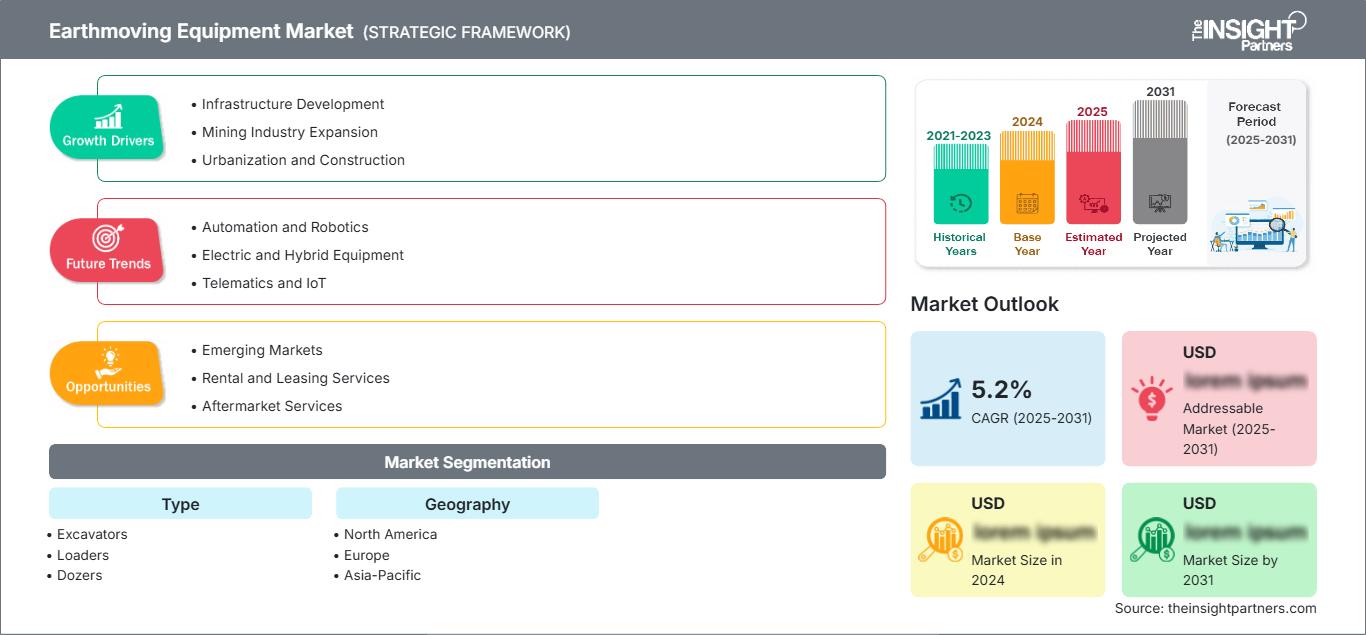
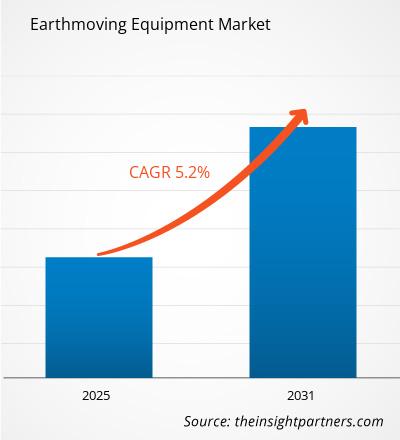
The earthmoving equipment market was valued at US$ 78.26 Billion in 2025 and is projected to reach US$ 127.11 Billion by 2034, registering a CAGR of 5.54% during 2026–2034. Demand is being shaped by infrastructure renewal, mining expansion, residential construction, and mechanized site preparation, with fleet owners prioritizing productivity, uptime, operator safety, and total cost of ownership across excavation, grading, loading, hauling, trenching, and compaction applications.
Across North America, the earthmoving equipment market size is expected to advance at a 4.8–5.2% CAGR through 2034 as public infrastructure programs, quarrying activity, and utility replacement cycles support sustained fleet purchases. Contractors are also upgrading machines with telematics, grade control, and lower-emission engines to reduce rework, improve fuel efficiency, and meet tightening state-level procurement and emissions requirements.
Earthmoving Equipment Market Assessment and Insights
- North America accounted for 24–26% share in 2025 and is set to grow at a 4.8–5.2% CAGR between 2026–2034, supported by highway modernization, mining fleet renewal, and rental fleet digitization.
- US represented 78–82% of North America in 2025 and is expected to grow at a 4.9–5.3% CAGR between 2026–2034 as infrastructure spending sustains equipment replacement.
- Europe held 20–22% share in 2025 and is projected to expand at a 4.3–4.7% CAGR between 2026–2034, led by Germany, France, the UK, Italy, and Spain.
- Asia Pacific captured 38–40% share in 2025 and is forecast to grow at a 6.1–6.5% CAGR between 2026–2034, with China, India, Japan, South Korea, and Australia leading demand.
- Largest Segment Excavators held 27–29% market share in 2025 and are expected to grow at a 5.3–5.7% CAGR between 2026–2034 due to broad utility across construction and mining.
- High Growth Segment Electric propulsion held 4–6% market share in 2025 and is projected to grow at an 11.5–12.5% CAGR between 2026–2034 as urban low-emission jobsites expand.
- Key companies analyzed in detail: Caterpillar Inc., Komatsu Ltd., AB Volvo, Hitachi Construction Machinery Co., Ltd., Liebherr-International AG, HD Hyundai Infracore Co., Ltd., Terex Corporation, Deere & Company, Xuzhou Construction Machinery Group Co., Ltd., SANY Group Co., Ltd.
Source: The Insight Partners' analysis based on proprietary research, government publications, company annual reports, investor presentations, industry databases, and expert interviews.
Machine design has evolved from performance alone to interconnected, efficient, and semi-automated platforms. The excavator and loader continue to be vital to the production process as they determine cycle time, truck match-up, and labor productivity. Equipment suppliers are working on localized components, better hydraulics, payload measurement, 2D grading, 3D machine control, and machine diagnostics in order to enable builders to control cost inflation and ensure equipment productivity for their infrastructure, quarrying, road construction, and urban renewal activities.
In the coming years, new regions will determine purchasing behavior, since government investment in capital will go towards transport arteries, energy networks, industrial estates, and resilient urban systems. Diesel exhaust regulations are spurring the testing of hybrid and battery power in compact equipment. In view of this, it can be seen that the earthmoving equipment market will gain traction from fleet upgrades, rental services, and digital services that turn machine information into operational decisions.
Earthmoving Equipment Market Report Scope
| Report Attribute | Details |
|---|---|
| Market size in 2025 | US$ 78.26 Billion |
| Market Size by 2034 | US$ 127.11 Billion |
| Global CAGR (2026 - 2034) | 5.54% |
| Historical Data | 2021-2024 |
| Forecast period | 2026-2034 |
Earthmoving Equipment Market Analysis
The earthmoving equipment market growth is anchored in the need to move higher volumes of soil, rock, aggregates, and construction debris with fewer operators and tighter project schedules. Demand will be highest where there are repeated requirements for earthworks such as excavation, loading, grading, and compaction through roads, rail routes, ports, and mining. The buyer of construction equipment has started to look at many factors, like life cycle fuel consumption, uptime, dealer support, financing capabilities, and attachment capabilities, before making any investment decision.
The ecosystem consists of manufacturers, component suppliers, dealers, rental firms, contractors, mining firms, financing firms, and digital platforms suppliers. The supply situation will still be dependent on steel costs, hydraulic components, engines, batteries, sensors, and electronics. Larger contractors are adopting fleet standardization in order to simplify their operations, while rentals are increasing the number of compact and mid-size machines in their inventory.
Earthmoving Equipment Market Analysis reveals that the earthmoving equipment market is quite competitive, dominated by global OEMs featuring extensive portfolios, captive finance, and intensive dealer networks. Caterpillar Inc., Komatsu Ltd., AB Volvo, Hitachi Construction Machinery Co., Ltd., and Deere & Company are competing based on technology integration and service reach, whereas Xuzhou Construction Machinery Group Co., Ltd. and SANY Group Co., Ltd. enhance their value proposition in developing markets.
Electrification, autonomy-ready architecture, advanced hydraulics, remanufacturing, and predictive maintenance have become important areas for investment in earthmoving equipment. Liebherr-International AG and HD Hyundai Infracore Co., Ltd. are launching energy-efficient platforms, whereas Terex Corporation continues to be relevant in special handling and compact categories. Strategic positioning requires software-driven productivity, parts availability, and the capability to accommodate mixed fleets of diesel, hybrid, and electric machines without impacting contractors' productivity.
● REPORT CUSTOMIZATION
Tailor This Report To Align With Your Specific Business Requirements
This report can be customized to align precisely with your business objectives, scope, and target markets. Customization options include tailored segmentation, geography, competitive analysis, and strategic insights to support informed decision-making.
Customize This Report →WHAT YOU CAN ADJUST
- ● Segmentations
- ● Geography
- ● Competitive Analysis
- ● Language Preferences
Earthmoving Equipment Market: Strategic Insights
Regional Insights
North America earthmoving equipment market
North America held 24–26% of the global earthmoving equipment market share in 2025 and is forecast to expand at a 4.8–5.2% CAGR during 2026–2034. Demand is supported by bridge rehabilitation, highway widening, airport upgrades, oil and gas site development, quarry expansion, and municipal utility replacement. Large rental fleets shape purchasing because contractors prefer access over ownership for specialized machines.
Technology adoption is comparatively advanced, with machine-control systems, telematics dashboards, and payload management used to reduce idle time and rework. Federal and state funding pipelines support multi-year visibility, but labor shortages encourage automation-assisted digging and grading. The region’s replacement cycle favors excavators, loaders, compactors, and articulated dump trucks equipped with lower-emission engines and connected maintenance tools.
U.S. Earthmoving Equipment Market
The U.S. represented 78–82% of North America in 2025 and is projected to grow at a 4.9–5.3% CAGR during 2026–2034. Infrastructure investments by the government, semiconductor factories, logistical centers, renewable energy facilities, and water facilities diversify the demand for such products as excavators, loaders, bulldozers, graders, dump trucks, and compact construction machinery.
The market is still saturated with leading companies such as Caterpillar Inc., Deere & Company, Komatsu Ltd., AB Volvo, and Hitachi Construction Machinery Co., Ltd., which serve contractors through the distribution of equipment, spare parts, financing, and rental services. Current application trends include growing demand for excavators with a grade control system, compact loaders for utilities, and large trucks for aggregates.
Europe Earthmoving Equipment Market
Europe accounted for 20–22% share in 2025 and is expected to register a 4.3–4.7% CAGR during 2026–2034. Germany is the top nation due to industrial constructions, transport enhancements, recycling plants, and advanced OEM & suppliers’ capabilities. The market is being driven by low-emission purchasing policy and urban noise regulation.
The United Kingdom relies on railway, residential, utility, and energy transition works; France exhibits its demand through urban renovation and transport investments. Italy and Spain rely on road works, renewable energy, and municipal constructions. Constructors are speeding up their tests with compact electrical machines, but diesel is still the prevalent fuel in excavations, quarrying, tunneling, and earthworks.
APAC Earthmoving Equipment Market
APAC held 38–40% share in 2025 and is forecast to grow at a 6.1–6.5% CAGR during 2026–2034. China remains the leading country, supported by urban renewal, mining, and transport projects, while India contributes high incremental demand from roads, rail, irrigation, and industrial corridors.
Japan and South Korea emphasize replacement, automation, and low-emission equipment, whereas Australia relies on mining, infrastructure, and quarrying. Policy-led capital spending, rapid urbanization, and domestic manufacturing scale support the earthmoving equipment market across Asia Pacific, although pricing pressure keeps value-engineered machines highly competitive.
Middle East & Africa Earthmoving Equipment Market
The Middle East & Africa is projected to expand at a 5.7–6.1% CAGR during 2026–2034, led by Saudi Arabia. Infrastructure for energy projects, megatourism projects, logistics parks, and mining developments will require greater use of excavators, dump trucks, loaders, compactors, and graders in tough conditions.
In the UAE, the demand comes from port, real estate, and utility projects, whereas in South Africa, it is driven by mining and local infrastructure. The rest of the MEA will continue to be driven by projects and will rely on imports. Durability, cooling, parts, and dealers’ service will be very important due to the high costs of downtime.
Segmentation Analysis
By Equipment Type
The equipment type segment is expected to grow at a 5.2–5.6% CAGR during 2026–2034. The earthmoving equipment market scope is broad because machines are selected according to digging depth, payload, terrain, mobility, and cycle-time requirements. Excavators and loaders dominate core production, while graders, compactors, trenchers, scrapers, and dump trucks support specialized workflow needs.
- Excavators remain the largest category because they perform digging, demolition, trenching, loading, and site preparation across construction, quarrying, mining, and utility projects with high attachment flexibility.
- Loaders serve material handling, stockpiling, roadwork, and aggregate movement, with demand supported by bucket versatility, rapid cycle times, and integration with weighing systems.
- Bulldozers are essential for land clearing, grading, ripping, and heavy pushing, especially in roadbuilding, mining, forestry, and large-scale site development.
- Backhoe Loaders retain strong demand in municipal, rural, and small contractor fleets because they combine loading, digging, trenching, and utility repair capabilities in one machine.
- Motor Graders are strategically important for road construction, mining haul roads, and precision leveling, where surface quality directly influences safety, drainage, and haul efficiency.
- Skid Steer Loaders support compact construction, landscaping, snow removal, and urban utility work, benefiting from attachment compatibility and high maneuverability on space-constrained jobsites.
- Dump Trucks are critical for bulk hauling of soil, aggregates, overburden, and construction debris, with demand tied to quarrying, mining, roads, and large infrastructure projects.
- Trenchers are used for pipelines, fiber networks, irrigation, and drainage, where narrow, consistent trench profiles improve installation speed and reduce restoration costs.
- Scrapers support high-volume earthmoving across open sites, highways, dams, and land development projects where long cuts, hauls, and fills require continuous production.
- Compactors & Rollers are required for soil stabilization, road bases, embankments, and landfill work, making them vital to quality control and long-term structural performance.
By Propulsion Type
The propulsion type segment is projected to grow at a 5.6–6.0% CAGR during 2026–2034. Internal combustion engines remain dominant because heavy-duty work demands long runtime, high torque, and rapid refueling. Electric and hybrid machines are gaining traction in compact, urban, and regulated environments where lower noise, lower emissions, and predictable duty cycles justify higher upfront costs.
- Internal Combustion Engine machines dominate heavy excavation, hauling, grading, and mining because diesel power provides high utilization, refueling flexibility, established service networks, and proven durability.
- Electric propulsion is scaling in mini excavators, compact loaders, and urban machines where zero tailpipe emissions, lower noise, and charging access align with project requirements.
- Hybrid systems bridge performance and efficiency by recovering energy, reducing fuel use, and supporting contractors that need lower emissions without full battery-electric operational changes.
By Power Output
The power output segment is expected to grow at a 5.1–5.5% CAGR during 2026–2034. Below 100 HP machines serve compact construction and rental fleets, while 101–200 HP and 201–400 HP classes address mainstream excavation, loading, and grading. Above 400 HP equipment is concentrated in mining, quarrying, and major civil works requiring maximum productivity.
- Below 100 HP machines are used in landscaping, utilities, municipal maintenance, and small building sites, where compact size, transportability, and rental availability influence purchasing.
- 101–200 HP equipment supports mainstream contractors with balanced productivity, fuel consumption, and versatility across excavation, loading, roadwork, and medium-duty infrastructure applications.
- 201–400 HP machines address demanding earthmoving, quarry, road, and mining tasks where higher breakout force, bucket capacity, and hydraulic performance improve output.
- Above 400 HP equipment serves large mining, dam, highway, and bulk excavation projects where high power, payload capacity, and durability determine project economics.
Opportunity Snapshot
| Equipment Type | Revenue Contribution | Trend Tag | Adoption Stage |
| Excavators | High | Grade Control | Mature |
| Loaders | High | Payload Tech | Mature |
| Bulldozers | Medium | Site Prep | Mature |
| Backhoe Loaders | Medium | Utility Work | Mature |
| Motor Graders | Medium | Road Leveling | Mature |
| Skid Steer Loaders | Medium | Compact Sites | Scaling |
| Dump Trucks | High | Bulk Haul | Mature |
| Trenchers | Low | Fiber Builds | Scaling |
| Scrapers | Low | Mass Grading | Mature |
| Compactors & Rollers | Medium | Soil Quality | Mature |
Earthmoving Equipment Market Growth Drivers and Impact Analysis
Infrastructure Renewal and Civil Construction Pipelines
Government-supported projects in transportation, waterworks, energy, and city construction increase machine utilization and order visibility for the original equipment manufacturers (OEMs) and dealers. Roads, bridges, harbors, drainage, and railway routes need to be excavated, graded, hauled, trenchered, and compacted during all phases of their construction. The most evident effect can be seen in replacement demand, when contractors tend to choose those machines that have engines consuming less fuel, as well as telematics and grade control features that decrease the construction cycle. The effect also works for rental companies, because public works generate equipment demand for several contractors intermittently.
Mining, Quarrying, and Aggregates Expansion
Growing demands on aggregates, metals, critical minerals, materials for cement production, and construction materials have led to the growing need for excavators, wheel loaders, dozers, dump trucks, and compactors with high capacity. Mining and quarrying clients rate equipment based on output per hour, fuel consumption, load weight, tire life span, repair and maintenance intervals, and availability of dealers. Tough operating conditions make equipment with reinforced constructions, heavy-duty cooling systems, and long-life hydraulic systems highly attractive. It is profitable for equipment makers due to the fact that equipment operates in high utilization mode, providing repeated parts and service income.
Digital Productivity and Fleet Optimization
Connected machines are making productivity rather than cost of the machine the basis for buying decisions. Telematics, weight monitoring, remote diagnostic tools, idle time, geofencing, and grade control enable contractors to save on fuel, prevent overload situations, plan maintenance activities, and monitor production processes. The impact is most evident among big contractors, equipment leasing companies, and miners managing heterogeneous fleet operations on various sites. Original Equipment Manufacturers equipped with a digital ecosystem have the opportunity to create closer customer ties via subscriptions, service agreements, and parts predictions. Shortage of skilled labor creates an additional incentive for using machine control functionalities.
Earthmoving Equipment Market Future Trends
Electrified Compact Jobsites
The most visible earthmoving equipment market trends will emerge in compact equipment used for urban construction, indoor demolition, landscaping, utilities, and municipal work. Battery-electric mini excavators, compact wheel loaders, and skid steer loaders are becoming practical where duty cycles are predictable and charging can be planned. Lower noise expands permissible operating hours in cities, while zero tailpipe emissions support hospitals, schools, tunnels, and enclosed sites. Adoption will remain selective in heavy earthmoving, but compact electrification will influence dealer training, battery service, charging partnerships, and rental fleet planning through 2034.
Autonomy-Ready Earthmoving Workflows
Autonomy will move on from individual demonstrations to a process of monitored workflows that integrate machine operation, digital terrain modeling, site connectivity, and remote monitoring. Initial deployment will focus on mining sites, quarrying sites, major road construction projects, and repetitive grading projects in which traffic flows can be managed. The use of semi-autonomous dozing, autonomous hauling management, and assisted excavation will decrease variance and increase safety in high-risk operations. Standardization of data, cybersecurity practices, and operator re-skilling initiatives will be required of the equipment suppliers and contractors.
Earthmoving Equipment Market Opportunities
Rental Fleet Electrification and Data Services
Rental companies can convert electrification uncertainty into a service-led opportunity by bundling compact electric machines, chargers, operator training, battery health reports, and utilization analytics. Many contractors want to test lower-emission machines without committing capital, making rental fleets a practical adoption channel. The earthmoving equipment market forecasts favor suppliers that help rental partners manage residual values, charging logistics, and maintenance economics. OEMs can also monetize data through fleet dashboards, preventive maintenance alerts, and productivity benchmarking. This opportunity is strongest in cities with clean-construction policies, noise limits, and high-density utility projects.
Localized Manufacturing and Aftermarket Expansion
Regional manufacturing capability, warehousing of parts, remanufacturing capabilities, and service support from dealerships may be able to open up demand where delays in imports, currency fluctuations, and downtime risk make growing fleets difficult. Manufacturing capabilities locally allow OEMs to design equipment for their local fuels, climatic conditions, duty cycle, and regulations, in addition to making bidding more competitive. The aftermarket provides a very strong area for growth as older fleets require hydraulic parts, undercarriage parts, filters, tires, buckets, and digitalization kits.
Recent Developments
- March 2026: HD Construction Equipment Hyundai North America launched the first five of its Next Generation HX excavator models at CONEXPO-CON/AGG. FEH, or fully electrohydraulic controls, make these new excavators run more smoothly and increase productivity by at least 22 percent. At the same time, the new, award-winning DX Series Hyundai engines powering these HX models are nearly 10 percent more fuel efficient.
- May 2025: Caterpillar Inc. updated its excavator lineup with enhanced Cat Grade technologies, a new operator interface, Grade with 3D as a factory-installed option, and Advanced Payload capabilities for crawler excavators. The upgrades support production tracking, jobsite analytics, electronic ticketing, and faster setup of bucket and attachment combinations.
- April 2025: Volvo Construction Equipment unveiled the A30 Electric articulated hauler at Bauma 2025 and positioned it as the world’s first serial-produced battery-electric articulated hauler in its size class. The model, alongside the A40 Electric, is planned for rental availability in selected European markets in 2026.
Frequently Asked Questions

- Comprehensive Market Sizing and Forecast Analysis
- Detailed Segmentation Analysis
- In-Depth Market Dynamics Assessment
- Regional and Country-Level Insights
- Competitive Landscape and Company Benchmarking
- Strategic Business Intelligence
Recent Reports
Testimonials

The Insight Partners provided valuable market intelligence that supported our global go-to-market strategy. Their team was professional, responsive, and attentive to our feedback, providing thoughtful analysis and helpful methodological clarifications throughout the project.
Junmo Kim Chief Financial Officer (CFO), Enertech Co., Ltd.
The Insight Partners' SCADA System Market report is comprehensive, with valuable insights on current trends and future forecasts. The team was highly professional, responsive, and supportive throughout. We are very satisfied and highly recommend their services.
RAN KEDEM Partner, Reali Technologies LTDs
I requested a report on a very specific software market and the team produced the report in a few days. The information was very relevant and well presented. I then requested some changes and additions to the report. The team was again very responsive and I got the final report in less than a week.
JEAN-HERVE JENN Chairman, Future Analytica
We worked with The Insight Partners for an important market study and forecast. They gave us clear insights into opportunities and risks, which helped shape our plans. Their research was easy to use and based on solid data. It helped us make smart, confident decisions. We highly recommend them.
PIYUSH NAGPAL Sr. Vice President, High Beam Global
The Insight Partners delivered insightful, well-structured market research with strong domain expertise. Their team was professional and responsive throughout. The user-friendly website made accessing industry reports seamless. We highly recommend them for reliable, high-quality research services
YUKIHIKO ADACHI CEO, Deep Blue, LLC.
This is the first time I have purchased a market report from The Insight Partners.While I was unsure at first, I visited their web site and felt more comfortable to take the risk and purchase a market report.I am completely satisfied with the quality of the report and customer service. I had several questions and comments with the initial report, but after a couple of dialogs over email with their analyst I believe I have a report that I can use as input to our strategic planning process.Thank you so much for taking the extra time and making this a positive experience.I will definitely recommend your service to others and you will be my first call when we need further market data.
JOHN SUZUKI President and Chief Executive Officer, Board Director, BK Technologies
I wish to appreciate your support and the professionalism you displayed in the course of attending to my request for information regarding to infectious disease IVD market in Nigeria. I appreciate your patience, your guidance, and the fact that you were willing to offer a discount, which eventually made it possible for us to close a deal. I look forward to engaging The Insight Partners in the future, all thanks to the impression you have created in me as a result of this first encounter.
DR CHIJIOKE ONYIA MANAGING DIRECTOR, PineCrest Healthcare Ltd.Reason to Buy
- Informed Decision-Making
- Understanding Market Dynamics
- Competitive Analysis
- Identifying Emerging Markets
- Customer Insights
- Market Forecasts
- Risk Mitigation
- Boosting Operational Efficiency
- Strategic Planning
- Investment Justification
- Tracking Industry Innovations
- Aligning with Regulatory Trends





 Get Free Sample for