
Eco-Friendly Food Packaging Market Growth, Size & Forecast by 2034
Coverage: By Material (Paper and paperboard, Plastic, Metal, Cans, Barrels and drums, Others); Application (Food, Bakery and confectionery, Convenience food, Meat, Fish, And poultry, Fruits and vegetables, Others); Type (Recycled content packaging, Degradable packaging, Reusable packaging); Technique (Active packaging, Molded packaging, Alternate fiber packaging, Multipurpose packaging), and Geography (North America, Europe, Asia Pacific, and South and Central America)
- Status : Data Released
- Report Code : TIPRE00015489
- Category : Chemicals and Materials
- No. of Pages : 150
- Available Report Formats :


- Last update date : July 30, 2026


2025 Market Size
US$ 215.43 Bn
Base year value
2034 Forecast
US$ 417.69 Bn
Projected by 2034
CAGR 2026-2034
7.63 %
Growth rate
Addressable Market
US$ 2,851.11 Bn
(2026-2034)
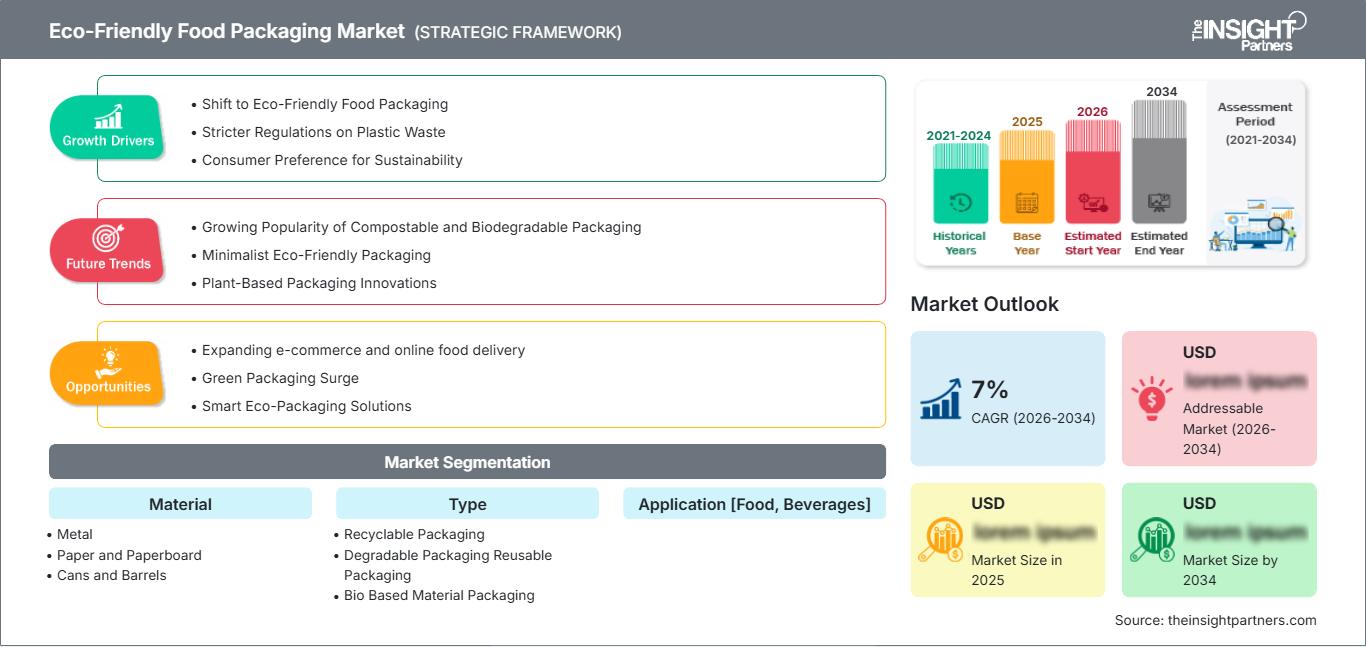
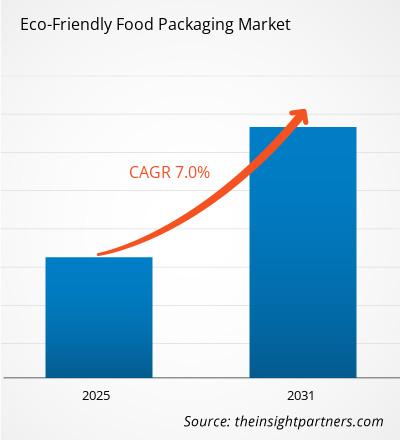
The Eco-Friendly Food Packaging Market size was US$ 215.43 billion in 2025 and is expected to reach US$ 417.69 billion by 2034, recording a compound annual growth rate of 7.63% during 2026-2034. The dynamics are driven by food brands, retailers, and foodservice players which are switching from traditional forms of packaging to those that are recyclable, biodegradable, reusable, and bio-based packaging in food and beverages products.
Demand for North America will be a focal region for the Eco-Friendly Food Packaging Market forecast, due to the presence of state-level packaging legislation, sustainability scorecard of retailers, and high consumption of packaged foods. The demand from the region is estimated to register a CAGR of 6.8–7.6%.
Eco-Friendly Food Packaging Market Assessment and Insights
- North America: Share in 2025 of 31–35% and CAGR between 6.8–7.6%. Growth reflects foodservice packaging conversion, extended producer responsibility programs, and brand commitments to recyclable and compostable formats.
- US: Share in 2025 of 82–86% of North America and CAGR between 6.9–7.7%. State packaging laws and major grocery chains are accelerating supplier adoption.
- Europe: Share in 2025 of 24–28% and CAGR between 6.6–7.4%. Germany, France, the UK, Italy, and Spain lead adoption under circular packaging rules.
- Asia Pacific: Share in 2025 of 27–31% and CAGR between 8.4–9.2%. China, India, Japan, South Korea, and Australia benefit from food delivery, retail growth, and plastic reduction policies.
- Largest Segment: Paper and Paperboard held market share of 34–38% in 2025 and CAGR of 7.0–7.8% during 2026–2034, supported by cartons, wraps, trays, and molded fiber formats.
- High Growth Segment: Bio Based Material Packaging held market share of 14–18% in 2025 and CAGR of 9.0–10.0% during 2026–2034, driven by compostable polymers, cellulose films, and coated fiber innovation.
- Key companies analyzed in detail: Amcor plc, Ball Corporation, Crown Holdings, Inc., Elopak ASA, Evergreen Packaging LLC, Mondi plc, Printpack Inc., Sealed Air Corporation, Tetra Pak International S.A., WestRock Company.
Source: The Insight Partners' analysis based on proprietary research, government publications, company annual reports, investor presentations, industry databases, and expert interviews.
Material substitution has moved from being a pilot program to commercial purchasing due to advancements in barrier coatings, seals, and food contact approval among converters. Material networks are moving towards substrates that are comprised of paper, light metal formulations, and multiple-use recycling systems. The market for Eco-Friendly Food Packaging is also feeling the effects of automation in molded fiber and carton conversion, offering good economics in quick service restaurants and beverages.
Projected future trends include urban Asia, foodservice distribution channels in Europe, and North American retail private label markets. Investment in bio-based resin production facilities, paper coating technology, and closed-loop collection programs has occurred. Regulations that are favorable include the EU packaging directive requiring recyclable packaging by 2030 and state EPR programs in the United States which link producer costs to recyclability.
Eco-Friendly Food Packaging Market Report Scope
| Report Attribute | Details |
|---|---|
| Market size in 2025 | US$ 215.43 Billion |
| Market Size by 2034 | US$ 417.69 Billion |
| Global CAGR (2026 - 2034) | 7.63% |
| Historical Data | 2021-2024 |
| Forecast period | 2026-2034 |
Eco-Friendly Food Packaging Market Analysis
Growth drivers of the Eco-Friendly Food Packaging Market include growth in packaged food, beverages’ premiumization, and consumers’ desire to avoid packaging waste in terms of plastic. Food manufacturers need packaging materials which would preserve shelf-life and be acceptable to retailers in terms of sustainability standards; thus, there is growing demand for recyclable cans, fiber cartons, paperboard trays, and biodegradable films. The industry becomes increasingly integrated as resin manufacturers, paper mills, converters, and food manufacturers cooperate in developing food-safe, eco-friendly packaging.
One of the key limiting factors here is input availability, as recycled fiber’s quality, access to food-grade recycled plastic and bio-based polymers varies depending on the region. Manufacturers’ response lies in lightweighting, monomaterial packaging and coating technologies, which are making material usage more efficient.
The Eco-Friendly Food Packaging Market report indicates that competition trends towards circular designs, global accounts, and material science expertise. Amcor plc is developing recycleable flexible packaging platforms, whereas Mondi plc and WestRock Company are developing their paper-based food packaging capabilities. Beverage cartons with renewable content have been developed by Tetra Pak International S.A. and Elopak ASA, whereas Ball Corporation and Crown Holdings, Inc. have the advantage of recyclability of metal packaging.
Positioning of the companies in the current environment is defined more and more by investments into barrier performance, regulations, and sustainability reporting to customers. Protective food packaging formats, where safety and shelf life are still key issues, are developed by Sealed Air Corporation and Printpack Inc., whereas Evergreen Packaging LLC develops its fiber-based beverage and foodservice packaging.
● REPORT CUSTOMIZATION
Tailor This Report To Align With Your Specific Business Requirements
This report can be customized to align precisely with your business objectives, scope, and target markets. Customization options include tailored segmentation, geography, competitive analysis, and strategic insights to support informed decision-making.
Customize This Report →WHAT YOU CAN ADJUST
- ● Segmentations
- ● Geography
- ● Competitive Analysis
- ● Language Preferences
Eco-Friendly Food Packaging Market: Strategic Insights
Regional Insights
North America Eco-Friendly Food Packaging Market
The share of North America in global revenues was 31–35% in 2025 and is estimated to record a 6.8–7.6% CAGR through 2034. Eco-Friendly Food Packaging Market share in the region is backed by packaged foods volume, high beverage consumption, and state-led packaging responsibility initiatives. California and Oregon are developing more producer accountability through recyclable, compostable, and reusable food packaging systems.
Producers are making investments in molded fiber, paperboard, and recyclable flexible structures to cater to restaurants and food processing companies. Brands are focusing on packaging designs due to the importance of such elements in the scorecards of the retailers. Recyclability and carbon disclosure in the packaging materials matter most when there is proper infrastructure in place for collecting packages.
U.S. Eco-Friendly Food Packaging Market Market
United States accounts for 82% to 86% of the total North American revenue share and is expected to register a CAGR of 6.9% to 7.7%. The need is high in packaged meals, beverages, snacks, frozen products, and quick service restaurants packaging. EPR laws in the states, restriction of PFAS in food contact material, and retail sustainable initiatives are making more business sense of recyclable paperboard, aluminum cans, and degradable serviceware.
Company reach is extensive, with major companies such as Amcor plc, Ball Corporation, Crown Holdings, Inc., Sealed Air Corporation, Printpack Inc., and WestRock Company providing solutions to national food & beverage customers. Increasing applications include lightweight cans, recyclable pouches, fiber bowls, and cartons which maintain product quality while reducing dependency on multilayer plastic.
Europe Eco-Friendly Food Packaging Market
Europe accounted for 24–28% of worldwide revenue in 2025 and is predicted to develop at a 6.6–7.4% CAGR. Germany dominates regional consumption by means of food processing volume, participation in deposit return schemes, and packaging engineering expertise. EU Packaging and Packaging Waste Regulation, which became applicable as of February 2025 and will be generally applicable as of August 2026, is driving design-for-recycling trends and the decline of some single-use packages.
In the UK, foodservice conversion is being accelerated via supermarket pledges and consumers' pressure on plastic waste. In France, Italy, and Spain, demand is driven by dairy, bakery, ready meal, and beverages applications where acceptance of paperboard, cartons, and metal packages is high. Region's suppliers focus on recyclability, PFAS compliance, and light-weight fibers.
APAC Eco-Friendly Food Packaging Market
In 2025, the Asia Pacific region held 27–31% of the total global revenue share and is expected to record a CAGR of 8.4–9.2%. The leading country markets will be China due to its packaged food volume, e-commerce groceries, and beverages production. India is growing via organized retail and food delivery services, whereas Japan, South Korea, and Australia focus on quality and recycling.
The industrial factors driving growth include the fast carton conversion, molded fiber production capacities, and growing investments into bio-based products. The policy factors are also rising because of the increasing restriction from the governments of problematic single-use plastic packaging and development of recyclable options. The food manufacturers are adjusting packaging for urban consumption.
Middle East & Africa Eco-Friendly Food Packaging Market
The Middle East & Africa region will witness a CAGR of 6.1–6.9% during the forecast period. Saudi Arabia dominates this region owing to the investment in hospitality, foodservice, and large-scale retail modernization projects. The UAE witnesses strong demand for tourism, high-end beverages, and imported food items.
South Africa is contributing to the region through demand for packaging for groceries and beverages, whereas the remaining MEA region has benefited from urbanization and food infrastructure development. Also, economies that have energy are exploring diversification of materials downstream, which includes sustainability and safety in packaging.
Segmentation Analysis
Material
The Material segment is expanding at a CAGR of 7.5–8.5% during 2026–2034, driven by increasing demand for sustainable alternatives to traditional plastics. Paper and paperboard materials are gaining traction due to recyclability and biodegradability, while innovations in bio-based plastics and coatings are improving performance characteristics.
• Paper and paperboard: Widely adopted due to recyclability and sustainability benefits, supporting demand across food packaging applications.
• Plastic: Transitioning toward biodegradable and recyclable variants to reduce environmental impact.
• Metal: Preferred for durability and recyclability, particularly in beverage packaging.
• Cans: Used for food preservation and extended shelf life.
• Barrels and drums: Utilized for bulk food storage and transportation.
Application
The Application segment is growing at a CAGR of 7.4–8.6% during 2026–2034. Increasing demand for packaged food products is driving adoption of eco-friendly packaging across various applications.
• Food: Represents the largest application, driven by demand for safe and sustainable packaging.
• Bakery and confectionery: Requires packaging solutions that maintain freshness and quality.
• Convenience food: Growing demand for ready-to-eat products supports packaging innovation.
• Meat, Fish, and poultry: Emphasizes hygiene and extended shelf life.
• Fruits and vegetables: Focuses on breathable and biodegradable packaging.
Type
The Type segment is expanding at a CAGR of 7.8–9.0% during 2026–2034, driven by increasing focus on sustainability and waste reduction.
• Recycled content packaging: Utilizes recycled materials to reduce environmental impact.
• Degradable packaging: Designed to break down naturally, reducing waste accumulation.
• Reusable packaging: Supports circular economy initiatives and long-term sustainability.
Technique
The Technique segment is growing at a CAGR of 7.3–8.5% during 2026–2034, driven by technological advancements in packaging solutions.
• Active packaging: Enhances shelf life through interaction with food products.
• Molded packaging: Uses fiber-based materials for sustainable packaging solutions.
• Alternate fiber packaging: Utilizes agricultural residues and other materials.
• Multipurpose packaging: Combines functionality and sustainability.
Opportunity Snapshot
| Application | Revenue Contribution | Trend Tag | Adoption Stage |
| Food | High | Sustainable Packs | Mature |
| Bakery and confectionery | Medium | Freshness Tech | Scaling |
| Convenience food | High | Ready Meals | Scaling |
| Meat, Fish, And poultry | Medium | Barrier Films | Mature |
| Fruits and vegetables | Medium | Breathable Packs | Emerging |
Eco-Friendly Food Packaging Market Growth Drivers and Impact Analysis
Regulatory Shift Toward Recyclable and Reusable Packaging
Regulation is becoming the most direct catalyst for packaging redesign. The EU Packaging and Packaging Waste Regulation requires all packaging placed on the market to become recyclable in an economically viable way by 2030, while several U.S. states are adopting extended producer responsibility programs that link producer costs with recyclability and material choices. These rules increase demand for fiber cartons, metal cans, reusable containers, and mono-material flexible structures. For food companies, compliance now affects market access, retailer approval, and brand reputation. Suppliers that can document food-contact safety, recycled content, and end-of-life compatibility are gaining stronger negotiating positions across procurement cycles.
Foodservice Conversion Away from Conventional Single-Use Plastics
Quick-service restaurants, cafeterias, delivery platforms, and convenience food operators are replacing foam containers, plastic cutlery, and multilayer takeaway packs with molded fiber, paperboard, compostable films, and reusable models. The shift is commercially important because foodservice packaging has high visibility and short use duration, making it a priority target for waste reduction campaigns. Operators need solutions that maintain heat resistance, grease protection, stackability, and transport performance. This creates opportunities for coated paperboard, bagasse containers, and bio-based barrier materials. Suppliers that combine performance validation with scalable pricing can capture recurring orders from chains standardizing sustainable packaging across multiple locations.
Brand Sustainability Targets and Retailer Procurement Scorecards
Large food and beverage brands are translating sustainability commitments into supplier requirements covering recyclability, recycled content, carbon disclosure, and packaging weight reduction. Retailers increasingly use procurement scorecards to compare vendors and support private-label sustainability claims, creating commercial pressure across the packaging value chain. This driver affects both premium and mass-market categories because packaging performance must improve without increasing product damage or food waste. Converters are responding with lighter cans, paper-based barriers, recyclable pouches, and cartons with renewable content. The practical impact is a faster replacement cycle for legacy packaging and stronger demand for suppliers able to provide technical data, certification support, and reliable supply.
Eco-Friendly Food Packaging Market Future Trends
High-Barrier Paper and Fiber Formats Enter Mainstream Food Use
Future Eco-Friendly Food Packaging Market trends will be shaped by high-barrier paper, molded fiber, and cellulose-based structures that compete with plastic laminates in dry foods, chilled meals, and foodservice applications. The next innovation cycle will focus on water-based coatings, dispersion barriers, and recyclable paper structures that resist grease, moisture, and oxygen without compromising recovery. Adoption is likely to rise as converters improve heat-seal performance and runnability on existing filling lines. Brands will favor solutions that reduce packaging complexity, support curbside recycling claims, and maintain shelf-life protection across temperature-controlled distribution.
Reusable Packaging Systems Move Beyond Pilots
Reusable packaging is expected to move from limited pilots toward structured urban systems supported by deposit technology, digital tracking, and reverse logistics. Growth will be strongest in campus dining, corporate cafeterias, grocery delivery, and dense quick-service restaurant networks where container retrieval can be managed efficiently. The model requires standardized designs, washing infrastructure, hygiene validation, and consumer participation. Packaging suppliers can create value by offering durable containers, tracking-enabled closures, and service partnerships. As cities and retailers seek measurable waste reduction, reusable systems may become a distinct procurement category rather than an experimental sustainability initiative.
Eco-Friendly Food Packaging Market Opportunities
Scalable Bio-Based Barriers for Processed Food Brands
Processed food brands need sustainable packaging that can preserve shelf life, resist moisture, and run efficiently on automated lines. Investment aligned with Eco-Friendly Food Packaging Market Forecasts should prioritize bio-based coatings, cellulose films, and compostable structures that meet food-contact requirements without sacrificing barrier performance. Suppliers that demonstrate comparable performance to conventional plastics can access snacks, bakery, dairy, and chilled meal categories. The strongest opportunity lies in solutions that integrate with existing converting assets and offer credible end-of-life pathways. Partnerships with food processors can accelerate qualification cycles and reduce switching risk.
Beverage Carton and Can Innovation for Circular Packaging
Beverage producers are seeking packaging that supports circularity, lightweight logistics, and strong brand visibility. Aluminum cans, paper-based cartons, and renewable-content closures provide practical opportunities because they combine consumer familiarity with improving sustainability performance. Growth potential is strongest in functional beverages, dairy alternatives, juices, and ready-to-drink products where shelf appeal and recycling claims influence purchasing decisions. Packaging companies can expand by offering lower-carbon production, improved recyclability, and design support for premium formats. Strategic collaboration with beverage fillers and retailers can help accelerate adoption while preserving product safety and distribution efficiency.
Recent Developments
- July 2025: Huhtamaki has launched new ice cream cups that are home and industrial compostable and recyclable, enhancing sustainability in food packaging. Made from certified paperboard with a bio-based coating, these cups shift from fossil-based to bio-based plastics, maintaining plastic content below 10%. This innovation supports Huhtamaki's commitment to sustainability and aids customers in reducing their environmental impact.
- May 2025: KIND Snacks launched its first curbside recyclable paper wrapper pilot in the U.S., a significant step towards achieving recyclable packaging for its bars by 2030. The innovative, pulpable paper wrapper is How2Recycle pre-qualified, allowing consumers to recycle it, promoting environmental sustainability.
Frequently Asked Questions

- Comprehensive Market Sizing and Forecast Analysis
- Detailed Segmentation Analysis
- In-Depth Market Dynamics Assessment
- Regional and Country-Level Insights
- Competitive Landscape and Company Benchmarking
- Strategic Business Intelligence
Recent Reports
Testimonials

The Insight Partners provided valuable market intelligence that supported our global go-to-market strategy. Their team was professional, responsive, and attentive to our feedback, providing thoughtful analysis and helpful methodological clarifications throughout the project.
Junmo Kim Chief Financial Officer (CFO), Enertech Co., Ltd.
The Insight Partners' SCADA System Market report is comprehensive, with valuable insights on current trends and future forecasts. The team was highly professional, responsive, and supportive throughout. We are very satisfied and highly recommend their services.
RAN KEDEM Partner, Reali Technologies LTDs
I requested a report on a very specific software market and the team produced the report in a few days. The information was very relevant and well presented. I then requested some changes and additions to the report. The team was again very responsive and I got the final report in less than a week.
JEAN-HERVE JENN Chairman, Future Analytica
We worked with The Insight Partners for an important market study and forecast. They gave us clear insights into opportunities and risks, which helped shape our plans. Their research was easy to use and based on solid data. It helped us make smart, confident decisions. We highly recommend them.
PIYUSH NAGPAL Sr. Vice President, High Beam Global
The Insight Partners delivered insightful, well-structured market research with strong domain expertise. Their team was professional and responsive throughout. The user-friendly website made accessing industry reports seamless. We highly recommend them for reliable, high-quality research services
YUKIHIKO ADACHI CEO, Deep Blue, LLC.
This is the first time I have purchased a market report from The Insight Partners.While I was unsure at first, I visited their web site and felt more comfortable to take the risk and purchase a market report.I am completely satisfied with the quality of the report and customer service. I had several questions and comments with the initial report, but after a couple of dialogs over email with their analyst I believe I have a report that I can use as input to our strategic planning process.Thank you so much for taking the extra time and making this a positive experience.I will definitely recommend your service to others and you will be my first call when we need further market data.
JOHN SUZUKI President and Chief Executive Officer, Board Director, BK Technologies
I wish to appreciate your support and the professionalism you displayed in the course of attending to my request for information regarding to infectious disease IVD market in Nigeria. I appreciate your patience, your guidance, and the fact that you were willing to offer a discount, which eventually made it possible for us to close a deal. I look forward to engaging The Insight Partners in the future, all thanks to the impression you have created in me as a result of this first encounter.
DR CHIJIOKE ONYIA MANAGING DIRECTOR, PineCrest Healthcare Ltd.Reason to Buy
- Informed Decision-Making
- Understanding Market Dynamics
- Competitive Analysis
- Identifying Emerging Markets
- Customer Insights
- Market Forecasts
- Risk Mitigation
- Boosting Operational Efficiency
- Strategic Planning
- Investment Justification
- Tracking Industry Innovations
- Aligning with Regulatory Trends





 Get Free Sample for