
Edible Packaging Market Demand, Size & Forecast by 2034
Coverage: by Source (Plant, Animal); Raw Material (Seaweeds and Algae, Polysaccharides, Lipids, Others); End Use (Food and Beverages, Pharmaceuticals); Packaging Process and System (Antimicrobial, Nanotechnology, Electrohydrodynamics, Coatings, Microbials) , and Geography (North America, Europe, Asia Pacific, and South and Central America)
- Status : Data Released
- Report Code : TIPRE00008585
- Category : Chemicals and Materials
- No. of Pages : 150
- Available Report Formats :


- Last update date : July 30, 2026


2025 Market Size
US$ 5.66 Bn
Base year value
2034 Forecast
US$ 9.13 Bn
Projected by 2034
CAGR 2026-2034
5.46 %
Growth rate
Addressable Market
US$ 67.08 Bn
(2026-2034)
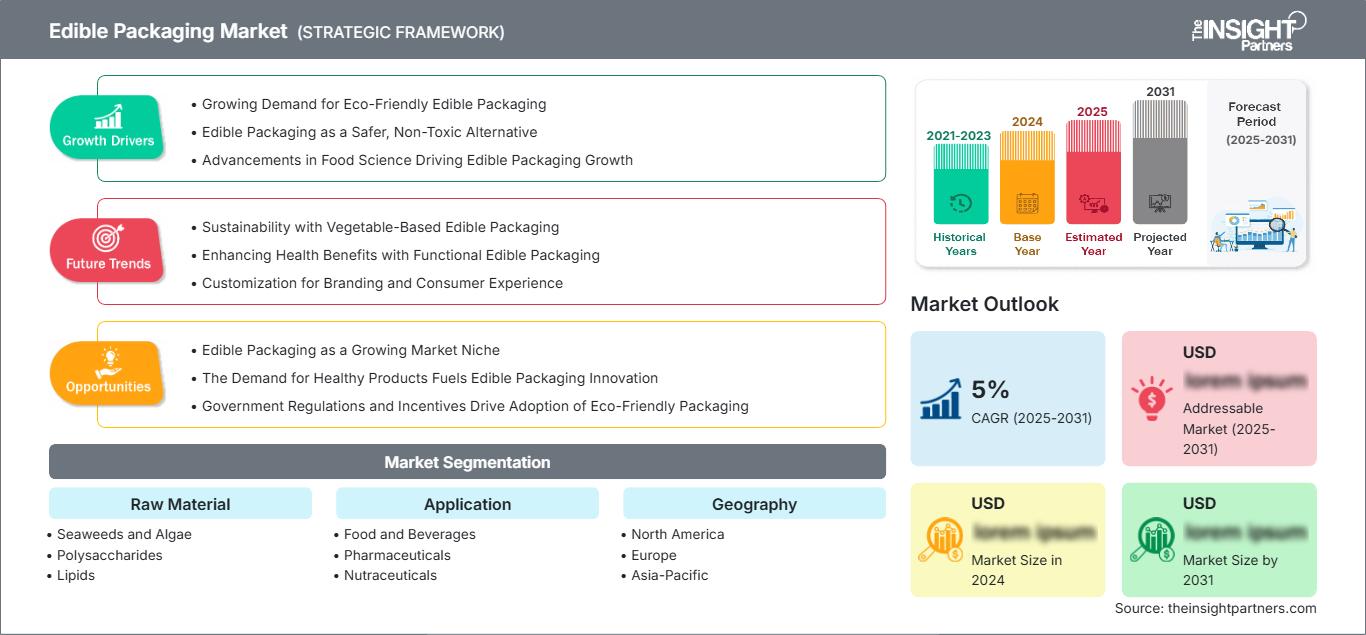
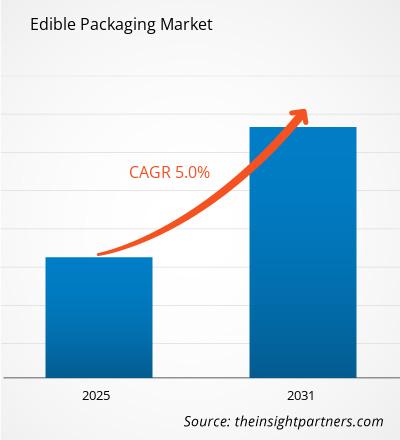
The Edible Packaging Market was valued at US$ 5.66 Billion in 2025 and is projected to reach US$ 9.13 Billion by 2034, registering a CAGR of 5.46% during 2026–2034. The market will experience growth because of increased pressure to minimize single-use plastic, growing commercialization of edible films, and usage of the products in food and beverages, pharmaceuticals, and nutraceuticals. Innovations related to materials such as seaweed, algae, polysaccharides, and lipids are increasing market relevancy. Application-specific materials and validation of the claims of being edible, soluble, and/or compostable will continue to define the market.
In North America, the forecast of the Edible Packaging Market size will be bolstered by CAGR of 5.0-5.8% during 2026-2034. State level regulations on plastic, innovations with food service consumable sachets, and investments of brands into compostable and food-safe barrier materials are among key drivers of the market. North America has established infrastructure for packaging food products, early stage venture capital, and cooperation of material suppliers and consumer packaged goods companies. Consumers will favor packaging solutions that minimize visibility of waste while not requiring any modifications of the processes of filling and distributing the products.
Edible Packaging Market Assessment and Insights
- North America: Share in 2025 of 31–35% and CAGR between 5.0–5.8%. Adoption is led by premium foodservice, beverages, and nutraceutical formats where brands can absorb higher material costs.
- US: Share in 2025 of 78–82% of North America and CAGR between 5.1–5.9%. Demand is supported by packaged snacks, dissolvable films, and early pilots by sustainability-focused food brands.
- Europe: Edible Packaging Market Share in 2025 of 27–31% and CAGR between 5.2–6.0%. The UK, Germany, France, Italy, and Spain lead through plastic restriction policies and circular packaging targets.
- Asia Pacific: Share in 2025 of 24–28% and CAGR between 6.0–6.8%. China, India, Japan, South Korea, and Australia benefit from seaweed availability, food innovation, and sustainable packaging mandates.
- Largest Segment: Food and Beverages held a market share of 68–72% in 2025 and CAGR of 5.4–6.2% during 2026–2034, driven by sachets, coatings, films, and novelty foodservice formats.
- High Growth Segment: Seaweeds and Algae held a market share of 34–38% in 2025 and CAGR of 6.2–7.0% during 2026–2034, supported by abundant marine feedstock and strong film-forming properties.
- Key companies analyzed in detail: Devro plc, EnviGreen Biotech India Private Limited, Evoware, Incredible Eats, Inc., JRF Technology, LLC, MonoSol, LLC, Nagase America LLC, Notpla Limited, TIPA Corp Ltd., Xampla Limited.
Source: The Insight Partners' analysis based on proprietary research, government publications, company annual reports, investor presentations, industry databases, and expert interviews.
The Technology Evolution trend driving the Edible Packaging Market will be going from novel products to edible packaging systems. Early generation products consisted of edible spoons, water balls, and dissolving wraps, whereas innovations in later generations include barrier packaging, oxygen scavengers, antimicrobials, and scaleable process technologies. Manufacturers are looking at ways to integrate extrusion, casting, coating, and encapsulation in materials that are natural polymers which require food contact, sensory, and shelf life properties. The future growth drivers are going to be feedstock supply chain ecosystem in Asia Pacific region, European regulators' pressures, and North American companies' pilot tests. The focus is shifting towards investment in plant protein films, seaweed film coatings, and dissolving sachet material which will be compatible with the existing filling machines.
Edible Packaging Market Report Scope
| Report Attribute | Details |
|---|---|
| Market size in 2025 | US$ 5.66 Billion |
| Market Size by 2034 | US$ 9.13 Billion |
| Global CAGR (2026 - 2034) | 5.46% |
| Historical Data | 2021-2024 |
| Forecast period | 2026-2034 |
Edible Packaging Market Analysis
Market growth for the Edible Packaging market will be determined by the issue of plastic waste, the desire for sustainability of brands, as well as demand for packaging which not only preserves but also minimizes waste generation. Edible films for confectionery, dry mix powders, beverage pods, and sauce sachets are being evaluated by food and beverages companies. Dissolvable films used for single dose convenience as well as improved visual appearance of the pharmaceutical and nutraceutical products are currently in development phase. Marine biomass providers, starch & hydrocolloids manufacturers, lipids formulations providers, coaters, converters, brand owners, and certifications agencies represent the value chain of the market. The supply factors still are vulnerable to the issues of feedstock availability and consistency, cost of food-grade processing, and barriers performance.
The Edible Packaging Market Report suggests a competitive scenario dominated by specialty material suppliers. Notpla Limited and Xampla Limited are making progress with seaweed and plant-based protein substitutes, whereas MonoSol, LLC and Nagase America LLC offer expertise in water-soluble and specialty materials. Devro plc offers experience in edible collagen casings, and TIPA Corp Ltd is a contributor in the space of compostable flexible packaging. Positioning increasingly relies on demonstrating food safety, economic scalability, and the ability to work with current packaging machinery. Evoware and EnviGreen Biotech India Private Limited are important players in Asian innovation, and Incredible Eats, Inc. and JRF Technology, LLC serve niches for edible utensils and functional films. Cooperation with foodservice companies, nutraceuticals and converters will most probably define success of different technologies at larger scales.
● REPORT CUSTOMIZATION
Tailor This Report To Align With Your Specific Business Requirements
This report can be customized to align precisely with your business objectives, scope, and target markets. Customization options include tailored segmentation, geography, competitive analysis, and strategic insights to support informed decision-making.
Customize This Report →WHAT YOU CAN ADJUST
- ● Segmentations
- ● Geography
- ● Competitive Analysis
- ● Language Preferences
Edible Packaging Market: Strategic Insights
Regional Insights
North America Edible Packaging Market
North America generated 31-35% of the global revenue in 2025 and is expected to grow at a 5.0-5.8% CAGR from 2026 to 2034. The Edible Packaging Market share demonstrates high demand for packaged food products, awareness of the problem with plastic waste, and experiments with dissolvable films and edible serviceware. American and Canadian brands use pilot projects to test consumer reaction before implementing edible packaging on a larger scale. The region has potential for further growth thanks to venture capital investments, food contact materials knowledge, and pressure from retailers to eliminate non-recyclable forms. The adoption of edible packaging is limited due to the need for neutral taste, moisture resistance, allergen labeling, and extended shelf life.
U.S. Edible Packaging Market
The U.S. was accounting for 78–82% of North American revenues in 2025, and the CAGR is expected to be between 5.1 and 5.9% up to 2034. The company’s strengths lie in specialty materials, functional films, and foodservice innovations, including MonoSol, LLC, JRF Technology, LLC, Incredible Eats, Inc., and Nagase America LLC in terms of technical contribution. Applications focus on single-serve beverages, confectionery packaging, powder sachets, edible cutlery, and nutraceutical applications. Brand manufacturers prefer piloting projects that allow for delivering convenience and sustainability messages via packaging without affecting the flavor of the products. Food contact regulation requires controlled launches in case of food films for products with moisture content.
Europe Edible Packaging Market
Europe had a market share of 27–31% in 2025 and is expected to expand at a CAGR of 5.2-6.0% in 2026-2034. The United Kingdom holds the highest market share owing to packaging activities using seaweed, trials in food services, and efforts against single-use plastic packaging. Germany is benefitted with its packaging engineering capabilities, retailing commitments towards sustainability, and validated food contact solutions. France, Italy, and Spain are working on their potential in the sectors of confectionary, fresh food coatings, hospitality, and gourmet groceries. Europe’s regulatory landscape makes a favorable testing ground for edible and compostable solutions, while cost effectiveness is of utmost importance.
APAC Edible Packaging Market
The Asia Pacific region holds a market share of 24–28% in 2025 and is expected to grow at a CAGR of 6.0–6.8%. China dominates the market, whereas Japan, South Korea, India, and Australia make contributions via packaging food innovation, seaweed processing, and sustainable policies. The region benefits from availability of feedstocks, providing sourcing advantages. Industry factors include good seaweed cultivation, high starch processing capabilities, and fast-growing convenience food sector. The ban on single-use plastics in India and elsewhere makes a compelling argument for use of edible products. Adoption will be higher in foodservice, beverages, confectionary, and nutraceuticals segments where consumers are open to new formats.
Middle East & Africa Edible Packaging Market
The Middle East & Africa will have a 4.8-5.6% CAGR until 2034. The countries of Saudi Arabia and UAE have high interests in the region due to the requirement for sustainable packaging solutions by the tourism industry, airlines, hospitality, and premium food services. The country of South Africa adds its share via retail upgrade and packaged food requirement. The energy rich Gulf economies have initiatives towards circular economy and advanced materials, thus providing selective opportunities for edible packaging innovations. The lack of infrastructure of composting and specialized conversion could hinder growth.
Segmentation Analysis
Source
The source segment is projected to grow at a CAGR of 5.2%–5.9% during 2026–2034, driven by increasing preference for plant-based and biodegradable materials. The Edible Packaging Market scope within this segment is expanding due to advancements in material extraction and processing technologies, enabling scalable production and enhanced product performance across food and pharmaceutical applications.
- Plant: Dominates due to abundant availability and lower production costs. Widely used in food packaging applications, plant-based materials offer biodegradability and compatibility with large-scale manufacturing processes, making them highly attractive for commercial adoption.
- Animal: Primarily used in specialized applications such as protein-based films. While offering strong barrier properties, adoption is limited by cost and ethical considerations, though niche demand persists in pharmaceutical and specialty packaging segments.
Raw Material
The raw material segment is expected to grow at a CAGR of 5.8%–6.4% during 2026–2034, supported by increasing innovation in biodegradable compounds. Advances in polysaccharides and lipid-based formulations are enhancing functional properties such as moisture resistance and shelf-life extension, driving adoption across multiple end-use industries.
- Seaweeds and Algae: Emerging as a high-potential material due to natural biodegradability and minimal environmental impact. Increasing investments in seaweed farming and processing are supporting commercial scalability and expanding application scope.
- Polysaccharides: Widely used due to excellent film-forming properties and compatibility with food products. Demand is driven by their ability to enhance packaging strength and flexibility while maintaining biodegradability.
- Lipids: Utilized for moisture barrier properties in food packaging. Lipid-based materials are gaining traction in applications requiring extended shelf life and improved product protection.
End Use
The end-use segment is projected to grow at a CAGR of 5.6%–6.2% during 2026–2034, driven by increasing adoption across food and pharmaceutical industries. Rising demand for sustainable packaging solutions and regulatory pressure to reduce plastic waste are key factors influencing segment growth.
- Food and Beverages: Represents the largest application area due to high consumption volumes and increasing demand for eco-friendly packaging. Adoption is driven by quick-service restaurants, retail chains, and food delivery platforms focusing on sustainability.
- Pharmaceuticals: Gaining traction for applications such as capsule coatings and drug delivery systems. The segment benefits from the need for biodegradable and consumable packaging solutions in medical applications.
Packaging Process and System
This segment is anticipated to grow at a CAGR of 6.0%–6.7% during 2026–2034, driven by technological advancements in packaging methods. Integration of antimicrobial and nanotechnology-based processes is enhancing product performance and expanding application possibilities.
- Antimicrobial: Increasingly used to enhance food safety and extend shelf life. These solutions are gaining importance in packaged food segments requiring longer storage durations.
- Nanotechnology: Enables improved barrier properties and structural integrity. Adoption is growing due to its ability to enhance performance without compromising biodegradability.
- Electrohydrodynamics: Emerging technique used for precision coating and film formation. It is gaining traction in high-performance packaging applications.
- Coatings: Widely used for enhancing durability and moisture resistance. Coating technologies are critical for improving functionality and product protection.
- Microbials: Utilized for natural preservation and biodegradability. These solutions are gaining traction in organic and clean-label food packaging applications.
Opportunity Snapshot
| End Use | Revenue Contribution | Trend Tag | Adoption Stage |
| Food and Beverages | High | Sustainable Food | Mature |
| Pharmaceuticals | Medium | Bio Delivery | Scaling |
Edible Packaging Market Growth Drivers and Impact Analysis
Plastic Waste Reduction and Single-Use Packaging Pressure
Plastic waste reduction remains the strongest structural driver because edible materials address formats that are difficult to recycle, including sachets, wrappers, films, and serviceware. Foodservice operators and consumer brands face increasing pressure from regulators, retailers, and consumers to demonstrate measurable progress on packaging waste. Edible alternatives can remove end-of-life friction when the pack is consumed, dissolved, or naturally degraded after use. The impact is most visible in single-serve foods, beverage pods, events, and quick-service meals, where high unit volumes create visible waste streams. Suppliers that prove shelf stability and safe ingestion can convert sustainability pressure into recurring contracts. Commercial teams are also using limited pilots to measure sensory response, storage behavior, sealing performance, and disposal outcomes before wider procurement decisions. This staged approach helps suppliers refine specifications while giving buyers evidence on cost, compliance, and operational fit. It also supports clearer brand communication because consumers can directly understand how the package reduces disposal steps after consumption.
Material Science Improvements in Natural Polymer Films
Advances in natural polymer formulation are improving commercial feasibility by addressing historical weaknesses in strength, taste, moisture sensitivity, and production consistency. Seaweed derivatives, starches, proteins, and lipid blends can now be engineered into composite systems that provide targeted barrier functions for specific applications. This development reduces reliance on purely novelty formats and opens opportunities in higher-volume packaged foods, powders, and nutraceuticals. Better compatibility with conventional coating and filling equipment also lowers adoption barriers for converters. As performance improves, edible packaging can compete not only on sustainability but also on convenience, product protection, and differentiated brand experience. Commercial teams are also using limited pilots to measure sensory response, storage behavior, sealing performance, and disposal outcomes before wider procurement decisions. This staged approach helps suppliers refine specifications while giving buyers evidence on cost, compliance, and operational fit. Improved process control should also help converters reduce batch variation and qualify materials for repeat commercial supply.
Expansion of Functional Foods and Nutraceutical Formats
The expansion of functional foods and nutraceuticals creates demand for packaging that aligns with wellness positioning and portion-control requirements. Powders, gummies, supplements, probiotics, and fortified beverages often use small-format packaging that is convenient but waste intensive. Edible films and dissolvable pouches can support cleaner consumption, precise dosing, and reduced secondary waste. This driver is commercially important because nutraceutical brands often operate at premium price points and can test differentiated formats faster than mass-market food categories. The result is a practical bridge between laboratory innovation and broader packaging commercialization. Commercial teams are also using limited pilots to measure sensory response, storage behavior, sealing performance, and disposal outcomes before wider procurement decisions. This staged approach helps suppliers refine specifications while giving buyers evidence on cost, compliance, and operational fit. These conditions make the category a useful launch platform for suppliers seeking validated performance data.
Edible Packaging Market Future Trends
Hybrid Edible and Compostable Barrier Systems
Future Edible Packaging Market trends will include hybrid systems that combine edible layers with compostable support structures to improve barrier performance without sacrificing sustainability. Rather than replacing every plastic function in one step, suppliers will design multilayer solutions where edible coatings protect food, while compostable substrates provide mechanical strength. This pathway is likely to accelerate adoption in snacks, bakery items, dry powders, and takeaway formats. The approach also enables converters to use familiar equipment while transitioning away from fossil-based films. Successful products will be those that clearly define whether the package is intended to be eaten, dissolved, composted, or separated after use. Commercial teams are also using limited pilots to measure sensory response, storage behavior, sealing performance, and disposal outcomes before wider procurement decisions. This staged approach helps suppliers refine specifications while giving buyers evidence on cost, compliance, and operational fit. This layered strategy should make adoption less disruptive for mainstream packaged food producers.
Regenerative Feedstock Sourcing and Localized Production
Regenerative sourcing will become a defining trend as brands scrutinize the environmental footprint of packaging inputs. Seaweed, algae, starch crops, and plant proteins can support lower-impact supply chains when responsibly cultivated and processed near conversion hubs. Localized production should reduce transport emissions, improve feedstock traceability, and create resilience against agricultural volatility. Companies may also use regional feedstocks to tailor material properties and labeling claims. Over time, buyers will evaluate edible packaging not only by biodegradability but also by land use, water intensity, carbon profile, and compatibility with food safety systems. Commercial teams are also using limited pilots to measure sensory response, storage behavior, sealing performance, and disposal outcomes before wider procurement decisions. This staged approach helps suppliers refine specifications while giving buyers evidence on cost, compliance, and operational fit. Traceable sourcing will also support procurement decisions by large brands with formal sustainability reporting obligations.
Edible Packaging Market Opportunities
Foodservice Pilots for High-Volume Sachets and Serviceware
Foodservice offers one of the clearest investment pathways because sauces, condiments, cups, straws, cutlery, and event packaging generate concentrated waste streams. Edible and dissolvable formats can be tested in controlled environments such as stadiums, airlines, quick-service restaurants, and corporate catering. These settings allow brands to measure customer response, operational fit, waste reduction, and cost impact before scaling. Edible Packaging Market Forecasts point to stronger adoption where operators can link packaging innovation to sustainability commitments and guest experience. Suppliers should prioritize formats with simple handling, predictable storage, and minimal taste interference. Commercial teams are also using limited pilots to measure sensory response, storage behavior, sealing performance, and disposal outcomes before wider procurement decisions. This staged approach helps suppliers refine specifications while giving buyers evidence on cost, compliance, and operational fit. Operators can also collect rapid feedback because service environments produce high transaction volumes.
Premium Nutraceutical and Pharmaceutical Unit-Dose Packaging
Recent Developments
- December 2025: Tetra Pak, in collaboration with García Carrión, has launched the first use of paper-based barrier technology for juice packaging, representing a significant advancement in sustainable food packaging and a move towards reducing fossil-based material reliance.
- May 2025: KIND Snacks launched its first curbside recyclable paper wrapper pilot in the U.S., a significant step towards achieving recyclable packaging for its bars by 2030. The innovative, pulpable paper wrapper is How2Recycle pre-qualified, allowing consumers to recycle it, promoting environmental sustainability.
Frequently Asked Questions

- Comprehensive Market Sizing and Forecast Analysis
- Detailed Segmentation Analysis
- In-Depth Market Dynamics Assessment
- Regional and Country-Level Insights
- Competitive Landscape and Company Benchmarking
- Strategic Business Intelligence
Recent Reports
Testimonials

The Insight Partners provided valuable market intelligence that supported our global go-to-market strategy. Their team was professional, responsive, and attentive to our feedback, providing thoughtful analysis and helpful methodological clarifications throughout the project.
Junmo Kim Chief Financial Officer (CFO), Enertech Co., Ltd.
The Insight Partners' SCADA System Market report is comprehensive, with valuable insights on current trends and future forecasts. The team was highly professional, responsive, and supportive throughout. We are very satisfied and highly recommend their services.
RAN KEDEM Partner, Reali Technologies LTDs
I requested a report on a very specific software market and the team produced the report in a few days. The information was very relevant and well presented. I then requested some changes and additions to the report. The team was again very responsive and I got the final report in less than a week.
JEAN-HERVE JENN Chairman, Future Analytica
We worked with The Insight Partners for an important market study and forecast. They gave us clear insights into opportunities and risks, which helped shape our plans. Their research was easy to use and based on solid data. It helped us make smart, confident decisions. We highly recommend them.
PIYUSH NAGPAL Sr. Vice President, High Beam Global
The Insight Partners delivered insightful, well-structured market research with strong domain expertise. Their team was professional and responsive throughout. The user-friendly website made accessing industry reports seamless. We highly recommend them for reliable, high-quality research services
YUKIHIKO ADACHI CEO, Deep Blue, LLC.
This is the first time I have purchased a market report from The Insight Partners.While I was unsure at first, I visited their web site and felt more comfortable to take the risk and purchase a market report.I am completely satisfied with the quality of the report and customer service. I had several questions and comments with the initial report, but after a couple of dialogs over email with their analyst I believe I have a report that I can use as input to our strategic planning process.Thank you so much for taking the extra time and making this a positive experience.I will definitely recommend your service to others and you will be my first call when we need further market data.
JOHN SUZUKI President and Chief Executive Officer, Board Director, BK Technologies
I wish to appreciate your support and the professionalism you displayed in the course of attending to my request for information regarding to infectious disease IVD market in Nigeria. I appreciate your patience, your guidance, and the fact that you were willing to offer a discount, which eventually made it possible for us to close a deal. I look forward to engaging The Insight Partners in the future, all thanks to the impression you have created in me as a result of this first encounter.
DR CHIJIOKE ONYIA MANAGING DIRECTOR, PineCrest Healthcare Ltd.Reason to Buy
- Informed Decision-Making
- Understanding Market Dynamics
- Competitive Analysis
- Identifying Emerging Markets
- Customer Insights
- Market Forecasts
- Risk Mitigation
- Boosting Operational Efficiency
- Strategic Planning
- Investment Justification
- Tracking Industry Innovations
- Aligning with Regulatory Trends





 Get Free Sample for