
Elastomeric Coating Market Demand, Share & Growth by 2034
Elastomeric Coating Market Size and Forecasts (2021 - 2034), Global and Regional Share, Trends, and Growth Opportunity Analysis Report Coverage : by Type (Acrylic, Polyurethane, Silicone, Butyl); Application (Wall Coatings, Roof Coatings, Floor/Horizontal Surface Coatings); and Geography (North America, Europe, Asia Pacific, and South and Central America)
- Status : Data Released
- Report Code : TIPRE00040529
- Category : Chemicals and Materials
- No. of Pages : 150
- Available Report Formats :


- Last update date : July 30, 2026


2025 Market Size
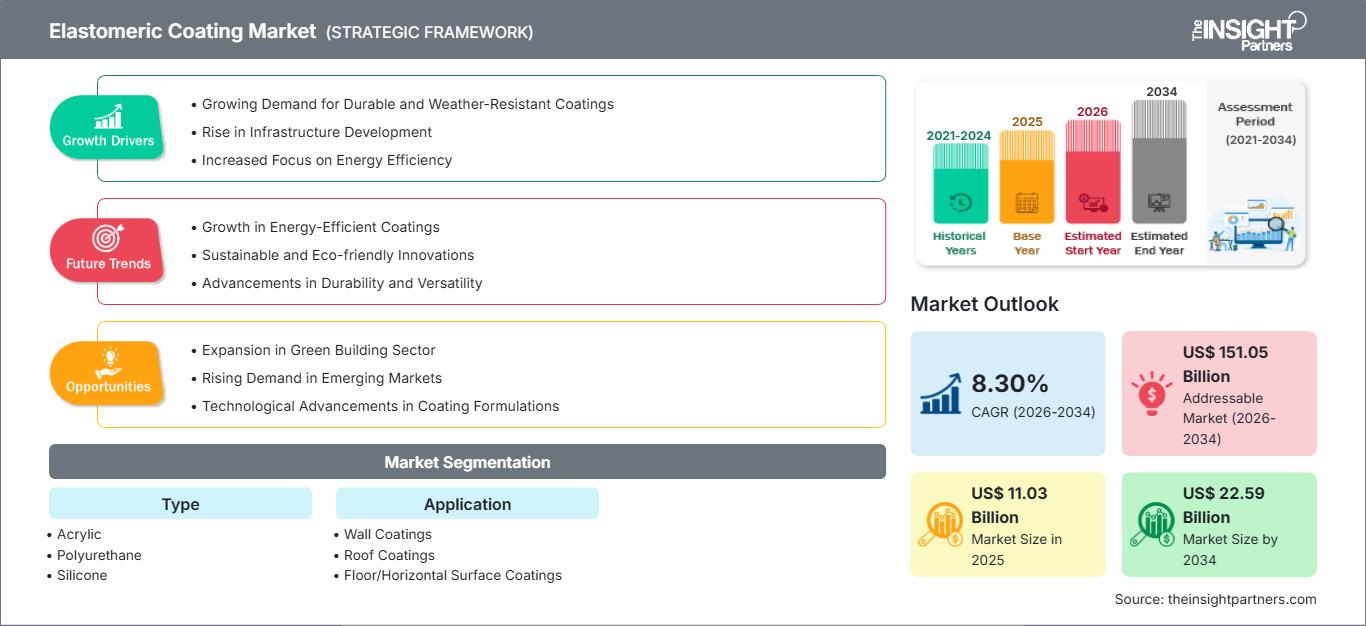
US$ 11.03 Bn
Base year value
2034 Forecast
US$ 22.59 Bn
Projected by 2034
CAGR 2026-2034
8.30 %
Growth rate
Addressable Market
US$ 151.05 Bn
(2026-2034)
The Elastomeric Coating Market was valued at US$ 11.03 Billion in 2025 and will be US$ 22.59 Billion by 2034, growing at a CAGR of 8.30% from 2026 to 2034. Demand is driven by building restoration, waterproofing, and energy-efficient envelopes for commercial, residential, and industrial structures. There is an increased uptake of flexible coatings when substrates need crack-bridging, UV protection, moisture protection, and extended service life.
North America continues to be a technically advanced demand center, with forecast growth in the region expected to be in the 7.4–8.4% CAGR bracket due to reroofing, façade renovation, and cool-roof initiatives driving market development. The future forecast of North America Elastomeric Coating Market size is influenced by the aging commercial stock, VOC-related legislation, and property owners preferring roof restoration options to avoid landfilling.
Elastomeric Coating Market Assessment and Insights
- North America: Share in 2025 of 31–35% and CAGR between 7.4–8.4%. Demand is led by reroofing, exterior wall protection, and energy-code compliance across commercial properties.
- US: Share in 2025 of 78–82% of North America and CAGR between 7.5–8.5%. Strong contractor networks and cool-roof specifications support steady procurement.
- Europe: Share in 2025 of 24–28% and CAGR between 6.8–7.8%. Germany, the UK, France, Italy, and Spain lead through renovation and low-VOC policy alignment.
- Asia Pacific: Share in 2025 of 28–32% and CAGR between 8.8–9.8%. China, India, Japan, South Korea, and Australia benefit from infrastructure renewal and urban building protection.
- Largest Segment: Acrylic held 38–42% market share in 2025 and CAGR of 7.8–8.8% during 2026–2034, supported by wall and roof coating use.
- High Growth Segment: Silicone held 18–22% market share in 2025 and CAGR of 9.0–10.0% during 2026–2034, driven by UV and ponding-water resistance.
- Key companies analyzed in detail: PPG Industries, Inc.; The Sherwin-Williams Company; Nippon Paint Holdings Co., Ltd.; Jotun A/S; Hempel A/S; Sika AG; BASF SE; The Henry Company LLC; RPM International Inc.; GAF Materials LLC.
Source: The Insight Partners' analysis based on proprietary research, government publications, company annual reports, investor presentations, industry databases, and expert interviews.
In terms of material development, this has evolved from flexible waterproof membranes to high-solids content, low-VOC, reflective, and substrate-specific coatings. Acrylic technology continues to be prevalent because of its favorable ratio of cost, color retention, and application ease, whereas polyurethane and silicone technologies cater to higher performance needs. The changing dynamics of production now include water-borne coatings, resin dispersion, and contractor coatings to minimize downtime during roof and wall repairs.
Expected future growth would cover hot climate cities, coastal facilities, logistics roofs, and institutions where thermal movement and moisture penetrate substrates faster. There will be more investment in energy-efficient construction, environmentally friendly procurement processes, and building renovation rather than demolition. The companies with technical warranties, applicator training programs, and manufacturing capabilities in the region would have an advantage.
Elastomeric Coating Market Report Scope
| Report Attribute | Details |
|---|---|
| Market size in 2025 | US$ 11.03 Billion |
| Market Size by 2034 | US$ 22.59 Billion |
| Global CAGR (2026 - 2034) | 8.30% |
| Historical Data | 2021-2024 |
| Forecast period | 2026-2034 |
Elastomeric Coating Market Analysis
The Elastomeric Coating Market growth drivers include increasing building renovation efforts, improving waterproofing demands, and the popularity of cool-roof technologies. These coatings are used by contractors for extending roof life, sealing cracks, and providing protection to masonry, concrete, and metal substrates against weathering. The demand stems from reducing heat load within the building as well as its maintenance costs, which become an important issue for commercial buildings with large exposed surfaces.
There are various parties within the value chain, including resin producers, formulators, distributors, roofing installers, facade contractors, and facilities management. Acrylic resins are utilized in exterior applications where price matters, whereas silicone and polyurethane systems are chosen in high-risk roof applications. Supply conditions are affected by resin supply issues, cost of titanium dioxide, VOCs legislation, and applicator certification program.
Competitive analysis of the Elastomeric Coating Market report suggests that competition is centered on technical features, warranties, and specifications. The leading players, PPG Industries, Inc., The Sherwin-Williams Company, Sika AG, BASF SE, and RPM International Inc., compete based on broad coatings product lines. Meanwhile, The Henry Company LLC and GAF Materials LLC focus on their strong position within the roofing systems. In its turn, Nippon Paint Holdings Co., Ltd., Jotun A/S, and Hempel A/S add geographic reach via architectural and protective coatings products lines.
Investments are being made in low VOC water-borne technologies, high quality reflective roof coatings, enhanced elongation retention, and compatibility with aged membranes. Furthermore, the industry participants are increasing trainings of the certified applicators as inappropriate surface preparation may decrease the efficiency of the coatings. Strategic positioning is becoming more and more climate-based, focused on the partnerships within the commercial reroofing segment and documentation of lifecycle cost savings for asset owners. Also, portfolio owners are standardizing specifications for different buildings that provides an opportunity for the manufacturers offering consistent product quality, regional distribution, technical documentation, and certified applicators.
● REPORT CUSTOMIZATION
Tailor This Report To Align With Your Specific Business Requirements
This report can be customized to align precisely with your business objectives, scope, and target markets. Customization options include tailored segmentation, geography, competitive analysis, and strategic insights to support informed decision-making.
Customize This Report →WHAT YOU CAN ADJUST
- ● Segmentations
- ● Geography
- ● Competitive Analysis
- ● Language Preferences
Elastomeric Coating Market: Strategic Insights
Regional Insights
North America Elastomeric Coating Market
The North American region contributed 31-35% revenue worldwide in 2025 and is estimated to witness 7.4-8.4% CAGR from 2026 to 2034. The Elastomeric Coating Market share of the regional segment includes vast low-slope roofing stock, existing restoration contractors, and application of reflective coating for decreasing cooling loads. The demand is high in warehouses, retail complexes, schools, healthcare facilities, and multifamily residential buildings needing waterproofing without tear-off.
Regulatory requirements also drive market growth as VOC limitations in certain states lead to usage of water-borne and compatible products. Roof restoration is becoming a preferred option to replacing roofs in addition to reducing disruption. The market is driven by availability of leading companies The Sherwin-Williams Company, PPG Industries, Inc., RPM International Inc., The Henry Company LLC, and GAF Materials LLC in the region.
U.S. Elastomeric Coating Market
The US constituted 78–82% of North American revenues in 2025, with growth estimated at a 7.5–8.5% CAGR. There were large commercial roofs, states on the coast where there is the possibility of hurricanes, and buildings in the Sun Belt exposed to high temperatures, which favor the application of acrylic and silicone paints. The facility managers appreciated systems that increased durability, prevented water penetration, and facilitated operations during application.
Presence was vital as local companies manufacture roofing membranes, primers, sealants, and coating systems through their contractors. GAF Materials LLC and The Henry Company LLC are important companies in roof restoration, whereas The Sherwin-Williams Company and PPG Industries, Inc. cater to architectural channels. Application trends focused on the use of reflective white paints, protection of masonry walls, and maintenance services for logistics and retail properties.
Europe Elastomeric Coating Market
Europe has 24-28% market share of worldwide revenue in 2025, with forecast growth of 6.8-7.8%. Germany is the dominant country due to renovation activities, energy efficiency policies, and technologically advanced exterior systems. Reroofing and façade rehabilitation of aged commercial structures, public buildings, and residential properties are also contributing to the UK.
France, Italy, and Spain also have contributions from climate-exposed building surfaces, tourism infrastructure, and urban renewal projects with waterproofing and thermal requirements. European consumers give high weight to products with low emissions, longevity evidence, and meeting environmental product requirements. Sika AG, BASF SE, Hempel A/S, Jotun A/S, and Nippon Paint Holdings Co., Ltd. are among companies that provide regional coverage via protective and architectural coating offerings.
APAC Elastomeric Coating Market
Asia Pacific accounted for 28%–32% of global revenue in 2025 and is anticipated to witness a CAGR of 8.8%–9.8%. China continues to dominate with its vast building inventory in urban areas, infrastructural maintenance, and requirements for exterior coating. India is growing with its housing developments, waterproofing, and commercial projects.
The focus on Japan and South Korea lies in durability, seismic movement capabilities, and façade maintenance, whereas Australia encourages cool roof and weather-resistant coating in high-UV environments. Regional policy focus on resilient buildings, urban heat island mitigation, and infrastructural renovation is likely to drive the growth of acrylic, polyurethane, and silicone coatings.
Middle East & Africa Elastomeric Coating Market
The Middle East & Africa is forecast to grow at a 7.0–8.0% CAGR through 2034. Saudi Arabia is the leading country as giga-projects, hospitality assets, and commercial buildings require coatings that tolerate UV exposure, thermal cycling, and dust abrasion. The UAE remains important for premium construction and roof maintenance.
SA is helping due to its requirements of commercial building refurbs and waterproofing. Rest of the MEA region is gaining due to selective infrastructure and energy-related construction. High temperatures help in reflecting roof coating, and moisture penetration in coastal cities creates a requirement for exterior wall protection. Training of applicators and proof of durability are the key factors when specifying. In many markets, government-sponsored construction, airport expansion projects, logistics parks, and hospitality developments are creating increased demand for heat resistance and wetness tolerance for coatings.
Segmentation Analysis
Type
The Type segment is projected to grow at a 8.0–9.0% CAGR during 2026–2034. The Elastomeric Coating Market scope across resin types reflects different performance needs, from cost-efficient wall protection to high-end roof waterproofing. Selection is influenced by elongation, UV stability, ponding-water tolerance, substrate adhesion, and maintenance interval expectations across commercial and residential assets. Acrylic products are typically selected for cost-controlled maintenance, polyurethane for tougher horizontal exposure, silicone for challenging roofs, and butyl where vapor control and waterproofing are central. This segmentation supports differentiated pricing because performance requirements vary meaningfully by substrate and climate.
- Acrylic: Acrylic coatings hold the leading position because they offer balanced cost, reflectivity, color retention, and ease of application for roofs and walls in moderate exposure conditions.
- Polyurethane: Polyurethane systems serve demanding applications requiring abrasion resistance, strong adhesion, and mechanical durability, especially across decks, horizontal surfaces, and industrial building protection.
- Silicone: Silicone products are strategically important for low-slope roofs exposed to UV, heat, and ponding water, making them attractive for commercial restoration projects.
- Butyl: Butyl coatings maintain a niche role where vapor resistance, waterproofing, and adhesion to difficult substrates are required in specialized roof and exterior applications.
Application
The Application segment is expected to expand at a 8.1–9.1% CAGR through 2034. Demand is shaped by building-envelope performance, lifecycle maintenance economics, and weather-resistance requirements. Roof coatings remain central due to energy and waterproofing benefits, while walls and horizontal surfaces support broader adoption across façades, balconies, walkways, and exposed concrete areas. Procurement teams increasingly evaluate coating selection alongside roof age, substrate condition, energy objectives, and warranty terms. This makes application-specific technical guidance important, particularly when owners seek to avoid premature recoating or coating failure caused by inadequate surface preparation.
- Wall Coatings: Wall coatings protect masonry, stucco, and concrete façades against water intrusion, hairline cracking, and weathering, making them important in renovation and exterior maintenance projects.
- Roof Coatings: Roof coatings generate high strategic value because they extend roof life, improve reflectivity, reduce thermal stress, and delay capital-intensive replacement in commercial buildings.
- Floor/Horizontal Surface Coatings: Horizontal surface coatings support balconies, decks, walkways, and exposed concrete areas where flexibility, abrasion resistance, and waterproofing are required together.
Opportunity Snapshot
| Segment Name | Revenue Contribution | Trend Tag | Adoption Stage |
| Wall Coatings | Medium | Façade Repair | Mature |
| Roof Coatings | High | Cool Roofs | Scaling |
| Floor/Horizontal Surface Coatings | Medium | Deck Protection | Scaling |
Elastomeric Coating Market Growth Drivers and Impact Analysis
Building Refurbishment and Roof Restoration Economics
Aging commercial and institutional buildings are increasing demand for restoration systems that avoid full roof replacement. Elastomeric coatings can seal cracks, bridge minor movement, and reduce water ingress while extending service intervals. For asset owners, the market impact is practical: coating systems reduce downtime, lower tear-off waste, and convert capital-intensive replacement into phased maintenance. This is especially relevant for warehouses, schools, retail centers, healthcare facilities, and multifamily properties. The Elastomeric Coating Market benefits because owners increasingly evaluate lifecycle cost, not only installed price. Demand is reinforced when contractors combine coatings with primers, flashing details, and inspection programs that provide documented performance and warranty confidence. The driver also supports recurring revenue because restored roofs require inspection, cleaning, and periodic recoating, creating repeat engagement between suppliers, contractors, and facility managers.
Energy-Efficient Building Envelope Requirements
Energy codes and voluntary green-building programs are encouraging reflective roof and wall systems that reduce solar heat absorption. Elastomeric coatings support this objective by improving surface reflectance, reducing thermal stress, and helping maintain interior comfort in hot climates. The impact is strongest across commercial buildings with large low-slope roof areas, where cooling loads are material operating expenses. Adoption is also supported by urban heat mitigation policies and sustainability reporting requirements. Manufacturers that can provide compliant low-VOC, high-reflectance, and durable formulations are well positioned. This driver moves procurement beyond waterproofing alone and links coating decisions to energy management, resilience planning, and building operating performance.
Shift Toward Low-VOC and Water-Borne Formulations
Environmental and occupational safety expectations are changing coating specifications. Low-VOC and water-borne elastomeric systems are gaining preference because they reduce odor, improve jobsite acceptance, and help meet regional air-quality rules. This shift affects product development, distribution, and contractor training because formulations must preserve elongation, adhesion, and weatherability while meeting compliance thresholds. The market impact is visible in architectural coating channels, public-sector projects, and occupied-building maintenance where application disruption must be minimized. Suppliers investing in resin technology, testing, and field guidance can differentiate themselves. As regulations tighten, compliant formulations are expected to become standard rather than premium options.
Elastomeric Coating Market Future Trends
Higher-Performance Silicone and Hybrid Roof Systems
Elastomeric Coating Market trends indicate stronger adoption of silicone and hybrid roof systems in applications exposed to heat, ultraviolet radiation, and ponding water. Future product development will focus on longer service life, faster cure profiles, improved dirt pickup resistance, and compatibility with aged roof membranes. These advances will support commercial building owners seeking restoration solutions with measurable durability. Manufacturers may also combine silicone topcoats with acrylic or polyurethane base layers to optimize cost and performance. The trend will likely increase specification complexity, making technical support, applicator certification, and documented field performance more important for competitive differentiation.
Data-Driven Maintenance and Warranty-Led Specification
Future demand will increasingly connect coatings with building-condition assessment, infrared roof scans, digital maintenance records, and warranty management. Facility owners are expected to specify elastomeric systems based on asset condition, moisture mapping, and projected lifecycle savings. This trend will benefit suppliers that can integrate products with inspection protocols and contractor networks. Digital documentation may also reduce disputes by creating clearer records of substrate preparation, film thickness, and inspection outcomes. Over time, data-supported maintenance programs could shift coating procurement from reactive repair toward planned asset management across commercial portfolios. Suppliers that provide digital job records, product traceability, and inspection templates may gain preference among institutional and multi-site commercial buyers.
Elastomeric Coating Market Opportunities
Commercial Roof Restoration Programs
Commercial roof restoration offers the strongest near-term opportunity because large roof areas create recurring demand for waterproofing, reflectivity, and service-life extension. Contractors can target logistics centers, schools, hospitals, shopping centers, and industrial facilities where replacement is costly and disruptive. Investment aligned with Elastomeric Coating Market Forecasts should prioritize certified applicator networks, region-specific technical approvals, and maintenance packages that include inspections and recoating schedules. Suppliers can also expand by bundling primers, seam treatments, flashing products, and topcoats into complete systems. This approach improves accountability and supports stronger margins than single-product sales in price-sensitive channels.
Urban Façade Renewal and Climate-Resilient Walls
Urban façade renewal creates an investment opportunity as cities address aging masonry, concrete cracking, and moisture intrusion. Elastomeric wall coatings provide flexibility, weather protection, and improved exterior appearance without extensive reconstruction. Demand is likely to rise in dense residential districts, coastal cities, hospitality properties, and public buildings exposed to thermal cycling and rain. Companies can pursue growth by developing breathable coatings, color-stable finishes, and systems compatible with stucco, concrete, and cementitious substrates. Partnerships with façade consultants and renovation contractors can improve specification access. The opportunity is distinct because it links building preservation, occupant comfort, and lower exterior maintenance frequency. In cities facing heavier rainfall and heat stress, specification of flexible wall coatings can become part of broader resilience planning rather than a cosmetic maintenance decision.
Recent Developments
- June 2026: The European Commission has approved The Carlyle Group Inc.'s acquisition of BASF's coatings division, conditional upon Carlyle selling Nouryon Ltd.'s worldwide polysulfides business to a suitable buyer. Carlyle, a global investment firm, owns Nouryon, which supplies chemical ingredients for various markets, including coatings and sealants. BASF Coatings produces coatings for the automotive sector and other industries.
- December 2025: Organik Kimya, a global polymer manufacturer with nearly a century of experience, has enhanced its Roof Coating Solutions portfolio to meet modern roofing demands. The portfolio features advanced acrylic and styrene-acrylic polymer emulsions ideal for elastomeric roof coatings, waterproofing membranes, and flexible protective systems. These polymers offer high elasticity, strong adhesion, crack-bridging capability, and long-term resistance to UV and weathering, aiding formulators in creating durable solutions for renovation and new-build projects.
Frequently Asked Questions

- Comprehensive Market Sizing and Forecast Analysis
- Detailed Segmentation Analysis
- In-Depth Market Dynamics Assessment
- Regional and Country-Level Insights
- Competitive Landscape and Company Benchmarking
- Strategic Business Intelligence
Recent Reports
Testimonials

The Insight Partners' SCADA System Market report is comprehensive, with valuable insights on current trends and future forecasts. The team was highly professional, responsive, and supportive throughout. We are very satisfied and highly recommend their services.
RAN KEDEM Partner, Reali Technologies LTDs
I requested a report on a very specific software market and the team produced the report in a few days. The information was very relevant and well presented. I then requested some changes and additions to the report. The team was again very responsive and I got the final report in less than a week.
JEAN-HERVE JENN Chairman, Future Analytica
We worked with The Insight Partners for an important market study and forecast. They gave us clear insights into opportunities and risks, which helped shape our plans. Their research was easy to use and based on solid data. It helped us make smart, confident decisions. We highly recommend them.
PIYUSH NAGPAL Sr. Vice President, High Beam Global
The Insight Partners delivered insightful, well-structured market research with strong domain expertise. Their team was professional and responsive throughout. The user-friendly website made accessing industry reports seamless. We highly recommend them for reliable, high-quality research services
YUKIHIKO ADACHI CEO, Deep Blue, LLC.
This is the first time I have purchased a market report from The Insight Partners.While I was unsure at first, I visited their web site and felt more comfortable to take the risk and purchase a market report.I am completely satisfied with the quality of the report and customer service. I had several questions and comments with the initial report, but after a couple of dialogs over email with their analyst I believe I have a report that I can use as input to our strategic planning process.Thank you so much for taking the extra time and making this a positive experience.I will definitely recommend your service to others and you will be my first call when we need further market data.
JOHN SUZUKI President and Chief Executive Officer, Board Director, BK Technologies
I wish to appreciate your support and the professionalism you displayed in the course of attending to my request for information regarding to infectious disease IVD market in Nigeria. I appreciate your patience, your guidance, and the fact that you were willing to offer a discount, which eventually made it possible for us to close a deal. I look forward to engaging The Insight Partners in the future, all thanks to the impression you have created in me as a result of this first encounter.
DR CHIJIOKE ONYIA MANAGING DIRECTOR, PineCrest Healthcare Ltd.Reason to Buy
- Informed Decision-Making
- Understanding Market Dynamics
- Competitive Analysis
- Identifying Emerging Markets
- Customer Insights
- Market Forecasts
- Risk Mitigation
- Boosting Operational Efficiency
- Strategic Planning
- Investment Justification
- Tracking Industry Innovations
- Aligning with Regulatory Trends





 Get Free Sample for