
Elastomeric Sealants Market Size, Trends & Growth by 2034
Coverage: By Type (Silicone, Polysulfide (PS), Polyurethanes (PU), Silyl Modified Polymers (SMP), Polybutadiene (PB), Others); End-Use Industry (Construction, Automotive, Electronics, Furniture and Woodwork, Aerospace and Defense, Marine, Others) , and Geography (North America, Europe, Asia Pacific, and South and Central America)
- Status : Data Released
- Report Code : TIPRE00009222
- Category : Chemicals and Materials
- No. of Pages : 150
- Available Report Formats :


- Last update date : August 04, 2026


2025 Market Size
US$ 5.96 Bn
Base year value
2034 Forecast
US$ 10.33 Bn
Projected by 2034
CAGR 2026-2034
6.29 %
Growth rate
Addressable Market
US$ 73.68 Bn
(2026-2034)
The Elastomeric Sealants Market was valued at US$ 5.96 Billion in 2025 and is projected to reach US$ 10.33 Billion by 2034, registering a CAGR of 6.29% during 2026–2034. Demand is supported by construction envelope upgrades, automotive sealing requirements, electronics protection needs, and durable bonding applications across aerospace, marine, furniture, and defense systems.
North America remains a technically advanced demand center, with an estimated 5.6–6.4% CAGR supported by renovation activity and infrastructure renewal. The Elastomeric Sealants Market size outlook is reinforced by stricter weatherproofing expectations, low-VOC product adoption, and specification-driven procurement in commercial buildings, transportation equipment, and high-performance industrial assemblies.
Elastomeric Sealants Market Assessment and Insights
- North America: Share in 2025 of 29–33% and CAGR between 5.6–6.4%. Demand reflects mature construction renovation, automotive assembly, and strong adoption of silicone, polyurethane, and SMP technologies.
- US: Share in 2025 of 78–82% of North America and CAGR between 5.7–6.5%. Commercial roofing, façade restoration, EV assembly, and industrial maintenance support steady uptake.
- Europe: Share in 2025 of 25–29% and CAGR between 5.3–6.1%. Germany, the UK, France, Italy, and Spain lead demand through energy-efficient building envelopes and transportation production.
- Asia Pacific: Share in 2025 of 31–35% and CAGR between 6.8–7.6%. China, India, Japan, South Korea, and Australia benefit from infrastructure, electronics, automotive, and urban construction investment.
- Largest Segment: Construction held a market share of 48–52% in 2025 and a CAGR of 5.9–6.7% during 2026–2034, supported by façades, glazing, roofing, and expansion joints.
- High Growth Segment: Silyl Modified Polymers held a market share of 12–16% in 2025 and a CAGR of 7.1–8.1% during 2026–2034, driven by low-VOC, paintable, hybrid performance.
- Key companies analyzed in detail: 3M Company, Arkema S.A., Dow Inc., Franklin International, H.B. Fuller Company, Henkel AG & Co. KGaA, MAPEI S.p.A., RPM International Inc., Sika AG, Wacker Chemie AG.
Source: The Insight Partners' analysis based on proprietary research, government publications, company annual reports, investor presentations, industry databases, and expert interviews.
Technology development is shifting the Market from commodity gap-filling products toward validated systems engineered for movement accommodation, substrate compatibility, low emissions, and longer service life. Silicone remains important for weathering and glazing, while polyurethane and SMP formulations gain share where adhesion, paintability, and construction productivity matter. Producers are expanding localized capacity, technical service, and certified applicator networks to reduce project risk and improve specification conversion.
Over the forecast period, demand will broaden across fast-urbanizing economies, infrastructure retrofit programs, electronics manufacturing clusters, and EV platforms. Regulatory emphasis on indoor air quality and building energy performance favors low-VOC, durable sealants with documented lifecycle benefits. Investment is expected to prioritize hybrid polymer chemistry, automation, packaging efficiency, and regional supply resilience as buyers seek consistent quality and faster installation.
Elastomeric Sealants Market Report Scope
| Report Attribute | Details |
|---|---|
| Market size in 2025 | US$ 5.96 Billion |
| Market Size by 2034 | US$ 10.33 Billion |
| Global CAGR (2026 - 2034) | 6.29% |
| Historical Data | 2021-2024 |
| Forecast period | 2026-2034 |
Elastomeric Sealants Market Analysis
The Elastomeric Sealants Market growth profile is tied to construction durability, mobility electrification, and industrial miniaturization. Buildings consume substantial global final energy, making air sealing, façade integrity, and weatherproof joints important for efficiency. In automotive and electronics, sealants protect assemblies from vibration, moisture, corrosion, and thermal cycling, raising their role from auxiliary material to performance-critical input.
Supply dynamics are shaped by silicone intermediates, isocyanates, polyols, fillers, additives, and packaging materials. Producers balance raw material volatility with reformulation programs that reduce VOC content and improve curing speed. Contractors favor systems that shorten installation time, while OEMs require repeatable dispensing, adhesion reliability, and qualification support across metals, glass, plastics, wood, composites, and coated substrates.
Current Elastomeric Sealants Market analysis shows competition moving toward validated solutions rather than price-only selling. 3M Company, Dow Inc., Henkel AG & Co. KGaA, Sika AG, and Wacker Chemie AG leverage polymer science, testing facilities, and global technical support. Arkema S.A., H.B. Fuller Company, MAPEI S.p.A., RPM International Inc., and Franklin International strengthen reach through construction channels, professional applicators, and specialty product portfolios.
Strategic positioning increasingly centers on regional capacity, distribution density, sustainability documentation, and application engineering. Sika AG’s agreement to acquire Akkim strengthens adhesives and sealants reach in Eastern Europe, Central Asia, the Middle East, and North Africa, while Henkel and Dow are expanding low-carbon adhesive collaboration. These moves reflect a broader shift toward scale, resilience, and emissions-conscious material sourcing.
● REPORT CUSTOMIZATION
Tailor This Report To Align With Your Specific Business Requirements
This report can be customized to align precisely with your business objectives, scope, and target markets. Customization options include tailored segmentation, geography, competitive analysis, and strategic insights to support informed decision-making.
Customize This Report →WHAT YOU CAN ADJUST
- ● Segmentations
- ● Geography
- ● Competitive Analysis
- ● Language Preferences
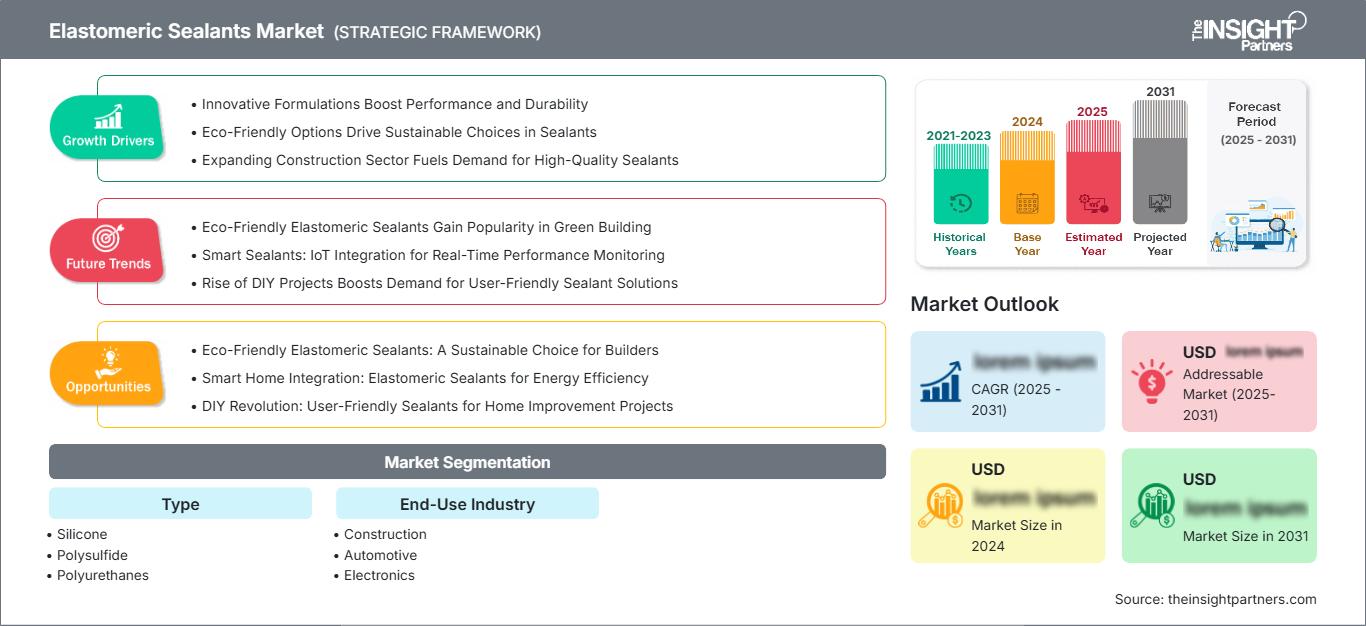
Elastomeric Sealants Market: Strategic Insights
Regional Insights
North America Elastomeric Sealants Market
North America accounted for 29–33% of global revenue in 2025 and is projected to grow at a 5.6–6.4% CAGR. The region benefits from renovation of aging commercial buildings, roofing replacement, façade rehabilitation, and industrial maintenance. Adoption is supported by ASTM-based performance specifications, contractor familiarity with elastomeric systems, and demand for low-VOC interior and exterior sealants.
The Elastomeric Sealants Market share in North America is driven by manufacturing hubs that require vibration resistance and weather protection for materials. The products in the silicone, polyurethane, and SMP categories continue to hold their ground in a variety of applications, including glazing, transportation, HVAC, and infrastructure. Competitiveness comes through warranty programs, distributor coverage, technical training, and product lines designed for rapid cure and multi-substrate adhesion.
U.S. Elastomeric Sealants Market
The U.S. accounted for 78–82% of North American revenue in 2025 and is forecast to grow at a 5.7–6.5% CAGR. Demand is led by commercial construction renovation, residential weatherization, highway and bridge maintenance, and advanced manufacturing. Building owners increasingly specify sealants that reduce water ingress, protect assemblies, and support energy-efficient envelopes.
The presence of companies in the industry is wide-ranging, with companies such as 3M Company, Dow Inc., H.B. Fuller Company, RPM International Inc., and Sika AG supplying the industrial, construction, and transportation sectors. Some of the application areas include EV battery casing sealants, curtain wall joint sealants, roof transition sealants, and electronics sealants. Technical information, performance, and distribution are very important to buyers.
Europe Elastomeric Sealants Market
Europe accounted for 25-29% of the global market in 2025 and is forecast to grow at a CAGR of 5.3%-6.1%. The German market dominates regional demand due to automobile manufacturing, façade renovation, and industry. Energy-efficiency policies, refurbishment initiatives, and environmental criteria for low-emission materials ensure a focus on certified, durable, and environmentally friendly products.
The UK market has growth potential due to building repairs, modular construction, and commercial refurbishments, in which the sealant provides flexible façade protection. Germany is the dominant country due to its developed automotive and construction industries. France, Italy, and Spain influence demand due to infrastructure improvements, hospitality, and climate-resilient building-envelope construction in warm coastal climates.
APAC Elastomeric Sealants Market
Asia Pacific accounted for 31–35% of total revenues in 2025 and is forecast to grow at a 6.8–7.6% CAGR. In the region, China has the highest share of consumption due to its infrastructure, electronics, solar equipment, and automobile production. India is driving the growth in the construction and industry sectors. Japan and South Korea place greater emphasis on premium-quality sealants for electronics, vehicles, and high-precision assembly applications.
Australia's demand is driven by commercial construction, marine exposure applications, and residential repair applications. Policies encouraging energy-efficient buildings, domestic manufacturing, and transport infrastructure increase consumption in the region. The suppliers are enhancing their local production and distribution to reduce lead times and improve technical services.
Middle East & Africa Elastomeric Sealants Market
The Middle East & Africa are projected to grow at a 6.0–6.8% CAGR until 2034. Saudi Arabia is the leading market, propelled by tourism, giga-projects, commercial construction, and transportation. Demand from the UAE is driven by towers, hospitality assets, airports, and marine sites that require sealants with UV resistance and weather resistance.
South Africa will drive demand in the commercial, transportation, and industrial maintenance sectors, while other MEA markets will see demand driven by select investments in infrastructure and energy. Hot weather, sand, humidity, and proximity to the sea increase the need for silicone-based, hybrid, and polyurethane sealants.
Segmentation Analysis
Type
The Type segment is estimated to expand at a CAGR of 6.3%-7.1% during 2026-2034. The Elastomeric Sealants Market scope is expanding due to end users' increasing choice of chemistries, depending on flexibility, curing system, adhesion, emissions, and service conditions. Silicone sealant is preferred for heavy weathering, while polyurethane and SMP systems are preferred for paintability and productivity.
- Silicone: Silicone sealants hold a leading position in glazing, façades, electronics, and high-weathering environments because they retain flexibility, UV resistance, and adhesion across temperature extremes.
- Polysulfide: Polysulfide remains strategically important in aerospace, defense, fuel-resistant joints, and marine applications where chemical resistance, flexibility, and long-term sealing reliability are essential.
- Polyurethanes: Polyurethane sealants are widely used in construction and automotive applications due to strong adhesion, abrasion resistance, paintability, and effective movement accommodation.
- Silyl Modified Polymers: SMP products are gaining share because they combine hybrid performance, low odor, low VOC potential, primerless adhesion, and compatibility with demanding construction substrates.
- Polybutadiene: Polybutadiene-based sealants serve specialized industrial and transportation uses where elasticity, moisture resistance, and chemical stability are required under dynamic operating conditions.
End-Use Industry
The End-Use Industry segment is projected to register a 6.1%-6.9% CAGR from 2022 to 2034. While construction remains the largest end-use segment for growth, other industries such as automotive, electronics, aerospace, marine, and furniture also contribute to revenue. Sealants are used to provide strength, insulation, vibration reduction, and protection against corrosion and moisture, making procurement more performance-led across industrial value chains.
- Construction: Construction leads revenue contribution through façade joints, glazing, roofing, flooring, expansion gaps, cladding, and infrastructure repair where movement tolerance and weatherproofing are critical.
- Automotive: Automotive demand reflects body sealing, windshield bonding, battery enclosures, corrosion protection, and noise-vibration-harshness control across conventional and electric vehicle platforms.
- Electronics: Electronics applications require moisture protection, insulation support, thermal cycling resistance, and precision dispensing for devices, modules, sensors, and industrial electrical assemblies.
- Furniture and Woodwork: Furniture and woodwork use sealants for flexible joints, panel bonding, edge protection, and moisture resistance in cabinetry, flooring, doors, and engineered wood products.
- Aerospace and Defense: Aerospace and defense applications demand validated sealants for fuel resistance, vibration control, environmental protection, and lightweight assembly reliability under strict qualification regimes.
- Marine: Marine applications depend on UV-stable, saltwater-resistant, and flexible sealants for decks, windows, hull penetrations, fittings, and maintenance of leisure and commercial vessels.
Opportunity Snapshot
| Segment Name | Revenue Contribution | Trend Tag | Adoption Stage |
| Construction | High | Envelope Repair | Mature |
| Automotive | High | EV Sealing | Scaling |
| Electronics | Medium | Moisture Shield | Scaling |
| Furniture and Woodwork | Medium | Panel Bonding | Mature |
| Aerospace and Defense | Medium | Fuel Barrier | Scaling |
| Marine | Low | Saltproof Joints | Emerging |
Elastomeric Sealants Market Growth Drivers and Impact Analysis
Energy-Efficient Building Envelope Requirements
Buildings consume a significant proportion of final energy use; therefore, issues such as joint integrity, air sealing, and moisture management are key to energy-saving applications. Elastomeric sealants play a vital role in façade management because they offer flexibility to accommodate thermal movement while providing water and air resistance. These effects will be most pronounced in commercial buildings, high-rise building glazing, roof connections, and building retrofits, since a failure may result in higher maintenance costs and energy waste. Specifications are increasingly favoring materials that have demonstrated performance in terms of movement capacity, low-emission characteristics, and longevity.
Vehicle Electrification and Advanced Mobility Manufacturing
Automotive manufacturing is seeing increased use of sealing compounds as cars are equipped with battery packs, sensors, lightweight construction, and electronics. Sealants made of elastomers protect against water, dust, vibration, and corrosion, while also improving acoustic and durability properties. Electric cars introduce new requirements for battery sealing, heat-management interfaces, and access openings. Original Equipment Manufacturers need qualified compounds that can be applied reliably and will be compatible with metals, plastics, paints, and composites. This trend creates barriers to entry, since suppliers need to demonstrate capabilities in testing and processes, which improves the position of technically advanced suppliers.
Low-VOC Regulation and Sustainable Construction Materials
Indoor air quality guidelines, green building initiatives, and company emissions-reduction goals are spurring reformulation towards solvent-free, lower-carbon-footprint sealants. The purchasers are evaluating the products' green claims, as well as their adhesion, flexibility, and durability. Manufacturers are developing SMP, waterborne, and optimized silicone- or polyurethane-based formulations that meet all regulatory requirements and perform well in the field. This market effect can be observed in commercial and school buildings, hospitals, and public infrastructure projects, where compliance documentation plays an important role in the selection of specifications.
Elastomeric Sealants Market Future Trends
Hybrid Polymer Platforms Move Into Mainstream Specification
Future Elastomeric Sealants Market trends point toward broader use of hybrid polymer systems that combine adhesion, flexibility, paintability, and lower emissions. SMP products are predicted to evolve out of specialty markets to be specified for building envelope systems, prefabrication, and industrial assemblies. They offer value in the tradeoff between productivity in the field and performance on different substrates. In an effort to have fewer products that serve more purposes, hybrid products can simplify inventory and training. The key elements in the development of these products will be rapid skinning, wider temperature ranges, improved recyclability, and compatibility with automated dispensing systems.
Digital Specification and Application Support Tools
The selection of sealants is going digital as architects, OEM engineers, and contractors increasingly require information on movement properties, emission levels, compatibility, and service life. Digital specification systems, product selectors, and technical advice will play a role in shaping purchase decisions by minimizing risks involved in the designing and purchasing processes. The suppliers should incorporate calculators, BIM-enabled data, substrate recommendations, and warranty information in customer processes. There will be benefits for brands, as well as fewer installation errors in complex facades, transport assemblies, and electronic devices.
Elastomeric Sealants Market Opportunities
Prefabricated Construction and Modular Building Systems
Prefabricated panels, bathroom pods, façades, and modular rooms offer opportunities for sealant producers, as repeated sealing operations will take place in a controlled manufacturing environment. Investments aligned with the Elastomeric Sealants Market Forecasts should be in products that have a fast cure rate, are compatible with automation, and have low odor. The suppliers can add value to the market by offering dispensing equipment assistance, application expertise, and qualification kits to manufacturers of modular units. This is more likely to generate stickiness since the materials get integrated into the manufacturing process. Growth potential is strongest in markets facing labor shortages, housing deficits, and demand for faster commercial construction delivery.
Electronics Protection and Industrial Assembly Expansion
The combination of electronics, sensors, energy storage devices, and industrial machines offers the market applications that require protection against moisture, vibration, dust, and thermal cycling. Specific grades of sealants can be developed by the suppliers for enclosures, connectors, power modules, control units, and outdoor electrical distribution facilities. The opportunity is operational in nature, as the customer may need technical assistance and qualification testing. A company capable of aligning its polymer science with the demands of electronics will earn higher margins than in commodity construction channels. Regional growth will be strongest near electronics manufacturing clusters, EV supply chains, and renewable energy equipment producers.
Recent Developments
- July 2026: Univar Solutions LLC has acquired Interpur Chemicals, enhancing its Performance Materials sector by expanding technical capabilities and regional reach in Europe, the Middle East, and Africa (EMEA). The acquisition combines Interpur's market expertise with Univar's distribution strengths, aiming to improve material access and supply continuity. CEO Nick Powell expressed enthusiasm, noting that Interpur's position in a growing CASE market aligns with Univar's strategic focus, allowing for an expanded offering and continued investment in growth capabilities.
- March 2026: Cinova Medical has acquired Elastomer Technologies, Inc. (ETI), which specializes in liquid silicone rubber molding for the medical and life sciences sectors. ETI will operate from its current site while Cinova Medical expands a new Class 8 cleanroom for silicone molding. Once completed, ETI's manufacturing will be integrated into Cinova's operations. Cinova Medical, based in Phoenix, AZ, produces high-quality injection-molded components and sterile Class II medical devices.
Frequently Asked Questions

- Comprehensive Market Sizing and Forecast Analysis
- Detailed Segmentation Analysis
- In-Depth Market Dynamics Assessment
- Regional and Country-Level Insights
- Competitive Landscape and Company Benchmarking
- Strategic Business Intelligence
Recent Reports
Testimonials

The Insight Partners' SCADA System Market report is comprehensive, with valuable insights on current trends and future forecasts. The team was highly professional, responsive, and supportive throughout. We are very satisfied and highly recommend their services.
RAN KEDEM Partner, Reali Technologies LTDs
I requested a report on a very specific software market and the team produced the report in a few days. The information was very relevant and well presented. I then requested some changes and additions to the report. The team was again very responsive and I got the final report in less than a week.
JEAN-HERVE JENN Chairman, Future Analytica
We worked with The Insight Partners for an important market study and forecast. They gave us clear insights into opportunities and risks, which helped shape our plans. Their research was easy to use and based on solid data. It helped us make smart, confident decisions. We highly recommend them.
PIYUSH NAGPAL Sr. Vice President, High Beam Global
The Insight Partners delivered insightful, well-structured market research with strong domain expertise. Their team was professional and responsive throughout. The user-friendly website made accessing industry reports seamless. We highly recommend them for reliable, high-quality research services
YUKIHIKO ADACHI CEO, Deep Blue, LLC.
This is the first time I have purchased a market report from The Insight Partners.While I was unsure at first, I visited their web site and felt more comfortable to take the risk and purchase a market report.I am completely satisfied with the quality of the report and customer service. I had several questions and comments with the initial report, but after a couple of dialogs over email with their analyst I believe I have a report that I can use as input to our strategic planning process.Thank you so much for taking the extra time and making this a positive experience.I will definitely recommend your service to others and you will be my first call when we need further market data.
JOHN SUZUKI President and Chief Executive Officer, Board Director, BK Technologies
I wish to appreciate your support and the professionalism you displayed in the course of attending to my request for information regarding to infectious disease IVD market in Nigeria. I appreciate your patience, your guidance, and the fact that you were willing to offer a discount, which eventually made it possible for us to close a deal. I look forward to engaging The Insight Partners in the future, all thanks to the impression you have created in me as a result of this first encounter.
DR CHIJIOKE ONYIA MANAGING DIRECTOR, PineCrest Healthcare Ltd.Reason to Buy
- Informed Decision-Making
- Understanding Market Dynamics
- Competitive Analysis
- Identifying Emerging Markets
- Customer Insights
- Market Forecasts
- Risk Mitigation
- Boosting Operational Efficiency
- Strategic Planning
- Investment Justification
- Tracking Industry Innovations
- Aligning with Regulatory Trends





 Get Free Sample for