
Electromagnetic Compatibility Filter Market Size, Trends & Demand by 2034
Coverage: By Load Type (Single Phase, Three Phase); Insertion Loss (Common-Mode (Asymmetrical), Differential-Mode (Symmetrical)); End-user (Aerospace and Defense, Railway, Medical, Automotive, Commercial), and Geography (North America, Europe, Asia Pacific, and South and Central America)
- Status : Data Released
- Report Code : TIPRE00016006
- Category : Electronics and Semiconductor
- No. of Pages : 150
- Available Report Formats :


- Last update date : August 10, 2026


2025 Market Size
US$ 2.22 Bn
Base year value
2034 Forecast
US$ 3.62 Bn
Projected by 2034
CAGR 2026-2034
5.57 %
Growth rate
Addressable Market
US$ 26.46 Bn
(2026-2034)
The Electromagnetic Compatibility Filter Market size was estimated to be worth US$ 2.22 Billion in 2025 and further predicted to reach US$ 3.62 Billion by 2034, exhibiting a growth rate of 5.57% during 2026-2034. The market is growing due to increased needs for control over conducted emissions, immunity, and compliance ready power architecture in interconnected platforms, electrified mobility, medical devices, rail electronics, and defense systems.
The electromagnetic compatibility filter market size in North America is forecasted to witness growth at a growth rate of 5.1-5.8% due to defense electronics upgrading, medical devices requirements, infrastructure of electric vehicle charging stations, and upgrading of industrial automation. Well-established supply chains of aerospace sector, efficient test environments, and advanced adoption of high frequency power electronics lead to steady demand of single phase and three phase filters.
Electromagnetic Compatibility Filter Market Assessment and Insights
- North America held 30–33% Electromagnetic Compatibility Filter Market share in 2025 and is growing at a CAGR range of 5.1–5.8% during 2026–2034, driven by defense platforms, healthcare electronics, EV charging, and data-heavy commercial systems.
- US represented 78–82% of North America in 2025 and is growing at a CAGR range of 5.2–5.9%, led by aerospace, medical, and automotive electronics.
- Europe accounted for 25–28% share in 2025 and is advancing at a CAGR range of 4.8–5.5%, with Germany, the UK, France, Italy, and Spain leading demand.
- Asia Pacific captured 32–35% share in 2025 and is expanding at a CAGR range of 6.0–6.8%, led by China, Japan, South Korea, India, and Australia.
- Largest Segment Three Phase load type held 54–57% market share in 2025 and is growing at a CAGR range of 5.6–6.2%, supported by drives, rail traction, and industrial systems.
- High Growth Segment Automotive end-user held 15–18% market share in 2025 and is growing at a CAGR range of 6.3–7.1%, driven by EV platforms and charging electronics.
- Key companies analyzed in detail: Astrodyne TDI Corporation, DEM Manufacturing Ltd., ETS-Lindgren Inc., PREMO S.L., REO AG, Schaffner Holding AG, SCHURTER Holding AG, TDK Electronics AG, TE Connectivity Ltd., and Total EMC Products Ltd.
Source: The Insight Partners' analysis based on proprietary research, government publications, company annual reports, investor presentations, industry databases, and expert interviews.
Electromagnetic Compatibility Filter technology development is moving away from individual suppression parts and toward application-oriented assemblies which are capable of meeting higher switching frequencies, leakage current requirements, thermal stresses, and package size constraints. Manufacturing involves the use of magnetic cores, capacitors, wound inductors, metal cases, potting compounds, and safety certifications. Manufacturers are offering a combination of catalog filters and engineered filters to address customer demands for shorter certification timelines, predictable insertion loss, and filters optimized for EMC tests of systems.
Future demand is driven by electrified transportation, digital health care, industrial automation, power converter efficiency, and military communication. Regulatory headwinds provided by IEC, EN, MIL-STD, and medical EMC specifications prompt early filter selection at design phase as opposed to last-minute solutions. The rise of new manufacturing centers in Asia contributes to production volume while North American and European end-users focus on compliance, documentation, qualification, and application engineering.
Electromagnetic Compatibility Filter Market Report Scope
| Report Attribute | Details |
|---|---|
| Market size in 2025 | US$ 2.22 Billion |
| Market Size by 2034 | US$ 3.62 Billion |
| Global CAGR (2026 - 2034) | 5.57% |
| Historical Data | 2021-2024 |
| Forecast period | 2026-2034 |
Electromagnetic Compatibility Filter Market Analysis
The market growth results from increasing electronic densities, faster power switching speeds, and stricter emission controls in critical applications. Filters decrease conducted noise in the power and signal lines, ensuring compliance with emission standards and immunity performance. The market depends on any application where there is risk of interference from devices such as inverters, variable-speed drives, switched mode power supplies, communications modules, and charging circuits.
The value chain consists of magnet suppliers, capacitors manufacturers, enclosure providers, filters manufacturers, testing labs, Original Equipment Manufacturers, system integrators, and certification agencies. The supply side favors companies that can offer platforms and networks for filtering in common and differential modes. Component availability, safety certificates, heat dissipation capability, and documentations are factors in the selection process since changing the filter after a late stage in the validation process requires re-testing.
The competitive positioning is driven by application engineering, worldwide approvals, wide range of phase ratings, and tested technical support. The company TE Connectivity Ltd. improves its competitive advantage due to the Schaffner and Corcom product lines, whereas TDK Electronics AG focuses on components in the chokes, ferrites, and power-line filters. The competitors Astrodyne TDI Corporation, REO AG, SCHURTER Holding AG, and DEM Manufacturing Ltd. operate on the basis of power quality, medical, industrial, and defense products.
The investment trend for the future is aimed at developing small-size products capable of handling high current, minimal leakage, and thermal stability. These products will be used for electrified cars, medical equipment, railway converters, aerospace subsystems, and commercial power installations. The company ETS-Lindgren Inc. develops EMC shielded and facility-based solutions, whereas PREMO S.L. and Total EMC Products Ltd. focus on magnetic suppression and applications.
● REPORT CUSTOMIZATION
Tailor This Report To Align With Your Specific Business Requirements
This report can be customized to align precisely with your business objectives, scope, and target markets. Customization options include tailored segmentation, geography, competitive analysis, and strategic insights to support informed decision-making.
Customize This Report →WHAT YOU CAN ADJUST
- ● Segmentations
- ● Geography
- ● Competitive Analysis
- ● Language Preferences
Electromagnetic Compatibility Filter Market: Strategic Insights
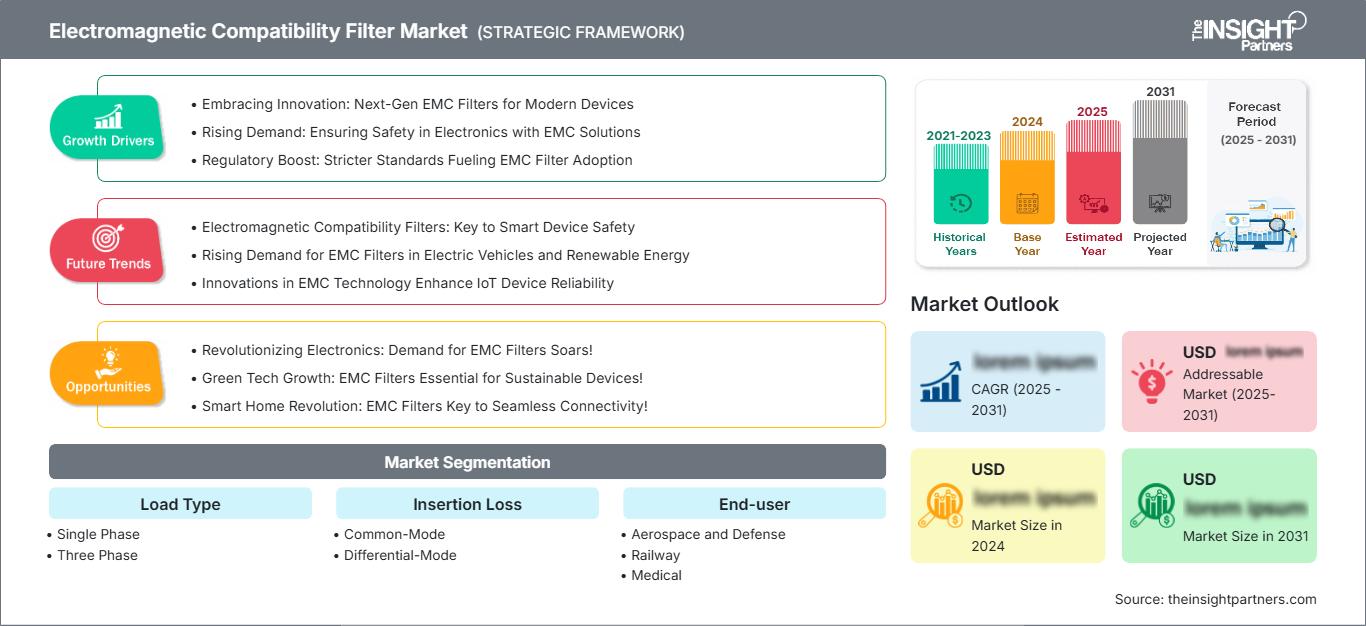
Regional Insights
North America Electromagnetic Compatibility Filter Market
Share of North America was 30–33% in 2025, and it will grow at CAGR 5.1–5.8% during 2026-2034. Demand for EMC Filters market share is driven by aerospace electronics, defense communications systems, medical validation, EV infrastructure, and industrial automation projects. In 2025, according to IATA, the passenger growth is forecasted at 5.8%, which supports the demand for avionics and fleet-service electronics.
There are well-developed EMC testing laboratories, advanced defense procurement processes, and strict medical market entry conditions in the region. According to IEC 60601-1-2, medical electrical equipment needs to solve problems of emissions and immunity, driving demand for filters in monitors, imaging, surgical systems, and home healthcare equipment. Buyers in USA and Canada appreciate local technical service as EMC failure can be very costly.
U.S. Electromagnetic Compatibility Filter Market
In 2025, the US accounted for 78–82% of the North American market and is expected to experience a CAGR of 5.2–5.9%. Key applications of the filter include demand in defense electronics, aerospace manufacturing chain, medical OEM, EV chargers, robotics, and data center power systems. Astrodyne TDI Corporation, ETS-Lindgren Inc., TE Connectivity Ltd., and TDK Electronics AG are highly visible with their engineering services and catalog-driven business models with focus on compliance solutions.
Current applications include filters with low leakage in medical equipment, durable filters in the military, facility filters in shielded rooms, and three-phase filters for drives and automation. Early specification of filters is common practice in the US market as any certification delays may be costly. Commercial equipment manufacturers also utilize EMC filters to secure their connected equipment in a dense wireless and power conversion environment.
Europe Electromagnetic Compatibility Filter Market
Europe held 25–28% share in 2025 and is expected to grow at a CAGR range of 4.8–5.5%. Germany leads through industrial automation, machinery, rail electronics, and automotive electrification. The UK supports defense, aerospace, and testing services, while France contributes through rail, energy systems, medical electronics, and public infrastructure modernization.
Italy and Spain add demand through manufacturing machinery, renewable converters, EV charging, and rail upgrades. EN 50121 railway EMC requirements cover rolling stock, signaling, telecommunications, and power supply installations, giving rail suppliers a clear compliance route. European buyers emphasize documentation, CE conformity, lifecycle reliability, and verified insertion loss across real installation conditions.
APAC Electromagnetic Compatibility Filter Market
The Asia Pacific region has 32–35% share in 2025 and will grow at CAGR between 6.0–6.8%. The growth is driven by leadership from China with electronics manufacturing, electric vehicles, railways, and industrial drives, followed by Japan and South Korea due to their high-reliability applications in automobiles and automation. India and Australia have their contributions due to electrification, healthcare applications, and infrastructural development.
Support policies towards manufacturing localization, renewable energy, digital hospitals, and rail infrastructure drive the expansion of the installation base of noise sensitive systems. The cost competition is cutthroat in the industry; however, certification for filters makes the difference when export requirements, automobile requirements, and public infrastructure are considered. Asia Pacific is the primary volume driver of the Electromagnetic Compatibility Filter Market.
Middle East & Africa Electromagnetic Compatibility Filter Market
Middle East & Africa is projected to grow at a CAGR range of 4.6–5.4% as Saudi Arabia, the UAE, South Africa, and rest of MEA invest in airports, healthcare, rail, energy, and commercial infrastructure. Saudi Arabia leads through industrial diversification, defense procurement, and large-scale urban development.
Demand favors robust filters for hot, dusty, and power-quality-variable environments. UAE projects emphasize premium commercial and healthcare electronics, while South Africa requires reliable suppression for industrial equipment and utility-linked systems. Growth remains project-led, but energy and transport investments raise selective opportunities for compliance-grade products.
Segmentation Analysis
Load Type
Load Type is expected to grow at a CAGR range of 5.4–6.1% during 2026–2034 as Electromagnetic Compatibility Filter Market scope covers Single Phase and Three Phase systems. Single-phase filters serve medical, commercial, and compact equipment, while three-phase filters dominate higher-power drives, charging, rail, and industrial machinery. Selection depends on current rating, leakage current, enclosure design, and required attenuation.
- Single Phase filters hold strong demand in medical devices, laboratory systems, commercial electronics, and compact machinery where safety approvals, low leakage current, and predictable conducted-noise suppression are central to compliance.
- Three Phase filters lead high-power applications because motor drives, traction converters, industrial automation, EV infrastructure, and energy systems require stable attenuation, thermal endurance, and reliable grounding under heavier electrical loads.
Insertion Loss
Insertion Loss is projected to grow at a CAGR range of 5.2–5.9% during 2026–2034 as design engineers match filter topology to the dominant noise path. Common-mode performance is critical where cable structures radiate noise, while differential-mode filtering addresses line-to-line disturbances from switching devices. Balanced designs increasingly combine both to pass system-level testing.
- Common-Mode filtering is strategically important in drives, medical devices, railway systems, and EV electronics because shared noise currents can travel on cables and create emissions beyond enclosure boundaries.
- Differential-Mode filtering addresses noise between conductors, supporting power supplies, converters, and charging equipment where switching edges can disturb connected loads, measurement circuits, or upstream power networks.
End-user
End-user is forecast to grow at a CAGR range of 5.5–6.2% during 2026–2034 as aerospace and defense, railway, medical, automotive, and commercial buyers require different qualification depth. Aerospace and medical demand prioritize reliability and documentation, railway applications require system coexistence, automotive filters follow EV power electronics, and commercial systems scale through automation and connected infrastructure.
- Aerospace and Defense buyers require rugged filters for avionics, communications, radar, ground systems, and mission electronics where electromagnetic interference can affect operational reliability, safety margins, or secure system performance.
- Railway demand is driven by traction drives, signaling, passenger information systems, and substations, where EN 50121 compliance supports coexistence across high-voltage power and sensitive control equipment.
- Medical applications require low-leakage and compliance-ready filters for monitors, imaging, surgical tools, laboratory equipment, and connected home healthcare devices operating near sensitive electronics and wireless systems.
- Automotive is the high-growth end-user as EV powertrains, onboard chargers, charging stations, battery systems, and advanced driver assistance electronics increase conducted-noise control requirements.
- Commercial demand arises from data centers, HVAC drives, robotics, telecom equipment, retail power systems, and building automation where reliable operation depends on clean power and reduced interference.
Opportunity Snapshot
| End-user | Revenue Contribution | Trend Tag | Adoption Stage |
| Aerospace and Defense | High | Mission EMC | Mature |
| Railway | Medium | Traction Noise | Scaling |
| Medical | Medium | Low Leakage | Mature |
| Automotive | High | EV Power | Scaling |
| Commercial | Medium | Connected Sites | Scaling |
Electromagnetic Compatibility Filter Market Growth Drivers and Impact Analysis
Higher Power Density Raises Conducted-Noise Risk
Power electronics are moving toward faster switching, smaller enclosures, and higher current density, which increases the probability of conducted emissions and immunity failures. The effect is visible in EV chargers, industrial drives, railway converters, medical power supplies, and aerospace subsystems where compact designs leave less room for passive suppression. Filters become strategic because they allow OEMs to control noise without redesigning the entire power architecture. The real-world impact is lower compliance risk, fewer late-stage prototype changes, and better reliability in electrically crowded installations. Vendors with thermal design expertise and validated attenuation curves can win specified positions earlier.
Regulated Medical and Transport Systems Tighten Qualification Needs
Medical and transport applications increasingly treat EMC performance as a safety and availability requirement rather than a final laboratory hurdle. IEC 60601-1-2 links medical electrical equipment to basic safety and essential performance under electromagnetic disturbances, while railway standards such as EN 50121 define emissions and immunity expectations for rolling stock, signaling, and power installations. These frameworks increase demand for filters with traceable documentation, repeatable performance, and application-specific leakage current control. The market impact is a shift toward qualified suppliers that can support test plans, risk documentation, and corrective engineering when prototypes fail pre-compliance scans.
Electrified Mobility Expands Filter Content per Platform
Electric vehicles, charging stations, rail traction systems, and airport ground equipment use multiple converters, inverters, battery interfaces, and communication modules. Each subsystem can introduce noise, and each cable path can become an emissions route if filtering is inadequate. As electrified mobility scales, filter content per platform rises across onboard chargers, DC fast chargers, auxiliary converters, battery management systems, and test equipment. The impact extends beyond automotive suppliers because commercial buildings, utilities, and transport operators must also protect adjacent electronics. Companies offering automotive-grade and infrastructure-grade products can address both vehicle and charging ecosystems.
Electromagnetic Compatibility Filter Market Future Trends
Digital Filter Selection Becomes a Design Workflow Standard
Electromagnetic Compatibility Filter Market trends will increasingly include digital selection tools that connect attenuation curves, leakage current, phase configuration, current rating, and safety approvals with customer design constraints. Engineers need faster ways to narrow filter options before prototype testing, especially when product schedules are compressed. Suppliers that provide validated simulation data, 3D models, thermal information, and application notes can move upstream in the design cycle. This trend will also improve distributor productivity because technical teams can recommend compliant alternatives without relying only on legacy catalog matching or manual cross-referencing.
Low-Leakage and High-Current Designs Gain Strategic Weight
Future systems will require filters that combine stronger suppression with lower leakage current, smaller footprints, and higher current handling. Medical equipment, EV charging, industrial drives, and railway converters all face different limits, but each rewards filter designs that reduce compromises between safety and attenuation. Materials innovation in magnetic cores, capacitors, shielding, and thermal interfaces will influence supplier competitiveness. Buyers will increasingly compare lifecycle reliability and certification risk alongside price. This trend can elevate engineered filters from peripheral accessories to core design elements in compliance-sensitive equipment programs.
Electromagnetic Compatibility Filter Market Opportunities
Custom Filter Platforms for EV Charging and Industrial Drives
Electromagnetic Compatibility Filter Market Forecasts point to an opportunity for modular filter platforms aligned with EV charging cabinets, industrial drives, and distributed energy converters. Suppliers can create families that share mechanical envelopes, terminal layouts, and approvals while allowing current, leakage, and attenuation tuning. This approach helps OEMs scale product lines faster and reduces validation burden across power classes. The opportunity is attractive because charging and drive applications need high-current suppression, thermal stability, and predictable supply. Manufacturers that combine custom engineering with catalog-like repeatability can capture program-level demand rather than one-off component orders.
Compliance Support Packages for Medical and Aerospace OEMs
Medical and aerospace OEMs offer a strong opportunity for filter suppliers that package hardware with documentation, pre-compliance guidance, and rapid engineering support. These customers face high consequences when EMC issues emerge late because regulatory submissions, aircraft qualification, and production release schedules can slip. Suppliers can differentiate by providing test evidence, risk-assessment inputs, installation guidance, and alternate approved configurations. The opportunity is less about selling more parts and more about reducing customer certification uncertainty. Firms with experienced field engineers and recognized approvals can build durable relationships across multiple device or platform generations.
Recent Developments
- July 2026: EMIS launches new power line filter series for EMI and RFI protection. The new SMF911 single-phase and TMF911 three-phase filter series have been developed to provide noise suppression for a wide range of AC and DC power applications, supporting the reliable operation of equipment used in commercial, industrial, defence and other mission-critical installations.
- July 2026: Astrodyne TDI Corporation highlighted its power supplies and EMI/EMC filters portfolio, including the RP285 EMI filter for industrial automation, process control, utilities, and power line communication systems. The company positioned the product around common-mode and differential-mode noise blocking with reliable PLC signal integrity, reinforcing its engineered support for industrial and utility applications.
- March 2026: DOREXS Introduces Next-Generation EMI Filter Solutions for Industrial Performance. The newly introduced EMI filters are built with performance and durability in mind. Each unit is carefully designed to support high-demand environments where consistency and efficiency are critical.
Frequently Asked Questions

- Comprehensive Market Sizing and Forecast Analysis
- Detailed Segmentation Analysis
- In-Depth Market Dynamics Assessment
- Regional and Country-Level Insights
- Competitive Landscape and Company Benchmarking
- Strategic Business Intelligence
Recent Reports
Testimonials

The Insight Partners' SCADA System Market report is comprehensive, with valuable insights on current trends and future forecasts. The team was highly professional, responsive, and supportive throughout. We are very satisfied and highly recommend their services.
RAN KEDEM Partner, Reali Technologies LTDs
I requested a report on a very specific software market and the team produced the report in a few days. The information was very relevant and well presented. I then requested some changes and additions to the report. The team was again very responsive and I got the final report in less than a week.
JEAN-HERVE JENN Chairman, Future Analytica
We worked with The Insight Partners for an important market study and forecast. They gave us clear insights into opportunities and risks, which helped shape our plans. Their research was easy to use and based on solid data. It helped us make smart, confident decisions. We highly recommend them.
PIYUSH NAGPAL Sr. Vice President, High Beam Global
The Insight Partners delivered insightful, well-structured market research with strong domain expertise. Their team was professional and responsive throughout. The user-friendly website made accessing industry reports seamless. We highly recommend them for reliable, high-quality research services
YUKIHIKO ADACHI CEO, Deep Blue, LLC.
This is the first time I have purchased a market report from The Insight Partners.While I was unsure at first, I visited their web site and felt more comfortable to take the risk and purchase a market report.I am completely satisfied with the quality of the report and customer service. I had several questions and comments with the initial report, but after a couple of dialogs over email with their analyst I believe I have a report that I can use as input to our strategic planning process.Thank you so much for taking the extra time and making this a positive experience.I will definitely recommend your service to others and you will be my first call when we need further market data.
JOHN SUZUKI President and Chief Executive Officer, Board Director, BK Technologies
I wish to appreciate your support and the professionalism you displayed in the course of attending to my request for information regarding to infectious disease IVD market in Nigeria. I appreciate your patience, your guidance, and the fact that you were willing to offer a discount, which eventually made it possible for us to close a deal. I look forward to engaging The Insight Partners in the future, all thanks to the impression you have created in me as a result of this first encounter.
DR CHIJIOKE ONYIA MANAGING DIRECTOR, PineCrest Healthcare Ltd.Reason to Buy
- Informed Decision-Making
- Understanding Market Dynamics
- Competitive Analysis
- Identifying Emerging Markets
- Customer Insights
- Market Forecasts
- Risk Mitigation
- Boosting Operational Efficiency
- Strategic Planning
- Investment Justification
- Tracking Industry Innovations
- Aligning with Regulatory Trends





 Get Free Sample for