Electronic Adhesives Market Size, Share & Demand by 2034

Electronic Adhesives Market Size and Forecasts (2021 - 2034), Global and Regional Share, Trend, and Growth Opportunity Analysis By Resin Type (Epoxy, Silicone, Acrylic, Polyurethane and Others.) Application (Consumer Electronics, Semiconductor Packaging, Automotive Electronics, Aerospace and Others)

Historic Data: 2021-2024 | Base Year: 2025 | Forecast Period: 2026-2034
  • Status : Data Released
  • Report Code : TIPRE00003940
  • Category : Chemicals and Materials
  • No. of Pages : 150
  • Available Report Formats : pdf-format excel-format
  • Last update date : August 10, 2026
Electronic Adhesives Market Size, Share & Demand by 2034
Report Date: August 10, 2026   |   Report Code: TIPRE00003940 Email: sales@theinsightpartners.com

2025 Market Size

US$ 5.82 Bn

Base year value

2034 Forecast

US$ 10.23 Bn

Projected by 2034

CAGR 2026-2034

6.47 %

Growth rate

Addressable Market

US$ 72.61 Bn

(2026-2034)

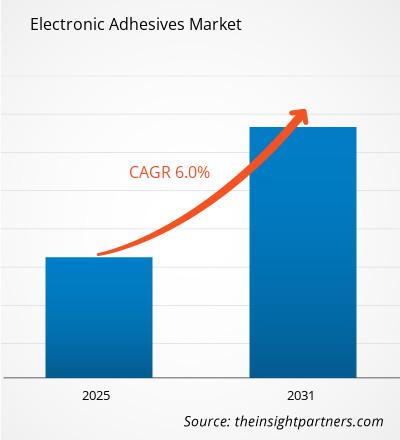
The Electronic Adhesives Market was valued at US$ 5.82 Billion in 2025 and is projected to reach US$ 10.23 Billion by 2034, registering a CAGR of 6.47% during 2026–2034. The market is driven by increasing demand for miniaturized electronic components, advanced semiconductor packaging solutions, and reliable bonding materials across consumer electronics, automotive systems, and industrial applications. Adhesive technologies are evolving toward improved thermal conductivity, electrical insulation, durability, and compatibility with next-generation electronic assemblies.

The Electronic Adhesives Market size is expanding in North America due to semiconductor manufacturing investments, electric vehicle electronics adoption, and rising demand for advanced packaging technologies. The region is expected to register an estimated CAGR range of 5.8%–6.8% between 2026 and 2034. Growth is supported by reshoring initiatives, investments in semiconductor fabrication facilities, and increasing utilization of high-performance adhesives in automotive electronics and aerospace systems.

Electronic Adhesives Market Assessment and Insights

  • North America: Holds a significant position with an estimated share of 28%–32% in 2025 and is projected to grow at a CAGR range of 5.8%–6.8% during 2026–2034. The region benefits from semiconductor investments, automotive electrification, and advanced electronics manufacturing.
  • US: Accounts for approximately 75%–80% of the North American market share in 2025 and is expected to expand at a CAGR range of 5.9%–6.9% from 2026–2034, supported by semiconductor initiatives and aerospace electronics demand.
  • Europe: Represents around a 22%–26% share in 2025 and is estimated to grow at a CAGR range of 5.5%–6.5% during the Electronic Adhesives Market forecasts of 2026–2034. Germany, France, the UK, and Italy are key contributors due to automotive electronics production and industrial automation.
  • Asia Pacific: Represents the largest regional contribution with an estimated share of 35%–40% in 2025 and is anticipated to grow at a CAGR range of 7.0%–8.0% through 2034. China, Japan, South Korea, and India support expansion through electronics manufacturing ecosystems.
  • Largest Segment: Consumer Electronics accounts for an estimated market share of 35%–40% in 2025 and is expected to grow at a CAGR range of 6.5%–7.5%, driven by smartphones, wearables, and connected devices.
  • High Growth Segment: Semiconductor Packaging holds an estimated share of 25%–30% in 2025 and is projected to register a CAGR range of 7.0%–8.0% due to advanced chip packaging requirements.
  • Key companies analyzed in detail: Dow Inc., H.B. Fuller Company, 3M Company, Henkel AG & Co. KGaA, Arkema S.A., Sika AG, RPM International Inc., Dymax Corporation, Covestro AG, Avery Dennison Corporation.

Source: The Insight Partners' analysis based on proprietary research, government publications, company annual reports, investor presentations, industry databases, and expert interviews.

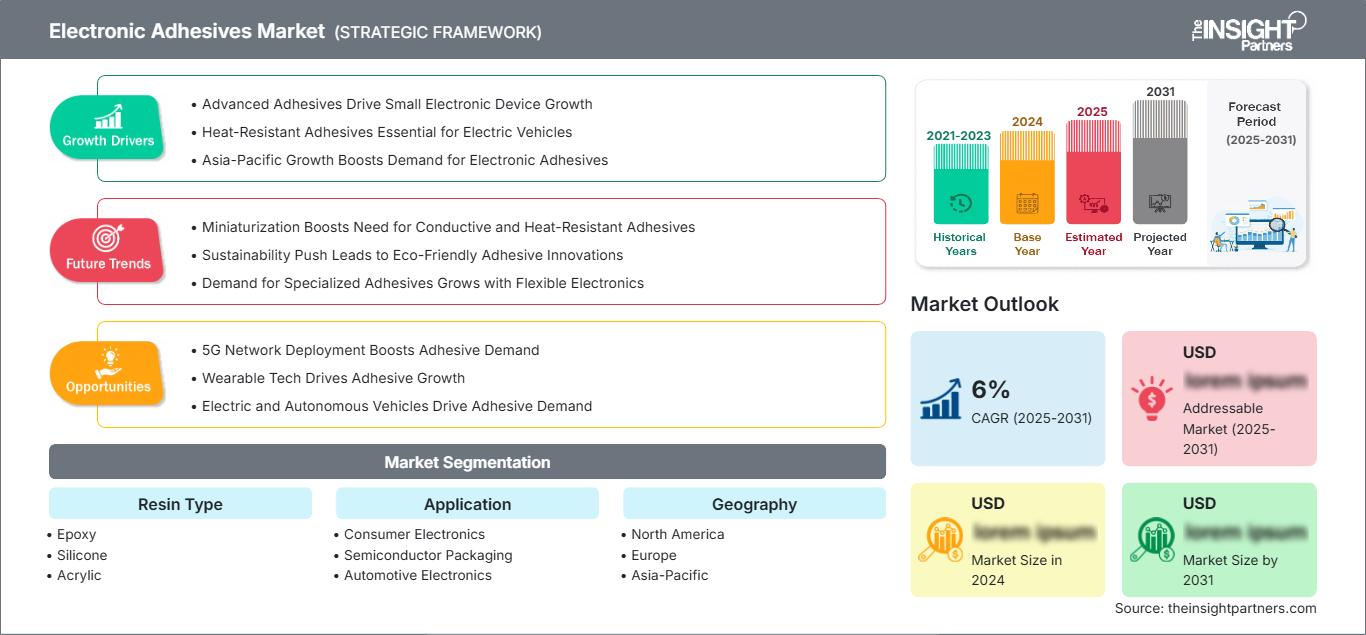
Continuous improvements have influenced the development of the Electronic Adhesives Market report in formulation chemistry, manufacturing precision, and component integration requirements. Conventional bonding solutions are increasingly being replaced by high-performance adhesives offering improved thermal management, reduced component stress, and compatibility with compact electronic designs. Epoxy, silicone, acrylic, and polyurethane formulations are being optimized for applications requiring electrical insulation, vibration resistance, and environmental stability. Manufacturers are also focusing on faster curing technologies and automated dispensing processes to support high-volume electronics production. The transition toward lightweight automotive systems and complex semiconductor architectures is further reshaping adhesive requirements across multiple industries.

Future expansion of the Electronic Adhesives Market is expected to be supported by emerging manufacturing hubs, increased investment in semiconductor capacity, and regulatory emphasis on energy-efficient technologies. Countries developing electronics production capabilities, including India and Southeast Asian economies, are becoming important locations for adhesive suppliers. Sustainability considerations are encouraging manufacturers to develop low-emission formulations and recyclable material solutions. Increasing adoption of electric vehicles, autonomous systems, and advanced computing platforms will continue creating opportunities for specialized adhesive technologies that meet higher reliability and performance standards.

Electronic Adhesives Market Report Scope

Report Attribute Details
Market size in 2025 US$ 5.82 Billion
Market Size by 2034 US$ 10.23 Billion
Global CAGR (2026 - 2034)6.47%
Historical Data 2021-2024
Forecast period 2026-2034
Inquire More about this report.
Inquire More

Electronic Adhesives Market Analysis

Electronic Adhesives Market growth is closely associated with the increasing complexity of electronic devices and the requirement for durable bonding solutions. Electronics manufacturers are integrating more components into smaller form factors, creating demand for adhesives with superior thermal resistance, dielectric properties, and mechanical strength. The value chain includes raw material suppliers, adhesive formulators, component manufacturers, electronics assemblers, and end-use industries.

Resin producers provide key chemical inputs, while adhesive companies develop customized formulations for specific applications. Supply dynamics are influenced by availability of specialty chemicals, semiconductor production cycles, and regional manufacturing trends. Asia Pacific remains central to supply networks due to its strong electronics manufacturing base.

The Electronic Adhesives Market analysis indicates that competitive positioning is shaped by technological capability, application expertise, and geographic reach. Companies such as Dow Inc., Henkel AG & Co. KGaA, 3M Company, and H.B. Fuller Company focus on developing advanced adhesive formulations for semiconductor packaging, automotive electronics, and consumer devices.

Strategic investments are directed toward improving thermal management solutions, expanding production capacity, and supporting customer-specific requirements. Specialized players including Dymax Corporation and Avery Dennison Corporation contribute through application-focused technologies, while companies such as Arkema S.A., Sika AG, Covestro AG, and RPM International Inc. strengthen market participation through material innovation and diversified portfolios.

● REPORT CUSTOMIZATION

Tailor This Report To Align With Your Specific Business Requirements

This report can be customized to align precisely with your business objectives, scope, and target markets. Customization options include tailored segmentation, geography, competitive analysis, and strategic insights to support informed decision-making.

Customize This Report →

WHAT YOU CAN ADJUST

  • Segmentations
  • Geography
  • Competitive Analysis
  • Language Preferences

Electronic Adhesives Market: Strategic Insights
electronic-adhesives-market
Download Free sample to check more details about report.
This FREE sample will include data analysis, ranging from market trends to estimates and forecasts.
Download Free Sample

Regional Insights

North America Electronic Adhesives Market

North America market is supported by strong electronics manufacturing capabilities, semiconductor investments, and automotive technology development. The region accounted for an estimated share of 28%–32% in 2025 and is projected to expand at a CAGR range of 5.8%–6.8% during 2026–2034. The US remains the primary contributor due to semiconductor fabrication expansion, electric vehicle production, and aerospace electronics applications. Increasing adoption of advanced packaging materials and miniaturized components is encouraging manufacturers to develop adhesives with enhanced thermal and electrical performance.

The regional ecosystem includes adhesive producers, semiconductor companies, automotive suppliers, and research institutions working toward advanced material solutions. Government support for domestic semiconductor manufacturing and supply chain resilience is strengthening demand for specialized bonding technologies. Canada and Mexico are also contributing through automotive manufacturing activities and electronics assembly operations. Growing investments in electric mobility, industrial automation, and connected devices are expected to maintain steady demand for high-performance electronic bonding solutions across North America.

U.S. Electronic Adhesives Market

The U.S. represents approximately 75%–80% of the North American Electronic Adhesives Market share in 2025 and is expected to grow at a CAGR range of 5.9%–6.9% during 2026–2034. The country benefits from semiconductor research, aerospace manufacturing, defense electronics, and automotive electrification initiatives. Increasing production of advanced chips and electronic systems is driving demand for adhesives that provide reliability under thermal and mechanical stress conditions.

Companies including Dow Inc., 3M Company, Henkel AG & Co. KGaA, and H.B. Fuller Company maintain significant application presence through specialized adhesive technologies. Automotive electronics, semiconductor packaging, and consumer device manufacturing are key application areas. Expansion of domestic semiconductor facilities and investments in electric vehicle supply chains are expected to support long-term consumption. The focus on high-performance materials and localized manufacturing is encouraging suppliers to expand product development capabilities within the US market.

Europe Electronic Adhesives Market

Europe accounted for an estimated share of 22%–26% in 2025 and is anticipated to grow at a CAGR range of 5.5%–6.5% during 2026–2034. Germany remains the leading country due to its automotive electronics industry, industrial automation capabilities, and engineering expertise. The region is increasingly adopting advanced adhesives for electric vehicles, renewable energy systems, and electronic control units.

The UK market is supported by aerospace electronics, research activities, and specialized manufacturing applications. Germany contributes significantly through automotive suppliers and semiconductor-related investments. France, Italy, and Spain are expanding demand through automotive electrification, industrial electronics, and consumer device applications. European manufacturers are emphasizing environmentally compliant adhesive formulations due to sustainability regulations. Increasing focus on lightweight vehicle components, energy-efficient electronics, and localized supply chains is expected to support regional expansion over the forecast period.

APAC Electronic Adhesives Market

APAC Electronic Adhesives Market held the largest regional share of approximately 35%–40% in 2025 and is projected to grow at a CAGR range of 7.0%–8.0% during 2026–2034. China leads the regional market due to its extensive electronics manufacturing base, semiconductor ecosystem, and consumer electronics production capacity.

Japan and South Korea contribute through advanced semiconductor and display manufacturing. India and Australia are emerging markets supported by electronics production expansion and industrial technology investments. Government initiatives promoting domestic manufacturing, semiconductor development, and electric mobility are strengthening adhesive demand. The presence of large-scale component manufacturers and increasing adoption of smart devices continue to support regional growth.

Middle East & Africa Electronic Adhesives Market

Middle East & Africa market is expected to expand at a CAGR range of 4.5%–5.5% during 2026–2034, supported by infrastructure modernization, industrial diversification, and technology adoption. Saudi Arabia and the UAE are developing advanced industrial sectors through investments in automation, electronics infrastructure, and renewable energy systems.

South Africa contributes through automotive manufacturing and industrial applications, while other Middle Eastern and African economies are gradually adopting electronic systems across energy, transportation, and telecommunications sectors. Increasing digitalization and infrastructure development are creating opportunities for adhesive suppliers. The region remains smaller compared with Asia Pacific and North America but demonstrates potential through industrial transformation initiatives and increasing electronics utilization.

electronic-adhesives-market-cagr-image
Get a regional analysis of this market.
Download Free Sample Brochure

Segmentation Analysis

Resin Type

Resin Type segment of the market is expected to grow at a CAGR range of 6.0%–7.0% during 2026–2034. Resin formulations determine adhesive performance characteristics such as thermal resistance, electrical insulation, flexibility, and chemical durability. Demand is increasing for specialized formulations suitable for semiconductor packaging, automotive electronics, and high-temperature applications.

  • Epoxy: Adhesives represent a widely adopted solution due to their excellent bonding strength, thermal stability, and compatibility with electronic components. They are extensively used in semiconductor packaging, printed circuit board assembly, and industrial electronic applications.
  • Silicone: Adhesives are preferred where flexibility, temperature resistance, and environmental durability are required. They support applications involving thermal cycling, vibration resistance, and electronic assemblies exposed to harsh operating conditions.
  • Acrylic: Adhesives provide fast curing capabilities and strong adhesion across multiple substrates. Their usage is increasing in consumer electronics and applications requiring efficient manufacturing processes and reliable component attachment.
  • Polyurethane: Adhesives offer flexibility, impact resistance, and strong bonding performance. They are increasingly used in automotive electronics and applications requiring durability under mechanical stress and environmental exposure.

Application

The application segment of the market is projected to register a CAGR range of 6.5%–7.5% during 2026–2034. Increasing electronic integration across industries is driving demand for adhesives capable of supporting compact designs, improved reliability, and enhanced thermal management. Applications vary based on performance requirements and operating environments.

  • Consumer Electronics: Remains a major application area due to rising demand for smartphones, wearable devices, tablets, and connected products. Adhesives enable lightweight designs, component protection, and efficient assembly processes.
  • Semiconductor Packaging: Experiencing strong adoption due to advanced chip designs and increasing packaging complexity. Adhesives support die attachment, encapsulation, thermal management, and miniaturized semiconductor structures.
  • Automotive Electronics: Demand is increasing with electric vehicles, autonomous systems, and advanced driver assistance technologies. Adhesives provide reliable bonding for sensors, control modules, and electronic assemblies.
  • Aerospace: Applications require adhesives with high reliability, lightweight properties, and resistance to extreme operating conditions. Electronic bonding solutions support avionics systems, communication equipment, and aerospace control technologies.

Opportunity Snapshot

Application

Revenue Contribution

Trend Tag

Adoption Stage

Consumer Electronics

High

Miniaturized Devices

Mature

Semiconductor Packaging

High

Advanced Chips

Scaling

Automotive Electronics

Medium

EV Integration

Scaling

Aerospace

Low

Avionics Systems

Emerging

Request for Customization for extensive market insights.
Customize This Report

Electronic Adhesives Market Growth Drivers and Impact Analysis

Increasing Demand for Advanced Semiconductor Packaging Solutions

The growing complexity of semiconductor devices is creating demand for adhesives with enhanced thermal conductivity, electrical insulation, and mechanical reliability. Advanced packaging techniques, including chip-scale packaging and heterogeneous integration, require materials capable of maintaining performance under high operating temperatures and compact designs. Semiconductor manufacturers are increasingly adopting specialized bonding solutions to improve device durability and production efficiency. The expansion of semiconductor fabrication facilities in North America and Asia Pacific is expected to increase consumption of high-performance adhesive materials. This shift is influencing suppliers to invest in research and development activities focused on low-stress bonding, faster curing technologies, and improved compatibility with next-generation electronic components.

Rising Integration of Electronics in Automotive Systems

Electrification in the automotive sector is driving the adoption of electronic components across power systems, safety features, and connectivity. Electric cars, self-driving car technology, and advanced driver assistance systems necessitate adhesives that can withstand vibration, thermal, and mechanical stresses. As the use of electronics in automobiles continues to grow, demand for adhesives in sensors, battery management systems, and controllers will rise. Software-defined automobiles will continue to increase the amount of electronics in vehicles. Formulations have been customized to meet the requirements of automotive qualifications and longer life cycles. These Electronic Adhesives Market Trends are changing the consumption patterns from traditional uses to new automotive electronic bonding materials.

Expansion of Miniaturized Consumer Electronic Devices

The continuous evolution of smartphones, wearable devices, smart appliances, and connected electronics is increasing the demand for compact, reliable assembly materials. The manufacturing industry tends to shrink components to add functionality, thereby creating a need for lighter adhesives. Flex electronics and displays have further contributed to the development of flexible adhesives. The consumer electronics market remains a volume driver due to the large-scale production capacity in the Asia-Pacific region. Adhesive manufacturers are working to provide faster processing, precise dispensing, and automation to support mass production of electronics.

Electronic Adhesives Market Future Trends

Development of Sustainable and Low-Emission Adhesive Formulations

The environment plays an increasingly significant role in the design of electronic materials and will compel manufacturers to develop environmentally friendly bonding solutions. Future materials design will revolve around reduced volatility of organic compounds, improved recyclability, and lower environmental impact throughout the product lifecycle. Manufacturers in the electronics industry will explore material options that align with their sustainability objectives and provide the required thermodynamic and mechanical properties. The adoption of sustainable manufacturing practices will influence supplier selection, particularly in locations with stricter environmental policies. Bio-sourced materials, solvent-free technologies, and energy-saving curing techniques are among the innovations that will receive greater focus from manufacturers.

Integration of Smart Manufacturing and Automated Adhesive Dispensing

Automated manufacturing technologies are expected to change adhesive dispensing processes in electronics factories in the coming years. With the help of precision dispensing machines, robots, and real-time quality control, manufacturers can enhance product consistency and reduce waste. In the future, electronics production lines will need more advanced adhesive products for automation processes, with quick curing and high-volume production. The adoption of Industry 4.0 practices in semiconductor and electronics manufacturing encourages collaboration between adhesive and equipment companies. Such developments will create opportunities to develop specialized formulations tailored to automated production environments, thereby increasing the efficiency and reliability of large-scale electronic production.

Electronic Adhesives Market Opportunities

Growth Potential in Emerging Electronics Manufacturing Hubs

Emerging manufacturing hubs, including India, Southeast Asia, and certain Middle Eastern countries, offer business opportunities for adhesive suppliers due to their growing electronics manufacturing capacity. With the government’s efforts towards local manufacturing, semiconductor ecosystem, and technological investments, more component makers and assembly facilities are being drawn towards these places. Such regions will need adhesives for consumer electronics, automotive, and industrial applications. Companies that have established facilities and technical application centers in these regions will benefit greatly from this. As electronics manufacturing becomes localized, it would lead to more collaboration between adhesive makers and electronics manufacturers.

Advancement of High-Performance Adhesives for Electric Mobility

The rapid transition toward electric mobility creates opportunities for adhesive manufacturers developing solutions for automotive electronic systems and battery-related applications. Electric vehicles require lightweight, durable, and thermally stable materials for electronic modules, sensors, and power management systems. The formulation of reliable solutions for harsh environments can be leveraged across more automotive applications. There is a need for collaboration with the vehicle manufacturer and component supplier as the amount of electronics per car increases. Adhesives that improve thermal management, reduce weight, and enable efficient assembly processes can create growth opportunities in the automotive electronics industry.

Recent Developments

  • July 2026: Henkel Adhesive Technologies has introduced the Bergquist Gap Filler TGF 6500LVO, a next-generation thermal gap filler with a thermal conductivity of 6.5W/m∙K. This product addresses the increasing thermal loads in vehicle electronics, particularly for advanced applications like ADAS and electric vehicle components, by facilitating more effective heat transfer and enhancing performance and reliability.
  • January 2026: Henkel has agreed to acquire Swiss-based ATP Adhesive Systems from Arsenal Capital Partners. ATP specializes in high-performance water-based specialty tapes for various markets, including automotive and medical, with a presence in Europe and North America. The company, employing around 700 people, is expected to generate sales of approximately 270 million euros in fiscal year 2025. CEO Carsten Knobel emphasized that this acquisition aligns with Henkel's growth strategy and sustainability goals, as over 90% of ATP's portfolio utilizes low-carbon water-based technologies.

Frequently Asked Questions

Semiconductor applications are gaining importance because advanced chips require reliable bonding technologies that support higher performance, smaller designs, and improved thermal management.

Sustainability is encouraging companies to develop low-emission formulations, reduce environmental impact, and improve lifecycle performance while maintaining technical requirements.

Manufacturers are developing formulations with improved thermal resistance, faster curing, enhanced flexibility, and compatibility with automated production systems.

Consumer electronics, semiconductor packaging, automotive electronics, and aerospace represent important application areas due to increasing electronic integration.

Demand is influenced by increasing semiconductor complexity, electronic miniaturization, automotive electrification, and the need for durable assembly solutions across multiple industries.
Vrushali Bothare
Manager,
Market Research & Consulting
Vrushali is a senior consultant with over 7 years of experience in the Chemicals & Materials industry, with deep domain expertise across specialty chemicals. She holds a Bachelor's degree in Chemistry and a Master's degree in Management, enabling her to combine strong technical acumen with strategic business insight. Her experience spans multiple sectors, including chemicals, food & beverage, and consumer goods, with expertise in functional ingredients, renewable chemicals, feed, and agrochemicals. She has successfully supported clients through market expansion, business growth, and operational transformation initiatives. Vrushali is recognized for her strong capabilities in client conversion, stakeholder management, and leading high-performing teams. She has consistently driven operational efficiency and productivity improvements through a structured, results-oriented approach. Her ability to bridge technical expertise with commercial strategy enables her to deliver impactful solutions tailored to client needs across complex and evolving markets.
  • Comprehensive Market Sizing and Forecast Analysis
  • Detailed Segmentation Analysis
  • In-Depth Market Dynamics Assessment
  • Regional and Country-Level Insights
  • Competitive Landscape and Company Benchmarking
  • Strategic Business Intelligence

Testimonials

Reason to Buy

  • Informed Decision-Making
  • Understanding Market Dynamics
  • Competitive Analysis
  • Identifying Emerging Markets
  • Customer Insights
  • Market Forecasts
  • Risk Mitigation
  • Boosting Operational Efficiency
  • Strategic Planning
  • Investment Justification
  • Tracking Industry Innovations
  • Aligning with Regulatory Trends
Sales Assistance
US: +1-646-491-9876
UK: +44-20-8125-4005
DUNS Logo
ISO Certified Logo
GDPR
CCPA