
Electronic Home Locks Market Trends, Share & Demand by 2034
Coverage: by Product Type (Strikes, Deadbolts and Latches, Lever Locks); Application (Residential, Commercial) , and Geography (North America, Europe, Asia Pacific, and South and Central America)
- Status : Data Released
- Report Code : TIPRE00011318
- Category : Electronics and Semiconductor
- No. of Pages : 150
- Available Report Formats :


- Last update date : August 14, 2026


2025 Market Size
US$ 3.83 Bn
Base year value
2034 Forecast
US$ 5.65 Bn
Projected by 2034
CAGR 2026-2034
5.00 %
Growth rate
Addressable Market
US$ 44.34 Bn
(2026-2034)
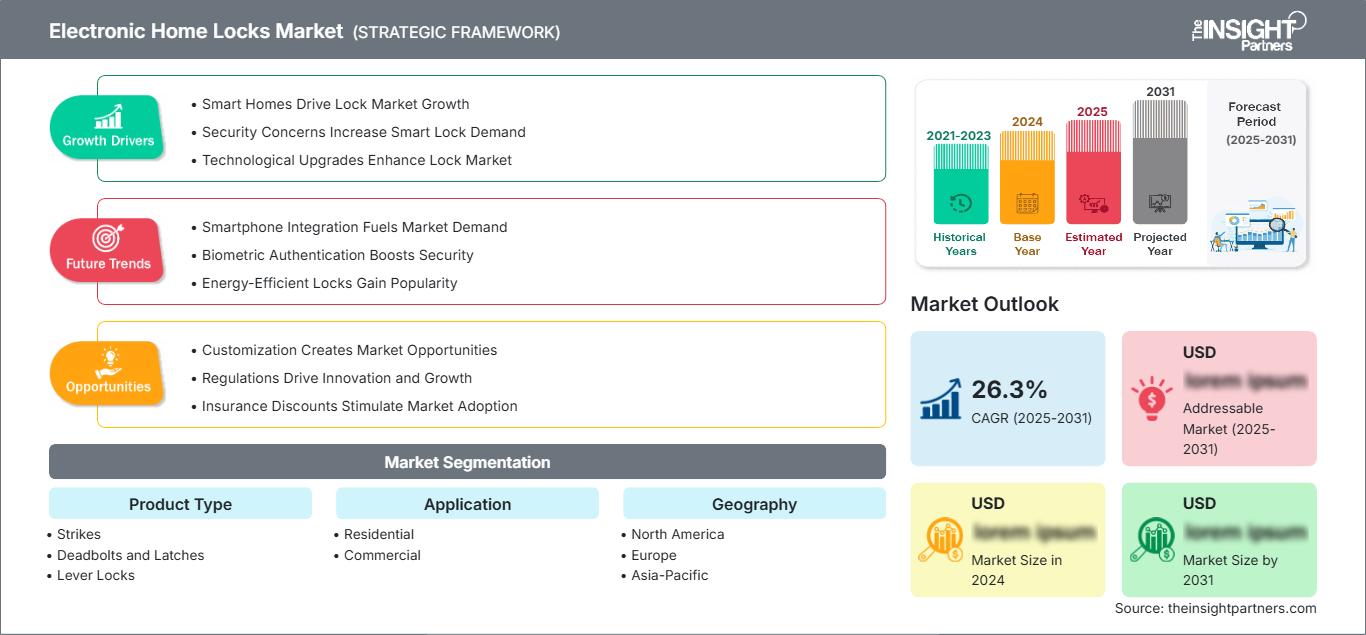
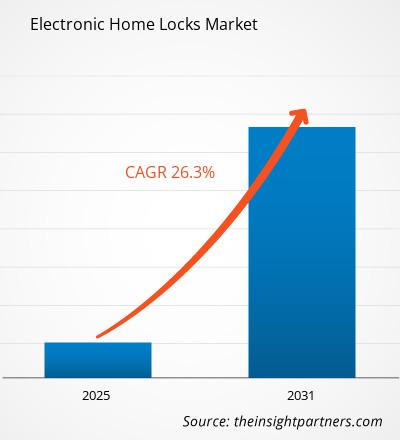
The global Electronic Home Locks Market size was valued at US$ 3.83 Billion in 2025 and is projected to reach US$ 5.65 Billion by 2034, registering a compound annual growth rate (CAGR) of 5.00% from 2026 to 2034. This growth trajectory reflects increasing consumer emphasis on home security and the adoption of smart home technologies. The rising demand for keyless entry systems, remote access capabilities, and integration with home automation platforms continues to shape market expansion dynamics across residential and commercial sectors.
North America represents a significant revenue pocket within the global Electronic Home Locks Market, with estimates suggesting a CAGR of approximately 4.5-5.0% through the forecast period. The region's growth is anchored by high smart home penetration rates and robust consumer awareness of advanced security solutions. Additionally, the expansion of multifamily housing and the increasing popularity of short-term rental properties support demand for electronic access control systems across the United States and Canada.
Electronic Home Locks Market Assessment and Insights
- North America: Captured approximately 34-38% of the global Electronic Home Locks Market share in 2025, supported by high smart home adoption and mature retail channels. The region is projected to grow at a CAGR of 4.5-5.0% during 2026-2034, driven by DIY retail channels and multifamily access control demand.
- US: Representing about 85-90% of the North American market in 2025, the U.S. continues to lead regional demand. The market is projected to expand at a CAGR of 4.0-4.5% through 2034, supported by professional security providers and short-term rental property management.
- Europe: Held roughly 25-29% of the global market share in 2025, with Germany, the UK, and France as leading contributors. The region is expected to witness a CAGR of 4.5-5.0% from 2026 to 2034, driven by smart home renovation and stringent connected-device security regulations.
- Asia Pacific: Accounted for approximately 28-32% of the global market in 2025, with China, Japan, and South Korea as major contributors. The region is projected to grow at a robust CAGR of 6.0-6.5% during 2026-2034, driven by rapid urbanization and large-scale smart apartment development.
- Largest Segment: The Deadbolts and Latches segment dominated the Electronic Home Locks Market in 2025, accounting for an estimated 40-44% market share. This segment's prominence is attributed to widespread residential adoption and compatibility with standard door hardware configurations.
- High Growth Segment: The Lever Locks segment is projected to exhibit robust growth, with a CAGR of 5.0-5.5% from 2026 to 2034. This growth is driven by increasing use in commercial settings and multi-family properties where accessibility and ease of operation are prioritized.
- Key companies analyzed in detail: Allegion plc, ASSA ABLOY, August Home, HANMAN INTERNATIONAL PTE LTD (Samsung), Honeywell International Inc., Nuki Home Solutions, Safewise, SentriLock, LLC, The Godrej Group, Weiser.
Source: The Insight Partners' analysis based on proprietary research, government publications, company annual reports, investor presentations, industry databases, and expert interviews.
Evolution of Electronic Home Locks Market implies a paradigm shift from standalone keypad locks to advanced cloud-based and smartphone-controlled smart locks. This shift is characterized by digitalization and incorporation of home security devices into an integrated home environment. The companies are actively working on designing their locking devices with advanced interoperable features like compatibility with Matter, Wi-Fi, Bluetooth, Z-Wave, Zigbee, etc., which allows for their easy incorporation into the leading smart home platforms. Improvements in power efficiency and wireless communication capabilities make it possible to provide reliable operation and reduce the maintenance needs.
Prospects of Electronic Home Locks Market suggest that it is likely to continue growing in the coming years owing to the rise of emerging economies and investment in residential technologies. Government-led development of smart cities and connected homes, especially in the region of Asia Pacific, may generate new prospects for electronic lock installations. AI-enabled analytics used for anomaly detection, predictive maintenance, and access control is likely to be another growth engine. Cybersecurity and data privacy regulations will be another influential factor in product development in Europe and North America.
Electronic Home Locks Market Report Scope
| Report Attribute | Details |
|---|---|
| Market size in 2025 | US$ 3.83 Billion |
| Market Size by 2034 | US$ 5.65 Billion |
| Global CAGR (2026 - 2034) | 5.00% |
| Historical Data | 2021-2024 |
| Forecast period | 2026-2034 |
Electronic Home Locks Market Analysis
According to the Electronic Home Locks Market forecast, growth is driven by the growing need for convenience and secured access control in both residential and commercial environments. Homeowners favor electronic locking devices that help prevent risks related to losing or duplicating keys, as well as provide functions like auto-locking, alerts, and access control from a distance. In the multifamily housing industry, the use of electronic locks helps manage access control for tenants and avoid additional costs associated with changing keys. In the commercial setting, such as office buildings and hotels, electronic access control helps improve security and operational efficiency. The emergence of short-term rental platforms has contributed to the growing popularity of electronic access control systems needed for granting guests access.
According to the Electronic Home Locks Market report, the value chain involves the supply of components, manufacture of locks, connectivity solutions providers, and channels of distribution, increasingly focused on access management solutions platforms. The manufacturing industry is researching and developing products that are more secure and efficient in terms of battery power and connectivity solutions. The availability of high-precision mechanical parts and secure wireless module supply is vital to the reliability and security of the products. On top of this, the increasing use of AI in analytics for anomalies and access pattern analysis creates demand for smarter locks.
The competitive environment involves both security companies and dedicated smart lock producers. The company that has a prominent leadership position within the market is ASSA ABLOY through the production of an extensive range of products like Yale and August. The company Allegion plc also has a leadership position with its dedicated brands like Schlage. Honeywell International offers automation technologies to the market and Samsung through HANMAN INTERNATIONAL takes advantage of its ecosystem of technologies. Weiser and SentriLock have their own market segments. Investing is focused on platform integration and interoperability.
Electronic Home Locks Market trends indicate that strategic partnerships between companies and smart home platform providers have been explored to help grow the company’s reach and capabilities. The partnership between lock manufacturers and technology companies is boosting innovation that matches big ecosystems like Apple HomeKit, Google Home, and Amazon Alexa. Regional growth, especially in emerging Asia Pacific markets, has become an important target area for several businesses that want to tap into opportunities from mass home construction and smart cities initiatives. Moreover, the trend of software-enabled services like remote access management and subscription analytics is changing how revenue streams and consumer engagement tactics have been developed.
● REPORT CUSTOMIZATION
Tailor This Report To Align With Your Specific Business Requirements
This report can be customized to align precisely with your business objectives, scope, and target markets. Customization options include tailored segmentation, geography, competitive analysis, and strategic insights to support informed decision-making.
Customize This Report →WHAT YOU CAN ADJUST
- ● Segmentations
- ● Geography
- ● Competitive Analysis
- ● Language Preferences
Electronic Home Locks Market: Strategic Insights
Regional Insights
North America Electronic Home Locks Market
The North American Electronic Home Locks Market accounted for approximately 34-38% of the global market share in 2025 and is projected to grow at a CAGR of 4.5-5.0% from 2026 to 2034. Market leadership within the region is assured by high adoption rates of smart homes, established DIY distribution channels, and strong awareness of electronic security solutions among consumers. Within the United States and Canada, security needs and rising short-term rental management systems create demand for smart access control systems. Professional security solution provider channel aids adoption by installing systems and integrating them. Moreover, rising development of multi-family housing and condominiums creates a need for electronic access control systems to streamline tenant management and access control. Commercial applications such as offices and hospitality properties use electronic locks.
U.S. Electronic Home Locks Market
The U.S. Electronic Home Locks Market represented approximately 85-90% of the North American market in 2025 and is expected to grow at a CAGR of 4.0-4.5% during 2026-2034. The market leadership of the country is based on the combination of high adoption of smart homes, presence of a developed retail distribution channel and high demand from single-family residences as well as multi-residence properties. Among the key players operating in the market there are companies such as Allegion plc, ASSA ABLOY, and Honeywell International that provide the broadest product range for residential and light commercial use. Application trends suggest a higher adoption of cloud-based locks that have capabilities of remote management and connection with the security system. The development of short term rental and co-working facilities drives further adoption. Moreover, the implementation of AI features becomes more popular.
Europe Electronic Home Locks Market
The European Electronic Home Locks Market captured approximately 25-29% of the global market share in 2025 and is projected to expand at a CAGR of 4.5-5.0% from 2026 to 2034. The development in the area is backed up by intelligent home renovations, privacy demands of customers, and strict laws concerning security of connected devices. Germany is the largest market due to the high level of manufacturing in the country and quality-certified products. The second place goes to the UK, where there is high demand for smart homes and apartments. The other countries showing steady growth are France, Italy, and Spain, due to renovations and tourism housing. With an accent on privacy, security of products, and cyber resilience, compliance with such laws as the EU Cyber Resilience Act is crucial for vendors.
APAC Electronic Home Locks Market
The Asia Pacific Electronic Home Locks Market accounted for approximately 28-32% of the global market share in 2025 and is projected to grow at the highest CAGR of 6.0-6.5% during 2026-2034. China and Japan are the leading contributors, driven by urbanization, high smartphone use, and large-scale smart apartment development. Features of the Chinese market include manufacturing in China, apartment digitization, and ecosystem platforms with features of locks integrated with the entire smart home ecosystem. Features of the Indian market are an increased market owing to digital payments, ecommerce, and growth in apartment communities. Advantages in South Korea include apartment-based lifestyle and high expertise in digital locks. The Australian market growth is driven by the connected security industry and property technologies. Japan prefers efficient solutions for dense buildings and aged population.
Middle East & Africa Electronic Home Locks Market
The Middle East & Africa Electronic Home Locks Market is projected to experience robust growth, with a CAGR of approximately 5.0-5.5% from 2026 to 2034. Saudi Arabia and the UAE are the leading markets, driven by premium residential projects, smart-city investments, and high-rise development under economic diversification plans. South Africa's market is supported by urbanization and formal housing development. The Rest of MEA region is witnessing gradual adoption, supported by mobile connectivity and managed property segments seeking improved access control. The demand for professionally installed electronic locks in premium segments is gaining traction, particularly in GCC countries where smart-city programs and expatriate housing drive adoption.
Segmentation Analysis
Product Type
The Product Type segment of the Electronic Home Locks Market is categorized into Strikes, Deadbolts and Latches, and Lever Locks. This segment is projected to grow at a CAGR of 4.5-5.0% during 2026-2034, driven by diverse consumer preferences and application requirements. Deadbolts and Latches continue to dominate in terms of volume due to their widespread residential adoption and compatibility with standard door hardware. Lever Locks are increasingly adopted in commercial settings and multi-family properties where accessibility and ease of operation are prioritized. Strikes represent a specialized segment serving both residential and commercial applications where remote release functionality is required.
- Strikes: Electric strikes are specialized locking mechanisms used in access control systems, particularly in commercial and multi-family properties. These devices enable remote door release from security systems and are commonly integrated with intercom systems and keypads. The segment's growth is supported by commercial building automation and property management requirements.
- Deadbolts and Latches: Deadbolts and latches represent the largest segment, driven by widespread residential adoption and compatibility with standard door hardware. These products offer enhanced security compared to traditional locks and are available in both retrofit and new-build configurations. The segment's dominance is supported by broad consumer familiarity and ease of installation.
- Lever Locks: Lever locks are increasingly adopted in settings where accessibility and ease of operation are priorities, including multi-family properties and light commercial applications. These locks offer ergonomic operation and are often used in accessibility-focused installations. The segment's growth is driven by commercial adoption and multi-family property management requirements.
Application
The Application segment of the Electronic Home Locks Market is categorized into Residential and Commercial sectors. This segment is projected to grow at a CAGR of 4.5-5.0% from 2026 to 2034, reflecting the diverse end-user requirements for electronic access control solutions. The Residential sector continues to dominate in terms of volume, driven by smart home adoption and security concerns, while the Commercial sector expands through property management and access control requirements in office, retail, and hospitality settings.
- Residential: Residential applications represent the largest market segment, driven by smart home adoption, security concerns, and convenience factors. Single-family homeowners and multi-family tenants are increasingly adopting electronic locks for keyless entry, remote access management, and integration with home security systems. The growth of short-term rentals and apartment living further supports residential adoption.
- Commercial: Commercial applications encompass office buildings, retail spaces, hospitality properties, and institutional facilities requiring access control solutions. Electronic locks in commercial settings support employee access management, security compliance, and operational efficiency. The sector is expanding with the growth of co-working spaces and hybrid work models requiring flexible access control systems.
Opportunity Snapshot
| Application Segment | Revenue Contribution | Trend Tag | Adoption Stage |
|---|---|---|---|
| Residential | High | Keyless Entry | Scaling |
| Commercial | Medium | Access Control | Mature |
Electronic Home Locks Market Growth Drivers and Impact Analysis
Smart Home Integration Driving Electronic Lock Adoption
The inclusion of electronic home locks in larger smart homes is driving growth in the market to a great extent. Increasing consumer demand for centralized security management of homes using their mobile application, which includes features such as remotely locking or unlocking doors, managing guests, and monitoring activities, can help in incorporating the electronic lock system into the infrastructure of today’s homes, thus offering convenience and improved security management of the homes. In addition to this, the growing popularity of voice assistants such as Amazon Alexa and Google Assistant is expected to increase adoption due to their voice-controlled home automation capabilities.
Rising Security Concerns and Urbanization Fueling Demand
Growth in urbanization, increased population density, and awareness about burglary threats have led homeowners to shift from their conventional lock mechanisms to advanced electronic locks. Some benefits offered by electronic locks include keyless entry, auto-lock mechanism, and timely alerts. These help in having better control over home security and eliminate issues related to key loss or duplication. There is high demand for electronic locks among urban residents, gated residential complexes, and tenants whose access needs to be managed efficiently.
Biometric Authentication and Technological Advancements
The continuous development of new technologies in the realm of biometric systems and wireless communication is revolutionizing the product offering and consumer requirements. Innovative features such as fingerprint identification, personal identification numbers, and connection via Bluetooth or Wi-Fi are helping in providing better security as well as convenience to the users, eliminating the need for using the traditional lock keys and making the process of authentication more efficient and convenient. Improvements in wireless technology and energy savings ensure that these products function efficiently even when there are no sources of power.
Electronic Home Locks Market Future Trends
Convergence of Interoperability Standards and Ecosystem Integration
Standards such as Matter, Thread, Wi-Fi, Bluetooth Low Energy, Zigbee, and Z-Wave are driving product development strategies as consumers look for locks that are interoperable in the major ecosystems and property management systems. Transitioning from key pad locks to connected locks without hubs is making the purchase decision much easier. Multi-ecosystem products have a much better chance of being adopted by consumers. Standards convergence is reducing fragmentation and enabling a more consistent consumer experience for connected home devices.
Cybersecurity and Privacy Regulations Reshaping Product Development
Regulations and standards are altering the rules of market entry and product development. Requirements such as those found in the UK's Product Security and Telecommunications Infrastructure program, California's regulations on connected device security, the EU's Cyber Resilience Act, ETSI EN 303 645, and NIST's cybersecurity guidance all increase the expectations for unique identification, update capabilities, vulnerability disclosures, and support during the life cycle of the product. Successful products balance physical resilience with encryption, tamper notifications, power efficiency, safe access, and privacy. Consumer awareness of the security concerns of the IoT is creating demand for products that deliver security and privacy features.
Electronic Home Locks Market Opportunities
Expansion into Emerging Smart City Projects and Apartment Development
Government-led smart city initiatives in Asia Pacific and the Middle East present significant opportunities for electronic home lock deployments. These projects require integrated security solutions, including smart access control for residential and mixed-use developments. Companies that offer scalable, interoperable electronic locking systems with cloud-based management capabilities are well-positioned to capitalize on these large-scale infrastructure investments. The expansion of smart apartment developments in China and other Asian markets, driven by urbanization and mobile-first consumers, represents a substantial growth opportunity.
Development of AI-Enhanced Access Management Platforms with Value-Added Services
Opportunities exist for electronic lock manufacturers to develop integrated platforms that combine hardware with AI-powered software for anomaly detection, access scheduling, and security analytics. Predictive models can estimate battery depletion, identify motor strain, detect firmware performance issues, and recommend preventive maintenance before lock failure. Subscription-based models offering remote access management, activity monitoring, and tenant integration provide recurring revenue streams while addressing the evolving needs of property managers and homeowners seeking comprehensive security solutions.
Recent Developments
- July 2026: Häfele India launched the Vega Digital Lock, an advanced smart locking solution designed for modern homes and commercial spaces. The new digital lock combines a sleek black-glass-inspired design with multiple intelligent access features, including fingerprint recognition, password access, RFID, mobile application control, and mechanical key backup. Equipped with smart features such as remote access through the Häfele Smart Living App, Smart Password technology, Smart Voice guidance, Smart Freeze security, and audit trail management, the Vega Digital Lock enhances convenience, privacy, and security for users. The launch strengthens Häfele’s digital security portfolio and supports the growing adoption of smart home technologies by providing integrated access control solutions for contemporary living spaces.
- May 2026: Hikvision India launched its Intelligent Electric Lock Series, introducing the DS-K4E100 Pro Series Intelligent Electric Motor Lock as part of its expansion beyond surveillance products into the smart home and access control market. Designed for residential, commercial, and small business applications, the new lock offers intelligent access management with features including multiple unlocking methods, remote control through mobile applications, and integration with Hikvision’s broader security ecosystem. The solution is engineered for flexible installation across different door configurations and aims to enhance security, convenience, and operational efficiency. The launch strengthens Hikvision India’s smart security portfolio and supports the growing adoption of connected access control solutions in homes and businesses.
- March 2026: Samsung Electronics launched Digital Home Key within Samsung Wallet, enabling Samsung Galaxy users to unlock compatible smart door locks using their smartphones. Built on the Aliro smart lock access protocol developed by the Connectivity Standards Alliance (CSA), the feature allows secure digital key management through the Samsung Galaxy ecosystem. Users can set up compatible locks through Samsung SmartThings using the Matter smart home standard and access their homes through NFC tap-to-unlock, ultra-wideband (UWB) hands-free access, or remote app-based controls, depending on device and lock compatibility. Protected by Samsung Knox security technology and designed to meet advanced security certification standards, Digital Home Key strengthens Samsung’s smart home ecosystem, enhances convenience, and supports the growing adoption of connected access control solutions.
Frequently Asked Questions

- Comprehensive Market Sizing and Forecast Analysis
- Detailed Segmentation Analysis
- In-Depth Market Dynamics Assessment
- Regional and Country-Level Insights
- Competitive Landscape and Company Benchmarking
- Strategic Business Intelligence
Recent Reports
Testimonials

The Insight Partners' SCADA System Market report is comprehensive, with valuable insights on current trends and future forecasts. The team was highly professional, responsive, and supportive throughout. We are very satisfied and highly recommend their services.
RAN KEDEM Partner, Reali Technologies LTDs
I requested a report on a very specific software market and the team produced the report in a few days. The information was very relevant and well presented. I then requested some changes and additions to the report. The team was again very responsive and I got the final report in less than a week.
JEAN-HERVE JENN Chairman, Future Analytica
We worked with The Insight Partners for an important market study and forecast. They gave us clear insights into opportunities and risks, which helped shape our plans. Their research was easy to use and based on solid data. It helped us make smart, confident decisions. We highly recommend them.
PIYUSH NAGPAL Sr. Vice President, High Beam Global
The Insight Partners delivered insightful, well-structured market research with strong domain expertise. Their team was professional and responsive throughout. The user-friendly website made accessing industry reports seamless. We highly recommend them for reliable, high-quality research services
YUKIHIKO ADACHI CEO, Deep Blue, LLC.
This is the first time I have purchased a market report from The Insight Partners.While I was unsure at first, I visited their web site and felt more comfortable to take the risk and purchase a market report.I am completely satisfied with the quality of the report and customer service. I had several questions and comments with the initial report, but after a couple of dialogs over email with their analyst I believe I have a report that I can use as input to our strategic planning process.Thank you so much for taking the extra time and making this a positive experience.I will definitely recommend your service to others and you will be my first call when we need further market data.
JOHN SUZUKI President and Chief Executive Officer, Board Director, BK Technologies
I wish to appreciate your support and the professionalism you displayed in the course of attending to my request for information regarding to infectious disease IVD market in Nigeria. I appreciate your patience, your guidance, and the fact that you were willing to offer a discount, which eventually made it possible for us to close a deal. I look forward to engaging The Insight Partners in the future, all thanks to the impression you have created in me as a result of this first encounter.
DR CHIJIOKE ONYIA MANAGING DIRECTOR, PineCrest Healthcare Ltd.Reason to Buy
- Informed Decision-Making
- Understanding Market Dynamics
- Competitive Analysis
- Identifying Emerging Markets
- Customer Insights
- Market Forecasts
- Risk Mitigation
- Boosting Operational Efficiency
- Strategic Planning
- Investment Justification
- Tracking Industry Innovations
- Aligning with Regulatory Trends





 Get Free Sample for