
Engine Oil Additive Market Trends, Size & Growth by 2034
Coverage: by Type (Anti-oxidants, Detergents, Pour point Depressants, Anti-wear additives, Viscosity modifiers, Antifoam agents, Friction modifiers, Metal Deactivators, Corrosion inhibitors, Extreme pressure (EP) Additives, Demulsifiers, Emulsifiers, Biocides, Tackifiers, Seal Swell Agent, Oxidation inhibitors, Others); Engine Types (Gasoline, Diesel, Natural Gas, Others); End Use Industry (Automotive, Industrial, Others) , and Geography (North America, Europe, Asia Pacific, and South and Central America)
- Status : Data Released
- Report Code : TIPRE00008726
- Category : Chemicals and Materials
- No. of Pages : 150
- Available Report Formats :


- Last update date : August 19, 2026


2025 Market Size
US$ 21.65 Bn
Base year value
2034 Forecast
US$ 28.36 Bn
Projected by 2034
CAGR 2026-2034
3.05 %
Growth rate
Addressable Market
US$ 227.12 Bn
(2026-2034)
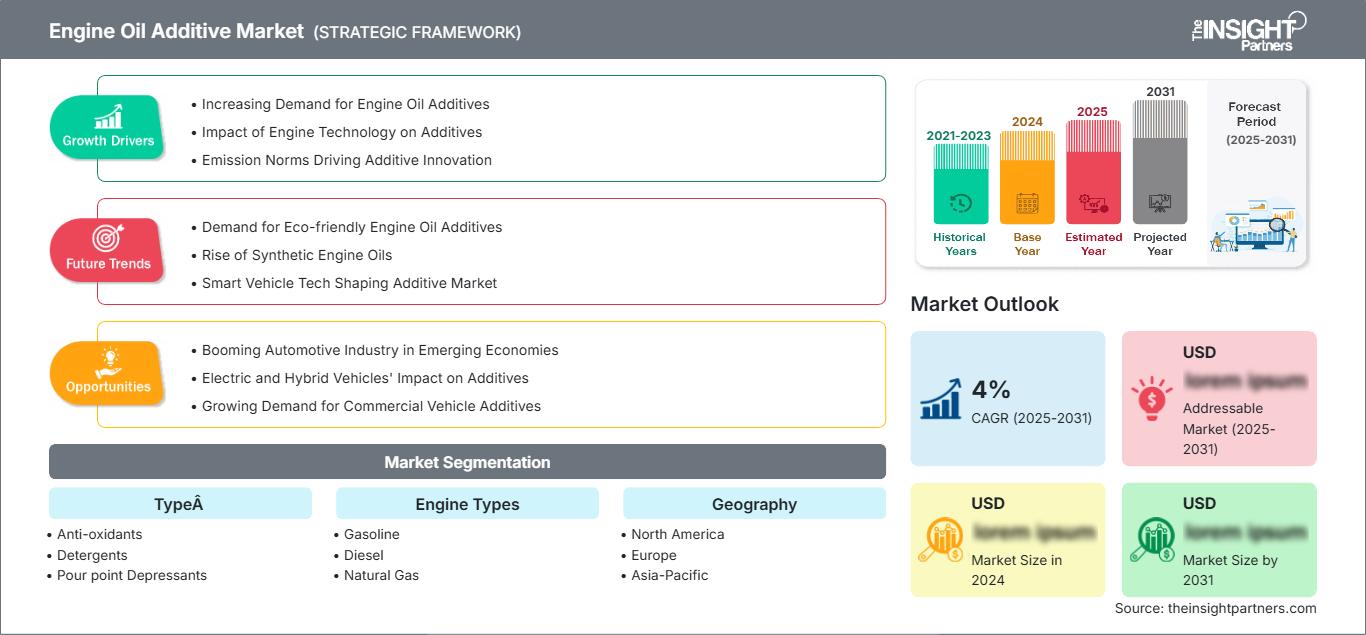
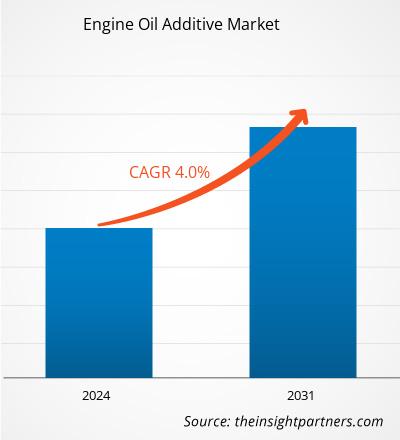
The Engine Oil Additive Market Size was valued at US$ 21.65 Billion in 2025 and is expected to grow and touch the mark of US$ 28.36 Billion by 2034, growing at a CAGR of 3.05% between 2026 and 2034. Growth drivers include stricter engine performance standards, higher oil drain cycles, fuel economy needs, and more complicated formulations for lubricants. New developments in the additives will include technologies for addressing oxidation, wear, deposit, viscosity, emission system compatibility, and low-speed pre-ignition protection in gas, diesel, and natural gas engines.
North America continues to be a hub for formulation and technologies. It has a large fleet of vehicles and more stringent engine performance standards. Engine Oil Additive market depends on passenger car and heavy duty lubricant use, OEM approvals and shift towards low viscosity lubricants.
Engine Oil Additive Market Assessment and Insights
- North America: North America accounted for a 28–32% Engine Oil Additive market share in 2025 and is projected to grow at a CAGR of 2.5–3.0% between 2026–2034, supported by mature vehicle fleets, lubricant replacement, and advanced engine specifications.
- US: The US represented 78–82% of North America's 2025 demand and is projected to grow at a CAGR of 2.4–2.9% between 2026–2034, supported by passenger-car and heavy-duty applications.
- Europe: Europe held a 23–27% share in 2025 and is expected to expand at a CAGR of 2.7–3.2% between 2026–2034, led by Germany, France, Italy, the UK, and Spain.
- Asia Pacific: Asia Pacific represented a 34–38% share in 2025 and is projected to grow at a CAGR of 3.6–4.1% between 2026–2034, led by China, India, Japan, South Korea, and Southeast Asia.
- Largest Segment: Anti-oxidants held a 13–17% market share in 2025 and are projected to grow at a CAGR of 3.0–3.4% between 2026–2034, reflecting their essential role in oil durability.
- High Growth Segment: Viscosity modifiers held a 9–13% market share in 2025 and are projected to grow at a CAGR of 3.7–4.2% between 2026–2034, supported by low-viscosity lubricant demand.
- Key companies analyzed in detail: The Lubrizol Corporation; Chevron Oronite Company LLC; Infineum International Limited; Afton Chemical Corporation; BASF SE; Evonik Industries AG; LANXESS AG; Croda International Plc; Clariant AG; Innospec Inc.
Source: The Insight Partners' analysis based on proprietary research, government publications, company annual reports, investor presentations, industry databases, and expert interviews.
The market has evolved from basic protection chemistry toward multifunctional additive systems capable of balancing oxidation stability, deposit control, wear protection, fuel economy, emissions-system compatibility, and extended drain intervals. Modern formulations increasingly combine detergents, dispersants, antioxidants, viscosity modifiers, friction modifiers, and anti-wear chemistry. Engine downsizing, turbocharging, hybridization, and after-treatment systems have increased formulation complexity.
Future demand is expected to remain strongest in Asia Pacific as vehicle populations and lubricant consumption expand. Mature markets should emphasize premium formulations, longer drain intervals, fuel economy, and compatibility with advanced emissions systems. Investment is also moving toward lower-ash formulations, improved oxidation resistance, sustainable chemistry, and additive systems capable of supporting newer engine architectures.
Engine Oil Additive Market Report Scope
| Report Attribute | Details |
|---|---|
| Market size in 2025 | US$ 21.65 Billion |
| Market Size by 2034 | US$ 28.36 Billion |
| Global CAGR (2026 - 2034) | 3.05% |
| Historical Data | 2021-2024 |
| Forecast period | 2026-2034 |
Engine Oil Additive Market Analysis
The Engine Oil Additive Market is more correlated with lubricant properties expectations rather than vehicle sales numbers. Additives allow base oils to comply with specifications concerning oxidation resistance, detergency, viscosity stability, wear protection, corrosion protection, foaming, and deposit formation. The value chain covers specialty chemical manufacturers and additive packages providers, lubricant formulators, original equipment manufacturers (OEMs), distributors, servicing companies, and vehicle owners. Rising sophistication of specifications increases significance of formulation capabilities. According to Afton, the company provides its line of engine-oil additives for passenger-car, heavy-duty, motorcycle, and railroad segments, with R&D initiatives being focused on API and ILSAC standards.
Supply considerations include specialty chemical raw materials, production capacity, formulation capabilities, testing facilities, and regional lubricant blending infrastructure. Large companies can rely on long OEM relations and wide array of testing systems. Small players try to distinguish themselves in terms of individual additive chemistries, regional formulations, and specific applications. One of Evonik’s VISCOPLEX line product types is polyalkyl methacrylate-based viscosity index improvers and pour point depressants.
Competitive positioning in the Engine Oil Additive Market report is centered on a select number of suppliers globally that have wide capabilities in terms of additive-package formulation. These include the Lubrizol Corporation, the Chevron Oronite Company LLC, the Infineum International Limited, and the Afton Chemical Corporation, which compete based on formulation technology, OEM approvals, testing capabilities, and global customer base. Competitors including BASF SE, Evonik Industries AG, LANXESS AG, Croda International Plc, Clariant AG, and Innospec Inc., contribute to the competition through specialty chemistry.
Investments are shifting toward additive packages, regional production, sustainability, and new specifications. Afton is focusing on technology consistent with the API SP, ILSAC GF-6 standards, and the upcoming API SQ and ILSAC GF-7 standards. LANXESS, on its part, has been emphasizing lubricant additives ranging from antioxidants, anti-wear additives, corrosion inhibitors, and friction modifiers.
● REPORT CUSTOMIZATION
Tailor This Report To Align With Your Specific Business Requirements
This report can be customized to align precisely with your business objectives, scope, and target markets. Customization options include tailored segmentation, geography, competitive analysis, and strategic insights to support informed decision-making.
Customize This Report →WHAT YOU CAN ADJUST
- ● Segmentations
- ● Geography
- ● Competitive Analysis
- ● Language Preferences
Engine Oil Additive Market: Strategic Insights
Regional Insights
North America Engine Oil Additive Market
North America accounted for 28–32% of the Engine Oil Additive Market in 2025 and is projected to grow at a CAGR of 2.5–3.0% through 2034. The region benefits from a large installed vehicle base, established lubricant distribution, substantial commercial transportation activity, and mature aftermarket channels. Demand is also supported by increasingly sophisticated engine and lubricant specifications.
The US represents the dominant regional market, while Canada contributes through passenger vehicles, heavy-duty transportation, and industrial equipment. Demand is shifting toward additive systems supporting fuel economy, longer drain intervals, deposit control, and emissions-system compatibility. Suppliers with extensive testing and OEM relationships retain an advantage because lubricant qualification requires technical validation and formulation consistency.
U.S. Engine Oil Additive Market
The US represented 78–82% of North America's 2025 demand and is projected to grow at a CAGR of 2.4–2.9% through 2034. The market benefits from passenger-car ownership, commercial trucking, construction, agriculture, and industrial equipment.
The Lubrizol Corporation, Afton Chemical Corporation, Chevron Oronite Company LLC, and Infineum International Limited have strong technology positions serving major lubricant formulators. Application demand increasingly favors low-viscosity oils, fuel-economy performance, extended drain intervals, and compatibility with modern emissions systems. Heavy-duty diesel remains important because fleet operators prioritize oil durability and engine protection.
Europe Engine Oil Additive Market
In 2025, Europe contributed to 23–27% of global demand and is forecast to grow with a CAGR of 2.7–3.2% up to 2034. Germany is the largest market due to its premium automotive manufacturing capacity and robust OEM infrastructure. The UK, France, Italy, and Spain contribute to demand through passenger cars, commercial transport, and industrial applications.
The European market is tilting more towards low-viscosity and low-SAPS technologies as they help in protecting sophisticated engine and after-treatment systems. OEM approvals will have significant influence on the formulations chosen. Germany remains crucial in the strategic sense as premium automotive manufacturing and advanced lubricants technology will drive demand for unique additive chemistries. France and Italy have good aftermarket and commercial vehicle segments, while the UK and Spain have good replacement demand.
APAC Engine Oil Additive Market
APAC occupied a market share of 34-38% in 2025 and is forecasted to witness CAGR of 3.6-4.1% until 2034. APAC consists of China, which is the dominant market in the region, followed by Japan, India, South Korea, and Australia. Rising number of vehicles, industrialization, and usage of lubricants favor additive consumption.
While China and India provide volume growth, countries such as Japan and South Korea focus on formulating technology and OEM standards. Southeast Asia is another market that presents some other opportunities as more vehicles are registered and there is a rise in manufacturing operations.
Middle East & Africa Engine Oil Additive Market
Middle East and Africa is projected to expand at a CAGR of 2.8–3.4% through 2034. Saudi Arabia and the UAE lead regional demand, supported by transportation, construction, industrial activity, and high-temperature operating conditions. South Africa represents an important automotive and commercial-vehicle market.
Rest of MEA remains fragmented, with demand strongly connected to vehicle imports, fleet operations, and lubricant distribution. High ambient temperatures increase requirements for oxidation stability, deposit control, and viscosity retention. Growth should remain strongest in commercial transportation, industrial equipment, and aftermarket lubricants.
Segmentation Analysis
Type
Type is projected to grow at a CAGR of 2.9–3.3% during 2026–2034. The Engine Oil Additive Market scope across additive types reflects the increasing need to balance multiple performance characteristics within increasingly demanding lubricant formulations. No individual chemistry operates independently because formulators must optimize interactions among additives.
- Anti-oxidants: Anti-oxidants protect lubricant molecules against thermal and oxidative degradation, helping maintain oil stability during extended operating periods and supporting longer drain intervals.
- Detergents: Detergents control deposits and neutralize acidic combustion by-products, protecting engine surfaces and maintaining cleanliness under demanding operating conditions.
- Pour point Depressants: Pour point depressants improve low-temperature flow by modifying wax-crystal behavior, supporting engine starting and lubricant circulation in colder environments.
- Anti-wear additives: Anti-wear additives create protective films on contacting surfaces, reducing wear during boundary-lubrication conditions and supporting engine component durability.
- Viscosity modifiers: Viscosity modifiers help lubricants maintain suitable viscosity across temperature changes and support the formulation of multigrade and fuel-efficient engine oils.
- Antifoam agents: Antifoam agents suppress excessive foam formation that can interfere with oil circulation, lubrication consistency, and reliable operation under high-speed conditions.
- Friction modifiers: Friction modifiers reduce friction at interacting surfaces and support fuel-economy improvements, particularly in modern passenger-car lubricants with lower viscosity targets.
- Metal Deactivators: Metal deactivators limit catalytic reactions between metal surfaces and lubricant components, improving oxidation stability and protecting formulations during prolonged operation.
- Corrosion inhibitors: Corrosion inhibitors protect engine components from moisture, acids, and chemically aggressive compounds generated during combustion and lubricant aging.
- Extreme pressure Additives: Extreme pressure additives provide protection under severe load and pressure conditions by forming chemically protective films on contacting metal surfaces.
- Demulsifiers: Demulsifiers promote separation of water from lubricating oil, helping preserve lubricant performance and limiting corrosion or degradation caused by water contamination.
- Emulsifiers: Emulsifiers support controlled interaction between oil and water phases where formulation requirements demand stable dispersion or specialized lubrication characteristics.
- Biocides: Biocides limit microbial growth in susceptible lubricant systems, particularly where water contamination and storage conditions can create environments favorable to microorganisms.
- Tackifiers: Tackifiers improve lubricant adhesion and reduce oil fling, supporting applications where stronger retention on moving or exposed engine-related surfaces is desirable.
- Seal Swell Agent: Seal swell agents help maintain elastomer compatibility by controlling seal dimensions and reducing leakage risks caused by lubricant and seal interactions.
- Oxidation inhibitors: Oxidation inhibitors slow chemical degradation of lubricant components, supporting viscosity stability, deposit control, and longer useful oil life.
Engine Types
Engine Types is projected to grow at a CAGR of 3.0–3.4% during 2026–2034. The segment reflects different combustion environments and formulation requirements across gasoline, diesel, and natural-gas engines. Changes in emissions technology and engine architecture continue to influence additive selection.
- Gasoline: Gasoline engines increasingly require additive systems supporting fuel economy, deposit control, turbocharger protection, low-speed pre-ignition mitigation, and compatibility with modern emissions-control hardware.
- Diesel: Diesel engines demand strong detergency, oxidation stability, anti-wear protection, soot management, and compatibility with particulate filters and other emissions-treatment systems.
- Natural Gas: Natural-gas engines require oxidation stability, deposit control, wear protection, and formulations capable of maintaining performance under high-temperature and relatively clean-combustion operating conditions.
Opportunity Snapshot
| Segment Name | Revenue Contribution | Trend Tag | Adoption Stage |
| Gasoline | High | Fuel Economy | Mature |
| Diesel | High | Fleet Durability | Mature |
| Natural Gas | Low | Gas Engines | Scaling |
Engine Oil Additive Market Growth Drivers and Impact Analysis
Increasing engine efficiency and tighter lubricant performance requirements
Present-day engines work at increased temperatures, pressures, and loading conditions, and there is a constant search for reduced friction and improved fuel economy. It results in increased reliance on additive technology that provides protection to engine components without affecting viscosity and compatibility with emissions control systems. The presence of turbochargers, downsizing of engines, and extended drain intervals put additional load on the engine oils, and there is increased need for antioxidants, detergents, anti-wear and viscosity additives. Special attention is paid to pre-ignition protection and passenger car oils by Afton. The economic relevance of this area is high because lubricant suppliers are forced to certify increasingly complex formulations according to different performance criteria. This creates competitive advantage for those suppliers who have adequate test facilities and OEM contacts, as well as a wide library of formulas.
Expansion of vehicle fleets and lubricant consumption in emerging economies
The growth in vehicle ownership is increasing further in developing countries, especially in Asia, where there is growing need for replacement of engine oil in the increasing fleet. China and India are the key markets because there are varying needs of lubricants from passenger vehicles, trucks, motorcycles, agricultural machinery, and other industrial equipment. With more utilization of the vehicles, there will be repeat business even if there is no growth in the sales of new vehicles. There is an increasing demand for multifunctional additives with the development of higher quality products and international standards among local lubricant manufacturers. Afton says that there are still evolving requirements of engine oils in the emerging markets with special additives to cope with extreme conditions of use. The implications for the market go beyond increased demand because there are more needs for technical assistance and custom-made additives among the local formulators.
Longer oil-drain intervals and stronger emissions-system compatibility
Increased drain interval for oil demands a design that requires better oxidation resistance, deposit control, viscosity stabilization, and anti-wear. At the same time, particulate filters, catalysts, and other emissions reduction equipment demand less ash content from lubricating oil. These requirements make it difficult for lubricant formulators to come up with additives that would not interfere with exhaust system performance. This trend means more demand for optimized additive packages rather than individual components. It is necessary to examine the compatibility of detergents, dispersants, antioxidants, anti-wear, and friction modifiers over long run times. Another trend in additive use is the growing importance of premium oils because fleet managers and car owners can balance the cost of lubricant and lower maintenance expenses and extended service periods.
Engine Oil Additive Market Future Trends
Movement toward lower-viscosity and multifunctional formulations
The Engine Oil Additive Market trends are increasingly centered on formulations that combine low viscosity with strong wear, oxidation, deposit, and volatility control. Low viscosity products may help achieve fuel economy goals, but thinner films could require the chemistry to be better balanced between anti-wear and friction modifier properties. The viscosity modifier needs to ensure reliable operation over wide temperature range and minimum shearing. However, the complexity of additive interaction is expected to become higher due to the need for alignment between OEM demands and emission system limitations. As a result, future additive packages are supposed to include a larger number of multifunctional additives capable of providing multiple effects.
Sustainability and lower-impact additive chemistry
Sustainability is expected to become more important in additive development as lubricant manufacturers evaluate lifecycle emissions, renewable feedstocks, biodegradability, and manufacturing intensity. Suppliers are exploring chemistry that reduces environmental impact while maintaining engine protection and formulation stability. LANXESS, for example, introduced a more sustainable variant of Additin RC 2515 with a reported 34% lower product carbon footprint and more than 80% of raw materials sourced from sustainable sources. Future development is likely to focus on renewable and recycled feedstocks, lower-carbon manufacturing, improved additive efficiency, and formulations requiring lower treat rates. Sustainability credentials may increasingly influence procurement alongside performance, price, OEM approval, and supply reliability.
Engine Oil Additive Market Opportunities
Advanced additive packages for hybrid and next-generation powertrains
The Engine Oil Additive Market Forecasts indicate an opportunity to develop formulations specifically optimized for hybrid and emerging powertrain architectures. Hybrid engines can experience frequent start-stop cycles, lower average operating temperatures, fuel dilution, and intermittent engine operation, creating different lubricant stress profiles from conventional engines. These conditions can increase the importance of oxidation control, deposit management, corrosion protection, and viscosity stability. Additive suppliers that develop validated formulations for hybrid-specific operating conditions can differentiate from conventional packages. Collaboration with OEMs and lubricant blenders will be particularly valuable because new specifications can emerge before broad aftermarket adoption. Testing capabilities that reproduce hybrid duty cycles can shorten development timelines and improve qualification. The opportunity is strongest for suppliers capable of combining multiple additive functions while maintaining compatibility with evolving emissions systems and lower-viscosity lubricant requirements.
Localized formulation platforms in emerging automotive markets
Emerging automotive markets provide an opportunity for localized additive packages tailored to climate, fuel quality, driving patterns, vehicle age, and maintenance practices. India, Southeast Asia, Latin America, and parts of Africa contain diverse vehicle populations where global formulations may require adjustment for operating conditions. Local blending and technical centers can help additive suppliers respond faster to customer requirements while reducing logistics exposure. Products optimized for high ambient temperatures, stop-and-go traffic, extended drain intervals, or older engines can create differentiated demand. Suppliers can also support local lubricant brands through formulation assistance, laboratory testing, field trials, and regulatory guidance. Building regional technical capabilities therefore offers a route to capture volume growth while developing deeper customer relationships. The opportunity is especially relevant as emerging-market lubricant producers increasingly target international performance specifications.
Recent Developments
- April 2026: BRB Lube Oil Additives & Chemicals, a Netherlands-based global manufacturer, debuted in the North American market at the Lubricant Expo held from March 17-19. Established in 1981, the company has expanded to 16 locations and became a subsidiary of Malaysia's PETRONAS Chemicals Group in 2019. Despite this, it operates independently, focusing on innovation. BRB aims to grow its presence in North America, showcasing its Petrolad® and Viscotech® technology brands. Roger Dohmen, Head of BRB, expressed enthusiasm for introducing their technology and sustainability strengths to regional partners and customers.
- November 2025: Lucas Oil has launched its first product line specifically for hybrid vehicles, including Hybrid Oil Treatment and Hybrid Fuel Treatment with HybridShield Technology. These products, showcased at the 2025 AAPEX Show, address specific issues faced by hybrid engines. As the global hybrid market is expected to grow over 7% annually through 2034, the demand for effective long-term engine protection is increasing, especially with automakers expanding their hybrid offerings and owners sustaining usage longer than traditional vehicles.
Frequently Asked Questions

- Comprehensive Market Sizing and Forecast Analysis
- Detailed Segmentation Analysis
- In-Depth Market Dynamics Assessment
- Regional and Country-Level Insights
- Competitive Landscape and Company Benchmarking
- Strategic Business Intelligence
Recent Reports
Testimonials

The Insight Partners' SCADA System Market report is comprehensive, with valuable insights on current trends and future forecasts. The team was highly professional, responsive, and supportive throughout. We are very satisfied and highly recommend their services.
RAN KEDEM Partner, Reali Technologies LTDs
I requested a report on a very specific software market and the team produced the report in a few days. The information was very relevant and well presented. I then requested some changes and additions to the report. The team was again very responsive and I got the final report in less than a week.
JEAN-HERVE JENN Chairman, Future Analytica
We worked with The Insight Partners for an important market study and forecast. They gave us clear insights into opportunities and risks, which helped shape our plans. Their research was easy to use and based on solid data. It helped us make smart, confident decisions. We highly recommend them.
PIYUSH NAGPAL Sr. Vice President, High Beam Global
The Insight Partners delivered insightful, well-structured market research with strong domain expertise. Their team was professional and responsive throughout. The user-friendly website made accessing industry reports seamless. We highly recommend them for reliable, high-quality research services
YUKIHIKO ADACHI CEO, Deep Blue, LLC.
This is the first time I have purchased a market report from The Insight Partners.While I was unsure at first, I visited their web site and felt more comfortable to take the risk and purchase a market report.I am completely satisfied with the quality of the report and customer service. I had several questions and comments with the initial report, but after a couple of dialogs over email with their analyst I believe I have a report that I can use as input to our strategic planning process.Thank you so much for taking the extra time and making this a positive experience.I will definitely recommend your service to others and you will be my first call when we need further market data.
JOHN SUZUKI President and Chief Executive Officer, Board Director, BK Technologies
I wish to appreciate your support and the professionalism you displayed in the course of attending to my request for information regarding to infectious disease IVD market in Nigeria. I appreciate your patience, your guidance, and the fact that you were willing to offer a discount, which eventually made it possible for us to close a deal. I look forward to engaging The Insight Partners in the future, all thanks to the impression you have created in me as a result of this first encounter.
DR CHIJIOKE ONYIA MANAGING DIRECTOR, PineCrest Healthcare Ltd.Reason to Buy
- Informed Decision-Making
- Understanding Market Dynamics
- Competitive Analysis
- Identifying Emerging Markets
- Customer Insights
- Market Forecasts
- Risk Mitigation
- Boosting Operational Efficiency
- Strategic Planning
- Investment Justification
- Tracking Industry Innovations
- Aligning with Regulatory Trends





 Get Free Sample for