
Engineered Wood Adhesives Market Size, Trends & Demand by 2034
Engineered Wood Adhesives Market Size and Forecasts (2021–2034), Global and Regional Share, Trends, and Growth Opportunity Analysis Report Coverage : by Resin (Melamine Formaldehyde, Phenol Resorcinol Formaldehyde); Product (CLT, OSB, MDF, LVL); Technology (Solvent-Based, Water-Based); Application (Structural, Non-Structural); and Geography (North America, Europe, Asia Pacific, and South and Central America)
- Status : Data Released
- Report Code : TIPRE00040507
- Category : Chemicals and Materials
- No. of Pages : 150
- Available Report Formats :


- Last update date : August 27, 2026


2025 Market Size
US$ 8.39 Bn
Base year value
2034 Forecast
US$ 11.59 Bn
Projected by 2034
CAGR 2026-2034
3.66 %
Growth rate
Addressable Market
US$ 90.77 Bn
(2026-2034)
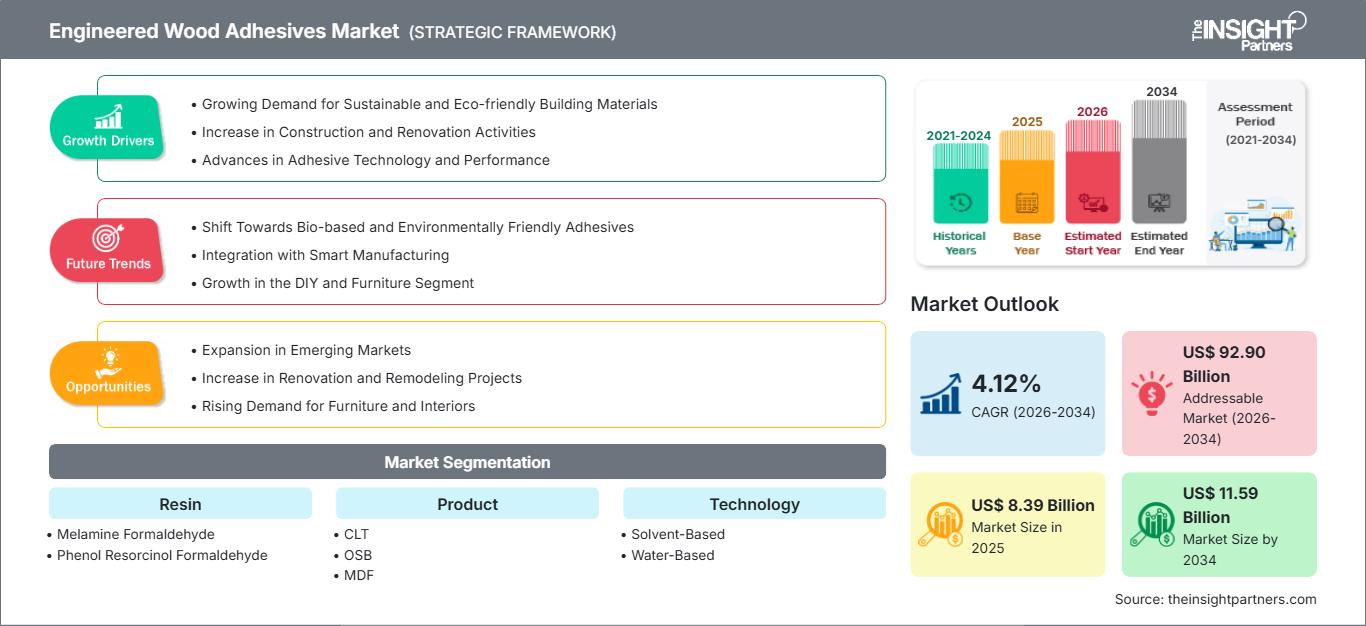
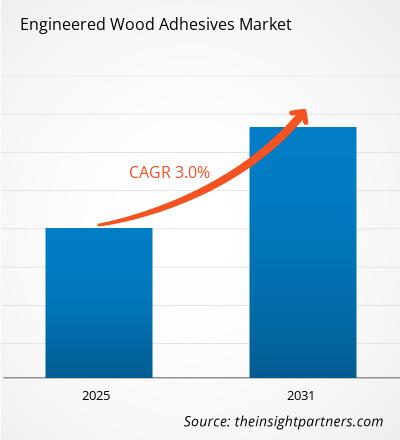
The Engineered Wood Adhesives market was valued at US$ 8.39 billion in 2025 and is expected to reach US$ 11.59 billion by 2034; it is estimated to record a CAGR of 3.66% during 2026-2034.
Engineered Wood Adhesives Market Assessment and Insights
- North America: North America is estimated to hold a 31–35% share in 2025 and grow at a CAGR of 4.0–4.6% between 2026–2034, supported by mass-timber construction, panel manufacturing, remodeling, and demand for high-performance structural bonding.
- US: The US is estimated to represent 82–86% of North America’s 2025 value and grow at a CAGR of 3.9–4.5% between 2026–2034, driven by CLT, OSB, MDF, and prefabricated construction.
- Europe: Europe is estimated to hold a 27–31% share in 2025 and grow at a CAGR of 3.8–4.4% between 2026–2034, led by Germany, the UK, France, Italy, and Spain through timber construction and panel manufacturing.
- Asia Pacific: Asia Pacific is estimated to account for a 29–33% share in 2025 and register a CAGR of 4.7–5.3% between 2026–2034, led by China, Japan, India, South Korea, and Australia.
- Largest Segment: MDF is estimated to hold a 28–32% market share in 2025 and grow at a CAGR of 3.9–4.4% between 2026–2034, supported by furniture and interior applications.
- High Growth Segment: CLT is estimated to hold a 10–14% market share in 2025 and expand at a CAGR of 5.5–6.3% between 2026–2034, supported by mass-timber construction.
- Key companies analyzed in detail: AICA Kogyo Co., Ltd., Akzo Nobel N.V., Arkema S.A., Astral Limited, BASF SE, Dow Inc., H.B. Fuller Company, Henkel AG & Co. KGaA, Hexion Inc., Huntsman Corporation.
Source: The Insight Partners' analysis based on proprietary research, government publications, company annual reports, investor presentations, industry databases, and expert interviews.
Engineered Wood Adhesives Market has evolved from conventional bonding systems toward formulations engineered for higher productivity, improved moisture resistance, lower emissions, fire performance, and compatibility with automated panel production. The adhesive history of AICA Kogyo dates back to the production of the first urea resin adhesive in Japan in 1936. At the moment, AICA Kogyo produces resins for composite boards, which are used for bonding wood chips and fibers together.
It is anticipated that the future will favor suppliers who will be able to demonstrate the combination of both structural properties and environmentality. Biodegradable polyurethane systems, clear environmental statements, lower emissions of formaldehyde, and fire-proof adhesives have become essential purchase factors. Henkel's engineered wood products include biodegradable PUR products and fire performance adhesives.
Engineered Wood Adhesives Market Report Scope
| Report Attribute | Details |
|---|---|
| Market size in 2025 | US$ 8.39 Billion |
| Market Size by 2034 | US$ 11.59 Billion |
| Global CAGR (2026 - 2034) | 3.66% |
| Historical Data | 2021-2024 |
| Forecast period | 2026-2034 |
Engineered Wood Adhesives Market Analysis
The Engineered Wood Adhesives Market growth is supported by the conversion of lower-value timber, fibers, flakes, and strands into standardized panels and structural components. The value chain starts with the resin and feedstock stage, formulation, adhesive production, panel manufacturing, pressing, finishing, distribution, and finally, the construction. Adhesive manufacturers need to consider issues like bond strength, curing time, viscosity, moisture resistance, emissions and application cost. According to H.B. Fuller, engineered wood adhesives play a critical role in the strength and durability of MDF, flooring, panels, laminating, and other similar products.
Supply issues vary according to the chemistry and applications. The formaldehyde-based adhesives continue to be important due to their cost advantages and proven processing attributes in composite panels, whereas structural wood products are increasingly tolerant of polyurethane and other specialized adhesives. Manufacturing economics depend on resin supply, energy costs, press cycle efficiencies, spreading rates, and yields. Technical laboratories that offer application support services may have an advantage in influencing product qualification and process optimization, especially in structural products.
Competition in the Engineered Wood Adhesives Market combines diversified chemical companies with specialists serving wood-processing customers. Henkel emphasizes PUR systems for CLT and glulam, while Hexion supplies adhesive technologies serving structural wood applications. AICA maintains industrial resins for plywood and laminated lumber and composite-board resins for wood fibers and chips. These capabilities indicate competition across chemistry, processing efficiency, certification, technical support, and geographic availability.
Strategic positioning increasingly centers on sustainability and regulatory readiness. Henkel introduced the Loctite HB XE line for CLT and glulam with stronger fire-performance characteristics, while its later environmental-product-declaration program expanded transparent sustainability documentation for engineered-wood adhesives. Such developments raise the importance of verified environmental information alongside technical performance, especially among architects, developers, timber manufacturers, and construction-specification teams.
● REPORT CUSTOMIZATION
Tailor This Report To Align With Your Specific Business Requirements
This report can be customized to align precisely with your business objectives, scope, and target markets. Customization options include tailored segmentation, geography, competitive analysis, and strategic insights to support informed decision-making.
Customize This Report →WHAT YOU CAN ADJUST
- ● Segmentations
- ● Geography
- ● Competitive Analysis
- ● Language Preferences
Engineered Wood Adhesives Market: Strategic Insights
Regional Insights
North America Engineered Wood Adhesives Market
North America is estimated to hold a 31–35% Engineered Wood Adhesives Market share in 2025 and grow at a CAGR of 4.0–4.6% between 2026–2034. The US dominates regional consumption, supported by OSB and MDF production, residential construction, remodeling, and increasing interest in mass timber. CLT adoption is creating an additional structural-adhesive opportunity as developers and architects pursue prefabricated timber systems.
Canada contributes through engineered wood manufacturing, residential construction, and mass-timber projects. Regional manufacturers increasingly require adhesives capable of maintaining bond integrity under moisture, temperature, and fire exposure. Henkel states that its structural wood adhesives support CLT and glulam manufacturing, including fire-resistant applications. The region’s established wood-products industry, strong construction base, and growing preference for prefabrication should sustain demand through 2034.
U.S. Engineered Wood Adhesives Market
The US is estimated to account for 82–86% of North America's 2025 value and grow at a CAGR of 3.9–4.5% between 2026–2034. Demand is supported by OSB, MDF, LVL, CLT, and other engineered timber applications across residential and commercial construction.
The country benefits from established production infrastructure and broad supplier participation. Structural timber construction creates demand for high-strength adhesives, while panel production emphasizes throughput, controlled curing, and cost efficiency. H.B. Fuller, Hexion, Dow, BASF, Henkel, and Huntsman serve overlapping wood and adhesive value chains, while specialized suppliers compete through formulation performance and technical service. The US also provides a strong platform for developing lower-emission and bio-based adhesive systems. The Engineered Wood Adhesives Market report examines these competitive dynamics, innovation trends, and sustainability-focused developments shaping industry growth.
Europe Engineered Wood Adhesives Market
Europe is estimated to hold a 27–31% share in 2025 and grow at a CAGR of 3.8–4.4% between 2026–2034. Germany is a leading market because of its advanced woodworking industry, construction base, and adoption of timber-based building systems. The UK, France, Italy, and Spain provide additional demand through furniture, flooring, panels, renovation, and structural timber applications. The Engineered Wood Adhesives Market forecast reflects sustained demand driven by timber construction growth, renovation activity, and continued innovation in wood-bonding technologies.
The UK has a growing interest in timber construction and prefabricated building components, creating opportunities for structural adhesives that satisfy safety and sustainability requirements. Germany remains important for CLT, glulam, MDF, and other engineered wood manufacturing. France, Italy, and Spain combine furniture and interior manufacturing with construction demand, supporting water-based and structural adhesive technologies. Henkel's Loctite HB XE line specifically targets European CLT and glulam manufacturers facing stringent fire requirements.
APAC Engineered Wood Adhesives Market
APAC is estimated to account for a 29–33% share in 2025 and grow at a CAGR of 4.7–5.3% between 2026–2034. China is the leading market, supported by large-scale panel manufacturing and furniture production. Japan contributes through advanced wood processing and adhesive technology, while India benefits from construction, furniture, and engineered-panel demand. These developments are shaping key Engineered Wood Adhesives Market trends, including increased adoption of engineered wood products, advanced adhesive formulations, and sustainable bonding solutions.
South Korea and Australia add demand through construction and wood-product manufacturing. Regional producers increasingly evaluate lower-emission formulations and improved processing efficiency. AICA's composite-board resin activities illustrate the importance of adhesive technologies for wood chips and fibers in engineered panel production.
Middle East & Africa Engineered Wood Adhesives Market
The Middle East & Africa is expected to expand at a CAGR of 3.5–4.2% between 2026–2034, with Saudi Arabia leading regional growth through construction and infrastructure investment. UAE demand is supported by commercial, hospitality, and residential development, while South Africa maintains established woodworking and panel applications in the Engineered Wood Adhesives Market.
The Rest of MEA remains comparatively dependent on imported engineered wood products and adhesive technologies. Growth is therefore linked to construction activity, furniture manufacturing, renovation, and the expansion of modern building systems. Increasing infrastructure investment and diversification away from resource-dependent economies can support the gradual adoption of engineered wood and associated bonding technologies.
Segmentation Analysis
Resin
Resin defines the adhesive chemistry used to manufacture and assemble engineered wood products. The segment is projected to grow at a CAGR of 3.9–4.5% during 2026–2034, with melamine formaldehyde and phenol resorcinol formaldehyde serving different performance requirements. Resin selection depends on structural load, moisture exposure, curing conditions, emissions requirements, and manufacturing economics in the Engineered Wood Adhesives Market.
- Melamine Formaldehyde: Melamine formaldehyde supports engineered panels requiring strong bonds, dimensional stability, and controlled processing. Its established production infrastructure makes it important for high-volume wood-panel manufacturing and furniture-related applications.
- Phenol Resorcinol Formaldehyde: Phenol resorcinol formaldehyde is positioned toward demanding structural applications requiring high durability and resistance to moisture and environmental exposure. Its performance characteristics support load-bearing timber and specialized laminated products.
Product
Product represents the major engineered wood formats consuming adhesive systems and is projected to grow at a CAGR of 4.0–4.7% during 2026–2034. Demand varies according to construction activity, furniture production, panel manufacturing, and structural timber adoption. The product mix determines adhesive requirements for pressing, curing, moisture resistance, and structural performance in the Engineered Wood Adhesives Market.
- CLT: CLT requires reliable structural bonding between orthogonally arranged timber layers. Increasing prefabrication and mass-timber construction support demand for adhesives with high bond integrity, fire performance, and efficient curing.
- OSB: OSB production uses adhesives to consolidate oriented wood strands into structural panels. Demand is closely associated with residential construction, roofing, flooring, and wall systems, where dimensional stability and mechanical strength are essential.
- MDF: MDF uses adhesive systems to bind refined wood fibers into uniform boards. Its broad use in furniture, cabinetry, doors, and interior components supports substantial adhesive consumption and emphasizes consistent pressing and surface quality.
- LVL: LVL requires adhesives capable of creating strong, durable bonds across aligned veneer layers. Its use in beams, headers, and structural components supports demand for high-performance bonding systems with dependable load-bearing characteristics.
Technology
Technology comprises Solvent-Based and Water-Based systems and is projected to grow at a CAGR of 3.8–4.4% during 2026–2034. Technology selection reflects application requirements, production equipment, environmental considerations, curing conditions, and desired emissions profile. Water-based systems can support lower-solvent processing, while solvent-based systems remain relevant in applications requiring specific performance characteristics in the Engineered Wood Adhesives Market.
- Solvent-Based: Solvent-based systems provide established bonding performance and can deliver controlled wetting and application characteristics. Their use is influenced by substrate compatibility, production requirements, environmental controls, and plant configuration.
- Water-Based: Water-based adhesives are increasingly important where manufacturers prioritize reduced solvent use, manageable processing, and environmental performance. They support multiple engineered wood applications, including lamination, flooring, veneering, and woodwork.
Application
Application covers Structural and Non-Structural uses and is projected to grow at a CAGR of 4.1–4.8% during 2026–2034. Structural applications demand higher bond reliability, certification, durability, and fire performance, whereas non-structural applications emphasize processing efficiency, appearance, cost, and surface quality in the Engineered Wood Adhesives Market.
- Structural: Structural applications include CLT, LVL, glulam-related components, and load-bearing panels. Adhesives must provide dependable long-term strength, moisture resistance, controlled curing, and compliance with structural standards.
- Non-Structural: Non-structural applications include furniture, cabinetry, flooring, interior panels, and decorative components. Buyers typically prioritize production speed, appearance, substrate compatibility, moisture resistance, and cost-effective adhesive application.
Opportunity Snapshot
| Application | Revenue Contribution | Trend Tag | Adoption Stage |
|---|---|---|---|
| Structural | High | Mass Timber | Scaling |
| Non-Structural | Medium | Furniture Panels | Mature |
Engineered Wood Adhesives Market Growth Drivers and Impact Analysis
Expansion of Mass Timber and Prefabricated Construction
The mass timber building technique has created a high-value business opportunity for the structural adhesives suppliers since they need reliable bonding of the timber layers in CLT and other products. Prefabrication of such structures has increased the need for precise application of the adhesives, their fast curing process, press efficiency and quality control. Henkel observes that CLT allows for quicker assembly and a more uniform construction process on-site, and the structural PUR adhesives from Henkel have been employed in CLT and glulam by the leading manufacturers. However, such a business opportunity is not simply driven by the volume of the adhesives but rather by technical differences in those systems that can cope with all necessary requirements related to the fire resistance, moisture and others.
Rising Demand for Efficient Composite Wood Manufacturing
Engineered panels like MDF and OSB enable manufacturers to create standardized products by using wood fibers, flakes, and strands. The resins act as the key ingredients during the process and impact the press time, board strength, dimensional stability, quality of surface finish, and production efficiency. Industrial resin range from AICA offers products which are used for board making from wood chips and wood fibers, showing the importance of resins in the manufacture of composite boards. Increase in the manufacture of furniture, construction of homes, cabinetry, flooring, and interiors helps in the continuous demand for resins despite changes in the construction of structural timber.
Stricter Emissions and Sustainability Requirements
Environmental needs have brought about new priorities in the formulation of adhesives used in engineered wood production. Consumers are now factoring in the amount of formaldehyde emission, the degree of renewability, carbon footprint, the level of use of solvents, and environmental documentation, besides the ability of an adhesive to bond well. Henkel has come up with bio-based PUR technology that shows the direction in which the industry is moving. The firm has reported that its ECO products release 60 percent less CO2 than the fossil-based options. The firm has also gone ahead to increase the environmental declarations among its range of construction adhesives, including engineered wood products.
Engineered Wood Adhesives Market Future Trends
Bio-Based and Lower-Carbon Adhesive Systems
It is anticipated that the concept of sustainability will evolve from being a product differentiation factor to becoming a criterion for purchase decision-making when it comes to wood adhesives. There will be an increased use of bio-feedstock sources, mass balance systems, renewable carbon, and verified environmental claims. Henkel’s LOCTITE HB SECO and CR 821 ECO are examples of how bio-feedstock sources can be used while still maintaining compatibility with current production processes. The systems of the future will be assessed based on carbon footprints, traceability, emission rates, and lifecycle assessment. This will compel resin makers to acquire certified renewable feedstock sources and come up with formulations which will not affect the environment yet at the same time have no impact on curing characteristics, bond strength, or manufacturing throughput.
Fire-Resistant Adhesives for Larger Timber Structures
Fire-resistance properties will be required to assume ever-growing significance in the context of applying engineered timber in large and complicated structures. Adhesive technology needs to maintain bonding strength during high temperatures while meeting certification standards and an effective manufacturing process. Loctite HB XE range by Henkel was developed specifically for CLT and glulam products, focusing on their fire-resistive qualities, environmental friendliness, decreased manufacturing time, and compatibility with the current manufacturing process. The future developments in adhesive technology can combine fire-resistant formula, fast curing process, lightweight application, and a positive impact on the environment. With evolving standards for timber construction, suppliers will have to prove the quality of their product via tests and certifications. This tendency can create technical obstacles to entering the market and favor suppliers with expertise in formulations and the testing process.
Engineered Wood Adhesives Market Opportunities
Regional Production of Structural Timber Adhesives
Expanding CLT, glulam, and LVL production in areas beyond the known markets in Europe and North America would provide an opportunity for localized adhesive production. The potential in the Asia Pacific region – including China, Japan, India, and Australia – lies in urban construction projects, prefabrication, and the modernization of wood processing plants. Local production or technical centers will minimize lead time, aid in the customer qualification process, and develop adhesive recipes that are suitable for the local timber types. Application laboratories can be set up by adhesive suppliers in close proximity to the developing timber regions to assist manufacturers in optimizing the adhesive application rates, pressing cycle, moisture content, and curing processes.
Digital Quality Monitoring and Process Optimization
Digitalization provides an emerging opportunity to improve adhesive utilization and quality assurance in engineered wood manufacturing. Sensors and production-data systems can monitor application weight, temperature, pressure, moisture, curing conditions, and bond-line consistency. These capabilities can reduce adhesive waste, identify process deviations earlier, and improve traceability for structural products. Henkel has highlighted the potential for sensors to monitor bonding processes and optimize production output, as well as future possibilities for monitoring the condition of timber components. Adhesive suppliers can participate by integrating application equipment, formulation expertise, digital monitoring, and technical service into broader production solutions. This could shift competition from selling resin alone toward supporting measurable manufacturing performance, quality control, and lifecycle efficiency.
Recent Developments
- May 2025: Henkel AG & Co. KGaA showcased its latest wood-adhesive technologies at LIGNA 2025, including new TECHNOMELT MicroEmission (ME) hot-melt adhesives for edge banding and other woodworking applications. The ME products contain less than 0.1% monomeric isocyanate, helping improve workplace safety and meet REACH requirements. Henkel also introduced an ME adhesive in granulate form to simplify machine handling and highlighted the development of ME products incorporating renewable carbon. The company additionally presented bio-based Loctite HB S ECO and Loctite CR821 ECO adhesives for engineered wood, reinforcing its focus on lower-emission and resource-efficient bonding solutions.
- February 2025: BioBond Adhesives, Inc. launched its BioAdhere line of bio-based adhesives for cabinetry, furniture, wallpaper, and engineered wood applications. The plant-based adhesives are USDA BioPreferred certified, contain zero microplastics, and are designed to provide no odor while maintaining performance and cost competitiveness with conventional solvent-based adhesives. The company introduced BioAdhere SUP250 for engineered wood applications, including applications requiring no priming and no solvent odors. The launch highlights the growing shift toward bio-based, safer, and lower-impact adhesive technologies in engineered wood manufacturing.
Frequently Asked Questions

- Comprehensive Market Sizing and Forecast Analysis
- Detailed Segmentation Analysis
- In-Depth Market Dynamics Assessment
- Regional and Country-Level Insights
- Competitive Landscape and Company Benchmarking
- Strategic Business Intelligence
Recent Reports
Testimonials

The Insight Partners provided valuable market intelligence that supported our global go-to-market strategy. Their team was professional, responsive, and attentive to our feedback, providing thoughtful analysis and helpful methodological clarifications throughout the project.
Junmo Kim Chief Financial Officer (CFO), Enertech Co., Ltd.
The Insight Partners' SCADA System Market report is comprehensive, with valuable insights on current trends and future forecasts. The team was highly professional, responsive, and supportive throughout. We are very satisfied and highly recommend their services.
RAN KEDEM Partner, Reali Technologies LTDs
I requested a report on a very specific software market and the team produced the report in a few days. The information was very relevant and well presented. I then requested some changes and additions to the report. The team was again very responsive and I got the final report in less than a week.
JEAN-HERVE JENN Chairman, Future Analytica
We worked with The Insight Partners for an important market study and forecast. They gave us clear insights into opportunities and risks, which helped shape our plans. Their research was easy to use and based on solid data. It helped us make smart, confident decisions. We highly recommend them.
PIYUSH NAGPAL Sr. Vice President, High Beam Global
The Insight Partners delivered insightful, well-structured market research with strong domain expertise. Their team was professional and responsive throughout. The user-friendly website made accessing industry reports seamless. We highly recommend them for reliable, high-quality research services
YUKIHIKO ADACHI CEO, Deep Blue, LLC.
This is the first time I have purchased a market report from The Insight Partners.While I was unsure at first, I visited their web site and felt more comfortable to take the risk and purchase a market report.I am completely satisfied with the quality of the report and customer service. I had several questions and comments with the initial report, but after a couple of dialogs over email with their analyst I believe I have a report that I can use as input to our strategic planning process.Thank you so much for taking the extra time and making this a positive experience.I will definitely recommend your service to others and you will be my first call when we need further market data.
JOHN SUZUKI President and Chief Executive Officer, Board Director, BK Technologies
I wish to appreciate your support and the professionalism you displayed in the course of attending to my request for information regarding to infectious disease IVD market in Nigeria. I appreciate your patience, your guidance, and the fact that you were willing to offer a discount, which eventually made it possible for us to close a deal. I look forward to engaging The Insight Partners in the future, all thanks to the impression you have created in me as a result of this first encounter.
DR CHIJIOKE ONYIA MANAGING DIRECTOR, PineCrest Healthcare Ltd.Reason to Buy
- Informed Decision-Making
- Understanding Market Dynamics
- Competitive Analysis
- Identifying Emerging Markets
- Customer Insights
- Market Forecasts
- Risk Mitigation
- Boosting Operational Efficiency
- Strategic Planning
- Investment Justification
- Tracking Industry Innovations
- Aligning with Regulatory Trends





 Get Free Sample for