
Epoxy Adhesives Market Size, Share & Demand by 2034
Coverage: by Product Type (One- Component, Two- Component); End Use Industry (Aerospace and Defence, Automotive, Marine, Electrical and Electronics, Construction, Energy and Power, Others) , and Geography (North America, Europe, Asia Pacific, and South and Central America)
- Status : Data Released
- Report Code : TIPRE00005846
- Category : Chemicals and Materials
- No. of Pages : 150
- Available Report Formats :


- Last update date : August 27, 2026


2025 Market Size
US$ 9.67 Bn
Base year value
2034 Forecast
US$ 16.81 Bn
Projected by 2034
CAGR 2026-2034
6.34 %
Growth rate
Addressable Market
US$ 119.84 Bn
(2026-2034)
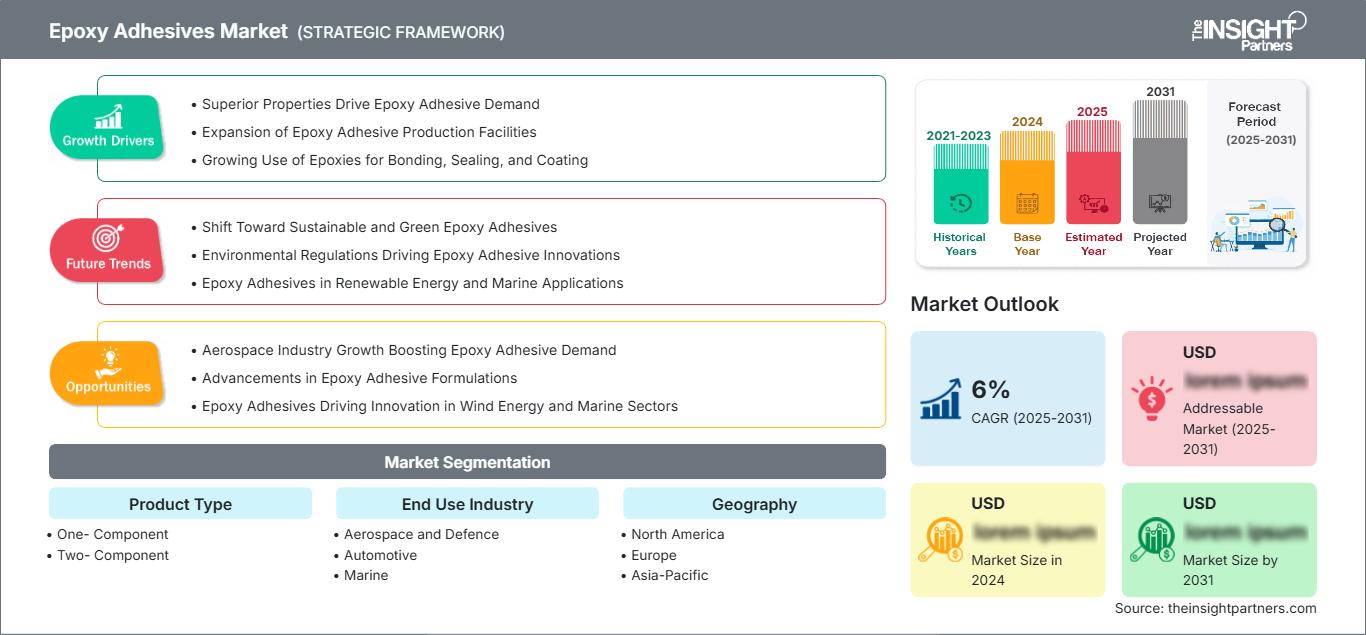
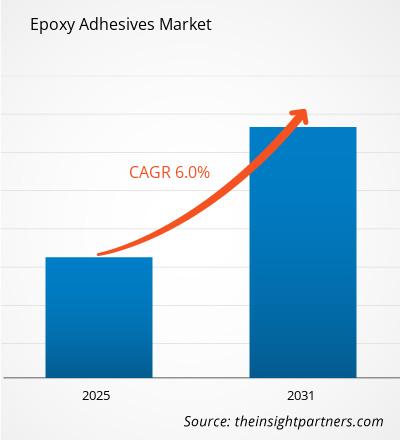
The Epoxy Adhesives Market was valued at US$ 9.67 Billion in 2025 and is projected to reach US$ 16.81 Billion by 2034, expanding at a CAGR of 6.34% during 2026–2034. The market is shaped by demand for durable structural bonding, lightweight assembly, electrical insulation, and high-performance joining across transportation, construction, electronics, marine, aerospace, and energy applications, where reliability and process efficiency remain critical.
North America is expected to register a CAGR of 5.8–6.4% through 2034. Mature aerospace and automotive manufacturing, expanding electric vehicle supply chains, and refurbishment of industrial infrastructure support recurring demand. The Epoxy Adhesives Market size is also influenced by higher adoption of automated dispensing, engineered composites, and low-emission formulations that improve assembly consistency while reducing dependence on mechanical fastening.
Epoxy Adhesives Market Assessment and Insights
- North America: The region is estimated to hold a 26–29% Epoxy Adhesives Market share in 2025 and expand at a CAGR of 5.8–6.4% between 2026–2034, supported by aerospace, automotive, electronics, infrastructure, and industrial maintenance requirements.
- US: The US represents about 77–81% of North American demand in 2025 and is projected to grow at a CAGR of 5.7–6.3%, led by aerospace, defense, automotive, and electronics production.
- Europe: Europe accounts for a 22–25% share in 2025 and is expected to grow at a CAGR of 5.5–6.1%, with Germany, France, Italy, and the UK supporting automotive, aerospace, wind energy, and advanced manufacturing applications.
- Asia Pacific: Asia Pacific represents a 37–41% share in 2025 and is projected to grow at a CAGR of 6.8–7.5%, led by China, Japan, South Korea, and India through electronics, automotive, construction, and renewable-energy manufacturing.
- Largest Segment: Two- Component holds an estimated 58–62% market share in 2025 and is expected to advance at a CAGR of 6.1–6.7%, reflecting broad industrial versatility.
- High Growth Segment: Energy and Power represents an estimated 8–11% share in 2025 and is expected to expand at a CAGR of 7.0–7.8%, supported by grid and renewable-energy equipment.
- Key companies analyzed in detail: 3M Company, Alfa International Corporation, Arkema S.A., Ashland Inc., Henkel AG & Co. KGaA, Huntsman Corporation, LORD Corporation, Permabond LLC, Sika AG, and WEICON GmbH & Co. KG.
Source: The Insight Partners' analysis based on proprietary research, government publications, company annual reports, investor presentations, industry databases, and expert interviews.
The Epoxy Adhesives Market is shifting from rigid bonding systems to tougher, faster-setting, and application-specific systems. One-part epoxy systems are focusing more on automation using controlled heat setting, whereas two-part epoxy systems are focusing on flexible room temperature setting. Improved impact resistance, thermal resistance, moisture resistance, and adhesion to dissimilar substrates are some of the properties that formulators are working on. Such improvements are expected to help in substituting welding, riveting, screwing and other mechanical fastening technologies due to their ability to improve economic value in products based on weight and design freedom.
Future growth is expected to tilt towards those players who can offer performance along with ease of processing and reduced environmental footprint. The future market demand will be for those formulations that have potential in robotics, dispensing technology, composite bonding, battery assembly and repair applications. The growing regulation for workers safety and emissions control will lead to development of lower odor, solvent-free systems, and investment in infrastructure is expected to help the construction and energy segments.
Epoxy Adhesives Market Report Scope
| Report Attribute | Details |
|---|---|
| Market size in 2025 | US$ 9.67 Billion |
| Market Size by 2034 | US$ 16.81 Billion |
| Global CAGR (2026 - 2034) | 6.34% |
| Historical Data | 2021-2024 |
| Forecast period | 2026-2034 |
Epoxy Adhesives Market Analysis
Growth in demand is directly related to lightweighting, electrification, use of composites, and reliable bonding of metal, plastic, ceramic, and fiber-reinforced components. The Epoxy Adhesives Market growth is driven by the network of players ranging from epoxy resin and hardener producers to formulation companies, equipment makers, distributors, OEMs, contract manufacturers, and maintenance providers. Value of products becomes increasingly dependent on cure schedule, bond strength, temperature resistance, viscosity, stability, and suitability for automated dispensing.
In addition, product developers need to optimize balance between performance and process efficiency. Factories of automotive and electronic goods more and more appreciate repeatable metering and dispensing capabilities, while construction and maintenance companies tend to look for room temperature curing ability and tolerance to site conditions variability. Aerospace and defense customers usually give preference to qualification, traceability, and durability rather than the lowest material cost.
Competition is diverse among global chemicals, adhesive specialty firms, and regional formulators. Competitors include 3M Company, Henkel AG & Co. KGaA, Sika AG, Arkema S.A., Huntsman Corporation, and Ashland Inc., all of which offer competition by virtue of their comprehensive formulation range and application engineering skills. Permabond LLC, WEICON GmbH & Co. KG, Alfa International Corporation, and LORD Corporation offer specialized systems and technical customization, thereby intensifying competition. Hence, the Epoxy Adhesives Market analysis revolves around formulation range, qualification capabilities, distribution network, and product development speed as opposed to capacity alone.
The Epoxy Adhesives Market trends indicate that investment is increasingly focused on lower temperature cure, toughened resins, automated dispensing compatibility, and electrified transportation. Regional manufacturing and technical services are also critical for strategic positioning because qualification cycles can be long. OEMs and component manufacturers' partnerships are key to gaining design-in positions even before production starts at scale. Firms with unique chemistry and application engineering have an easier time defending margins in aerospace, electronics, energy, and advanced mobility applications.
● REPORT CUSTOMIZATION
Tailor This Report To Align With Your Specific Business Requirements
This report can be customized to align precisely with your business objectives, scope, and target markets. Customization options include tailored segmentation, geography, competitive analysis, and strategic insights to support informed decision-making.
Customize This Report →WHAT YOU CAN ADJUST
- ● Segmentations
- ● Geography
- ● Competitive Analysis
- ● Language Preferences
Epoxy Adhesives Market: Strategic Insights
Regional Insights
North America Epoxy Adhesives Market
North America is estimated at 26–29% of global demand in 2025, with a regional CAGR of 5.8–6.4% through 2034. The USA continues to be the key demand market, with aerospace fabrication, defense acquisitions, automotive production, electronics, construction, and industrial machinery. Canada provides additional demand from transport, energy, construction, and resource processing machinery. Stringent qualification criteria make well-established companies with their labs, experience in formulation, and customer service more advantageous.
Increasing use of adhesive bonding due to automotive lightweighting creates growing demand for structural adhesives, while aerospace production requires adhesives capable of retaining their mechanical properties in fluctuating temperatures, vibration and chemical environments. Additional demand comes from electronics production where dielectric and heat-resistant adhesives are used. Investments in manufacturing and energy infrastructure in the region create additional advantages for suppliers. Thus, suppliers increasingly develop their products in relation to automation of dispensing, fast cure and process control.
U.S. Epoxy Adhesives Market
The US represents approximately 77–81% of North American Epoxy Adhesives Market in 2025 and is expected to grow at a CAGR of 5.7–6.3%. Some of the key application areas include aerospace, defense, automotive, semiconductor equipment, electrical systems, and construction sectors. There is the presence of companies like 3M Company, Henkel AG & Co. KGaA, LORD Corporation, Huntsman Corporation, and Permabond LLC to help facilitate this.
The trend in the application area is towards lightweight vehicles, composites, batteries, and electronics. The trend in aerospace sector applications is a key demand generator as it influences adhesive performance for both structure and maintenance purposes. The industrial sector is also seeking adhesives that have long working time, low viscosity, and reliable curing.
Europe Epoxy Adhesives Market
Europe holds an estimated 22–25% Epoxy Adhesives Market in 2025 and is projected to grow at a CAGR of 5.5–6.1%. Germany dominates regional demand in automotive engineering, industrial machinery, electronics, and renewable energy equipment. The UK plays an important role in aerospace, defense, marine, and advanced manufacturing, and France provides aerospace and transportation demand. Italy and Spain offer construction, automotive parts, industrial equipment, and renewable energy demand.
Germany stays at the top because of its manufacturing needs, which involve the use of durable adhesives for car construction, machinery and equipment, electrical equipment and composites. Aerospace products from France have good relevance. The UK provides aerospace, marine and defense applications. Construction, manufacturing, transportation equipment and energy production are offered by Italy and Spain. European customers give preference to sustainable low-emission products, worker safety and repairability, and efficient processes.
APAC Epoxy Adhesives Market
APAC is estimated to hold 37–41% of global Epoxy Adhesives Market in 2025 and is expected to grow at a CAGR of 6.8–7.5%. China leads, followed by Japan, South Korea, India, and Australia. Electronics manufacturing, automotive production, construction, batteries, renewable-energy equipment, and industrial machinery provide a broad application base.
Growth at the regional level is enabled by the localization of manufacturing, investment in infrastructure, as well as development of electric mobility and electronics chains. Scale is an advantage for China, while Japan and South Korea focus on electronics of precision as well as automobile applications. India is growing fast in the fields of construction, automobiles, as well as industrial manufacturing, and Australia participates via its investments in infrastructure and energy.
Middle East & Africa Epoxy Adhesives Market
Middle East and Africa demand is smaller but increasingly diversified, with a projected CAGR of 4.9–5.6%. The driving force in the region comes from Saudi Arabia's initiatives to diversify its industry and build infrastructure, while the UAE promotes investments in building, transportation, and energy projects. The contribution of South Africa lies in mining, industrial machinery, construction, and assembly of automobiles. Demand from the rest of MEA is related to infrastructure, maintenance, and energy projects.
Development of energy projects and infrastructure provides possibilities for using adhesives in the assembly of equipment, protective coatings, maintenance and composites. Operating conditions in the region make chemical resistance, heat resistance, moisture resistance and durability very important. Adhesive suppliers with regional distributors and technical assistance can benefit from project-related demand. Growth will be application-driven, industrial maintenance and energy equipment projects will be more reliable opportunities than residential building.
Segmentation Analysis
Product Type
Product Type is divided into One- Component and Two- Component systems. The segment is projected to expand at a CAGR of 6.0–6.7% from 2026–2034. Selection depends on cure requirements, equipment, production speed, working life, substrate configuration, and whether mixing is practical. One-component systems suit controlled factory environments, while two-component products remain versatile across industrial, construction, and maintenance applications.
- One- Component: These systems are pre-formulated for controlled dispensing and typically cure through heat or other activation. Their metering simplicity supports automated manufacturing, electronics, automotive assemblies, and applications requiring consistent bond quality.
- Two- Component: Separate resin and curing components provide flexible cure profiles, including room-temperature processing. They are important for structural bonding, construction, marine repair, automotive assembly, and applications involving large or irregular components.
End Use Industry
End Use Industry includes Aerospace and Defence, Automotive, Marine, Electrical and Electronics, Construction, Energy and Power. This segment is expected to grow at a CAGR of 6.3–7.0% during 2026–2034. Demand is influenced by lightweighting, electrification, composite materials, infrastructure investment, and increasing reliance on adhesive joining where mechanical fastening is difficult or adds unnecessary weight.
- Aerospace and Defence: High-strength, fatigue-resistant bonding supports composites, interiors, structural components, and equipment where qualification, traceability, thermal stability, and durability are critical procurement requirements.
- Automotive: Epoxy systems enable lightweight mixed-material assemblies, battery components, structural bonding, and vibration management while reducing reliance on welding, rivets, and mechanical fasteners.
- Marine: Resistance to moisture, chemicals, vibration, and saltwater makes epoxy systems valuable for vessel construction, composite joining, repairs, and maintenance.
- Electrical and Electronics: High dielectric strength, thermal stability, and environmental protection support component bonding, encapsulation, magnet assembly, sensors, and electronic power systems.
- Construction: Structural anchoring, concrete bonding, flooring, repair, and composite reinforcement create demand for durable systems capable of reliable field application.
- Energy and Power: Wind equipment, electrical infrastructure, power electronics, transformers, and renewable-energy systems require adhesives that withstand thermal cycling, vibration, moisture, and demanding operating environments.
Opportunity Snapshot
| End Use Industry | Revenue Contribution | Trend Tag | Adoption Stage |
|---|---|---|---|
| Aerospace and Defence | Medium | Composite Bonding | Mature |
| Automotive | High | Lightweight Joining | Scaling |
| Marine | Medium | Composite Repair | Mature |
| Electrical and Electronics | High | Thermal Management | Scaling |
| Construction | High | Structural Anchoring | Mature |
| Energy and Power | Medium | Grid Hardware | Scaling |
Epoxy Adhesives Market Growth Drivers and Impact Analysis
Vehicle Lightweighting and Mixed-Material Assembly
Automotive manufacturers are combining aluminum, high-strength steel, plastics, and composites to reduce mass while maintaining crash performance and structural rigidity. Adhesive bonding allows dissimilar substrates to be joined without drilling or creating localized stress concentrations. The impact extends beyond vehicle body structures into battery enclosures, thermal systems, electric motors, sensors, and interior modules. Epoxy formulations with improved toughness and vibration resistance can support durability requirements while contributing to lower assembly weight. Automated dispensing also enables consistent bead placement and integration with high-volume production. As vehicle architectures become more electrically and electronically intensive, the adhesive becomes part of the functional assembly rather than simply a joining material. This increases formulation value and encourages suppliers to develop products around specific manufacturing processes.
Expansion of Electronics and Electrified Equipment
Electronics manufacturers require materials that protect components from vibration, humidity, thermal cycling, and electrical stress. Epoxy systems can provide structural bonding, encapsulation, insulation, and component reinforcement within compact assemblies. Electrification expands this requirement into batteries, power electronics, charging equipment, motors, sensors, and control modules. The resulting opportunity is significant because performance requirements are becoming more demanding while available assembly space is shrinking. Manufacturers increasingly value controlled viscosity, predictable cure, dielectric strength, thermal management, and compatibility with automated dispensing. Suppliers that can combine adhesive performance with thermal or electrical functionality can participate in higher-value applications. This driver also creates demand for customized formulations because component geometries, operating temperatures, and production cycles differ substantially among electronics manufacturers.
Infrastructure Renewal and Renewable-Energy Investment
Infrastructure rehabilitation and renewable-energy deployment create demand for adhesives capable of long service under moisture, vibration, temperature variation, and mechanical loading. Construction applications include anchoring, structural repair, concrete bonding, and reinforcement, while energy applications extend to wind turbines, electrical equipment, solar structures, and power systems. Epoxy adhesives can provide durable bonding where conventional mechanical methods are difficult, particularly for repair operations and composite components. Project owners increasingly assess lifetime performance rather than initial material price, creating room for higher-performance systems with documented durability. Renewable-energy assets also require maintenance strategies that minimize downtime. Suppliers that develop repair-friendly, fast-curing, and field-tolerant formulations can capture value from installed equipment, while established technical networks can support specification by contractors and engineering firms.
Epoxy Adhesives Market Future Trends
Lower-Temperature Cure and Energy-Efficient Processing
Formulators are likely to prioritize curing systems that achieve required mechanical performance at lower temperatures and within shorter process windows. This direction can reduce oven energy consumption, shorten assembly cycles, and broaden adhesive use across substrates that are sensitive to heat. Future systems may combine latent curing agents, accelerated chemistry, and controlled rheology to balance storage stability with rapid activation. Integration with induction, infrared, or localized heating could further improve process efficiency. For electronics and transportation manufacturers, lower cure temperatures may also reduce thermal distortion and simplify equipment requirements. Sustainability targets will reinforce this shift because manufacturers increasingly evaluate adhesive processes alongside broader factory energy consumption. The resulting competitive advantage will favor suppliers able to deliver validated performance without requiring major changes to existing production infrastructure.
Design-for-Disassembly and Circular Manufacturing
Future adhesive development will increasingly consider the complete product lifecycle rather than only initial bond strength. Manufacturers are exploring debonding approaches that enable repair, component replacement, material recovery, or safer end-of-life processing. For vehicles and electronics, controlled separation could reduce waste and improve recovery of valuable components without compromising durability during service. Formulators may therefore develop adhesives that respond to heat, electrical stimulus, chemical treatment, or other controlled triggers. This trend will not eliminate permanent structural bonding, but it can create differentiated product families for assemblies where circularity is economically relevant. Suppliers that collaborate with OEMs during product design can influence joint geometry, cure conditions, and recovery processes. Such early involvement may strengthen customer retention and create technical barriers to substitution.
Epoxy Adhesives Market Opportunities
Localization of High-Performance Formulation and Technical Service
The Epoxy Adhesives Market Forecasts point toward opportunities in regions where manufacturing capacity is expanding faster than local access to specialized adhesive engineering. Suppliers can invest in regional formulation, application laboratories, technical centers, and inventory hubs to shorten qualification and delivery cycles. India, Southeast Asia, Mexico, and selected Eastern European markets offer attractive platforms because automotive, electronics, renewable-energy, and industrial production are becoming more localized. Local technical support is especially valuable when customers need assistance with surface preparation, dispensing, cure optimization, or joint design. Companies can strengthen positions by combining standardized global formulations with regionally adapted packaging, viscosity, cure profiles, and service models. Such investments can reduce logistics exposure while improving responsiveness to OEM and tier-supplier development programs.
Specialized Adhesives for Batteries and Power Electronics
Battery packs and power electronics require combinations of structural integrity, electrical insulation, thermal control, vibration resistance, and environmental protection. This creates an opportunity for suppliers to develop multifunctional epoxy systems that consolidate bonding and protection functions. Products designed for battery module assembly, busbar insulation, power-device attachment, and electronic component reinforcement can command higher technical value than general-purpose formulations. Qualification requirements can also create longer customer relationships because materials become embedded in production processes and product specifications. Companies should therefore prioritize partnerships with battery manufacturers, automotive suppliers, inverter producers, and power-equipment companies during early design stages. Formulation platforms that offer controlled flow, predictable cure, thermal conductivity, and dielectric performance can address several requirements simultaneously and support differentiation in rapidly expanding electrification value chains.
Recent Developments
- June 2025: Gurit launched its BondPro range of epoxy adhesives for high-performance structural bonding. The products provide strong adhesion to composites and other materials, controlled curing, gap-filling capability from 0.2 mm to 20 mm, and resistance to thermal and chemical conditions. The range targets automotive, transportation, construction, agriculture, and industrial applications, including load-bearing components and heavy equipment.
- September 2025: Huntsman launched a reformulated ARALDITE epoxy adhesive range designed without intentionally added BPA and substances classified as carcinogenic, mutagenic, or reprotoxic under EU CLP regulations. Initial products became available in Europe, with additional grades scheduled for October 2025. The company also introduced PCR plastic cartridges that can reduce CO₂ emissions by up to 36% compared with virgin-plastic cartridges.
Frequently Asked Questions

- Comprehensive Market Sizing and Forecast Analysis
- Detailed Segmentation Analysis
- In-Depth Market Dynamics Assessment
- Regional and Country-Level Insights
- Competitive Landscape and Company Benchmarking
- Strategic Business Intelligence
Recent Reports
Testimonials

The Insight Partners' SCADA System Market report is comprehensive, with valuable insights on current trends and future forecasts. The team was highly professional, responsive, and supportive throughout. We are very satisfied and highly recommend their services.
RAN KEDEM Partner, Reali Technologies LTDs
I requested a report on a very specific software market and the team produced the report in a few days. The information was very relevant and well presented. I then requested some changes and additions to the report. The team was again very responsive and I got the final report in less than a week.
JEAN-HERVE JENN Chairman, Future Analytica
We worked with The Insight Partners for an important market study and forecast. They gave us clear insights into opportunities and risks, which helped shape our plans. Their research was easy to use and based on solid data. It helped us make smart, confident decisions. We highly recommend them.
PIYUSH NAGPAL Sr. Vice President, High Beam Global
The Insight Partners delivered insightful, well-structured market research with strong domain expertise. Their team was professional and responsive throughout. The user-friendly website made accessing industry reports seamless. We highly recommend them for reliable, high-quality research services
YUKIHIKO ADACHI CEO, Deep Blue, LLC.
This is the first time I have purchased a market report from The Insight Partners.While I was unsure at first, I visited their web site and felt more comfortable to take the risk and purchase a market report.I am completely satisfied with the quality of the report and customer service. I had several questions and comments with the initial report, but after a couple of dialogs over email with their analyst I believe I have a report that I can use as input to our strategic planning process.Thank you so much for taking the extra time and making this a positive experience.I will definitely recommend your service to others and you will be my first call when we need further market data.
JOHN SUZUKI President and Chief Executive Officer, Board Director, BK Technologies
I wish to appreciate your support and the professionalism you displayed in the course of attending to my request for information regarding to infectious disease IVD market in Nigeria. I appreciate your patience, your guidance, and the fact that you were willing to offer a discount, which eventually made it possible for us to close a deal. I look forward to engaging The Insight Partners in the future, all thanks to the impression you have created in me as a result of this first encounter.
DR CHIJIOKE ONYIA MANAGING DIRECTOR, PineCrest Healthcare Ltd.Reason to Buy
- Informed Decision-Making
- Understanding Market Dynamics
- Competitive Analysis
- Identifying Emerging Markets
- Customer Insights
- Market Forecasts
- Risk Mitigation
- Boosting Operational Efficiency
- Strategic Planning
- Investment Justification
- Tracking Industry Innovations
- Aligning with Regulatory Trends





 Get Free Sample for