
Ethyl Acetate Market Growth, Trends & Demand by 2034
Coverage: by Application (Adhesives and Sealants, Paints and Coatings, Pigments, Process Solvents, Intermediates, Others); End-User Industry (Food and Beverage, Pharmaceuticals, Automotive, Artificial Leather, Packaging, Others) , and Geography (North America, Europe, Asia Pacific, and South and Central America)
- Status : Data Released
- Report Code : TIPRE00009466
- Category : Chemicals and Materials
- No. of Pages : 150
- Available Report Formats :


- Last update date : September 01, 2026


2025 Market Size
US$ 4.90 Bn
Base year value
2034 Forecast
US$ 9.69 Bn
Projected by 2034
CAGR 2026-2034
7.87 %
Growth rate
Addressable Market
US$ 65.65 Bn
(2026-2034)
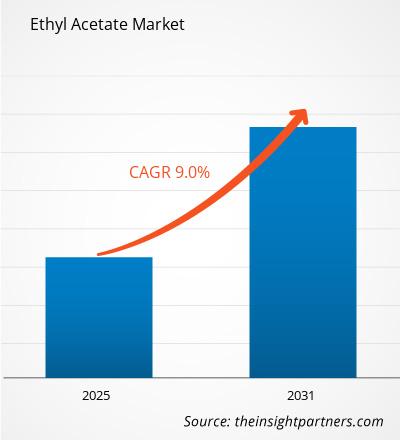
The Ethyl Acetate Market is projected to expand from US$ 4.90 Billion in 2025 to US$ 9.69 Billion by 2034, registering a CAGR of 7.87% during 2026–2034. The market has been driven by robust solvent demand in coatings, adhesives, packaging inks, pharmaceuticals, and food processing. Preference for solvent with quick evaporation properties and good handling is fostering substitution possibilities, whereas development in green production process is opening up alternative opportunities.
North America is projected to grow at a 5.8–6.8% CAGR till 2034, fueled by demand from coatings, pharmaceutical manufacturing, packaging, and specialty chemical industry. The Ethyl Acetate Market size in the regionhas a well-established chemical industry along with increasing demand for lower carbon solvent. Availability of bio-sourced ethanol is fueling investments towards renewable sources of production, whereas strict formulation standards have been boosting demand for high purity solvent.
Ethyl Acetate Market Assessment and Insights
- North America: North America is estimated to hold a 21–25% share in 2025 and grow at a 5.8–6.8% CAGR between 2026 and 2034, supported by coatings, packaging, pharmaceuticals, and emerging renewable-solvent investments.
- U.S.: The U.S. represents approximately 68–72% of North America's share in 2025 and is expected to expand at a 5.7–6.7% CAGR between 2026–2034, led by coatings, pharmaceutical, and packaging applications.
- Europe: Europe is estimated at a 19–23% share in 2025, with a 5.6–6.6% CAGR between 2026 and 2034. Germany, France, Italy, the UK, and Spain remain important consumers because of established coatings, packaging, pharmaceutical, and specialty chemical industries.
- Asia Pacific: Asia Pacific is estimated to command a 43–47% share in 2025 and grow at an 8.0–9.0% CAGR between 2026 and 2034. China, India, Japan, and South Korea benefit from expanding manufacturing, flexible packaging, coatings, and pharmaceutical production.
- Largest Segment: Process Solvents is estimated to represent a 34–38% market share in 2025, with a 7.3–8.0% CAGR during 2026–2034, reflecting its broad industrial utilization.
- High Growth Segment: Pharmaceuticals is estimated at a 9–12% market share in 2025, with an 8.4–9.1% CAGR during 2026–2034, supported by high-purity solvent requirements.
- Key companies analyzed in detail: Celanese Corporation, DAICEL CORPORATION, Eastman Chemical Company, INEOS AG, Jiangsu Sopo (Group) Co., Ltd., Jinyimeng Group Co., Ltd., Jubilant Pharmova Limited, KAI CO., LTD., Sasol Limited, and Solvay SA.
Source: The Insight Partners' analysis based on proprietary research, government publications, company annual reports, investor presentations, industry databases, and expert interviews.
The Ethyl Acetate market has grown from its status as a standard commodity solvent to that of a differentiated product segment in which purity, quality, feedstock sourcing, and application performance are key factors influencing purchase decisions. Producers are also focusing on developing high-purity grades for pharmaceutical, food, coatings, and specialty applications. Production is highly concentrated in Asia, while integrated producers control costs based on ethanol and acetic acid availability.
Going forward, industry growth will be driven by both capacity expansion and increased value through high-purity grades and bio-based sources. India and Southeast Asia are well positioned for investment due to the increasing demand for packaging, pharmaceuticals, and coatings. North American projects focus on using ethanol as a source, while demand in Europe is being driven more by substitution and environmental factors.
Ethyl Acetate Market Report Scope
| Report Attribute | Details |
|---|---|
| Market size in 2025 | US$ 4.90 Billion |
| Market Size by 2034 | US$ 9.69 Billion |
| Global CAGR (2026 - 2034) | 7.87% |
| Historical Data | 2021-2024 |
| Forecast period | 2026-2034 |
Ethyl Acetate Market Analysis
Prospects for Growth in the Ethyl Acetate market are highly dependent on coatings, printing inks, flexible packaging, adhesives, pharmaceuticals, and food industries. Its fast evaporation rate, ability to dissolve in solvents, and proven formulating performance allow it to be utilized in different value chains. The production process involves demand for ethanol and acetic acid or other chemical feedstock, then comes esterification, purification, storing, transport, and distribution. Manufacturers who have an integrated feedstock supply source can ensure stability of costs and supply chain.
Current market supply situation is affected by plant capacity utilization rates, prices for feedstock, regional freight charges, and plant operating rates. Asian companies have good manufacturing infrastructure especially Chinese and Indian companies; on the other hand, there are North American and European suppliers who work for customers that need reliable logistics and special grades of product. Economics of production can change rapidly with fluctuations in prices for ethanol or acetic acid.
Analysis of the Ethyl Acetate Market Report reveals a competitive market landscape that includes major chemical producers along with regional chemical producers competing on cost, location, purity, and application focus. Both Celanese Corporation and Eastman Chemical Company offer their own range of solvents, and DAICEL CORPORATION and INEOS AG are engaged in extensive chemical production. Jiangsu Sopo (Group) Co., Ltd. and Jinyimeng Group Co., Ltd. offer stronger presence in Asia owing to their integrated production economy.
Positioning is more and more oriented towards sustainability and grade specialization. Jubilant Pharmova Limited has its presence in the pharmaceutical and chemical sectors, while Sasol Limited and Solvay SA are involved due to their solvent and chemicals range. KAI CO., LTD. and regional Chinese chemical producers are competing owing to specialization and location. The focus of investments is now more on renewable feedstock, purification, energy, storage, and customer contracts.
● REPORT CUSTOMIZATION
Tailor This Report To Align With Your Specific Business Requirements
This report can be customized to align precisely with your business objectives, scope, and target markets. Customization options include tailored segmentation, geography, competitive analysis, and strategic insights to support informed decision-making.
Customize This Report →WHAT YOU CAN ADJUST
- ● Segmentations
- ● Geography
- ● Competitive Analysis
- ● Language Preferences
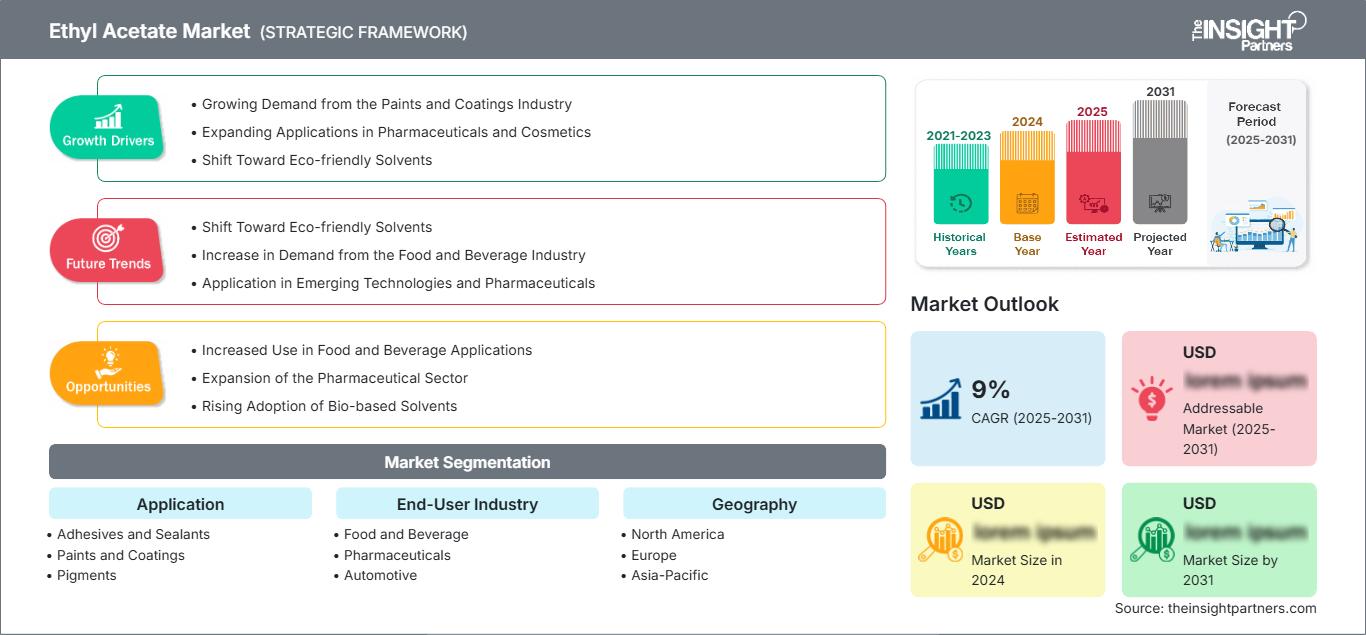
Ethyl Acetate Market: Strategic Insights
Regional Insights
North America Ethyl Acetate Market
It is expected that North America will have a Ethyl Acetate Market share of 21–25% until 2025 and will see growth of 5.8-6.8% CAGR up to 2034. Leading regional consumer of acetic acid is USA, due to usage in coatings, adhesives, pharmaceuticals, packaging, and specialty chemicals.
Regional acetic acid market is more and more driven by solvent reformulation programs and the development of renewable feedstock. Manufacturers of pharmaceuticals need controlled purity grades, while manufacturers of packaging materials and coatings need good evaporation properties. Presence of domestic sources of ethanol makes possible the production from biological raw material, though economic efficiency depends on many factors.
U.S. Ethyl Acetate Market
The U.S. accounts for approximately 68–72% of the North America Ethyl Acetate Market share in 2025 and is expected to grow at a 5.7–6.7% CAGR through 2034. Demand comes from coatings, printing inks, adhesives, pharmaceuticals, and packaging. Celanese Corporation and Eastman Chemical Company provide established supply capabilities and application-specific grades.
Strict requirements exist for pharmaceutical and food applications, while the industry stresses delivery performance and economical nature of the supply. Production is gradually becoming more important because of the presence of ethanol available locally, which enables environmentally friendly production. Therefore, the market can be described as a combination of the existing demand for a commodity and new premium demand for quality solvents.
Europe Ethyl Acetate Market
Estimates show that Europe is expected to account for 19-23% and exhibit 5.6-6.6% CAGR up to 2034. The top countries in this region include Germany, France, Italy, the United Kingdom, and Spain. Application segments such as coatings, printing, packaging, pharmaceuticals, and production of specialty chemicals drive demand, and formulations are being optimized due to pressure from regulation.
Demand is sustained in the United Kingdom due to application segments such as pharmaceuticals, foods, packaging, and specialty manufacturing. Germany has its strength in the large base in coatings, automotive industry, industrial manufacturing, and chemicals. The consumption of solvents in France, Italy, and Spain is driven by segments such as packaging, coatings, food processing, and pharmaceuticals.
APAC Ethyl Acetate Market
The APAC region is forecast at 43%–47% in 2025 and is forecast to grow at a 8.0%–9.0% CAGR through 2034 to be the dominant regional market. China is the lead regional consumer, followed by India, Japan, and South Korea. Demand is driven by packaging, coatings, inks, and pharmaceutical manufacturing.
China leverages its significant chemical capacity and manufacturing. India has increased pharmaceutical and flexible packaging manufacturing capabilities. Japan and South Korea drive specialty end-use applications. Australia will continue to have modest demand for food, coatings, and industrial chemicals applications. Expansion of industry and localized manufacturing as well as renewables-based feedstocks will add regional capacity.
Middle East & Africa Ethyl Acetate Market
The Middle East & Africa region is forecast to grow with a 5.0–6.0% CAGR until 2034. Saudi Arabia and the UAE have chemical integration capabilities, whereas South Africa is the source of demand due to coatings, packaging, pharmaceutical, and industrial application needs. The rest of MEA region continues fragmented, but has growth through gradual consumption.
In terms of investments, the region will be associated with diversification, logistical infrastructure, and manufacturing facilities. The Gulf countries have an advantage of feedstock integration, however, Africa will require more imports of solvent products. Growth in the region will be driven by industrialization, connectivity, pharmaceutical production, packaging and regional logistic infrastructure.
Segmentation Analysis
Application
The Ethyl Acetate Market scope covers application and end-user industry segments, enabling assessment of consumption patterns across adhesives and sealants, paints and coatings, pigments, process solvents, intermediates, food and beverage, pharmaceuticals, automotive, artificial leather, and packaging. Application demand is diversified across industrial solvents, coatings, adhesives, pigments, and intermediate processing. Process Solvents remains the largest application category, supported by broad formulation requirements. The segment is projected to register a 7.4–8.0% CAGR during 2026–2034. Increasing use in fast-drying formulations and solvent substitution supports sustained demand.
- Adhesives and Sealants: Demand is supported by packaging, construction, footwear, and industrial bonding applications where rapid evaporation and resin compatibility improve processing efficiency.
- Paints and Coatings: Coatings manufacturers use the solvent for formulation balance, drying control, and resin compatibility across industrial, decorative, and specialty coating systems.
- Pigments: Pigment processors use the solvent in dispersion and formulation operations, particularly where controlled evaporation and compatibility with organic systems are important.
- Process Solvents: This category has broad industrial relevance across chemical processing, coatings, inks, extraction, and formulation, providing the strongest demand base.
- Intermediates: Intermediate applications support chemical synthesis and downstream manufacturing where controlled purity and predictable reaction behavior are important.
End-User Industry
End-user demand spans consumer products, industrial manufacturing, pharmaceuticals, food processing, and packaging. Pharmaceuticals represent the high-growth category because of increasing requirements for controlled-purity solvents. The end-user segment is projected to expand at a 7.3–8.1% CAGR during 2026–2034, supported by manufacturing expansion and formulation requirements.
- Food and Beverage: Food applications require appropriate grades and controlled manufacturing practices, including solvent use in permitted processing and extraction operations.
- Pharmaceuticals: Pharmaceutical producers require consistent purity and controlled residual-solvent characteristics for formulation, extraction, processing, and manufacturing operations.
- Automotive: Automotive coatings and refinishing formulations use the solvent for rapid evaporation and compatibility with coating resin systems.
- Artificial Leather: Synthetic leather manufacturers use solvent-based formulations during coating and finishing processes, supporting demand from footwear, furniture, and automotive interiors.
- Packaging: Flexible packaging and printing inks represent significant consumption because rapid drying supports high-speed converting and printing operations.
Opportunity Snapshot
| End-User Industry | Revenue Contribution | Trend Tag | Adoption Stage |
|---|---|---|---|
| Food and Beverage | Medium | Food Grade | Mature |
| Pharmaceuticals | Medium | High Purity | Scaling |
| Automotive | Medium | Fast Drying | Mature |
| Artificial Leather | Medium | Surface Coating | Scaling |
| Packaging | High | Flexible Packaging | Mature |
Ethyl Acetate Market Growth Drivers and Impact Analysis
Expansion of Flexible Packaging and Printing Applications
Flexible packaging growth is strengthening solvent consumption because gravure and flexographic inks require fast-drying formulations compatible with high-speed production. Ethyl Acetate provides favorable evaporation characteristics and can support resin systems used in packaging inks. Increasing consumption of packaged food, beverages, personal-care products, and household goods, therefore, expands the addressable customer base. The impact extends across solvent producers, ink formulators, packaging converters, and distributors. Producers located close to packaging manufacturing clusters can reduce logistics exposure and improve delivery reliability. At the same time, converters increasingly require consistent solvent quality to maintain print performance. This favors suppliers that can provide stable specifications, reliable inventory, and application support rather than purely commodity-based transactions.
Increasing Pharmaceutical Manufacturing and High-Purity Solvent Demand
Pharmaceutical manufacturing is creating an attractive demand pathway because ethyl acetate can function as a processing and extraction solvent under controlled specifications. Regulatory requirements encourage manufacturers to source materials with documented purity, traceability, consistent batch characteristics, and validated production processes. This creates differentiation between commodity and pharmaceutical-grade supply. Eastman, for example, markets NF/EP material produced with controlled testing and batch-release procedures. Growth in pharmaceutical manufacturing across India, China, North America, and Europe can therefore increase demand for premium grades even when overall commodity consumption grows more slowly. Suppliers able to combine manufacturing scale with documentation, quality systems, and reliable logistics can capture higher-value contracts and reduce exposure to purely price-driven competition.
Shift Toward Renewable and Lower-Carbon Solvent Production
Sustainability is becoming a strategic driver as chemical users assess feedstock origin and carbon intensity alongside conventional performance measures. Renewable ethanol can provide an alternative feedstock pathway for producing ethyl acetate, creating opportunities for lower-carbon product portfolios. Celanese offers an ECO-B option in which bio-content can be increased through mass-balance approaches. The commercial effect is likely to be strongest among packaging, coatings, consumer goods, and pharmaceutical customers with sustainability targets. However, adoption depends on price competitiveness, reliable renewable feedstock availability, certification, and customer willingness to distinguish bio-derived material from conventional grades. Producers with scalable low-carbon technologies can consequently develop differentiated products while retaining established solvent performance.
Ethyl Acetate Market Future Trends
Bio-Based Ethyl Acetate and Feedstock Traceability
The Ethyl Acetate Market trends landscape is increasingly influenced by bio-based production and feedstock traceability. Producers are exploring ethanol-derived pathways that can reduce dependence on fossil-based inputs while retaining established chemical functionality. The development of dedicated renewable plants is particularly relevant in regions with a strong agricultural ethanol supply. Over time, buyers are likely to request greater transparency concerning feedstock origin, renewable content, lifecycle emissions, and certification. This could create differentiated pricing structures between conventional and renewable grades. Producers are therefore expected to invest in mass-balance systems, dedicated bio-based capacity, and process efficiency. Commercial adoption will depend on whether renewable material can achieve competitive economics at scale. Companies that combine traceable feedstocks with reliable purity and supply continuity are positioned to gain early customer commitments.
Application-Specific Purity and Performance Grades
Future product development is likely to emphasize application-specific grades rather than treating ethyl acetate as a uniform commodity. Pharmaceutical, food, electronics, coatings, and specialty chemical customers have different purity, impurity, packaging, and documentation requirements. Suppliers can respond through tighter process control, validated analytical methods, customized specifications, and improved batch traceability. This trend may increase the share of higher-value sales within an otherwise price-sensitive market. It can further strengthen relationships between producers and downstream formulators because qualification requirements create switching costs. Digital quality systems and predictive process monitoring could support more consistent production while reducing off-specification batches. As regulatory and customer expectations become more detailed, suppliers with technical service capabilities and specialized logistics are likely to gain an advantage over producers competing solely through volume and price.
Ethyl Acetate Market Opportunities
Expansion of Pharmaceutical and Food-Grade Manufacturing
The Ethyl Acetate Market Forecasts indicate attractive opportunities for producers that develop dedicated pharmaceutical and food-grade capacity. These applications require stronger quality assurance than many commodity solvent uses, creating room for differentiated margins and longer customer relationships. Eastman currently offers both food-grade and NF/EP grades, demonstrating the commercial relevance of application-specific specifications. Producers can pursue opportunities by investing in validated purification, contamination controls, dedicated storage, and traceable batch documentation. India and the Asia Pacific offer particularly strong potential because pharmaceutical manufacturing and food processing are expanding. North American and European customers can provide additional opportunities where qualification standards are stringent. Strategic partnerships with formulators and contract manufacturers could accelerate adoption while reducing customer acquisition costs.
Localized Capacity and Renewable Production Platforms
Another opportunity lies in developing localized production facilities near ethanol sources and downstream demand centers. Regional manufacturing can reduce freight costs, improve supply reliability, and reduce exposure to international disruptions. India provides an example of this capacity-building direction, while North American projects demonstrate the potential for renewable ethanol-based production. Laxmi Organic Industries commissioned an ethyl acetate plant in Maharashtra in May 2026, with commercial dispatches commencing from the new facility. Investors can evaluate integrated feedstock availability, utilities, transport infrastructure, and customer concentration when selecting new locations. Renewable plants may additionally command differentiated value where customers have carbon-reduction commitments. The strongest projects are likely to combine competitive conventional economics with a credible pathway toward lower-carbon production.
Recent Developments
- May 2026: Laxmi Organic Industries Limited commissioned an ethyl acetate manufacturing plant at its Manufacturing Site-III in Lote Parshuram, Maharashtra. The company reported that commercial dispatches had commenced following successful commissioning. The project strengthens domestic manufacturing capacity and expands Laxmi Organic's ability to supply ethyl acetate to downstream customers across industrial and specialty chemical applications.
- January 2026: Kemvera announced completion of the Front-End Loading 1 process design package for a planned 50,000 metric tons per year commercial-scale bio-based chemicals plant. The company also reported commissioning a 20-metric-ton-per-year pilot reactor and designing a 500-metric-ton-per-year demonstration reactor for its bio-based acetic acid and ethyl acetate process.
- January 2026: Viridis Chemical halted work on its planned bio-based ethyl acetate facility near Peoria, Illinois, after relocating equipment during 2025. The project had been designed to convert corn-derived ethanol into ethyl acetate, but tariffs and difficult cleantech market conditions contributed to the decision to halt the development.\
Frequently Asked Questions

- Comprehensive Market Sizing and Forecast Analysis
- Detailed Segmentation Analysis
- In-Depth Market Dynamics Assessment
- Regional and Country-Level Insights
- Competitive Landscape and Company Benchmarking
- Strategic Business Intelligence
Recent Reports
Testimonials

The Insight Partners provided valuable market intelligence that supported our global go-to-market strategy. Their team was professional, responsive, and attentive to our feedback, providing thoughtful analysis and helpful methodological clarifications throughout the project.
Junmo Kim Chief Financial Officer (CFO), Enertech Co., Ltd.
The Insight Partners' SCADA System Market report is comprehensive, with valuable insights on current trends and future forecasts. The team was highly professional, responsive, and supportive throughout. We are very satisfied and highly recommend their services.
RAN KEDEM Partner, Reali Technologies LTDs
I requested a report on a very specific software market and the team produced the report in a few days. The information was very relevant and well presented. I then requested some changes and additions to the report. The team was again very responsive and I got the final report in less than a week.
JEAN-HERVE JENN Chairman, Future Analytica
We worked with The Insight Partners for an important market study and forecast. They gave us clear insights into opportunities and risks, which helped shape our plans. Their research was easy to use and based on solid data. It helped us make smart, confident decisions. We highly recommend them.
PIYUSH NAGPAL Sr. Vice President, High Beam Global
The Insight Partners delivered insightful, well-structured market research with strong domain expertise. Their team was professional and responsive throughout. The user-friendly website made accessing industry reports seamless. We highly recommend them for reliable, high-quality research services
YUKIHIKO ADACHI CEO, Deep Blue, LLC.
This is the first time I have purchased a market report from The Insight Partners.While I was unsure at first, I visited their web site and felt more comfortable to take the risk and purchase a market report.I am completely satisfied with the quality of the report and customer service. I had several questions and comments with the initial report, but after a couple of dialogs over email with their analyst I believe I have a report that I can use as input to our strategic planning process.Thank you so much for taking the extra time and making this a positive experience.I will definitely recommend your service to others and you will be my first call when we need further market data.
JOHN SUZUKI President and Chief Executive Officer, Board Director, BK Technologies
I wish to appreciate your support and the professionalism you displayed in the course of attending to my request for information regarding to infectious disease IVD market in Nigeria. I appreciate your patience, your guidance, and the fact that you were willing to offer a discount, which eventually made it possible for us to close a deal. I look forward to engaging The Insight Partners in the future, all thanks to the impression you have created in me as a result of this first encounter.
DR CHIJIOKE ONYIA MANAGING DIRECTOR, PineCrest Healthcare Ltd.Reason to Buy
- Informed Decision-Making
- Understanding Market Dynamics
- Competitive Analysis
- Identifying Emerging Markets
- Customer Insights
- Market Forecasts
- Risk Mitigation
- Boosting Operational Efficiency
- Strategic Planning
- Investment Justification
- Tracking Industry Innovations
- Aligning with Regulatory Trends





 Get Free Sample for