
Ethyl Violet Market Share, Growth & Forecast by 2034
Coverage: by Type (Dimethyl Aniline Synthesis, Formaldehyde Condensation); Application (Medical, Industrial) , and Geography (North America, Europe, Asia Pacific, and South and Central America)
- Status : Data Released
- Report Code : TIPRE00012844
- Category : Chemicals and Materials
- No. of Pages : 150
- Available Report Formats :


- Last update date : November 02, 2026


2025 Market Size
US$ 35.56 Mn
Base year value
2034 Forecast
US$ 56.17 Mn
Projected by 2034
CAGR 2026-2034
5.21 %
Growth rate
Addressable Market
US$ 416.12 Mn
(2026-2034)
The Ethyl Violet Market size was valued at US$ 35.56 Million in 2025 and is projected to reach US$ 56.17 Million by 2034, expanding at a CAGR of 5.2% from 2026 to 2034. The market covers ethyl violet produced through dimethyl aniline synthesis and formaldehyde condensation routes, with demand concentrated across medical and industrial applications. Its role as a triarylmethane dye supports continued use in staining, analytical procedures, indicators, specialty colorants, and industrial formulations.
North America represents an established demand center supported by laboratory diagnostics, histological applications, specialty chemical distribution, and research activity. The region is expected to expand at a CAGR of ~4% through 2034. Demand is supported by established laboratory infrastructure and recurring requirements for standardized staining and analytical reagents, while stringent handling requirements encourage procurement from qualified chemical producers and specialized distributors.
Ethyl Violet Market Assessment and Insights
Regional Outlook
- North America: ~31% of the global Ethyl Violet Market share in 2025 | ~4% CAGR through 2034. Market position: North America holds the largest regional position, supported by established diagnostic laboratories, research institutions, specialty chemical channels, and industrial users requiring consistent dye specifications and documented quality.
- U.S.: ~75% of North American market revenue in 2025 | ~4% CAGR through 2034. Market position: The U.S. accounts for the largest share within North America because of its extensive laboratory, healthcare, pharmaceutical research, and specialty chemical ecosystem, with demand spanning histology, analytical testing, and industrial formulations.
- Europe: ~30% of the global market in 2025 | ~5% CAGR through 2034. Market position: Europe represents a mature demand center, with Germany the leading country in Europe. The UK, France, Italy, and Spain contribute through laboratory diagnostics, specialty chemicals, research, and regulated industrial applications.
- Asia Pacific: ~25% of the global market in 2025 | ~7% CAGR through 2034. Market position: Asia Pacific is the fastest-growing region, supported by expanding chemical manufacturing, laboratory infrastructure, printing, and specialty colorant applications. China is the leading country in the Asia Pacific, followed by Japan, South Korea, India, and Australia.
Segment Outlook
- Formaldehyde Condensation: ~58% Share in 2025 | ~5% CAGR through 2034. Market position: This segment leads because condensation-based production is closely aligned with established triarylmethane dye manufacturing pathways and supports commercial-scale production for industrial and specialty applications.
- Dimethyl Aniline Synthesis: ~42% Share in 2025 | ~6% CAGR through 2034. Market position: This segment has the higher growth outlook as producers optimize feedstock utilization, improve process control, and serve specialty grades where consistent purity and application-specific performance are important.
Competitive Coverage
Abbey Color, Algon Corporation, ChemSpider, Emichem, Fisher Scientific, Kolor Jet Chemical Pvt. Ltd., Loba Chemie Pvt. Ltd., Seidler Chemical Co., Inc., TCI Chemicals, Spectrum Chemical, Glentham Life Sciences
Methodology
The Insight Partners follows Data Collection & Secondary Research, Primary Research, Data Analysis, and Data Triangulation & Final Review to validate market estimates and insights.
Source: The Insight Partners' analysis based on proprietary research, government publications, company annual reports, investor presentations, industry databases, and expert interviews.
Markets have grown into specialty chemicals manufacturing rather than standard dye making due to factors such as consistency, purity, solubility, color performance, and application-related specifications that guide buying behavior. Ethyl violet is a cationic triarylmethane dye applied in histological and pathological staining, analysis, and industrial applications to meet specific colorant needs. Manufacturers have been differentiating their products based on whether they produce powders or liquids, specifications, documentation, and packages suited for laboratory and industrial customers. This development has increased the importance of quality management systems and product formulations.
The future market growth will go beyond laboratory demand due to improvements in regional supply and specialized chemical distribution. New demand points in the Asia Pacific will take advantage of increased chemical production and laboratory facilities, while established markets will continue to be significant in high specification dyes. Regulations concerning chemical classification, employee safety, release, labeling, and waste disposal are likely to affect production methods. As a result, investment will be oriented towards effective synthesis, quality control, package security, and distribution rather than production capacity alone.
Ethyl Violet Market Report Scope
| Report Attribute | Details |
|---|---|
| Market size in 2025 | US$ 35.56 Million |
| Market Size by 2034 | US$ 56.17 Million |
| Global CAGR (2026 - 2034) | 5.21% |
| Historical Data | 2021-2024 |
| Forecast period | 2026-2034 |
Ethyl Violet Market Analysis
Growth prospects of the Ethyl Violet Market are associated with the demand for medical laboratories, research institutions, testing laboratories, and specialized industry end users. Medical purposes involve the need for consistent staining qualities of tissues and cells, thus, leading to repetitive utilization of dye in standardized form. Industry end users have preference to color intensity, solubility, compatibility, and consistent batches. Along the value chain, manufacturers produce chemicals used as feedstock, perform synthesis and purification processes, test the quality of dyes, package the final products, and sell them directly to laboratories and industrial end users.
Supply conditions continue to remain relatively specialized in nature due to the fact that ethyl violet is a specialized chemical instead of mass-market dyes. Manufacturers will compete through product availability, grade consistency, batch documentation, and capacity to supply various quantities of orders. Trade dynamics in regions permit laboratory chemical manufacturers to supply markets without the need of manufacturing dyes domestically. Availability of feedstock, economics of synthesis process, environmental factors, and quality assurance could impact the supplier decision-making process.
The competition comprises dye specialists and laboratory chemicals companies. Emichem categorizes Ethyl Violet 4 as Basic Violet 4 and classifies it among their range of basic dyes, while Loba Chemie offers Ethyl Violet as a microscopy-grade product. TCI Chemicals and Glentham Life Sciences offer laboratory-grade product lines, while Fisher Scientific and Spectrum Chemical are involved via laboratory chemicals route. Abbott Color, Algon Corporation, Kolor Jet Chemical Pvt. Ltd., Seidler Chemical Co., Inc. and others in the list increase the participant pool.
Investments will be focused on quality control, production efficiency, product documentation and regional distribution. Companies that have a well-established laboratory network could benefit from ensuring standard specifications and packaging. For manufacturers of industrial products, there could be opportunities in application-specific grades and liquid form, where efficiency of handling would be important. Hence, strategic positioning will rely less on commodity economics and more on process efficiency, product documentation and supply reliability.
● REPORT CUSTOMIZATION
Tailor This Report To Align With Your Specific Business Requirements
This report can be customized to align precisely with your business objectives, scope, and target markets. Customization options include tailored segmentation, geography, competitive analysis, and strategic insights to support informed decision-making.
Customize This Report →WHAT YOU CAN ADJUST
- ● Segmentations
- ● Geography
- ● Competitive Analysis
- ● Language Preferences
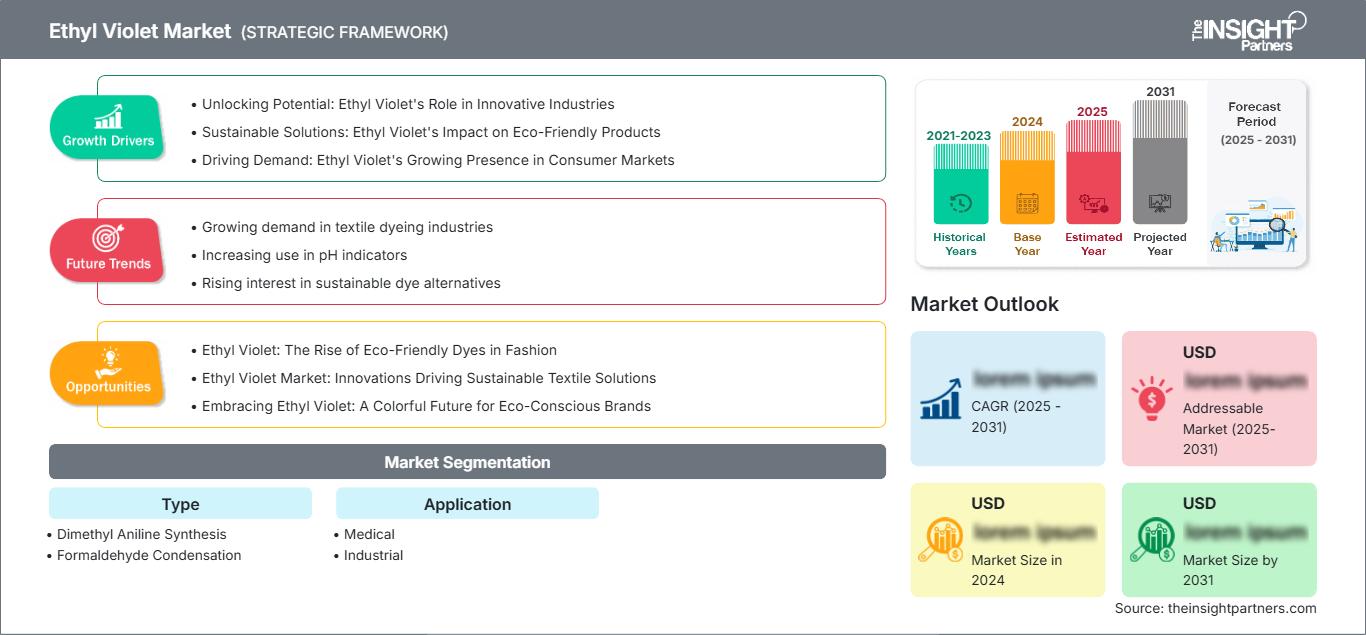
Ethyl Violet Market: Strategic Insights
Regional Insights
North America Ethyl Violet Market
North America accounted for ~31% of global demand in 2025 and is expected to expand at a CAGR of ~4% through 2034. This area is privileged to have available medical laboratories, pharmaceutical research bodies, universities, analyzers and specialty chemical distributors. The United States is the key customer base whereas Canada makes its contribution via research and health care and specialty chemicals. The buyers place an importance on traceability, specification, packaging, and replenishment.
Medical staining and lab testing continue to be the major areas of demand owing to the use of this chemical as a histological and pathological stain and an analytical agent. The industrial demands are specialized and include applications which involve color control and chemical compatibility. North American producers can retain their market share via documentation, quality assurance, technical assistance and assured delivery. The chemical management and exposure regulations add up to this end.
U.S. Ethyl Violet Market
The U.S. represented ~75% of North American revenue in 2025 and is projected to grow at a CAGR of ~4% through 2034. The location of the industry takes into account the clustering of diagnostic labs, research in pharma and biotechnology, universities, and distributors of specialty dyes. The demand arises from the need for specialty dyes in microscopy, analysis, research, and certain industrial applications that require the properties of specialty dyes.
The competitors in the industry include lab-based companies like Fisher Scientific, TCI Chemicals, Spectrum Chemicals, and Glentham Life Sciences, among manufacturers and specialty dyes firms. The development trend for the products involves the use of standardized grades with known purity levels and color performance in addition to proper packaging. Growth will continue to be moderate owing to the maturity of the industry.
Europe Ethyl Violet Market
The Ethyl Violet Market forecast shows that Europe represented ~30% of the global market in 2025 and is forecast to expand at a CAGR of ~5% through 2034. Germany is the largest country in Europe, due to its chemical production industry, laboratory facilities, healthcare sector, and research activities. The UK makes its contribution via its pharmaceutical research, laboratories, and testing facilities, whereas France maintains its demand from the sectors of healthcare, scientific research, and specialty chemicals.
In addition, Italy and Spain add extra demand for their laboratory facilities, healthcare sector, industrial chemicals, and research requirements. Increasingly, European buyers consider issues of documentation, chemical classification, handling, and the environment in their purchasing activities. These factors affect purchasing decisions in favor of those suppliers that can offer proper documentation and consistent quality of products. Growth in the region is thus associated with laboratory consumption and industrial applications.
The supply framework of Europe encompasses regional manufacturers of chemicals along with overseas laboratory reagents suppliers. The firms can boost their competitiveness through efficient operations and quality maintenance. Distributors can help the small-scale laboratories and research centers. Regulatory issues are significant operational factors due to product classification, safety of workers, packaging, transportation, and environmental issues that may influence the overall cost of supply. Demand will be rather stable where ethyl violet is used in laboratories.
APAC Ethyl Violet Market
The Ethyl Violet Market trends show that Asia Pacific represented ~25% of the global market in 2025 and is expected to expand at a CAGR of ~7% through 2034, making it the fastest-growing region. China is the largest nation within Asia Pacific region due to its ability to manufacture chemicals and the rising demands for laboratories. Japan and South Korea add to the picture through advanced research and industries while India takes advantage of pharmaceuticals, healthcare and specialty chemical applications.
The industrial and laboratory demand is driven by overall manufacturing activities and the development of science infrastructures. Regional producers can take advantage of the availability of feedstock materials and the capability to manufacture dyes. The policy focus on local manufacturing of chemicals, environmental issues, worker safety and quality is driving process upgrading. Australia is the smaller but well-established market due to healthcare, research and laboratories.
Middle East & Africa Ethyl Violet Market
The Middle East & Africa is projected to expand at a CAGR of ~5% through 2034. Saudi Arabia represents the leading country in the Middle East & Africa region, where specialty chemicals and healthcare infrastructure provide a basis for demand. The UAE functions as an important distribution and laboratory services center, while South Africa provides established research, healthcare, and industrial capabilities.
Energy availability and industrial infrastructure influence regional chemical economics, although ethyl violet remains a specialized product with relatively limited volume requirements. Expansion of laboratories, healthcare facilities, educational research, and industrial testing can support consumption. Suppliers with regional warehousing and established chemical distribution relationships can reduce lead times and improve product availability. Environmental handling and import requirements remain important considerations for regional buyers.
Segmentation Analysis
Type
The Type segment of the Ethyl Violet Market comprises Dimethyl Aniline Synthesis and Formaldehyde Condensation. The overall Type segment is expected to expand at ~5% CAGR from 2026 to 2034. Production economics, feedstock availability, reaction control, purification requirements, and the desired product grade influence route selection. Established manufacturers generally prioritize reproducibility and process control because laboratory and industrial buyers require stable colorimetric performance.
- Dimethyl Aniline Synthesis: This route holds the largest position because established aromatic amine chemistry supports repeatable production and broad industrial familiarity. Its strategic importance is reinforced by accessible feedstock channels, established process knowledge, and compatibility with specialty dye manufacturing infrastructure.
- Formaldehyde Condensation: Formaldehyde-based condensation chemistry remains relevant where producers optimize reaction conditions, feedstock utilization, and purification. Demand is influenced by manufacturing capabilities and product-grade requirements, with strategic value in maintaining alternative production pathways and supply flexibility.
Application
The Application segment in the Ethyl Violet Market is projected to expand at ~5% CAGR through 2034, with Medical and Industrial uses forming the defined demand base. Medical applications benefit from established staining practices, while industrial uses are supported by analytical testing and specialty chemical applications. Differences in purity, documentation, packaging, and purchasing volume influence supplier selection across both application groups.
- Medical: Medical applications include histological, pathological, diagnostic, and research-oriented staining workflows. Demand is tied to laboratory throughput and reproducibility requirements. Strategic importance comes from the need for controlled specifications and dependable supply, where staining performance directly affects laboratory procedures.
- Industrial: Industrial applications include analytical testing, specialty chemical processes, and applications using ethyl violet's colorimetric or spectrophotometric properties. The category has greater expansion potential as industrial laboratories broaden testing programs and require reliable specialty reagents for repeatable measurements.
Opportunity Snapshot
| Application | Revenue Contribution | Trend Tag | Adoption Stage |
| Medical | High | Histology Testing | Mature |
| Industrial | Medium | Analytical Testing | Scaling |
Ethyl Violet Market Growth Drivers and Impact Analysis
Expansion of Diagnostic and Histological Laboratory Activity
Medical and research laboratories remain an important demand foundation because ethyl violet is used in histological and pathological staining and related analytical procedures. Growth in laboratory testing, biomedical research, academic studies, and diagnostic capacity supports recurring requirements for staining reagents. The market impact is stronger for suppliers that can provide reproducible grades with consistent absorption characteristics, solubility, and documentation. Laboratories often prioritize reliability over large-scale price differences because inconsistent staining performance can affect testing workflows and research reproducibility. As laboratory networks expand in emerging economies, demand can shift from locally sourced general chemicals toward standardized specialty reagents. Suppliers that maintain stable specifications, secure packaging, and dependable replenishment can capture this incremental demand without relying on major changes in end-use technology.
Process Optimization and Specialty Grade Development
Manufacturers in the Ethyl Violet Market are under pressure to improve production efficiency while maintaining consistent purity and performance. Process optimization can reduce material losses, improve reaction control, and strengthen batch-to-batch reproducibility. For a specialty dye with medical and industrial uses, these improvements can affect procurement decisions because customers require dependable product characteristics rather than only low unit costs. Manufacturers can further strengthen market access by offering powder and liquid formats, laboratory grades, and application-specific specifications. Better quality control can reduce customer qualification barriers and support longer supplier relationships. The impact extends through the supply chain because improved production planning can reduce stock-outs and enable distributors to maintain more predictable inventories. Process efficiency, therefore, contributes to both cost management and service reliability.
Growth of Specialty Chemical Distribution Networks
Ethyl violet is distributed through a combination of direct manufacturers, laboratory chemical suppliers, and specialty distribution channels. Expansion of digital procurement and regional chemical distribution can improve accessibility for laboratories and smaller industrial users who cannot purchase directly from producers. This channel development increases the addressable customer base while reducing geographic barriers to specialized chemical procurement. Product catalogs, technical documentation, safety data, packaging flexibility, and inventory visibility increasingly influence supplier selection. The market impact is particularly relevant in the Asia Pacific and other developing demand centers where local production and imported laboratory chemicals coexist. Suppliers that integrate manufacturing with responsive distribution can shorten procurement cycles and serve customers requiring smaller quantities, while industrial buyers can benefit from more predictable access to bulk grades.
Ethyl Violet Market Future Trends
Greater Emphasis on Traceable Specialty Reagents
Future procurement is likely to place greater emphasis on traceability, documentation, and consistent product specifications. Laboratories and industrial users increasingly need clear identification of chemical composition, batch characteristics, storage requirements, and safe handling practices. For ethyl violet, this trend can encourage suppliers to strengthen certificates of analysis, digital technical documentation, lot-level records, and standardized packaging. Such practices can become particularly important when products move across multiple jurisdictions or through several distribution stages. Manufacturers that integrate quality systems with digital documentation can reduce qualification friction and provide greater transparency to customers. The trend should favor suppliers capable of maintaining consistent product information from production through final delivery while meeting application-specific requirements.
Regionalization of Specialty Dye Supply
Supply chains for specialized chemicals are likely to become more regionally diversified as buyers seek shorter lead times and greater resilience. Asia Pacific can strengthen its role as a production and consumption center, while North America and Europe will continue to support higher-specification laboratory demand. Regional inventories, local packaging, and qualified distribution partnerships can reduce dependence on a single supply route. This trend does not necessarily imply complete localization because niche chemicals can remain economically efficient to trade internationally. Instead, producers and distributors may establish regional stock points and multiple sourcing arrangements. Such strategies can improve service continuity and enable suppliers to respond more effectively to regulatory, logistics, and customer-specific requirements.
Ethyl Violet Market Opportunities
Development of Application-Specific Medical Grades
Medical and research applications offer an opportunity for suppliers to develop differentiated grades around reproducibility, purity, solubility, and staining performance. Rather than competing only through commodity pricing, manufacturers can package products for specific laboratory workflows and provide detailed technical documentation. Application-specific positioning can strengthen customer qualification and create recurring demand from laboratories that value consistent results. Suppliers can further expand opportunities by offering multiple pack sizes and stable inventory for research institutions, diagnostic facilities, and academic users. Partnerships with laboratory distributors can improve reach without requiring extensive direct sales infrastructure. Investment in analytical quality control and application testing can therefore create differentiation in a market where end users often prioritize dependable performance and documentation.
Expansion of Industrial Dye Formulations in Emerging Markets
Industrial applications provide opportunities to expand through liquid formulations, customized concentrations, and packaging designed for production environments. Emerging manufacturing centers can create incremental demand from printing, specialty colorants, and other industrial processes requiring basic dye characteristics. Local technical support and regional inventories can make imported specialty dyes easier to integrate into manufacturing workflows. Producers can evaluate opportunities around formulation stability, handling efficiency, and compatibility with customer processes while maintaining appropriate chemical controls. Partnerships with local distributors and industrial chemical formulators can provide access to smaller customers that may not justify direct sales coverage. The opportunity is therefore centered on application support and channel development rather than broad commodity-scale expansion.
Recent Developments
- December 2025: Fisher Scientific Company - Fisher Scientific updated the safety documentation for its Ethyl Violet product, with the revised SDS dated December 19, 2025. The update reinforces the importance of current hazard communication and compliance documentation for laboratory chemical sales. It also strengthens the role of documented product stewardship in specialty dye procurement and supports institutional customers that require current handling and regulatory information.
Frequently Asked Questions

- Comprehensive Market Sizing and Forecast Analysis
- Detailed Segmentation Analysis
- In-Depth Market Dynamics Assessment
- Regional and Country-Level Insights
- Competitive Landscape and Company Benchmarking
- Strategic Business Intelligence
Recent Reports
Testimonials

The Insight Partners provided valuable market intelligence that supported our global go-to-market strategy. Their team was professional, responsive, and attentive to our feedback, providing thoughtful analysis and helpful methodological clarifications throughout the project.
Junmo Kim Chief Financial Officer (CFO), Enertech Co., Ltd.
The Insight Partners' SCADA System Market report is comprehensive, with valuable insights on current trends and future forecasts. The team was highly professional, responsive, and supportive throughout. We are very satisfied and highly recommend their services.
RAN KEDEM Partner, Reali Technologies LTDs
I requested a report on a very specific software market and the team produced the report in a few days. The information was very relevant and well presented. I then requested some changes and additions to the report. The team was again very responsive and I got the final report in less than a week.
JEAN-HERVE JENN Chairman, Future Analytica
We worked with The Insight Partners for an important market study and forecast. They gave us clear insights into opportunities and risks, which helped shape our plans. Their research was easy to use and based on solid data. It helped us make smart, confident decisions. We highly recommend them.
PIYUSH NAGPAL Sr. Vice President, High Beam Global
The Insight Partners delivered insightful, well-structured market research with strong domain expertise. Their team was professional and responsive throughout. The user-friendly website made accessing industry reports seamless. We highly recommend them for reliable, high-quality research services
YUKIHIKO ADACHI CEO, Deep Blue, LLC.
This is the first time I have purchased a market report from The Insight Partners.While I was unsure at first, I visited their web site and felt more comfortable to take the risk and purchase a market report.I am completely satisfied with the quality of the report and customer service. I had several questions and comments with the initial report, but after a couple of dialogs over email with their analyst I believe I have a report that I can use as input to our strategic planning process.Thank you so much for taking the extra time and making this a positive experience.I will definitely recommend your service to others and you will be my first call when we need further market data.
JOHN SUZUKI President and Chief Executive Officer, Board Director, BK Technologies
I wish to appreciate your support and the professionalism you displayed in the course of attending to my request for information regarding to infectious disease IVD market in Nigeria. I appreciate your patience, your guidance, and the fact that you were willing to offer a discount, which eventually made it possible for us to close a deal. I look forward to engaging The Insight Partners in the future, all thanks to the impression you have created in me as a result of this first encounter.
DR CHIJIOKE ONYIA MANAGING DIRECTOR, PineCrest Healthcare Ltd.Reason to Buy
- Informed Decision-Making
- Understanding Market Dynamics
- Competitive Analysis
- Identifying Emerging Markets
- Customer Insights
- Market Forecasts
- Risk Mitigation
- Boosting Operational Efficiency
- Strategic Planning
- Investment Justification
- Tracking Industry Innovations
- Aligning with Regulatory Trends





 Get Free Sample for