Europe Canned Seafood Market Size, Share & Demand by 2034
Europe Canned Seafood Market Size and Forecast (2021 - 2034), Regional Share, Trend, and Growth Opportunity Analysis Report Coverage: By Product (Tuna, Salmon, Sardines, Mackerel, Shrimps and Prawns, Clams, Crabs, Lobsters, and Others), and By Distribution Channel (Supermarket and Hypermarkets, Convenience Stores, Online Retail, and Others), and Country
Historic Data: 2021-2024 | Base Year: 2025 | Forecast Period: 2026-2034- Report Date : Feb 2026
- Report Code : TIPRE00042247
- Category : Food and Beverages
- Status : Published
- Available Report Formats :


- No. of Pages : 275

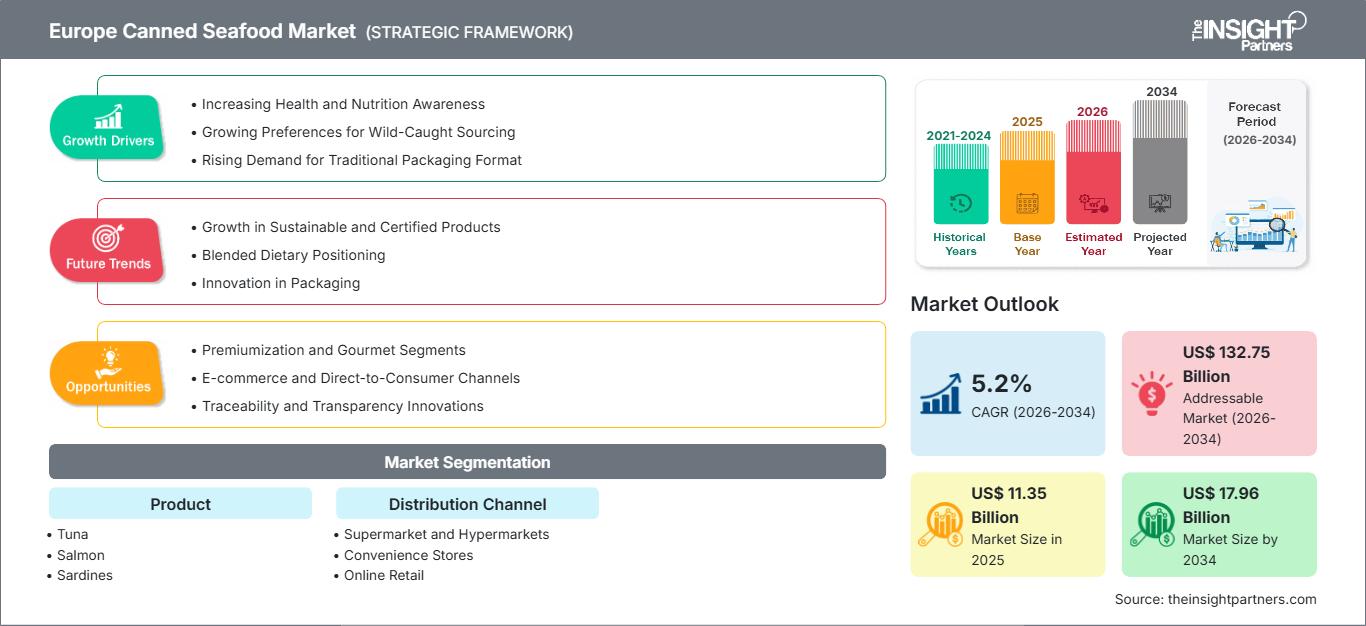
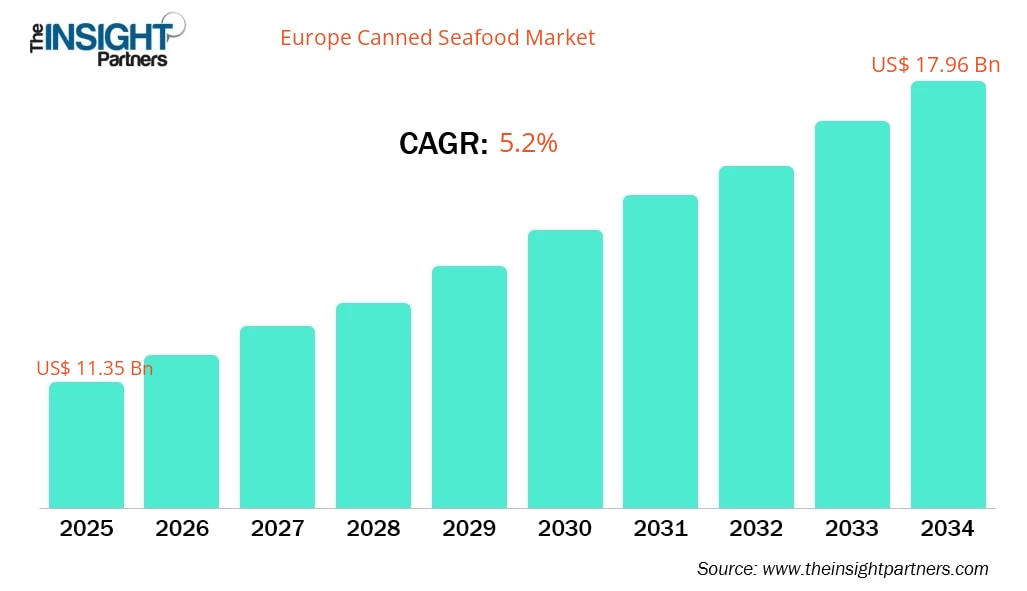
The Europe canned seafood market size is projected to reach US$ 17.96 billion by 2034 from US$ 11.35 billion in 2025. The market is expected to register a CAGR of 5.2% during 2026–2034.
Europe Canned Seafood Market Analysis
Retailers, food service operators, and export distributors favour preserved seafood of high quality, which provides excellent flavour, texture, nutritional retention, and appearance. The growth of the modern forms of retail, automated canning lines, and high-speed filling equipment is the driving force behind the growth of the market. The sustainability of traditional recipes without the need to compromise on scalability is attained by sustainable MSC/ASC-certified sourcing, low-sodium olive oil formulations, and long shelf-life packaging. Since it is responsive to the requirements of traceability, adherence to EU fisheries policies, and the maintenance of natural organoleptic profiles, canned seafood in Spain continues to be a favorite among consumers in France, Italy, Germany, and Latin America.
Europe Canned Seafood Market Overview
The production throughput needs, brand uniformity, and presentation to export markets require advanced processing methods that provide muscle stability, brine crystalization, and microbial stability to various SKUs. Long shelf-life stability, low percentage drip loss, and clean label formulations that do not use artificial preservatives are needed in the premium tuna belly, wild mussel, and artisan sardine preserves. New differentiators that correspond to European retail ESG scorecards include pole-and-line caught and FAD-free certifications. Competitiveness in the market is improved through automation of Galician cameries, improved sterilization retorts, and the spread of high-speed portion-pack lines. Spain, the unchallenged hub of production, is the country with the highest density of certified processing facilities. Portugal and Italy are stable volume markets as they have deep-rooted Mediterranean consumption, food service distribution to tours, and cross-border integration of own-label products.
Customize This Report To Suit Your Requirement
Get FREE CUSTOMIZATIONEurope Canned Seafood Market: Strategic Insights
-
Get Top Key Market Trends of this report.This FREE sample will include data analysis, ranging from market trends to estimates and forecasts.
Europe Canned Seafood Market Drivers and Opportunities
Market Drivers:
- Growing Retail Modernization and Private Label Expansion: The growth of organized grocery chains and high-throughput automated distribution centres in Spain, France, and Italy is driving the demand to have consistent and traceable canned seafood that guarantees uniformity in portions, drained weights, and long ambient shelf life.
- Strict EU Fisheries and Traceability Mandates: Enforcement of the Common Fisheries Policy control measures and IUU fishing rules on Spanish packers is forcing them to pursue fully documented, blockchain-verified supply chains to ensure legal catch, supply chain transparency, and carbon-footprint labelling.
- Demand for Premium and Origin‑Certified Specialties: The distributors in export markets such as Germany, the UK, or North America need authentic conserves with PDO, PGI, or traditional-specialty guarantees, which warrant the retail premiums and distinguish mass-market private label products.
Market Opportunities:
- The introduction of Carbon-Neutral and Plastic-Free Packaging: The growing interest of retailers in net-zero Scope 3 emissions and circular economy contracts is driving the increasing research into infinitely recyclable aluminium trays, fibre-based barrier lids, and compostable overwraps that maintain product integrity without a marine liability.
- Growth in Emerging Southern and Eastern European Consumption: Increased disposable income and modernised shopping infrastructure in Portugal, Greece, Poland, and Romania offer white-space opportunities that Spanish packers can tap into by introducing European-style recipes, value-added sauce options, and downsizing single-serving sizes.
- Advanced Sterilisation Technologies for Texture and Nutrient Retention: Gentle retort, ohmic heating, and high pressuring are under test to provide raw-like albacore texture, reduced-sodium brine, and vitamin-retaining mackerel fillets, which attract flexitarian, senior, and higher-end wellness consumer groups.
Europe Canned Seafood Market Report Segmentation Analysis
The Europe canned seafood market is divided into different segments to give a clearer view of its growth potential and the latest trends. Below is the standard segmentation approach used in industry reports:
By Product:
- Tuna: The volume leader that has been appreciated in terms of consistent protein production, retort stability, and all-purpose availability in both private label and branded oil-packed SKUs.
- Salmon: The high-end market segment holds cold-water origin claims, fine flake texture, and clean-label properties in high and wellness-based forms.
- Sardines: The cultural staple that is treasured due to the ancient curing techniques, skin-on presentation, and a high PDO/PGI recognition in the Mediterranean export markets.
- Mackerel: The sustainably bountiful competitor that is gaining momentum around sound flavour profiles, economical nutrient content, and smoke-flavoured specialty versions.
- Shrimps and Prawns: The high-value crustacean segment is characterized by brine-packed tenderness, cocktail-ready convenience, and cross-merchandising capability in the chilled cabinet.
- Clams: The niche mollusc market continued to service Iberian canned clam tradition, liquor-filled authenticity, and tapas food service loyalty.
- Crabs: The gourmet specialty is based on the hand-picked white meat, shell-piece guarantees, and high-quality glass jar packaging in the Northern European deli retail.
- Lobsters: The ultra-premium infrequent buy is marked by entire-meat illustrations, butter-sausage sauce enhancements, and giving or Christmas-time seasonal SKU assortments.
- Others: The innovation trap of octopus, anchovies, squid, and mackerel fillets in new ethnic marinades, plant-oil infusions, and single-serve packets.
By Distribution Channel:
- Supermarket and Hypermarkets
- Convenience Stores
- Online Retail
- Others
By Country:
- Germany
- France
- Italy
- Spain
- UK
- Poland
- Sweden
- Norway
- Denmark
- Czech Republic
- Hungary
- Belgium
- Romania
- Slovakia
- Bulgaria
- Lithuania
- Latvia
- Estonia
- Slovenia
- Rest of Europe
High modernization and the high level of automated canning lines, high-pressure sterilization retorts, and high-precision quality sorting in the Galician and Cantabrian production centers have made the sustained capital investment in continuous cookers, high-speed filling carousels, and blockchain-made lot traceability in Spain to drive the steady throughput of premium tuna, wild mussels, and Iberian sardines. The growth opportunities in developing consumption poles in Poland, Romania, and the Nordic markets are large due to growing modern retail offerings, procurement of food services across borders, and the growing buyer requirement of MSC/ASC-certified raw material, coupled with the non-receding compliance cost burden of EU fisheries control and carbon-footprint reporting laws.
Europe Canned Seafood Market Report Scope
| Report Attribute | Details |
|---|---|
| Market size in 2025 | US$ 11.35 Billion |
| Market Size by 2034 | US$ 17.96 Billion |
| CAGR (2026 - 2034) | 5.2% |
| Historical Data | 2021-2024 |
| Forecast period | 2026-2034 |
| Segments Covered |
By Product
|
| Regions and Countries Covered |
Europe
|
| Market leaders and key company profiles |
|
Europe Canned Seafood Market Players Density: Understanding Its Impact on Business Dynamics
The Europe Canned Seafood Market is growing rapidly, driven by increasing end-user demand due to factors such as evolving consumer preferences, technological advancements, and greater awareness of the product's benefits. As demand rises, businesses are expanding their offerings, innovating to meet consumer needs, and capitalizing on emerging trends, which further fuels market growth.
Europe Canned Seafood Market Players Density: Understanding Its Impact on Business Dynamics
High Market Density and Competition
Competition is intense due to the presence of established players such as Bolton Group S.p.A., Princes Limited, and Frinsa.
This high level of competition urges companies to stand out by:
- Procuring full traceability of MSC/ASC skipjack, yellowfin, and Iberian sardines to meet the EU due diligence requirements and Biodiversity claims by retailers.
- Providing high-quality drained weight, fillet integrity, and brine clarity that decreases complaints made to retailers and increases renewal rates on own-label products.
- The introduction of various olive oil infusions, Mediterranean sauces, and skin-on/bone-in classic recipes to assert premium shelf placement and barrier against low-cost Asian competition.
Opportunities and Strategic Moves
- Incorporate carbon-neutral facility certifications and plastic-free aluminum trays to follow the European grocery net-zero schedules and Gen Z customer purchasing ethics.
- Innovate long shelf-life ambient formats through mild retort and high-pressure treatments to maintain omega-3 retention and raw texture on wellness SKUs.
- Optimize yield and detect contaminants in real-time with AI-controlled X-ray and NIR sorters to reduce labor reliance and recall risk.
- Enter into multi-year supply partnerships with French head offices of private labels, German discounters, and Spanish food services distributors to share in the development of exclusive recipe channels and to ensure catch-to-shelf visibility.
Major companies operating in the Europe Canned Seafood market are:
- Bolton Group S.p.A.
- Princes Limited
- Frinsa
- Petrossian
- John West Foods Limited
- King Oscar AS
- Pinhais & Ca Lda
- RAMIREZ
- Conservas Ortiz S.A.
- FANGST
Disclaimer: The companies listed above are not ranked in any particular order.
Other companies analyzed during research:
- Bolton Group SRL
- Austevoll Seafood ASA
- Mowi ASA
- Thai Union Group PCL
Europe Canned Seafood Market News and Recent Developments
- Bolton Inaugurates First "Bolton Food Research & Innovation Center" to Advance Sustainable Seafood Science: In January 2026, Bolton, through its Food Business Unit, inaugurated its first Bolton Food Research & Innovation Center, marking a significant milestone in the company's long-standing commitment to innovation, science, and sustainable development in the global seafood industry. Conceived as a permanent platform, the Center is designed to deepen scientific understanding of the impacts of seafood products on both people and the planet, and to translate this knowledge into concrete solutions that optimize resources, reduce waste, and support more resilient food systems.
- King Oscar Launches New Line of Tinned Salmon Beyond Anything Consumers Have Seen: In 2024, King Oscar, the premium canned seafood company, announced the launch of a new line of skinless and boneless Atlantic salmon in extra virgin olive oil.
Europe Canned Seafood Market Report Coverage and Deliverables
The "Europe Canned Seafood Market Size and Forecast (2021–2031)" report provides a detailed analysis of the market covering the following areas:
- Europe Canned Seafood market size and forecast at global, regional, and country levels for all segments covered under the scope
- Europe Canned Seafood market trends, as well as dynamics such as drivers, restraints, and key opportunities
- Detailed Porter's five forces analysis and SWOT analysis
- Europe Canned Seafood market analysis covering trends, global and regional framework, major players, regulations, and recent developments
- Industry landscape and competition analysis covering market concentration, heat map analysis, prominent players, and recent developments for the Europe canned seafood market
- Detailed company profiles
Frequently Asked Questions

- Historical Analysis (2 Years), Base Year, Forecast (7 Years) with CAGR
- PEST and SWOT Analysis
- Market Size Value / Volume - Regional, Country
- Industry and Competitive Landscape
- Excel Dataset
Recent Reports
Testimonials

The Insight Partners' SCADA System Market report is comprehensive, with valuable insights on current trends and future forecasts. The team was highly professional, responsive, and supportive throughout. We are very satisfied and highly recommend their services.
RAN KEDEM Partner, Reali Technologies LTDs
I requested a report on a very specific software market and the team produced the report in a few days. The information was very relevant and well presented. I then requested some changes and additions to the report. The team was again very responsive and I got the final report in less than a week.
JEAN-HERVE JENN Chairman, Future Analytica
We worked with The Insight Partners for an important market study and forecast. They gave us clear insights into opportunities and risks, which helped shape our plans. Their research was easy to use and based on solid data. It helped us make smart, confident decisions. We highly recommend them.
PIYUSH NAGPAL Sr. Vice President, High Beam Global
The Insight Partners delivered insightful, well-structured market research with strong domain expertise. Their team was professional and responsive throughout. The user-friendly website made accessing industry reports seamless. We highly recommend them for reliable, high-quality research services
YUKIHIKO ADACHI CEO, Deep Blue, LLC.
This is the first time I have purchased a market report from The Insight Partners.While I was unsure at first, I visited their web site and felt more comfortable to take the risk and purchase a market report.I am completely satisfied with the quality of the report and customer service. I had several questions and comments with the initial report, but after a couple of dialogs over email with their analyst I believe I have a report that I can use as input to our strategic planning process.Thank you so much for taking the extra time and making this a positive experience.I will definitely recommend your service to others and you will be my first call when we need further market data.
JOHN SUZUKI President and Chief Executive Officer, Board Director, BK Technologies
I wish to appreciate your support and the professionalism you displayed in the course of attending to my request for information regarding to infectious disease IVD market in Nigeria. I appreciate your patience, your guidance, and the fact that you were willing to offer a discount, which eventually made it possible for us to close a deal. I look forward to engaging The Insight Partners in the future, all thanks to the impression you have created in me as a result of this first encounter.
DR CHIJIOKE ONYIA MANAGING DIRECTOR, PineCrest Healthcare Ltd.Reason to Buy
- Informed Decision-Making
- Understanding Market Dynamics
- Competitive Analysis
- Identifying Emerging Markets
- Customer Insights
- Market Forecasts
- Risk Mitigation
- Boosting Operational Efficiency
- Strategic Planning
- Investment Justification
- Tracking Industry Innovations
- Aligning with Regulatory Trends




 Get Free Sample For