
Aquaculture Products Market Size, Share & Trends by 2034
Aquaculture Products Market Size and Forecasts (2021 - 2034), Global and Regional Share, Trends, and Growth Opportunity Analysis Report Coverage : by Rearing Product Type (Equipment, Chemicals, Pharmaceuticals, Fertilizers); Culture (Freshwater, Marine, Brackish Water); Species (Aquatic Animals, Aquatic Plants); and Geography (North America, Europe, Asia Pacific, and South and Central America)
- Status : Data Released
- Report Code : TIPRE00040462
- Category : Food and Beverages
- No. of Pages : 150
- Available Report Formats :


- Last update date : August 28, 2026


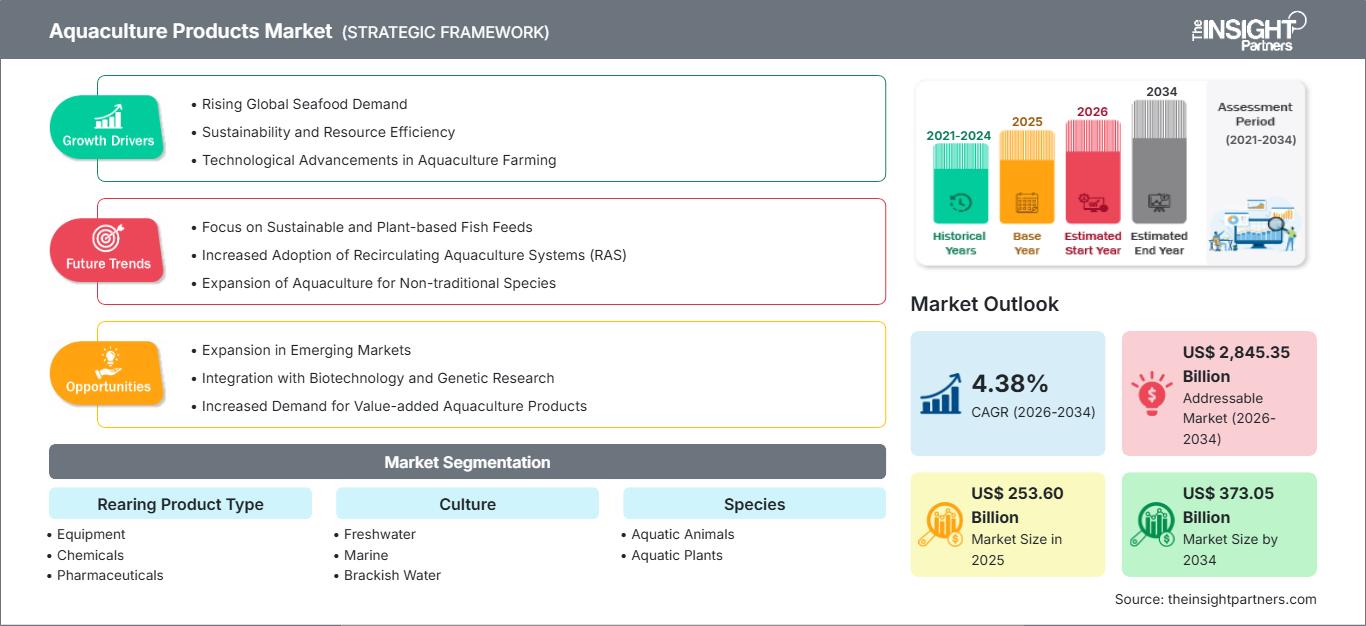
2025 Market Size
US$ 253.60 Bn
Base year value
2034 Forecast
US$ 373.05 Bn
Projected by 2034
CAGR 2026-2034
4.38 %
Growth rate
Addressable Market
US$ 2,845.35 Bn
(2026-2034)
The aquaculture products market was valued at US$ 253.60 Billion in 2025 and is projected to reach US$ 373.05 Billion by 2034, expanding at a CAGR of 4.38% during 2026–2034. The market continues to benefit from rising seafood consumption, increasing pressure on wild fisheries, and growing adoption of intensive farming systems. Advancements in feed optimization, water quality management, disease control solutions, and aquaculture infrastructure are supporting productivity improvements across commercial farming operations worldwide.
Across North America, commercial fish farming investments, sustainability initiatives, and recirculating aquaculture systems are creating favorable industry conditions. The aquaculture products market size in the region is supported by increasing seafood imports, technology-driven production facilities, and stronger fish health management practices. Market expansion is expected to remain steady at a CAGR range of 3.8%–4.4% through 2034, supported by regulatory oversight and growing preference for traceable seafood products.
Aquaculture Products Market Assessment and Insights
- North America: Strong adoption of advanced fish farming technologies and biosecurity solutions supports regional expansion. Share in 2025: 16–18% and CAGR between 2026–2034: 3.8%–4.4%.
- US: Large-scale investments in land-based aquaculture and fish health technologies strengthen market prospects. Share in 2025: 72–76% of North America and CAGR between 2026–2034: 3.9%–4.5%.
- Europe: Norway, the UK, Spain, and Greece remain major aquaculture hubs supported by sustainable farming policies. Share in 2025: 24–26% and CAGR between 2026–2034: 3.7%–4.3%.
- Asia Pacific: China, India, Indonesia, Vietnam, Japan, and Australia maintain leadership through extensive production capacity. Share in 2025: 48–52% and CAGR between 2026–2034: 4.8%–5.4%.
- Largest Segment: Freshwater culture remains dominant owing to extensive inland fish farming operations. Market share in 2025: 54–58% and CAGR 2026–2034: 4.1%–4.7%.
- High Growth Segment: Pharmaceuticals benefits from increasing disease prevention requirements and fish welfare standards. Market share in 2025: 18–22% and CAGR 2026–2034: 5.3%–5.9%.
- Key companies analyzed in detail: Blue Ridge Aquaculture, Cermaq Group AS, Cooke Aquaculture Inc., Eastern Fish Company, Huon Aquaculture Group Pty Ltd, International Fish Farming Company K.S.C.C. (Asmak), Mowi ASA, Nireus Aquaculture S.A., Promarisco S.A., Selonda Aquaculture S.A.
Source: The Insight Partners' analysis based on proprietary research, government publications, company annual reports, investor presentations, industry databases, and expert interviews.
Technology adoption is redefining production efficiency throughout the aquaculture products market. State-of-the-art monitoring technologies, automatic feeding solutions, genetic breeding programs, and sophisticated water quality management systems are boosting productivity and minimizing losses for farms. Producers are using more and more technology and digital analytics, as well as sensors, to increase the survival rate of fish and improve feed conversion. On the other hand, an increased focus on sustainability encourages farmers to use environmentally responsible practices and high-performance aquaculture solutions.
In the future, the development of the industry will be driven by increasing investments into new aquaculture markets, especially in Southeast Asia, the Middle East, and Africa. The government's efforts to ensure food security, address rising demand for seafood products, and update infrastructure facilities will result in new capacity investments. Disease management and traceability systems, as well as environmentally friendly production techniques, can increase resilience and attract investment.
Aquaculture Products Market Report Scope
| Report Attribute | Details |
|---|---|
| Market size in 2025 | US$ 253.60 Billion |
| Market Size by 2034 | US$ 373.05 Billion |
| Global CAGR (2026 - 2034) | 4.38% |
| Historical Data | 2021-2024 |
| Forecast period | 2026-2034 |
Aquaculture Products Market Analysis
Growing global seafood consumption remains a key contributor to aquaculture products market growth. Rising population levels, changing dietary preferences, and increasing awareness regarding protein-rich diets are supporting greater demand for aquaculture-derived seafood. The value chain includes breeding, hatcheries, feeding, farming equipment, medicines, water treatment, harvesting, processing, and distribution. Technology continues to be integrated within these processes, leading to increased commercial viability and improved consistency in results.
Supply dynamics have become influenced by disease control, environmental considerations, and production optimization measures. The focus on biosecurity measures, effective feed use, and proper water management has been done for the sake of profitability. The growth in intensive and semi-intensive farming practices has led to better yields and more consistent availability of products in major seafood-consuming countries.
The competitive environment reflected in the current aquaculture products market analysis remains moderately consolidated, with leading companies pursuing production expansion, vertical integration, and technological modernization. Cermaq Group AS, Mowi ASA, Cooke Aquaculture Inc., and Huon Aquaculture Group Pty Ltd continue investing in operational efficiency and sustainability-focused initiatives. Strategic partnerships and farm modernization activities remain prominent across major producing countries.
Investment activity increasingly focuses on recirculating aquaculture systems, precision health monitoring, and environmentally efficient production technologies. Companies, including Blue Ridge Aquaculture and International Fish Farming Company K.S.C.C. (Asmak), are enhancing production capabilities through technology adoption and operational upgrades. Competitive positioning is increasingly determined by productivity, fish health performance, sustainability compliance, and supply chain reliability.
● REPORT CUSTOMIZATION
Tailor This Report To Align With Your Specific Business Requirements
This report can be customized to align precisely with your business objectives, scope, and target markets. Customization options include tailored segmentation, geography, competitive analysis, and strategic insights to support informed decision-making.
Customize This Report →WHAT YOU CAN ADJUST
- ● Segmentations
- ● Geography
- ● Competitive Analysis
- ● Language Preferences
Aquaculture Products Market: Strategic Insights
Regional Insights
North America Aquaculture Products Market
North America accounted for approximately 16–18% aquaculture products market share in 2025 and is projected to expand at a CAGR of 3.8%–4.4% through 2034. Growth is primarily supported by demand for domestically produced seafood, expansion of advanced aquaculture facilities, and increasing investment in recirculating aquaculture technologies. Adoption of automated feeding systems and advanced water treatment solutions continues to improve commercial production efficiency.
Regulatory oversight related to environmental management and seafood traceability is encouraging investment in modern production infrastructure. Producers are focusing on disease prevention, feed optimization, and resource efficiency to strengthen profitability. Expansion of salmon, trout, and shellfish farming activities across the United States and Canada supports regional development while enhancing supply chain resilience and reducing reliance on imported seafood products.
U.S. Aquaculture Products Market
The United States represents approximately 72–76% of the North American Aquaculture Products Market and is anticipated to register a CAGR of 3.9%–4.5% during the forecast period. Federal and state-level initiatives promoting domestic seafood production are encouraging industry investment. Commercial operators increasingly deploy automated monitoring technologies and advanced aquaculture management systems to improve yields and strengthen production forecasting capabilities.
Application trends indicate growing emphasis on land-based fish farming systems, water recirculation technologies, and enhanced biosecurity infrastructure. The presence of companies such as Blue Ridge Aquaculture, Eastern Fish Company, and several specialized producers supports innovation throughout the domestic industry. Investments in sustainable seafood production, hatchery modernization, and fish-health programs are contributing to broader national aquaculture development objectives.
Europe Aquaculture Products Market
Europe accounted for approximately 24–26% of global Aquaculture Products Market revenue in 2025 and is projected to grow at a CAGR of 3.7%–4.3% through 2034. Norway remains the region's leading producer, while the United Kingdom continues expanding salmon and shellfish operations. Sustainability requirements, animal welfare standards, and technology adoption remain important drivers shaping industry evolution across the region.
The United Kingdom benefits from established salmon farming infrastructure and growing investment in production efficiency technologies. Germany demonstrates increasing interest in land-based systems that strengthen domestic seafood supply. Both countries continue prioritizing traceability, environmental stewardship, and innovation-led production improvements.
France, Italy, and Spain represent important Mediterranean aquaculture centers with strong production of fish and shellfish species. These countries continue investing in operational modernization and disease management solutions. Spain remains among the leading contributors due to diversified aquaculture activity and strong seafood consumption patterns that support long-term industry expansion.
APAC Aquaculture Products Market
Asia Pacific represented approximately 48–52% of global Aquaculture Products Market revenue in 2025 and is expected to record a CAGR of 4.8%–5.4% through 2034. China remains the dominant producer, supported by extensive freshwater and marine farming operations. India, Japan, South Korea, and Australia continue expanding production through technology adoption and government-supported aquaculture initiatives.
Regional growth is supported by seafood demand, export opportunities, and large production bases. Policy support for food security and sustainable farming methods encourages continued investment. Strong availability of aquaculture inputs, labor resources, and favorable climatic conditions further strengthen the region's leadership position.
Middle East & Africa Aquaculture Products Market
The Middle East & Africa market is anticipated to expand at a CAGR of 4.4%–5.0% through 2034. Saudi Arabia and the UAE are investing in aquaculture infrastructure as part of broader food security strategies. Expansion of commercial fish farming operations is increasing demand for equipment, pharmaceuticals, and water management solutions.
South Africa remains a notable production center, while additional opportunities emerge across developing markets in the rest of MEA. Infrastructure improvements, desalination capabilities, and growing interest in sustainable protein production are supporting industry expansion despite environmental and resource-management challenges.
Segmentation Analysis
Rearing Product Type
The rearing product type segment is projected to grow at a CAGR of 4.5%–5.1% during 2026–2034. Demand is supported by increasing farm intensification, disease management requirements, and productivity enhancement initiatives. The aquaculture products market scope within this segment continues to expand as producers invest in specialized solutions that improve operational efficiency, animal health, and environmental compliance.
- Equipment – Feeding systems, aeration technologies, monitoring sensors, and water circulation solutions remain essential for commercial production. Adoption is increasing as operators pursue automation, efficiency improvements, and reduced operational risks.
- Chemicals – Water quality management products play an important role in maintaining healthy production environments. Demand is supported by increasing focus on environmental control, productivity optimization, and regulatory compliance requirements.
- Pharmaceuticals – Fish health management solutions continue gaining importance due to rising disease risks and welfare standards. Advanced treatment approaches help reduce mortality and support consistent commercial output.
- Fertilizers – Fertilizers remain relevant in pond-based production systems where nutrient management supports aquatic productivity. Usage is especially important across freshwater aquaculture operations in developing economies.
Culture
The culture segment is expected to record a CAGR of 4.1%–4.7% during the forecast period. Production systems vary according to geographic conditions, species requirements, and commercial objectives. Expansion of sustainable aquaculture practices and technological improvements is supporting productivity gains across freshwater, marine, and brackish-water farming operations.
- Freshwater – The largest segment benefits from extensive inland farming activities, lower production costs, and broad species diversity. Freshwater systems remain central to aquaculture output across Asia and several emerging economies.
- Marine – Marine aquaculture supports high-value species production and export-oriented operations. Investments focus on offshore technologies, environmental monitoring, and productivity enhancement solutions.
- Brackish Water – Brackish-water farming supports shrimp and other commercially important species. Producers continue improving disease management and water-quality monitoring to enhance operational performance.
Species
The species segment is forecast to expand at a CAGR of 4.3%–4.9% between 2026 and 2034. Rising seafood demand, food security considerations, and diversification strategies encourage the cultivation of both aquatic animals and aquatic plants. Producers continue exploring species-specific production improvements and value-added opportunities.
- Aquatic Animals – Fish, crustaceans, and mollusks account for the majority of commercial aquaculture production. Consistent consumer demand and expanding international trade support strong market relevance.
- Aquatic Plants – Seaweed and other aquatic plants are gaining attention due to applications in food, pharmaceuticals, nutraceuticals, and industrial products. Growing sustainability focus supports broader commercial adoption.
Opportunity Snapshot
| Culture | Revenue Contribution | Trend Tag | Adoption Stage |
| Freshwater | High | Inland Farming | Mature |
| Marine | High | Offshore Systems | Scaling |
| Brackish Water | Medium | Shrimp Culture | Scaling |
Aquaculture Products Market Growth Drivers and Impact Analysis
Rising Global Demand for Sustainable Seafood Protein
Rising consumer interest in high-protein diets is increasing the demand for farmed seafood products around the world. Constraints in wild fisheries and sustainability issues related to the resources have led to an increased emphasis on aquaculture farming. Manufacturers are continuing to expand their production capabilities to cater to the growing population numbers and changing dietary habits. Investment in feed, hatchery systems, and efficiencies can help meet these increased production capabilities. This will lead to more demand for equipment, medicines, fertilizer, and water management products, which can help the upstream sector. Distribution channels for seafood are also contributing to demand visibility.
Advancement of Precision Farming Technologies
Digitization is revolutionizing production methods in aquaculture farms. Modernized sensors, automation technology, monitoring systems, and predictive analytics help increase management skills. Technologies help the farm managers to minimize waste and optimize production processes, such as decreasing mortality and minimizing the amount of feed consumption. Visibility in farming helps to respond faster to the changes in the environment. Technology implementation is also helpful in achieving sustainability goals and efficiency targets. The increasing investments in both land-based and marine aquaculture farms will create high demand for modernized production technologies in the future.
Strengthening Government Support for Aquaculture Development
In many countries, aquaculture is seen as a means for food security, diversification of the economy, and rural development. Public programs in the areas of infrastructure improvement, production modernization, and sustainability are motivating private sector investments. The regulatory environment places more emphasis on traceability, environmental management, and disease control, thus promoting the credibility of the sector in the long run. Financial inducements and research efforts promote the use of technologies while improving performance. The expansion of local production capacity of seafood lowers dependency on imports and contributes to other agricultural development strategies.
Aquaculture Products Market Future Trends
Expansion of Smart Aquaculture Ecosystems
The adoption of integrated digital farming platforms is expected to accelerate during the coming decade. Emerging aquaculture products market trends indicate wider deployment of artificial intelligence, cloud-connected monitoring systems, and automated operational controls. These technologies support real-time decision-making, predictive maintenance, and resource optimization. As technology costs gradually decline, small and medium-sized producers are likely to increase adoption. The trend supports enhanced productivity, reduced environmental impact, and stronger operational transparency, contributing to improved profitability and sustainability outcomes throughout commercial aquaculture operations globally.
Growth of Land-Based Recirculating Aquaculture Systems
Investments in production facilities that are located on land will remain prevalent as stakeholders look for means to exercise better control over environmental factors and the health of their fish. The use of recirculation aquaculture systems lowers water usage, boosts biosecurity, and facilitates production year-round. Increased interest in such technology is driving its adoption on an industrial scale. Its increased adoption is expected to boost the reliability of the supply chain and lower production risks associated with climate change.
Aquaculture Products Market Opportunities
Expansion Across Emerging Production Centers
Growing investment in Southeast Asia, the Middle East, and selected African countries represents a significant development opportunity. Governments are increasingly prioritizing domestic seafood production and food security objectives. Infrastructure improvements, technology transfer programs, and private capital participation are supporting industry modernization. Aquaculture products market forecasts indicate that emerging production centers will contribute a larger share of incremental revenue generation through 2034. Suppliers capable of providing integrated solutions related to equipment, health management, and operational efficiency are positioned to benefit from expanding commercial activity and new facility development projects.
Development of High-Value Aquatic Plant Production
Aquatic plant cultivation, including seaweed, is becoming increasingly attractive for diversification and value addition. Increasing demands from the food, nutraceutical, pharmaceutical, and industrial industries are fostering investments in this sector. Producers are developing methods of large-scale cultivation, as well as improving their processing skills and logistical connections. Companies capable of building successful production chains and value-added product lines will have competitive advantages. The increasing interest in sustainable resources and the circular economy makes the long-term prospects even more appealing.
Frequently Asked Questions

- Comprehensive Market Sizing and Forecast Analysis
- Detailed Segmentation Analysis
- In-Depth Market Dynamics Assessment
- Regional and Country-Level Insights
- Competitive Landscape and Company Benchmarking
- Strategic Business Intelligence
Recent Reports
Testimonials

The Insight Partners' SCADA System Market report is comprehensive, with valuable insights on current trends and future forecasts. The team was highly professional, responsive, and supportive throughout. We are very satisfied and highly recommend their services.
RAN KEDEM Partner, Reali Technologies LTDs
I requested a report on a very specific software market and the team produced the report in a few days. The information was very relevant and well presented. I then requested some changes and additions to the report. The team was again very responsive and I got the final report in less than a week.
JEAN-HERVE JENN Chairman, Future Analytica
We worked with The Insight Partners for an important market study and forecast. They gave us clear insights into opportunities and risks, which helped shape our plans. Their research was easy to use and based on solid data. It helped us make smart, confident decisions. We highly recommend them.
PIYUSH NAGPAL Sr. Vice President, High Beam Global
The Insight Partners delivered insightful, well-structured market research with strong domain expertise. Their team was professional and responsive throughout. The user-friendly website made accessing industry reports seamless. We highly recommend them for reliable, high-quality research services
YUKIHIKO ADACHI CEO, Deep Blue, LLC.
This is the first time I have purchased a market report from The Insight Partners.While I was unsure at first, I visited their web site and felt more comfortable to take the risk and purchase a market report.I am completely satisfied with the quality of the report and customer service. I had several questions and comments with the initial report, but after a couple of dialogs over email with their analyst I believe I have a report that I can use as input to our strategic planning process.Thank you so much for taking the extra time and making this a positive experience.I will definitely recommend your service to others and you will be my first call when we need further market data.
JOHN SUZUKI President and Chief Executive Officer, Board Director, BK Technologies
I wish to appreciate your support and the professionalism you displayed in the course of attending to my request for information regarding to infectious disease IVD market in Nigeria. I appreciate your patience, your guidance, and the fact that you were willing to offer a discount, which eventually made it possible for us to close a deal. I look forward to engaging The Insight Partners in the future, all thanks to the impression you have created in me as a result of this first encounter.
DR CHIJIOKE ONYIA MANAGING DIRECTOR, PineCrest Healthcare Ltd.Reason to Buy
- Informed Decision-Making
- Understanding Market Dynamics
- Competitive Analysis
- Identifying Emerging Markets
- Customer Insights
- Market Forecasts
- Risk Mitigation
- Boosting Operational Efficiency
- Strategic Planning
- Investment Justification
- Tracking Industry Innovations
- Aligning with Regulatory Trends





 Get Free Sample for