
Europe Welded Steel Tubes Market Demand and Growth Outlook Through 2034
Coverage: By Material (Carbon Steel Welded Tubes (Grade, and End Use Industry ) and Stainless Steel (Inox) Welded Tubes(Grade, and End Use Industry)), Manufacturing Process (Electric Resistance Welded, Longitudinal Submerged Arc Welded and Spiral Submerged Arc Welded), Product Type (Round Welded Tubes (Outer Diameter, Wall Thickness) , Square Welded Tubes (Outer Diameter, Wall Thickness), Rectangular Welded Tubes (Outer Diameter, Wall Thickness), and Other Special Profiles(Outer Diameter, Wall Thickness)), and Geography
- Status : Published
- Report Code : TIPRE00041784
- Category : Manufacturing and Construction
- No. of Pages : 250
- Available Report Formats :


- Last update date : August 20, 2026


2025 Market Size
US$ 19.80 Bn
Base year value
2034 Forecast
US$ 28.63 Bn
Projected by 2034
CAGR 2026-2034
3.97 %
Growth rate
Addressable Market
US$ 217.59 Bn
(2026-2034)
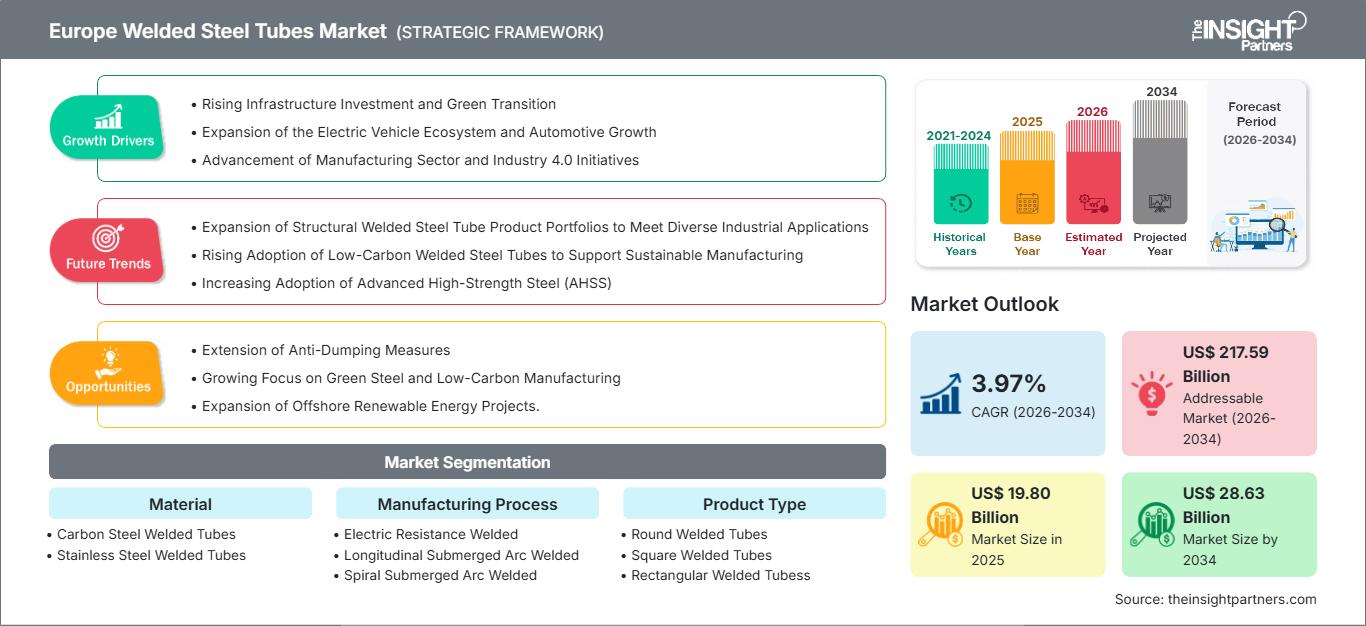
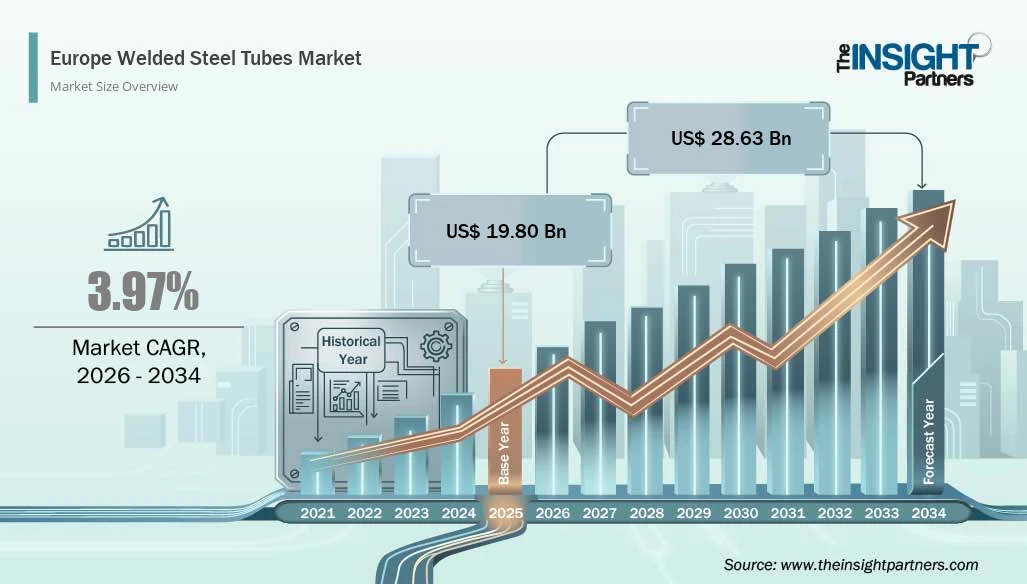
The Europe welded steel tubes market was valued at US$ 19.80 billion in 2025 and is projected to reach US$ 28.63 Million by 2034, registering a CAGR of 3.97% during 2026–2034. Demand reflects the product’s structural efficiency, dimensional consistency, and suitability for transporting fluids and gases. Construction, infrastructure, oil and gas, automotive, mechanical engineering, energy, power, and agricultural applications collectively underpin a broad and resilient customer base.
Germany welded steel tubes market size is expected to expand at a 1.8% CAGR through 2034. Germany represents one of the largest and most technologically advanced markets for welded steel tubes in Europe, supported by its strong automotive, machinery, construction, and industrial manufacturing sectors. The country's well-established steel industry, advanced manufacturing capabilities, and continuous investments in production modernization contribute significantly to market growth. Demand for welded steel tubes is driven by their extensive use in automotive components, industrial equipment, structural applications, and infrastructure projects.
Europe Welded Steel Tubes Market Assessment and Insights
- Germany: Accounted for a 14% share in 2025 and is expected to grow at a 1.8% CAGR during 2026–2034, supported by energy infrastructure renewal, reshoring, and established precision-tube demand .
- Italy: Held a 14% share in 2025 and should post a 3.2% CAGR.
- Russia: Captured a 11.7% share in 2025 and is forecast to expand at a 1.6% CAGR.
- Largest Segment: Carbon steel welded tubes held a 83% market share in 2025 and are expected to advance at a 2.8% CAGR through 2034.
- High Growth Segment: Stainless steel welded tubes represented a 16% market share in 2025 and are projected to grow at a 5.7% CAGR through 2034.
- Key companies analyzed in detail: Vallourec S.A., ArcelorMittal S.A., Marcegaglia Holding S.p.A., Gruppo Arvedi S.p.A., Tubos Reunidos, S.A., CELSA OPCO, S.A.U., LIBERTY Steel Group Holdings Pte Ltd, Alchemia S.A., FERRUM S.A., Salzgitter AG, EUROTUBI S.r.l., Schoeller Werk GmbH & Co. KG, BENTELER International AG, Precision Tubes Europe s.r.o., AMETEK, Inc., and Muhr und Bender KG.
Source: The Insight Partners' analysis based on proprietary research, government publications, company annual reports, investor presentations, industry databases, and expert interviews.
Production has shifted from labor-intensive forming and inspection toward high-frequency electric resistance welding, inline non-destructive testing, laser measurement, and digitally controlled finishing. Mills increasingly connect coil preparation, seam monitoring, heat treatment, cutting, and packaging to reduce variability and changeover time. Electric resistance welded output dominates standardized structural and mechanical requirements, while longitudinal and spiral submerged arc processes retain importance for larger diameters. Greater grade diversity and tighter traceability have expanded the addressable applications without displacing the cost advantages of welded construction.
Europe Welded Steel Tubes Market Report Scope
| Report Attribute | Details |
|---|---|
| Market size in 2025 | US$ 19.80 Billion |
| Market Size by 2034 | US$ 28.63 Billion |
| CAGR (2026 - 2034) | 3.97% |
| Historical Data | 2021-2024 |
| Forecast period | 2026-2034 |
Europe Welded Steel Tubes Market Analysis
The Europe welded steel tubes market growth is primarily driven by rising demand from construction and infrastructure development, sustained investment in oil and gas pipeline networks, and continuous growth in automotive and mechanical engineering production. The rising trend towards infrastructure modernization, expansion of renewable energy, and activities related to industrial manufacturing within the major European economies is expected to create continuous demands for both types of welded tubes. This would be complemented by the government-led efforts for decarbonization through schemes such as the Fit for 55 frameworks of the European Union and green steel schemes. Furthermore, innovations in terms of precision welding, laser welding, and corrosion resistant coating would facilitate this move towards higher quality production of tubes.
In addition to this, the rise in demand for carbon and stainless steel welded tubes owing to the increasing trend towards automotive lightweighting, energy transmission network expansion and industrial applications in Germany, Italy, France, Poland, and the UK would continue to drive market growth in the future.
The welded steel tubes market analysis indicates a fragmented competitive field with integrated steelmakers, diversified processors, and precision specialists. ArcelorMittal S.A., Marcegaglia Holding S.p.A., Gruppo Arvedi S.p.A., and Salzgitter AG benefit from feedstock integration and European networks, while EUROTUBI S.r.l., Schoeller Werk GmbH & Co. KG, and Precision Tubes Europe s.r.o. emphasize application engineering and responsiveness.
● REPORT CUSTOMIZATION
Tailor This Report To Align With Your Specific Business Requirements
This report can be customized to align precisely with your business objectives, scope, and target markets. Customization options include tailored segmentation, geography, competitive analysis, and strategic insights to support informed decision-making.
Customize This Report →WHAT YOU CAN ADJUST
- ● Segmentations
- ● Geography
- ● Competitive Analysis
- ● Language Preferences
Europe Welded Steel Tubes Market: Strategic Insights
Regional Insights
Germany welded steel tubes market
Germany held 14.0% of global revenue in 2025 and is expected to register a 1.8% CAGR during 2026–2034. Manufacturing plants are expanding their manufacturing capacities to keep up with the increasing local and regional demands. In one such example, in March 2026, the Benteler Group invested €17 million in increasing the manufacturing capacity of tubes at their plant in Schloß Neuhaus, located in Paderborn, Germany. It is expected that this expansion will help in increasing the capacity of the plant by 15% mainly to cater to the increasing demands in the automotive industry to improve its standing in the European seamless and welded steel tubes market.
France Welded Steel Tubes Market
The France represented 5.2% of regional total sales in 2025 and is projected to expand at a 2.2% CAGR through 2034. The market for welded steel tubes in France will be fueled by continuous investments in the areas of industrial decarbonization, cleantech innovations, and manufacturing infrastructural modernizations. In France, due to the country’s significant efforts towards reaching its climate objectives, there will be growing interest among the steel manufacturers and industrial companies in low-carbon production processes.
Italy Welded Steel Tubes Market
Italy accounted for 11.6% of 2025 revenue and is expected to grow at a 4.2% CAGR. The market for welded steel tubes in Italy has been boosted by the presence of a robust industrial infrastructure in terms of industries such as the manufacture of automobiles, machinery, engineering, and construction among others. Italy’s well-developed manufacturing infrastructure provides constant demand for welded steel tubes that can be utilized in the manufacture of vehicles, machinery, engineering solutions, and other applications.
Spain Welded Steel Tubes Market
Spain held 5.4% of revenue in 2025 and is forecast to record a 5.8% CAGR. The welded steel tubes industry in Spain is currently gaining a boost from rising investments being made in energy infrastructure, industrialization, and the shift towards more sustainable sources of energy. The current emphasis on hydrogen network infrastructure, renewable energy projects, and the upgrade of energy infrastructure is generating new prospects for the producers of steel pipes. Welded steel tubes have been making vital contributions in the areas of hydrogen transportation, energy infrastructure, construction, and industrial projects.
Poland Welded Steel Tubes Market
The country is projected to grow at a 3.6% CAGR through 2034. The Polish market for welded steel pipes is driven by the energy transformation taking place in the country. This is because the use of clean energy sources, upgrading power infrastructure, and the modernization of industries are generating demand for these pipes, which can be utilized in construction, pipelines, and structures. This is due to the fact that the country is making efforts to ensure its energy security by decreasing its reliance on carbon.
Segmentation Analysis
Material
The welded steel tubes market scope by material covers carbon and stainless products, with the segment expected to progress at a 3.97% CAGR during 2026–2034. Carbon steel remains the economical choice for structures and general engineering, while stainless steel gains where corrosion, hygiene, heat, or lifecycle performance justifies higher initial cost.
- Carbon Steel Welded Tubes: This category leads volume because construction, infrastructure, machinery, agriculture, and conventional energy users require economical strength, broad standards coverage, easy fabrication, and dependable availability.The carbon steel welded tubes market is further bifurcated on the basis of grade and end use industry. Based on grades, EN S235 is anticipated to dominate the market during the forecast period. Based on end use industry, energy and power segment is projected to grow with a highest CAGR during the forecast period .
- Stainless Steel (Inox) Welded Tubes: Demand concentrates in corrosive, hygienic, and high-temperature services, making surface quality, alloy control, weld finishing, and lifecycle economics strategically important purchasing criteria.The stainless steel welded tubes market is further bifurcated on the basis of grade and end use industry. Based on grades, 304 is anticipated to dominate the market during the forecast period. Based on end use industry, energy and power segment is projected to grow with a highest CAGR during the forecast period.
Manufacturing Process
The Europe welded steel tubes market by manufacturing process covers electric resistance welded (ERW), longitudinal submerged arc welded (LSAW), and spiral submerged arc welded (SSAW) products. ERW is anticipated to dominate the market during the forecast period, supported by high production efficiency, cost-effectiveness, dimensional consistency. The ERW is projected to grow with a 3.72% CAGR during the forecast period.
- Electric Resistance Welded (ERW) Tubes: This category leads volume due to its suitability for small- and medium-diameter applications, automated production, consistent weld quality, and economical manufacturing.
- Longitudinal Submerged Arc Welded (LSAW) Tubes: Demand is driven by large-diameter and heavy-wall applications, particularly water infrastructure, energy, oil and gas transmission, offshore projects, and major construction activities.
- Spiral Submerged Arc Welded (SSAW) Tubes: SSAW tubes are favored for large-diameter applications in water transmission, infrastructure, piling, construction, and selected energy projects due to manufacturing flexibility and cost competitiveness.
Opportunity Snapshot
| End Use Industry | Revenue Contribution | Trend Tag | Adoption Stage |
| Construction and Infrastructure | High | Urban Renewal | Mature |
| Oil and Gas | High | Pipeline Integrity | Mature |
| Automotive | High | Lightweight Chassis | Scaling |
| Mechanical Engineering | Medium | Factory Automation | Mature |
| Energy and Power | High | Hydrogen Networks | Scaling |
| Agriculture | Medium | Protected Farming | Scaling |
| Others | Low | Custom Fabrication | Emerging |
Europe Welded Steel Tubes Market Growth Drivers and Impact Analysis
Expansion of the Electric Vehicle Ecosystem and Automotive Growth
The fast-growing electric vehicle (EV) ecosystem in Europe and the continuous increase in automotive production provide promising prospects for the welded steel tubes market. Investments in EV production, batteries, infrastructure, and supply chain creation create the demand for high-quality steel materials that are applied in automotive structures and manufacturing equipment. Steel tubes have been utilized in automotive industry due to their high strength, durability, weight-saving potential, and affordability.
For example, until May 2026, Europe invested almost EUR 200 billion or about US$ 235 billion into the EV ecosystem including vehicle production, batteries, charging infrastructure, and supply chain development. Such big investments are likely to contribute to the automotive production facilities expansion and the rise in demand for steel materials. Furthermore, as per the European Automobile Manufacturers' Association (ACEA), there was a 5.7% increase in EU car registrations year-to-date on the background of good results in June and the first half of 2026.
Advancement of Manufacturing Sector and Industry 4.0 Initiatives
The steady growth of Europe's manufacturing industry is providing an ideal growth environment for the market of welded steel tubes. Manufacturing is a major sector of Europe's economy that ensures innovation, technology, and sustainable production in this field. The growth of this industry is increasing the need for steel-based products for machinery, industrial equipment, infrastructure, automation systems, and manufacturing facilities. Welded steel tubes are extensively used in industrial operations owing to their reliability, flexibility, and ability to operate in different manufacturing environments.
For example, the manufacturing industry in Europe provides employment to around 29.7 million people that form 19% of total EU business economy employment, and €2.2 trillion value added that form 23.7% of the EU business economy. Moreover, the Horizon Europe Partnership Made in Europe (MiE) program that is running from 2021 to 2027 with the total budget of EUR 1.8 billion promotes the transition of the manufacturing sector towards digitalization, sustainable production, circular economy solutions, and advanced industrial services..
Energy network diversification raises technical requirements
Investment in oil and gas is still key, although tube use is expanding into areas like carbon capture, hydrogen ready, geothermal, renewables, power grid, and process electrification. These may all involve more stringent requirements regarding chemistry, strength, resistance to corrosion and welding, and documentation than standard construction. Carbon steels have an edge in terms of cost for most transmission and structural work, while stainless steels are preferred in highly corrosive or high-temperature conditions. Qualification processes can be time-consuming, but qualified suppliers establish long-term business and maintenance income. Tube mills that put in the effort on non-destructive testing, heat treating, coatings, and digital track-and-trace will be able to handle tougher specifications..
Europe Welded Steel Tubes Market Future Trends
Expansion of Structural Welded Steel Tube Product Portfolios to Meet Diverse Industrial Applications
The welded steel tubes market trends will increasingly center on product development. Companies operating in Europe are increasingly broadening their product range of structural welded steel tubes due to an increasing need from the construction sector, infrastructure development, manufacturing of heavy industrial equipment, automobile and utilities industry. Manufacturers of these products are increasingly concentrating on supplying standardized, high-quality welded tubes with increased performance capabilities according to European standards.
In July 2025, for example, Moris.eu widened its product range by launching structural welded steel seam pipes made of steel grade S235JR (S235JRH). The welded tubes conform to European standards PN-EN 10219-1:2007 and PN-EN 10219-2:2007 and they are manufactured by using high-frequency induction (HFI) welding process. They can be used for a variety of purposes, such as steel structures, heavy industrial machines, automobiles, water supply lines, district heating, gas pipeline transport and construction projects.
Rising Adoption of Low-Carbon Welded Steel Tubes to Support Sustainable Manufacturing
The Europe welded steel tubes market is witnessing a growing trend toward the development and commercialization of low-carbon steel tube solutions as manufacturers align their product portfolios with decarbonization goals and sustainability regulations. Recycling, renewable energy, and cleaner processes are some of the practices that steel tube manufacturers are implementing to minimize carbon emissions while fulfilling the increased need for sustainable products in the construction, infrastructure, automotive, and renewable energy industries.
For example, in July 2023, the European arm of ArcelorMittal – Tubular Products introduced its new family of low-carbon steel tubes produced using the XCarb recycled and renewable energy-based steel. The new hollow structural sections come with up to 75% reduced CO₂ emissions compared to traditional steel tubes and are manufactured through the electric arc furnaces process by using high amounts of recycled scrap as well as 100% renewable energy. The products have been independently certified for their Environmental Product Declaration and can help the customers measure and lower the carbon footprint of their projects.
Europe Welded Steel Tubes Market Opportunities
Extension of Anti-Dumping Measures
The welded steel tubes market Forecasts support scalable opportunities anti-damping measures. In April 2026, the European Commission has initiated the expiry review of anti-dumping duties imposed on imports of specific welded steel tubes and pipes originating in Belarus, China, and Russia. The review has been initiated in light of the submission of a request from the European Steel Tube Association in which the risks of the return of dumping and injury to European producers in case of the expiry of the measures have been described. The investigation will cover the period from January 1, 2025, to December 31, 2025, and is supposed to take 12 months.
The prolongation of the measures of the protection of trade serves as an important opportunity for the Europe welded steel tubes market as it assists with the increase of the domestic production as well as helps to improve the competitiveness of the producers in the region.
Growing Focus on Green Steel and Low-Carbon Manufacturing
The shift towards low-carbon production of steel in Europe has paved the way for some major opportunities in the welded steel tubes market. Growing investments in the green steel production process along with sustainability practices have motivated steel producers to manufacture sustainable steel products which are in line with carbon emissions rules. Sustainable sourcing practices of the construction, automotive, energy, and infrastructure industries are expected to drive demand for low carbon welded steel tubes and help manufacturers enhance their market presence and product portfolio.
For example, the Green Steel for Europe (GREENSTEEL) project, which is financed through the Research Fund for Coal and Steel (RFCS) project, contributes towards the EU’s 2030 climate and energy goals and the 2050 climate-neutral objectives through low carbon steel production..
Recent Developments
- July 2026: Spanish seamless tube producer Tubos Reunidos has supplied 160 tons of seamless stainless steel tubes for the Gorakhpur Nuclear Power Plant (GHAVP) in India, strengthening its presence in the global nuclear supply chain. The company said the tubes will be used in safety-critical systems at the plant, requiring high standards of corrosion resistance, mechanical performance and full material traceability. Nuclear-grade tubular products must comply with stringent technical specifications and quality control requirements throughout the manufacturing process. The Gorakhpur Haryana Anu Vidyut Pariyojana (GHAVP), being developed by the Nuclear Power Corporation of India Ltd. (NPCIL) in Haryana, will have a total installed capacity of 2,800 MW upon completion through four indigenous 700 MWe pressurized heavy water reactors (PHWRs).
- May 2026: ArcelorMittal Nippon Steel India has become the first steel company in the world to manufacture the highest strength welded pipes equivalent to API 5L X100 standards, marking a significant development in offshore and marine engineering applications. The company received certification from the American Bureau of Shipping (ABS), validating that the welded pipes comply with internationally recognized offshore standards for strength, structural integrity and marine performance. The development supports India’s efforts to strengthen domestic manufacturing capabilities for critical infrastructure sectors while reducing reliance on imported seamless pipes used in offshore projects.
- September 2026: thyssenkrupp Schulte and Tubos Reunidos Group have established a strategic partnership to promote the adoption of sustainable steel solutions across Europe. The collaboration focuses on expanding market access for O-Next, Tubos Reunidos Group’s sustainable seamless steel tube solution, by making it available to a wider network of industrial customers and infrastructure companies. Through this partnership, both companies aim to accelerate the transition toward low-carbon steel by providing high-performance tubular products that meet demanding technical requirements and ESG standards. The collaboration supports industries such as upstream, midstream, downstream, mechanical applications, and downstream pressure parts with more sustainable material solutions.
Frequently Asked Questions

- Comprehensive Market Sizing and Forecast Analysis
- Detailed Segmentation Analysis
- In-Depth Market Dynamics Assessment
- Regional and Country-Level Insights
- Competitive Landscape and Company Benchmarking
- Strategic Business Intelligence
Recent Reports
Testimonials

The Insight Partners' SCADA System Market report is comprehensive, with valuable insights on current trends and future forecasts. The team was highly professional, responsive, and supportive throughout. We are very satisfied and highly recommend their services.
RAN KEDEM Partner, Reali Technologies LTDs
I requested a report on a very specific software market and the team produced the report in a few days. The information was very relevant and well presented. I then requested some changes and additions to the report. The team was again very responsive and I got the final report in less than a week.
JEAN-HERVE JENN Chairman, Future Analytica
We worked with The Insight Partners for an important market study and forecast. They gave us clear insights into opportunities and risks, which helped shape our plans. Their research was easy to use and based on solid data. It helped us make smart, confident decisions. We highly recommend them.
PIYUSH NAGPAL Sr. Vice President, High Beam Global
The Insight Partners delivered insightful, well-structured market research with strong domain expertise. Their team was professional and responsive throughout. The user-friendly website made accessing industry reports seamless. We highly recommend them for reliable, high-quality research services
YUKIHIKO ADACHI CEO, Deep Blue, LLC.
This is the first time I have purchased a market report from The Insight Partners.While I was unsure at first, I visited their web site and felt more comfortable to take the risk and purchase a market report.I am completely satisfied with the quality of the report and customer service. I had several questions and comments with the initial report, but after a couple of dialogs over email with their analyst I believe I have a report that I can use as input to our strategic planning process.Thank you so much for taking the extra time and making this a positive experience.I will definitely recommend your service to others and you will be my first call when we need further market data.
JOHN SUZUKI President and Chief Executive Officer, Board Director, BK Technologies
I wish to appreciate your support and the professionalism you displayed in the course of attending to my request for information regarding to infectious disease IVD market in Nigeria. I appreciate your patience, your guidance, and the fact that you were willing to offer a discount, which eventually made it possible for us to close a deal. I look forward to engaging The Insight Partners in the future, all thanks to the impression you have created in me as a result of this first encounter.
DR CHIJIOKE ONYIA MANAGING DIRECTOR, PineCrest Healthcare Ltd.Reason to Buy
- Informed Decision-Making
- Understanding Market Dynamics
- Competitive Analysis
- Identifying Emerging Markets
- Customer Insights
- Market Forecasts
- Risk Mitigation
- Boosting Operational Efficiency
- Strategic Planning
- Investment Justification
- Tracking Industry Innovations
- Aligning with Regulatory Trends





 Get Free Sample for