
EV Test Equipment Market Size, Share, and Future Forecast 2034
Coverage: By Vehicle Type (Passenger Car, Commercial Vehicle, and Low Speed Electric Vehicles), Equipment Type (Battery Test Equipment, Motor Test Equipment, Engine Dynamometer, Chassis Dynamometer, Transmission Dynamometer, Fuel Injection Pump Tester, Inverter Tester, EV Drivetrain Test, On-Board Charger, and AC/DC EVSE), Application (EV Component and Drivetrain System, EV charging, and Powertrain), and End-Users (OEMs, Tier 1 Suppliers, Research and Academics, and Others)
- Status : Data Released
- Report Code : TIPRE00020871
- Category : Electronics and Semiconductor
- No. of Pages : 150
- Available Report Formats :


- Last update date : August 26, 2026


2025 Market Size
US$ 82.84 Mn
Base year value
2034 Forecast
US$ 490.33 Mn
Projected by 2034
CAGR 2026-2034
18.27 %
Growth rate
Addressable Market
US$ 1,891.73 Mn
(2026-2034)
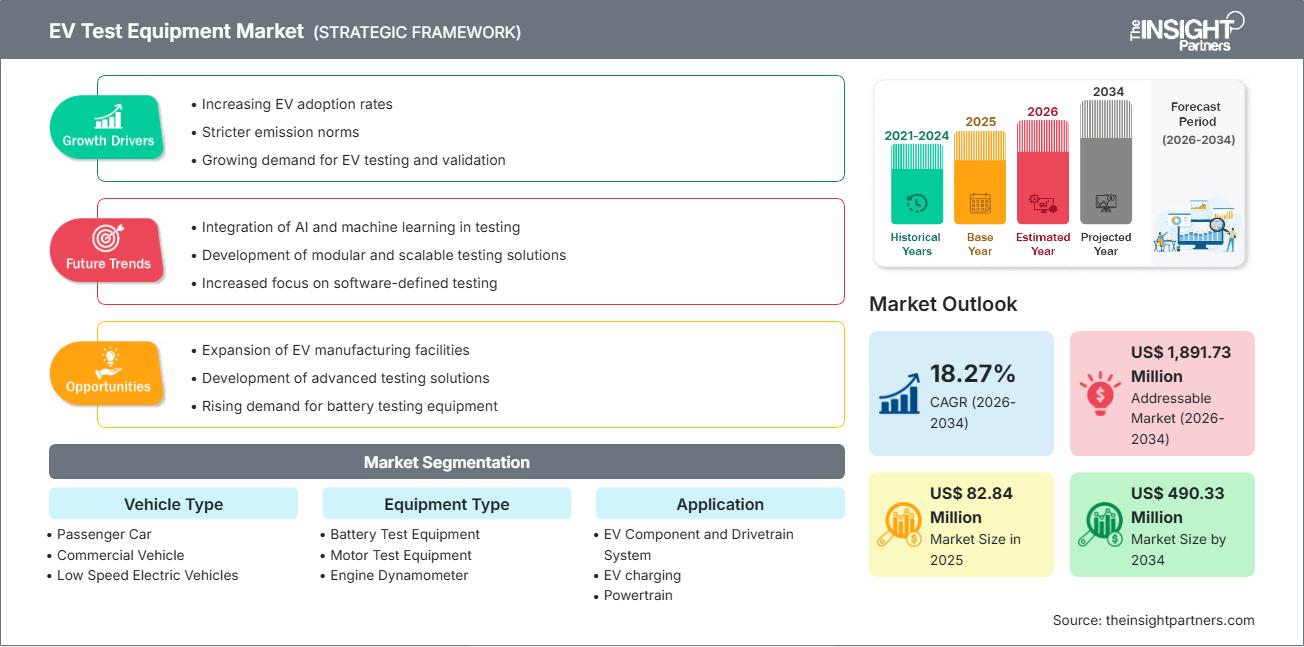
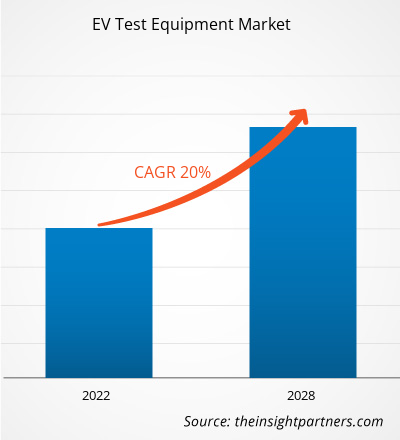
The EV Test Equipment Market size is expanding as automotive electrification increases the need for repeatable validation of batteries, motors, inverters, charging systems, and complete drivetrains. The market size is US$ 82.84 Million in 2025 and is projected to reach US$ 490.33 Million by 2034, registering a CAGR of 18.27% from 2026 to 2034. Rising testing complexity, higher voltage architectures, and stricter performance requirements are reshaping automotive engineering workflows.
North America remains strategically important because established vehicle manufacturers, battery developers, and technology suppliers are increasing investments in electrified powertrains and validation infrastructure. The EV Test Equipment Market in the region is supported by high-power laboratory development, regulatory testing requirements, and demand for accelerated product qualification. Growth is expected at an estimated 16–18% CAGR during 2026–2034, with the US accounting for the dominant regional demand.
EV Test Equipment Market Assessment and Insights
- North America: North America is expected to hold a 28–32% EV Test Equipment Market share in 2025 and grow at a 16–18% CAGR between 2026–2034, supported by battery manufacturing, advanced vehicle engineering, charging infrastructure validation, and high-power testing investments.
- US: The US is projected to represent 78–82% of North America's 2025 demand, growing at a 15–17% CAGR between 2026–2034 as OEM laboratories expand battery, drivetrain, and charging validation capabilities.
- Europe: Europe is estimated to capture a 24–28% share in 2025 and expand at an 18–20% CAGR between 2026–2034, led by Germany, the UK, France, Italy, and Spain through stringent vehicle testing and electrification programs.
- Asia Pacific: Asia Pacific is expected to command a 34–38% share in 2025 and record a 20–22% CAGR between 2026–2034, led by China, Japan, South Korea, and India through vehicle production, battery investment, and charging expansion.
- Largest Segment: Passenger Car is estimated to hold a 62–66% market share in 2025, with a 17–19% CAGR during 2026–2034, reflecting its broad testing requirements and production scale.
- High Growth Segment: EV charging is estimated to represent a 20–24% market share in 2025 and grow at a 21–23% CAGR during 2026–2034 as charging interoperability and high-power validation intensify.
- Key companies analyzed in detail: National Instruments Corporation, HORIBA Ltd., Arbin Instruments, Maccor Inc., Keysight Technologies, Inc., Froude, Inc., Dynomerk Controls, Comemso Electronics GmbH, Dürr Group, TÜV Rheinland, Intertek Group plc, TOYO SYSTEM CO., LTD., WONIK PNE CO., LTD.
Source: The Insight Partners' analysis based on proprietary research, government publications, company annual reports, investor presentations, industry databases, and expert interviews.
The EV Test Equipment market has transitioned from traditional components measuring to full validation that includes batteries, modules, inverter, motors, chargers, and even entire drivetrain. Increased voltages in EV platforms have created an increasing need for accuracy in power conversions, regeneration loads, thermal analysis, and safety monitoring. Increasingly, production labs incorporate modular equipment, automation software, and data management systems into their setups to enable test procedures to be taken from engineering prototypes to reliable production validation.
The EV Test Equipment Market forecast indicates that testing infrastructure will continue to develop in emerging auto-manufacturing hubs and upgraded in existing regions. Growing investments will shift towards systems capable of adapting to different chemistries, charging modes, and architectures in the vehicles without hardware changes. Increased regulations around battery safety, electromagnetic compatibility, functionality, and charging will drive adoption of automated testing processes.
EV Test Equipment Market Report Scope
| Report Attribute | Details |
|---|---|
| Market size in 2025 | US$ 82.84 Million |
| Market Size by 2034 | US$ 490.33 Million |
| Global CAGR (2026 - 2034) | 18.27% |
| Historical Data | 2021-2024 |
| Forecast period | 2026-2034 |
EV Test Equipment Market Analysis
EV Test Equipment Market growth is directly tied to the increased complexity of the entire electric vehicle supply chain. Batteries, components, OEMs, certification centers, and research institutes all need test equipment for cells, packs, motors, inverters, chargers, and drive trains. Suppliers then differentiate themselves not just on accuracy but also on automation capabilities, software integrations, power density, regeneration capabilities, and compatibility with evolving vehicle designs.
Supply chain dynamics in the EV Test Equipment Market are driven by specialized test equipment, power electronics, sensors, control software, and integration capabilities. High-power test systems are inherently engineering-intensive since electrical safety, thermal considerations, grid connections, and laboratory infrastructures have to be taken into account at once. Modularity allows customers to scale channels and power ratings in phases. Independent laboratories also offer an option for small suppliers who do not want to build their own high-voltage labs.
The EV Test Equipment Market analysis indicates that the competition is heavily fragmented in several categories such as test instrument vendors, engineering services providers for automobiles, certifiers, and high power systems vendors. National Instruments Corporation has been focusing on hardware and software integration, whereas HORIBA Ltd. and Froude, Inc. serve needs for powertrain and dynamometer respectively. Key Sight Technologies, Inc. has been building capability in charging validation, whereas Arbin Instruments and Maccor Inc. still remain significant players in battery test environment.
Strategies in the EV Test Equipment Market have become oriented on interoperability, automation, and life cycle aspects rather than single instruments. Comemso Electronics GmbH concentrates on EV/EVSE validation, whereas TÜV Rheinland and Intertek Group plc have testing and certification capabilities. Dynomerk Controls, TOYO SYSTEM CO., LTD., WONIK PNE CO., LTD., and Dürr Group add even more fragmentation with their test equipment and engineering capabilities. Hence, the investment flows are being directed to integrated test systems capable of working at a higher power level and more complex test procedures.
● REPORT CUSTOMIZATION
Tailor This Report To Align With Your Specific Business Requirements
This report can be customized to align precisely with your business objectives, scope, and target markets. Customization options include tailored segmentation, geography, competitive analysis, and strategic insights to support informed decision-making.
Customize This Report →WHAT YOU CAN ADJUST
- ● Segmentations
- ● Geography
- ● Competitive Analysis
- ● Language Preferences
EV Test Equipment Market: Strategic Insights
Regional Insights
North America EV Test Equipment Market
The North American EV Test Equipment market is forecasted to hold a 28-32% share by 2025, growing with a 16-18% CAGR during 2025-2034. The market gains an edge due to the presence of robust automotive engineering skills, battery development initiatives, semiconductor ecosystem, and charging stations. The US leads demand in the region, whereas Canada participates via battery material supply, automobile production, and clean technology investments. High power testing solutions are gaining prominence as the producers assess larger batteries and charging capabilities.
The EV Test Equipment Market report indicates that automotive test laboratories will need high-performance test stands, battery emulation, hardware-in-loop, and drivetrain dynamometer solutions. The region's structural strength lies in its engineering expertise and certification infrastructure. Yet, capital intensity and grid infrastructure could constrain further growth of laboratories. Solutions providers with modularity in architecture, energy-efficient power, measurement automation, and software solutions for testing can gain an edge.
U.S. EV Test Equipment Market Market
The US accounts for around 78–82% of the 2025 demand from North America and is forecasted to grow at a 15–17% CAGR until 2034. Leading OEMs, battery manufacturers, charging solution providers, and parts makers operate testing facilities that encompass battery validation, electric motors, power electronics, EVSE, and vehicle system testing. In addition, research institutions also help in driving demand for test equipment and simulation environment.
Application wise, there is an inclination towards testing of high-power batteries, bidirectional charging, inverter validation, and connected testing. Some of the key players operating in this space include National Instruments Corporation, Keysight Technologies, Inc., HORIBA Ltd., and Intertek Group plc among others. Decisions related to investments are focusing on lab usage efficiency, energy recovery, automated reports, and flexible configuration owing to rapid changes in battery and charging technologies.
Europe EV Test Equipment Market
Europe will constitute a 24-28% market share by 2025 and register an 18-20% CAGR till 2034. Germany dominates region-wise market owing to its automotive manufacturing industry, well-established engineering industry, and presence of vehicle and components development companies. UK, France, Italy, and Spain also play their part through initiatives on electrification and development of charging solutions and technologies.
Germany is key to all activities related to drivetrain, batteries, and vehicles certifications. Manufacturers need highly accurate dynamometer and power electronics testing. UK focuses on research and development of advanced mobility solutions along with charging technology, whereas France and Italy offer combination of OEM manufacturing along with supplier engineering activities. Spain has been building its EV manufacturing and battery manufacturing capabilities. Emissions, safety, interoperability and performance of vehicles are regulated and hence ensure a constant demand for testing.
APAC EV Test Equipment Market
APAC is estimated to hold a 34–38% share in 2025 and record a 20–22% CAGR through 2034, making it the leading regional market. China leads regional demand, followed by Japan, South Korea, India, and Australia. Large-scale vehicle production and battery manufacturing create substantial requirements for laboratory and production testing.
China benefits from extensive EV manufacturing and charging deployment, while Japan and South Korea maintain strong automotive and battery engineering capabilities. India is expanding EV production and testing infrastructure, and Australia contributes through research and resource-linked battery activity. Industrial policy, localization initiatives, battery investment, and charging development support laboratory modernization across the region.
Middle East & Africa EV Test Equipment Market
Middle East and Africa demand is expected to expand at a 14–16% CAGR through 2034. Saudi Arabia and the UAE lead regional activity through transport diversification, smart mobility programs, and charging infrastructure investment. South Africa remains an important automotive production center, while the rest of MEA develops selectively around urban mobility and fleet electrification.
Energy infrastructure is a major consideration because high-power test facilities require reliable electricity, cooling, and controlled laboratory environments. Regional buyers are therefore likely to favor scalable systems and specialist testing partnerships instead of fully integrated facilities. Saudi Arabia is positioned as the leading regional market as mobility investment and industrial diversification increase the need for vehicle and charging validation capabilities.
Segmentation Analysis
Vehicle Type
Vehicle Type is expected to expand at a 17–19% CAGR during 2026–2034. Passenger vehicles account for the broadest testing demand because battery, drivetrain, charging, and software validation are required across multiple development stages. Commercial and low-speed electric platforms add specialized requirements related to duty cycles, durability, payload, and operating environments.
- Passenger Car: Passenger cars represent the core testing base because manufacturers require repeated validation of batteries, motors, inverters, charging systems, and complete powertrains across diverse vehicle platforms.
- Commercial Vehicle: Commercial vehicles require endurance-oriented testing for heavier loads, longer operating cycles, thermal stress, and charging performance, making specialized drivetrain and battery validation strategically important.
- Low Speed Electric Vehicles: Low-speed electric vehicles generate demand for compact battery, motor, controller, and charger validation systems, particularly where manufacturers prioritize cost efficiency and simplified development architectures.
Equipment Type
Equipment Type is projected to grow at an 18–20% CAGR during 2026–2034. Demand is broad because electrified vehicles require interconnected validation across energy storage, propulsion, charging, and transmission systems. Buyers increasingly seek configurable equipment that can support multiple voltage levels and automated test protocols rather than isolated instruments.
- Battery Test Equipment: Battery test equipment supports cell, module, and pack characterization, lifecycle evaluation, safety validation, and production verification, making it fundamental to battery development and quality control.
- Motor Test Equipment: Motor test equipment measures torque, speed, efficiency, thermal behavior, and transient performance, supporting optimization of electric propulsion systems and validation of advanced motor architectures.
- Engine Dynamometer: Engine dynamometers remain relevant where electrified and hybrid powertrains require controlled mechanical testing, comparative evaluation, and validation of power delivery under repeatable operating conditions.
- Chassis Dynamometer: Chassis dynamometers provide controlled whole-vehicle testing for efficiency, performance, range, and drive-cycle behavior, supporting development teams that need repeatable road-load conditions.
- Transmission Dynamometer: Transmission dynamometers enable controlled evaluation of drivetrain components, helping manufacturers assess mechanical losses, durability, thermal behavior, and integration with electrified propulsion systems.
- Fuel Injection Pump Tester: Fuel injection pump testers support hybrid and conventional powertrain programs where combustion systems remain part of vehicle development, particularly for diversified propulsion portfolios.
- Inverter Tester: Inverter testers validate switching behavior, efficiency, thermal performance, protection functions, and control strategies, supporting the increasing use of high-voltage power electronics.
- EV Drivetrain Test: EV drivetrain testing combines motor, inverter, transmission, and control validation to reproduce demanding operating conditions and identify integration issues before vehicle-level testing.
- On-Board Charger: On-board charger testing evaluates conversion efficiency, power quality, communication, thermal behavior, and charging reliability, supporting compatibility with increasingly diverse charging environments.
- AC/DC EVSE: AC/DC EVSE testing addresses charging performance, communication, protection, interoperability, and compliance, becoming strategically important as charging networks diversify across markets.
Application
Application is expected to register a 19–21% CAGR during 2026–2034. The segment benefits from expanding test requirements across components, charging interfaces, and powertrain systems. Integration of hardware, software, simulation, and data analytics is increasing as manufacturers attempt to identify defects earlier and reduce physical prototype cycles.
- EV Component and Drivetrain System: This application covers validation of batteries, motors, inverters, controllers, and drivetrain assemblies, supporting component-level optimization before integration into complete vehicles.
- EV charging: EV charging applications require interoperability, protocol, power quality, safety, and performance validation across vehicles and charging equipment, making automated test systems increasingly valuable.
- Powertrain: Powertrain testing evaluates coordinated behavior among energy storage, motor, inverter, and mechanical systems, helping engineers optimize efficiency, durability, responsiveness, and thermal performance.
End-Users
End Users are forecast to grow at a 17–19% CAGR during 2026–2034. OEMs remain central because they require comprehensive validation infrastructure, while Tier 1 suppliers increasingly conduct component-level testing independently. Research and academic institutions contribute through battery, power electronics, mobility, and charging research programs requiring adaptable laboratory platforms.
- OEMs: OEMs require comprehensive test environments spanning prototype validation, certification preparation, production quality, and vehicle integration, making scalable and software-connected infrastructure strategically significant.
- Tier 1 Suppliers: Tier 1 suppliers increasingly validate batteries, motors, inverters, chargers, and electronic systems independently, creating demand for compact, modular equipment that can support multiple customer programs.
- Research and Academics: Research and academic institutions prioritize flexible platforms for experimental battery chemistries, power electronics, charging protocols, and vehicle simulation where configurable instrumentation supports changing research objectives.
Opportunity Snapshot
| End Users | Revenue Contribution (High/Medium/Low) | Trend Tag | Adoption Stage |
|---|---|---|---|
| OEMs | High | Integrated Labs | Mature |
| Tier 1 Suppliers | Medium | Component Validation | Scaling |
| Research and Academics | Low | Open Testing | Emerging |
EV Test Equipment Market Growth Drivers and Impact Analysis
Higher Battery Voltage and Power Density
According to the EV Test Equipment Market trends, the transition toward higher-voltage battery architectures is increasing the technical requirements placed on testing laboratories. Engineering design needs to address fast transients, insulation properties, heat effects, charge capabilities, and power conversion under increasingly challenging operating environments. All this necessitates the need for regenerative power supplies, battery simulation capabilities, high-bandwidth instrumentation and safety interlocks. Increased power density affects lab economics, as electricity supply capacity, cooling and energy recovery becomes part of the economic considerations. Suppliers who offer such test capabilities on modular platforms can be of immense value as labs expand without having to redesign the supporting facilities. Such an investment cycle involves not only the battery makers but also inverter suppliers, charger suppliers, drivetrain providers, and even certification laboratories.
Expansion of Automated and Data-Centric Validation
Automation becomes essential for automotive development due to the inefficiency of manual operations to handle complicated parameter sets, lengthy endurance tests, and large amounts of data. Automation allows designers to create identical conditions, make comparisons between the performance of different prototypes, and have traceable documentation for decision-making regarding the quality and compliance of the design. The effect spills over to production as the production of batteries and other components is associated with the necessity of high-speed inspection without loss of measurement precision. Instrumentation coupled with software allows managers to monitor the testing process centrally and remotely and create uniform reports in different laboratories. Therefore, the investments made now are increasingly concerned not only about hardware but also about software and related services, such as calibration management and workflow organization.
Stricter Charging Interoperability and Safety Requirements
Charge systems are growing in complexity in light of the fact that manufactures provide several types of communication standards, bidirectional charging capabilities, high charging power, and different grid conditions. Testing will be required to confirm electrical functionality, communication, faults, compatibility, and safe operation. This trend is especially clear in EVSE testing labs and certification facilities, as protocol testing automation will help to decrease repeated engineering efforts and speed up certification. High-power charging raises the requirement for emulation due to the fact that real cars and batteries are costly, dangerous, and challenging to use repeatedly in development phase. Therefore, test equipment providers can target a wide variety of customers ranging from charging companies, component manufacturers, OEMs, and utility companies. When charging standards change, it is advisable to prefer configurational test systems over fixed ones.
EV Test Equipment Market Future Trends
Digital Twins and Hardware-in-the-Loop Expansion
The application of digital twins for EV testing will probably grow deeper, since engineers will need to verify the behavior of batteries, inverters, motors, and charging stations at an earlier stage. The model-based environment will make it possible to simulate the conditions that precede the full availability of hardware prototypes. A hardware-in-the-loop test system will make it possible to combine simulation and hardware to test the control software and the electronics. In the long term, test laboratories may use a common digital model throughout design, validation, and production engineering, thus establishing an uninterrupted chain of evidences. Digital twins should also enable quicker assessment of new battery materials and designs, as well as new vehicle architectures, due to the ability to modify test parameters in software.
Regenerative Testing and Energy-Efficient Laboratories
Future laboratory design will increasingly emphasize regenerative power systems that return energy to the electrical network rather than dissipating it as heat. This becomes particularly relevant for battery cycling, motor testing, inverter validation, and high-power charging because repeated charge and discharge operations can create substantial energy loads. Regenerative architectures can reduce operating costs while also lowering cooling requirements and improving laboratory utilization. Test facilities may consequently evaluate equipment according to total lifecycle economics rather than acquisition price alone. Modular power stages will become valuable because laboratories can expand capacity as vehicle programs mature. Integration with facility energy management systems could further optimize load scheduling and grid interaction. These developments should encourage closer coordination among test equipment suppliers, power infrastructure providers, and automotive engineering organizations.
EV Test Equipment Market Opportunities
Independent Validation Services in Emerging Manufacturing Hubs
Emerging automotive manufacturing locations can create attractive opportunities for independent testing providers because smaller suppliers may lack capital for dedicated high-voltage laboratories. Service-based models can provide access to battery cycling, drivetrain dynamometers, charging validation, and certification preparation without requiring full equipment ownership. India, Southeast Asia, and selected Middle Eastern markets are particularly relevant as vehicle assembly, battery supply chains, and charging infrastructure develop. Investors can target facilities that combine accredited testing with engineering support, enabling customers to move from prototype evaluation to compliance evidence through one workflow. Flexible capacity is important because utilization can vary significantly between development programs. Partnerships with OEMs, Tier 1 suppliers, universities, and standards organizations could improve equipment utilization while building recurring demand for specialized testing services.
Interoperability Platforms for Global Charging Standards
The expansion of charging standards creates an opportunity for suppliers to develop software-defined platforms that support multiple protocols through configurable interfaces. Such systems can help manufacturers test vehicles and EVSE products intended for several geographic markets without maintaining separate equipment for every standard. Investment opportunities extend beyond physical instruments into automated test libraries, protocol analysis, fault simulation, and compliance reporting. Platforms that can accommodate changing requirements through software updates may offer stronger lifecycle economics than fixed-purpose systems. The opportunity is especially relevant to suppliers serving global OEMs and charging companies because product variants increasingly need validation across regions. Combining communication testing with electrical and power-performance measurements could further differentiate these platforms by reducing fragmented laboratory workflows.
Recent Developments
- April 2026: Vitrek launched its V10X high-voltage electrical safety tester, designed for automated production environments requiring high-voltage performance and precise leakage measurement. The tester delivers up to 30 kV AC for dielectric withstand testing, with 100-picoamp leakage-current resolution, while integrating low-resistance and ground-bond measurements in a single platform. It targets applications including household appliances, EV components, cable assemblies, lighting systems, power distribution equipment and medical electrical devices, with automation, barcode integration and data-traceability capabilities.
- May 2026: Fluke launched the FEV500, an all-in-one tester designed for fast DC Level 3 EV charging stations, enabling technicians to simulate an electric vehicle and conduct safety, performance and communication checks without connecting an actual EV. The device combines multiple testing functions, supports ISO 15118 and DIN SPEC 70121 communication standards, and provides guided workflows and PASS/FAIL results to simplify commissioning, maintenance and troubleshooting while reducing charging-station downtime.
- October 2025: Exeliq Solutions launched its AI-powered VoltPRO Series of smart EV battery testing systems, designed to provide real-time insights into battery State of Charge, State of Health and lifecycle performance. The range includes BTM80, BTM300 and BTM500 variants for production, R&D and large-scale battery testing, helping manufacturers identify issues earlier, improve battery reliability and safety, and support the growing Indian EV market.
Frequently Asked Questions

- Comprehensive Market Sizing and Forecast Analysis
- Detailed Segmentation Analysis
- In-Depth Market Dynamics Assessment
- Regional and Country-Level Insights
- Competitive Landscape and Company Benchmarking
- Strategic Business Intelligence
Recent Reports
Testimonials

The Insight Partners' SCADA System Market report is comprehensive, with valuable insights on current trends and future forecasts. The team was highly professional, responsive, and supportive throughout. We are very satisfied and highly recommend their services.
RAN KEDEM Partner, Reali Technologies LTDs
I requested a report on a very specific software market and the team produced the report in a few days. The information was very relevant and well presented. I then requested some changes and additions to the report. The team was again very responsive and I got the final report in less than a week.
JEAN-HERVE JENN Chairman, Future Analytica
We worked with The Insight Partners for an important market study and forecast. They gave us clear insights into opportunities and risks, which helped shape our plans. Their research was easy to use and based on solid data. It helped us make smart, confident decisions. We highly recommend them.
PIYUSH NAGPAL Sr. Vice President, High Beam Global
The Insight Partners delivered insightful, well-structured market research with strong domain expertise. Their team was professional and responsive throughout. The user-friendly website made accessing industry reports seamless. We highly recommend them for reliable, high-quality research services
YUKIHIKO ADACHI CEO, Deep Blue, LLC.
This is the first time I have purchased a market report from The Insight Partners.While I was unsure at first, I visited their web site and felt more comfortable to take the risk and purchase a market report.I am completely satisfied with the quality of the report and customer service. I had several questions and comments with the initial report, but after a couple of dialogs over email with their analyst I believe I have a report that I can use as input to our strategic planning process.Thank you so much for taking the extra time and making this a positive experience.I will definitely recommend your service to others and you will be my first call when we need further market data.
JOHN SUZUKI President and Chief Executive Officer, Board Director, BK Technologies
I wish to appreciate your support and the professionalism you displayed in the course of attending to my request for information regarding to infectious disease IVD market in Nigeria. I appreciate your patience, your guidance, and the fact that you were willing to offer a discount, which eventually made it possible for us to close a deal. I look forward to engaging The Insight Partners in the future, all thanks to the impression you have created in me as a result of this first encounter.
DR CHIJIOKE ONYIA MANAGING DIRECTOR, PineCrest Healthcare Ltd.Reason to Buy
- Informed Decision-Making
- Understanding Market Dynamics
- Competitive Analysis
- Identifying Emerging Markets
- Customer Insights
- Market Forecasts
- Risk Mitigation
- Boosting Operational Efficiency
- Strategic Planning
- Investment Justification
- Tracking Industry Innovations
- Aligning with Regulatory Trends





 Get Free Sample for