
EVA Film Market Trends, Size & Forecast by 2034
Coverage: By Application (Solar Cell, Laminated Glass, Automotive Parts, Others) , and Geography (North America, Europe, Asia Pacific, and South and Central America)
- Status : Data Released
- Report Code : TIPRE00020155
- Category : Chemicals and Materials
- No. of Pages : 150
- Available Report Formats :


- Last update date : November 09, 2026


2025 Market Size
US$ 5.76 Bn
Base year value
2034 Forecast
US$ 9.56 Bn
Projected by 2034
CAGR 2026-2034
5.78 %
Growth rate
Addressable Market
US$ 69.38 Bn
(2026-2034)
The EVA Film Market was valued at US$ 5.76 Billion in 2025 and is projected to reach US$ 9.56 Billion by 2034, registering a CAGR of 5.78% during 2026–2034. Market expansion is supported by photovoltaic module manufacturing, demand for durable polymer films, growth in flexible packaging, and the use of laminated materials in automotive and industrial applications. Product performance, manufacturing efficiency, feedstock availability, and the growing importance of long-term material reliability influence purchasing decisions and competitive positioning.
North America remains an important market for EVA film because of its solar manufacturing investments, established packaging industry, and demand for engineered materials. The region is expected to register a modeled CAGR of ~5% through 2034. Investments in domestic photovoltaic supply chains and the continued use of polymer films in industrial lamination support demand. Supplier qualification, product consistency, and compliance with end-use performance requirements are important factors shaping procurement and investment decisions across the region.
EVA Film Market Assessment and Insights
Regional Outlook
- North America: ~25% of the global EVA Film Market share in 2025 | ~5% CAGR through 2034. Market position: North America has an established industrial and packaging base, alongside investment in domestic solar manufacturing. Demand is supported by photovoltaic supply-chain development, specialty materials procurement, and applications requiring reliable bonding and protective film performance.
- US: ~75% of North American market revenue in 2025 | ~5% CAGR through 2034. Market position: The United States represents the largest national market within North America in this modeled assessment. Solar manufacturing investment, industrial packaging demand, and specialty-film applications support consumption, while procurement decisions emphasize technical qualification and dependable supply.
- Europe: ~22% of the global market in 2025 | ~5% CAGR through 2034. Market position: Europe benefits from established automotive, packaging, and renewable energy industries. Germany has a prominent role in the regional industrial ecosystem, while the UK, France, Italy, and Spain contribute through manufacturing, solar deployment, and demand for application-specific films.
- Asia Pacific: ~45% of the global market in 2025 | ~7% CAGR through 2034. Market position: Asia Pacific is the largest and fastest-growing region in this modeled outlook. China's photovoltaic manufacturing ecosystem, South Korea's chemical industry, Japan's advanced materials capabilities, and expanding Indian solar manufacturing underpin regional demand.
Segment Outlook
- Solar Panel Encapsulation: ~62% share in 2025 | ~6% CAGR through 2034. Market position: Photovoltaic encapsulation is the largest modeled application segment because EVA films provide adhesion, insulation, and environmental protection within solar modules. Module production, durability requirements, and encapsulant qualification influence demand.
- Renewable Energy: ~55% share in 2025 | ~7% CAGR through 2034. Market position: Renewable energy is the high-growth end-use segment in this modeled outlook. Expanding solar manufacturing, deployment of photovoltaic installations, and requirements for dependable module performance support demand for encapsulant materials.
Competitive Coverage
Allied Glasses, Arkema, Brentwood Plastics, Inc., Celanese Corporation, Changzhou Bbetter Film Technologies Co., Ltd., Dr. Dietrich Müller GmbH, Folienwerk Wolfen GmbH, Hanwha Solutions/Chemical Corporation, Mitsui Chemicals Tohcello, Inc., The 3M Company.
Methodology
The Insight Partners follows Data Collection & Secondary Research, Primary Research, Data Analysis, and Data Triangulation & Final Review to validate market estimates and insights.
Source: The Insight Partners' analysis based on proprietary research, government publications, company annual reports, investor presentations, industry databases, and expert interviews.
The EVA Film Market has grown along with developments in polymer technology, multilayer film manufacturing, and photovoltaic module development. Ethylene-vinyl acetate provides flexibility, adhesion, and useful optical properties, making it appropriate for applications in which films are needed for surface bonding or protection of sensitive elements. Advances in manufacturing technology have made the significance of uniform thickness, purity, curing characteristics, and consistent rolls more important. In the solar industry, the quality of encapsulation is particularly important because any imperfections in the material can impact adhesion, optical transmittance, and module lifetime. The industrial converters require films that are compatible with existing lamination, extrusion, and sealing equipment.
The forecast until 2034 will depend on the geographical concentration of the solar manufacturing, investments in polymer processing capacities, and the ability of the suppliers to deliver ever more specialized products. Emerging manufacturing centers may enjoy the benefits of local raw material sourcing, shorter transportation time, and closer collaboration with module manufacturers. Requirements for materials may also be driven by regulatory requirements, product testing, and environmental factors. Application engineering experience may give an advantage to the suppliers of materials needed in various operating conditions by their customers.
EVA Film Market Report Scope
| Report Attribute | Details |
|---|---|
| Market size in 2025 | US$ 5.76 Billion |
| Market Size by 2034 | US$ 9.56 Billion |
| Global CAGR (2026 - 2034) | 5.78% |
| Historical Data | 2021-2024 |
| Forecast period | 2026-2034 |
EVA Film Market Analysis
The demand side of the market for EVA film is driven by the level of manufacturing activity downstream as well as specific requirements of the end-users. Photovoltaic modules utilize encapsulation film to secure the assembled cells together, while packaging converters need certain levels of sealing and lamination performance. Automotive and industrial customers evaluate substrate compatibility of the film, its performance at certain temperatures and under certain appearances, and production conditions. The above factors lead to different demands and priorities from purchasers who are not able to rely solely on prices.
The supply network includes producers of ethylene and vinyl acetate feedstock materials, manufacturers of polymers, converters into films, equipment suppliers, distributors, and ultimate manufacturers of products. The level of availability and changes in prices of the feedstock materials will affect the cost of conversion, while manufacturing yields and power consumption will determine the margins for the producers. Film suppliers have to coordinate resin choice, formulations, processes of extrusion or casting, and controls to secure the reproducible output.
Competitors include existing chemicals manufacturers, film specialists, and regional converters catering to various needs. Competing suppliers are Arkema, Celanese Corporation, Mitsui Chemicals Tohcello, Inc., whose expertise is in polymers and materials, Hanwha Solutions/Chemical Corporation, which fits into the supply chain of solar materials. 3M Company is involved in engineered films and solar materials applications. Also included among other competitors are Brentwood Plastics, Inc., Changzhou Bbetter Film Technologies Co., Ltd., Dr. Dietrich Müller GmbH, Folienwerk Wolfen GmbH, and Allied Glasses.
Investment focus would be on productivity, application development, quality control, and manufacturing capabilities by regions. Those suppliers able to show repeatable processing, supply capability, and performance for particular applications will be able to establish better customer relationships. However, at the same time, buyers can evaluate alternative suppliers in order to manage cost and supply risks. Thus, strategic focus will depend more on product performance, economic efficiency, geography, and customer relations rather than simply production scale.
● REPORT CUSTOMIZATION
Tailor This Report To Align With Your Specific Business Requirements
This report can be customized to align precisely with your business objectives, scope, and target markets. Customization options include tailored segmentation, geography, competitive analysis, and strategic insights to support informed decision-making.
Customize This Report →WHAT YOU CAN ADJUST
- ● Segmentations
- ● Geography
- ● Competitive Analysis
- ● Language Preferences
EVA Film Market: Strategic Insights
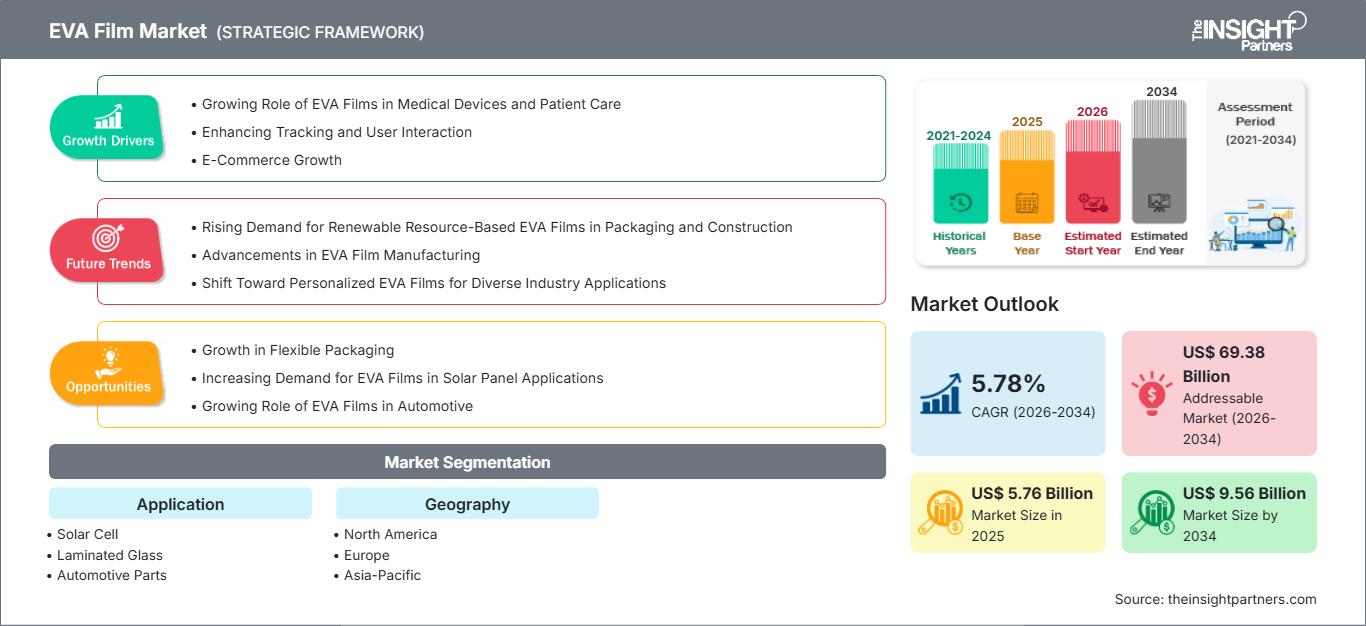
Regional Insights
North America EVA Film Market
North America accounts for a modeled ~25% of the global EVA Film Market in 2025 and is projected to expand at a CAGR of ~5% through 2034. Demand regionally will be driven by the mix of the conversion of packaging, automotive production, industrial lamination, and the involvement of solar power supplies. The United States is the largest national market in the region as per this assessment due to its manufacturing capacity and demand for engineered materials. Canada brings in its share through the use in industry and renewable energy sources, while Mexico provides support to regional manufacturing processes especially in automotive and consumer goods.
The regional outlook will be dependent on the speed at which photovoltaics are being manufactured locally, capital expenditure, and the ability of the manufacturers to source materials efficiently. The buyers will examine specifications, reliability of delivery and consistency in batch production. Proximity to the supplier may minimize risks in logistics and allow for problem-solving in qualification process. However, local producers will have to compete with imports, as well as cope with fluctuating prices of polymers and manufacturing costs.
U.S. EVA Film Market
The United States represents a modeled ~75% of North American market revenue in 2025 and is expected to record a CAGR of ~5% through 2034. Demands for films arise from photovoltaic encapsulation, photovoltaic packaging, and specialized industrial applications. Investments into solar manufacturing generate demands for films used as protection and adhesives in the bonding of module parts, whereas the packaging converters make purchases based on sealing capabilities and performance in processing equipment. Automotive and electronic applications represent further applications for engineered polymers.
Some competitors include international suppliers of materials and converters. 3M Company provides products for photovoltaic encapsulation along with other engineered materials, whereas multinationals in the chemical industry are part of the polymer supply chain. The buyer selects based on material quality and reliability, technical information, availability, and capability of sustaining consistent production on commercial scale. Local manufacture provides logistic advantage, whereas imports remain pertinent as long as they offer cost or quality advantage. Growth depends on utilization rate and investment by the end-users and qualification of suppliers beyond solar applications.
Europe EVA Film Market
Europe represents a modeled ~22% of the global EVA Film Market in 2025, with a projected CAGR of ~5% through 2034. The region encompasses conventional packaging converting, automotive manufacture, industrial materials processing, and renewable energy installations. Germany is the foremost nation in Europe in this ranking due to its wide industrial portfolio, its automotive industry, and its sophisticated knowledge of materials. The industrial portfolio requires polymers films with particular processing properties and qualities. Competition in the region is based on reliability of products, continuity of supply, and customizing.
The United Kingdom makes contributions in packaging, materials for construction, industrial converting and renewable energy applications. The French market is driven by packaging demand, automotive industry, and solar installations. Italy has markets supported by packaging converters, machinery industries, and automotive suppliers. Spain is helped by the development of solar energy and material demands in industrial and consumer packaging. There is a difference in application of nations' markets.
Europeans have become more sensitive to issues of production efficiency, conformity to standards, waste disposal, and reliability of material performance. Technical validation becomes important for automotive and industrial end-users, while package manufacturers demand reliability of sealing, processing efficiency, and applicability to their packaging systems. At the same time, producers should be prepared to react to changes in cost of energy and raw materials influencing the cost-effectiveness of film conversion. The most promising areas for investment are those where suppliers can provide reliable services and specific grades at competitive prices.
APAC EVA Film Market
Asia Pacific accounts for a modeled ~45% of the global EVA Film Market in 2025 and is projected to grow at a CAGR of ~7% through 2034. China is the leading country in Asia Pacific in this assessment, supported by its photovoltaic manufacturing base, chemical production capacity, and extensive network of film converters. Solar module manufacturing is a particularly important demand channel because encapsulation materials are required during module assembly. The region also benefits from packaging demand and industrial production across multiple economies.
The EVA Film Market forecast shows that Japan participates via advanced materials, industrial manufacturing, and high-performance film applications. South Korea is involved via chemical production along with solar material technology, whereas India provides market growth via domestic photovoltaic manufacturing and packaging conversion. Australia contributes by virtue of solar deployment and downstream demand, but its manufacturing capabilities are different from those of other Asian countries. Regional growth will be dependent on manufacturing capabilities, investment, and competitiveness of materials available locally. Competition management, technology evolution of modules, and qualification of the performance of encapsulants will be important for suppliers.
Middle East & Africa EVA Film Market
The Middle East and Africa region is projected to register a modeled CAGR of ~7% through 2034. Demand is supported by renewable energy investment, infrastructure development, packaging consumption, and industrial diversification. Saudi Arabia has an important position in the Middle East through its petrochemical base and investment in economic diversification, while the United Arab Emirates contributes through trade, manufacturing, and solar projects. These markets may offer opportunities for regional distribution, downstream conversion, and partnerships with established materials suppliers.
South Africa is an important market in Africa due to its industries, packaging needs, and renewable energy projects. Other markets in the region help out in the building sector, consumer goods, and industrial sectors; however, the need and readiness differ depending on the specific market. The cost of shipping film, the availability of suitable distributors, and transportation logistics are important factors in the decision-making process. The development of the region will be determined by how many projects get built out of announced energy projects, industrial activity in the region, and servicing of customers at competitive landed prices.
Segmentation Analysis
Type
Type is an important purchasing dimension because film formulations must meet different requirements for adhesion, optical behavior, electrical reliability, and durability. Buyers select materials based on the operating environment and the consequences of performance failure. In photovoltaic applications, qualification and long-term reliability can be more important than initial price alone. Demand is expected to favor suppliers that can deliver consistent formulation quality and technical support. Within this category, Anti-PID EVA Films are projected to record a modeled CAGR of ~7% through 2034 as manufacturers seek encapsulation materials that help mitigate potential-induced degradation risks.
- Standard EVA Film: Standard EVA film serves established applications requiring adhesion, flexibility, and dependable processing characteristics. It remains relevant where existing product specifications and production equipment are designed around conventional formulations. Buyers assess consistency, sealing or bonding performance, and cost effectiveness when selecting suitable grades.
- Anti-PID EVA Films: Anti-PID EVA films are designed for photovoltaic applications where reducing the risk of potential-induced degradation is a priority. Their relevance depends on module architecture, system voltage, environmental exposure, and validation results. Adoption is influenced by manufacturer qualification requirements and expectations for long-term performance.
Production Method
Production method influences film uniformity, processing economics, output characteristics, and the ability to meet customer specifications. Manufacturers select processes according to product formulation, required thickness, equipment capability, and the intended end use. Operational consistency and yield affect the competitiveness of each production line, while maintenance, energy use, and process control shape unit costs. Buyers prioritize the resulting film properties and dependable supply rather than the production route alone. Extrusion is projected to register a modeled CAGR of ~6% through 2034, supported by continuous production capabilities and its relevance to scalable film manufacturing.
- Extrusion: Extrusion supports continuous film production and can be configured for commercial-scale output. Process control is important for maintaining thickness, surface quality, and consistent material properties. Its economic value depends on line utilization, formulation requirements, equipment efficiency, and quality management.
- Casting: Casting enables manufacturers to produce films with controlled characteristics suited to specific conversion requirements. Its commercial suitability depends on equipment design, material formulation, production scale, and the required surface or dimensional properties. Buyers evaluate whether the resulting film meets application specifications and processing needs.
Application
Application requirements determine how EVA film is specified, processed, and evaluated after installation or conversion. Solar-related applications emphasize bonding, protection, and long-term material stability, while packaging and lamination customers focus on sealing performance, surface quality, and compatibility with substrates. Suppliers must understand application-specific operating conditions and customer validation procedures. Product development is therefore closely linked to downstream equipment, end-user standards, and performance expectations. Solar Panel Encapsulation is projected to register a modeled CAGR of ~6% through 2034, reflecting its importance in photovoltaic module assembly and the need for reliable protective materials.
- Solar Panel Encapsulation: Solar panel encapsulation uses EVA film to bond module layers and protect photovoltaic cells against mechanical and environmental exposure. Material selection considers adhesion, optical transmission, electrical insulation, and resistance to degradation. Qualification requirements make consistency and long-term reliability central purchasing criteria.
- Lamination: Lamination applications use EVA film to bond or integrate compatible materials into a combined structure. Demand depends on substrate compatibility, appearance, bond strength, and the temperature and pressure conditions of the converting process. Film quality can affect finished-product performance and manufacturing yield.
- Heat Seal: Heat-seal applications require film behavior that supports reliable joining under defined processing conditions. Seal integrity, processing speed, and compatibility with the packaging or finished-product design influence selection. Customers assess whether the film can deliver repeatable seals without compromising productivity or product quality.
End-Use Industry
End-use industry influences the specification, sales channel, and demand profile of EVA film. Customers differ in their qualification procedures, operating environments, purchasing volumes, and tolerance for material variation. Suppliers serving several industries can diversify demand, although each application may require distinct technical support and product controls. Renewable Energy is projected to record a modeled CAGR of ~7% through 2034, supported by photovoltaic manufacturing and deployment. Its outlook remains sensitive to solar investment, module production, technology changes, and competition from alternative encapsulant materials.
- Renewable Energy: Renewable energy applications are closely associated with photovoltaic module assembly and the requirement to protect cells and maintain module integrity. Demand depends on manufacturing volumes, project deployment, module design, and encapsulant qualification. Reliable supply and product consistency are important to production planning.
- Packaging: Packaging customers use EVA film where bonding, sealing, flexibility, or compatibility with multilayer structures is required. Demand reflects consumer-goods production, industrial packaging, and converter activity. Buyers consider processability, seal quality, product appearance, and material cost when comparing suppliers.
- Automotive: Automotive applications require films and related polymer materials that meet defined performance, manufacturing, and durability requirements. Selection depends on component design, substrate compatibility, processing conditions, and quality standards. Supplier qualification and stable production are important because material variation can affect downstream assembly and finished-product consistency.
Opportunity Snapshot
| End Users | Revenue Contribution | Trend Tag | Adoption Stage |
|---|---|---|---|
| Renewable Energy | High | Solar Encapsulation | Scaling |
| Packaging | Medium | Flexible Packaging | Mature |
| Automotive | Low | Lightweight Materials | Scaling |
EVA Film Market Growth Drivers and Impact Analysis
Expansion of Photovoltaic Manufacturing and Solar Module Production
Photovoltaic manufacturing is a central demand driver for EVA film because encapsulation materials are integral to module assembly. As module manufacturers increase output, they require consistent film supply, predictable lamination performance, and materials that protect cells throughout their operating life. This creates opportunities for film converters that can meet technical specifications and maintain dependable deliveries. Manufacturing expansion also increases the importance of local supply networks, production planning, and quality assurance. However, demand does not automatically translate into higher margins because capacity additions can intensify competition among suppliers. Producers must balance output growth with utilization, yield, and customer qualification requirements to convert downstream expansion into sustainable commercial performance.
Demand for Reliable Polymer Films Across Industrial Applications
Packaging, lamination, and automotive manufacturing create demand for EVA film beyond photovoltaic encapsulation. These industries use polymer films where adhesion, flexibility, sealing performance, or compatibility with other materials contributes to finished-product functionality. Application requirements vary, making technical consultation and consistent processing characteristics important differentiators. Packaging converters prioritize reliable production and seal quality, while automotive and industrial customers may require additional validation against component specifications and operating conditions. This diversity creates opportunities for suppliers that can serve multiple customer groups without compromising application-specific quality. The commercial impact is strongest when manufacturers combine efficient conversion processes with dependable product documentation, responsive customer support, and the ability to maintain consistent material properties across production batches.
Investment in Localized Supply Chains and Manufacturing Efficiency
Regional sourcing strategies influence EVA film procurement as manufacturers seek to manage delivery risk, transportation costs, and production interruptions. Investment in upstream resin facilities, film-conversion lines, and technical service capabilities can improve coordination between material producers and downstream customers. Local manufacturing may shorten replenishment cycles and simplify troubleshooting, particularly where customers require close control over material specifications. Nevertheless, new capacity must be supported by sufficient demand, competitive operating costs, and effective distribution. Producers evaluating expansion should consider utilization, feedstock availability, equipment productivity, and customer qualification timelines. The market impact of localization therefore depends on whether investment creates a reliable cost and service advantage rather than merely adding nominal production capacity.
EVA Film Market Future Trends
Development of Application-Specific and Higher-Reliability Encapsulant Films
The EVA Film Market trends indicate that future product development is likely to place greater emphasis on matching encapsulant formulations to photovoltaic module designs, operating environments, and long-term reliability requirements. Manufacturers are evaluating material properties that influence adhesion, optical behavior, moisture exposure, electrical performance, and degradation. This creates room for differentiated formulations designed around specific module architectures and climatic conditions. Technical collaboration between film suppliers, resin producers, and module manufacturers may become more important as customers validate material combinations before commercial adoption. For suppliers, the strategic implication is a greater need for application testing, technical documentation, and controlled production. Commercial success will depend on demonstrated performance and manufacturing compatibility rather than product claims alone.
Material Substitution and Integration of Encapsulant Technologies
The evolution of photovoltaic module designs is encouraging manufacturers to compare EVA with alternative encapsulant materials and multilayer constructions. Polyolefin-based alternatives and combined film structures can offer different electrical, moisture-resistance, and processing characteristics, depending on the application. This competitive pressure may encourage EVA film producers to improve formulations, develop complementary products, and support customers with material-selection guidance. Adoption will depend on qualification results, cost, availability, and compatibility with existing production equipment. Rather than assuming that one material will displace another across the industry, suppliers should monitor the requirements of individual module designs and customer segments. The ability to demonstrate appropriate performance at a competitive total cost will influence material selection.
EVA Film Market Opportunities
Capacity Expansion and Technical Partnerships in Emerging Solar Manufacturing Hubs
Manufacturers can pursue opportunities by establishing production partnerships, distribution networks, and technical support capabilities in regions expanding photovoltaic manufacturing. India and selected Southeast Asian markets offer potential for closer coordination between film converters and module producers as domestic manufacturing ecosystems develop. Commercial feasibility depends on local customer commitments, feedstock access, equipment costs, logistics, and the scale required to operate efficiently. Partnerships may reduce market-entry barriers by providing established customer relationships and application knowledge. Before investing, companies should assess qualification timelines, existing supplier competition, expected plant utilization, and the availability of skilled production personnel. A phased expansion strategy can help limit exposure while allowing suppliers to build a credible customer base.
Product Differentiation Through Quality Assurance and Application Engineering
A further opportunity lies in improving customer retention through specialized technical support and consistent quality management. Suppliers can invest in testing capabilities, process monitoring, formulation control, and application-specific troubleshooting to help customers reduce manufacturing defects and maintain finished-product reliability. In photovoltaic applications, this can include supporting encapsulant qualification and investigating adhesion or durability concerns. Packaging and industrial customers may benefit from guidance on sealing conditions, substrate compatibility, and converting performance. Differentiation through technical service can reduce dependence on price competition, particularly where changing suppliers requires additional validation. Companies should prioritize investments that address measurable customer problems and can be supported by repeatable testing and documented production controls.
Recent Developments
- May 15, 2025: RenewSys India announced its CONSERV AA-14 FC anti-acid EVA encapsulant for next-generation solar modules. The product is designed to address concerns associated with acetic acid formation, including corrosion, yellowing, delamination, and degradation under challenging environmental conditions. The launch illustrates the industry's focus on specialized encapsulant formulations and improved module protection. Its commercial significance will depend on customer qualification, production compatibility, and demonstrated performance under relevant operating conditions.
- December 8, 2025: RenewSys secured a 400 MW EPE encapsulant supply agreement with ZNShine Solarworld. The agreement covers encapsulants for solar panels, with deliveries scheduled from November 2025 through February 2026. The EPE film combines EVA layers with a central POE layer, aiming to deliver improved potential-induced degradation (PID) resistance, durability, and reliability for high-efficiency solar modules, including TOPCon designs. The agreement highlights growing commercial demand for multilayer encapsulant films as manufacturers adopt advanced cell technologies. Its longer-term significance will depend on delivery execution, customer retention, and repeat orders.
Frequently Asked Questions

- Comprehensive Market Sizing and Forecast Analysis
- Detailed Segmentation Analysis
- In-Depth Market Dynamics Assessment
- Regional and Country-Level Insights
- Competitive Landscape and Company Benchmarking
- Strategic Business Intelligence
Recent Reports
Testimonials

The Insight Partners provided valuable market intelligence that supported our global go-to-market strategy. Their team was professional, responsive, and attentive to our feedback, providing thoughtful analysis and helpful methodological clarifications throughout the project.
Junmo Kim Chief Financial Officer (CFO), Enertech Co., Ltd.
The Insight Partners' SCADA System Market report is comprehensive, with valuable insights on current trends and future forecasts. The team was highly professional, responsive, and supportive throughout. We are very satisfied and highly recommend their services.
RAN KEDEM Partner, Reali Technologies LTDs
I requested a report on a very specific software market and the team produced the report in a few days. The information was very relevant and well presented. I then requested some changes and additions to the report. The team was again very responsive and I got the final report in less than a week.
JEAN-HERVE JENN Chairman, Future Analytica
We worked with The Insight Partners for an important market study and forecast. They gave us clear insights into opportunities and risks, which helped shape our plans. Their research was easy to use and based on solid data. It helped us make smart, confident decisions. We highly recommend them.
PIYUSH NAGPAL Sr. Vice President, High Beam Global
The Insight Partners delivered insightful, well-structured market research with strong domain expertise. Their team was professional and responsive throughout. The user-friendly website made accessing industry reports seamless. We highly recommend them for reliable, high-quality research services
YUKIHIKO ADACHI CEO, Deep Blue, LLC.
This is the first time I have purchased a market report from The Insight Partners.While I was unsure at first, I visited their web site and felt more comfortable to take the risk and purchase a market report.I am completely satisfied with the quality of the report and customer service. I had several questions and comments with the initial report, but after a couple of dialogs over email with their analyst I believe I have a report that I can use as input to our strategic planning process.Thank you so much for taking the extra time and making this a positive experience.I will definitely recommend your service to others and you will be my first call when we need further market data.
JOHN SUZUKI President and Chief Executive Officer, Board Director, BK Technologies
I wish to appreciate your support and the professionalism you displayed in the course of attending to my request for information regarding to infectious disease IVD market in Nigeria. I appreciate your patience, your guidance, and the fact that you were willing to offer a discount, which eventually made it possible for us to close a deal. I look forward to engaging The Insight Partners in the future, all thanks to the impression you have created in me as a result of this first encounter.
DR CHIJIOKE ONYIA MANAGING DIRECTOR, PineCrest Healthcare Ltd.Reason to Buy
- Informed Decision-Making
- Understanding Market Dynamics
- Competitive Analysis
- Identifying Emerging Markets
- Customer Insights
- Market Forecasts
- Risk Mitigation
- Boosting Operational Efficiency
- Strategic Planning
- Investment Justification
- Tracking Industry Innovations
- Aligning with Regulatory Trends





 Get Free Sample for