
Exhaust Sensor Market Size, Growth & Trends by 2034
Coverage: By Fuel Type (Gasoline Fuel, Diesel Fuel); Sensor Type (Exhaust Gas Pressure Sensor, Exhaust Gas Temperature Sensor, Particulate Matter Sensor, Oxygen/Lambda Sensor, Others), and Geography (North America, Europe, Asia Pacific, and South and Central America)
- Status : Data Released
- Report Code : TIPRE00016458
- Category : Electronics and Semiconductor
- No. of Pages : 150
- Available Report Formats :


- Last update date : August 17, 2026


2025 Market Size
US$ 38.44 Bn
Base year value
2034 Forecast
US$ 44.13 Bn
Projected by 2034
CAGR 2026-2034
1.54 %
Growth rate
Addressable Market
US$ 373.72 Bn
(2026-2034)
The exhaust sensor market was valued at US$ 38.44 Billion in 2025 and is projected to reach US$ 44.13 Billion by 2034, expanding at a CAGR of 1.54% during 2026–2034. The market includes sensors that monitor exhaust pressure, temperature, particulate matter, and oxygen concentration to support combustion control, emissions compliance, diagnostics, fuel efficiency, and the reliable operation of gasoline and diesel powertrains.
North America remains an important replacement and technology-development market, with the Exhaust Sensor Market size expected to expand at an estimated CAGR of 1.2–1.8%. Structural drivers include strict emissions-control requirements and a substantial installed base of passenger and commercial vehicles. Demand is also supported by hybrid powertrains, aftermarket diagnostics, heavy-duty applications, and continued investment in vehicle software and powertrain monitoring.
Exhaust Sensor Market Assessment and Insights
- North America: North America is estimated to hold a 24–28% exhaust sensor market share in 2025 and grow at a CAGR of 1.2–1.8% between 2026–2034, supported by emissions compliance, vehicle replacement, commercial fleets, and aftermarket diagnostics.
- US: The US is projected to represent 78–83% of North American demand in 2025 and expand at a CAGR of 1.3–1.9%, driven by light vehicles, heavy trucks, and stringent onboard diagnostics.
- Europe: Europe is estimated to account for 27–31% of global 2025 demand and grow at a CAGR of 1.0–1.6%, led by Germany, France, the UK, Italy, and Spain.
- Asia Pacific: Asia Pacific is expected to capture 36–40% of 2025 demand and register a CAGR of 1.8–2.4%, with China, Japan, India, South Korea, and Thailand leading regional production.
- Largest Segment: Oxygen/Lambda Sensor is estimated to hold a 44–48% market share in 2025 and grow at a CAGR of 1.2–1.8% between 2026–2034.
- High Growth Segment: Particulate Matter Sensor is estimated to represent a 9–13% market share in 2025 and expand at a CAGR of 4.5–5.5% through 2034.
- Key companies analyzed in detail: Continental AG, Delphi Technologies PLC, DENSO Corporation, HELLA GmbH & Co. KGaA, Hitachi, Ltd., Infineon Technologies AG, Niterra Co., Ltd., Robert Bosch GmbH, Sensata Technologies Holding plc, and Stoneridge, Inc.
Source: The Insight Partners' analysis based on proprietary research, government publications, company annual reports, investor presentations, industry databases, and expert interviews.
Exhaust Sensor Market development has been driven by the link among combustion efficiency, emission laws, and engine control through electronics. Traditional oxygen and temperature sensors have remained important, although pressure, particulate sensors, and wideband lambda technology enable more efficient control techniques. The production has been moving towards smaller size, faster reaction time, increased resistance to heat, and better self-diagnosis. The manufacturers are also tailoring their sensors to gasoline particulate filters, diesel after-treatment, exhaust gas recirculation, and intermittent running of the engine in hybrids.
According to the Exhaust Sensor Market, the future outlook will be determined by more stringent tests for real driving emissions, vehicle inspections, and the continued use of the internal combustion and hybrid engines. China, India, Southeast Asia, Eastern Europe, and Latin America present replacement and production market potential. Investments will likely focus on particulate measurement, sensor longevity, calibration software, and economical servicing in the aftermarket. Environmental agencies and regulators will continue shaping sensor product composition since accurate measurement is essential to meet the compliance regulations.
Exhaust Sensor Market Report Scope
| Report Attribute | Details |
|---|---|
| Market size in 2025 | US$ 38.44 Billion |
| Market Size by 2034 | US$ 44.13 Billion |
| Global CAGR (2026 - 2034) | 1.54% |
| Historical Data | 2021-2024 |
| Forecast period | 2026-2034 |
Exhaust Sensor Market Analysis
Growth Drivers in Exhaust Sensor market arise from the necessity of monitoring oxygen content, exhaust temperature, pressure differences, and particulate loadings depending on the varying operating conditions of the engine. While gasoline engines need lambda feedback to control air-to-fuel ratio, diesel systems rely on the pressure, temperature, and particulate monitoring to control the filters, exhaust gas recirculation system and the selective catalytic reduction system. Hybrid cars pose extra challenges in terms of frequent engine starts and stops.
According to the Exhaust Sensor Market forecast, the value chain includes ceramic materials, sensing elements, electronics packaging, signal conditioning, software, vehicle control unit, exhaust system manufacturer, Original Equipment Manufacturer, distribution, and servicing. Performance characteristics include response time, capability to withstand thermal shocks, contamination resistance, stability of calibration, and compatibility with the engine control software. The supply dynamics are affected by precious metals, technical ceramics, semiconductors, and qualification timelines. Demand for the aftermarket is driven by vehicle park age, diagnostic trouble codes, testing regulations, and repair costs.
The Exhaust Sensor Market report indicates that competition is very strong since the main competitors use the combination of their sensing technologies and the powertrain, electronics, exhaust treatment, and vehicle system offerings. Robert Bosch GmbH, Continental AG, DENSO Corporation, Niterra Co., Ltd., HELLA GmbH & Co. KGaA, Sensata Technologies Holding plc, and Stoneridge, Inc. fight using the portfolio approach, original equipment relationships, and global production capability. Delphi Technologies PLC, Hitachi, Ltd., and Infineon Technologies AG provide engine electronics, sensing, semiconductors, and control systems integration competencies.
Exhaust Sensor Market trends indicate that investments are going into the development of high-temperature materials, particulate detection sensors, wideband lambda sensing systems, and intelligent sensors. The strategic positioning will depend more on the ability to offer calibrated sensors that generate software-compliant outputs and the capability to provide such components after the initial program period. Competitors with global validation facilities and vehicle program expertise can secure design wins, whereas specialized firms might benefit from retrofit solutions and new particulate monitoring architectures.
● REPORT CUSTOMIZATION
Tailor This Report To Align With Your Specific Business Requirements
This report can be customized to align precisely with your business objectives, scope, and target markets. Customization options include tailored segmentation, geography, competitive analysis, and strategic insights to support informed decision-making.
Customize This Report →WHAT YOU CAN ADJUST
- ● Segmentations
- ● Geography
- ● Competitive Analysis
- ● Language Preferences
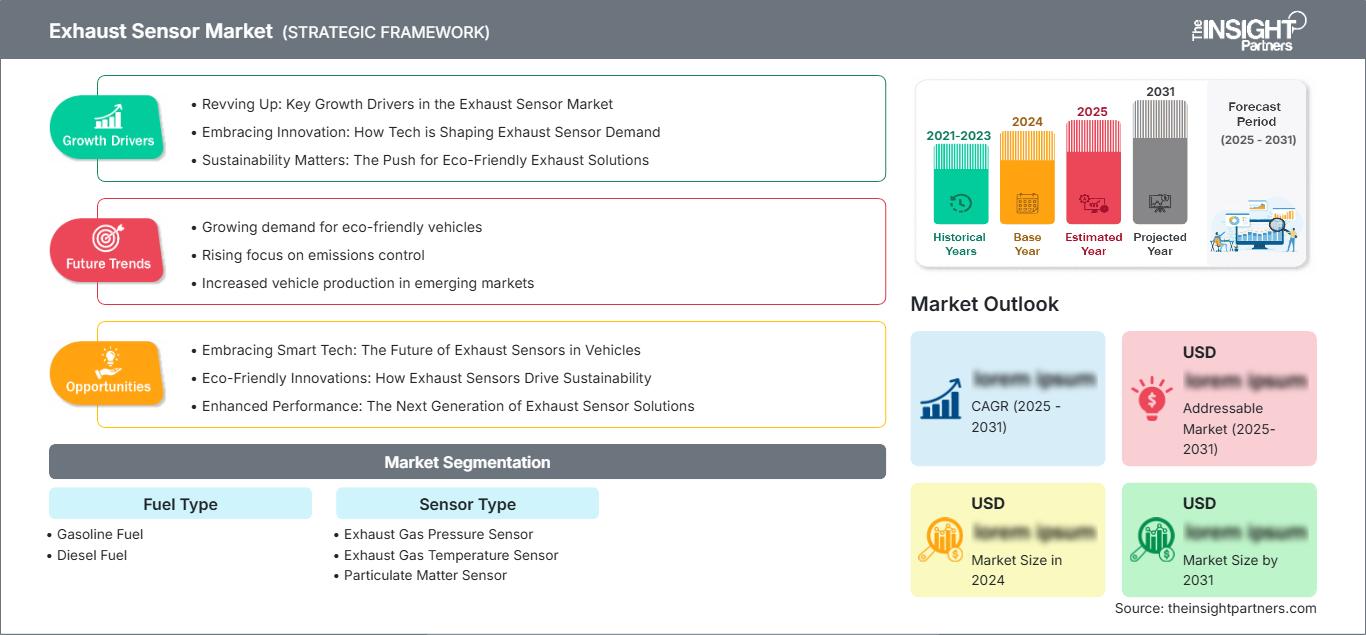
Exhaust Sensor Market: Strategic Insights
Regional Insights
North America Exhaust Sensor Market
North America is estimated to hold a 24–28% share in 2025 and grow at a CAGR of 1.2–1.8% through 2034. USA leads the region's consumption owing to its huge fleet of passenger cars and commercial trucks, emissions testing systems, and aftermarkets service system. Canada has contributions from commercial transportation, automobile manufacturing, mining machines, and replacements.
In terms of purchase behavior, the region prefers sensors that exhibit high resistance to heat, are compatible with diagnostics and have proven performance in heavy duty use. There is wide adoption of gasoline lambda sensors whereas diesel pressure, temperature and particulate sensors are used for trucks, buses, construction machines, and industrial engines. Continental AG, Delphi Technologies PLC, DENSO Corporation, Robert Bosch GmbH, Sensata Technologies Holding plc, and Stoneridge, Inc. are the significant players. Hybrid cars increase calibration needs without reducing demand for exhaust sensors.
U.S. Exhaust Sensor Market
The US is projected to account for 78–83% of North American demand in 2025 and expand at a CAGR of 1.3–1.9% during 2026–2034. Demand is driven by government initiatives related to emissions, vehicle testing practices, commercial fleets maintenance, and a wide range of existing gasoline and diesel engines. Cycles of replacements will stay significant since sensors are prone to contaminants, high temperatures, vibrations, and aging.
The industry's applications cover oxygen detection, exhaust gas temperature measuring, monitoring of diesel particulate filters, pressure detection, and on-board diagnostics. Manufacturers and dealerships need parts that have accurate calibration, reliable connections, and are compatible with various models. Original equipment providers include Robert Bosch GmbH, Continental AG, Delphi Technologies PLC, DENSO Corporation, Sensata Technologies Holding plc, and Stoneridge, Inc. Heavy duty fleets are especially stable sources of demand due to direct economic dependence from uptime and compliance.
Europe Exhaust Sensor Market
Europe is estimated to represent 27–31% of global 2025 demand and grow at a CAGR of 1.0–1.6%. The dominant country is Germany, driven by automotive manufacturing, powertrain systems development, commercial vehicles and a vast supplier base of components. The legal landscape of the region ensures accurate reporting, durable parts and sophisticated after-treatment system controls.
The UK contributes via vehicle service, commercial vehicle fleets, engineering and emissions testing. Germany drives demand for passenger cars, diesel systems, exhaust after treatment, and automotive research. Volume contributions come from France, Italy and Spain through vehicle manufacturing, transportation, agriculture and replacements. European adoption is increasingly dictated by real driving emissions, particulate sensing, hybrid power train tuning and keeping old vehicles compliant. Major players include Continental AG, HELLA GmbH & Co. KGaA, Robert Bosch GmbH, Niterra Co., Ltd., and Sensata Technologies Holding plc.
APAC Exhaust Sensor Market
APAC is expected to hold a 36–40% share in 2025 and grow at a CAGR of 1.8–2.4%, making it the leading region. China leads through vehicle production, emissions regulation, commercial transport, and local supplier development. Japan, India, South Korea, and Thailand contribute through passenger vehicles, diesel equipment, automotive exports, and aftermarket activity.
Industrial policy, rising ownership of automobiles, stringent emission norms, and local sourcing of automotive components are some of the factors aiding demand. Japan focuses on high accuracy and long life of sensors, whereas China and India contribute in terms of volume and replacement business. South Korea is important because of vehicle and electronics production, while Australia may not be significant but it still matters in commercial vehicles, mining equipment, and imported car maintenance.
Middle East & Africa Exhaust Sensor Market
Middle East and Africa demand is expected to expand at a CAGR of 1.5–2.2% through 2034. Saudi Arabia and the UAE lead regional opportunity through commercial fleets, logistics, construction, energy services, and vehicle-import networks. South Africa contributes through mining, passenger vehicles, commercial transport, and established automotive assembly.
The Remaining MEA Market still functions mainly as a replacement market, with the level of demand being dependent on vehicle imports, road transport, testing, and shop capacity. The hot climate, dusty environment, varying fuels, and long maintenance cycles lead to the growing need for durable sensors. The demand for oxygen and temperature sensors dominates the overall replacement market, whereas particulate and pressure sensors become more relevant among new diesel fleets.
Segmentation Analysis
Fuel Type
Fuel Type includes Gasoline Fuel and Diesel Fuel. The segment is projected to grow at a CAGR of 1.3–1.9% during 2026–2034. Gasoline remains the larger demand base because of passenger-vehicle volume, while diesel retains importance in commercial vehicles, buses, agriculture, construction, marine equipment, and long-distance transport. Hybridization changes operating patterns but continues requiring sensors in combustion-engine systems.
- Gasoline Fuel: Gasoline applications maintain the leading position because lambda feedback is central to air-fuel control, catalytic-converter efficiency, fuel economy, and onboard emissions diagnostics across passenger vehicles.
- Diesel Fuel: Diesel applications require coordinated pressure, temperature, particulate, and oxygen monitoring for exhaust gas recirculation, filters, selective catalytic reduction, and dependable heavy-duty emissions compliance.
Sensor Type
Sensor Type includes Exhaust Gas Pressure Sensor, Exhaust Gas Temperature Sensor, Particulate Matter Sensor, and Oxygen/Lambda Sensor. The segment is expected to expand at a CAGR of 1.5–2.1%. Oxygen/Lambda Sensor remains the largest category, while Particulate Matter Sensor records the strongest structural growth as monitoring requirements become more detailed. Pressure and temperature sensors remain essential for after-treatment control and diagnostics.
- Exhaust Gas Pressure Sensor: Exhaust gas pressure sensors measure pressure differences across filters and treatment components, supporting regeneration control, blockage detection, diagnostics, and optimized diesel-system operation.
- Exhaust Gas Temperature Sensor: Exhaust gas temperature sensors protect catalysts and filters, guide regeneration strategies, and provide thermal feedback for gasoline, diesel, hybrid, and commercial-vehicle powertrains.
- Particulate Matter Sensor: Particulate matter sensors are gaining strategic importance as regulators and manufacturers seek direct confirmation of filter performance, particle control, and real-world emissions behavior.
- Oxygen/Lambda Sensor: Oxygen/Lambda sensors remain foundational to closed-loop combustion control, catalytic-converter management, fuel efficiency, and emissions diagnostics in gasoline and diesel applications.
Opportunity Snapshot
| Sensor Type | Revenue Contribution | Trend Tag | Adoption Stage |
|---|---|---|---|
| Exhaust Gas Pressure Sensor | Medium | Filter Monitoring | Mature |
| Exhaust Gas Temperature Sensor | High | Thermal Control | Mature |
| Particulate Matter Sensor | Medium | PM Compliance | Scaling |
| Oxygen/Lambda Sensor | High | Air-Fuel Control | Mature |
Exhaust Sensor Market Growth Drivers and Impact Analysis
Stricter Emissions Monitoring and Real-Driving Compliance
There is an increasing trend towards emission testing outside the lab, higher useful life ratings, and stricter on-board diagnostics. This raises the importance of sensors which provide reliable readings despite varying temperatures, transient loads on the engine, and longer operation periods. It becomes necessary for vehicle makers to prove that their catalysts, filters, EGR and combustion management systems deliver reliable performance under road conditions. What this means is that there is growing need for high quality wideband lambda, temperature, pressure, and particulate sensors with better diagnostics. For suppliers, increased measurement points or tighter tolerances required by regulations are advantageous, albeit at higher development costs and validation time.
Growth of Hybrid and Advanced Combustion Powertrains
The hybrid vehicle has the conventional engine along with more start/stop conditions, dynamic loads, and engine operating cycles at different temperature conditions. This makes it necessary to provide proper sensing so that combustion efficiency, catalyst light-off, and exhaust emission control can be maintained while switching from electric to engine modes. The use of advanced gasoline engines, turbos, exhaust gas recycling, and efficient diesel engines increases the requirement for proper feedback. Thus, hybridization does not mean the elimination of the exhaust sensor right away but may make the process even more complicated in terms of calibration and response times and thermal resistance requirements.
Expansion of Commercial and Heavy-Duty Vehicle Fleets
Commercial vehicles, buses, construction equipment, agricultural equipment, and long haul trucks generally work for more hours and at a higher load capacity than passenger vehicles. The exhaust systems of these vehicles are subject to continuous high temperatures, vibrations, contamination, and fluctuating pressures. There is always a need to replace parts and components. Moreover, there are monetary losses and even fines when the vehicle fails an emission test or experiences any unexpected downtime. In this way, investments in long-lasting pressure, temperature, oxygen, and particulate sensors along with diagnostics that decrease the maintenance intervals are justified. The heavy duty market offers resilience due to the slower pace of electrification in various applications.
Exhaust Sensor Market Future Trends
Intelligent Sensors with Embedded Diagnostics
Upcoming exhaust gas sensors will incorporate enhanced features of self-monitoring, drift measurement, calibration status reporting, and communication capabilities. The sensor, rather than just reporting its output, will indicate that there is a problem such as contamination, aging, bad connections, heat stress, or unusual operating conditions for the vehicle control system. Such an approach will assist manufacturers in complying with diagnosis requirements and will avoid unnecessary alarms. Intelligent sensors will be very useful for particulate, pressure, and wide-band oxygen sensors, whose output is used by a number of control systems at once. Future product development will concentrate on low-power consumption, fast processing, reliable communication, and stable operation throughout the entire life cycle of the vehicle.
Particulate Monitoring Across Gasoline and Diesel Platforms
Particulate detection technology is expected to find increasing application beyond the use in diesel filters as gasoline direct injection and particle number standards get more recognition. Sensors will need to be capable of detecting low particle numbers, and withstand the effects of temperature, vibrations, condensation, and contamination in exhaust. There is potential in the future for sensors to be integrated along with temperature, pressure, and oxygen measurement for a more comprehensive evaluation of the filtration process and combustion process efficiency. The rate at which these sensors become standard will depend on issues such as standardization, calibration, and costs.
Exhaust Sensor Market Opportunities
Aftermarket Coverage for Aging Vehicle Parc
A large and old global fleet of cars presents opportunities for manufacturers who can produce replacement sensors that are able to cover several car models and different engines and regions concerning emissions regulations. It is crucial to have extensive catalogs of applications, precise cross-referencing, proper packaging, and distribution via repair shops, spare part sellers, and even online stores. Compatibility with the diagnostic equipment is important as now technicians rely more on fault codes and real-time sensors' information to determine faults. Money should be spent on the production of popular oxygen and temperature sensors first, and then on pressure and particulate sensors for new diesel and petrol platforms.
Localized Sensor Production and Calibration Services
Automotive industry expansion in India, Southeast Asia, Mexico, Eastern Europe, and chosen parts of the Middle East presents an opportunity to establish sensor production facilities, test and calibrate sensors, as well as provide engineering support on site. The manufacture of sensors locally may decrease the risk related to logistics, facilitate faster customer qualification processes, and increase responsiveness to regional platforms. It is also important to consider the option of calibration services, since the exhaust sensors have to work properly under specific conditions defined by the strategy of engine control and regulations. Investors should consider collaborations with tier one suppliers, vehicle producers, service networks, and electronics labs.
Recent Developments
- October 2025: Niterra Co., Ltd. expanded its oxygen-sensor range with 16 new references, including six first-to-market items, contributing to broader vehicle coverage and an estimated car parc reach of more than nine million vehicles in 2025. The update strengthens the company’s aftermarket position and demonstrates continued demand for application-specific lambda-sensor coverage across aging vehicle fleets.
- September 2025: DENSO Corporation announced an agreement to transfer its spark plug and exhaust gas sensor business, including oxygen and air-fuel ratio sensors, to Niterra Co., Ltd. The proposed transaction covers selected ceramic product operations and is subject to regulatory approvals. The development indicates strategic portfolio realignment within the global exhaust-sensor and ignition-component supply chain.
- June 2026: Robert Bosch GmbH marked the fiftieth anniversary of its lambda sensor, highlighting the technology’s continuing role in controlling pollutant emissions and fuel consumption. Bosch stated that approximately 1.7 billion lambda sensors had been produced worldwide. The milestone reflects the long operating life of oxygen-sensor technology while illustrating its continued relevance in gasoline, diesel, and hybrid powertrains.
Frequently Asked Questions

- Comprehensive Market Sizing and Forecast Analysis
- Detailed Segmentation Analysis
- In-Depth Market Dynamics Assessment
- Regional and Country-Level Insights
- Competitive Landscape and Company Benchmarking
- Strategic Business Intelligence
Recent Reports
Testimonials

The Insight Partners provided valuable market intelligence that supported our global go-to-market strategy. Their team was professional, responsive, and attentive to our feedback, providing thoughtful analysis and helpful methodological clarifications throughout the project.
Junmo Kim Chief Financial Officer (CFO), Enertech Co., Ltd.
The Insight Partners' SCADA System Market report is comprehensive, with valuable insights on current trends and future forecasts. The team was highly professional, responsive, and supportive throughout. We are very satisfied and highly recommend their services.
RAN KEDEM Partner, Reali Technologies LTDs
I requested a report on a very specific software market and the team produced the report in a few days. The information was very relevant and well presented. I then requested some changes and additions to the report. The team was again very responsive and I got the final report in less than a week.
JEAN-HERVE JENN Chairman, Future Analytica
We worked with The Insight Partners for an important market study and forecast. They gave us clear insights into opportunities and risks, which helped shape our plans. Their research was easy to use and based on solid data. It helped us make smart, confident decisions. We highly recommend them.
PIYUSH NAGPAL Sr. Vice President, High Beam Global
The Insight Partners delivered insightful, well-structured market research with strong domain expertise. Their team was professional and responsive throughout. The user-friendly website made accessing industry reports seamless. We highly recommend them for reliable, high-quality research services
YUKIHIKO ADACHI CEO, Deep Blue, LLC.
This is the first time I have purchased a market report from The Insight Partners.While I was unsure at first, I visited their web site and felt more comfortable to take the risk and purchase a market report.I am completely satisfied with the quality of the report and customer service. I had several questions and comments with the initial report, but after a couple of dialogs over email with their analyst I believe I have a report that I can use as input to our strategic planning process.Thank you so much for taking the extra time and making this a positive experience.I will definitely recommend your service to others and you will be my first call when we need further market data.
JOHN SUZUKI President and Chief Executive Officer, Board Director, BK Technologies
I wish to appreciate your support and the professionalism you displayed in the course of attending to my request for information regarding to infectious disease IVD market in Nigeria. I appreciate your patience, your guidance, and the fact that you were willing to offer a discount, which eventually made it possible for us to close a deal. I look forward to engaging The Insight Partners in the future, all thanks to the impression you have created in me as a result of this first encounter.
DR CHIJIOKE ONYIA MANAGING DIRECTOR, PineCrest Healthcare Ltd.Reason to Buy
- Informed Decision-Making
- Understanding Market Dynamics
- Competitive Analysis
- Identifying Emerging Markets
- Customer Insights
- Market Forecasts
- Risk Mitigation
- Boosting Operational Efficiency
- Strategic Planning
- Investment Justification
- Tracking Industry Innovations
- Aligning with Regulatory Trends





 Get Free Sample for