
Fatty Alcohol Market Size, Growth & Trends by 2034
Coverage: By Type (Pure and Mid-Cut, Short Chain, Long Chain, and Others), and Application (Detergents, Personal Care & Cosmetics, Pharmaceuticals, Food & Beverages, Plasticizers, and Others)
- Status : Data Released
- Report Code : TIPRE00005088
- Category : Chemicals and Materials
- No. of Pages : 150
- Available Report Formats :


- Last update date : September 15, 2026


2025 Market Size
US$ 7.39 Bn
Base year value
2034 Forecast
US$ 10.62 Bn
Projected by 2034
CAGR 2026-2034
4.63 %
Growth rate
Addressable Market
US$ 83.97 Bn
(2026-2034)
The Fatty Alcohol Market was valued at US$ 7.39 Billion in 2025 and is projected to reach US$ 10.62 Billion by 2034, expanding at a CAGR of 4.63% during 2026–2034. Fatty alcohols serve as intermediates for the synthesis of surfactants, emollients, lubricants, plasticizers, pharmaceuticals, and food. The demand is influenced by usage in detergents, personal care product formulation, oleochemical replacement, downstream specialty chemicals development, and growing preference for sustainable raw materials.
North America offers a mature yet constantly growing market, where Fatty Alcohol Market size is determined by the presence of established production of detergents, cosmetics, pharmaceuticals, and specialty chemicals. The region is projected to grow at an estimated 4.0-4.5% CAGR during 2026-2034. The demand will be driven by premium personal care formulations and utilization of fatty alcohol derivatives in household cleansers.
Fatty Alcohol Market Assessment and Insights
- North America: North America accounted for a modeled 20–24% share in 2025 and is projected to grow at a 4.0–4.5% CAGR between 2026–2034, supported by personal care, detergents, pharmaceuticals, and specialty chemical demand.
- US: The US represented approximately 82–86% of North American demand in 2025 and is expected to expand at a 3.9–4.4% CAGR during 2026–2034, led by personal care and homecare formulations.
- Europe: Europe held an estimated 22–26% share in 2025 and is expected to register a 3.8–4.3% CAGR during 2026–2034. Germany, France, Italy, Spain, and the UK support demand across detergents, cosmetics, pharmaceuticals, and specialty chemicals.
- Asia Pacific: Asia Pacific represented an estimated 38–42% share in 2025 and is projected to grow at a 5.0–5.5% CAGR between 2026–2034. China, India, Indonesia, Malaysia, Japan, and South Korea anchor production and consumption.
- Largest Segment: Detergents represented an estimated 31–35% market share in 2025 and are projected to grow at a 4.5–4.9% CAGR during 2026–2034, supported by surfactant production.
- High Growth Segment: Personal Care and Cosmetics accounted for an estimated 24–28% market share in 2025 and are projected to expand at a 5.0–5.5% CAGR during 2026–2034.
- Key companies analyzed in detail: BASF SE, Ecogreen Oleochemicals, Emery Oleochemicals, Kao Corporation, Kuala Lumpur Kepong Berhad, Musim Mas Holdings, The Procter & Gamble Company, SABIC, Sasol Limited, and Timur Oleochemicals.
Source: The Insight Partners' analysis based on proprietary research, government publications, company annual reports, investor presentations, industry databases, and expert interviews.
The Fatty Alcohol Market has been built on the basis of two main pathways of production: the oleochemical pathway involving natural fats and oils and the synthetic one based on petrochemical intermediates. Manufacturers seek optimization in processes such as hydrogenation, hydroformylation, purification, fractionation, and catalysis in order to create products with certain carbon chain lengths. The range of commercial products comprises both single-cut and blends, with high purity levels being used for specific applications in cosmetics, pharmaceuticals, and specialties. The importance of feedstock diversification has emerged due to different costs, sustainability and performance offered by various pathways, including palm, palm kernel, coconut, rapeseed, and synthetic.
Future investments will be made in areas like traceability of feedstock, processing efficiency, backward integration, and development of specialty products. The region of Asia Pacific will be prominent because of the availability of oleochemical feedstock and increasing demand from detergent and personal care sectors. Europe will favor feedstock that is deforestation free and sustainable in nature, while North America will prioritize availability.
Fatty Alcohol Market Report Scope
| Report Attribute | Details |
|---|---|
| Market size in 2025 | US$ 7.39 Billion |
| Market Size by 2034 | US$ 10.62 Billion |
| Global CAGR (2026 - 2034) | 4.63% |
| Historical Data | 2021-2024 |
| Forecast period | 2026-2034 |
Fatty Alcohol Market Analysis
The demand for fatty alcohols is linked directly to the manufacture of surfactants, including alcohol ethoxylates employed in domestic and industrial cleaning applications. Personal care companies also demand fatty alcohols such as cetyl, stearyl, lauryl, etc., as emollients, thickening agents, and as intermediates. Pharmaceutical, food, plasticizer, and specialty chemical sectors have stricter purity demands, while certain chain lengths are required for others. The result is a complex web of applications that provides the Fatty Alcohol Market with a diverse demand base.
From palm oil, palm kernel oil, coconut oil, rape seed oil, or petrochemicals as raw materials to the production of fatty alcohol, purification, separation into chain lengths, storage, distribution, and further processing. The challenges faced by producers include feedstock price volatility, energy price considerations, transportation, yield from the carbon chain, and quality demands. An integrated producer may mitigate risks by managing more links within the value chain. Supply availability is especially susceptible to agricultural seasonality and oleochemical production in the region.
The Fatty Alcohol Market Report is competitive for integrated chemical firms, oleochemical producers, and formulators. BASF SE and SABIC have strong synthetic and specialty chemicals technology, while Kao Corporation has a well-established portfolio of oleochemicals with high purity and derivatives of fatty alcohols. KLK, Musim Mas Holdings, Ecogreen Oleochemicals, Emery Oleochemicals, and Timur Oleochemicals have enhanced the oleochemicals raw materials supply. Sasol Limited provides a wide range of fatty alcohols with linear and branched chains, while The Procter & Gamble Company has demand for formulations downstream.
Increased investment is being made in higher-value grades, sustainable feedstock supplies, and production flexibility. Fatty alcohol producers are competing on quality, chain-length control, sustainability, documentation, and downstream formulation support. Collaboration with formulators will assist in sourcing sustainable feedstocks and new formulations. This market is thus competitive for firms with large size and downstream formulation knowledge. Specialized smaller firms can successfully compete when their customers require customized grades, fast technical support, or local supply instead of bulk commodity sales.
● REPORT CUSTOMIZATION
Tailor This Report To Align With Your Specific Business Requirements
This report can be customized to align precisely with your business objectives, scope, and target markets. Customization options include tailored segmentation, geography, competitive analysis, and strategic insights to support informed decision-making.
Customize This Report →WHAT YOU CAN ADJUST
- ● Segmentations
- ● Geography
- ● Competitive Analysis
- ● Language Preferences
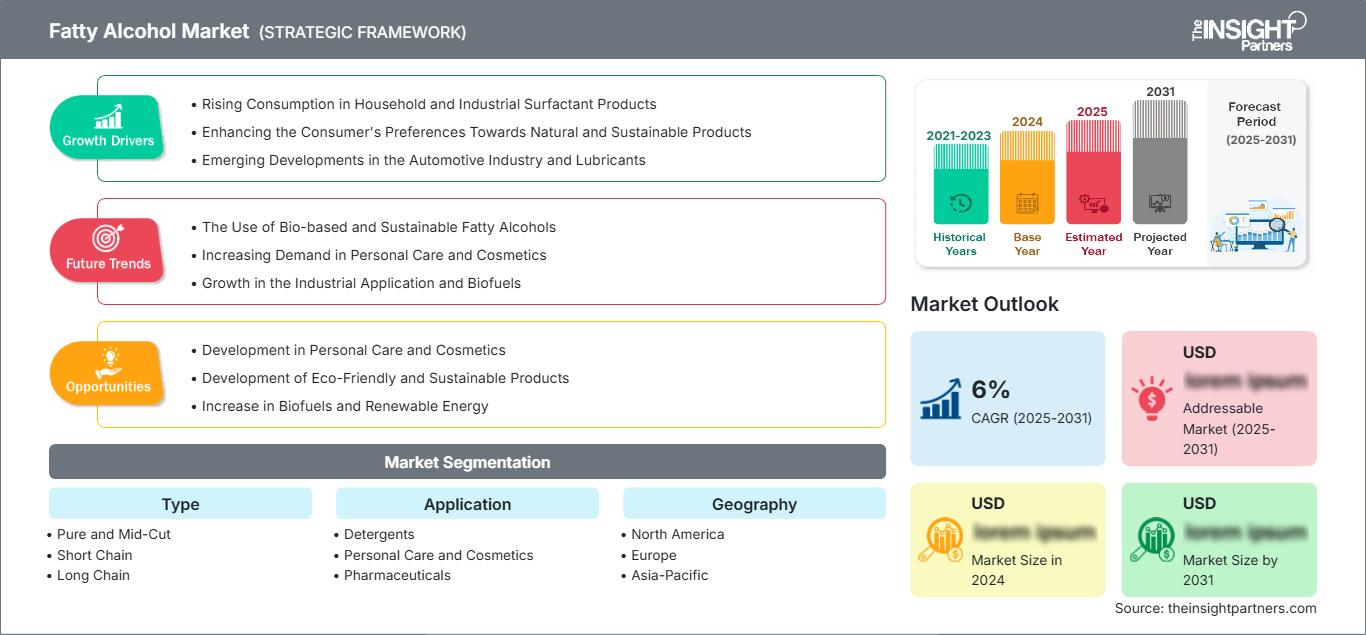
Fatty Alcohol Market: Strategic Insights
Regional Insights
North America Fatty Alcohol Market
The North American region had a 20–24% Fatty Alcohol Market share in 2025 and is forecasted to grow at a 4.0–4.5% compound annual growth rate from 2026 to 2034. This region leads in terms of demand in the United States as a result of usage in detergents, cosmetics, medicines, food processing, and specialty chemicals. There is also contribution from Canada and Mexico as a result of consumer product manufacture and industrial uses.
Formulation for personal care is a key value driver since fatty alcohol contributes emolliency, viscosity, stability and texture. Fatty alcohol is widely used by detergent formulators as surfactant intermediates, while customers in the pharmaceutical segment are concerned about high purity and documentation. Producers and distributors have been increasing their flexibility in stock management and technical assistance. Regional growth would be moderate as opposed to rapid because the market is mature.
U.S. Fatty Alcohol Market
In 2025, the US accounted for about 82-86% of North American consumption and is expected to grow at a CAGR of 3.9-4.4% during 2026-2034. Presence of large number of industries in household products, personal care, pharmaceuticals, and specialty chemicals contributes to varied customer base. Local formulation capability also provides opportunities in different chain lengths and purities. Competitive factors include timely supply, technical support, product quality, and sustainability certifications.
Growing demand is towards grades appropriate for high-end skin care, hair care, detergent applications, and specialties. Market would also benefit from growing demand for alcohol ethoxylate and related surfactants. Firms which have diversified sources of raw materials on an international level would be able to hedge against risks in agriculture and logistics. Distributors would also enable smaller firms to get access to special grades. Traceability and sustainability would probably become major factors in sourcing decisions, especially in case of consumer goods companies.
Europe Fatty Alcohol Market
Europe holds an estimated market share of 22-26% in 2025 and is anticipated to register a CAGR of 3.8-4.3% through 2034. UK, Germany, France, Italy, and Spain are some of the prominent demand centers for glycols, with Germany having a larger share in the consumption of industrial-grade glycols. Regulatory norms are driving the choice of raw material, traceability, and sustainability claims.
UK continues its demand for glycols in personal care, detergents, and special formulations. Germany gets the advantage of chemical processing and industrial cleaning applications. In France, there are both cosmetics and household products, in Italy cosmetics and specialty chemicals, and in Spain detergents and consumer products manufacturing. European consumers are increasingly preferring certified and traceable raw materials, hence making way for alternative feedstocks and palm-free products.
APAC Fatty Alcohol Market
APAC held a share of around 38-42% in 2025 and is projected to exhibit a CAGR of 5.0-5.5% until 2034. China consumes the maximum amount of oleochemicals; however, Indonesia and Malaysia offer feedstock advantages for oleochemicals. India is growing due to detergent and personal care segments, while Japan and South Korea contribute to specialty applications.
The regional demand is driven by increasing household products consumption, cosmetics production, and the availability of oleochemical value chain. Availability of feedstock and industrial policies encourage investments in downstream processing. The local players are increasingly producing high-purity and specific grades oleochemicals rather than being engaged in exporting commodity grade oleochemicals.
Middle East & Africa Fatty Alcohol Market
Middle East and Africa demand is projected to grow at a 4.1–4.7% CAGR during 2026–2034. Saudi Arabia and the UAE are important specialty-chemical and consumer-product centers, while South Africa supports detergent, cosmetics, and industrial demand. Rest of MEA remains smaller but is expanding with urbanization and consumer-product manufacturing.
Regional expansion will be driven by usage of detergents, penetrative use of personal care products, and diversification of industries. The Middle East region will benefit from integrated petrochemical feedstock, offering opportunities in the production of synthetic alcohols and derivatives. Demand in Africa will be dispersed and import driven, hence the need for distributors and regional stock. Formulation capability in the regions will gradually increase usage, whereas manufacturers with logistical advantages and chain length products will serve the various regions.
Segmentation Analysis
Type
Type selection influences purity, carbon-chain distribution, melting behavior, reactivity, and downstream formulation performance. The Fatty Alcohol Market scope encompasses pure and mid-cut products alongside short- and long-chain grades. Demand is increasingly shaped by application-specific requirements, with higher-purity and controlled-chain products gaining importance in personal care, pharmaceuticals, and specialty chemicals. The Type segment is expected to grow at a 4.4–4.9% CAGR during 2026–2034.
- Pure and Mid-Cut: Pure and mid-cut grades are important for applications requiring controlled composition and predictable downstream performance. They are widely selected for surfactants, cosmetics, pharmaceuticals, and specialty chemical formulations.
- Short Chain: Short-chain alcohols serve specialized chemical, solvent, plasticizer, and intermediate applications. Their strategic relevance comes from controlled reactivity and compatibility with downstream chemical synthesis rather than broad commodity consumption.
- Long Chain: Long-chain grades are important for detergents, cosmetics, lubricants, and wax-like formulations. Cetyl and stearyl alcohols are particularly valuable where thickening, emolliency, conditioning, and formulation stability are required.
Application
Application demand varies according to purity, carbon-chain length, functionality, and formulation requirements. Detergents represent the largest outlet because fatty alcohols are important surfactant intermediates, while personal care provides higher-value opportunities through specialized emollients and texture modifiers. The Application segment in the Fatty Alcohol Market is projected to grow at a 4.6–5.1% CAGR during 2026–2034, with premium formulations supporting value expansion.
- Detergents: Detergents constitute the largest application base, driven by alcohol ethoxylates and related surfactants used in household, institutional, and industrial cleaning formulations.
- Personal Care and Cosmetics: Personal care uses fatty alcohols as emollients, thickeners, stabilizers, and conditioning agents. Premium skincare and haircare formulations create demand for consistent purity and sensory performance.
- Pharmaceuticals: Pharmaceutical applications prioritize controlled purity and reproducibility. Fatty alcohols serve as formulation aids, excipients, and intermediates in selected products requiring stringent quality documentation.
- Food and Beverages: Food applications require appropriate grades for emulsification, processing, and formulation support. Demand is comparatively specialized and depends strongly on regulatory compliance and product-specific formulation requirements.
- Plasticizers: Plasticizer applications use selected fatty alcohols as intermediates and formulation components. Demand follows polymer processing, coatings, flexible materials, and specialty chemical production.
Opportunity Snapshot
| Application | Revenue Contribution | Trend Tag | Adoption Stage |
| Detergents | High | Surfactant Feedstock | Mature |
| Personal Care and Cosmetics | High | Premium Formulation | Scaling |
| Pharmaceuticals | Medium | High Purity | Scaling |
| Food and Beverages | Medium | Functional Ingredients | Emerging |
| Plasticizers | Medium | Specialty Intermediates | Mature |
Fatty Alcohol Market Growth Drivers and Impact Analysis
Expanding Detergent and Surfactant Consumption
Household and institutional cleaning remains a structural demand base because fatty alcohols are converted into alcohol ethoxylates and other surfactants. Population growth, urbanization, hygiene awareness, and increasing use of concentrated cleaning products support consumption across emerging and developed economies. Formulators also seek surfactants that deliver effective cleaning while meeting biodegradability and environmental expectations. This creates opportunities for producers offering consistent carbon-chain profiles and renewable feedstock options. The impact extends beyond basic volume growth because concentrated formulations can require tighter raw-material specifications and improved performance. Producers can therefore capture value through specialty grades and technical support. Expansion of detergent manufacturing in Asia, Africa, and Latin America should broaden the customer base, while mature markets will emphasize formulation efficiency, sustainability, and premium performance.
Rising Demand for Premium Personal-Care Formulations
Personal-care products increasingly emphasize sensory characteristics, conditioning, skin compatibility, texture, and formulation stability. Fatty alcohols such as cetyl and stearyl alcohol perform multiple functions, allowing formulators to modify viscosity, emolliency, spreadability, and product consistency. Premium skincare, haircare, and color cosmetics therefore create attractive demand for higher-quality and tightly specified grades. The shift toward sophisticated formulations also increases the value of technical collaboration between raw-material suppliers and cosmetic manufacturers. Producers that can document purity, origin, sustainability, and performance can differentiate beyond commodity pricing. Demand is particularly strong in Asia Pacific, where cosmetics manufacturing and consumer spending are expanding. Mature markets in Europe and North America provide additional value opportunities through clean-label positioning, specialty formulations, and products requiring precise sensory performance.
Greater Use of Renewable and Traceable Feedstocks
Environmental requirements are increasingly influencing how fatty alcohol producers source and process raw materials. Palm and palm-kernel derivatives remain important, but customers are placing greater emphasis on certified supply chains, deforestation risk, carbon intensity, and traceability. Alternative feedstocks such as coconut, rapeseed, and emerging bio-based routes can therefore create differentiated product opportunities. Producers are also improving chain-of-custody systems and developing palm-free options for customers with specific sustainability objectives. This trend affects procurement decisions because large consumer-product companies increasingly incorporate raw-material sustainability into supplier evaluations. The resulting market impact is a gradual shift from purely price-based purchasing toward balanced assessments covering cost, performance, environmental credentials, and documentation. Suppliers with flexible feedstock strategies should be better positioned to respond to changing customer requirements.
Fatty Alcohol Market Future Trends
Growth of Palm-Free and Alternative-Feedstock Alcohols
Future product development in the Fatty Alcohol Market Trends is likely to focus increasingly on fatty alcohols derived from alternative renewable feedstocks. Rapeseed, coconut, fermentation-derived intermediates, and other emerging pathways can provide customers with options that reduce dependence on palm-based supply chains. Formulators in Europe and premium personal care markets are particularly likely to evaluate these materials where deforestation risk or consumer expectations influence sourcing. Commercial success will depend on achieving competitive economics without compromising purity, odor, color, stability, or formulation performance. Producers may increasingly offer parallel portfolios covering conventional, certified, and palm-free grades. This approach allows customers to select materials according to sustainability objectives while maintaining formulation flexibility. Over time, alternative-feedstock products could move from niche applications toward broader adoption as manufacturing scale improves and procurement standards become more demanding.
Greater Integration of Fatty Alcohols with Specialty Derivatives
Manufacturers are expected to place greater emphasis on converting fatty alcohols into higher-value derivatives rather than relying exclusively on basic alcohol sales. Ethoxylates, amines, esters, surfactants, and specialty intermediates can provide additional value and reduce exposure to commodity pricing. Integrated producers can also optimize carbon-chain allocation across multiple downstream products according to changing demand. This flexibility becomes particularly valuable when individual applications experience temporary weakness. Research efforts will increasingly target catalyst efficiency, selective conversion, lower energy consumption, and reduced by-product generation. Digital process monitoring may further improve yield and quality consistency. The long-term implication is a more integrated industry in which fatty alcohol production is closely connected to application-specific chemistry. Companies with broad derivative portfolios should be able to capture greater value from the same feedstock base.
Fatty Alcohol Market Opportunities
Expansion of Sustainable Specialty Alcohol Portfolios
Producers can pursue attractive opportunities by developing differentiated alcohol grades with verified renewable content, traceable origins, controlled carbon-chain distributions, and improved environmental profiles. Such products can address the requirements of cosmetic brands, detergent companies, pharmaceutical manufacturers, and specialty chemical formulators that increasingly assess sustainability alongside technical performance. Investment should focus on purification, feedstock flexibility, certification systems, and customer testing capabilities. Producers can also establish dedicated grades for palm-free, low-carbon, or region-specific procurement requirements. The opportunity of the Fatty Alcohol Market Forecast is strongest where customers are willing to pay for documented attributes rather than treating fatty alcohols solely as commodities. Building formulation partnerships with downstream customers can accelerate qualification and create longer-term supply relationships. This strategy can improve margins while supporting broader differentiation in increasingly transparent raw-material markets.
Regional Downstream Integration in Emerging Markets
Emerging markets offer opportunities to expand downstream conversion capacity close to growing detergent, personal-care, pharmaceutical, and specialty-chemical customers. Establishing local derivative production can reduce transportation costs, shorten lead times, and provide customers with application-specific materials rather than imported intermediates. India, Southeast Asia, and selected African markets are attractive because consumer-product manufacturing is expanding while some downstream chemicals remain import dependent. Investors can consider joint ventures, toll manufacturing, distribution partnerships, or modular processing facilities depending on local scale requirements. Integration should be supported by reliable feedstock contracts and technical application centers. Companies that establish regional formulation support alongside manufacturing can strengthen customer relationships and reduce qualification barriers. The strategy also creates opportunities to tailor chain lengths and purity levels to local formulation requirements rather than relying on standardized global grades.
Recent Developments
- August 2026: PT Unilever Oleochemical Indonesia inaugurated a US$155 million expansion of its fatty alcohol production facility at the Sei Mangkei Special Economic Zone in North Sumatra. The expansion strengthens Indonesia’s downstream palm oil and oleochemical industry and is expected to lift the facility’s overall shipment capacity to around 600,000 mt of oleochemical products to more than 30 countries, with potential export value reaching US$800 million. UOI’s cumulative investment in Sei Mangkei has reached about Rp9.31 trillion.
- March 2025: Kao Corporation: Kao announced an agreement to purchase a majority of the first manufacturing plant’s capacity of NALO, a C12/C14 fatty alcohol produced by Future Origins from a palm-oil alternative. Kao stated that it plans to expand the use of NALO and derivatives globally as part of its chemical business and sustainable raw-material strategy.
Frequently Asked Questions

- Comprehensive Market Sizing and Forecast Analysis
- Detailed Segmentation Analysis
- In-Depth Market Dynamics Assessment
- Regional and Country-Level Insights
- Competitive Landscape and Company Benchmarking
- Strategic Business Intelligence
Recent Reports
Testimonials

The Insight Partners' SCADA System Market report is comprehensive, with valuable insights on current trends and future forecasts. The team was highly professional, responsive, and supportive throughout. We are very satisfied and highly recommend their services.
RAN KEDEM Partner, Reali Technologies LTDs
I requested a report on a very specific software market and the team produced the report in a few days. The information was very relevant and well presented. I then requested some changes and additions to the report. The team was again very responsive and I got the final report in less than a week.
JEAN-HERVE JENN Chairman, Future Analytica
We worked with The Insight Partners for an important market study and forecast. They gave us clear insights into opportunities and risks, which helped shape our plans. Their research was easy to use and based on solid data. It helped us make smart, confident decisions. We highly recommend them.
PIYUSH NAGPAL Sr. Vice President, High Beam Global
The Insight Partners delivered insightful, well-structured market research with strong domain expertise. Their team was professional and responsive throughout. The user-friendly website made accessing industry reports seamless. We highly recommend them for reliable, high-quality research services
YUKIHIKO ADACHI CEO, Deep Blue, LLC.
This is the first time I have purchased a market report from The Insight Partners.While I was unsure at first, I visited their web site and felt more comfortable to take the risk and purchase a market report.I am completely satisfied with the quality of the report and customer service. I had several questions and comments with the initial report, but after a couple of dialogs over email with their analyst I believe I have a report that I can use as input to our strategic planning process.Thank you so much for taking the extra time and making this a positive experience.I will definitely recommend your service to others and you will be my first call when we need further market data.
JOHN SUZUKI President and Chief Executive Officer, Board Director, BK Technologies
I wish to appreciate your support and the professionalism you displayed in the course of attending to my request for information regarding to infectious disease IVD market in Nigeria. I appreciate your patience, your guidance, and the fact that you were willing to offer a discount, which eventually made it possible for us to close a deal. I look forward to engaging The Insight Partners in the future, all thanks to the impression you have created in me as a result of this first encounter.
DR CHIJIOKE ONYIA MANAGING DIRECTOR, PineCrest Healthcare Ltd.Reason to Buy
- Informed Decision-Making
- Understanding Market Dynamics
- Competitive Analysis
- Identifying Emerging Markets
- Customer Insights
- Market Forecasts
- Risk Mitigation
- Boosting Operational Efficiency
- Strategic Planning
- Investment Justification
- Tracking Industry Innovations
- Aligning with Regulatory Trends





 Get Free Sample for