
Fatty Amides Market Size, Trends & Growth by 2034
Coverage: by Type (Erucamide, Oleamide, Stearamide, Behenamide, Others); Product Form (Bead, Powder, Others); Function (Lubricants, Anti-Block Agents, Release Agents, Slip Agents, Dispersants, Others); End-Use Industry (Paper, Textile, Rubber, Plastic, Others) , and Geography (North America, Europe, Asia Pacific, and South and Central America)
- Status : Data Released
- Report Code : TIPRE00009224
- Category : Chemicals and Materials
- No. of Pages : 150
- Available Report Formats :


- Last update date : September 17, 2026


2025 Market Size
US$ 416.09 Mn
Base year value
2034 Forecast
US$ 672.73 Mn
Projected by 2034
CAGR 2026-2034
5.48 %
Growth rate
Addressable Market
US$ 4,936.20 Mn
(2026-2034)
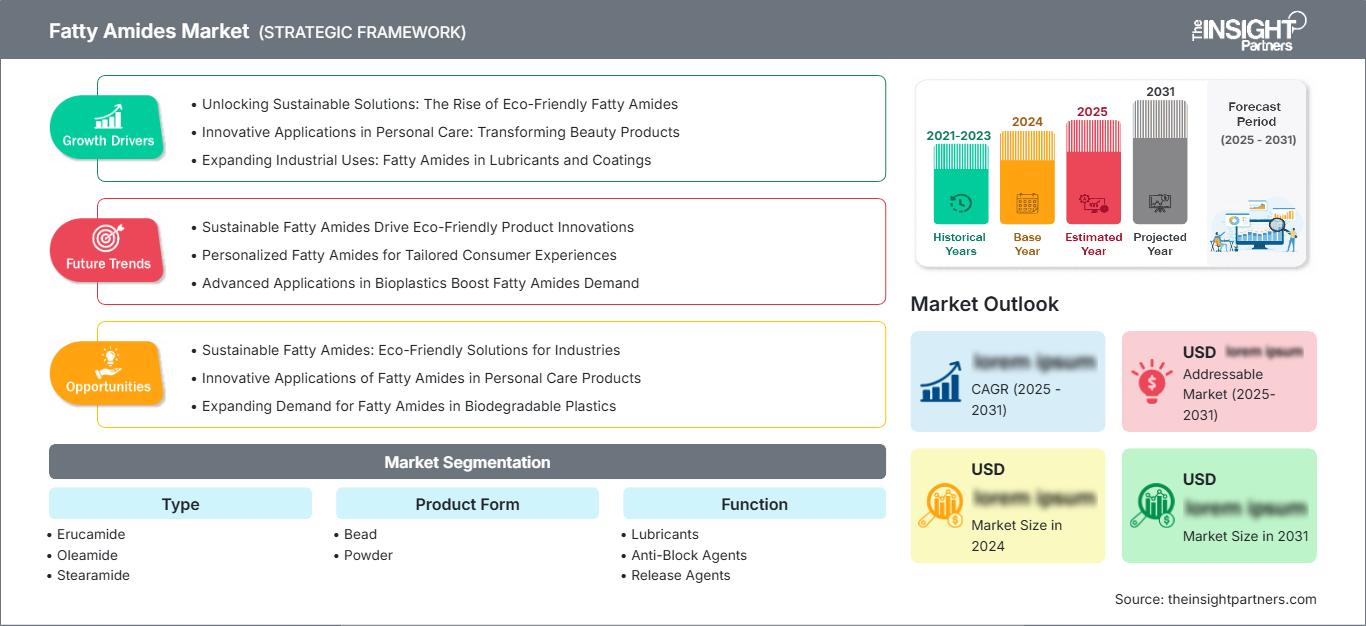
The Fatty Amides Market is valued at US$ 416.09 Million in 2025 and is projected to reach US$ 672.73 Million by 2034, expanding at a CAGR of 5.48% during 2026–2034. The growing incorporation of specialty additives in polymer processing, films, rubber, coatings, and industrial products drives up demand. Specifications related to friction resistance, surface properties, release from molds, and ease of processing drive up consumption in various end-user industries.
In North America, the Fatty Amides Market Size should experience a CAGR of roughly 4.8–5.6% up to 2034 driven by advanced polymer processing, mature packaging production, and high demand for high-performance additives. Substitution of traditional processing agents with eco-friendly or higher purity products is another factor driving product differentiation. The region enjoys mature technical expertise, a comprehensive oleochemical industry chain, and demand from flexible packaging, engineering plastics, and specialty industrial markets.
Fatty Amides Market Assessment and Insights
- North America: The region is estimated to represent a 23–27% share in 2025 and is projected to grow at a 4.8–5.6% CAGR between 2026–2034, supported by polymer processing, flexible packaging, and specialty additive demand.
- US: The US accounts for approximately 78–82% of North America's 2025 market, with growth of 4.9–5.7% CAGR between 2026–2034, reflecting mature plastics conversion and demand for higher-performance additives.
- Europe: Europe is estimated at a 22–26% share in 2025 and is expected to expand at a 4.7–5.5% CAGR between 2026–2034, led by Germany, Italy, France, the UK, and Spain.
- Asia Pacific: Asia Pacific holds an estimated 34–38% share in 2025 and is projected to record the strongest regional expansion at 6.0–6.8% CAGR between 2026–2034, led by China, Japan, South Korea, and India.
- Largest Segment: Erucamide is estimated to hold a 39–43% market share in 2025, with a 5.7–6.4% CAGR between 2026–2034, supported by extensive film-processing applications.
- High Growth Segment: Powder products represent approximately 30–34% share in 2025 and are projected to grow at 5.9–6.7% CAGR between 2026–2034, supported by handling flexibility and formulation precision.
- Key companies analyzed in detail: BASF SE, Croda International Plc, Fine Organic Industries Limited, Italmatch Chemicals S.p.A., Kao Corporation, Kuala Lumpur Kepong Berhad, Mitsubishi Chemical Group Corporation, Nippon Fine Chemical Co., Ltd., PMC Biogenix, Larodan AB, and Sichuan Tianyu Oleochemical Co., Ltd.
Source: The Insight Partners' analysis based on proprietary research, government publications, company annual reports, investor presentations, industry databases, and expert interviews.
The technology has moved away from simple friction-modifying uses to multipurpose additive systems that need controlled migration, heat stability, compatibility, and surface properties. Fatty amides have become increasingly engineered based on the polymer grade, processing temperature, loading level, and the desired coefficient of friction. Production economics will continue to depend on the availability of fatty acids feedstock, but companies with oleochemical production facilities will be able to gain from their integration into production.
In the future, opportunities will expand into Southeast Asian, Indian, and select Latin American manufacturing hubs due to increased plastics converting capacity. Fatty Amides Market trends will involve using renewable feedstocks, sourcing traceable raw materials, and producing higher purity grades. Pressure from regulations on material efficiency and recyclability has caused formulators to look into optimizing the amount of additives instead of increasing them, thus offering an opportunity to develop grades with uniform migration and processing performance.
Fatty Amides Market Report Scope
| Report Attribute | Details |
|---|---|
| Market size in 2025 | US$ 416.09 Million |
| Market Size by 2034 | US$ 672.73 Million |
| Global CAGR (2026 - 2034) | 5.48% |
| Historical Data | 2021-2024 |
| Forecast period | 2026-2034 |
Fatty Amides Market Analysis
Fatty Amides Market Growth is very much linked with the manufacture of polymers in the form of film, wherein slip and anti-block affect machine efficiency, winding quality, surface friction, and conversion process. Chain starts from vegetable oils or animal sources as raw materials and then goes through the processing of fatty acids, amidation, refining, finishing, packaging, and formulation process. Hence, competition is about having assured and pure raw material supply, particle form, consistency, and application services, instead of prices.
High demand exists when small amounts of additives can give considerable benefit to the manufacturing process. Flexible packaging films, agricultural films, industrial films, molded plastics, rubber goods, textile, and paper coatings create diverse market. Supply depends on the availability of oleochemical raw material and amidation assets. Integrated companies minimize risk of sourcing intermediates while regional companies compete with custom formulated grades and technical services.
This competition entails diversified chemical firms alongside those who specialize in oleochemicals production. In the Fatty Amides Market Report, BASF SE and Croda International Plc represent companies with vast experience in formulation, while PMC Biogenix is specialized in erucamide, oleamide, stearamide, and other chemistry production. Fine Organic Industries Limited is focused on specialty additives made from oleochemical base chemicals, and Kao Corporation, as well as Kuala Lumpur Kepong Berhad, enjoy wide downstream oleochemical facilities.
Competitiveness involves sustainability, consistency, application engineering, and geographical coverage. The companies such as Mitsubishi Chemical Group Corporation, Nippon Fine Chemical Co., Ltd., Italmatch Chemicals S.p.A., Larodan AB, and Sichuan Tianyu Oleochemical Co., Ltd. provide additional technical and geographical capabilities. Investments go into manufacturing flexibility, renewables feedstocks, quality management, and closer relationship with plastics processing consumers in Asia.
● REPORT CUSTOMIZATION
Tailor This Report To Align With Your Specific Business Requirements
This report can be customized to align precisely with your business objectives, scope, and target markets. Customization options include tailored segmentation, geography, competitive analysis, and strategic insights to support informed decision-making.
Customize This Report →WHAT YOU CAN ADJUST
- ● Segmentations
- ● Geography
- ● Competitive Analysis
- ● Language Preferences
Fatty Amides Market: Strategic Insights
Regional Insights
North America Fatty Amides Market
North America is forecast to represent 23-27% of worldwide demand in 2025 with 4.8-5.6% CAGR from 2025 to 2034. The US holds a dominant share in the region owing to the presence of a well-established plastics conversion, flexible packaging, and film, mold, and specialty polymer production industry. Canada and Mexico complete the regional value chain through packaging, automotive, and industrial manufacturing sectors.
Preference for additives which exhibit controlled migration, low friction, thermal stability, and recycling compatibility is rising. Technical service is an important consideration during procurement, as additives need to be optimized in terms of concentration depending upon the type of resin and extrusion process involved. Regional players have the advantage of shorter logistics chains and business relations with converters. Growth in efficient use of materials and recyclable packaging will drive adoption of high-performance products.
U.S. Fatty Amides Market
US accounts for about 78–82% of North America's 2025 demand and is forecast to record a 4.9–5.7% CAGR till 2034. Drivers include flexible packaging, polyethylene film, engineering plastics, rubber compounding, and coatings. Existing specialty chemicals' formulation facilities support the production processes.
Domestic manufacturing and technical know-how are strengths of PMC Biogenix, while foreign firms cater to customers through their distribution and application networks. Recycled polymer compounding, light weight packaging, and extrusion performance standards are driving forces behind the market. Those producers which can offer consistent particle size, migration properties, and renewable feedstocks stand to benefit from convertors demanding processing consistency without an increased addition rate.
Europe Fatty Amides Market
The Fatty Amides Market share of Europe is anticipated to be around 22–26% in 2025, with growth of 4.7–5.5% CAGR till 2034. Germany is the largest country, owing to its huge base in plastics, automotive, packaging, and manufacturing industries. UK continues to be a leader in specialty chemicals, while France, Italy, and Spain contribute due to their strength in packaging, rubber, textile, and polymer conversion industries. Germany and the UK, on the other hand, are leaders in high-value formulations, whereas Italy and Spain gain advantage due to the presence of converting and manufacturing hubs. European demand is increasingly becoming dependent on circular materials goals, efficiency of resources, and restrictions on additive usage. Additives manufacturers are focusing on bio-based feedstocks, controlled migration, and recycling compatibility in order to cater to such needs. Croda International Plc is one of the key players in this region owing to its expertise in specialty additives. On the other hand, BASF SE focuses on polymer processing.
APAC Fatty Amides Market
APAC is forecast to account for 34-38% of total demand in 2025 and is predicted to witness growth at a CAGR of 6.0-6.8% during 2024-2034. China is leading the regional demand, followed by Japan, South Korea, India, and Australia. Growing packaging, conversion, and industrial manufacturing are the main demand drivers.
China integrates large-scale plastics conversion with domestic chemical production, whereas Japan and South Korea focus on high-performance plastics. India is gaining prominence via growing packaging and manufacturing. Integration with local oleochemicals, renewable feedstocks, and specialty additives are contributing towards the competitiveness of the region. Growing domestic production of engineered films and polymer additives will keep up the demand.
Middle East & Africa Fatty Amides Market
MEA demand is driven by plastic conversions, packaging and manufacturing related to infrastructure development, along with availability of petrochemical feedstock. Saudi Arabia and UAE form the main market in the Gulf, whereas South Africa is another key downstream market for this region. The rest of MEA forms a small region which presents incremental opportunities, driven by developing manufacturing capabilities.
It is projected to grow at a CAGR of about 4.2–5.0% till 2034, slower than APAC but supported by diversification of industry and infrastructure investment. Saudi Arabia gains from petrochemical integration, whereas UAE has a well-developed infrastructure for distribution and re-exporting. Increasing domestic capacity for plastic conversions can gradually drive demand for slip, release, lubricant, and anti-block additives.
Segmentation Analysis
Type
The type segment in the Fatty Amides Market is led by erucamide because its slip performance and migration characteristics make it particularly suitable for polyethylene films and other polymer-processing applications. The segment is projected to expand at 5.6–6.3% CAGR during 2026–2034, supported by packaging and film-conversion demand.
- Erucamide: Widely selected for high-slip applications where low surface friction and controlled migration are important, particularly in polyethylene films and flexible packaging.
- Oleamide: Provides rapid slip development and is used where processors require faster surface modification, making it valuable in films, inks, and selected polymer applications.
- Stearamide: Supports moderate slip, anti-blocking, and release performance, with demand extending across films, rubber, inks, and specialized processing formulations.
- Behenamide: Offers high-temperature stability and controlled additive behavior, creating opportunities in demanding polymer-processing environments where conventional lower-chain amides may be less suitable.
Product Form
Product form influences handling, dispersion, dosing, storage, and production efficiency. The segment is expected to grow at 5.2–6.0% CAGR during 2026–2034, with bead and powder formats serving different processor requirements.
- Bead: Preferred where controlled dosing, lower dust generation, and easy incorporation into polymer formulations are important, supporting efficient handling in industrial production environments.
- Powder: Favored for precise blending and specialized formulations, particularly where rapid dispersion or customized additive loading is required during compounding and processing.
Function
The function segment in the Fatty Amides Market is projected to grow at 5.4–6.2% CAGR during 2026–2034, reflecting the broad role of fatty amides in improving surface characteristics, processing efficiency, and formulation performance across multiple materials.
- Lubricants: Reduce internal and external friction during processing, helping converters improve material flow, surface quality, and equipment efficiency across polymer and rubber applications.
- Anti-Block Agents: Prevent adjacent polymer surfaces from adhering, supporting film separation, roll handling, packaging conversion, and consistent downstream processing.
- Release Agents: Facilitate separation from processing equipment or molds, improving production consistency and reducing defects in demanding polymer and engineering-plastic applications.
- Slip Agents: Lower surface friction and improve handling characteristics, making them strategically important for high-speed film extrusion, packaging, printing, and converting.
- Dispersants: Promote uniform distribution of formulation components, supporting consistent performance in coatings, inks, polymer systems, and specialty compound formulations.
End-Use Industry
The end-use industry segment is expected to expand at 5.3–6.1% CAGR during 2026–2034, with plastics remaining strategically important because fatty amides directly improve film processing and surface performance.
- Paper: Uses specialty additives where improved surface behavior, processing efficiency, and coating performance are required across selected paper and converting applications.
- Textile: Incorporates fatty-amide chemistries into selected processing systems where lubrication, surface modification, and handling characteristics influence manufacturing efficiency.
- Rubber: Benefits from lubricating and processing properties that can improve compound handling, surface characteristics, and manufacturing consistency in selected rubber formulations.
- Plastic: Represents the principal application base, particularly in polyethylene films, packaging, extrusion, injection molding, and engineering polymers requiring controlled slip or release performance.
Opportunity Snapshot
| Industry Vertical | Revenue Contribution (High/Medium/Low) | Trend Tag (MAX 2 words) | Adoption Stage |
|---|---|---|---|
| Paper | Medium | Surface Control | Mature |
| Textile | Low | Process Lubrication | Mature |
| Rubber | Medium | Compound Efficiency | Scaling |
| Plastic | High | Film Processing | Mature |
Fatty Amides Market Growth Drivers and Impact Analysis
Expansion of Flexible Packaging and Polymer Film Conversion
Manufacturers of plastics, rubber, coatings, and industrial materials increasingly seek additives that improve production efficiency while maintaining product quality. Fatty amides can provide lubrication, release, slip, and anti-block properties within relatively small formulation additions, making them attractive when processors aim to optimize throughput and reduce material losses. High-speed extrusion and automated converting equipment place greater emphasis on predictable coefficient of friction and stable surface behavior. This trend favors suppliers capable of maintaining tight specifications across batches and geographies. Specialized grades can also command stronger customer retention because processors may need extensive testing before changing an additive supplier. As manufacturing becomes more automated, reliable additive performance can directly influence line stability, downtime, and finished-product consistency.
Greater Demand for High-Performance Processing Additives
Manufacturers of plastics, rubber, coatings, and industrial materials increasingly seek additives that improve production efficiency while maintaining product quality. Fatty amides can provide lubrication, release, slip, and anti-block properties within relatively small formulation additions, making them attractive when processors aim to optimize throughput and reduce material losses. High-speed extrusion and automated converting equipment place greater emphasis on predictable coefficient of friction and stable surface behavior. This trend favors suppliers capable of maintaining tight specifications across batches and geographies. Specialized grades can also command stronger customer retention because processors may need extensive testing before changing an additive supplier. As manufacturing becomes more automated, reliable additive performance can directly influence line stability, downtime, and finished-product consistency.
Shift Toward Renewable and Traceable Oleochemical Feedstocks
Sustainability considerations are changing purchasing criteria for specialty additives, particularly where customers seek renewable carbon content, traceable sourcing, and lower environmental impacts. Fatty amides derived from vegetable feedstocks can provide an alternative pathway for formulators seeking to reduce dependence on fossil-derived inputs. The commercial opportunity is not limited to bio-based claims because traceability and consistent feedstock quality can also support product differentiation. Producers with integrated oleochemical operations can strengthen supply visibility and respond more effectively to customer requirements concerning origin and sustainability documentation. The shift encourages investment in certified raw materials, lifecycle assessment, process efficiency, and transparent supply chains. Over time, these capabilities can become purchasing prerequisites for multinational packaging, consumer-goods, and industrial customers rather than optional product attributes.
Fatty Amides Market Future Trends
Next-Generation Low-Migration Additive Systems
Future product development in the Fatty Amides Market Trends is likely to focus on controlling additive migration while preserving slip, anti-block, and release performance. Conventional formulations can require careful balancing because excessive migration may affect printing, coating, sealing, or surface appearance, while insufficient migration can reduce the intended friction-reduction benefit. Suppliers are therefore expected to develop grades with more predictable migration profiles and compatibility across different polymer systems. Advanced testing, application modeling, and tighter particle-size control can help formulators optimize dosage according to processing conditions. The trend will be particularly relevant for multilayer films and applications where surface treatment or printing occurs after extrusion. Product differentiation should increasingly center on measurable performance windows rather than simply chemical identity, creating opportunities for suppliers with strong application laboratories and converter partnerships.
Data-Driven Formulation and Circular Polymer Compatibility
Digital formulation tools and improved material characterization are likely to influence additive selection as processors use more recycled and chemically diverse polymer streams. Variations in melt flow, contamination, molecular weight, and additive history can alter the behavior of fatty amides, making standardized formulations less effective across recycled feedstocks. Future systems may combine resin characterization with additive recommendations, dosage optimization, and process monitoring. Suppliers can support this transition by generating application datasets covering recycled polyethylene, polypropylene, engineering polymers, and multilayer structures. Such capabilities can reduce trial-and-error during formulation changes and strengthen technical relationships with converters. Compatibility with recycling processes will also become more important, encouraging development of additive systems that provide required surface performance while minimizing undesirable effects during mechanical or chemical recycling.
Fatty Amides Market Opportunities
Localized Production and Technical Support in Emerging Asian Markets
Expansion of plastics conversion in India, Southeast Asia, and selected Chinese manufacturing clusters creates opportunities for suppliers to establish localized production, warehousing, or application centers. Regional customers increasingly require shorter lead times and technical assistance tailored to local resin grades, processing equipment, and packaging structures. A localized model can reduce inventory exposure while allowing producers to develop customer-specific formulations. India is particularly attractive because its packaging and manufacturing industries are expanding alongside investments in chemical production. Southeast Asian markets offer additional opportunities through integrated oleochemical feedstocks and growing polymer conversion. Companies that combine local technical support with reliable international quality standards can strengthen customer retention and reduce the qualification barriers associated with switching additive suppliers.
Premium Sustainable Grades for High-Value Polymer Applications
A second opportunity lies in premium grades in the Fatty Amides Market Forecast that combine renewable sourcing, consistent performance, and documentation suitable for multinational customers. Buyers increasingly evaluate specialty additives through total formulation economics rather than purchase price alone, creating room for products that reduce dosage, improve processing stability, or support sustainability targets. High-value applications such as engineering polymers, specialty films, inks, and advanced packaging can support stronger margins than commodity formulations. Suppliers can differentiate through verified feedstock origin, controlled migration, narrow specifications, and application-specific technical data. Partnerships with polymer producers and converters can accelerate qualification because new grades often require testing under defined extrusion, molding, printing, and recycling conditions. Investment in application laboratories can therefore become as important as additional production capacity.
Recent Developments
- September 2025: Kuala Lumpur Kepong Berhad showcased renewable-sourced specialty oleochemicals for plastics at K 2025, including PALMOWAX EBO and PALMOWAX OPA. The portfolio highlighted applications spanning process optimization and improved polymer performance, reinforcing the company's focus on plant-based solutions for plastics processors and specialty additive users.
- July 2025: Fine Organic Industries Limited announced land acquisition for its first manufacturing facility in the US, expanding its global manufacturing footprint. The initiative strengthens the company's ability to serve customers in North America while supporting its broader specialty-additives strategy and geographic diversification.
Frequently Asked Questions

- Comprehensive Market Sizing and Forecast Analysis
- Detailed Segmentation Analysis
- In-Depth Market Dynamics Assessment
- Regional and Country-Level Insights
- Competitive Landscape and Company Benchmarking
- Strategic Business Intelligence
Recent Reports
Testimonials

The Insight Partners provided valuable market intelligence that supported our global go-to-market strategy. Their team was professional, responsive, and attentive to our feedback, providing thoughtful analysis and helpful methodological clarifications throughout the project.
Junmo Kim Chief Financial Officer (CFO), Enertech Co., Ltd.
The Insight Partners' SCADA System Market report is comprehensive, with valuable insights on current trends and future forecasts. The team was highly professional, responsive, and supportive throughout. We are very satisfied and highly recommend their services.
RAN KEDEM Partner, Reali Technologies LTDs
I requested a report on a very specific software market and the team produced the report in a few days. The information was very relevant and well presented. I then requested some changes and additions to the report. The team was again very responsive and I got the final report in less than a week.
JEAN-HERVE JENN Chairman, Future Analytica
We worked with The Insight Partners for an important market study and forecast. They gave us clear insights into opportunities and risks, which helped shape our plans. Their research was easy to use and based on solid data. It helped us make smart, confident decisions. We highly recommend them.
PIYUSH NAGPAL Sr. Vice President, High Beam Global
The Insight Partners delivered insightful, well-structured market research with strong domain expertise. Their team was professional and responsive throughout. The user-friendly website made accessing industry reports seamless. We highly recommend them for reliable, high-quality research services
YUKIHIKO ADACHI CEO, Deep Blue, LLC.
This is the first time I have purchased a market report from The Insight Partners.While I was unsure at first, I visited their web site and felt more comfortable to take the risk and purchase a market report.I am completely satisfied with the quality of the report and customer service. I had several questions and comments with the initial report, but after a couple of dialogs over email with their analyst I believe I have a report that I can use as input to our strategic planning process.Thank you so much for taking the extra time and making this a positive experience.I will definitely recommend your service to others and you will be my first call when we need further market data.
JOHN SUZUKI President and Chief Executive Officer, Board Director, BK Technologies
I wish to appreciate your support and the professionalism you displayed in the course of attending to my request for information regarding to infectious disease IVD market in Nigeria. I appreciate your patience, your guidance, and the fact that you were willing to offer a discount, which eventually made it possible for us to close a deal. I look forward to engaging The Insight Partners in the future, all thanks to the impression you have created in me as a result of this first encounter.
DR CHIJIOKE ONYIA MANAGING DIRECTOR, PineCrest Healthcare Ltd.Reason to Buy
- Informed Decision-Making
- Understanding Market Dynamics
- Competitive Analysis
- Identifying Emerging Markets
- Customer Insights
- Market Forecasts
- Risk Mitigation
- Boosting Operational Efficiency
- Strategic Planning
- Investment Justification
- Tracking Industry Innovations
- Aligning with Regulatory Trends





 Get Free Sample for