
FCC catalyst and additives Market Share, Demand & Growth by 2034
Coverage: By Product (Octane Number Improving Agent, Light Olefins Enhancing Agent, Sulphur Reducing Agent, Metal Passivation Agent, Others); Application (Vacuum Gas Oil, Residue, Others), and Geography (North America, Europe, Asia Pacific, and South and Central America)
- Status : Data Released
- Report Code : TIPRE00014351
- Category : Chemicals and Materials
- No. of Pages : 150
- Available Report Formats :


- Last update date : September 17, 2026


2025 Market Size
US$ 3.04 Bn
Base year value
2034 Forecast
US$ 3.88 Bn
Projected by 2034
CAGR 2026-2034
2.75 %
Growth rate
Addressable Market
US$ 31.41 Bn
(2026-2034)
The FCC Catalyst and Additives Market is valued at US$ 3.04 Billion in 2025 and is projected to reach US$ 3.88 Billion by 2034, expanding at a CAGR of 2.75% during 2026–2034. The demand will be driven by fluid catalytic cracking systems which help produce gasoline, LPG, olefins, etc., from vacuum gas oil and residue. Many refiners now deploy catalysts and additives to help them attain desired selectivity and handle contaminates among others.
North America FCC Catalyst and Additives Market Size is projected to experience a CAGR of around 2.3–3.0% during 2026-2034 due to its advanced refining infrastructure, use of FCC technology and demand for more valuable gasoline as well as petrochemical feedstocks. The refiners are also deploying catalyst technologies that handle heavier feedstocks and offer more metals tolerance, minimize coke formation and allow for more operation flexibility without revamping FCC units.
FCC catalyst and additives Market Assessment and Insights
- North America: North America is estimated to hold a 27–31% share in 2025 and is projected to grow at a 2.3–3.0% CAGR between 2026–2034, supported by established refineries, FCC optimization, and demand for cleaner, higher-value products.
- US: The US represents approximately 82–86% of North America's 2025 demand, with a 2.4–3.1% CAGR between 2026–2034, supported by sophisticated FCC infrastructure and extensive catalyst service capabilities.
- Europe: Europe is estimated to account for a 19–23% share in 2025 and is expected to expand at a 2.0–2.7% CAGR between 2026–2034, led by Germany, Italy, France, Spain, and the Netherlands.
- Asia Pacific: Asia Pacific represents approximately 35–39% of demand in 2025 and is projected to register a 3.2–4.0% CAGR between 2026–2034, led by China, India, Japan, South Korea, and Singapore.
- Largest Segment: The Octane Number Improving Agent segment is estimated to hold a 28–32% market share in 2025, growing at a 2.8–3.5% CAGR between 2026–2034.
- High Growth Segment: The Light Olefins Enhancing Agent segment is estimated at 20–24% market share in 2025 and is projected to expand at a 3.5–4.2% CAGR between 2026–2034.
- Key companies analyzed in detail: Albemarle Corporation, Axens, BASF SE, ExxonMobil Chemical Company, Grace Catalysts Technologies, HCpect, Johnson Matthey, Sinopec, The China National Petroleum Corporation, W. R. Grace & Co., and Ketjen Corporation.
Source: The Insight Partners' analysis based on proprietary research, government publications, company annual reports, investor presentations, industry databases, and expert interviews.
Technology advancement has led to an emphasis on FCC catalysts for increased selectivity, pore structure, metals compatibility, and gas and coke formation controls. The development of zeolites and matrices enables refineries to optimize catalyst performance based on feedstock properties and desired products. The use of additives makes the job even easier by enabling refiners to tweak performance in octane, olefins, sulfur, metals, and bottoms without having to change the whole inventory of the circulating catalysts.
Future growth in the FCC Catalyst and Additives Market Size will require catalyst technologies that can process heavy crudes, residues, petrochemical feeds, and alternative co-processing feeds. There are new centers of refineries in emerging Asia, whereas existing centers focus on efficiency and environmental emissions control. Hence, investment will be geared towards technology development in catalytic testing, digitalization of catalyst optimization, feed characterization, and formulations to ensure continued performance with variable refinery feedstocks.
FCC catalyst and additives Market Report Scope
| Report Attribute | Details |
|---|---|
| Market size in 2025 | US$ 3.04 Billion |
| Market Size by 2034 | US$ 3.88 Billion |
| Global CAGR (2026 - 2034) | 2.75% |
| Historical Data | 2021-2024 |
| Forecast period | 2026-2034 |
FCC catalyst and additives Market Analysis
Refinery Economics will be responsible for FCC Catalyst and Additives Market growth since the choice of catalysts will affect the conversion efficiency, yields, coke formation and unit limitations. Ecosystem consists of producers of zeolites and matrices, catalyst formulation companies, additive producers, refining technology licensing companies, distribution companies and technical service companies. Quality of the feedstock dictates what catalysts should be used while products slate at refineries defines the proportion of gasoline, LPG, light olefins and distillates.
Supply chain will be affected by the availability and cost of specialty minerals, rare earth elements, alumina, zeolites precursor and energy required to produce them. Supplier differentiation will increase due to formulation, rather than commodity prices, of catalysts. Technical service will also play crucial role as equilibrium catalyst analyses, pilot plant tests, unit modeling and refinery testing allow determining proper formulation. Qualification process may create good supplier relationship and switching barriers after catalyst will be installed at FCC units.
Catalyst positioning in the FCC Catalyst and Additives Market Report is largely related to catalyst performance, customization for particular refineries, technical service, and the capability to cope with feedstock changes. BASF SE, Grace Catalysts Technologies, Johnson Matthey, and Ketjen Corporation have diverse technology portfolios including both FCC catalysts and additives. Axens provides integration of catalyst technology with process technology, while HCpect and large Chinese producers add to competitive depth in Asia.
Increasingly, investment strategy involves high-value performance improvement as opposed to capacity expansion. BASF SE has prioritized FCC research and catalyst customization for particular refineries, while Grace Catalysts Technologies is focusing on residue conversion, metal tolerance, and low carbon refining. Johnson Matthey integrates additive technologies and testing. These strategies work best for companies which can demonstrate economic value of their catalysts on a per unit basis.
● REPORT CUSTOMIZATION
Tailor This Report To Align With Your Specific Business Requirements
This report can be customized to align precisely with your business objectives, scope, and target markets. Customization options include tailored segmentation, geography, competitive analysis, and strategic insights to support informed decision-making.
Customize This Report →WHAT YOU CAN ADJUST
- ● Segmentations
- ● Geography
- ● Competitive Analysis
- ● Language Preferences
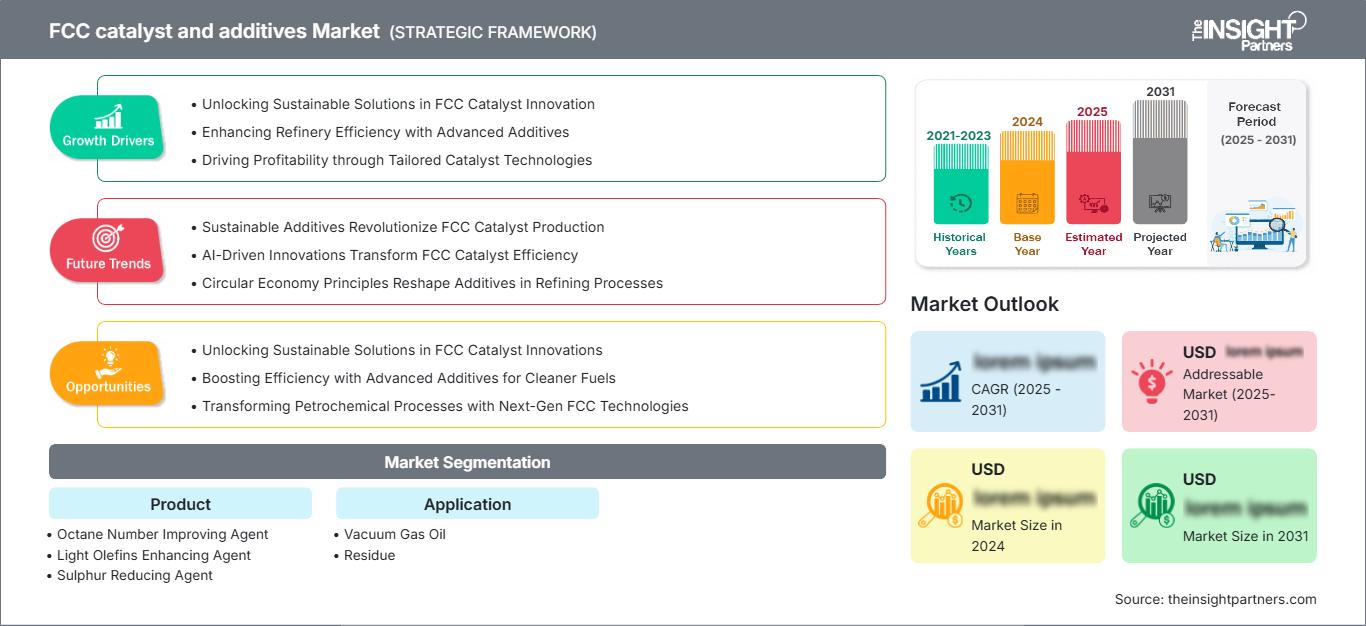
FCC catalyst and additives Market: Strategic Insights
Regional Insights
North America FCC Catalyst and Additives Market
The share of North America in terms of demand in 2025 is expected to be 27-31%, with 2.3-3.0% CAGR until 2034. The US continues to be the dominant player in the region because of its advanced refining capacities and FCC. The rest of the demand comes from Canada and Mexico via integration of refining, fuels and petrochemical production.
Current refiners are focusing on development of technologies enabling better conversion of heavy feeds, handling of nickel and vanadium contaminations and increasing yields of gasoline or olefins. Catalytic and additive manufacturers benefit from well-established technical service infrastructure, routine equilibrium catalyst testing and good relationships with customers. Also, North America provides good conditions for feedstocks produced from renewables or waste testing.
As the operators of refineries look for ways to optimize their operations without significant investments, incremental catalysts and additives reformulation looks like an interesting option for the industry.
U.S. FCC Catalyst and Additives Market
The US contributes about 82% to 86% of North America's total 2025 consumption and is forecasted to record a CAGR growth of 2.4% to 3.1% up to 2034. The presence of a vast base of existing FCC installations ensures that there is an ongoing requirement for new catalysts, additives, services, and catalyst replacement.
Ketjen Corporation, Grace Catalysts Technologies, BASF SE, Johnson Matthey, and ExxonMobil Chemical Company all have existing partnerships with US refiners and technology providers. Some of the main applications are octane in gasoline, olefin in LPG, residue conversion, sulphur reduction, and metal passivation. Digital analysis and testing are becoming more important as operators seek to optimize catalyst circulation and dosage.
Europe FCC Catalyst and Additives Market
The Europe region is estimated to occupy 19-23% FCC Catalyst and Additives Market share by 2025 and grow at a 2.0-2.7% CAGR from 2025 through 2034. The reason behind Germany being an important player is that of its integrated refining and petrochemical capabilities. Italy, France, Spain and the Netherlands are also major contributors through their advanced refineries and petrochemical connections. Both Germany and the Netherlands place importance on integration and high-value conversion, whereas Italy, France and Spain still have a substantial presence of FCC technologies for both fuels and petrochemicals production. Refiners in Europe are increasingly judging catalysts based on criteria such as energy efficiency, emissions reduction and feed flexibility. Residue upgrading and maximizing existing FCC capabilities continue to be relevant since refinery builds are not desired by operators and only incremental value can be generated. Regulation on sulfur, nitrogen oxide and carbon intensity is putting pressure on refiners to use additives and advanced catalysts formulations.
APAC FCC Catalyst and Additives Market
APAC contributes to around 35-39% of the world demand in 2025 and is forecasted to grow at a CAGR of 3.2-4.0% until 2034. China dominates, followed by India, Japan, South Korea, and Singapore. The growing demand for refinery and petrochemical integration drives catalysts' demand.
China benefits from a huge refining base combined with domestic catalyst production capabilities, while India is building up its refining base. Japan and South Korea focus on high performance of their refineries, and Singapore stays an essential region for refining activities.
Middle East & Africa FCC Catalyst and Additives Market
Middle East and Africa demand is supported by refining modernization, petrochemical integration, and the development of higher-value downstream products. Saudi Arabia and the UAE lead regional activity, while South Africa remains an important African refining market. Other Gulf and African markets provide smaller but developing opportunities.
The market in the region will grow at around 2.5-3.3% CAGR during 2034. Saudi Arabia has the advantage of having integrated refining and petrochemical facilities, while the UAE provides advanced downstream facilities. Heavy crude processing, residue upgrading, and emissions control promote catalyst optimization. Refineries are now looking for a way to increase conversion along with the management of metals, sulfur, and coke.
Segmentation Analysis
Product
The product segment in the FCC Catalyst and Additives Market is expected to expand at a 2.8–3.5% CAGR during 2026–2034. Product selection increasingly reflects refinery economics, feed characteristics, and target product yields. Octane and light-olefin enhancement remain important as refiners balance transportation fuels with petrochemical feedstock demand, while sulfur reduction and metals passivation address increasingly stringent operating constraints.
- Octane Number Improving Agent: Supports higher-value gasoline production by increasing octane characteristics, making it strategically important for refiners optimizing gasoline margins and responding to changing fuel specifications.
- Light Olefins Enhancing Agent: Improves propylene and related olefin production, supporting petrochemical integration and creating value where refinery operators prioritize chemical feedstocks alongside conventional fuels.
- Sulphur Reducing Agent: Helps reduce sulfur transfer into FCC products and supports compliance with fuel-quality requirements, particularly where refiners process higher-sulfur feeds.
- Metal Passivation Agent: Mitigates catalyst deactivation caused by nickel, vanadium, and related contaminants, supporting stable conversion and broader flexibility in processing challenging feedstocks.
Application
The application segment is projected to grow at a 2.6–3.3% CAGR during 2026–2034. Application economics depend on feed boiling range, contaminant concentration, refinery configuration, and desired product slate. Vacuum gas oil remains important in conventional FCC operations, while residue processing requires increasingly specialized catalyst systems.
- Vacuum Gas Oil: Provides a major FCC feedstream and supports conventional gasoline and LPG production, with catalyst selection centered on conversion, selectivity, coke control, and stable unit operation.
- Residue: Requires stronger metals tolerance and deeper matrix cracking because heavier feeds contain larger molecules and higher contaminant concentrations, increasing demand for specialized catalyst and additive solutions.
Opportunity Snapshot
| Application | Revenue Contribution (High/Medium/Low) | Trend Tag (MAX 2 words) | Adoption Stage |
| Vacuum Gas Oil | High | Yield Optimization | Mature |
| Residue | Medium | Bottoms Conversion | Scaling |
FCC catalyst and additives Market Growth Drivers and Impact Analysis
Rising Refinery Focus on Higher-Value Product Selectivity
Refiners increasingly adjust FCC operations to maximize the economic value of each barrel rather than simply maximize total conversion. Changes in gasoline, LPG, propylene, and butylene economics can alter the preferred catalyst formulation and additive package. This creates recurring demand for technologies that can modify selectivity without replacing the entire FCC system. Octane-improving and light-olefin-enhancing additives are particularly valuable because they allow operators to respond to changing product margins through relatively incremental interventions. Catalyst suppliers that combine formulation expertise with refinery modeling can demonstrate value in terms of additional product yield, lower coke, or improved unit throughput. The driver therefore strengthens demand for customized catalyst solutions and shortens the commercial payback period associated with performance-focused additive deployment.
Processing Heavier and More Contaminated Feedstocks
Refineries are increasingly evaluating heavier and more contaminated feedstocks to widen crude procurement options and manage feedstock economics. Higher concentrations of nickel, vanadium, iron, and other contaminants can reduce catalyst activity, alter coke selectivity, and constrain regenerator operation. Metals passivation and advanced catalyst matrices provide a mechanism for maintaining conversion while processing more challenging feeds. Residue applications are particularly dependent on matrix accessibility because large molecules cannot readily penetrate conventional zeolite structures. Suppliers that improve pore architecture and metals tolerance can therefore expand the operating envelope available to refiners. The commercial effect extends beyond catalyst sales because better feed flexibility can reduce dependence on premium crude grades and improve refinery resilience when feedstock differentials change.
Stricter Emissions and Fuel-Quality Requirements
Environmental requirements are encouraging refiners to use additives that manage sulfur oxides, nitrogen oxides, carbon monoxide, and related emissions from FCC regenerators. Regulatory compliance can sometimes be achieved through additive deployment without major equipment modification, making catalyst-based solutions economically attractive for existing plants. Sulfur-reduction additives can complement refinery desulfurization strategies, while combustion and emissions-control additives can help manage regenerator performance. The impact is particularly relevant in mature refining markets where operators face high capital costs for large equipment changes. Suppliers with established environmental-additive portfolios can therefore expand wallet share by combining base catalyst supply with targeted emissions solutions. Compliance needs also increase the value of technical services because additive dosage must be optimized against unit configuration and operating conditions.
FCC catalyst and additives Market Future Trends
FCC Integration With Renewable and Circular Feedstocks
Future FCC development will increasingly involve co-processing renewable oils, biomass-derived intermediates, and plastics-derived pyrolysis streams. These feeds can introduce oxygenates, metals, acidity, and other contaminants that differ from conventional petroleum feedstocks. Catalyst systems will consequently evolve toward greater tolerance and more controlled product selectivity. Technical evaluation will become more important because each alternative feed can affect heat balance, coke formation, corrosion, and downstream product quality differently. Refiners may favor flexible catalyst platforms that allow gradual changes in feed composition rather than requiring dedicated catalyst replacement. This FCC Catalyst and Additives Market trend can expand the role of additives as operational tools for managing new feed characteristics. It also creates opportunities for suppliers that combine catalyst development with pilot testing, feed characterization, process modeling, and refinery-scale technical support.
Greater Use of Digital Catalyst Optimization
Digitalization is expected to become more deeply integrated with catalyst management as refiners seek continuous optimization of FCC units. Advanced analytics can combine feed properties, equilibrium-catalyst characteristics, operating conditions, product yields, and emissions data to identify opportunities for formulation or dosage adjustments. Digital tools can also improve prediction of catalyst deactivation and help operators determine when additive changes may be more economical than major unit interventions. As data quality improves, suppliers can move from periodic technical recommendations toward continuous performance monitoring. This shift may strengthen long-term customer relationships because catalyst companies become embedded in refinery decision processes. The FCC Catalyst and Additives Market trend also supports premium pricing for solutions that deliver measurable economic outcomes through lower catalyst consumption, improved selectivity, or greater unit flexibility.
FCC catalyst and additives Market Opportunities
Localized Catalyst Capacity Across High-Growth Asian Refining Hubs
Expanding refinery and petrochemical capacity in Asia creates opportunities in the FCC Catalyst and Additives Market Forecast for catalyst producers to strengthen regional manufacturing and technical-service infrastructure. Local production can reduce logistics exposure, improve supply responsiveness, and support faster catalyst qualification with regional refiners. India, China, and Southeast Asia offer particularly attractive conditions because refining systems increasingly emphasize petrochemical integration and residue conversion. Suppliers can combine local catalyst manufacturing with equilibrium-catalyst laboratories, pilot testing, and refinery troubleshooting capabilities. This approach would also improve responsiveness to regional feedstock characteristics, which can differ substantially from those in mature Western markets. Strategic partnerships with refinery technology licensors and local engineering companies could accelerate market entry while reducing capital requirements. Companies that establish regional technical credibility alongside manufacturing access may capture long-term contracts with newly upgraded and expanding FCC units.
Premium Catalyst Platforms for Residue and Petrochemical Integration
A second opportunity lies in high-performance catalyst platforms designed for residue conversion and petrochemical-oriented FCC operation. Residue processing requires stronger metals tolerance, improved diffusion, and controlled coke selectivity, while petrochemical integration favors higher yields of propylene and other light olefins. These requirements create opportunities for differentiated formulations that generate measurable incremental value per barrel rather than competing primarily on catalyst price. Suppliers can target refineries undertaking revamps, product-slate changes, or deeper integration with petrochemical complexes. Commercial trials and pilot testing can help demonstrate economic benefits before full-scale adoption. Partnerships with process licensors can further support deployment because catalyst formulation, reactor configuration, and operating severity are closely interconnected. Premium platforms can therefore create higher-value recurring revenue through technical services, additives, and catalyst optimization programs.
Recent Developments
- May 2026: BASF SE opened a new refinery catalyst research and development center at its Attapulgus, Georgia, production site. The facility focuses on next-generation FCC catalyst development, advanced testing, quality control, and faster scale-up. BASF stated that locating R&D alongside production will strengthen collaboration with process engineering teams and enable closer customization around real refinery operating requirements.
- March 2026: Albemarle Corporation completed the sale of a controlling stake in Ketjen Corporation's refining catalyst solutions business to affiliates of KPS Capital Partners. Albemarle retained a 49% minority stake, while Ketjen's Performance Catalyst Solutions business remained under Albemarle ownership. The transaction reshaped ownership of a major global FCC catalyst supplier while preserving Albemarle's ongoing economic interest.
Frequently Asked Questions

- Comprehensive Market Sizing and Forecast Analysis
- Detailed Segmentation Analysis
- In-Depth Market Dynamics Assessment
- Regional and Country-Level Insights
- Competitive Landscape and Company Benchmarking
- Strategic Business Intelligence
Recent Reports
Testimonials

The Insight Partners provided valuable market intelligence that supported our global go-to-market strategy. Their team was professional, responsive, and attentive to our feedback, providing thoughtful analysis and helpful methodological clarifications throughout the project.
Junmo Kim Chief Financial Officer (CFO), Enertech Co., Ltd.
The Insight Partners' SCADA System Market report is comprehensive, with valuable insights on current trends and future forecasts. The team was highly professional, responsive, and supportive throughout. We are very satisfied and highly recommend their services.
RAN KEDEM Partner, Reali Technologies LTDs
I requested a report on a very specific software market and the team produced the report in a few days. The information was very relevant and well presented. I then requested some changes and additions to the report. The team was again very responsive and I got the final report in less than a week.
JEAN-HERVE JENN Chairman, Future Analytica
We worked with The Insight Partners for an important market study and forecast. They gave us clear insights into opportunities and risks, which helped shape our plans. Their research was easy to use and based on solid data. It helped us make smart, confident decisions. We highly recommend them.
PIYUSH NAGPAL Sr. Vice President, High Beam Global
The Insight Partners delivered insightful, well-structured market research with strong domain expertise. Their team was professional and responsive throughout. The user-friendly website made accessing industry reports seamless. We highly recommend them for reliable, high-quality research services
YUKIHIKO ADACHI CEO, Deep Blue, LLC.
This is the first time I have purchased a market report from The Insight Partners.While I was unsure at first, I visited their web site and felt more comfortable to take the risk and purchase a market report.I am completely satisfied with the quality of the report and customer service. I had several questions and comments with the initial report, but after a couple of dialogs over email with their analyst I believe I have a report that I can use as input to our strategic planning process.Thank you so much for taking the extra time and making this a positive experience.I will definitely recommend your service to others and you will be my first call when we need further market data.
JOHN SUZUKI President and Chief Executive Officer, Board Director, BK Technologies
I wish to appreciate your support and the professionalism you displayed in the course of attending to my request for information regarding to infectious disease IVD market in Nigeria. I appreciate your patience, your guidance, and the fact that you were willing to offer a discount, which eventually made it possible for us to close a deal. I look forward to engaging The Insight Partners in the future, all thanks to the impression you have created in me as a result of this first encounter.
DR CHIJIOKE ONYIA MANAGING DIRECTOR, PineCrest Healthcare Ltd.Reason to Buy
- Informed Decision-Making
- Understanding Market Dynamics
- Competitive Analysis
- Identifying Emerging Markets
- Customer Insights
- Market Forecasts
- Risk Mitigation
- Boosting Operational Efficiency
- Strategic Planning
- Investment Justification
- Tracking Industry Innovations
- Aligning with Regulatory Trends





 Get Free Sample for