
Feed Market Demand, Size & Forecast by 2034
Feed Market Size and Forecasts (2021–2034), Global and Regional Share, Trends, and Growth Opportunity Analysis Report Coverage : by Form (Pellets, Crumbles, Mash); Livestock (Poultry, Swine, Ruminants, Aquaculture); and Geography (North America, Europe, Asia Pacific, and South and Central America)
- Status : Data Released
- Report Code : TIPRE00040382
- Category : Chemicals and Materials
- No. of Pages : 150
- Available Report Formats :


- Last update date : September 22, 2026


2025 Market Size
US$ 509.18 Bn
Base year value
2034 Forecast
US$ 825.63 Bn
Projected by 2034
CAGR 2026-2034
5.52 %
Growth rate
Addressable Market
US$ 6,052.83 Bn
(2026-2034)
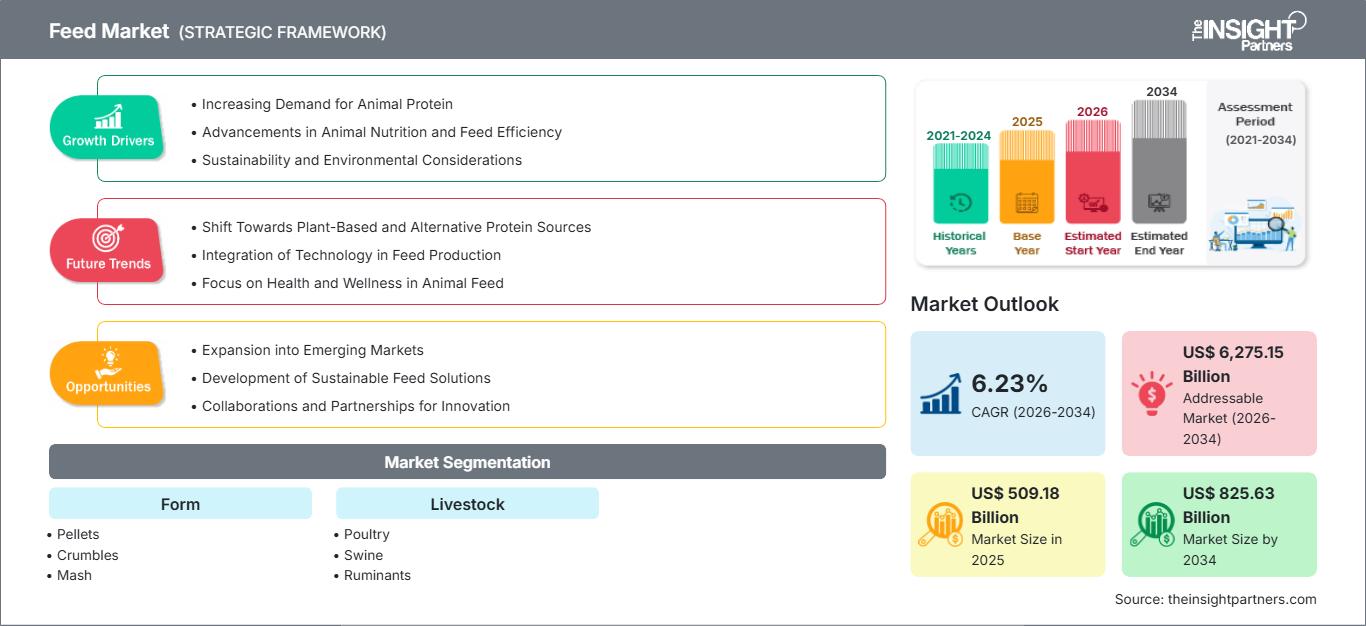
The Feed market was valued at US$ 509.18 billion in 2025 and is expected to reach US$ 825.63 billion by 2034; it is estimated to record a CAGR of 5.52% during 2026-2034.
Feed Market Assessment and Insights
- North America accounted for an estimated 20–24% Feed Market share in 2025 and is expected to grow at a 4.8–5.5% CAGR between 2026–2034, supported by intensive livestock production, established feed manufacturing infrastructure, precision nutrition, and increasing emphasis on feed efficiency.
- US represented approximately 72–76% of North American demand in 2025 and is projected to expand at a 4.7–5.4% CAGR between 2026–2034, reflecting its large poultry, swine, dairy, and beef production base.
- Europe held an estimated 22–26% share in 2025 and is expected to register a 3.8–4.6% CAGR between 2026–2034. Germany, Spain, France, Italy, the Netherlands, and the UK remain significant markets, supported by sophisticated livestock production and sustainability-oriented feed formulation.
- Asia Pacific represented approximately 36–40% share in 2025 and is projected to grow at a 7.0–7.8% CAGR between 2026–2034. China, India, Japan, South Korea, Indonesia, Vietnam, and Australia remain major markets, with expanding poultry, aquaculture, swine, and dairy production.
- Largest Segment – Poultry accounted for an estimated 42–46% market share in 2025 and is projected to grow at a 5.8–6.5% CAGR between 2026–2034, supported by efficient poultry production and strong demand for affordable animal protein.
- High Growth Segment – Aquaculture represented approximately 7–10% market share in 2025 and is expected to expand at an 8.0–9.0% CAGR between 2026–2034, driven by intensification, feed efficiency requirements, and increasing farmed seafood production.
- Key companies analyzed in detail: Cargill Incorporated, Archer-Daniels-Midland Company, Nutreco N.V., ARASCO, Purina Animal Nutrition LLC, Charoen Pokphand Foods Public Company Limited, Land O'Lakes, Inc., De Heus Animal Nutrition B.V., Kent Nutrition Group, Inc., and ForFarmers N.V.
Source: The Insight Partners' analysis based on proprietary research, government publications, company annual reports, investor presentations, industry databases, and expert interviews.
The move from commodity formulations to compound feed specific to species is increasingly being driven through formulations geared towards feed efficiency, health, and stage of production. Pelleting processes, ingredient processing, enzymatic supplementation, amino acid balancing, and computerized formulation tools will continue to become an integral part of the process. In terms of the evolution of the market for animal feed, therefore, there is an interplay between physical feed output and the nutritional science that goes into every tonne of feed produced.
For the coming years, the major growth potential will be seen in the Asia-Pacific region and selected emerging economies, while in the more mature markets, there will be emphasis on productivity and sustainability. Investments will probably be made in local feed production capacities, alternative raw materials, precision feeding, and aquaculture systems. Regulations on feed emissions, antibiotics management, traceability and responsible sourcing will drive improvements in formulations among other things. These trends should drive up the value of specialized feeds despite slow growth in livestock populations.
Feed Market Report Scope
| Report Attribute | Details |
|---|---|
| Market size in 2025 | US$ 509.18 Billion |
| Market Size by 2034 | US$ 825.63 Billion |
| Global CAGR (2026 - 2034) | 5.52% |
| Historical Data | 2021-2024 |
| Forecast period | 2026-2034 |
Feed Market Analysis
The development of feed industry follows the development of poultry, swine, ruminant, and aquaculture production. Feed producers procure grains, oilseed meals, amino acids, vitamins, minerals, enzymes, and specialty products, transforming them into species- and life cycle-specific formulations. Feed distribution occurs via integrated supply chains, feed distributors, cooperatives, and producer contacts. The demand is particularly responsive to meat prices, feed-to-meat conversion efficiency, feed ingredient prices, disease, and farm margins.
The supply of feed industry depends on the geographical access to corn, wheat, soybean meal, and other protein sources. The suppliers of feed ingredients have been diversifying their raw material portfolio due to the fact that weather, political, and logistics issues may significantly affect the economic side of feed formulation. Big integrated firms can capitalize on the scale effect in procurement, and specialized regional companies – on proximity and custom formulation.
Feed market analysis depicts an intensely competitive market comprising global agribusinesses, integrated protein businesses, regional feed suppliers, and nutrition specialists. Cargill Incorporated and Archer-Daniels-Midland Company integrate ingredient production with extensive nutritional expertise, while Nutreco N.V. focuses on specialized livestock and aquaculture nutrition. Charoen Pokphand Foods Public Company Limited gains from vertical integration along the feed-farming-food processing value chain. De Heus Animal Nutrition B.V., ForFarmers N.V., ARASCO, Purina Animal Nutrition LLC, Land O'Lakes, Inc., and Kent Nutrition Group, Inc. contribute to intensifying regional competitiveness.
The Feed market trends show that there is an increasing focus on investment in production capacity, precision nutrition, sustainability, and localized production. The expansion in micronutrition production capacity for Cargill took place in Austria in 2025, whereas De Heus established its production facilities in India and Uganda. Researching capacity of ADM has been increased in relation to animal microbiomes and feed efficiencies. Nutreco is focusing on investments in alternative ingredients, digitalization, and aquaculture systems through its innovation platform.
● REPORT CUSTOMIZATION
Tailor This Report To Align With Your Specific Business Requirements
This report can be customized to align precisely with your business objectives, scope, and target markets. Customization options include tailored segmentation, geography, competitive analysis, and strategic insights to support informed decision-making.
Customize This Report →WHAT YOU CAN ADJUST
- ● Segmentations
- ● Geography
- ● Competitive Analysis
- ● Language Preferences
Feed Market: Strategic Insights
Regional Insights
North America Feed Market
North America represented an estimated 20–24% share in 2025 and is projected to grow at a 4.8–5.5% CAGR during 2026–2034. Domination of demand is attributed to the extensive poultry, swine, dairy, and beef production. Formulated feeds are being increasingly used for improving feed efficiency and performance in animals. Contributions from Canada are based on their existing poultry, swine, dairy, and aquaculture production systems, whereas Mexico’s contributions are from increased growth in the consumption of animal proteins.
The presence of well-developed feed mill facilities, feed ingredient chains, and technologies used in formulation and production makes this region favorable. Feed manufacturers are using enzymes, amino acids, minerals, and specialized nutritional additives for optimizing the feed formulations in face of commodity price volatility. Formulation is also influenced by disease prevention and biosecurity measures. Localized supply of capacity and technical services from the suppliers and reliable supply and consistent formulation from integrated producers are key drivers of growth in this region, which will be moderate in the coming years.
U.S. Feed Market Market
The U.S. represented approximately 72–76% of North American demand in 2025 and is expected to grow at a 4.7–5.4% CAGR during 2026–2034. The poultry sector will remain a prominent one after the swine, dairy, and beef sectors. Formulations that increase feed efficiency and animal health are being favored in large commercial settings. The use of automation and data-backed formulation is becoming common among feed millers as well.
There are prominent players in the industry including Cargill Incorporated, Archer Daniels Midland Company, Purina Animal Nutrition LLC, and Land O’Lakes Inc. that have a presence across various segments. The market is highly integrated with ingredient suppliers, feed manufacturers, and large-scale farms. Growing interest in precision nutrition would favor high-end formulations, while disease management would lead to better feed quality controls. Growth would occur due to efficiency, specialization, and replacement demand rather than growth in livestock population.
Europe Feed Market Market
Europe held an estimated 22–26% share in 2025 and is projected to grow at a 3.8–4.6% CAGR during 2026–2034. Germany is an important feed market due to the huge number of livestock processing operations and presence of the compound feed industry in the region. Spain shows high demand for poultry and swine products, and France retains its high poultry, dairy, and cattle production. Italy and Netherlands help with intensive livestock production and advanced feed production technologies.
The UK will remain a market due to its production of poultry, swine, dairy, and ruminants. European producers are under increased pressure regarding the use of nitrogen, emissions, animal welfare, traceability, and responsible use of ingredients. All these factors support the development of more efficient and effective formulations that enhance feed conversion. ForFarmers N.V. and De Heus Animal Nutrition B.V. are positioned regionally, while Nutreco N.V. is oriented on special livestock and aquaculture markets.
APAC Feed Market Market
Asia Pacific represented approximately 36–40% share in 2025 and is projected to grow at a 7.0–7.8% CAGR during 2026–2034. China is the leading market, while India, Japan, South Korea, Indonesia, Vietnam, and Australia provide diverse demand across poultry, swine, dairy, and aquaculture.
Industrial livestock expansion, rising protein consumption, and government priorities around food security support feed demand. Aquaculture is particularly important across China, Vietnam, India, and Indonesia, while poultry provides broad regional volume growth. Feed manufacturers are increasing local production capacity and improving automation, formulation quality, and supply reliability.
Middle East & Africa Feed Market Market
The Middle East and Africa is expected to expand at a 4.5–5.2% CAGR during 2026–2034. Saudi Arabia leads regional demand through intensive poultry and dairy production, while the UAE maintains an important role in modern food and livestock infrastructure. South Africa provides a developed feed-manufacturing base and diversified livestock demand.
Rest of MEA remains more fragmented, but investment in poultry, dairy, aquaculture, and food-security infrastructure creates opportunities. Regional feed producers increasingly emphasize local sourcing, formulation efficiency, and dependable supply as imported ingredient costs remain volatile.
Segmentation Analysis
Form
The Form segment is projected to grow at a 5.8–6.5% CAGR during 2026–2034. Form selection depends on livestock species, animal age, feeding equipment, ingredient characteristics, and production economics. The feed market scope includes manufactured forms designed to improve handling, reduce wastage, and deliver consistent nutrient intake. Pellets remain particularly important for commercial operations because processing can improve physical uniformity and facilitate mechanized feeding.
- Pellets: Pellets maintain a leading position across poultry, swine, ruminant, and aquaculture applications because they provide uniform nutrient distribution, convenient handling, and reduced ingredient separation during transport and feeding.
- Crumbles: Crumbles are widely used for young poultry and selected livestock stages where smaller particles improve intake and transition from starter diets. Their physical structure supports controlled feeding during early development.
- Mash: Mash remains important where producers prioritize formulation flexibility, lower processing requirements, or specific animal preferences. Demand is sustained across ruminant and selected poultry applications, particularly in cost-sensitive production systems.
Livestock
The Livestock segment is expected to register a 6.3–7.0% CAGR during 2026–2034. Poultry remains the largest demand center, while aquaculture is expected to post the fastest expansion. Swine and ruminants provide substantial recurring consumption because commercial farms require nutritionally balanced diets across production stages. The feed market Report therefore encompasses both mature livestock systems and rapidly expanding protein-production models.
- Poultry: Poultry represents the largest feed-consuming livestock category, supported by efficient feed conversion and strong demand for chicken meat and eggs. Commercial production requires precise formulations across starter, grower, and finisher stages.
- Swine: Swine feed demand is concentrated in intensive production systems where nutrition directly influences growth rate, feed conversion, reproductive performance, and herd health. Formulations increasingly incorporate specialized additives and balanced amino-acid profiles.
- Ruminants: Dairy and beef operations use formulated feeds to complement forage and optimize energy, protein, mineral, and fiber intake. Demand is closely tied to milk yields, herd productivity, forage availability, and farm economics.
- Aquaculture: Aquaculture is the fastest-expanding livestock category in the scope, supported by growing farmed seafood production. Species-specific pellets must balance nutrient density, water stability, palatability, and efficient feed conversion under controlled production conditions.
Opportunity Snapshot
| Livestock | Revenue Contribution | Trend Tag | Adoption Stage |
| Poultry | High | Protein Efficiency | Mature |
| Swine | High | Herd Nutrition | Mature |
| Ruminants | Medium | Dairy Yield | Scaling |
| Aquaculture | Medium | Aqua Intensification | Scaling |
Feed Market Growth Drivers and Impact Analysis
Expansion of Commercial Animal Protein Production
The rising trend of consumption of chicken, pork, dairy, eggs, and farmed aquatic species drives demand for feed continuously. Commercial livestock farming operations tend to use compound feed because the nutritional uniformity influences animal development, reproduction, and health and feed utilization. Chickens play an especially critical role because their short lifecycle makes demand for feed very sensitive to changes in protein consumption. Another factor is due to aquaculture, which is becoming an increasingly significant complement to the catching of the fish. It includes commercial components such as the source of the ingredients, feed production, transportation, farm management, and nutrition knowledge. Big farms will have the capacity to acquire automatic feed mills and proper feed formulations, while small ones will use compound feed.
Increasing Importance of Feed Conversion Efficiency
Feeds account for a large part of the operating costs associated with raising livestock, thus making feed conversion a critical measure of profitability. ADM reports that the percentage of total production cost allocated to feeds can be as high as 60-70 percent in dairies, indicating that the economics are significant enough to influence the formulation choice. In this case, farmers opt for feed formulations that not only enhance nutrient absorption but also improve performance and consistency of their livestock, rather than just focusing on low procurement cost. The use of enzymes, amino acids, probiotics, minerals and other formulation technologies increases the nutritional value of the feed components. It makes the market competition different, since feed suppliers should be capable of showing results at the farm level.
Pressure to Improve Sustainability and Resource Utilization
Pressure from the environment has begun to play an increasing role in the decisions made for formulating, sourcing ingredients, and producing the feed. The food and feed industry players are now looking for low emission value chains, increased use of co-products, sustainable sourcing, and reduction of dependency on ingredients that cause land use issues. The feed producers can respond to the pressure from the environment through better utilization of the nutrients, utilizing food industries by-products and reducing excretions of unnecessary nutrients. ForFarmers have been working on circular feed solutions that are based on residual streams while Nutreco is working on solutions based on by-products and alternative ingredients. Such efforts can lead to commercial success if there is a simultaneous improvement in sustainability and reduced cost/ better feed performance of the ingredients used.
Feed Market Future Trends
Precision Nutrition Through Data-Enabled Formulation
Precision nutrition will get even more advanced as feed companies begin to use farm data, animal performance information, information about ingredients, and formulation software in their formulation process. The current process that focuses on using standardized feeds may be gradually replaced by the approach that takes into account genetics of animals, production phase, animal health, environment, and quality of ingredients. Machine learning algorithms can assist in finding connections between nutrient consumption and animal performance, thus allowing for more tailored formulation. Information about consumption, growth, milk production, egg production, or water quality can be received in real-time from connected farm systems. Such formulations will help decrease unnecessary nutritional excesses and increase productivity. For feed companies, being digitally equipped will become an additional advantage next to the quality of physical feed.
Greater Adoption of Alternative Feed Ingredients
The use of alternative ingredients is anticipated to become more popular as companies try to cope with fluctuations in the cost of commodities, sustainability needs, and competition for feed material. These alternatives could be insect-based protein, single cell proteins, algae, food processing waste products, fermentation waste products, and locally available agricultural waste. However, adoption will hinge on nutritional uniformity, regulatory compliance, economic feasibility, and farmer acceptability. As such, the shift to alternative ingredients will be gradual and not universal. Companies are expected to use blends of alternative ingredients along with traditional ingredients, prior to substituting large amounts of the traditional ingredients. The use of technology in processing ingredients is going to increase due to moisture content, particle size, digestibility, and storage problems.
Feed Market Opportunities
Localized Production Capacity in Emerging Livestock Regions
New livestock areas present an opportunity for the companies to build feed mills in proximity to their farms and lower reliance on imported finished feeds. India, Southeast Asia, Africa, as well as certain markets in the Middle East, demonstrate growing needs in proteins together with intensification of agriculture business there. Building facilities locally will allow for shorter delivery times, formulation flexibility regarding available materials in a region, as well as improved resilience of the supply chain in case of transportation issues. Investment plans of De Heus in India and Uganda show how beneficial it is to have the production capacity built close to the growing livestock and aquaculture hubs. Potential investors should look for the facilities that have modular production lines allowing them to serve poultry, swine, dairy, and aqua customers.
Specialized Nutrition for Aquaculture and High-Value Livestock
Specialized nutrition represents an attractive investment pathway because performance differences can justify higher feed value than conventional commodity formulations. Aquaculture is particularly suited to differentiated products because feed affects growth, survival, water quality, and production-cycle economics. Similar opportunities exist in dairy and breeding livestock, where producers evaluate diets against milk yield, reproductive performance, or herd health. Suppliers can invest in species-specific formulations, microencapsulation, functional ingredients, and digital feeding guidance. Partnerships with farms and research institutions can accelerate validation and demonstrate economic benefits before broader commercialization. The feed market Forecasts therefore point toward a gradual increase in value-added nutrition within overall feed consumption. Companies with strong technical teams and localized formulation capabilities can capture premium opportunities while maintaining established commodity-feed relationships.
Recent Developments
- February 2026: Cargill Incorporated – Cargill opened a new dairy feed plant in Wazirabad, Punjab, India, with an investment of approximately ₹300 crore and production capacity of 400,000 tonnes per year. The facility is Cargill's largest dairy feed plant in South Asia and is intended to support dairy farmers through expanded local production and science-based nutrition solutions.
- September 2025: De Heus Animal Nutrition B.V. – De Heus opened a new animal feed factory in Rajpura, Punjab, India, following an investment of approximately US$17 million. The facility has installed capacity of 180,000 tonnes, expandable to 240,000 tonnes, with separate production lines for cattle, buffalo, poultry, and pig feed.
Frequently Asked Questions

- Comprehensive Market Sizing and Forecast Analysis
- Detailed Segmentation Analysis
- In-Depth Market Dynamics Assessment
- Regional and Country-Level Insights
- Competitive Landscape and Company Benchmarking
- Strategic Business Intelligence
Recent Reports
Testimonials

The Insight Partners' SCADA System Market report is comprehensive, with valuable insights on current trends and future forecasts. The team was highly professional, responsive, and supportive throughout. We are very satisfied and highly recommend their services.
RAN KEDEM Partner, Reali Technologies LTDs
I requested a report on a very specific software market and the team produced the report in a few days. The information was very relevant and well presented. I then requested some changes and additions to the report. The team was again very responsive and I got the final report in less than a week.
JEAN-HERVE JENN Chairman, Future Analytica
We worked with The Insight Partners for an important market study and forecast. They gave us clear insights into opportunities and risks, which helped shape our plans. Their research was easy to use and based on solid data. It helped us make smart, confident decisions. We highly recommend them.
PIYUSH NAGPAL Sr. Vice President, High Beam Global
The Insight Partners delivered insightful, well-structured market research with strong domain expertise. Their team was professional and responsive throughout. The user-friendly website made accessing industry reports seamless. We highly recommend them for reliable, high-quality research services
YUKIHIKO ADACHI CEO, Deep Blue, LLC.
This is the first time I have purchased a market report from The Insight Partners.While I was unsure at first, I visited their web site and felt more comfortable to take the risk and purchase a market report.I am completely satisfied with the quality of the report and customer service. I had several questions and comments with the initial report, but after a couple of dialogs over email with their analyst I believe I have a report that I can use as input to our strategic planning process.Thank you so much for taking the extra time and making this a positive experience.I will definitely recommend your service to others and you will be my first call when we need further market data.
JOHN SUZUKI President and Chief Executive Officer, Board Director, BK Technologies
I wish to appreciate your support and the professionalism you displayed in the course of attending to my request for information regarding to infectious disease IVD market in Nigeria. I appreciate your patience, your guidance, and the fact that you were willing to offer a discount, which eventually made it possible for us to close a deal. I look forward to engaging The Insight Partners in the future, all thanks to the impression you have created in me as a result of this first encounter.
DR CHIJIOKE ONYIA MANAGING DIRECTOR, PineCrest Healthcare Ltd.Reason to Buy
- Informed Decision-Making
- Understanding Market Dynamics
- Competitive Analysis
- Identifying Emerging Markets
- Customer Insights
- Market Forecasts
- Risk Mitigation
- Boosting Operational Efficiency
- Strategic Planning
- Investment Justification
- Tracking Industry Innovations
- Aligning with Regulatory Trends





 Get Free Sample for