
Feeding System Market Share, Demand & Growth by 2034
Feeding System Market Size and Forecasts (2021 - 2034), Global and Regional Share, Trends, and Growth Opportunity Analysis Report Coverage : By Type (Rail Guided, Conveyor, Self-Propelled), Technology (Automatic, Manual), Livestock (Ruminants, Poultry, Swine, Other Livestock), Power Source (Electric, Battery Operated, Hydraulic/Pneumatic)
- Status : Data Released
- Report Code : TIPRE00039429
- Category : Manufacturing and Construction
- No. of Pages : 150
- Available Report Formats :


- Last update date : July 28, 2026


2025 Market Size
US$ 3.53 Bn
Base year value
2034 Forecast
US$ 6.82 Bn
Projected by 2034
CAGR 2026-2034
7.59 %
Growth rate
Addressable Market
US$ 46.62 Bn
(2026-2034)
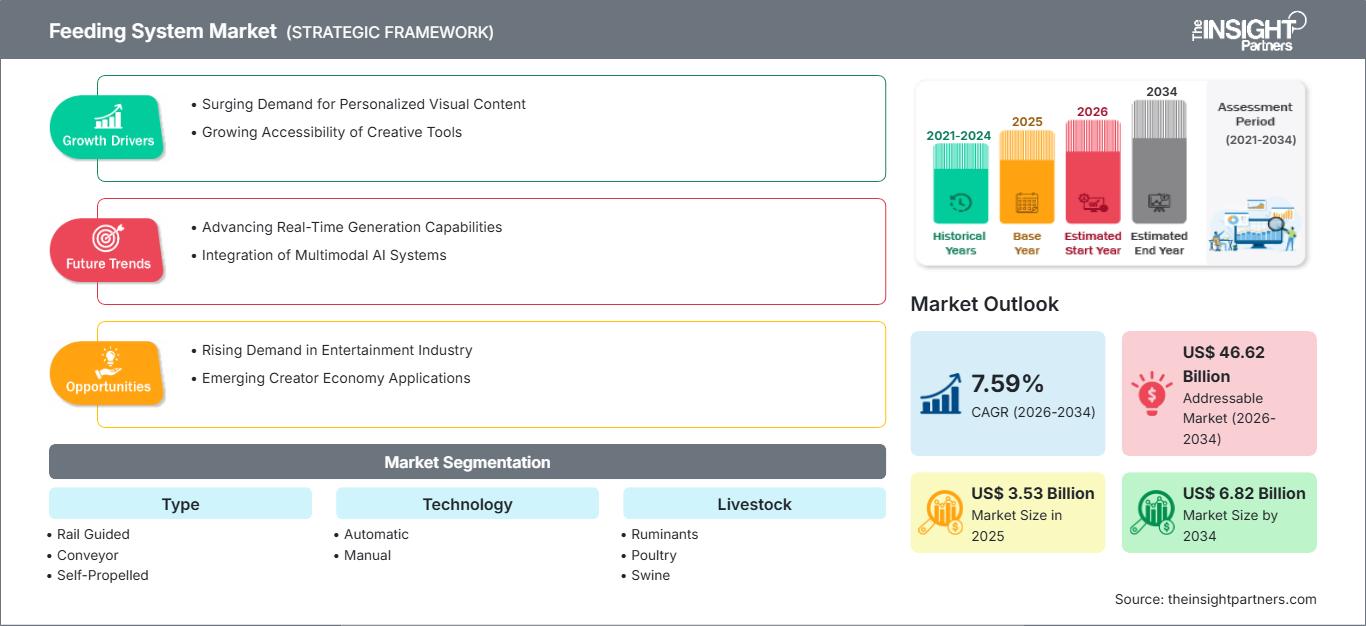
The feeding system market size is expected to rise from US$ 3.53 Billion in 2025 to US$ 6.82 Billion by 2034, growing at a CAGR of 7.59% in the period of 2026–2034. The market is driven by increasing spending on automation for feed preparation, rationing, and nutritional management in commercial livestock facilities. Adoption is highest where labor shortage, feed price hikes, and precision livestock farming are driving changes in farm operating practices.
North America continues to be a source of income, with a projected 2026–2034 CAGR of 7.0–7.8%, driven by increased consolidation in the dairy sector, increased use of mechanization, and the need to replace labor-efficient feeding machines. The North American feeding system market size is also driven by herd management using data, feed efficiency measures, and increased use of electric and battery-powered feeding machines on medium and large farms.
Feeding System Market Assessment and Insights
- North America: The region accounted for 31–34% feeding system market share in 2025 and is projected to grow at a CAGR of 7.0–7.8% during 2026–2034, supported by labor scarcity, automated dairy operations, and high feed-cost sensitivity.
- US: The US represented 78–82% of North America in 2025 and is expected to expand at a CAGR of 7.1–7.9% during 2026–2034, led by dairy automation.
- Europe: Europe held 27–30% share in 2025 and is forecast to grow at a CAGR of 6.8–7.5% during 2026–2034, with Germany, the Netherlands, France, and Italy leading adoption.
- Asia Pacific: Asia Pacific captured 21–24% share in 2025 and is expected to grow at a CAGR of 8.2–9.0% during 2026–2034, led by China, Japan, India, Australia, and South Korea.
- Largest Segment: Ruminants held 44–47% market share in 2025 and is projected to grow at a CAGR of 7.2–7.9% during 2026–2034, driven by dairy ration automation.
- High Growth Segment: Self-Propelled systems held 22–25% market share in 2025 and is expected to grow at a CAGR of 8.6–9.4% during 2026–2034, reflecting flexible farm deployment.
- Key companies analyzed in detail: DeLaval International AB, GEA Group Aktiengesellschaft, Lely International N.V., Trioliet B.V., AGCO Corporation, BouMatic LLC, Pellon Group Oy, Rovibec Agrisolutions Inc., HETWIN Automation GmbH, Schauer Agrotronic GmbH.
Source: The Insight Partners' analysis based on proprietary research, government publications, company annual reports, investor presentations, industry databases, and expert interviews.
The evolution of technology means that the feeding system industry is transitioning from mechanized distribution to fully integrated ration control, mixing and feed intake management systems using sensors. Dairy farming operations continue to be early adopters, since ruminant nutrition is closely linked to milk output, herd health, and labor planning. The production process is also shifting due to hardware, software and farm data platform provision by equipment makers in order to make the investment justifiable through savings on feeds and repetition of activities.
In terms of future adoption of the technology, it will extend beyond dairy farms which have high levels of mechanization as other farms like commercial poultry, swine and mixed-livestock farms consider controlled feed delivery systems. The focus on animal welfare, nutrient efficiency, and waste reduction in the regulatory framework will drive investments in Europe and North America, whereas farm consolidation and demand for protein will help the Asia-Pacific region.
Feeding System Market Report Scope
| Report Attribute | Details |
|---|---|
| Market size in 2025 | US$ 3.53 Billion |
| Market Size by 2034 | US$ 6.82 Billion |
| Global CAGR (2026 - 2034) | 7.59% |
| Historical Data | 2021-2024 |
| Forecast period | 2026-2034 |
Feeding System Market Analysis
The feeding system market growth is being spurred on account of the need to curb feed wastage, shortage of labor, and delivery of uniform rations over larger numbers of herds. Feeding is one of the major operational expenses in livestock farming. Thus, it results in significant benefit from automation in weighing, mixing, and delivery of feed on time. There will be high demand in cases where the farms are running more than one feeding cycles a day and require traceability with regards to ingredients, herd and feed consumption behavior.
Supply is influenced by manufacturing of machinery, sensors, farm management software, dealership network, and after sales service. The rail-guided and conveyor systems are still applicable in case of fixed barns, whereas self-propelled systems will be suitable for farms requiring flexibility in the route.
According to the feeding system market analysis, competition is stiff, with DeLaval International AB, GEA Group Aktiengesellschaft, Lely International N.V., and Trioliet B.V. competing on automation systems, while AGCO Corporation and BouMatic LLC compete in systems that form part of an entire farm equipment ecosystem. Specialty companies including Pellon Group Oy, Rovibec Agrisolutions Inc., HETWIN Automation GmbH, and Schauer Agrotronic GmbH specialize in designing automated feeding systems based on the barn layout requirements of customers.
Modularity, remote diagnostics, and retrofitting of livestock barns into automated systems are emerging investment trends. Strategic positioning involves focusing on the total cost of ownership, ease of use of software, accuracy of feeding, and availability of service locally. Companies that integrate good mechanical engineering skills with data capabilities are likely to win upgrade opportunities from manual feeding to automatic or semi-automatic modes of operation.
● REPORT CUSTOMIZATION
Tailor This Report To Align With Your Specific Business Requirements
This report can be customized to align precisely with your business objectives, scope, and target markets. Customization options include tailored segmentation, geography, competitive analysis, and strategic insights to support informed decision-making.
Customize This Report →WHAT YOU CAN ADJUST
- ● Segmentations
- ● Geography
- ● Competitive Analysis
- ● Language Preferences
Feeding System Market: Strategic Insights
Regional Insights
North America feeding system market
North America has a share of 31-34% in 2025 and is expected to progress at a CAGR of 7.0-7.8% till 2034. Large herd sizes, rapid equipment turnover rates, and high level of dealership assistance in installing automated feeding equipment in the region will drive the regional market. Feed prices fluctuation is creating an incentive for the farmers to calculate the accuracy of rations and create a need for solutions reducing refusals and improving consistency on a day-to-day basis.
Market shares for feeding systems in North America are dominated by the US and Canada, with Canada supporting the development due to modern dairy and poultry operations. Systems are becoming popular among medium-sized farms as adoption shifts from large to medium-sized farms, because of modular product designs. Electric and battery-powered machines are emerging due to reduced indoor emissions, reduced barn noise, and sustainability programs.
U.S. Feeding System Market
The share of the US in North America stood at 78%–82% in 2025 and it is projected to exhibit a CAGR of 7.1%–7.9% for the period 2026-2034. Big dairy farms in Wisconsin, California, Idaho, and New York are more interested in automated feeding systems to solve problems of labour shortage, feed efficiency, and animal health monitoring. Farms with poultry and pigs are examining controlled feeding systems where consistency is critical for predicting weight gain and production levels.
The presence of key companies includes DeLaval International AB, GEA Group Aktiengesellschaft, Lely International N.V., Trioliet B.V., AGCO Corporation, and BouMatic LLC. Application trends suggest more use of robotised feed pushers, automated calf feeders, self-propelled mixers, and herd management systems that will help farms connect their feeding results with milk production and animal performance.
Europe Feeding System Market
Europe captured a market share of 27-30% in 2025 and is expected to grow at a CAGR of 6.8-7.5% from 2025 to 2034. Germany holds a dominant position due to its advanced dairy industry, engineering expertise, and high labor costs, which promote automation. In the UK, there is the need for systems which can ensure consistency in rationing with the fluctuations in feed prices, while German farms focus on precise feeding, barn integration, and energy-saving electric systems.
France, Italy, and Spain play a role through their dairy cooperatives, mixed livestock farming, and poultry industry. France prefers automation in feeding for the sake of productivity and compliance with welfare regulations, northern dairy clusters of Italy spend in high-capacity mixers, while in Spain there is an expansion of automation in swine and poultry.
APAC Feeding System Market
The share held by the Asia Pacific region in 2025 was 21–24%, and it is estimated to grow at an 8.2–9.0% CAGR during 2026–2034. China dominates the market as there are advancements on large scale farms of dairy and swine production. Japan and South Korea focus on automation for efficiency of the workforce, whereas India and Australia follow selective adoption practices in organized dairies and livestock farms.
Key industrial factors influencing the market are farm consolidation, higher cold chain investments, and increase in demand for consistent supply of animal protein. Supportive policies regarding productivity of the livestock and food security motivate the adoption of advanced technology, especially when feeding animals manually restricts scalability.
Middle East & Africa Feeding System Market
It is estimated that the Middle East and Africa market will grow at a CAGR of 6.5% to 7.2% from 2026 to 2034, with Saudi Arabia being the leading country. Huge dairy farming in Saudi Arabia and UAE demands reliable supply of feed under heat stress. South Africa meets the demand with commercial dairy, poultry and feed lot farms.
The energy and infrastructural factors significantly influence the equipment choice. The farms seek robust solutions for reliable maintenance along with water-efficient livestock farming techniques. The demand in the rest of MEA is growing and is mostly associated with food security initiatives, dairy farms and poultry modernization.
Segmentation Analysis
Type
Type is expected to grow at a CAGR of 7.4–8.1% during 2026–2034 as farms select systems based on barn layout, herd size, and feeding frequency. The feeding system market scope across type categories reflects a balance between fixed infrastructure and mobile flexibility, with buyers assessing installation cost, feed route complexity, maintenance requirements, and integration with existing ration workflows.
- Rail Guided: Rail guided systems suit dairy barns with predictable routes and frequent feeding cycles, offering precise delivery, lower operator involvement, and strong compatibility with automated mixing rooms.
- Conveyor: Conveyor systems remain important for poultry, swine, and fixed feeding lines where continuous delivery, hygiene control, and integration with storage silos support efficient feed movement.
- Self-Propelled: Self-propelled units offer route flexibility for larger and mixed farms, combining mixing, transport, and distribution in one platform while reducing dependence on separate tractors.
Technology
Technology is projected to grow at a CAGR of 7.3–8.0% during 2026–2034 as automated and manual systems coexist across farm sizes. Automatic platforms gain share where labor constraints and data needs justify investment, while manual systems remain relevant for smaller farms or facilities with simpler feeding routines and lower capital budgets.
- Automatic: Automatic systems support scheduled feeding, ration accuracy, and herd data integration, making them strategically important for farms pursuing productivity, labor savings, and repeatable nutrition outcomes.
- Manual: Manual systems retain demand among smaller farms and cost-sensitive users, especially where operators prioritize simple maintenance, lower upfront spending, and gradual automation upgrades.
Livestock
Livestock is forecast to grow at a CAGR of 7.2–8.0% during 2026–2034 as species-specific nutrition requirements influence system design. Ruminants dominate due to dairy ration complexity, while poultry and swine farms adopt controlled feed delivery to improve uniformity, reduce waste, and support production planning in intensive facilities.
- Ruminants: Ruminants represent the largest demand base because dairy and beef farms need consistent mixed rations, frequent feed access, and measurable links between nutrition and productivity.
- Poultry: Poultry systems prioritize uniform distribution, hygiene, and rapid throughput, making automated feeding attractive for commercial houses focused on weight consistency and feed conversion.
- Swine: Swine operations use feeding systems to manage age-specific diets, reduce feed losses, and support batch production models where timing and ration control affect performance.
Power Source
Power Source is expected to grow at a CAGR of 7.1–7.8% during 2026–2034 as farms compare energy cost, emissions, maintenance, and reliability. Electric systems are favored in fixed barns, battery-operated models gain interest for flexible automation, and hydraulic or pneumatic systems remain relevant for demanding mechanical applications.
- Electric: Electric systems suit fixed installations and automated barns, offering predictable power delivery, lower indoor emissions, and compatibility with digitally controlled feeding cycles.
- Battery Operated: Battery operated systems are gaining strategic importance where farms want mobile automation, quieter barn movement, and reduced reliance on combustion equipment.
- Hydraulic/Pneumatic: Hydraulic and pneumatic systems remain valued for robust actuation, heavy-duty mixing, and reliable performance in high-load environments with demanding feeding schedules.
Opportunity Snapshot
| Livestock | Revenue Contribution | Trend Tag | Adoption Stage |
| Ruminants | High | Dairy Precision | Mature |
| Poultry | Medium | Uniform Intake | Scaling |
| Swine | Medium | Phase Feeding | Scaling |
| Other Livestock | Low | Niche Automation | Emerging |
Feeding System Market Growth Drivers and Impact Analysis
Labor Scarcity Accelerates Feeding Automation
The farm labor shortage is making feed automation a necessity rather than an option. The livestock farms are supposed to feed at regular intervals, but due to the labor shortage, this is compromised, and the farms incur more costs in overtime payment. Feed mixers, wagons with guidance systems, conveyors, and feed pushers automate the process reducing reliance on labor and enhancing proper scheduling. The effect is mostly felt in the dairy farm since there are many feeding rounds during the day. This driver is favorable to suppliers with good installations and servicing capabilities due to the need for uptime and training.
Feed Cost Pressure Supports Precision Delivery
Feed costs are one of the biggest expenses in raising livestock. Therefore, farmers look for innovations that can make their rations more accurate and less likely to be refused. Systems that include weighing, mixing, and timed feeding of the animals allow the farmer to track how his ingredients are used. Market needs can be noticed in the increase of demand for systems that can be connected to rationing software or herd management software and allow the nutritionist to change his rationing plan depending on the performance.
Animal Welfare and Sustainability Requirements
Animal welfare expectations and sustainability reporting are influencing feeding investment decisions across developed and emerging livestock regions. Consistent access to properly mixed rations can support healthier feeding behavior, while lower waste contributes to better nutrient efficiency. Automated systems also generate operational records that help farms demonstrate process control to customers, cooperatives, and regulators. The impact extends beyond productivity because equipment selection increasingly considers emissions, energy use, noise, and barn hygiene. Suppliers offering electric, battery-operated, and data-enabled platforms are positioned to meet this wider set of compliance and sustainability requirements.
Feeding System Market Future Trends
AI-Enabled Ration Optimization
The most important feeding system market trends will center on artificial intelligence that links feed intake, milk yield, growth rates, and health indicators. Future systems will not only deliver feed but also recommend ration changes, detect consumption anomalies, and support predictive herd interventions. This shift will increase the value of software subscriptions, data services, and interoperability with milking, weighing, and environmental monitoring platforms. Farms adopting AI-enabled feeding will seek measurable gains in feed conversion, animal performance, and labor planning, creating opportunities for vendors that combine agronomic knowledge with reliable machinery.
Electrification of Mobile Feeding Platforms
Electrification will reshape product development as farms look for quieter, cleaner, and easier-to-maintain equipment. Battery-operated feed pushers, electric mixers, and hybrid self-propelled units can reduce indoor exhaust exposure and support lower operating costs where electricity prices are favorable. The trend is especially relevant in enclosed dairy barns and high-density livestock facilities. Adoption will depend on charging infrastructure, battery durability, and service readiness, but the direction is clear as livestock automation aligns with broader agricultural decarbonization and farm energy-management strategies.
Feeding System Market Opportunities
Retrofitting Mid-Sized Dairy Farms
Mid-sized dairy farms represent a strong investment opportunity because many already use mechanized feeding but have not yet adopted full automation. Vendors can capture this gap through modular systems that fit existing barns, staged financing, and service packages that reduce adoption risk. The feeding system market forecasts indicate that growth will depend on making automation accessible beyond the largest farms. Practical opportunities include compact rail guided systems, automatic feed pushers, and software add-ons that demonstrate payback through labor savings, feed consistency, and easier compliance documentation.
Integrated Service and Data Models
Equipment manufacturers and dealers can create recurring revenue by bundling maintenance, software, analytics, and nutrition support into integrated service models. Farms increasingly want predictable uptime, remote diagnostics, and actionable feeding insights rather than standalone machinery. This opportunity favors companies with strong dealer networks, cloud platforms, and partnerships with veterinarians or nutrition consultants. Subscription-based data services can help suppliers differentiate in a market where core mechanical functions are becoming more comparable. The strongest offerings will translate feeding data into decisions that improve performance, reduce waste, and simplify farm management.
Recent Developments
- July 2026: Trioliet B.V. introduced the Double Ended Differential Beam weighing system for tandem-axle mixer wagons, making the new 5-point weighing concept standard on these models. The development strengthens feeding accuracy for professional livestock farms seeking more consistent ration preparation and better control over mixed-feed distribution.
- May 2026: DeLaval International AB announced Milk Solids Analysis for the DeLaval VMS V300, expanding its BioSensors portfolio with near-infrared spectroscopy to measure fat, protein, and lactose during milking. While centered on milking, the development improves data depth for precision dairy management and supports more informed feeding and herd nutrition decisions.
- December 2025: Trioliet B.V. opened a Parts Distribution Centre in the UK to support rising demand for feed mixer spare parts and strengthen service availability. The initiative improves aftermarket responsiveness for livestock farms using mechanized and automated feeding equipment, reducing downtime risk and reinforcing the company’s regional support capabilities.
Frequently Asked Questions

- Comprehensive Market Sizing and Forecast Analysis
- Detailed Segmentation Analysis
- In-Depth Market Dynamics Assessment
- Regional and Country-Level Insights
- Competitive Landscape and Company Benchmarking
- Strategic Business Intelligence
Recent Reports
Testimonials

The Insight Partners provided valuable market intelligence that supported our global go-to-market strategy. Their team was professional, responsive, and attentive to our feedback, providing thoughtful analysis and helpful methodological clarifications throughout the project.
Junmo Kim Chief Financial Officer (CFO), Enertech Co., Ltd.
The Insight Partners' SCADA System Market report is comprehensive, with valuable insights on current trends and future forecasts. The team was highly professional, responsive, and supportive throughout. We are very satisfied and highly recommend their services.
RAN KEDEM Partner, Reali Technologies LTDs
I requested a report on a very specific software market and the team produced the report in a few days. The information was very relevant and well presented. I then requested some changes and additions to the report. The team was again very responsive and I got the final report in less than a week.
JEAN-HERVE JENN Chairman, Future Analytica
We worked with The Insight Partners for an important market study and forecast. They gave us clear insights into opportunities and risks, which helped shape our plans. Their research was easy to use and based on solid data. It helped us make smart, confident decisions. We highly recommend them.
PIYUSH NAGPAL Sr. Vice President, High Beam Global
The Insight Partners delivered insightful, well-structured market research with strong domain expertise. Their team was professional and responsive throughout. The user-friendly website made accessing industry reports seamless. We highly recommend them for reliable, high-quality research services
YUKIHIKO ADACHI CEO, Deep Blue, LLC.
This is the first time I have purchased a market report from The Insight Partners.While I was unsure at first, I visited their web site and felt more comfortable to take the risk and purchase a market report.I am completely satisfied with the quality of the report and customer service. I had several questions and comments with the initial report, but after a couple of dialogs over email with their analyst I believe I have a report that I can use as input to our strategic planning process.Thank you so much for taking the extra time and making this a positive experience.I will definitely recommend your service to others and you will be my first call when we need further market data.
JOHN SUZUKI President and Chief Executive Officer, Board Director, BK Technologies
I wish to appreciate your support and the professionalism you displayed in the course of attending to my request for information regarding to infectious disease IVD market in Nigeria. I appreciate your patience, your guidance, and the fact that you were willing to offer a discount, which eventually made it possible for us to close a deal. I look forward to engaging The Insight Partners in the future, all thanks to the impression you have created in me as a result of this first encounter.
DR CHIJIOKE ONYIA MANAGING DIRECTOR, PineCrest Healthcare Ltd.Reason to Buy
- Informed Decision-Making
- Understanding Market Dynamics
- Competitive Analysis
- Identifying Emerging Markets
- Customer Insights
- Market Forecasts
- Risk Mitigation
- Boosting Operational Efficiency
- Strategic Planning
- Investment Justification
- Tracking Industry Innovations
- Aligning with Regulatory Trends





 Get Free Sample for