
Ferric Chloride Market Size, Share & Demand by 2034
Coverage: By Grade (Anhydrous, Ferric Chloride Hexahydrate Lumps, Ferric Chloride Liquid); Application (Wastewater Treatment, Potable Water Treatment, Metal Surface Treatment, Electronic Etchants, Reagents, Others) , and Geography (North America, Europe, Asia Pacific, and South and Central America)
- Status : Data Released
- Report Code : TIPRE00020582
- Category : Chemicals and Materials
- No. of Pages : 150
- Available Report Formats :


- Last update date : September 22, 2026


2025 Market Size
US$ 8.13 Bn
Base year value
2034 Forecast
US$ 11.73 Bn
Projected by 2034
CAGR 2026-2034
4.16 %
Growth rate
Addressable Market
US$ 90.21 Bn
(2026-2034)
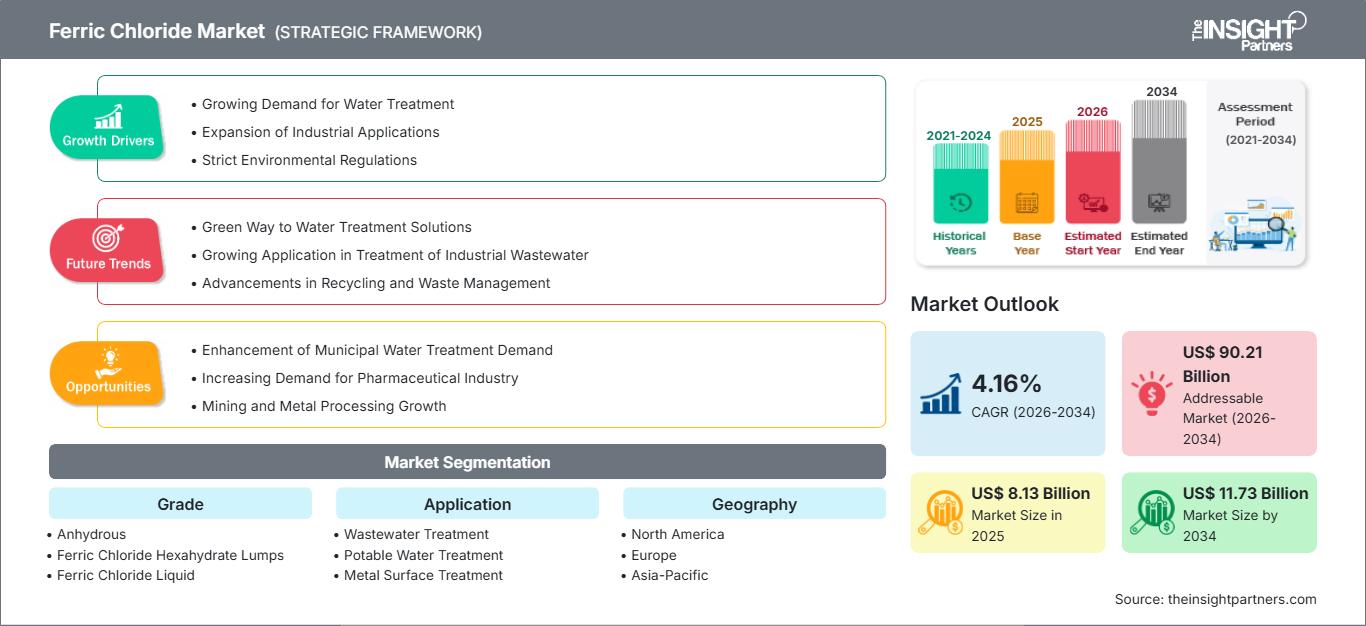
The Ferric Chloride Market was valued at US$ 8.13 Billion in 2025 and is projected to reach US$ 11.73 Billion by 2034, registering a 4.16% CAGR during 2026–2034. Demand is supported primarily by water and wastewater treatment, where ferric chloride functions as a coagulant, phosphorus removal chemical, and sulfide-control agent, while industrial consumption across metal treatment, electronics, and chemical processing provides additional application diversity.
Across North America, the Ferric Chloride Market size is expected to expand at an estimated 3.8–4.3% CAGR during 2026–2034, supported by municipal wastewater infrastructure renewal and increasingly stringent nutrient-discharge requirements. Replacement of aging treatment assets and investment in industrial water management are reinforcing demand for reliable inorganic coagulants. Regional buyers also prioritize supply security, product consistency, bulk logistics, and technical support because treatment plants generally require uninterrupted chemical availability.
Ferric Chloride Market Assessment and Insights
- North America: North America accounted for an estimated 27–31% Ferric Chloride Market share in 2025 and is projected to grow at a 3.8–4.3% CAGR between 2026–2034. Municipal wastewater treatment, phosphorus removal, industrial effluent treatment, and replacement of aging water infrastructure support sustained consumption.
- US: The US represented approximately 79–83% of North American demand in 2025 and is expected to expand at a 3.9–4.4% CAGR between 2026–2034, supported by municipal treatment compliance and industrial water-management requirements.
- Europe: Europe held an estimated 24–28% share in 2025 and is projected to grow at a 3.4–3.9% CAGR between 2026–2034. Germany, the UK, France, Italy, and Spain remain important markets because of established water-treatment infrastructure and environmental compliance requirements.
- Asia Pacific: Asia Pacific represented approximately 34–38% share in 2025 and is estimated to register a 4.8–5.4% CAGR between 2026–2034. China, India, Japan, and South Korea lead demand, supported by industrial wastewater treatment and continuing municipal infrastructure development.
- Largest Segment: Wastewater Treatment represented an estimated 43–47% market share in 2025 and is projected to expand at a 4.4–4.9% CAGR during 2026–2034, supported by phosphorus control and industrial effluent treatment requirements.
- High Growth Segment: Electronic Etchants accounted for an estimated 9–13% market share in 2025 and is expected to grow at a 5.2–5.9% CAGR during 2026–2034, benefiting from electronics manufacturing investment and specialty chemical consumption.
- Key companies analyzed in detail: Nobian Industrial Chemicals B.V., BASF SE, BPS Products Limited, Feralco AB, Gulbrandsen Chemicals Pvt. Ltd., Kemira Oyj, Malay-Sino Chemical Industries Sdn. Bhd., PVS Chemicals, Inc., SAF Sulphur Factory, and SIDRA Wasserchemie GmbH.
Source: The Insight Partners' analysis based on proprietary research, government publications, company annual reports, investor presentations, industry databases, and expert interviews.
The market has shifted from a commodity-focused supply chain toward an application-driven ecosystem of chemicals. Differentiation by suppliers comes in the form of concentration consistency, impurities management, storability, logistics, and technical expertise. Liquids are still essential to municipal treatment since they can be fed directly into bulk handling systems, while anhydrous forms are still important for specialty chemicals and industrial use. Economics of production will depend on iron ore availability, chlorine chemistry utilization, energy costs, logistics, and handling of hazardous materials.
Future demand growth is going to be more geographically diversified due to investments in wastewater infrastructure in developing countries. Policies that support electronics manufacturing will also positively affect specialty applications. Environmental regulations are another positive force driving demand because strict phosphorus and wastewater discharges increase the need for chemicals. Future investments will target production and distribution at the regional level, thus limiting the distance of corrosive liquids transportation.
Ferric Chloride Market Report Scope
| Report Attribute | Details |
|---|---|
| Market size in 2025 | US$ 8.13 Billion |
| Market Size by 2034 | US$ 11.73 Billion |
| Global CAGR (2026 - 2034) | 4.16% |
| Historical Data | 2021-2024 |
| Forecast period | 2026-2034 |
Ferric Chloride Market Analysis
Ferric chloride use for municipal and industrial water treatment is the primary basis of demand for the chemical. The future development of the Ferric Chloride Market is thus strongly dependent on expenditures in wastewater infrastructure, the need to remove nutrients, and industrial effluent treatment. The structure starts from the input raw materials that include iron compounds and chlorine chemistry production process, then moves to production, concentration adjustment, storage, transportation, and distribution to the end-user facility. Given the corrosion properties and bulk transportation, the logistics capabilities could become as important for business as the production capacities.
The market situation makes producers with integrated chemistry capabilities, storage facilities, special tankers, and technical assistance network competitive. Water treatment facilities of the municipality usually require reliable supplies and standardized composition of the chemical, as any stoppage could bring about problems with compliance. Thus, producers have to compete in terms of local manufacturing and logistics presence. In addition, industrial facilities might need customized concentration or impurity level.
Competitive analysis of the Ferric Chloride Market consists of multinational water-chemical producers, integrated inorganic chemical producers, and regional suppliers. The companies such as Kemira Oyj and Feralco AB have the water treatment focus whereas PVS Chemicals, Inc. is known for producing and distributing inorganic chemicals. BASF SE engages into the market through its inorganic chemicals portfolio which contains anhydrous ferric chloride used in industrial chemical processes.
Nobian Industrial Chemicals B.V. is the continuation of AkzoNobel Industrial Chemicals company that proves the importance of European chlor-alkali and inorganic chemical legacy. SIDRA Wasserchemie GmbH produces the ferric-based chemicals for water and wastewater uses, while Gulbrandsen Chemicals Pvt. Ltd., Malay-Sino Chemical Industries Sdn. Bhd., BPS Products Limited, and SAF Sulphur Factory add regional diversification. Investment focuses on local water treatment solutions, production efficiency, and customer closeness.
● REPORT CUSTOMIZATION
Tailor This Report To Align With Your Specific Business Requirements
This report can be customized to align precisely with your business objectives, scope, and target markets. Customization options include tailored segmentation, geography, competitive analysis, and strategic insights to support informed decision-making.
Customize This Report →WHAT YOU CAN ADJUST
- ● Segmentations
- ● Geography
- ● Competitive Analysis
- ● Language Preferences
Ferric Chloride Market: Strategic Insights
Regional Insights
North America Ferric Chloride Market
North America accounted for an estimated 27–31% share in 2025 and is projected to expand at a 3.8–4.3% CAGR during 2026–2034. The region enjoys advanced water utility infrastructure, regular chemical usage, and consistent wastewater upgrades. Phosphorous removal is crucial in situations where there are discharge limits imposed on facilities for nutrient discharges. Wastewater treatment of industrial wastewater from food processing, chemicals, metals, and manufacturing industries also forms an additional steady source of demand. North America Ferric Chloride Market also enjoys support from the existing supplier base with regional manufacturing and bulk-distribution capabilities.
Infrastructure replacement will be more critical than new facility construction for several mature urban markets. This market favors suppliers who can deliver long-term contracts, strong storage capability, and technical support. Costs of transport and corrosive products make localized production and distribution more favorable. Canada plays a part with its municipal treatment and industrial resource sectors, while Mexico adds more potential due to industrial and water utility infrastructure development.
U.S. Ferric Chloride Market
The US represented approximately 79–83% of North American demand in 2025 and is projected to record a 3.9–4.4% CAGR during 2026–2034. Wastewater Treatment by Municipalities continues to be the biggest consuming base, owing to the ability of ferric chloride to coagulate and precipitate phosphorus. The country also exhibits large demand from industries involved in chemical manufacturing, food processing, metal industry, and electronics. PVS Chemicals, Inc. is a company with a notable regional presence in terms of water treatment products, while other chemical and water treatment supply chains increase the availability of the product.
Current application demands consider efficiency and effectiveness of treatment, as opposed to mere purchase cost. Utilities consider the dose efficacy, sludge properties, storage needs, and supply chain when selecting coagulants. Manufacturing of electronics and processing of metals create specialty demand for high-grade materials. The geographical size of the US makes multiple regional production and distribution facilities viable.
Europe Ferric Chloride Market
Europe accounted for an estimated 24–28% share in 2025 and is projected to grow at a 3.4–3.9% CAGR during 2026–2034. There is a well-established industry for water treatment chemicals in the area and very high environmental standards. Germany will be the leading market in Europe due to the presence of large industrial sectors and water treatment systems as well as the existing ecosystem for chemical manufacturing companies. The United Kingdom is another key market for demand in water treatment chemicals.
Germany will benefit from existing chemical manufacturing infrastructure and specialized wastewater treatment needs in various industries. The company SIDRA Wasserchemie GmbH is active in the field of ferric based water treatment chemicals, and Kemira Oyj plans to acquire SIDRA, which shows that there is further strategic interest in European coagulant production.
Additional demand comes from both the municipal infrastructure as well as the industrial treatment sectors of France, Italy, and Spain. The Spanish market has also seen the development of coagulant capacity, due to the significance of localized production. Municipal demand, chemicals demand, and industrial demand exist in the French market, while the Italian market has process water and effluent treatment needs for its industrial districts.
APAC Ferric Chloride Market
Asia Pacific represented approximately 34–38% share in 2025 and is projected to register a 4.8–5.4% CAGR during 2026–2034. Reasons for China’s dominance in regional demand are due to industrial size and wastewater treatment. India offers high potential for expansion due to municipal infrastructures and industrialization, whereas Japan and South Korea cater to special consumption needs associated with advanced manufacturing and electronics.
Australia offers contributions due to municipal treatment and mining industries. Wastewater treatment due to policy initiatives, industrial discharges, and semiconductor manufacturing improve the regional outlook. The presence of large urban centers coupled with manufacturing capacity makes the region the fastest-growing geographical region.
Middle East & Africa Ferric Chloride Market
The Middle East & Africa is expected to grow at a 4.3–4.9% CAGR during 2026–2034, supported by water infrastructure investment and industrial development. Both Saudi Arabia and the UAE represent key demand sources due to their need for water security and industrial growth, which would require treatment facilities. South Africa's contribution includes the needs of industrial and municipal water supplies.
Project development and infrastructure development provide an opportunity for industrial water treatment applications, while urbanization is beneficial for municipal water treatment demand. Development requires a local supply of chemicals since transportation over longer distances could raise costs and increase complexity. Saudi Arabia is forecasted to retain its position as the dominant market in the region.
Segmentation Analysis
Grade
The Grade segment is estimated to expand at a 3.9–4.5% CAGR during 2026–2034. Product selection depends on handling systems, purity requirements, concentration preferences, and application conditions. Liquid grades benefit from bulk municipal treatment systems, while anhydrous material serves industrial and specialty chemical processes. The Ferric Chloride Market scope therefore covers both high-volume water-treatment products and specialized grades where chemical reactivity or controlled composition is important.
- Anhydrous: This grade holds strategic importance in specialty chemical applications, catalysts, pigments, and electronic processing. Demand emphasizes controlled purity, safe handling, and dependable supply for applications where concentrated liquid formulations are unsuitable.
- Ferric Chloride Hexahydrate Lumps: Hexahydrate material serves users requiring solid handling or specific chemical-processing formats. Its market position is influenced by storage practicality, transport requirements, and industrial users with batch-based chemical operations.
- Ferric Chloride Liquid: Liquid product represents the most commercially important format for bulk water treatment. It integrates efficiently with dosing systems and supports continuous municipal and industrial wastewater treatment operations requiring reliable chemical delivery.
Application
The Application segment is projected to grow at a 4.2–4.8% CAGR during 2026–2034. Water treatment dominates consumption because ferric chloride provides effective coagulation and nutrient removal. Industrial applications diversify the demand base and reduce dependence on municipal investment cycles. Application expansion will increasingly depend on environmental compliance, advanced manufacturing, and treatment efficiency requirements.
- Wastewater Treatment: This is the largest application, supported by phosphorus precipitation, solids removal, odor control, and industrial effluent treatment. Compliance requirements make chemical treatment a recurring operational requirement for many facilities.
- Potable Water Treatment: Demand is supported by coagulation and impurity removal before distribution. Product certification, impurity control, treatment performance, and dependable bulk supply are particularly important purchasing considerations.
- Metal Surface Treatment: Industrial users employ ferric chloride in selected chemical processing and surface-related applications. Demand follows manufacturing activity and requires suppliers capable of meeting industrial quality and handling requirements.
- Electronic Etchants: Electronics applications require dependable chemical specifications and benefit from continued investment in semiconductor and advanced electronics manufacturing. This application provides a higher-growth opportunity within the broader demand structure.
- Reagents: Laboratory and industrial reagent demand remains comparatively specialized. Its strategic importance lies in diversification and higher specification requirements rather than bulk consumption volumes.
Opportunity Snapshot
| Application | Revenue Contribution | Trend Tag | Adoption Stage |
| Wastewater Treatment | High | Phosphorus Removal | Mature |
| Potable Water Treatment | High | Enhanced Coagulation | Mature |
| Metal Surface Treatment | Medium | Industrial Processing | Mature |
| Electronic Etchants | Medium | Semiconductor Fabrication | Scaling |
| Reagents | Low | Specialty Reagents | Mature |
Ferric Chloride Market Growth Drivers and Impact Analysis
Stricter Nutrient and Wastewater Discharge Management
Growing importance for phosphorus and industrial discharge pollutant removal is a basic driver for demand due to the widespread use of ferric chloride for coagulation and chemical precipitation. Sewage plants need to ensure consistent plant performance despite variations in influent water quality and increasing discharge requirements. Ferric chloride may be able to remove phosphorus, help with solid separation, and some applications of sulfide removal. This goes beyond municipal plants since the food industry, chemicals, metals, and many other industries also need treated wastewater. This results in ongoing demand for chemicals, not just capital expenses for equipment. Chemical vendors do well when they offer expertise as part of their chemical supply services, since optimization of dosage and sludge treatment affect total treatment costs.
Expansion and Modernization of Water Infrastructure
Modernization of water and wastewater infrastructure leads to higher demand for chemicals as there are expansions and upgradations of capacity in such facilities. Chemical dosing facilities are essential in new treatment installations. Meanwhile, there is potential growth in the consumption of chemicals in the case of improvement of nutrient removal processes in existing treatment facilities. Urbanization is an important factor that adds to the demand for water treatment, along with the growing amount of wastewater. Municipal infrastructure investments generate additional demand in emerging markets, while developed countries concentrate their efforts on rehabilitation and improvement of efficiency. Ferric chloride is well-placed for this type of two-way investment cycle, as it can be used in both new and existing installations.
Industrial Water Management Across Manufacturing Sectors
There is an increasing trend of treating wastewater as a critical business concern at industrial sites due to the relationship of water availability, discharge requirements, and process efficiency to production continuity. Ferric chloride will be useful for the treatment of industrial effluent wherever there are high levels of solids, nutrients, metals, or process chemicals. Food processing and beverage plants, chemical plants, metal processing companies, and some manufacturing industries constitute some of the diverse industries from which the customer base comes from. Chemical suppliers are evaluated by industrial sites not based on pricing but on reliability, efficacy, and service response time. This provides a niche for suppliers to fine-tune the concentration and delivery of their products to specific industrial sites.
Ferric Chloride Market Future Trends
Localized Coagulant Production and Distribution Networks
One of the significant Ferric Chloride Market trends will be the growing importance of regional production and storage facilities. Liquid ferric chloride is corrosive, and long-distance delivery can be associated with greater complexities and costs. Therefore, producers will find it beneficial to develop their capacity in close proximity to large centers of consumption. The purchase and development of regional production facilities could be an alternative option to delivering the product across continents. Buyers will consider the stability of the supplies in light of the recent logistics problems and volatility of raw materials. The trend will benefit companies that already have a network of distributors in the water treatment business. It will also create possibilities for acquisitions for multinational suppliers.
Higher Specification Demand from Advanced Manufacturing
Advanced manufacturing trends will result in growing need for more stringent specifications in chemistry. Quality, reproducible impurities profile, and reliable handling properties are needed in electronic production and specialized industrial processes. There is a chance for ferric chloride producers to expand their product range beyond bulk commodity production. They could start producing application specific grades of product with analysis and documentation of chemical properties. The development of semiconductor and electronics capacities in Asia Pacific region, especially in China, Japan, South Korea and India will help in this respect. Specialty uses, even if not as significant as municipal water treatment in volume, can contribute to product portfolio diversity and profitability improvement.
Ferric Chloride Market Opportunities
Expansion into High-Growth Asian Wastewater Markets
The Ferric Chloride Market Forecasts indicate significant opportunity for investment in Asian production, storage, and distribution infrastructure. China and India offer substantial municipal and industrial wastewater demand, while Southeast Asian manufacturing growth provides additional chemical-treatment opportunities. Investors can prioritize regional hubs that combine production with bulk storage and technical service. Partnerships with local water-treatment operators and engineering companies can improve market access and reduce customer qualification barriers. A localized strategy is particularly important because liquid chemical logistics can determine delivered competitiveness. Companies entering these markets should evaluate feedstock security, environmental permitting, transport corridors, and customer density before investing. The strongest opportunities will likely combine high-volume wastewater demand with industrial clusters requiring reliable chemical supply and technical support.
Acquisition of Specialized Regional Coagulant Producers
Strategic acquisitions provide an efficient route for expanding water-treatment chemical portfolios. Regional specialists can offer established production facilities, customer relationships, local permits, and technical knowledge that would require considerable time to replicate organically. Kemira's move to acquire SIDRA Wasserchemie demonstrates the strategic value of established coagulant production assets in Europe. Similar opportunities may exist in fragmented regional markets where municipal and industrial customers depend on long-term local suppliers. Investors should assess production integration, feedstock access, environmental liabilities, and customer concentration before pursuing transactions. Acquired businesses can also provide platforms for introducing broader water-treatment portfolios. The most attractive targets will combine recurring demand, specialized logistics infrastructure, and strong positions in regulated treatment applications.
Recent Developments
- April 2025: Kemira Oyj completed the acquisition of Thatcher Group's iron sulfate coagulant business in the United States. The acquisition expanded Kemira's position in iron-based coagulants and directly illustrates continuing strategic investment in inorganic treatment chemistry. Iron sulfate and ferric chloride address related treatment applications, making this transaction particularly relevant to competitive developments across the broader iron-based coagulant ecosystem.
- February 2026: Kemira Oyj announced the acquisition of SIDRA Wasserchemie GmbH to strengthen its Water Solutions business in Europe. SIDRA operates two production facilities in Germany and serves customers in Germany, Belgium, and the Netherlands. As a producer of coagulants and ferric-based water-treatment chemicals, the transaction directly strengthens Kemira's presence in a highly relevant inorganic coagulant supply segment.
Frequently Asked Questions

- Comprehensive Market Sizing and Forecast Analysis
- Detailed Segmentation Analysis
- In-Depth Market Dynamics Assessment
- Regional and Country-Level Insights
- Competitive Landscape and Company Benchmarking
- Strategic Business Intelligence
Recent Reports
Testimonials

The Insight Partners provided valuable market intelligence that supported our global go-to-market strategy. Their team was professional, responsive, and attentive to our feedback, providing thoughtful analysis and helpful methodological clarifications throughout the project.
Junmo Kim Chief Financial Officer (CFO), Enertech Co., Ltd.
The Insight Partners' SCADA System Market report is comprehensive, with valuable insights on current trends and future forecasts. The team was highly professional, responsive, and supportive throughout. We are very satisfied and highly recommend their services.
RAN KEDEM Partner, Reali Technologies LTDs
I requested a report on a very specific software market and the team produced the report in a few days. The information was very relevant and well presented. I then requested some changes and additions to the report. The team was again very responsive and I got the final report in less than a week.
JEAN-HERVE JENN Chairman, Future Analytica
We worked with The Insight Partners for an important market study and forecast. They gave us clear insights into opportunities and risks, which helped shape our plans. Their research was easy to use and based on solid data. It helped us make smart, confident decisions. We highly recommend them.
PIYUSH NAGPAL Sr. Vice President, High Beam Global
The Insight Partners delivered insightful, well-structured market research with strong domain expertise. Their team was professional and responsive throughout. The user-friendly website made accessing industry reports seamless. We highly recommend them for reliable, high-quality research services
YUKIHIKO ADACHI CEO, Deep Blue, LLC.
This is the first time I have purchased a market report from The Insight Partners.While I was unsure at first, I visited their web site and felt more comfortable to take the risk and purchase a market report.I am completely satisfied with the quality of the report and customer service. I had several questions and comments with the initial report, but after a couple of dialogs over email with their analyst I believe I have a report that I can use as input to our strategic planning process.Thank you so much for taking the extra time and making this a positive experience.I will definitely recommend your service to others and you will be my first call when we need further market data.
JOHN SUZUKI President and Chief Executive Officer, Board Director, BK Technologies
I wish to appreciate your support and the professionalism you displayed in the course of attending to my request for information regarding to infectious disease IVD market in Nigeria. I appreciate your patience, your guidance, and the fact that you were willing to offer a discount, which eventually made it possible for us to close a deal. I look forward to engaging The Insight Partners in the future, all thanks to the impression you have created in me as a result of this first encounter.
DR CHIJIOKE ONYIA MANAGING DIRECTOR, PineCrest Healthcare Ltd.Reason to Buy
- Informed Decision-Making
- Understanding Market Dynamics
- Competitive Analysis
- Identifying Emerging Markets
- Customer Insights
- Market Forecasts
- Risk Mitigation
- Boosting Operational Efficiency
- Strategic Planning
- Investment Justification
- Tracking Industry Innovations
- Aligning with Regulatory Trends





 Get Free Sample for