
Ferroelectric Ceramic Film Market Demand, Trends & Forecast by 2034
Coverage: By Source (Substrates, Ceramics, Others); Type (Barium Titanate, Lead Titanate, Lead Zirconate Titanate (PZT), Lead Lanthanum Zirconate Titanate (PLZT)), and Geography (North America, Europe, Asia Pacific, and South and Central America)
- Status : Data Released
- Report Code : TIPRE00016421
- Category : Chemicals and Materials
- No. of Pages : 150
- Available Report Formats :


- Last update date : November 05, 2026


2025 Market Size
US$ 1.33 Bn
Base year value
2034 Forecast
US$ 2.81 Bn
Projected by 2034
CAGR 2026-2034
8.65 %
Growth rate
Addressable Market
US$ 18.54 Bn
(2026-2034)
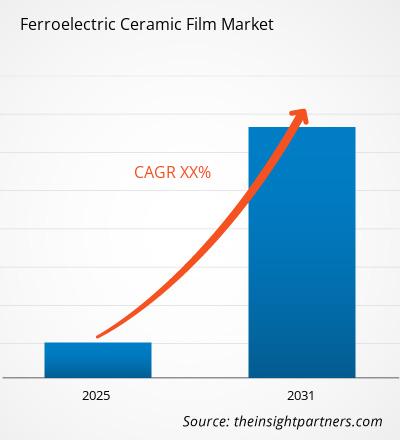
The ferroelectric ceramic film market size is projected to expand from US$ 1.33 Billion in 2025 to US$ 2.81 Billion by 2034, registering a CAGR of 8.65% during 2026–2034. Increasing demand for high-performance electronic components, advances in miniaturized sensors and actuators, and the integration of functional ceramic films into semiconductor and communication devices are supporting market development. Material engineering, improved deposition processes, and growing interest in energy-efficient electronic architectures are also influencing product development, supplier differentiation, and investment priorities across the value chain.
North America remains an important ferroelectric ceramic film market because of its semiconductor research ecosystem, established aerospace and defense industries, and demand for precision sensing and electronic control technologies. The region is estimated to record a CAGR of ~8% through 2034, supported by continued development of specialized electronic materials and the integration of functional thin films into increasingly compact devices. Collaboration between materials suppliers, research institutions, and component manufacturers can help translate laboratory advances into commercial products, although qualification requirements and manufacturing consistency remain important constraints.
Ferroelectric Ceramic Film Market Assessment and Insights
Regional Outlook
- North America: ~30% of the global ferroelectric ceramic film market share in 2025 | ~8% CAGR through 2034. Market position: North America is estimated to hold the largest regional share, supported by semiconductor research, aerospace electronics, defense-related sensing, and established advanced-materials supply chains. Commercial adoption depends on converting specialized material performance into repeatable manufacturing.
- US: ~75% of North American market revenue in 2025 | ~8% CAGR through 2034. Market position: The US represents the principal national market within North America, reflecting its concentration of semiconductor research, defense electronics, medical instrumentation, and advanced-device development. Domestic research capabilities support innovation, while qualification costs influence procurement.
- Europe: ~25% of the global market in 2025 | ~8% CAGR through 2034. Market position: Europe has a mature industrial and scientific base for advanced ceramics and precision electronics. Germany is estimated to lead the regional market, with the UK, France, Italy, and Spain contributing through research, industrial automation, automotive electronics, and specialized manufacturing.
- Asia Pacific: ~35% of the global market in 2025 | ~10% CAGR through 2034. Market position: Asia Pacific is estimated to be the largest and fastest-growing regional market, supported by electronics manufacturing, semiconductor investment, and advanced ceramic production. China, Japan, and South Korea provide established industrial demand, while India is developing additional electronics manufacturing capabilities.
- Barium Titanate: ~40% share in 2025 | ~10% CAGR through 2034. Market position: Barium titanate is estimated to be the largest material segment because of its lead-free composition, established dielectric applications, and compatibility with several electronic-device manufacturing approaches. Its relevance extends to compact capacitive structures and emerging functional-film applications.
- Ceramics: ~60% share in 2025 | ~9% CAGR through 2034. Market position: The ceramics source segment is estimated to lead because functional ceramic materials provide the polarization, dielectric behavior, and stability required in many targeted devices. Growth depends on composition control, film uniformity, substrate compatibility, and reliable processing.
Competitive Coverage
Ferro Corporation, Innovacera, Kureha Corporation, Mitsui Chemicals, Inc., Toshima Manufacturing Co., Ltd., Mitsubishi Materials Trading Corporation, WuXi Noble Electronics Co., Ltd., Sparkler Piezoceramics Pvt. Ltd., Cathay Advanced Materials Limited, Other Companies
Methodology
The Insight Partners follows Data Collection & Secondary Research, Primary Research, Data Analysis, and Data Triangulation & Final Review to validate market estimates and insights.
Source: The Insight Partners' analysis based on proprietary research, government publications, company annual reports, investor presentations, industry databases, and expert interviews.
Development in the ferroelectric ceramic film market is a result of the alignment of the functional ceramics chemistry, deposition control, and miniaturization. The ferroelectric film allows for maintaining the switchable polarization, which results in an electrical response being useful in sensing, actuation, memory, and tunable electrical components. Production has increasingly been moving toward the control of the thickness of films, the crystallinity, orientation, grain structures, interfaces, and compatibility of electrodes. All of those parameters affect dielectric losses, leakage currents, fatigue, and switching. Therefore, in the competition, suppliers compete not only in the composition of material but also in the repeatability of process, compatibility with substrates, and ability to maintain electrical performance.
In the future, commercialization will be determined by the interactions between the semiconductor capital investment, electronics manufacturing, and material processing infrastructure. There is a possibility for Asia Pacific because of its electronics supply chain; meanwhile, North America and Europe have capabilities in material research, expensive instrumentation, and specialty components design. Investments in deposition, characterization equipment, and pilot-scale manufacturing can facilitate the development of commercial performance from laboratory level. Environmental needs might drive further developments of lead-free formulations; however, substitution of the current technology depends on the fulfillment of electrical, thermal, and mechanical specifications.
Ferroelectric Ceramic Film Market Report Scope
| Report Attribute | Details |
|---|---|
| Market size in 2025 | US$ 1.33 Billion |
| Market Size by 2034 | US$ 2.81 Billion |
| Global CAGR (2026 - 2034) | 8.65% |
| Historical Data | 2021-2024 |
| Forecast period | 2026-2034 |
Ferroelectric Ceramic Film Market Analysis
The demand for these materials results from the desire to integrate several functionalities into smaller and smarter electronic devices. They can be useful for capacitor, sensor, actuator, and some memory applications due to their capabilities to exhibit switchable polarization, dielectric tunability, and electromechanical effects. With regard to increased integration density and energy efficiency, thin film formats have certain advantages over the bulk material in terms of geometry, switching properties, and layer integration. The business potential lies in the balance between performance and processability.
The value chain in the ferroelectric ceramic film market includes precursor chemicals and ceramics, composition preparation, deposition or coating, crystallization, metallization or electrode deposition, patterning, and electrical characterization. The suppliers of equipment, substrates, R&D facilities, and device producers affect the choice of the materials and manufacturing costs. The security of supply depends on the purity of precursors, process control, availability of the equipment, and quality of films. If the manufacturers are able to show compatibility with current processes, they might help their customers in qualification and get more orders.
Competitive environment in the ferroelectric ceramic film market includes existing chemical companies, ceramic suppliers, and suppliers of thin-film deposition materials. Supplied companies in this environment include Ferro Corporation, Innovacera, Kureha Corporation, and Mitsui Chemicals, Inc., although these companies' product range does not necessarily reflect similar exposure to ferroelectric ceramic films. Other companies that can be considered specialists in related materials and thin film components include Toshima Manufacturing Co., Ltd. and Mitsubishi Materials Trading Corporation. In addition, competition should be analyzed based on the product and processes, including availability, composition quality, customization, and technical support.
Investments should target process optimization, formulation for particular applications, and integration into the customers' manufacturing lines. Suppliers may choose to collaborate with research institutions and device producers in order to test electrical properties in practical applications. Financial considerations have to take into account investment in special deposition equipment, analysis, yield management, and customer qualification process. Supplier's excellent laboratory results do not guarantee its success in practical business, if it cannot consistently supply sufficient volume of materials or document uniformity of the batches. Increasingly, competitiveness requires reproducibility, application engineering, and reliable deliveries, rather than product characteristics alone.
● REPORT CUSTOMIZATION
Tailor This Report To Align With Your Specific Business Requirements
This report can be customized to align precisely with your business objectives, scope, and target markets. Customization options include tailored segmentation, geography, competitive analysis, and strategic insights to support informed decision-making.
Customize This Report →WHAT YOU CAN ADJUST
- ● Segmentations
- ● Geography
- ● Competitive Analysis
- ● Language Preferences
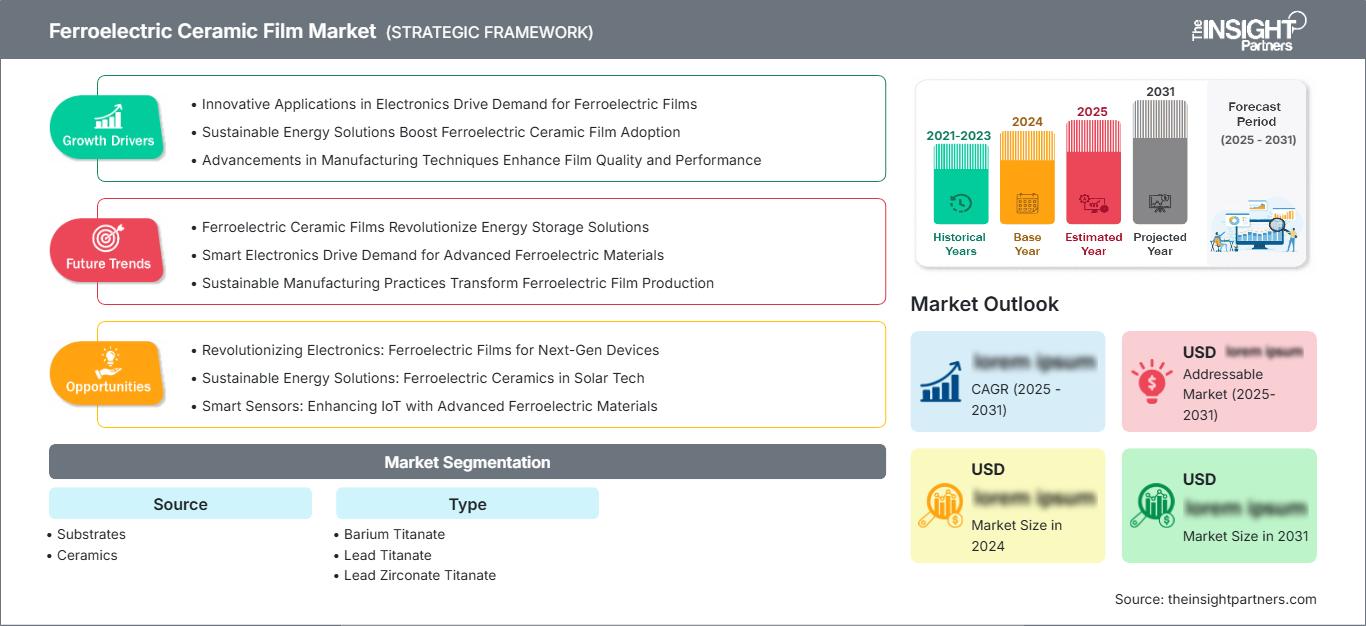
Ferroelectric Ceramic Film Market: Strategic Insights
Regional Insights
North America Ferroelectric Ceramic Film Market
North America is estimated to account for ~30% of global ferroelectric ceramic film market in 2025 and register a CAGR of ~8% through 2034. Its position reflects the presence of semiconductor research, aerospace and defense electronics, medical instrumentation, and specialized materials development. These applications can justify investment in materials that provide precise electrical responses, reliability, and integration flexibility. Demand is less dependent on high-volume commodity production than on qualification-intensive applications in which performance and dependable operation carry substantial weight.
U.S. Ferroelectric Ceramic Film Market
The United States is the leading source, whereas Canada contributes through research and industrial technology, as well as specialized manufacture. The future growth of the region will be determined by whether the material providers have managed to go beyond the experimental samples in laboratories to realize reliable deposition with sufficient yields and reliability in devices. There exists collaboration in universities, manufacturers of components, and providers of materials; however, commercialization can face challenges such as long qualification periods and the cost of modifying production tools.
The United States is estimated to represent ~75% of North American market revenue in 2025, with a projected CAGR of ~8% through 2034. It is further reinforced by the presence of design work on semiconductors, research infrastructure, defense electronics, and medical devices. The ferroelectric film research is done in memory, sensors, tunable electronics, and photonic integration; however, research work should not be equated to sales revenue. The demand for the product is bound to be application-oriented, being driven by the switching capabilities, leakage characteristics, longevity, and processability.
Commercial potential involves the provision of specialized film precursor materials, deposition materials, ceramic substrates, and engineering of applications. American device companies have an opportunity to test material in cooperation with research laboratories, whereas manufacturers should prove that the performance does not vary with temperature and batch conditions. The existence of Ferro Corporation and Innovacera as suppliers of neighboring materials provides industry context; however, it is important to check availability and commercial presence of the products individually. Purchasing strategy will remain focused on reliability, documentation, availability, and qualification costs.
Europe Ferroelectric Ceramic Film Market
Europe is estimated to account for ~25% of global market revenue in 2025 and record a CAGR of ~8% through 2034. Germany is estimated to be the leading country in Europe, supported by its advanced manufacturing base, industrial electronics, automotive engineering, and applied materials research. The regional market benefits from established networks connecting research institutions, specialty chemical producers, equipment developers, and industrial customers. These relationships can support the qualification of functional films for applications where electrical precision and operating reliability are essential.
Materials science, photonics and semiconductor research in universities are examples of contribution from the United Kingdom. Relevant capabilities from France include aerospace electronics, instrumentation and industrial research, while Italy participates in advanced manufacturing, automation and provision of specialty components. Relevant contributions from Spain relate to the demand and research for electronics, industrial systems and technology development. In terms of specialization, the national markets are different; thus, regional opportunities will vary depending on application rather than adoption pattern.
Opportunities for growth in Europe depend on translation of research capabilities into manufacturable components as well as availability of dependable sources of specialty materials. Suppliers must ensure qualification, environmental aspects and compatibility with production facilities. Composition including lead may continue being technically feasible in cases of challenging performance requirements, but environmental concerns will favor use of alternative solutions in cases when similar properties can be achieved. Development efforts may enable European suppliers to compete in high-value applications without reliance on volume commodity production.
APAC Ferroelectric Ceramic Film Market
Asia Pacific is estimated to account for ~35% of global revenue in 2025 and register a CAGR of ~10% through 2034, making it the fastest-growing region in this outlook. China is estimated to be the leading country in Asia Pacific, supported by its extensive electronics manufacturing ecosystem, ceramic-material production, and investment in domestic technology capabilities. Japan and South Korea contribute through advanced materials, semiconductor manufacturing, precision electronics, and established component supply chains.
India provides development through the process of electronics manufacturing and research, whereas Australia provides through material science and research activities. Localized supply chain and presence of devices manufacturers can be used to benefit the demand within the region, but ultimately, the development will be contingent upon yield, product qualification, and the ability to manufacture consistent films. Encouragement of electronics manufacturing and semiconductor technology by policies may attract investment, but not necessarily ensure that a particular ferroelectric composition becomes commercially adopted.
Middle East & Africa Ferroelectric Ceramic Film Market
The Middle East and Africa market is expected to expand as electronics, industrial monitoring, infrastructure modernization, and specialized technology investments create additional demand for functional materials. Saudi Arabia and the United Arab Emirates are relevant markets for advanced industrial systems, infrastructure technology, and investment in research and manufacturing capabilities. South Africa contributes through its established industrial base and research ecosystem. The regional CAGR is modeled at ~9% through 2034, reflecting a developing market in which growth depends on project execution and the availability of qualified component suppliers.
Saudi Arabia is a plausible leading country in the Middle East and Africa market by emerging industrial investment and technology-development priorities, although the relative revenue ranking requires direct market-specific sales evidence. The UAE's role in technology investment and industrial infrastructure also creates opportunities for specialist electronics applications. Across the region, energy systems, environmental monitoring, and infrastructure equipment may support demand indirectly. Adoption will nevertheless depend on local application requirements, access to imported materials, technical service capabilities, and the economics of integrating specialized films into end products.
Segmentation Analysis
Source
The source segment determines the material foundation, manufacturing route, and integration characteristics of ferroelectric films. Ceramic inputs are important where polarization response, dielectric behavior, and thermal stability must be controlled, while substrate selection affects film adhesion, crystallographic compatibility, electrical isolation, and downstream fabrication. Buyers assess the source category according to performance consistency, process compatibility, and the cost of achieving the required film properties. The category's outlook is supported by continued device miniaturization and demand for engineered material interfaces. Within the substrate sub-segment, growth will depend on increasing demand for compatible platforms for functional-film deposition.
- Substrates: Substrates provide the mechanical and electrical foundation on which functional films are deposited or integrated. Surface quality, thermal expansion, conductivity, and crystallographic compatibility can influence film uniformity and device reliability, making substrate selection an important part of process qualification.
- Ceramics: Ceramic materials provide the functional properties needed for ferroelectric behavior, including polarization response and dielectric characteristics. Composition control, purity, grain structure, and processing conditions influence performance, while established ceramic-processing expertise supports material development for specialized electronic components.
Type
The type segment reflects the choice of ferroelectric composition and its suitability for particular electrical, mechanical, and manufacturing requirements. Material selection involves trade-offs among polarization behavior, dielectric loss, operating stability, environmental considerations, and compatibility with electrodes and substrates. Buyers typically prioritize a repeatable combination of performance and processability rather than one isolated material property. The type segment's outlook is influenced by the expansion of functional electronic devices and ongoing efforts to improve thin-film integration. Lead-free compositions may attract additional development investment, while established lead-based materials remain relevant where demanding performance requirements favor proven formulations.
- Barium Titanate: Barium titanate is a lead-free ferroelectric material used in dielectric and functional electronic applications. Its material familiarity, compositional flexibility, and compatibility with several processing approaches make it relevant to capacitor structures, sensing technologies, and emerging thin-film device architectures.
- Lead Titanate: Lead titanate is a ferroelectric ceramic with useful polarization characteristics and a role in specialized material systems. Its relevance depends on composition control, phase stability, and integration requirements, particularly where engineers need to tailor electrical behavior for specific device designs.
- Lead Zirconate Titanate: Lead zirconate titanate, commonly abbreviated as PZT, combines ferroelectric and piezoelectric functionality. It is important in sensing, actuation, and ultrasonic technologies where electromechanical response is central. Its established application history supports continued development, although lead-related environmental considerations influence material selection.
- Lead Lanthanum Zirconate Titanate: Lead lanthanum zirconate titanate, commonly known as PLZT, allows compositional tuning of electrical and optical properties. It is relevant to specialized electro-optic and dielectric applications where engineers need tailored functional behavior, controlled processing, and compatibility with the device's electrode and substrate architecture.
Opportunity Snapshot
| Type | Revenue Contribution | Trend Tag | Adoption Stage |
| Barium Titanate | High | Lead-Free Films | Scaling |
| Lead Titanate | Low | Polarization Control | Mature |
| Lead Zirconate Titanate | High | Piezoelectric Integration | Mature |
| Lead Lanthanum Zirconate Titanate | Medium | Electro-Optic Control | Scaling |
Ferroelectric Ceramic Film Market Growth Drivers and Impact Analysis
Increasing Integration of Functional Materials in Electronic Devices
Electronic-device miniaturization increases the importance of materials that can provide useful electrical functions within limited space. Ferroelectric films can support polarization switching, dielectric tunability, and electromechanical responses in applications where conventional bulk components may be difficult to integrate. This creates opportunities for material suppliers that can meet strict requirements for film thickness, surface quality, electrical uniformity, and compatibility with surrounding layers. The impact is strongest when device manufacturers can incorporate the film without redesigning the entire fabrication process. As a result, supplier qualification increasingly involves joint engineering, interface characterization, and reliability testing. Commercial adoption remains application-dependent because a film that performs well in a laboratory may not deliver equivalent behavior under manufacturing conditions. Consistent processing and repeatable device-level results therefore remain central to converting technical capability into recurring demand.
Expansion of Precision Sensing and Electromechanical Components
Precision sensing and actuation require materials that respond predictably to applied electrical fields or mechanical forces. Ferroelectric ceramic films can contribute to compact transducers, specialized sensors, and microelectromechanical systems where space constraints and integration requirements shape material selection. These applications create demand for compositions with suitable polarization, stability, and fatigue characteristics. The commercial impact extends beyond raw material supply because film performance depends on electrode design, substrate selection, deposition conditions, and packaging. Suppliers that can help customers optimize these interacting variables may achieve stronger technical relationships and reduce development delays. Nevertheless, the presence of alternative piezoelectric and dielectric materials means that ferroelectric films must demonstrate a measurable system-level advantage. Reliability testing, calibration requirements, and lifetime performance remain important determinants of adoption in demanding industrial and medical applications.
Advances in Deposition and Manufacturing Process Control
The ferroelectric ceramic film market forecast shows that improvements in deposition and process-control techniques can expand the range of applications suitable for ferroelectric ceramic films. Sol-gel processing, sputtering, pulsed laser deposition, and other specialized methods offer different combinations of composition control, film quality, equipment requirements, and throughput. Manufacturers seek methods that produce uniform layers while limiting defects, unwanted phases, leakage, and interface degradation. More consistent manufacturing can reduce rejected material, simplify downstream integration, and make specialized films more commercially viable. The benefit depends on the compatibility of a process with the intended substrate, production scale, and end-use specifications. Investment in analytical tools and process monitoring can help identify defects earlier and improve reproducibility. However, process optimization must account for capital costs, energy consumption, equipment utilization, and the time needed to qualify a manufacturing route for customer production.
Ferroelectric Ceramic Film Market Future Trends
Lead-Free Formulations and Environmentally Considered Material Selection
The ferroelectric ceramic film market trends increasingly include the evaluation of lead-free formulations for applications in which environmental considerations and product requirements favor alternatives to lead-containing materials. Barium titanate-based systems are an important research platform because composition adjustments can influence dielectric response, phase behavior, and functional performance. The transition is unlikely to be uniform across all applications: established lead-based materials may remain preferable where their electrical or electromechanical properties are difficult to reproduce with alternatives. Manufacturers will therefore compare total device performance, processing requirements, reliability, and lifecycle considerations rather than material chemistry alone. Commercial opportunities may emerge for suppliers that can provide application-specific formulations and demonstrate consistent performance through independent characterization and customer qualification. Progress will depend on resolving the trade-offs between environmental objectives, processing cost, and technical performance.
Integration with Advanced Semiconductors, Photonics, and Reconfigurable Electronics
Future development may increasingly focus on integrating ferroelectric films with semiconductor and photonic platforms rather than treating them as standalone materials. Research into thin-film interfaces, polarization control, and electro-optic behavior illustrates the potential for functional layers in tunable components, compact memory architectures, and optical signal-processing devices. The commercial challenge is to preserve useful ferroelectric properties when films are reduced in thickness or integrated with dissimilar materials. Interface defects, strain, leakage, and thermal-budget constraints can alter performance, making process compatibility a decisive factor. If integration techniques become more reproducible, suppliers could serve a wider range of specialized device designs. However, emerging applications will require evidence of reliability, manufacturing yield, and system-level benefits before they translate into substantial commercial demand.
Ferroelectric Ceramic Film Market Opportunities
Developing Application-Specific Material and Process Partnerships
The ferroelectric ceramic film market presents opportunities for suppliers that collaborate with device manufacturers early in product development. Instead of selling a standard composition alone, suppliers can work with customers to optimize precursor chemistry, deposition conditions, substrate interfaces, and electrode compatibility for a defined application. Such partnerships can create differentiation through proprietary processing knowledge and shorter qualification pathways. Potential customers include developers of precision sensors, tunable electronic components, and specialized semiconductor devices. Commercial execution requires clear intellectual-property arrangements, reliable sample preparation, agreed testing protocols, and a realistic path from prototype quantities to repeatable production. Companies should assess whether a target application offers sufficient performance value to justify specialized development costs. Well-defined collaboration models can reduce uncertainty for both suppliers and buyers while supporting more durable customer relationships.
Scaling Pilot Production and Regional Technical Support
Ferroelectric ceramic film Forecasts create a strategic case for evaluating pilot-scale manufacturing, application laboratories, and regional technical support near important electronics production clusters. A supplier that can deliver repeatable sample batches, characterize electrical properties, and resolve integration problems locally may become more attractive than a distant materials vendor offering limited engineering support. Investment should prioritize processes that can scale without unacceptable changes in film uniformity, defect density, or functional performance. Partnerships with equipment providers and research institutions can help share development costs and improve access to specialized characterization capabilities. Regional expansion nevertheless requires evidence of customer demand, qualified personnel, dependable precursor sourcing, and sufficient production utilization. A staged investment strategy, beginning with customer validation and pilot manufacturing, can limit capital exposure while establishing the operational basis for larger-scale supply.
Recent Developments
- August 2026: Kureha Corporation. Kureha announced joint research on ceramic matrix composites with Tokyo University of Technology. The collaboration concerns advanced ceramic materials rather than a disclosed ferroelectric ceramic film product. It nevertheless demonstrates continuing research engagement in ceramic technologies, where material processing, interface behavior, and performance validation are important industrial capabilities. The announcement should not be interpreted as confirmation of new ferroelectric-film production capacity or a commercial product launch.
- December 2025: Mitsui Chemicals, Inc. The company announced that the Mitsui Chemicals Group would exhibit at SEMICON Japan 2025, presenting materials and solutions supporting semiconductor manufacturing. The announcement illustrates the group's engagement with semiconductor supply chains and advanced processing materials, although it does not establish a specific launch or investment in ferroelectric ceramic films. The development is relevant as industry participants evaluate specialized materials alongside evolving semiconductor fabrication requirements.
Frequently Asked Questions

- Comprehensive Market Sizing and Forecast Analysis
- Detailed Segmentation Analysis
- In-Depth Market Dynamics Assessment
- Regional and Country-Level Insights
- Competitive Landscape and Company Benchmarking
- Strategic Business Intelligence
Recent Reports
Testimonials

The Insight Partners provided valuable market intelligence that supported our global go-to-market strategy. Their team was professional, responsive, and attentive to our feedback, providing thoughtful analysis and helpful methodological clarifications throughout the project.
Junmo Kim Chief Financial Officer (CFO), Enertech Co., Ltd.
The Insight Partners' SCADA System Market report is comprehensive, with valuable insights on current trends and future forecasts. The team was highly professional, responsive, and supportive throughout. We are very satisfied and highly recommend their services.
RAN KEDEM Partner, Reali Technologies LTDs
I requested a report on a very specific software market and the team produced the report in a few days. The information was very relevant and well presented. I then requested some changes and additions to the report. The team was again very responsive and I got the final report in less than a week.
JEAN-HERVE JENN Chairman, Future Analytica
We worked with The Insight Partners for an important market study and forecast. They gave us clear insights into opportunities and risks, which helped shape our plans. Their research was easy to use and based on solid data. It helped us make smart, confident decisions. We highly recommend them.
PIYUSH NAGPAL Sr. Vice President, High Beam Global
The Insight Partners delivered insightful, well-structured market research with strong domain expertise. Their team was professional and responsive throughout. The user-friendly website made accessing industry reports seamless. We highly recommend them for reliable, high-quality research services
YUKIHIKO ADACHI CEO, Deep Blue, LLC.
This is the first time I have purchased a market report from The Insight Partners.While I was unsure at first, I visited their web site and felt more comfortable to take the risk and purchase a market report.I am completely satisfied with the quality of the report and customer service. I had several questions and comments with the initial report, but after a couple of dialogs over email with their analyst I believe I have a report that I can use as input to our strategic planning process.Thank you so much for taking the extra time and making this a positive experience.I will definitely recommend your service to others and you will be my first call when we need further market data.
JOHN SUZUKI President and Chief Executive Officer, Board Director, BK Technologies
I wish to appreciate your support and the professionalism you displayed in the course of attending to my request for information regarding to infectious disease IVD market in Nigeria. I appreciate your patience, your guidance, and the fact that you were willing to offer a discount, which eventually made it possible for us to close a deal. I look forward to engaging The Insight Partners in the future, all thanks to the impression you have created in me as a result of this first encounter.
DR CHIJIOKE ONYIA MANAGING DIRECTOR, PineCrest Healthcare Ltd.Reason to Buy
- Informed Decision-Making
- Understanding Market Dynamics
- Competitive Analysis
- Identifying Emerging Markets
- Customer Insights
- Market Forecasts
- Risk Mitigation
- Boosting Operational Efficiency
- Strategic Planning
- Investment Justification
- Tracking Industry Innovations
- Aligning with Regulatory Trends





 Get Free Sample for