
Fine Art Logistics Market Share, Demand & Growth by 2034
Coverage: By Type (Transportation, Packaging, Storage, Import Clearance, and Others), End User (Art Dealers and Galleries, Auction Houses, Museum, and Art Fair), and Geography
- Status : Published
- Report Code : TIPRE00015002
- Category : Automotive and Transportation
- No. of Pages : 201
- Available Report Formats :


- Last update date : August 17, 2026


2025 Market Size
US$ 2.39 Bn
Base year value
2034 Forecast
US$ 3.66 Bn
Projected by 2034
CAGR 2026-2034
4.9 %
Growth rate
Addressable Market
US$ 27.53 Bn
(2026-2034)
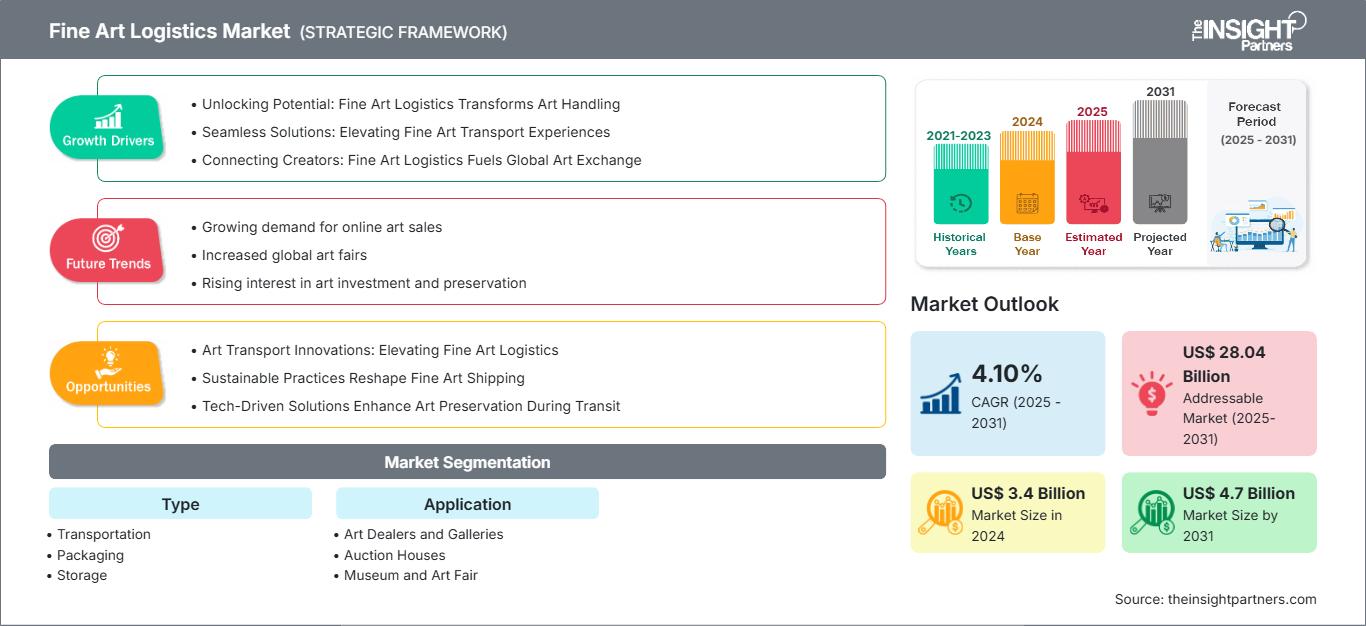
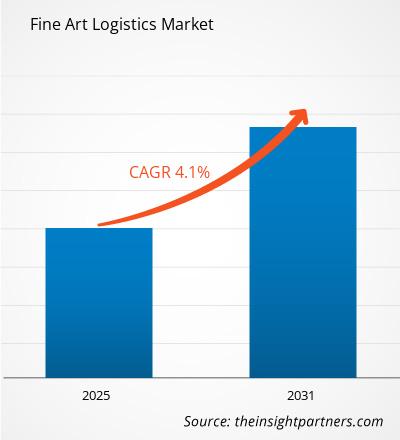
The Fine Art Logistics Market was valued at US$ 2.39 Billion in 2025 and is projected to reach US$ 3.66 Billion by 2034, growing at a CAGR of 4.9% during 2026–2034. Demand is expanding as museums, auction houses, galleries, and art fairs require secure transportation, climate-controlled storage, specialized packaging, import clearance, and condition-sensitive handling for high-value artworks across domestic and cross-border routes.
Across North America, institutional lending, private collection management, and auction-led cross-border movement support an estimated 3.9% CAGR through 2034. The Fine Art Logistics Market size in the region is shaped by dense museum networks, New York-centered auction flows, bonded storage demand, and expanding white-glove services that combine customs brokerage, security screening, and conservation-grade environmental control.
Fine Art Logistics Market Assessment and Insights
- North America held 29.5% share in 2025 and is growing at a CAGR of 3.9% during 2026–2034, supported by auction corridors, museum loans, and insured storage facilities.
- US represented 79.07% of North America in 2025 and is growing at a CAGR of 4.2% during 2026–2034, led by New York and California demand.
- Europe accounted for 24.4% share in 2025 and is growing at a CAGR of 4.8% during 2026–2034, with the UK, Germany, France, Italy, and Spain anchoring activity.
- Asia Pacific captured 42.3% share in 2025 and is growing at a CAGR of 5.7% during 2026–2034, led by China, Japan, South Korea, India, and Australia.
- Largest Segment Transportation held 36.98% market share in 2025 and is growing at a CAGR of 5.1% during 2026–2034 as shipment complexity increases.
- High Growth Segment Import Clearance held 6.01% market share in 2025 and is growing at a CAGR of 3.6% during 2026–2034 due to cross-border compliance demand.
- Key companies analyzed in detail: Malca-Amit, HELUTRANS (S) Pte Ltd, Fine Art Shippers Inc., Lotus Fine Arts Ltd, Crown Worldwide Group, Brink’s Incorporated, Nippon Express Co., Ltd., United Parcel Service, Inc., U.S.Art Company, Inc., and Deutsche Post AG.
Source: The Insight Partners' analysis based on proprietary research, government publications, company annual reports, investor presentations, industry databases, and expert interviews.
The operational models for the Fine Art Logistics Market have been transitioning from mere delivery services to custody management services. This involves utilizing vibration-controlled transportation, museum-quality boxes, condition reports online, route risks assessments, and monitoring storage systems. Air transport companies also focus on priority handling and secure hubs. Additionally, specialist carriers coordinate with customs, insurance, and couriers. This development can be attributed to increasing value of artworks and touring exhibitions and greater conservation concerns from both institutional and commercial clients.
In the coming years, market expansion is expected to be driven by the following factors; investments by Asian museums, cultural zones in the Middle East, digital tracking of shipping, and customs modernization. Freeport storage, temporary imports, and sustainability concerns have started to play a major role in procurement. The Fine Art Logistics Market is also growing through art fairs which need fast installations, secure short-term warehouses, and returns of internationally shipped artworks post sales and exhibitions.
Fine Art Logistics Market Report Scope
| Report Attribute | Details |
|---|---|
| Market size in 2025 | US$ 2.39 Billion |
| Market Size by 2034 | US$ 3.66 Billion |
| Global CAGR (2026 - 2034) | 4.9% |
| Historical Data | 2021-2024 |
| Forecast period | 2026-2034 |
Fine Art Logistics Market Analysis
The growth cycle of demand in the Fine Art Logistics Market is linked to the globalization of auction houses, collections, traveling exhibitions in museums, and schedules of art fairs. Shippers are demanding more from temperature control, shock protection, secure storage, and handing procedures. The supply chain involves handlers, craters, customs brokers, insurers, freight forwarders, storage providers, conservationists, and specialized couriers forming an interconnected ecosystem.
The supply is limited by the availability of qualified labor, facilities certification, and specialty vehicles. Companies with a capacity to handle air, trucking, ocean transport, bonded warehousing, and import documentation as one chain of custody have more flexibility in their prices. The Fine Art Logistics Market analysis suggests that clients prefer a loss prevention system rather than low-cost transport.
The competition is a combination of logistics services and specialized services for the transportation of works of art. Malca-Amit and Brink’s Incorporated focus on secure high-value transportation. Crown Worldwide Group, Nippon Express Co., Ltd., United Parcel Service, Inc., and Deutsche Post AG offer global reach. HELUTRANS (S) Pte Ltd, Fine Art Shippers Inc., Lotus Fine Arts Ltd, and U.S.Art Company, Inc. compete through specialized services in the handling, crating, storing, and exhibiting of artworks.
Capital investment is going into climate-controlled storage facilities, online portals, environmentally sustainable packaging, and GPS tracking systems. Strategic positioning involves closeness to auction hubs, art fairs, freeports, airports, and art museums clusters. The Fine Art Logistics Market appreciates the providers of services that combine discretion, customs knowledge, and locally available technicians with international transport coordination.
● REPORT CUSTOMIZATION
Tailor This Report To Align With Your Specific Business Requirements
This report can be customized to align precisely with your business objectives, scope, and target markets. Customization options include tailored segmentation, geography, competitive analysis, and strategic insights to support informed decision-making.
Customize This Report →WHAT YOU CAN ADJUST
- ● Segmentations
- ● Geography
- ● Competitive Analysis
- ● Language Preferences
Fine Art Logistics Market: Strategic Insights
Regional Insights
North America Fine Art Logistics Market
North America accounted for 29.5% share in 2025 and is forecast to grow at a CAGR of 3.9% during 2026–2034. The Fine Art Logistics Market share is supported by museum loans, art foundations, private collections, estate transfers, and auction-related movement. Demand is concentrated around New York, Los Angeles, Chicago, Toronto, and Miami.
The structural factors are insurance, bonded storage facilities, courier-escorted delivery, and security screening services through TSA or air cargo. The service providers enjoy developed customs brokerage and conservation practices. Fine Art Logistics Market of the region is influenced by the frequency of art fairs and the requirement for condition report before and after transportation.
U.S. Fine Art Logistics Market
The U.S. represented 79.07% of North America in 2025 and is expected to grow at a CAGR of 4.2% during 2026–2034. New York is still the place where auctions, galleries, and wealthy people’s activity takes place, whereas Los Angeles is where contemporary art, entertainment, and museum-related shipping happens.
The company has many branches, as there are U.S.Art Company, Inc., Fine Art Shippers Inc., Brink’s Incorporated, United Parcel Service, Inc., and other international companies providing services for galleries, museums, and auctions. The application process is connected with such things as crate design, viewing rooms in warehouses, transportation of private collections, and digital tracking of domestic transport.
Europe Fine Art Logistics Market
Europe held 24.4% share in 2025 and is growing at a CAGR of 4.8% during 2026–2034, with the UK leading regional activity. London auction houses, gallery areas, and customs knowledge facilitate international consignments, temporary imports, and storage needs.
Germany capitalizes on its museum systems, logistical know-how, and network of roads, whereas France exploits its museums, gallery of Paris, and storage needs. Italy and Spain bring in restorations-related shipments, exhibitions of heritage, and art fairs. Fine Art Logistics Market in Europe is driven by customs intricacies, sustainable practices, and cross-border exhibitions.
APAC Fine Art Logistics Market
APAC accounted for 42.3% share in 2025 and is growing at a CAGR of 5.7% during 2026–2034. China drives regional demand through museum development, gallery operations, and auctions, whereas Japan and South Korea maintain high quality in handling by conservation. India and Australia generate momentum through private collections, exhibition activities, and attendance at art fairs worldwide. The industrial drivers include airport cargo handling capabilities, warehouse security, and customs digitalization. HELUTRANS (S) Pte Ltd and regional relations are important for Fine Art Logistics Market, which connects Singapore, Hong Kong, China, and Southeast Asian art routes.
Middle East & Africa Fine Art Logistics Market
Middle East & Africa is expanding at a CAGR of 2.9% during 2026–2034, led by the UAE. Saudi Arabia and the UAE are investing in museums, cultural districts, and tourism-linked exhibitions, increasing demand for secure import clearance, temporary storage, and installation logistics.
The demand from sub-Saharan countries is underpinned by South Africa through galleries, private collectors, and exchange between institutions. Investment related to energy provides infrastructure for airports, warehouses, and safe transport links. The Fine Art Logistics Market thrives where cultural policy, free zone logistics, and exhibition schedules coincide with increased insurance, customs, and conservation costs.
Segmentation Analysis
Type
Type, the transportation segment is expected to grow at a CAGR of 5.1% during 2026–2034. The Fine Art Logistics Market scope across type reflects bundled demand for transportation, packaging, storage, and import clearance. Buyers increasingly prefer providers that can integrate custody, documentation, and environmental safeguards, reducing handoff risk across domestic and international art movements.
- Transportation remains the largest service category, supported by museum loans, art fair schedules, auction consignments, estate relocations, and the need for secure air, road, and sea movement.
- Packaging is strategically important because fragile paintings, sculptures, antiques, and mixed-media works require custom crates, cushioning, humidity control, and documentation before any shipment begins.
- Storage demand is rising as collectors, galleries, and institutions use climate-controlled warehouses, vaults, and viewing rooms to protect artworks between exhibitions, sales, loans, and relocations.
- Import Clearance is becoming more critical as cross-border loans and sales require temporary admission, customs valuation, cultural property checks, bonded handling, and coordination with insurers.
End User
End User, art dealers and galleries is expected to grow at a CAGR of 5.9% during 2026–2034. Demand varies by transaction speed, preservation requirements, and exhibition timing. Art dealers and galleries require flexible shipping, auction houses prioritize deadline certainty, museums demand conservation-grade procedures, and art fairs need rapid staging, onsite handling, and coordinated return logistics.
- Art Dealers and Galleries generate frequent shipments for client sales, exhibitions, and inventory rotation, making reliable pickup, packing, customs guidance, and discreet delivery central to supplier selection.
- Auction Houses depend on precise timelines, secure preview storage, condition checks, buyer deliveries, and international returns, especially when high-value lots move across multiple jurisdictions.
- Museum users emphasize conservation standards, courier supervision, climate stability, loan documentation, and installation planning because public collections often carry cultural, legal, and insurance obligations.
- Art Fair demand is event-driven, requiring consolidated freight, temporary warehousing, booth installation, customs coordination, and fast post-event dispatch for sold and unsold works.
Opportunity Snapshot
| End User | Revenue Contribution | Trend Tag | Adoption Stage |
| Art Dealers and Galleries | High | Dealer Shipping | Mature |
| Auction Houses | High | Auction Flow | Mature |
| Museum | Medium | Loan Custody | Scaling |
| Art Fair | Medium | Fair Setup | Scaling |
Fine Art Logistics Market Growth Drivers and Impact Analysis
Rising Cross-Border Art Trade and Exhibition Mobility
International art consignment auctions, museum loans, biennials, and exhibitions are causing an increase in the number of works traveling internationally within stringent timing and security requirements. The result is an increased need for import clearance, temporary admission documents, bonded storage, and couriers. In effect, this market is seeing its growth in part due to the fact that every international transaction becomes a series of services starting with the condition report before shipment, through supervision at airports, to the installation. A company offering customs brokerage, secure storage facilities, and art handling specialists can minimize delays in opening exhibitions or delivering goods to clients. The effect is most visible on routes between the U.S., UK, EU, Hong Kong, Singapore, and Gulf regions.
Expansion of Climate-Controlled Storage and Viewing Facilities
Collection, galleries, and institutions are beginning to see storage as an aspect of asset preservation, rather than just a temporary process. This development means there is increasing need for climate control, limited access, fire safety, CCTV, inventory systems, and private viewing facilities. The commercial benefits include consistent revenue, as storage agreements can span beyond a single shipment, helping build better relations with customers. Storage close to airports, auction zones, and freeports holds a competitive edge, owing to its shorter transit time and its ability to offer confidential inspections. Service providers will see increased credibility with insurance firms, museums, and estates, who require records of environmental controls before releasing any piece.
Digital Visibility and Risk-Controlled Chain of Custody
Digital portals, logistics tracking, photographic documentation of the piece's condition, barcode tracking, and electronic proof of delivery have become the norm for professional purchasers. Such measures minimize risk in an industry where any damage, delay, or unverified handover means significant insurance and reputation risks. Efficiency becomes more apparent within the Fine Art Logistics Market as the documentation process shifts from verbal communication to a more organized one, which speeds up the processing of claims, improves routing and increases customer satisfaction. Service providers that are able to combine digital transparency with professional handlers and secure storage will distinguish themselves from regular freight service providers.
Fine Art Logistics Market Future Trends
Sustainable Crating and Lower-Carbon Transport Planning
Fine Art Logistics Market Trends include a shift towards reusable crates, recycling packing materials, consolidation of routes, low emissions vehicles, and carbon emissions measurement for institutional clients. Fine arts exhibitions need to lower their environmental footprint without jeopardizing the conservational requirements. During the forecasted period, logistics companies which will be tracking the usage of their crates, maximizing their load factors, and providing emission estimates per individual consignment will have an upper hand during procurement. This trend will also affect logistics of art fairs as there will be more logistics activity during the temporary movements. Environmental considerations will become another factor besides safety and insurance among others.
Specialized Logistics for Digital, Fragile, and Large-Scale Art
The future demand will be for more of mixed media installations, digital art devices, large-sized sculptures, immersive exhibitions, and sensitive artwork, which will need custom engineering. In such projects, there is a combination of delicate surface finishes, electronic components, cables, monitors, and modular structures that will render regular packing and transportation inadequate. The companies dealing in art logistics will have to work very closely with the artist, conservator, registrar, and installation team before any transportation activity commences. As a result of this, the future market for Fine Art Logistics will be towards project logistics, where planning, fabrication, technical handling, and assembly becomes as much as an issue as the transport itself.
Fine Art Logistics Market Opportunities
Integrated Services for Art Fairs and Auction Calendars
Fairs and auction cycles result in certain peaks in activities such as collection, storage, customs, installation, and return shipping. Service providers can develop integrated solutions that would cover advanced documentation, consolidated transport, on-site handling, condition reporting, and post-event shipping. Fine Art Logistics Market Forecasts indicate a potential for higher activity where service providers coordinate calendar events with bonded storage and local technician capabilities. This business model is very appealing due to the potential to plan routes, schedule manpower, and maintain clients. Companies that can offer gallery handling in several cities with a uniform quality standard will have a competitive advantage in signing yearly contracts rather than shipping orders only.
Museum-Grade Storage in Emerging Cultural Hubs
The growing cultural centers in Asia Pacific and the Middle East require a safe storage facility that is in line with museum, insurance, and collecting standards. Examples of investment opportunities are cool storage warehouses close to airports, private viewings rooms, bonded storage areas, and inventory systems for lending and acquisition of collections and exhibitions. The Fine Art Logistics Market has an advantage of being the early mover in markets with increasing developments of museum facilities, wealth creation, and participation in art fairs. Facility operators will need to ensure proximity to customs efficient ports with utilities and competent handling labor.
Recent Developments
- January 2026: The Rock-It Company announced that DIETL has acquired multiple fine art logistics specialists, strengthening its infrastructure and expanding access to specialized services across key U.S. art markets. The acquired companies include Delaware Freeport, Delaware National Art Company, Techno Export, and Registrar Technologies. Together, these businesses add depth across fine art storage, handling, packing, crating, installation support, customs brokerage, and technology-enabled logistics services, complementing DIETL’s existing operations..
- November 2024: Horus Finance, a global leader in art logistics and storage, is proud to announce that Andera Partners, through its Andera MidCap 5 fund, has acquired a minority stake in its Fine Arts division. This strategic investment alongside the management team led by Matthieu and Julien Da Costa Noble, aims at supporting the group's strong growth in both public and private markets, with a particular focus on international acquisitions.
- October 2025: Crown Fine Art — the company was recognized as Best Art Logistics Company and Best Art Storage Facility in Hong Kong, highlighting its specialized transport, storage, and sustainability practices across regional art logistics operations.
Frequently Asked Questions

- Comprehensive Market Sizing and Forecast Analysis
- Detailed Segmentation Analysis
- In-Depth Market Dynamics Assessment
- Regional and Country-Level Insights
- Competitive Landscape and Company Benchmarking
- Strategic Business Intelligence
Recent Reports
Testimonials

The Insight Partners' SCADA System Market report is comprehensive, with valuable insights on current trends and future forecasts. The team was highly professional, responsive, and supportive throughout. We are very satisfied and highly recommend their services.
RAN KEDEM Partner, Reali Technologies LTDs
I requested a report on a very specific software market and the team produced the report in a few days. The information was very relevant and well presented. I then requested some changes and additions to the report. The team was again very responsive and I got the final report in less than a week.
JEAN-HERVE JENN Chairman, Future Analytica
We worked with The Insight Partners for an important market study and forecast. They gave us clear insights into opportunities and risks, which helped shape our plans. Their research was easy to use and based on solid data. It helped us make smart, confident decisions. We highly recommend them.
PIYUSH NAGPAL Sr. Vice President, High Beam Global
The Insight Partners delivered insightful, well-structured market research with strong domain expertise. Their team was professional and responsive throughout. The user-friendly website made accessing industry reports seamless. We highly recommend them for reliable, high-quality research services
YUKIHIKO ADACHI CEO, Deep Blue, LLC.
This is the first time I have purchased a market report from The Insight Partners.While I was unsure at first, I visited their web site and felt more comfortable to take the risk and purchase a market report.I am completely satisfied with the quality of the report and customer service. I had several questions and comments with the initial report, but after a couple of dialogs over email with their analyst I believe I have a report that I can use as input to our strategic planning process.Thank you so much for taking the extra time and making this a positive experience.I will definitely recommend your service to others and you will be my first call when we need further market data.
JOHN SUZUKI President and Chief Executive Officer, Board Director, BK Technologies
I wish to appreciate your support and the professionalism you displayed in the course of attending to my request for information regarding to infectious disease IVD market in Nigeria. I appreciate your patience, your guidance, and the fact that you were willing to offer a discount, which eventually made it possible for us to close a deal. I look forward to engaging The Insight Partners in the future, all thanks to the impression you have created in me as a result of this first encounter.
DR CHIJIOKE ONYIA MANAGING DIRECTOR, PineCrest Healthcare Ltd.Reason to Buy
- Informed Decision-Making
- Understanding Market Dynamics
- Competitive Analysis
- Identifying Emerging Markets
- Customer Insights
- Market Forecasts
- Risk Mitigation
- Boosting Operational Efficiency
- Strategic Planning
- Investment Justification
- Tracking Industry Innovations
- Aligning with Regulatory Trends





 Get Free Sample for