Fire Resistant Tapes Market Size & Overview
The Fire Resistant Tapes Market is valued at US$ 877.20 Million in 2025 and is projected to reach US$ 1,460.20 Million by 2034, registering a 5.83% CAGR during 2026–2034. The market covers specialized adhesive tapes designed to provide flame resistance, thermal protection, electrical insulation, and controlled flame propagation across critical applications. The scope is segmented by Coating Type into Nomex, Acetate, PPS, Glass Cloth, PVC, and Polyimide, and by End-Use Industry into Building & Construction, Electrical & Electronics, Automotive, and Aerospace & Defense.
North America remains an established demand center, supported by stringent fire-safety requirements, established aerospace and automotive manufacturing bases, and broad deployment of electrical insulation and fire-protection materials. The Fire Resistant Tapes Market size in the region is supported by replacement demand, infrastructure renovation, and increasing use of lightweight adhesive solutions in transportation and electronics. Adoption is also reinforced by manufacturers developing tapes that combine flame retardancy with dielectric strength, conformability, moisture resistance, and simplified installation.
The connection between demand and the need to inhibit the spread of fire while also preserving the advantages of the pressure sensitive adhesives is quite close. Fire resistant tapes are used by electricals and electronics companies as insulators and for other purposes, while automotive and aerospace companies need lightweight tapes which should meet their specific flammability and durability needs. The supply chain starts with raw materials (films, fibers, glass substrates, additives, adhesive chemistries) and includes coating, converting, slitting, die cutting and distribution. Thus, the Fire Resistant Tapes Market development involves not only material innovations but also manufacturing activities. The supply side is driven by access to specific backings and adhesive compounds, converting capabilities and approvals. Major players like 3M, Nitto Denko Corporation, Avery Dennison Corporation and Tesa SE have wide product lines, while specialists are fighting through specific constructions and customizations. Increasing demands of electronics and transportation industries include thin and light products with flame retardancy and no compromise of adhesion and dielectric properties.
The Fire Resistant Tapes Market report provides an overview of a competitive landscape where product range and application engineering are key criteria. 3M integrates their fire-resistant tapes with other construction and industrial products, while Nitto Denko Corporation focuses on delivering high-performance adhesives for electronic, transport, and industrial uses. Avery Dennison Corporation has diversified from the use of flame resistant tape into applications of electrical insulation and batteries. Positioning strategies have become more dependent upon material certification, technical services and customization of the tape constructions to OEM manufacturing processes. Scapa Group Ltd, Shurtape Technologies LLC, Rogers Corporation, Boyd Corporation, Saint Gobain, Tape-Pak Inc., and Nichiban Co. Ltd. cater to specific applications in transport, electrical, industrial and construction sectors. Strategic investments have started to focus more on flame retardant adhesive technology, light weight backings and die-cutting technologies.
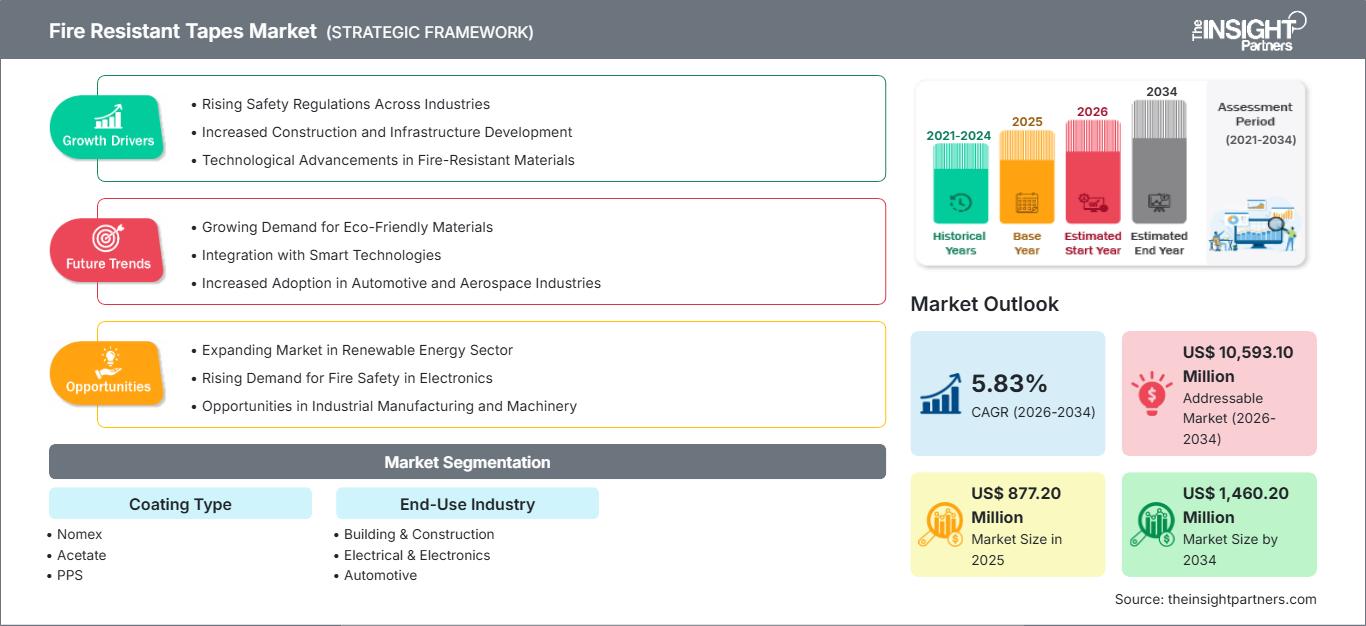
Fire Resistant Tapes Market Assessment and Insights
Regional Outlook
- North America: ~31% of the global Fire Resistant Tapes Market share in 2025 | ~5% CAGR through 2034. Market position: North America holds the largest regional position, supported by mature aerospace, automotive, electronics, and construction sectors. Demand benefits from established fire-safety practices, replacement activity, and extensive use of specialized tapes for insulation, sealing, and bonding.
- US: ~80% of North American market revenue in 2025 | ~5% CAGR through 2034. Market position: The US represents the dominant country within North America, supported by aerospace production, automotive manufacturing, electronics assembly, commercial construction, and extensive supplier capabilities. Product development increasingly combines flame resistance with electrical, thermal, and mechanical performance.
- Europe: ~29% of the global market in 2025 | ~5% CAGR through 2034. Market position: Europe is a mature market with strong demand from automotive, aerospace, industrial manufacturing, and building applications. Germany is the leading country in Europe, supported by automotive and industrial production, while France, the UK, Italy, and Spain provide additional demand through specialized manufacturing and infrastructure activity.
- Asia Pacific: ~28% of the global market in 2025 | ~7% CAGR through 2034. Market position: Asia Pacific is the fastest-growing region, supported by electronics manufacturing, automotive electrification, infrastructure development, and expanding aerospace capabilities. China is the leading country in Asia Pacific, with Japan, South Korea, India, and Australia contributing through electronics, transportation, industrial, and infrastructure applications.
Segment Outlook
- Electrical & Electronics: ~36% Share in 2025 | ~6% CAGR through 2034. Market position: Electrical and electronics applications account for the largest end-use position because tapes provide electrical insulation while addressing heat, flame, dielectric, and assembly requirements. Growing component density and thermal management needs sustain demand across equipment, wiring, batteries, and electronic assemblies.
- Aerospace & Defense: ~14% Share in 2025 | ~7% CAGR through 2034. Market position: Aerospace and defense represents the high-growth end-use segment as aircraft interiors, wiring systems, insulation assemblies, and lightweight components increasingly require materials that combine low weight, adhesion, thermal resistance, and controlled flammability characteristics.
Competitive Coverage
3M, Scapa Group Ltd, Avery Dennison Corporation, Nitto Denko Corporation, Saint Gobain, Shurtape Technologies LLC, Tesa SE, Americover Inc, Boyd Corporation, Rogers Corporation, Tape-Pak Inc., Nichiban Co. Ltd.
Methodology
The Insight Partners follows Data Collection & Secondary Research, Primary Research, Data Analysis, and Data Triangulation & Final Review to validate market estimates and insights.
Source: The Insight Partners' analysis based on proprietary research, government publications, company annual reports, investor presentations, industry databases, and expert interviews.
Fire Resistant Tapes Market Trends
Movement Toward Halogen-Free and Lower-Impact Formulations
Environmental requirements are increasingly influencing formulation decisions alongside fire performance. Future Fire Resistant Tapes Market trends are expected to favor halogen-free adhesive systems, lower-emission constructions, and material combinations designed to satisfy both flammability and restricted-substance requirements. This transition is particularly relevant in automotive, electronics, transportation, and building applications where customers increasingly evaluate environmental attributes during material qualification. Suppliers are likely to focus on maintaining flame performance while reducing the use of substances that create regulatory or recycling concerns. Backing materials and adhesive chemistry may also be redesigned together rather than optimized independently. The commercial implication is a shift toward higher-value products supported by documented compliance, application testing, and consistent manufacturing controls.
Integration of Functional Properties Into Single Tape Constructions
Future products are likely to combine several functions within one tape construction, reducing the number of separate materials required during assembly. Flame resistance may increasingly be integrated with dielectric insulation, thermal management, moisture protection, cushioning, acoustic performance, or high-temperature adhesion. Such multifunctionality can simplify manufacturing by reducing assembly steps and enabling automated application or die cutting. The trend is particularly relevant to battery systems, compact electronics, aircraft interiors, and transportation components where available space is limited. Tape suppliers with formulation, coating, laminating, and converting capabilities can tailor products around customer-specific requirements. This approach can also increase qualification barriers, because a multifunctional tape becomes part of the component's performance architecture rather than serving as a simple consumable.
Fire Resistant Tapes Market Growth Factors
Stricter Fire-Safety Requirements Across Critical Assemblies
Fire-safety requirements are strengthening the role of specialized tapes in applications where conventional adhesive products may not provide sufficient flame resistance. Building assemblies, aircraft interiors, electrical equipment, vehicle components, and industrial systems increasingly require materials capable of limiting flame propagation while maintaining adhesion and mechanical integrity. This shifts procurement toward products supported by recognized flammability and application testing. The effect is particularly important for OEMs because material qualification is embedded in product-development processes, making approved tape constructions difficult to replace without validation. Suppliers that combine fire performance with dielectric insulation, moisture resistance, conformability, and clean processing can therefore address multiple technical requirements through one material platform. This driver supports premiumization and encourages manufacturers to develop application-specific constructions rather than relying solely on standard industrial tapes.
Electrification Expands Requirements for Flame-Retardant Insulation
Vehicle electrification, battery deployment, power electronics, and higher electronic content are increasing the number of components requiring controlled thermal and electrical behavior. Adhesive tapes can perform several functions within these systems, including insulation, component fixation, wire management, shielding, and protection against localized heat or flame exposure. The combination of thinner assemblies and higher energy density creates a need for tapes that deliver fire resistance without adding unnecessary mass or thickness. Suppliers are consequently developing constructions with optimized dielectric strength, conformability, thermal resistance, and adhesion to difficult substrates. This demand mechanism broadens the addressable application base beyond traditional electrical insulation and supports greater use of engineered tape solutions in automotive, electronics, charging equipment, and related power-management systems.
Expansion of Lightweight Adhesive Assembly in Transportation
Transportation manufacturers increasingly use adhesive joining and mounting methods to reduce mechanical fasteners, simplify assembly, and accommodate lightweight materials. Fire-resistant tapes are relevant where these benefits must coexist with stringent safety requirements. Aerospace applications particularly value low-weight constructions, while automotive interiors and electrical systems require conformability and compatibility with plastics, foams, metals, and composite materials. Tape suppliers can capture this demand by combining flame-retardant adhesives with thin backings and die-cut formats tailored to OEM production. The resulting opportunity is not limited to replacing existing tape products; it also includes converting selected mechanical fastening or conventional adhesive applications to engineered pressure-sensitive solutions. This supports product development focused on process efficiency, automated assembly, and application-specific qualification.
Fire Resistant Tapes Market Opportunities
Localized Manufacturing for Asia Pacific OEM Supply Chains
Expanding electronics, automotive, battery, and industrial production in Asia Pacific creates an opportunity for tape suppliers to increase local coating, converting, and technical-service capabilities. Regional production can shorten lead times, reduce logistics complexity, and support faster customization for OEM customers. China, Japan, South Korea, and India offer distinct application bases, allowing suppliers to develop products around local manufacturing requirements rather than relying entirely on imported standard constructions. Investment in local die cutting and application engineering can further strengthen customer relationships because many fire-resistant tape applications require precise dimensions and substrate-specific adhesion. The Fire Resistant Tapes Market Forecasts therefore point toward greater value creation from localized technical support, application development, and supply-chain responsiveness alongside conventional capacity expansion.
Retrofit and Advanced Protection Solutions for Existing Assets
A substantial commercial opportunity exists in upgrading existing buildings, vehicles, industrial equipment, and electrical systems with higher-performance fire-resistant adhesive solutions. Retrofit applications can address insulation, joint sealing, wire management, component fixation, and localized protection without requiring complete replacement of the underlying assembly. Suppliers can strengthen this opportunity by offering application audits, material selection support, die-cut components, and installation guidance rather than selling tape as a standalone commodity. This service-oriented model is relevant where customers face aging infrastructure, evolving safety requirements, or changes in equipment configuration. It can also create recurring demand from maintenance programs because replacement cycles for protective tapes can be aligned with scheduled inspection and refurbishment activities.
Segmentation Analysis
Coating Type
The Coating Type segment is expected to expand at a ~6% CAGR through 2034. Material selection within this dimension is determined by the required combination of flame resistance, thermal stability, electrical insulation, adhesion, flexibility, and substrate compatibility. Manufacturers increasingly optimize backing and adhesive combinations for application-specific requirements rather than relying on a single construction across industries. Performance certification and converting efficiency remain important factors in supplier selection.
- Nomex: Nomex constructions are valued where high thermal and flame resistance are required alongside low weight. Demand is concentrated in demanding transportation, aerospace, electrical, and industrial applications where the tape must maintain protective performance under elevated thermal exposure.
- Acetate: Acetate tapes provide a balance of electrical insulation, conformability, and processing convenience. They are relevant to electrical assemblies and wiring applications where controlled flame behavior and reliable adhesion are required without the stiffness associated with heavier reinforcement materials.
- PPS: PPS constructions address applications requiring high thermal and chemical resistance. Their strategic importance is strongest where electronic, automotive, or industrial components experience elevated temperatures and require dimensional stability together with flame-retardant performance.
- Glass Cloth: Glass cloth tapes provide reinforcement, dimensional stability, and high-temperature resistance. They are used where mechanical strength and thermal protection must be maintained simultaneously, including electrical insulation, industrial equipment, and demanding repair or protection applications.
- PVC: PVC tapes remain relevant for electrical insulation and general industrial applications because of their flexibility, conformability, and established processing characteristics. Flame-retardant grades extend their use in wiring, harnessing, and equipment where cost and ease of application remain important.
- Polyimide: Polyimide tapes serve high-performance electrical and thermal applications because of their combination of temperature resistance, dielectric performance, thin construction, and dimensional stability. Demand is closely connected with electronics, batteries, semiconductor-related processes, and advanced electrical assemblies.
End-Use Industry
The End-Use Industry segment is projected to register a ~6% CAGR through 2034. Demand is shaped by the installed base of electrical and transportation equipment, construction activity, product safety requirements, and the increasing integration of electronic systems. Application engineering is becoming more important as customers seek tapes that satisfy several performance requirements simultaneously while remaining compatible with automated assembly and die-cutting processes.
- Building & Construction: Construction applications use fire-resistant tapes for joints, penetrations, sealing, insulation, and fire-protection assemblies. Demand is supported by new construction and renovation, particularly where installation efficiency, smoke control, moisture resistance, and compatibility with building materials influence material selection.
- Electrical & Electronics: Electrical and electronics applications represent the largest demand base because tapes can combine insulation, flame retardance, thermal management, and component fixation. Increasing component density and electrification create additional requirements for thin, conformable, high-performance adhesive materials.
- Automotive: Automotive manufacturers use flame-retardant tapes for wire harnesses, interior components, battery systems, insulation, and component bonding. Electrification increases the need for dielectric protection and thermal safety while maintaining lightweight construction and compatibility with high-volume assembly processes.
- Aerospace & Defense: Aerospace and defense applications prioritize low weight, thermal stability, flame resistance, and reliable adhesion. Tapes are used in aircraft interiors, carpeting, wiring, insulation, and component assembly, where material qualification and consistent performance are important procurement requirements.
Opportunity Snapshot
| End-Use Industry | Revenue Contribution | Trend Tag | Adoption Stage |
| Building & Construction | High | Firestop Installation | Mature |
| Electrical & Electronics | High | Thermal Insulation | Mature |
| Automotive | Medium | Battery Safety | Scaling |
| Aerospace & Defense | Medium | Lightweight Bonding | Scaling |
Regional Insights
North America Fire Resistant Tapes Market
North America accounts for ~31% of the global market in 2025 and is expected to register a ~5% CAGR through 2034. The market enjoys a developed demand for various applications, including aerospace, automotive, electronics, and buildings. Around 80% of the revenue comes from the US market; hence, it has an aggregated demand for tapes from both producers and tape converters. Demand is driven by production of aircraft, vehicles, electrical system installations, commercial construction projects, and replacements of older insulation systems.
Furthermore, the US market enjoys the benefit of 3M, Avery Dennison Corporation, Shurtape Technologies LLC, Americover Inc, Boyd Corporation, and Rogers Corporation. They supply the application markets with their products for various uses, such as fire barriers, electrical insulation, transportation bonding, and engineered parts. The Canadian market supports the demand for tapes via construction, transportation, energy infrastructure, and industrial applications, whereas the North American market has a benefit of an existing adhesive converting and distribution chain. Demand for multiple-function tapes drives consumers towards buying tapes with flame, moisture, and dielectric resistant properties.
U.S. Fire Resistant Tapes Market
The US represents ~80% of North American market revenue in 2025 and is projected to expand at a ~5% CAGR through 2034. This country's positioning is backed up by the presence of an extensive installed base of commercial buildings, industries, aircrafts, vehicles, and electronics. The need for fire-resistant tapes exists across the spectrum of electrical insulation, building joints, wire harnesses, aircraft interiors, and industrial adhesives.
The development of products is also being driven towards electrification. The need for batteries, charging stations, power electronics, and automotive architecture calls for tapes that offer flame-retardant properties and electrical resistance without increasing weight or thickness. 3M and Avery Dennison Corporation both have product lines that serve the needs of fire protection and electrical uses, while Boyd Corporation and Rogers Corporation offer engineered materials and components.
Europe Fire Resistant Tapes Market
Europe represents ~29% of the global market in 2025 and is expected to expand at a ~5% CAGR through 2034. Germany is the largest country in Europe, with industries of automobiles, engineering machines, electronic goods, and engineered materials driving its leadership position. The manufacturing sector of Germany results in a continual demand for tapes for electrical insulation, component mounting, wire management, and interior applications in transportation. TESA SE dominates the region, while Saint Gobain and others offer industrial tapes for construction and engineered material applications.
France is represented by its aerospace, automobile, construction, and engineering sectors, with a need for weight-saving and fire-resistant adhesives. The UK has demand in aerospace, construction, transportation, and industrial maintenance sectors. Italy is represented by its diversified applications in automobiles, machines, appliances, and construction. Spain has its share in demand coming from automobiles, infrastructure, electrical equipment, and transportation sectors. In Europe, fire performance is equally considered with environmental compliance, low emission adhesive systems, recyclability, and automation compatibility in purchasing decisions.
APAC Fire Resistant Tapes Market
Asia Pacific represents ~28% of the global market in 2025 and is forecast to grow at a ~7% CAGR through 2034, making it the fastest-growing region. China is the top Asian Pacific region country because of its extensive electronics, automotive, electrical equipment, construction, and industrial manufacturing industry. The electronics, battery, automotive systems, and precision manufacturing industry of Japan and South Korea contribute, while India gains from its infrastructure, automotive, electrical equipment, and industrial expansion.
Australia brings in contributions from construction, transportation, mining equipment, and industrial manufacturing. Localization of parts manufacturing and the increased use of adhesives in smaller electrical and electronic assemblies are some of the ways in which regional growth will be facilitated. This region will be best served by suppliers who have the ability to convert locally.
Middle East & Africa Fire Resistant Tapes Market
The Middle East & Africa market is projected to expand at a ~6% CAGR through 2034. Saudi Arabia is the leading country in the Middle East & Africa, supported by industrial diversification, infrastructure investment, construction activity, and energy-related projects. The UAE contributes through commercial construction, aviation, logistics, marine applications, and industrial development, creating demand for specialized sealing and insulation materials.
South Africa provides a regional base for mining, industrial manufacturing, electrical equipment, and infrastructure applications. Rest of MEA demand is connected with construction, utilities, transportation, and industrial modernization. The region's opportunity profile is influenced by requirements for reliable materials in demanding operating environments, while project-based procurement makes certification, supply continuity, and technical support important purchasing considerations.
Fire Resistant Tapes Market Report Scope
| Report Attribute | Details |
|---|---|
| Market size in 2025 | US$ 877.20 Million |
| Market Size by 2034 | US$ 1,460.20 Million |
| Global CAGR (2026 - 2034) | 5.83% |
| Historical Data | 2021-2024 |
| Forecast period | 2026-2034 |
| Segments Covered | Coating Type, End-Use Industry |
| Region scope | North America, Europe, Asia-Pacific, South and Central America, Middle East and Africa |
Recent Developments
- July 2026: Tesa SE –Ahlstrom, a global leader in fiber‑based specialty materials, launched MaxLiner™, a new high transparency and high-density release paper for pressure‑sensitive adhesive (PSA) labeling. Produced at the company’s plant in Jacareí, Brazil, the new product further expands and strengthens Ahlstrom’s global and regional footprint for release liner solutions.
- February 2026: Riwega S.r.l. introduced Tape Fire B 75, a new acrylic adhesive tape designed for sealing fire-resistant membranes in roofing and wall applications. The tape offers enhanced resistance to UV radiation and achieves a fire reaction classification of B-s1,d0. When installed in combination with Riwega’s Panther Universal A2 50/225 membrane, the solution achieves an A2-s1,d0 fire classification. The product is positioned for applications requiring durable sealing and enhanced fire and UV resistance in building envelope systems.
Frequently Asked Questions

Recent Reports






