
Flexible Substrate Market Size, Growth & Demand by 2034
Coverage: By Type (Plastic, Glass, Metal); Application (Consumer Electronics, Solar Energy, Medical and Healthcare, Aerospace and Defense), and Geography (North America, Europe, Asia Pacific, and South and Central America)
- Status : Data Released
- Report Code : TIPRE00015083
- Category : Chemicals and Materials
- No. of Pages : 150
- Available Report Formats :


- Last update date : November 02, 2026


2025 Market Size
US$ 1,039.47 Mn
Base year value
2034 Forecast
US$ 3,324.29 Mn
Projected by 2034
CAGR 2026-2034
13.79 %
Growth rate
Addressable Market
US$ 18,856.65 Mn
(2026-2034)
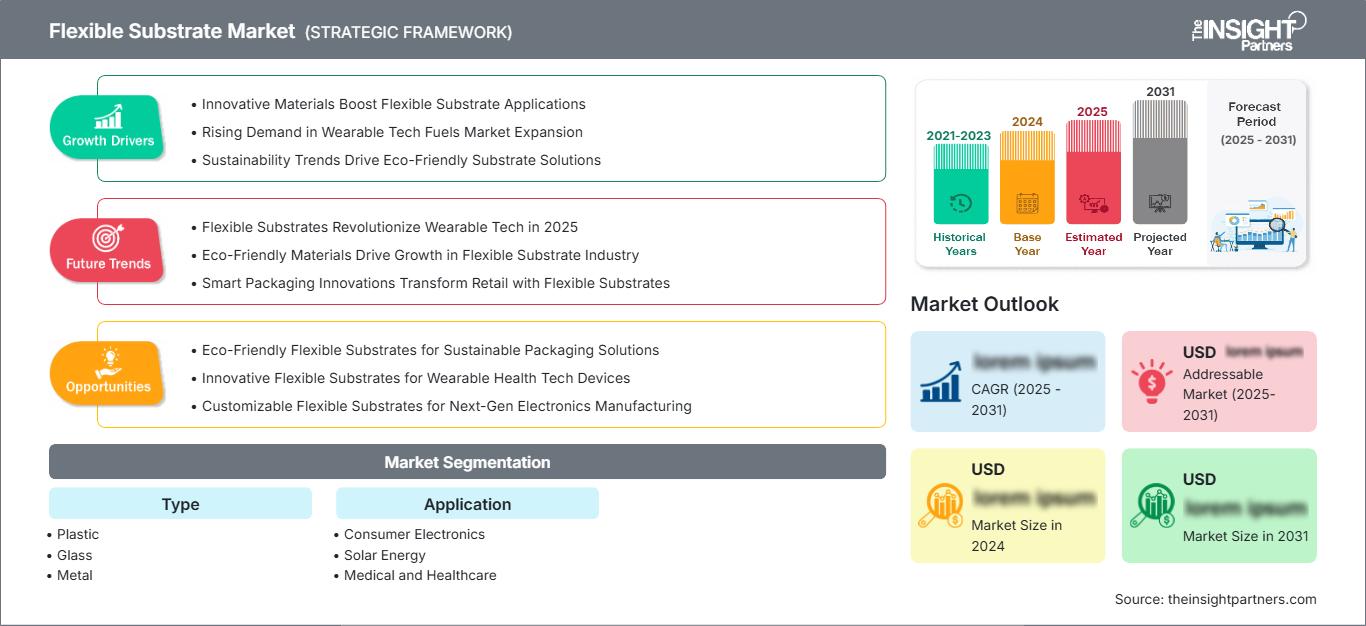
The flexible substrate market was valued at US$ 1,039.47 Million in 2025 and is projected to reach US$ 3,324.29 Million by 2034, expanding at a 13.79% CAGR during 2026–2034. Growth is supported by increasing demand for lightweight and conformable electronic architectures, foldable devices, flexible photovoltaic technologies, medical wearables, and high-performance components for aerospace systems. Improvements in thin-film processing, substrate reliability, barrier performance, and roll-to-roll manufacturing are also widening the addressable application base.
North America is expected to maintain a strong position, supported by advanced electronics manufacturing, materials science capabilities, semiconductor investment, and adoption of flexible technologies in specialized healthcare and aerospace applications. The regional flexible substrate market size is projected to expand at a ~11% CAGR through 2034, with demand increasingly shaped by higher-performance substrate requirements, domestic technology development, and integration of flexible components into next-generation electronic systems.
Flexible Substrate Market Assessment and Insights
Regional Outlook
- North America: ~25% of the global market in 2025 | ~11% CAGR through 2034. Market position: North America remains a major market supported by advanced electronics R&D, aerospace programs, healthcare-device innovation, and established materials suppliers. The regional ecosystem benefits from close integration between substrate developers, device manufacturers, and technology developers.
- US: ~78% of North American market revenue in 2025 | ~11% CAGR through 2034. Market position: The US represents the largest country market in North America, supported by electronics innovation, medical-device development, aerospace and defense procurement, and research activity focused on flexible and thin-film technologies.
- Europe: ~24% of the global market in 2025 | ~12% CAGR through 2034. Market position: Europe combines established specialty-material capabilities with demand from healthcare, automotive electronics, industrial sensing, and renewable-energy applications. Germany is the leading country in Europe, followed by established technology bases in the UK, France, Italy, and Spain.
- Asia Pacific: ~43% of the global market in 2025 | ~15% CAGR through 2034. Market position: Asia Pacific is the fastest-growing region, supported by large-scale electronics manufacturing, display production, photovoltaic deployment, and expanding flexible-device ecosystems. China is the leading country in Asia Pacific, with Japan, South Korea, and India providing additional technology and manufacturing depth.
Segment Outlook
- Plastic: ~62% Share in 2025 | ~14% CAGR through 2034. Market position: Plastic represents the largest material category because polymer substrates combine low weight, processability, bendability, and scalable manufacturing. Demand is reinforced by high-volume electronics applications where mechanical flexibility and material economics are important purchasing criteria.
- Consumer Electronics: ~55% Share in 2025 | ~15% CAGR through 2034. Market position: Consumer electronics represents the high-growth application category as foldable devices, curved displays, flexible circuits, and wearable products increase demand for thin, lightweight substrates capable of repeated bending and integration into compact device architectures.
Competitive Coverage
Corning Inc., Coveme Spa, Heraeus Deutschland GmbH and Co. KG, I-Components Co., Ltd., Kolon Industries, Nippon Electric Glass Co., Ltd., Polyonics, Rogers Corporation, Schott AG, The 3M Company
Methodology
The Insight Partners follows Data Collection & Secondary Research, Primary Research, Data Analysis, and Data Triangulation & Final Review to validate market estimates and insights.
Source: The Insight Partners' analysis based on proprietary research, government publications, company annual reports, investor presentations, industry databases, and expert interviews.
Flexible substrates have undergone transformation from traditional flexible polymer films into engineered material systems that cater to ever-increasing needs in the domain of electronic and energy applications. Plastics continue to play an essential role in this context, as polyimide, PET, and other plastics offer mechanical flexibility and lightweight characteristics, whereas ultra-thin glass is becoming increasingly relevant owing to its thermal, optical, and barrier properties. Metal foils are yet another choice that will see a growing number of applications due to the need for dimensional stability, conductivity, and high-temperature performance. As a result, the trend is toward better control of thickness, surface treatment, coatings, and continuous processing.
In the future, the market is likely to become more extensive geographically as manufacturing of flexible electronics products moves beyond East Asia. Development of photovoltaics, wearable healthcare devices, advanced displays, and aerospace electronics could stimulate new demands for substrates. Emphasis on energy savings, lightweight parts, miniaturization, and local technology production could also drive substrate producers to launch specific grades of material and manufacturing facilities.
Flexible Substrate Market Report Scope
| Report Attribute | Details |
|---|---|
| Market size in 2025 | US$ 1,039.47 Million |
| Market Size by 2034 | US$ 3,324.29 Million |
| Global CAGR (2026 - 2034) | 13.79% |
| Historical Data | 2021-2024 |
| Forecast period | 2026-2034 |
Flexible Substrate Market Analysis
The demands are driven by the desire to minimize thickness and weight while achieving performance in electrical, optical, thermal and mechanical functions. The flexible substrate market ecosystem ranges from raw material suppliers, substrate producers, coatings and surfaces treatments experts, electronics producers, photovoltaics makers, medical devices makers and aerospace integrators. Different needs from each application define the demand for different levels of bendability, dimensional stability, thermal process ability, transparency, barrier performance and reliability.
Supply conditions are increasingly tilting toward suppliers that can combine their material know-how and processing precision. While Corning illustrates the use of thin glass for high temperature and roll to roll processes, specialty material companies cater for polymer, glass and functional film requirements.
Competitive positioning in the flexible substrate market report is determined by proprietary materials, processing capability, customer qualification, scale of manufacturing, and adaptation of substrates for difficult application situations. Corning Inc. and Schott AG are strong rivals in respect of advanced glass, while Nippon Electric Glass Co., Ltd. is a competitor that offers specialty-glass technology. Coveme Spa, Kolon Industries, Polyonics, Rogers Corporation, Heraeus Deutschland GmbH and Co. KG, I-Components Co., Ltd., and The 3M Company all participate in the specialized materials and films industry.
More and more often money is invested not only in capacity but also in the materials themselves and their processing and qualification for various applications. This can be demonstrated with the example of continuing investments in glass, displays, solar energy, and advanced materials at Corning Inc. It means that it really pays off to be competitive in material properties and performance.
● REPORT CUSTOMIZATION
Tailor This Report To Align With Your Specific Business Requirements
This report can be customized to align precisely with your business objectives, scope, and target markets. Customization options include tailored segmentation, geography, competitive analysis, and strategic insights to support informed decision-making.
Customize This Report →WHAT YOU CAN ADJUST
- ● Segmentations
- ● Geography
- ● Competitive Analysis
- ● Language Preferences
Flexible Substrate Market: Strategic Insights
Regional Insights
North America Flexible Substrate Market
The North American region is expected to register a ~11% CAGR through 2034 on the back of advanced materials research, electronics design, medical-device design, and aerospace & defense activities. Demand in the region is dominated by the US, with Canada contributing through specialized electronics, energy, and advanced-material applications. Qualification, thermal stability, dimensional control, and availability form key criteria for buyers in the region, rather than material cost alone.
The flexibility offered by the technology holds special significance in areas where traditional stiff technologies impose limitations on weight, form factor, or compatibility. Flexible sensors are an advantage to the medical and healthcare industry, whereas aerospace technology requires a substrate that can endure harsh conditions. Consumer electronics and photovoltaics make up the other segments of the market. The network of suppliers in the region has strong connections among materials, researchers, equipment, and users.
U.S. Flexible Substrate Market
The US comprises nearly ~78% of North American flexible substrate market share in 2025 and will continue growing at an approximated CAGR of ~11% during the period from 2025-2034. The factors driving demand in the region are development of advanced electronics, healthcare devices, aerospace and domestic investments in semiconductor and material technologies. The wide industrial base in the country enables flexible substrates to shift from developmental stages to application-oriented processes.
Organizations such as Corning Inc., Rogers Corporation, and The 3M Company form part of the wider advanced-materials industry. The flexible glass substrate from Corning Inc. is a typical example that shows how flexible substrates may be used for display and touch components, and high-temperature applications. The wide materials expertise of the company enables it to be useful in electronics and solar energy applications.
Europe Flexible Substrate Market
Europe represents ~24% of the global flexible substrate market share in 2025 and is expected to expand at a ~12% CAGR through 2034. Germany is the leading country in Europe, supported by specialty-material manufacturing, industrial electronics, healthcare technologies, and strong engineering capabilities. The UK contributes through advanced electronics, research, and aerospace activity, while France combines aerospace and defense demand with electronics and energy applications.
There is an existing materials and manufacturing infrastructure that can accommodate special substrate and coating needs, while Spain contributes to the demand with its use of renewable energy and electronic technologies. In the region, there is a need for materials that provide both lightweight construction and performance in terms of thermal, optical, chemical, and mechanical properties. The European manufacturers are focusing on efficiency and sustainability, which means more yield from production and development of substrates suitable for manufacturing with reduced waste.
Specialty glasses are another competitive field. Schott AG has developed flexible glass used in foldable consumer electronics. In addition, the company has broadened its operations in high-tech glass solutions. The portfolio of the company, known as FLEXINITY, also features structured glass substrates for sensing, optoelectronics, diagnostics, and consumer products.
APAC Flexible Substrate Market
The Asia Pacific market will account for around 43% of the global flexible substrate market share in 2025, and the region is set to grow at a rate of around 15% CAGR until 2034 and is the fastest-growing region. China is the largest contributor from the Asia Pacific market owing to the availability of electronics manufacturing, photovoltaic manufacturing, display, and flexible manufacturing capabilities.
Japan and South Korea have strong contribution from specialty materials, display, and semiconductor capabilities. India is developing as another manufacturing and electronics consumer, and Australia’s contribution is mainly from specialization, renewable energy application, and technology innovation.
Middle East & Africa Flexible Substrate Market
Middle East & Africa is projected to expand at a ~14% CAGR through 2034, supported by renewable-energy investment, infrastructure modernization, electronics localization, and specialized applications requiring lightweight or conformable components. Saudi Arabia and the UAE are important Gulf markets because of their investment capacity and growing technology and energy ecosystems, while South Africa provides the region's most established industrial and electronics base.
The United Arab Emirates ranks topmost among countries in the Middle East and Africa region, based on technology investments, renewable energy projects, high-level infrastructure, and availability of international electronics sourcing chain. Saudi Arabia diversification initiatives and solar investments provide further opportunities, whereas South Africa provides demand support through industrial, health care, and research sectors.
Segmentation Analysis
Type
Type is projected to record a ~14% CAGR during 2026–2034. The flexible substrate market scope spans plastic, glass, and metal substrates, with adoption shaped by flexibility, weight, thermal stability, optical performance, barrier properties, electrical conductivity, dimensional stability, manufacturing compatibility, and application-specific reliability requirements.
- Plastic: Plastic substrates support broad adoption where low weight, flexibility, processability, and cost efficiency are priorities. They are particularly suitable for electronic architectures requiring repeated bending, conformable designs, and scalable film processing, while material selection depends on thermal, mechanical, and barrier requirements.
- Glass: Glass substrates are increasingly used where optical clarity, dimensional stability, thermal resistance, surface quality, and barrier performance are critical. Ultra-thin glass enables flexible and foldable architectures while retaining properties that can be difficult to achieve with conventional polymer films.
- Metal: Metal substrates serve specialized applications requiring electrical conductivity, thermal resistance, mechanical strength, and dimensional stability. Their adoption is concentrated in flexible electronics, thin-film energy technologies, and aerospace or defense systems where robust performance under demanding operating conditions is important.
Application
Application is expected to represent a major growth dimension of the flexible substrate market, with demand driven by the transition toward lightweight, thin, conformable, and increasingly integrated device architectures. Adoption depends on flexibility requirements, device geometry, operating environment, durability, manufacturing scalability, and the performance requirements of downstream systems.
- Consumer Electronics: Consumer electronics represents a major application for flexible substrates as manufacturers develop foldable smartphones, flexible displays, wearable devices, and compact electronic components. Substrate selection is influenced by bendability, optical properties, thickness, durability, and compatibility with high-volume electronics manufacturing.
- Solar Energy: Solar energy applications use flexible substrates to enable lightweight, conformable, and potentially portable photovoltaic architectures. Demand is supported by thin-film technologies and applications where conventional rigid modules create weight or installation constraints, with substrate performance influencing efficiency, durability, and manufacturing reliability.
- Medical and Healthcare: Medical and healthcare applications leverage flexible substrates for wearable sensors, conformable monitoring devices, diagnostic systems, and other compact electronics. Materials must balance flexibility with biocompatibility, chemical stability, signal integrity, durability, and compatibility with specialized medical-device manufacturing processes.
- Aerospace and Defense: Aerospace and defense applications require substrates that combine low weight with mechanical, thermal, electrical, and environmental reliability. Flexible materials can support compact sensors, specialized electronics, and conformable components where reduced mass and integration flexibility contribute to system-level performance.
Opportunity Snapshot
| Application | Revenue Contribution | Trend Tag | Adoption Stage |
| Consumer Electronics | High | Foldable Devices | Scaling |
| Solar Energy | Medium | Flexible Photovoltaics | Scaling |
| Medical and Healthcare | Medium | Wearable Sensors | Scaling |
| Aerospace and Defense | Low | Lightweight Electronics | Emerging |
Flexible Substrate Market Growth Drivers and Impact Analysis
Expansion of Foldable and Conformable Electronics
The transition from rigid to foldable, curved, wearable, and conformable electronic architectures is increasing the need for substrates capable of repeated mechanical deformation without compromising device performance. Flexible displays and related components require controlled thickness, surface quality, dimensional stability, and resistance to mechanical stress. Corning's Willow Glass illustrates how ultra-thin glass can combine bendability with optical and thermal properties, while polymer substrates remain important for applications prioritizing low mass and manufacturing flexibility. The commercial impact extends beyond smartphones to tablets, wearable devices, smart surfaces, sensors, and specialized electronics. As product designers increasingly incorporate non-planar geometries, substrate qualification becomes an integral part of product development, supporting demand for specialized material grades and application-specific processing.
Growth of Lightweight Flexible Solar Technologies
Flexible photovoltaic architectures create demand for substrates that reduce weight while supporting electrical, optical, thermal, and mechanical requirements. Research into perovskite and other thin-film photovoltaic technologies is expanding the role of flexible substrate engineering because device performance depends not only on photovoltaic materials but also on substrate compatibility and mechanical durability. Flexible solar systems can address applications where conventional rigid panels face limitations, including curved surfaces, portable systems, and weight-sensitive installations. The market impact is therefore linked to the commercialization rate of flexible photovoltaic technologies and the ability of substrate producers to deliver scalable, reliable materials. Suppliers capable of improving barrier properties, durability, and manufacturing yield can address higher-value photovoltaic applications as technology maturity increases.
Increasing Demand for Lightweight Medical and Aerospace Electronics
Medical wearables and aerospace electronics increasingly require components that conform to constrained geometries while minimizing mass and maintaining reliability. Flexible substrates can support wearable monitoring, conformable sensors, compact diagnostic systems, and specialized aerospace electronics where rigid components may restrict integration. Medical applications place emphasis on biocompatibility, chemical stability, and reliable signal transmission, while aerospace applications emphasize thermal resistance, dimensional stability, vibration tolerance, and environmental durability. This differentiation encourages suppliers to develop highly engineered substrate solutions rather than standardized commodity films. The resulting market impact is an expansion of the premium application base, with qualification requirements creating longer customer relationships and increasing the importance of joint development between substrate manufacturers and device designers.
Flexible Substrate Market Future Trends
Integration of Ultra-Thin Glass with Advanced Electronics
Ultra-thin glass is likely to become increasingly integrated into electronic architectures that require a combination of flexibility, optical performance, thermal stability, and barrier protection. Corning's Willow Glass is already designed for roll-to-roll processing and can tolerate processing temperatures that conventional polymer films cannot readily support. Future development is likely to focus on reducing thickness while improving bend reliability, edge strength, handling, and compatibility with increasingly complex electronic stacks. Glass suppliers may also expand structured and functionalized substrate formats for sensors, optoelectronics, medical diagnostics, and advanced packaging. This flexible substrate market trend could gradually expand glass beyond foldable displays into applications where polymer substrates face limitations associated with thermal processing, moisture transmission, or dimensional stability.
Convergence of Flexible Substrates with Printed and Thin-Film Devices
Flexible substrates are expected to become more closely integrated with printed electronics, thin-film photovoltaics, sensors, and other manufacturing approaches that deposit functional layers directly onto compliant surfaces. This convergence can reduce the dependence on conventional rigid assembly architectures and enable electronics to be produced in continuous or semi-continuous processes. Future development will focus on interface engineering because differences in mechanical properties between substrate and deposited functional layers can create cracking, delamination, or reliability challenges during repeated bending. Research has already highlighted substrate cracking as a critical reliability consideration in flexible electronic structures. Suppliers that improve adhesion, stress management, barrier performance, and surface uniformity will be positioned to support more complex flexible-device architectures.
Flexible Substrate Market Opportunities
Application-Specific Substrate Platforms for Medical and Aerospace Devices
An important commercial opportunity lies in developing application-specific substrates rather than treating flexibility as a standalone material characteristic. Medical and aerospace customers often require combinations of flexibility with environmental resistance, electrical functionality, optical performance, dimensional stability, and long service life. Suppliers can therefore differentiate through engineered surface treatments, multilayer structures, controlled thickness, and customized barrier properties. Qualification-intensive markets also create opportunities for technical partnerships because substrate selection can influence the performance and manufacturability of the complete device. Companies with established materials-science capabilities can use these relationships to move toward higher-value contracts and longer product lifecycles. The opportunity is particularly relevant for producers capable of adapting substrate formulations and processing parameters to customer-specific device architectures.
Regional Manufacturing Partnerships in Asia Pacific
Asia Pacific offers an opportunity in the flexible substrate market forecast to expand production and technical partnerships alongside its large electronics, display, photovoltaic, and semiconductor ecosystems. Establishing local processing, coating, converting, or technical-support capabilities can shorten qualification cycles and improve supply responsiveness for device manufacturers. China, Japan, South Korea, and India provide different combinations of manufacturing scale, technology expertise, and downstream demand, allowing suppliers to target distinct application clusters. Partnerships with electronics manufacturers can also accelerate substrate optimization because performance requirements can be translated directly into material and processing specifications. For global suppliers, localized technical capabilities can reduce logistics complexity while improving customer integration. For regional producers, investment in precision processing and quality systems can support movement into higher-value flexible electronics and energy applications.
Recent Developments
- June 2026: Schott AG launched its “Semicon next” knowledge hub focused on glass-enabled semiconductor technologies and advanced packaging. The company highlighted growing industry investment in glass-based solutions as semiconductor scaling increasingly depends on advanced packaging and system integration. The development is relevant to flexible substrate suppliers because it reinforces the broader expansion of engineered glass into advanced electronic architectures.
- December 2025: The 3M Company announced that its expanded Digital Materials Hub would incorporate optical models, allowing engineers in consumer electronics and advanced manufacturing to evaluate material performance through virtual simulations. The platform also supports requests for customized virtual materials, linking digital design workflows with 3M's materials-development capabilities.
Frequently Asked Questions

- Comprehensive Market Sizing and Forecast Analysis
- Detailed Segmentation Analysis
- In-Depth Market Dynamics Assessment
- Regional and Country-Level Insights
- Competitive Landscape and Company Benchmarking
- Strategic Business Intelligence
Recent Reports
Testimonials

The Insight Partners provided valuable market intelligence that supported our global go-to-market strategy. Their team was professional, responsive, and attentive to our feedback, providing thoughtful analysis and helpful methodological clarifications throughout the project.
Junmo Kim Chief Financial Officer (CFO), Enertech Co., Ltd.
The Insight Partners' SCADA System Market report is comprehensive, with valuable insights on current trends and future forecasts. The team was highly professional, responsive, and supportive throughout. We are very satisfied and highly recommend their services.
RAN KEDEM Partner, Reali Technologies LTDs
I requested a report on a very specific software market and the team produced the report in a few days. The information was very relevant and well presented. I then requested some changes and additions to the report. The team was again very responsive and I got the final report in less than a week.
JEAN-HERVE JENN Chairman, Future Analytica
We worked with The Insight Partners for an important market study and forecast. They gave us clear insights into opportunities and risks, which helped shape our plans. Their research was easy to use and based on solid data. It helped us make smart, confident decisions. We highly recommend them.
PIYUSH NAGPAL Sr. Vice President, High Beam Global
The Insight Partners delivered insightful, well-structured market research with strong domain expertise. Their team was professional and responsive throughout. The user-friendly website made accessing industry reports seamless. We highly recommend them for reliable, high-quality research services
YUKIHIKO ADACHI CEO, Deep Blue, LLC.
This is the first time I have purchased a market report from The Insight Partners.While I was unsure at first, I visited their web site and felt more comfortable to take the risk and purchase a market report.I am completely satisfied with the quality of the report and customer service. I had several questions and comments with the initial report, but after a couple of dialogs over email with their analyst I believe I have a report that I can use as input to our strategic planning process.Thank you so much for taking the extra time and making this a positive experience.I will definitely recommend your service to others and you will be my first call when we need further market data.
JOHN SUZUKI President and Chief Executive Officer, Board Director, BK Technologies
I wish to appreciate your support and the professionalism you displayed in the course of attending to my request for information regarding to infectious disease IVD market in Nigeria. I appreciate your patience, your guidance, and the fact that you were willing to offer a discount, which eventually made it possible for us to close a deal. I look forward to engaging The Insight Partners in the future, all thanks to the impression you have created in me as a result of this first encounter.
DR CHIJIOKE ONYIA MANAGING DIRECTOR, PineCrest Healthcare Ltd.Reason to Buy
- Informed Decision-Making
- Understanding Market Dynamics
- Competitive Analysis
- Identifying Emerging Markets
- Customer Insights
- Market Forecasts
- Risk Mitigation
- Boosting Operational Efficiency
- Strategic Planning
- Investment Justification
- Tracking Industry Innovations
- Aligning with Regulatory Trends





 Get Free Sample for