Flow Chemistry Market Size & Overview
The Flow Chemistry Market was valued at US$ 2.19 Billion in 2025 and is projected to reach US$ 7.55 Billion by 2034, registering a CAGR of 14.74% during 2026–2034. Market expansion is supported by demand for safer chemical processing, improved reaction control, reduced waste generation, and more efficient pharmaceutical manufacturing. The transition from batch processing to continuous production is creating opportunities for reactor manufacturers, process engineering specialists, and chemical producers seeking consistent product quality, scalable operations, and improved utilization of manufacturing assets.
North America remains an important market for continuous chemical processing, supported by pharmaceutical research capabilities, established specialty chemical manufacturing, and investment in advanced production technologies. The region's Flow Chemistry Market Size reflects increasing interest in process intensification, automated reaction monitoring, and manufacturing resilience. Pharmaceutical companies and contract development and manufacturing organizations are evaluating continuous processing to improve production consistency and manage hazardous reactions. Established research infrastructure and collaboration between equipment suppliers and industrial users also support technology adoption, while implementation costs, process validation requirements, and the need for specialized engineering expertise influence the pace of commercialization.
The demand is driven by the requirement to increase the selectivity of reactions, control heat sensitive reactions, and handle chemical reactions that pose high hazards in the conventional batch equipment. There is great potential for pharmaceutical companies to become users of the continuous process due to the fact that they have reactions that use hazardous chemicals, small window sizes, and very strict product quality specifications. Specialty chemical manufacturers consider continuous processes where reaction control and reproducibility influence either yields or the formation of impurities. Hence, the Flow Chemistry Market relies on more than just the sale of equipment. Value chain starts from the reactor design and choice of materials to pumps, temperature control instruments, automation, analysis, and integration with the separation or purification systems. The suppliers need to show that those elements are working together at the operating conditions that are specified for each reaction. Standardization of equipment may help, but specific needs of a process will still result in a need for customization and technical support of the process. The manufacturers take into account also the compatibility with the feeds, maintenance needs, energy consumption, and downstream processing before investing in the equipment.
According to the Flow Chemistry Market Report, the nature of competition is such that specialist reactor producers, suppliers of process technology solutions, and firms having wider chemical development and production facilities compete among themselves. The list of competitors includes Chemtrix BV, Vapourtec Ltd., Uniqsis Ltd., Syrris Ltd., ThalesNano Inc., and Ehrfeld Mikrotechnik GmbH. Each competitor operates in different niches in the sphere of equipment and process development. AM Technology, FutureChemistry, and Little Things Factory GmbH add specialist competencies, while Cambrex Corporation provides services of pharmaceutical development and production. Investment choices need proof of process-level value-added benefits rather than the presumption that running continuously is necessarily more cost-effective. Comparison between reactor usage, product quality, safety considerations, clean-up, maintenance, and set-up costs versus the current batch process takes place in prospective customer companies. Equipment suppliers can build their strength on the basis of platforms, application labs, joint development, and monitoring systems. Contract manufacturers could help customers access continuous processes without the immediate construction of special-purpose facilities. This could lower commitment at the start while enabling industrial users to demonstrate the feasibility of adoption.
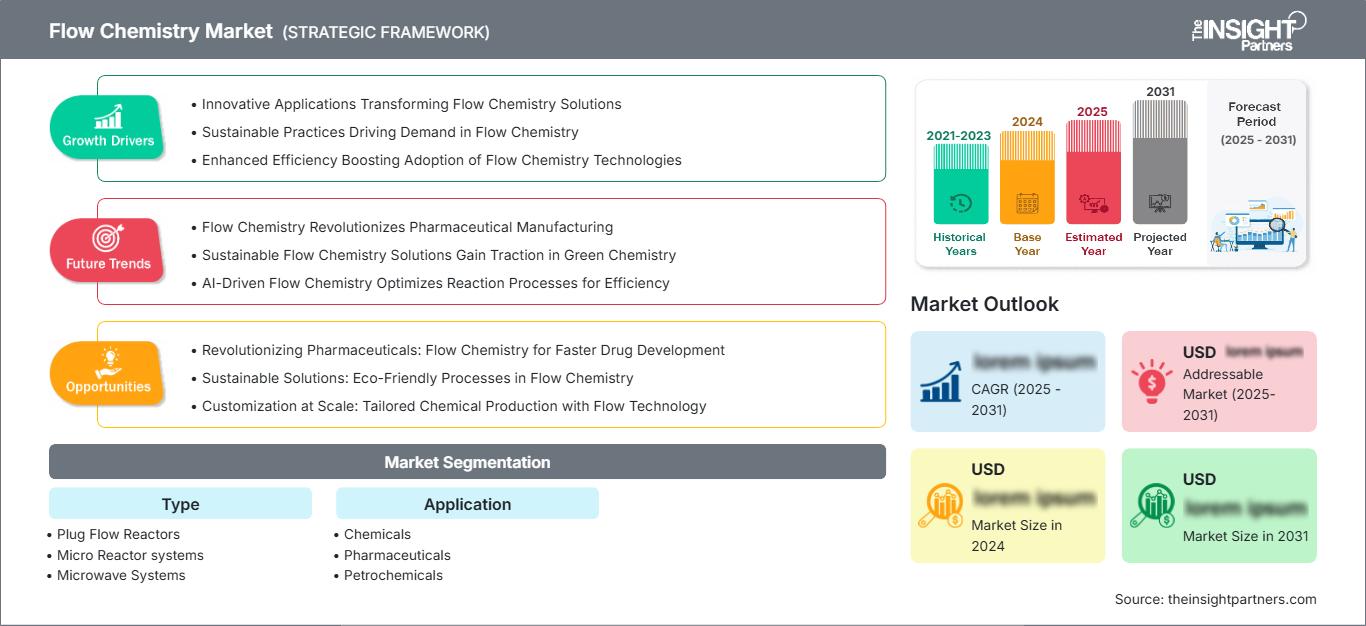
Flow Chemistry Market Assessment and Insights
Regional Outlook
- North America: ~35% of the global market in 2025 | ~14% CAGR through 2034. Market position: North America is estimated to hold the largest regional share, supported by pharmaceutical research, specialty chemical production, established technology suppliers, and investment in advanced manufacturing systems. Its mature industrial base supports adoption, although implementation and validation costs influence purchasing decisions.
- US: ~80% of North American market revenue in 2025 | ~14% CAGR through 2034. Market position: The United States is the largest national market within North America, benefiting from pharmaceutical research, contract manufacturing capabilities, and demand for process intensification. Its technology ecosystem supports reactor development, pilot-scale testing, and industrial implementation.
- Europe: ~30% of the global market in 2025 | ~14% CAGR through 2034. Market position: Europe has an established flow chemistry ecosystem spanning specialist equipment manufacturers, pharmaceutical process development, and advanced chemical engineering. Germany and the UK are important centers, while France, Italy, and Spain contribute through pharmaceutical and specialty chemical production.
- Asia Pacific: ~27% of the global market in 2025 | ~17% CAGR through 2034. Market position: Asia Pacific is estimated to be the fastest-growing region, supported by pharmaceutical manufacturing expansion, specialty chemical capacity additions, and investment in domestic production capabilities. China and Japan have established industrial and research infrastructure, while India and South Korea offer additional adoption opportunities.
Segment Outlook
- Plug Flow Reactors: ~42% share of the reactor-type segment in 2025 | ~15% CAGR through 2034. Market position: Plug flow reactors are estimated to represent the largest reactor-type subsegment because their controlled residence times, continuous operation, and suitability for scalable reaction processing align with industrial requirements. Their value depends on reaction compatibility, heat transfer, and engineering design.
- Pharmaceuticals: ~38% share of the application segment in 2025 | ~17% CAGR through 2034. Market position: Pharmaceuticals are positioned as a high-growth application because manufacturers require consistent product quality, precise reaction control, and safer handling of reactive intermediates. Adoption depends on validated process performance, regulatory compliance, and successful integration with downstream manufacturing operations.
Competitive Coverage
AM Technology, Cambrex Corporation, Chemtrix BV, Vapourtec Ltd., Uniqsis Ltd., Ehrfeld Mikrotechnik GmbH, FutureChemistry, Little Things Factory GmbH, Syrris Ltd., ThalesNano Inc.
Methodology
The Insight Partners follows Data Collection & Secondary Research, Primary Research, Data Analysis, and Data Triangulation & Final Review to validate market estimates and insights.
Source: The Insight Partners' analysis based on proprietary research, government publications, company annual reports, investor presentations, industry databases, and expert interviews.
Flow Chemistry Market Trends
Integration of Digital Monitoring and Process Analytics
Digital process monitoring is likely to become more closely integrated with reactor operation as manufacturers seek better visibility into reaction conditions and production variability. Inline analytical instruments, automated controls, and data acquisition systems can help operators identify deviations and assess the relationship between process parameters and product quality. Machine-learning tools may also support experimental planning, reaction optimization, and the identification of operating conditions that merit further investigation. These capabilities could reduce the time needed to evaluate candidate processes, although their value depends on reliable measurements, representative training data, and suitable validation. For the Flow Chemistry Market Trends, the strategic implication is that equipment differentiation may increasingly involve the quality of the software, analytical integration, and process data available alongside the physical reactor. Manufacturers will still need to demonstrate that digital tools improve operational decisions rather than simply increasing system complexity.
Integration of Continuous Reactions and Downstream Operations
An important future direction is the integration of multiple continuous operations into coordinated manufacturing systems. Instead of optimizing an isolated reaction, process developers can examine how reaction, quenching, extraction, purification, and other downstream steps interact. Such integration may reduce intermediate storage and improve production continuity when the individual steps have compatible operating requirements. Pharmaceutical manufacturing provides a relevant setting because intermediate quality and process consistency can influence the performance of downstream operations. However, integrated systems require careful management of residence times, changing feed characteristics, control strategies, and interruptions. A disruption in one unit may affect the wider process unless buffering and recovery arrangements are designed appropriately. Future deployment will therefore depend on robust engineering, monitoring, and process understanding. Manufacturers that establish dependable integrated workflows may gain more operational value than those that adopt continuous reactors as standalone equipment.
Flow Chemistry Market Growth Factors
Improved Process Safety and Reaction Control
Continuous processing can reduce the amount of reactive material held inside a reactor at any given moment compared with a suitably designed batch process. This can be particularly valuable for fast, exothermic, or otherwise hazardous transformations, where heat removal and reaction control influence operating risk. Flow systems also allow engineers to adjust flow rates, temperature, pressure, and residence time to establish appropriate reaction conditions. These characteristics make the technology relevant to pharmaceutical intermediates and specialty chemical synthesis. The commercial impact depends on the specific reaction and the safety measures already available in the incumbent process. Manufacturers must still address pressure containment, equipment compatibility, instrumentation, and emergency shutdown procedures. Consequently, adoption is strongest when a process assessment identifies a demonstrable safety or control improvement that justifies the cost of new equipment and integration.
Consistent Product Quality and Process Reproducibility
Manufacturers operating under demanding product specifications require repeatable reaction conditions and effective control of impurities. Continuous reactors can provide a stable operating environment once a process has been developed and established, potentially improving consistency across production runs. This is relevant to pharmaceutical intermediates, active ingredients, and specialty chemicals where reaction selectivity and impurity profiles affect downstream purification and product release. The impact extends beyond the reactor because stable upstream conditions can simplify process monitoring and reduce variability in subsequent operations. However, consistency is not automatic: feedstock variation, fouling, catalyst deactivation, equipment wear, and measurement uncertainty can affect results. Successful implementation therefore requires appropriate sensors, validated process parameters, and a maintenance strategy. The economic benefit depends on whether improved reproducibility reduces rework, process interruptions, or quality-related losses sufficiently to offset implementation costs.
Flexible and Modular Manufacturing Configurations
Specialty chemical and pharmaceutical manufacturers frequently manage product portfolios that require different reaction conditions and production volumes. Modular continuous systems can provide flexibility when appropriately configured, allowing individual processes to be developed, tested, and transferred without redesigning an entire manufacturing facility. The practical impact is especially relevant to contract manufacturers that serve multiple customers and need to balance equipment utilization with specialized process requirements. Flexible configurations may support faster experimentation, controlled scale-up, and more efficient use of selected production assets. Nevertheless, equipment changeovers, cleaning, product segregation, and process-specific validation remain necessary. The benefits depend on the degree of standardization achievable across applications and the cost of configuring the system for each new process. Manufacturers are therefore likely to favor modular investments when several suitable reactions can use a common infrastructure without compromising quality or operational reliability.
Flow Chemistry Market Opportunities
Pharmaceutical Process Development and Contract Manufacturing Services
Pharmaceutical process development offers an opportunity for equipment suppliers and contract manufacturers to provide batch-to-flow feasibility studies, route optimization, pilot testing, and manufacturing integration. Customers may prefer external development support when they lack specialized engineering expertise or want to evaluate a process before making a substantial capital commitment. Providers can build commercial relationships by demonstrating reaction compatibility, process safety, product quality, and a credible scale-up pathway. The Flow Chemistry Market Forecasts depend partly on whether these early projects translate into repeat equipment purchases and production contracts. Service providers should therefore measure performance through validated process outcomes, reproducibility, and the practical requirements of transferring a method into routine production. Partnerships between reactor vendors, analytical technology companies, and contract manufacturers may help close the gap between laboratory discovery and industrial implementation.
Application-Specific Solutions for Specialty Chemicals and Biofuels
Specialty chemical producers can explore continuous processing for high-value intermediates, selective synthesis, and reactions where process control provides a clear operational advantage. Opportunities are particularly relevant when manufacturers need to manage hazardous reagents, improve heat transfer, or maintain stable reaction conditions across production runs. Equipment providers can target customers through application-specific development programs, modular installations, and technical services that reduce the burden of evaluating unfamiliar technology. Biofuel conversion also presents selective opportunities, although feedstock variability, catalyst performance, and downstream separation can complicate implementation. Investment should prioritize processes with a defined technical bottleneck and measurable economic potential rather than assuming that every batch operation benefits from conversion. Demonstration projects, pilot-scale trials, and credible operating data can help manufacturers evaluate adoption risks and establish a practical route to commercialization.
Segmentation Analysis
Type
The type category in the Flow Chemistry Market reflects demand for reactor technologies that provide suitable mixing, residence-time control, heat transfer, and process reliability. Adoption depends on the reaction's physical and chemical characteristics, required throughput, operating pressure, and production objectives. Buyers evaluate both initial equipment expenditure and the engineering work needed to integrate the reactor into an existing process. Plug flow reactors are estimated to have the strongest overall position within the supplied type taxonomy, while demand for other configurations depends on specific reaction requirements. Micro reactor systems are expected to expand at an estimated CAGR of ~16% during 2026–2034 as manufacturers investigate precise reaction control and process intensification.
- Plug Flow Reactors: These systems move reactants through a defined flow path and can support controlled residence times and continuous production. Their suitability depends on mixing performance, reaction kinetics, pressure drop, heat transfer, and the ability to maintain stable operating conditions at the required throughput.
- Micro Reactor systems: Microreactors use small reaction channels to improve control over heat and mass transfer. They are relevant for laboratory development and specialized production where rapid mixing, precise temperature management, or safer handling of reactive intermediates can improve process performance.
- Microwave Systems: Microwave-assisted flow systems combine continuous processing with controlled energy delivery to suitable reactions. Their relevance depends on material response, energy absorption, reactor design, and process compatibility. They can be considered when conventional heating does not provide the desired reaction performance.
- Continuous Stirred Tank Reactors: Continuous stirred tank reactors provide mixing within a continuously fed and discharged vessel. They are relevant to processes requiring a comparatively uniform reaction environment, adaptable operating conditions, or integration into multistage continuous production arrangements.
Application
The application category in the Flow Chemistry Market reflects the industries and processes in which continuous chemical processing can offer practical benefits. Adoption is determined by reaction hazards, product specifications, production volume, downstream requirements, and the cost of modifying existing facilities. Pharmaceutical applications are estimated to have a strong growth outlook because manufacturers must balance product quality, process control, and operational safety. Demand in chemicals, petrochemicals, and biofuels depends on the compatibility of specific transformations with continuous operation and the commercial value of improving production performance. Pharmaceuticals are projected to grow at an estimated CAGR of ~17% during 2026–2034.
- Chemicals: Chemical producers assess flow systems for specialty synthesis, process intensification, and reactions requiring controlled operating conditions. Investment decisions depend on production economics, product consistency, material compatibility, and the potential to reduce unwanted side reactions or improve resource utilization.
- Pharmaceuticals: Pharmaceutical applications include the synthesis of intermediates and active ingredients where controlled reaction conditions can support product quality and process safety. Adoption requires suitable analytical controls, validated operating procedures, and alignment with manufacturing quality requirements.
- Petrochemicals: Petrochemical applications involve selected reactions where continuous processing can support controlled heat transfer, throughput, and process integration. Commercial suitability depends on feedstock characteristics, operating conditions, plant scale, material compatibility, and the economics of integrating new equipment into existing production infrastructure.
- Bio fuels: Biofuel applications include selected conversion and upgrading processes where continuous reactors may improve control over reaction conditions. Deployment depends on feedstock variability, catalyst performance, separation requirements, process energy demand, and the ability to produce a consistent output economically.
Opportunity Snapshot
| Application | Revenue Contribution | Trend Tag | Adoption Stage |
| Chemicals | High | Process Intensification | Scaling |
| Pharmaceuticals | High | Continuous Synthesis | Scaling |
| Petrochemicals | Medium | Reactor Integration | Mature |
| Bio fuels | Low | Renewable Conversion | Emerging |
Regional Insights
North America flow chemistry market
North America accounts for an estimated 35% of worldwide revenues in 2025, growing at a CAGR of 14% until 2034. The region is characterized by established pharmaceutical research activities, specialty chemicals production, and engineering know-how. This market segment is driven by the demand to increase manufacturing reliability and control reactions using hazardous or unstable substances. Technology suppliers may work together with research laboratories and pharmaceutical firms in order to test reactor capabilities prior to deployment at large scale.
The United States comprises the primary country-level demand source, whereas Canada provides its contribution due to chemical research, pharmaceutical product development, and specialty manufacturing. Implementation is affected by the presence of qualified specialists, investments into automation, and the commercial rationale of replacing or supplementing batch processing technology. Pharmaceuticals producers and CDMOs represent important possible buyers, especially in cases of necessity to ensure process repeatability and controlled reaction conditions. Growth in the commercial area will be based on successful scale-up, technology integration, and benefits achieved in operations. High costs of engineering and qualification of processes remain factors for companies considering their investments.
US flow chemistry market
North America is forecasted to make up for ~80% of Flow Chemistry Market Share in the United States in 2025, with a CAGR of ~14% between 2025-2034. This reflects the region's high concentration of pharmaceutical companies, CDMOs, specialized chemical manufacturers, and research centers. There is a demand for reactions development, process optimization, and transferring applicable laboratory techniques to manufacturing processes. This can be met by equipment providers through offering modular reactor systems, applications assistance, and process engineering collaborations.
One important sector of application will be pharmaceutical synthesis since continuous production offers better thermal control and reduced quantity of hazardous intermediate substances. Other sectors include specialty chemicals and certain petrochemical processes, where continuous operations provide an advantage in terms of process conditions. However, commercialization involves proper monitoring, process control, and quality documentation. Research infrastructure allows evaluating opportunities but adoption in manufacturing is subject to reliable process and economical benefits. Batch facilities will still be preferred in case of products which require infrequent manufacturing cycles or costly conversions.
Europe flow chemistry market
Europe is estimated to hold ~30% of global Flow Chemistry Market Share in 2025, with a projected CAGR of ~14% through 2034. The region combines specialist reactor engineering, established pharmaceutical manufacturing, and chemical process development expertise. Germany is an important country in Europe because of its chemical engineering base and industrial equipment ecosystem. The UK also contributes through pharmaceutical research, academic chemistry, and technology development. Regional demand is supported by manufacturers seeking precise process control, better use of production equipment, and improved management of demanding chemical reactions.
France contributes via pharmaceuticals and chemicals production, while Italy has an established specialty chemicals and industrial machines industry. Spain contributes via demand through pharmaceuticals production and chemical industry as well. In each of these countries, the rationale for the process differs depending on production scale, composition of products, labor and energy costs, and compatibility of existing technologies with continuous production processes. Collaboration of research and equipment providers helps industrial producers to evaluate the feasibility of implementation.
The European market is marked by the presence of technical capabilities combined with application-specific procurement strategies. It is possible for companies to implement continuous processing technology for a part of a synthetic process without adopting the whole production line to this method of production. Such strategy allows avoiding disruption and gaining experience in application of the technology. Potentialities exist with regard to equipment capability, technical assistance, and integration of the process with analysis and downstream processing equipment.
Asia Pacific flow chemistry market
Asia Pacific is estimated to represent ~27% of global revenue in 2025 and is projected to grow at a CAGR of ~17% through 2034, making it the fastest-growing region in this assessment. China is an important national market within Asia Pacific because of its chemical manufacturing scale, pharmaceutical production, and investment in process development. Japan contributes through advanced chemical engineering and pharmaceutical research, while South Korea benefits from sophisticated chemical and pharmaceutical manufacturing capabilities.
Opportunities in India arise through pharmaceutical manufacturing, development, and specialty chemicals. Opportunities in Australia lie in research organizations and pharmaceutical development. In the region, there is demand due to capacity expansion, diversification in the supply chain, and the necessity of having efficient production methods. Policies supporting local production and investments in industrial technologies can facilitate implementation, but issues like training, process validation, and capital requirements cannot be overlooked. Growth will be facilitated by scaling up laboratory and pilot results to become industrially feasible.
Middle East and Africa flow chemistry market
The Middle East and Africa market is expected to expand at an estimated CAGR of ~13% through 2034. Saudi Arabia and the United Arab Emirates offer opportunities through industrial diversification, chemical-sector investment, and efforts to expand higher-value manufacturing. South Africa contributes through its chemical industry, research capabilities, and industrial processing base. Regional adoption remains application-dependent because the availability of suitable infrastructure, technical expertise, and established pharmaceutical manufacturing varies across countries.
Saudi Arabia is a plausible leading national market within the Middle East and Africa for industrial chemical applications, supported by its large petrochemical ecosystem and investment in downstream production. The UAE offers additional opportunities through industrial development and international manufacturing partnerships. South Africa's potential is associated with specialty chemical processing and research-linked applications, while the rest of the region presents more selective opportunities. Commercial development will require reliable equipment servicing, appropriate process safety systems, and investment cases that account for feedstock availability, operating conditions, and production scale.
Flow Chemistry Market Report Scope
| Report Attribute | Details |
|---|---|
| Market size in 2025 | US$ 2.19 Billion |
| Market Size by 2034 | US$ 7.55 Billion |
| Global CAGR (2026 - 2034) | 14.74% |
| Historical Data | 2021-2024 |
| Forecast period | 2026-2034 |
| Segments Covered | Type, Application |
| Region scope | North America, Europe, Asia-Pacific, South and Central America, Middle East and Africa |
Recent Developments
- June 12, 2026: Anupam Rasayan India Ltd. reported the commercialization of ethyl trifluoroacetate production using its continuous flow chemistry platform. The development demonstrates the application of continuous processing to commercial specialty chemical manufacturing and highlights the potential for industrial implementation beyond laboratory synthesis. Its relevance lies in translating process development into commercial production, although broader adoption will depend on process economics, operational performance, and the suitability of individual chemical transformations.
- May 19, 2026: Vapourtec Ltd. reported the installation of its Peptide-Builder system at the University of Münster, where the platform is supporting research into bioactive peptides relevant to RNA therapeutics. The development illustrates the extension of flow-based technology into specialized peptide research. It also highlights the importance of application-specific equipment and research partnerships in developing workflows for complex molecules. The longer-term commercial relevance will depend on technical reproducibility and the transferability of research methods into suitable manufacturing processes.
Frequently Asked Questions

Recent Reports






