
Foot Traffic and Customer Location Intelligence Solution Market Size, Share & Demand by 2034
Coverage: By Component (Solution, Services); Application (Workforce Management, Facility Planning and Management, Foot Traffic Analytics, Risk/Security Management); Industry Vertical (Transportation and Logistics, Government and Defense, Retail, Healthcare, Other) , and Geography (North America, Europe, Asia Pacific, and South and Central America)
- Status : Data Released
- Report Code : TIPRE00009129
- Category : Electronics and Semiconductor
- No. of Pages : 150
- Available Report Formats :


- Last update date : August 17, 2026


2025 Market Size
US$ 2.04 Bn
Base year value
2034 Forecast
US$ 5.03 Bn
Projected by 2034
CAGR 2026-2034
10.56 %
Growth rate
Addressable Market
US$ 31.36 Bn
(2026-2034)
The Foot Traffic and Customer Location Intelligence Solution Market was valued at US$ 2.04 Billion in 2025 and is expected to reach US$ 5.03 Billion by 2034, registering a CAGR of 10.56% during 2026–2034. Expansion is characterized by the need for quantifiable visitor journeys, performance analysis, employee productivity analysis, facility planning, and geospatial decision-making based on privacy-sensitive data in the retail, transportation, government, healthcare, and logistics sectors.
Adoption is estimated to be 9.8% -10.5% CAGR in North America in response to integration challenges between digital and physical journeys and higher throughput in transport. The Foot Traffic and Customer Location Intelligence Solution Market size is enabled by advanced cloud-based analytics, extensive point-of-interest data availability, and the requirement for anonymous mobility data to optimize staff, leasing, security, and capital without depending solely on surveys or counterpoints.
Foot Traffic and Customer Location Intelligence Solution Market Assessment and Insights
- North America – Held 34–37% share in 2025 and is modeled to grow at 9.8–10.5% CAGR during 2026–2034, supported by omnichannel retail measurement, transport modernization, mature cloud adoption, and demand for privacy-governed mobility analytics.
- US – Represented 83–86% of North American revenue in 2025 and should advance at 9.9–10.6% CAGR through 2034 as retailers, airports, and public agencies operationalize visit intelligence.
- Europe – Accounted for 25–28% share in 2025 and is expected to record 9.6–10.3% CAGR, with the UK, Germany, and France leading privacy-centered retail, transport, and urban planning deployments.
- Asia Pacific – Captured 24–27% share in 2025 and should expand at 12.0–12.8% CAGR, led by China, Japan, South Korea, India, and Australia as digital infrastructure scales.
- Largest Segment – Solution held 69–73% market share in 2025 and is modeled at 10.2–10.9% CAGR through 2034 as buyers favor reusable cloud platforms and APIs.
- High Growth Segment – Foot Traffic Analytics represented 27–31% market share in 2025 and should deliver 12.5–13.4% CAGR through 2034 as offline measurement becomes operational.
- Key companies analyzed in detail: Cuebiq Group, LLC; Esri; Foursquare Labs, Inc.; HERE Global B.V.; Precisely Software Incorporated; Unacast AS; Placer Labs, Inc.; Point Inside, Inc.; Verve Group SE; and Neptune Retail Solutions.
Source: The Insight Partners' analysis based on proprietary research, government publications, company annual reports, investor presentations, industry databases, and expert interviews.
Location intelligence is changing from door counting and beacon systems to cloud-based technologies which will combine consensual mobile signals, Wi-Fi, computer vision, transactions, POIs, and demographics. It seems that in the future the production of location intelligence will be moving to a subscription software, APIs, and prepared data instead of analytics developed for clients. The machine learning algorithms will help to fill the gaps in data, create trading zones, and distinguish between the employees, residents, and visitors, while privacy engineering relies on aggregations, clean rooms, and irreversible anonymization.
Within the following decade, the deployment must incorporate the development of digital twins and connectivity in cities of Asia, Gulf region, and secondary European cities. Efforts will be made to develop interoperable geospatial software platforms, synthetic mobility models, and data cooperation on the local level. The regulatory framework will encourage transparent consent, minimum data use, and explanations of inference; companies which will be able to provide provenance, estimation validation with data, and regional hosting will win.
Foot Traffic and Customer Location Intelligence Solution Market Report Scope
| Report Attribute | Details |
|---|---|
| Market size in 2025 | US$ 2.04 Billion |
| Market Size by 2034 | US$ 5.03 Billion |
| Global CAGR (2026 - 2034) | 10.56% |
| Historical Data | 2021-2024 |
| Forecast period | 2026-2034 |
Foot Traffic and Customer Location Intelligence Solution Market Analysis
The Foot Traffic and Customer Location Intelligence Solution Market is impacted by the need to connect visit data to marketing, scheduling, merchandising, leasing, and safety activities. Data is collected from mobile apps, sensors, map vendors, loyalty programs, cameras, and open data, and is analyzed via consent management, identity resolution, geofencing, spatial analytics, modeling, and visualization layers. Increasingly procurement revolves around validated metrics including capture rate, dwell time, origin destination, visit incrementality, and congestion prediction.
Supply quality will be a function of the currency of the points of interest, representativeness of the datasets, accuracy of the maps, and defensibility of the forecast. Organizations lower their volatility through aggregation of first party data with context factors and calibration with ground truth. This sector is very responsive to OS permission settings, identifier persistence, camera settings, and region switching.
The Foot Traffic and Customer Location Intelligence Solution Market Report highlights the split in competition between the general geospatial platforms and the visiting focused offerings. Esri and HERE Global B.V. are providers of enterprise mapping capabilities; Foursquare Labs, Inc., Precisely Software Incorporated, and Unacast AS provide combination of places data and movement analytics; Cuebiq Group, LLC and Verve Group SE focus on privacy-led activation and measurement.
The trends include investment into self-service workbenches, clean room partnerships, H3 index data and AI-assisted spatial queries. Competition includes Placer Labs, Inc. that offers commercial analytics made accessible, Point Inside, Inc. that specializes in indoor mapping and Neptune Retail Solutions providing shopper activation. The strategy differentiation is about validation, vertical workflows, integration speed, and the capability to reconcile aggregate intelligence with enterprise first party data.
● REPORT CUSTOMIZATION
Tailor This Report To Align With Your Specific Business Requirements
This report can be customized to align precisely with your business objectives, scope, and target markets. Customization options include tailored segmentation, geography, competitive analysis, and strategic insights to support informed decision-making.
Customize This Report →WHAT YOU CAN ADJUST
- ● Segmentations
- ● Geography
- ● Competitive Analysis
- ● Language Preferences
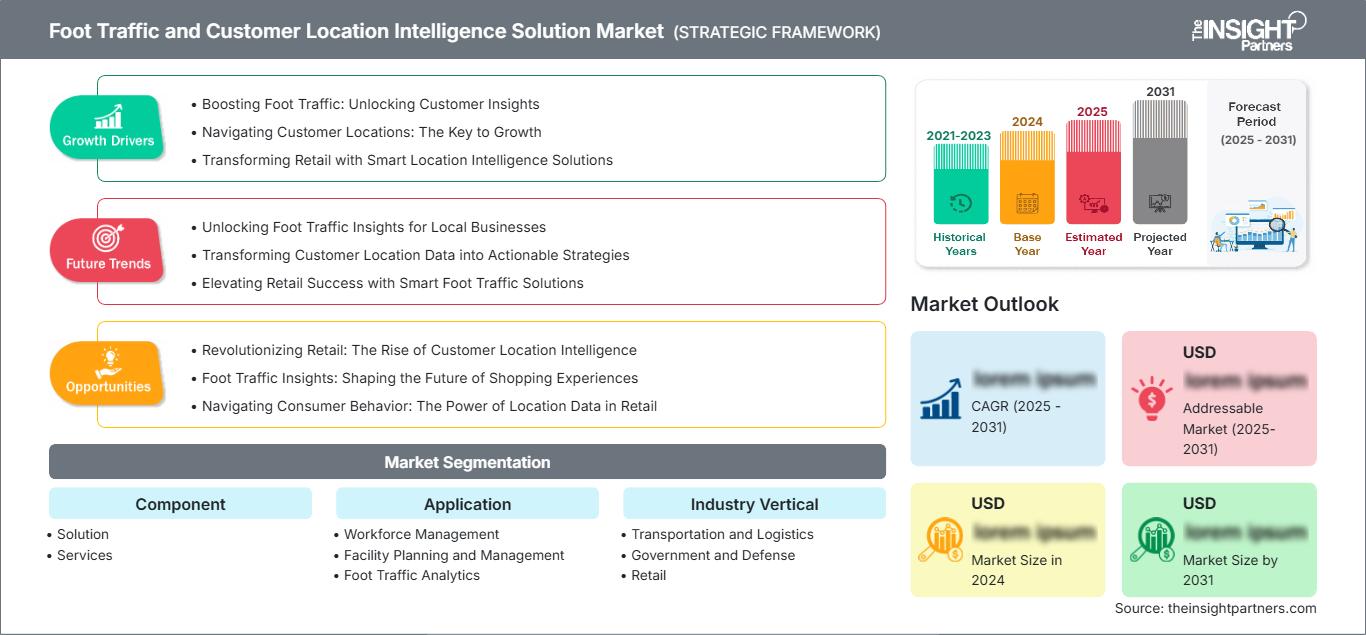
Foot Traffic and Customer Location Intelligence Solution Market: Strategic Insights
Regional Insights
North America Foot Traffic and Customer Location Intelligence Solution Market
North America accounted for 34-37% Foot Traffic and Customer Location Intelligence Solution market share in 2025 and is forecast to grow at 9.8-10.5% CAGR up to 2034. Cloud technology maturity, many multi-site retail footprints, and broad map coverage drive ongoing subscriptions. US e-commerce accounted for 16.4% of retail sales in third quarter 2025, underscoring the requirement to track how online discovery leads to brick-and-mortar visits.
Authorities from airports, transit agencies, real estate firms, hospitals, and public safety organizations add demand for products from non-retail categories. The growth in demand for international travel in 2025 was 7.1%, hence making additional planning important in gateways and intermodal hubs. Buyers appreciate configurability, APIs, and privacy-friendly data aggregation capabilities, whereas state privacy laws and procurement practices make consent, data management, and auditability more significant. Canada incorporates smart city, tourism, and transportation uses, although the major source of income is the US.
U.S. Foot Traffic and Customer Location Intelligence Solution Market
The US generated 83–86% of North American revenue in 2025 and should expand at 9.9–10.6% CAGR through 2034. National retailers use visit data to compare stores, optimize media, plan labor, and evaluate real estate. Airports and transport hubs require occupancy and flow analytics as 2025 global passenger traffic grew 5.3%, while government users apply aggregated mobility information to events, emergency response, and infrastructure planning.
Foursquare Labs, Inc., Cuebiq Group, LLC, Unacast AS, Placer Labs, Inc., Precisely Software Incorporated, Esri, and Point Inside, Inc. are major players with sizable product or customer presence. The application of these software services is moving away from historical reporting to a more regular focus on staffing, assortment, loss prevention, and tenant choices. Purchasing leans toward first party enhancement, geographic flexibility, and clear confidence intervals. Competition is a strong motivator for low-code operations.
Europe Foot Traffic and Customer Location Intelligence Solution Market
In 2025, Europe’s share was at 25-28%, modeled at 9.6-10.3% CAGR till 2034; the leading country being the UK. British retailers, transport operators, and commercial-property teams combine mobility information with catchment, spend, and transport layers. Germany takes advantage of highly dense urban networks and industrial expertise in GIS to plan facilities, optimize logistic flows, and analyze city center, while requiring high documentation and regional processing.
France uses geospatial analytics for its retail estates, tourism, transportation, and public administration. Italy and Spain present opportunities for growth via shopping centers, airports, hospitality and urban regeneration. EU in 2024 was comprised of 449 million residents, out of which Germany, France, Italy, and Spain are the major consumer countries. According to GDPR, re-identified pseudonymized data is considered personal information; therefore, vendors have to focus on irreversible anonymization, purpose limitation, minimization, and other controls, instead of exposing devices.
APAC Foot Traffic and Customer Location Intelligence Solution Market
APAC had 24-27% market share in 2025 and will have 12.0-12.8% CAGR till 2034 driven by China. Urban population in China is estimated to be around 933 million in 2025, providing scope for high volume retail, transit, and civic analysis.
Japan and South Korea bring in sophisticated digital infrastructure; India brings in fast-growing formal retail and transport investments; Australia provides scope for property and tourism analysis. Smart cities policies, cloud capability, and mobile engagement drive growth, while sovereignty needs ensure hosting and delivery partnerships.
Middle East & Africa Foot Traffic and Customer Location Intelligence Solution Market
MEA is forecast to grow from 11.2–12.0% CAGR until 2034, driven by the UAE. Large airports, malls, tourism zones, and mixed-use developments generate immediate requirement for analytics of crowd flow, facility, and tenants, while Saudi Arabia’s infrastructure projects increase potential deployments.
South Africa has use cases related to retail and transport; whereas other MEA requirements are primarily in the ports, public venues, and urban areas. Energy-secure data centers, indoor mapping, and local deployment capabilities become very important because connectivity and geocoding are not uniform across different countries.
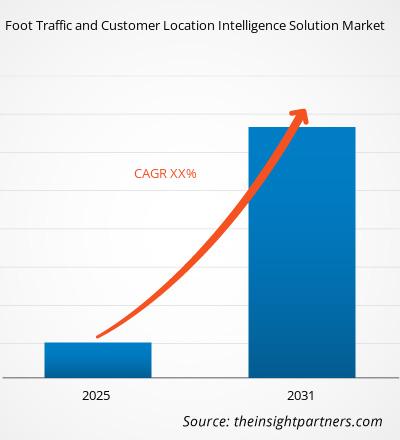
Segmentation Analysis
Component
Component revenue is modeled to grow at 10.4–11.1% CAGR during 2026–2034. The Foot Traffic and Customer Location Intelligence Solution Market scope includes cloud applications, APIs, curated datasets, implementation, validation, and advisory services. Platform demand leads because enterprises want repeatable analysis across portfolios, while services remain strategically important for consent design, data integration, custom geographies, model calibration, and operational adoption.
- Solution – Holds the dominant position through scalable dashboards, APIs, mapping, visitation datasets, and workflow tools that standardize portfolio benchmarking, campaign measurement, trade-area analysis, and recurring operational decisions.
- Services – Demand centers on implementation, privacy assessment, data engineering, model validation, training, and managed analysis, helping organizations translate spatial outputs into staffing, investment, safety, and facility actions.
Application
Application demand is modeled at 10.8–11.6% CAGR during 2026–2034. Foot traffic analytics is the fastest-growing use case as organizations convert visit estimates into operational metrics. Workforce and facility applications broaden recurring value beyond marketing, while risk and security deployments require near-real-time detection, governance, and integration with incident systems. Adoption depends on accuracy, update frequency, spatial granularity, and explainability.
- Workforce Management – Organizations align staffing with hourly visitation, queue, and seasonality patterns, reducing undercoverage and idle labor while supplying managers with forward schedules anchored in location-specific demand evidence.
- Facility Planning and Management – Spatial intelligence supports entrances, tenant mix, service placement, maintenance, capacity, and capital planning by showing where visitors originate, how they move, and when spaces face pressure.
- Foot Traffic Analytics – The application leads growth through store benchmarking, capture rates, dwell analysis, cross-visitation, campaign attribution, and site selection, turning physical behavior into comparable portfolio performance indicators.
- Risk/Security Management – Demand focuses on crowding, unusual movement, evacuation planning, restricted-zone monitoring, and event readiness, requiring governed data fusion, timely alerts, and clear escalation protocols.
Industry Vertical
Industry Vertical demand is modeled at 10.5–11.3% CAGR during 2026–2034. Retail remains the largest commercial user, but transportation and logistics, government and defense, and healthcare create diversified growth. Each vertical applies a different governance threshold: marketing prioritizes incrementality, transport prioritizes throughput, government prioritizes resilience, and healthcare prioritizes operational safety and strict handling of sensitive context.
- Transportation and Logistics – Airports, stations, ports, and distribution sites use movement intelligence to forecast throughput, design concessions, position resources, manage queues, and understand catchments across multimodal networks.
- Government and Defense – Aggregated mobility data informs urban planning, emergency response, border-area context, tourism strategy, and infrastructure allocation, while procurement emphasizes sovereignty, security, and explainable methods.
- Retail – Retailers link visits with media, transactions, loyalty, demographics, competitors, and real estate to optimize stores, trade areas, assortment, campaigns, leases, and localized expansion.
- Healthcare – Hospitals and health systems analyze arrival patterns, visitor flows, parking, wayfinding, capacity, and access gaps, with privacy-by-design controls essential for any person-linked data.
Opportunity Snapshot
| Application | Revenue Contribution | Trend Tag | Adoption Stage |
| Workforce Management | Medium | Demand Staffing | Scaling |
| Facility Planning and Management | High | Flow Design | Scaling |
| Foot Traffic Analytics | High | Visit Attribution | Mature |
| Risk/Security Management | Medium | Crowd Signals | Emerging |
Foot Traffic and Customer Location Intelligence Solution Market Growth Drivers and Impact Analysis
Need to Reconcile Digital and Physical Customer Journeys
Physical businesses need an overall strategy which ties together media, discoverability online, transactions, and physical store performance. During the third quarter of 2025, e-commerce made up 16.4 percent of US retail sales. Therefore, even if most of what is going on relates to the physical, customers start the journey online. Visit Intelligence delivers that extra piece of the puzzle in terms of observation in trade area, frequency, duration, competitive overlap, and incrementality. It's not just about media planning; the same data points guide retailers' actions concerning leasing, staffing, merchandising, and closures.
Higher Throughput Across Transport and Public Venues
Increased traffic and urbanization contribute to the rising cost of inefficient facility planning. In 2025, international flight traffic grew by 7.1%, and the worldwide passenger load factor is now at 83.6%, which means that the airport needs to get more productivity out of their gates, security lines, concession stands, and curb area. The same issues apply to train stations, hospitals, stadiums, and even government service facilities. Location intelligence helps to identify arrival peaks, origin areas, congestion points, and movement across facilities. The business opportunity includes subscriptions related to operations, planning, and tenant management, whereas the government purchaser will have a basis for infrastructure investment.
AI-Ready Geospatial Data Becomes Enterprise Infrastructure
The trend in business organizations is shifting away from standalone maps to governed spatial data products that enable modeling, dashboarding, and software agents. Foursquare Labs, Inc. claims that it has more than 100 million points of interest in more than 200 countries and territories around the world, showing how extensive the contextual data has become. Standard identifiers, H3 cells, cloud delivery, and semantic metadata help in minimizing the effort spent on preparing the data, while machine learning is used to estimate visits where raw signals are limited. The effect of this technology in the market will be less friction in integration and adoption by business analysts rather than just GIS professionals.
Foot Traffic and Customer Location Intelligence Solution Market Future Trends
Synthetic Mobility Models Replace Signal-Volume Dependence
Foot Traffic and Customer Location Intelligence Solution Market trends will shift toward models that blend aggregated first-party location signals with venue geometry, demographics, schedules, holidays, weather, and historical behavior. Unacast AS documents a methodology using more than 150 contextual features, indicating how estimation can become less vulnerable to fluctuating mobile supply. Future products will display confidence bands, bias diagnostics, and ground-truth performance alongside visit totals. This will expand coverage into lower-signal neighborhoods and regulated settings, but buyers will demand reproducible validation. Model governance, recalibration frequency, and transparent feature provenance will therefore become as important as dashboard usability.
Spatial Copilots Move From Querying to Workflow Execution
Natural-language spatial assistants will progress from generating maps to recommending staffing, ranking expansion sites, flagging anomalies, and drafting facility scenarios. The enabling architecture combines governed enterprise data with geocoding, routing, points of interest, movement estimates, and policy constraints. Human review will remain essential where recommendations affect security, healthcare access, closures, or public services. Vendors will differentiate through explainable reasoning, permission-aware retrieval, and the ability to trace every recommendation to approved data. Adoption will favor platforms embedded in existing BI and planning environments, reducing training needs while preserving auditability and role-based control.
Foot Traffic and Customer Location Intelligence Solution Market Opportunities
Vertical Packages for Airports, Hospitals, and Public Estates
Suppliers can move beyond generic visitation dashboards by packaging sector-specific metrics, connectors, and operating playbooks. Airport offerings should combine passenger flows, curb access, concessions, and gate schedules; hospital packages should address arrivals, parking, wayfinding, and service access; public-estate solutions should support event readiness and capital planning. Investment should fund reference data models, privacy assessments, and integrations with workforce, facility, and incident systems. This approach shortens deployment, clarifies return on investment, and creates implementation revenue without extensive customization. Partners with domain consultancies and systems integrators can provide local compliance, process redesign, and change management while software vendors retain scalable analytics.
Privacy-Preserving Data Collaboration Networks
Clean rooms and federated analytics can let retailers, landlords, transport operators, brands, and public agencies compare outcomes without exchanging raw person-level records. The investment case centers on standardized place identifiers, contractual purpose controls, minimum aggregation thresholds, differential privacy where appropriate, and auditable queries. Networks become more valuable as participants contribute complementary context such as transactions, campaigns, tenancy, schedules, or catchments. Providers should begin with narrow, measurable collaborations, including campaign-to-visit attribution or shared district planning, then expand after governance is proven. Revenue can combine platform subscriptions, secure computation, curated data, and managed analysis while lowering regulatory and reputational exposure.
Recent Developments
- May 2025: Dataplor introduced its Global Mobility Product, extending privacy-compliant foot traffic intelligence to major markets worldwide. The solution delivers monthly updated mobility insights linked to points of interest, enabling businesses to analyze consumer movement, evaluate market opportunities, and support expansion strategies across international regions. By combining global location intelligence with accurate foot traffic data, the platform helps retailers, investors, and urban planners make informed, data-driven decisions while maintaining strong privacy and regulatory compliance.
- July 2025: SiteZeus launched an intelligent foot traffic integration within its SiteZeus Locate platform to improve location selection accuracy for multi-unit businesses. Developed through a partnership with Dataplor, the feature combines estimated visit counts with demographic, psychographic, traffic, and competitive data instead of relying solely on footfall metrics. This integrated approach enables retailers and franchise operators to evaluate potential sites more effectively and make better-informed expansion and investment decisions.
- May 2026: Azira unveiled Estimated Visits Core, a location intelligence solution that provides brands and agencies with detailed visitation insights across more than 940,000 locations in the United States and Canada. The platform combines mobility and transaction data to deliver privacy-focused, ready-to-use analytics for competitive analysis, audience targeting, site selection, and campaign measurement. By simplifying access to reliable consumer movement data, the solution enables organizations to improve operational planning and marketing performance.
Frequently Asked Questions

- Comprehensive Market Sizing and Forecast Analysis
- Detailed Segmentation Analysis
- In-Depth Market Dynamics Assessment
- Regional and Country-Level Insights
- Competitive Landscape and Company Benchmarking
- Strategic Business Intelligence
Recent Reports
Testimonials

The Insight Partners' SCADA System Market report is comprehensive, with valuable insights on current trends and future forecasts. The team was highly professional, responsive, and supportive throughout. We are very satisfied and highly recommend their services.
RAN KEDEM Partner, Reali Technologies LTDs
I requested a report on a very specific software market and the team produced the report in a few days. The information was very relevant and well presented. I then requested some changes and additions to the report. The team was again very responsive and I got the final report in less than a week.
JEAN-HERVE JENN Chairman, Future Analytica
We worked with The Insight Partners for an important market study and forecast. They gave us clear insights into opportunities and risks, which helped shape our plans. Their research was easy to use and based on solid data. It helped us make smart, confident decisions. We highly recommend them.
PIYUSH NAGPAL Sr. Vice President, High Beam Global
The Insight Partners delivered insightful, well-structured market research with strong domain expertise. Their team was professional and responsive throughout. The user-friendly website made accessing industry reports seamless. We highly recommend them for reliable, high-quality research services
YUKIHIKO ADACHI CEO, Deep Blue, LLC.
This is the first time I have purchased a market report from The Insight Partners.While I was unsure at first, I visited their web site and felt more comfortable to take the risk and purchase a market report.I am completely satisfied with the quality of the report and customer service. I had several questions and comments with the initial report, but after a couple of dialogs over email with their analyst I believe I have a report that I can use as input to our strategic planning process.Thank you so much for taking the extra time and making this a positive experience.I will definitely recommend your service to others and you will be my first call when we need further market data.
JOHN SUZUKI President and Chief Executive Officer, Board Director, BK Technologies
I wish to appreciate your support and the professionalism you displayed in the course of attending to my request for information regarding to infectious disease IVD market in Nigeria. I appreciate your patience, your guidance, and the fact that you were willing to offer a discount, which eventually made it possible for us to close a deal. I look forward to engaging The Insight Partners in the future, all thanks to the impression you have created in me as a result of this first encounter.
DR CHIJIOKE ONYIA MANAGING DIRECTOR, PineCrest Healthcare Ltd.Reason to Buy
- Informed Decision-Making
- Understanding Market Dynamics
- Competitive Analysis
- Identifying Emerging Markets
- Customer Insights
- Market Forecasts
- Risk Mitigation
- Boosting Operational Efficiency
- Strategic Planning
- Investment Justification
- Tracking Industry Innovations
- Aligning with Regulatory Trends





 Get Free Sample for