
Forestry Equipment Market Size, Share & Trends by 2034
Coverage: by Type (Extracting, On-Site Processing, Parts and Attachments, and Others); By Industry (Oil & Gas, Power, Mining, Agriculture, and Others ), and Geography (North America, Europe, Asia Pacific, and South and Central America)
- Status : Data Released
- Report Code : TIPRE00002841
- Category : Manufacturing and Construction
- No. of Pages : 150
- Available Report Formats :


- Last update date : July 28, 2026


2025 Market Size
US$ 12.97 Bn
Base year value
2034 Forecast
US$ 21.61 Bn
Projected by 2034
CAGR 2026-2034
5.83 %
Growth rate
Addressable Market
US$ 156.63 Bn
(2026-2034)
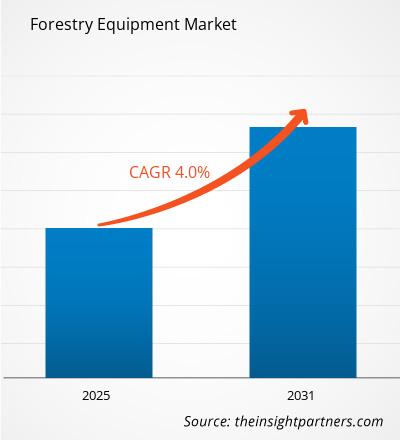
The forestry equipment market size was US$ 12.97 Billion in 2025 and will rise to US$ 21.61 Billion in 2034, with a CAGR of 5.83% between 2026 and 2034. The factors influencing demand include timber harvest using mechanization, fleet turnover, bioenergy feedstock transport, and safe logging practices in commercial forests, plantations, and managed woodlands.
North America continues to be a key source of revenue, and the North American market size for forestry equipment is driven by high mechanization, forest management, and the replacement of older diesel fleets. Growth is expected in the 4.9–5.4% CAGR range between 2026 and 2034, due to work on reducing fire risk, U.S. South timber transport, Canadian harvest seasonality, and telematics among contractor fleets.
Forestry Equipment Market Assessment and Insights
- North America accounted for 32–35% share in 2025 and is projected to grow at a 4.9–5.4% CAGR between 2026–2034, driven by mature logging contractors, high machine replacement intensity, and wildfire fuel-management programs.
- US represented 64–68% of North America revenue in 2025 and is expected to grow at a 4.8–5.3% CAGR between 2026–2034, supported by timber harvesting in the Southeast and Pacific Northwest.
- Europe held 26–29% share in 2025 and is forecast to grow at a 5.1–5.6% CAGR between 2026–2034, led by Sweden, Finland, Germany, France, and the UK.
- Asia Pacific captured 23–26% share in 2025 and is projected to grow at a 6.4–6.9% CAGR between 2026–2034, led by China, Japan, India, South Korea, and Australia.
- Largest Segment Felling equipment held 31–34% market share in 2025 and is expected to grow at a 5.4–5.9% CAGR between 2026–2034, reflecting demand for harvesters and feller bunchers.
- High Growth Segment Electric operation held 8–11% market share in 2025 and is forecast to grow at a 9.5–10.5% CAGR between 2026–2034 as hybrid and battery-ready platforms advance.
- Key companies analyzed in detail: Caterpillar Inc., Komatsu Ltd., Hitachi Construction Machinery Co., Ltd., AB Volvo, Bell Equipment Limited, Deere & Company, Ponsse Plc, Tigercat Industries Inc., Waratah Forestry Equipment, Rottne Industri AB.
Source: The Insight Partners' analysis based on proprietary research, government publications, company annual reports, investor presentations, industry databases, and expert interviews.
Introduction of mechanical harvesting has led to evolution of the forestry equipment industry into an industry of connected productivity systems that involve combined processes of felling, extraction, processing, and loading. Integration of telematics, hydraulic efficiency, and operator support systems in the equipment is being considered to reduce the time loss and fuel consumption. Production trends will change since the forestry contractors require flexible machines, dealer support, and machines that can work in difficult terrains such as wet soils and biomass harvesting.
Future adoption of the equipment will be high in areas where there is a convergence of timber supply chain, forest restoration, and emission reduction machinery regulations. Emerging markets are moving away from manual and semi-mechanized harvesting to more productive machinery while mature markets are concerned about replacement of machines and operation monitoring. Engine emissions, certified harvesting, and workers’ safety will determine purchase decisions.
Forestry Equipment Market Report Scope
| Report Attribute | Details |
|---|---|
| Market size in 2025 | US$ 12.97 Billion |
| Market Size by 2034 | US$ 21.61 Billion |
| Global CAGR (2026 - 2034) | 5.83% |
| Historical Data | 2021-2024 |
| Forecast period | 2026-2034 |
Forestry Equipment Market Analysis
Forestry equipment growth forecasts hinge on the demand for timber due to the use of wood for the construction, packaging, furniture industries, and as an energy source. The operators in commercial sector are mechanizing dangerous jobs for safety concerns as well as increased productivity of each team member. Equipment selection is now part of supply chain planning, which consists of software, machinery, attachments, services, and mill logistics, therefore, the selection process is strategic.
On the supply side, the cost of steel, hydraulic components, engine regulations and service capability of dealers affect the market. On the demand side, there is strong demand for machinery that can operate in multi-shift harvesting periods. Operators value equipment with low soil compaction capability, payload measurement capability, and preventive maintenance capability because unexpected equipment downtime will affect product transportation.
Forestry equipment market analysis reveals a competitive market where diversified companies of construction equipment and forestry equipment companies compete. Caterpillar Inc., Komatsu Ltd., Deere & Company, and AB Volvo have scale, wide dealer network, and powertrain capabilities, whereas Ponsse Plc, Tigercat Industries Inc., Waratah Forestry Equipment, and Rottne Industri AB compete through customized harvesting equipment and attachments.
There is a trend toward investment in data-driven equipment, comfort for operators, emission-efficient engines, and electric powertrains. Positioning is being increasingly influenced by economic benefits over the lifecycle of equipment, financial services, and availability of spare parts in remote logging areas. Hitachi Construction Machinery Co., Ltd. and Bell Equipment Limited enrich the ecosystem through heavy-duty equipment and regional presence, respectively.
● REPORT CUSTOMIZATION
Tailor This Report To Align With Your Specific Business Requirements
This report can be customized to align precisely with your business objectives, scope, and target markets. Customization options include tailored segmentation, geography, competitive analysis, and strategic insights to support informed decision-making.
Customize This Report →WHAT YOU CAN ADJUST
- ● Segmentations
- ● Geography
- ● Competitive Analysis
- ● Language Preferences
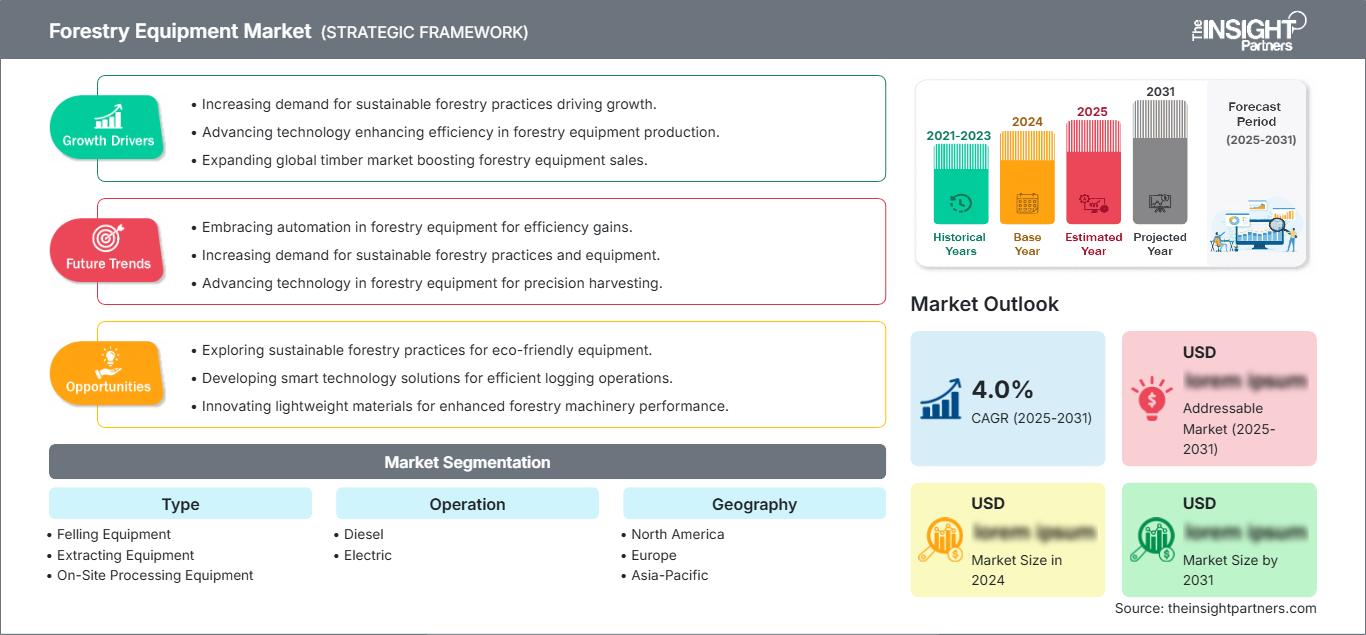
Forestry Equipment Market: Strategic Insights
Regional Insights
North America forestry equipment market
North America accounted for 32-35% market share in 2025, which implies that the forestry equipment market share geography is significantly influenced by the harvesting patterns in the United States and Canada. North America is anticipated to register a 4.9-5.4% CAGR between 2026 and 2034 due to replacements, steep slope operation capability, and telematics technology.
Drivers behind the industry are steady demand for softwood lumber, biomass gathering, and forest health treatments. In Canada, there are substantial managed forests that call for forwarders, harvesters, and loaders, whereas felling and extraction machines will be needed for commercial forests in the US timber belts.
U.S. Forestry Equipment Market
In 2025, the U.S. was responsible for 64% to 68% of North America’s sales and is expected to post a CAGR growth rate of 4.8% to 5.3% by 2034. The demand is in the Southeast, Pacific Northwest, and Lake States regions since logging activities in these areas involve felling, extracting, and loading.
The market presence of companies is high as there are dealers, attachment, or service network providers of Deere & Company, Caterpillar Inc., Komatsu Ltd., and Waratah Forestry Equipment that support logging contractors. Cut-to-length logging, roadside processing, biomass handling, and digital maintenance programs are used in this application.
Europe Forestry Equipment Market
Europe held 26–29% share in 2025 and is expected to grow at a 5.1–5.6% CAGR during 2026–2034. Sweden and Finland remain leading countries because cut-to-length systems, forwarders, and harvesters are deeply embedded in commercial forestry. Germany adds replacement demand through managed forests and strict environmental standards.
The UK market is smaller but strategically relevant for woodland management, biomass feedstock, and contractor-led mechanization. Germany benefits from high service expectations and emissions compliance, while France, Italy, and Spain show demand for mixed terrain, plantation management, and fire-prevention clearing. European buyers value low soil impact, operator ergonomics, and lifecycle cost transparency.
APAC Forestry Equipment Market
APAC had a 23–26% market share in 2025 and will have the fastest regional CAGR of 6.4–6.9%. China will lead demand due to plantation forestry and wood processing operations, whereas Japan and South Korea will rely on compact machinery for their managed forests.
India and Australia will offer diverse drivers of growth: India is mechanizing selective harvesting and its agroforestry-based value chain, while Australia needs durable machinery for plantation harvest and forest rehabilitation after wildfires. The policy direction toward the domestic wood supply, industrial wood processing, and workplace safety drives the demand for felling, extraction, and loading systems.
Middle East & Africa Forestry Equipment Market
Middle East & Africa is expected to grow at a 4.2–4.7% CAGR during 2026–2034, with South Africa as the leading country. Demand is tied to commercial plantations, pulpwood supply, and mechanized residue handling rather than broad natural-forest harvesting.
Saudi Arabia and the UAE create niche demand through landscaping, land management, and infrastructure-linked clearing, while the rest of MEA relies on forestry, agriculture, and biomass applications. Energy diversification, construction material needs, and imported equipment support gradual adoption, although financing and service coverage remain constraints.
Segmentation Analysis
Type
The Type segment is projected to grow at a 5.5–6.0% CAGR during 2026–2034. The forestry equipment market scope within this segment spans machines used from tree felling through roadside handling. Demand is strongest where contractors need higher productivity per operator, lower downtime, and equipment configurations suited to terrain, stand density, and log specification.
- Felling Equipment leads adoption because harvesters, feller bunchers, and related platforms improve safety and output in commercial timber operations, particularly where labor availability and steep terrain create operational pressure.
- Extracting Equipment supports the movement of timber from stump to roadside, with skidders and forwarders valued for payload optimization, traction, and reduced soil disturbance in managed forestry areas.
- On-Site Processing Equipment is important for delimbing, bucking, chipping, and sorting near harvest sites, helping operators reduce transport inefficiency and improve mill-ready log consistency.
- Cutting & Loading Equipment links forest operations with logistics by enabling rapid roadside loading, sorting, and material handling, especially where seasonal windows and truck availability influence productivity.
Operation
The Operation segment is forecast to grow at a 5.7–6.2% CAGR during 2026–2034. Diesel remains dominant for heavy continuous work because power density, refueling convenience, and proven service networks matter in remote forests. Electric platforms are gaining attention where lower noise, reduced emissions, and predictable operating cycles justify higher upfront investment.
- Diesel remains the preferred operating mode for high-duty felling, extraction, and loading machines because it provides range, torque, serviceability, and dependable performance in remote locations.
- Electric is emerging in compact machines, auxiliary systems, and hybrid-ready platforms, with adoption linked to emissions rules, depot charging feasibility, and lower noise requirements near communities.
Opportunity Snapshot
| Segment Name | Revenue Contribution | Trend Tag | Adoption Stage |
| Felling Equipment | High | Precision Felling | Mature |
| Extracting Equipment | High | Low Impact | Scaling |
| On-Site Processing Equipment | Medium | Roadside Processing | Scaling |
| Cutting & Loading Equipment | Medium | Fast Loading | Mature |
| Diesel | High | Fleet Renewal | Mature |
| Electric | Low | Zero Emission | Emerging |
Forestry Equipment Market Growth Drivers and Impact Analysis
Mechanized harvesting improves safety and crew productivity
This operation requires much manual labor and is very risky, so contractors are gradually moving more operations to feller bunchers, harvesters, forwarders, and loadallers. It can be seen from the purchasing trends that customers begin to compare machines according to how often the machine will operate, the visibility of the operator, maintenance needs, and the daily capacity of the machine. Mechanization also aids in overcoming the shortage of qualified labor by enabling small work teams to cut down large areas.
Apart from making operations more efficient, mechanized harvesting ensures consistency in terms of wood quality and cutting precision. With today’s machinery, workers can operate on steep terrains, in thick woods, and under unfavorable weather conditions without experiencing physical stress or risks of sustaining work-related injuries. Because of machine guidance systems and boom controls, the cutting becomes much more precise leading to less waste of the harvested wood. The contractors also experience savings on fuel, consuming less per unit volume of wood harvested due to machine optimization and efficient routing. In the face of increasingly stringent environmental policies, the use of low-emission engines and high-tech hydraulics by the mechanized equipment makes it easier for the companies to adhere to the requirements of sustainability.
Bioenergy and wood residue recovery widen machine utilization
The increasing interest in wood residues, substandard wood, and biomass plantations in bioenergy policy and industrial decarbonization is increasing the importance of chippers, loaders, extractors, and machinery used in on-site processing of wood. The opportunity to increase equipment efficiency by providing services in pulpwood, pellets, biomass energy, and land clearance segments exists. It becomes particularly important in areas where governments promote renewable energy, forest thinning, and wildfire fuel reduction, which will provide more working hours for forestry contractors.
The growing importance of circular economy principles will increase the economic importance of forestry waste which has not been utilized before. There will be more sources of revenue for contractors as they will participate in biomass collection and processing, which will contribute to clean energy production and effective utilization of forest resources. Increasing investments in pellet production, biomass energy generation facilities, and industrial energy production systems will promote the need for specialized machinery and transport systems. Removal of forest residues and vegetation will be increasingly important in areas affected by growing wildfire risks. As investments in renewable energy facilities grow, machinery used to process various types of biomass will be used more intensively in all seasons of the year.
Digital fleet management reduces downtime in remote operations
Remote forestry sites make service delays costly, which is why telematics, predictive maintenance, payload monitoring, and fuel analytics are becoming standard buying criteria. Connected machines help contractors schedule repairs, monitor operator behavior, and align harvesting output with truck dispatch and mill intake. The market impact is a shift toward premium equipment with embedded software and dealer support. Suppliers that combine durable hardware with actionable data are positioned to capture replacement demand and long-term service revenue.
Digital fleet management platforms also enable centralized oversight of multiple worksites, allowing fleet managers to evaluate machine utilization, maintenance schedules, and operational efficiency in real time. Cloud-based reporting tools provide detailed insights into idle time, engine performance, fuel consumption, and production output, enabling contractors to make informed decisions that improve profitability. Remote diagnostics reduce the need for on-site inspections by allowing technicians to identify potential issues before failures occur, minimizing unexpected downtime. Integration with enterprise resource planning systems and logistics platforms further strengthens coordination between harvesting operations, transportation providers, and processing facilities. As connectivity improves across rural regions, software-enabled equipment management is becoming an essential competitive advantage, encouraging forestry companies to invest in digitally advanced machinery and long-term service agreements.
Forestry Equipment Market Future Trends
Hybrid and electric platforms move into practical duty cycles
The most visible forestry equipment market trends will involve selective electrification rather than immediate replacement of diesel fleets. Battery-electric and hybrid systems are likely to appear first in compact machines, auxiliary drives, yard equipment, and predictable return-to-base operations. Manufacturers will focus on torque delivery, charging logistics, thermal management, and service training. Adoption will accelerate where emissions rules, fuel costs, and community noise limits make lower-emission equipment commercially attractive.
Precision forestry connects machines with forest planning
Future machines will generate operational data that feeds directly into forest inventory, certification, carbon accounting, and mill logistics. GPS guidance, stem measurement, terrain mapping, and automated reporting will help owners prove sustainable harvesting and improve yield decisions. This trend will raise expectations for interoperability between equipment, attachments, and planning software. Suppliers able to convert machine data into compliance and productivity insights will gain stronger customer retention.
Forestry Equipment Market Opportunities
Aftermarket services and remanufacturing create recurring value
Suppliers can capture value by expanding parts availability, certified rebuilds, remote diagnostics, and operator training. Many forestry contractors keep machines longer when financing costs rise, making maintenance quality central to uptime. Remanufactured components also support sustainability goals by extending equipment life and reducing replacement waste. This opportunity aligns with forestry equipment market forecasts because installed-base services can grow even when new-machine demand fluctuates across timber cycles.
Emerging-market mechanization opens dealer-led expansion
Asia Pacific, Latin America, and selected African markets offer expansion potential as plantation forestry, pulp production, and wood-processing investments increase. Equipment makers can prioritize mid-range machines, financing programs, mobile service teams, and training partnerships to reduce adoption barriers. The strongest opportunities will come from customers upgrading from manual or fragmented fleets to mechanized systems that improve safety, output consistency, and traceability for export-oriented wood products.
Recent Developments
- May 2025: Deere & Company highlighted updates to John Deere 900 M-Series forestry machines, including dedicated travel and return-to-level functions intended to improve stability and operator control on uneven terrain, supporting felling and bunching work in demanding North American conditions
- February 2025: Komatsu introduced its newest log loader, the TimberPro TN230D. The new machine was built from the ground up based on customer and distributor feedback and was carefully engineered to help improve productivity and provide additional operator benefits.
- September 2025: Waratah Forestry Equipment has launched two new harvester heads the H427 and the H427X to deliver powerful, durable and reliable solutions for today’s toughest forestry applications. Built to handle large timber, the H427 offers high productivity and precision, while the H427X extends that performance with heavy-duty features, purpose-built for tracked machine applications.
Frequently Asked Questions

- Comprehensive Market Sizing and Forecast Analysis
- Detailed Segmentation Analysis
- In-Depth Market Dynamics Assessment
- Regional and Country-Level Insights
- Competitive Landscape and Company Benchmarking
- Strategic Business Intelligence
Recent Reports
Testimonials

The Insight Partners' SCADA System Market report is comprehensive, with valuable insights on current trends and future forecasts. The team was highly professional, responsive, and supportive throughout. We are very satisfied and highly recommend their services.
RAN KEDEM Partner, Reali Technologies LTDs
I requested a report on a very specific software market and the team produced the report in a few days. The information was very relevant and well presented. I then requested some changes and additions to the report. The team was again very responsive and I got the final report in less than a week.
JEAN-HERVE JENN Chairman, Future Analytica
We worked with The Insight Partners for an important market study and forecast. They gave us clear insights into opportunities and risks, which helped shape our plans. Their research was easy to use and based on solid data. It helped us make smart, confident decisions. We highly recommend them.
PIYUSH NAGPAL Sr. Vice President, High Beam Global
The Insight Partners delivered insightful, well-structured market research with strong domain expertise. Their team was professional and responsive throughout. The user-friendly website made accessing industry reports seamless. We highly recommend them for reliable, high-quality research services
YUKIHIKO ADACHI CEO, Deep Blue, LLC.
This is the first time I have purchased a market report from The Insight Partners.While I was unsure at first, I visited their web site and felt more comfortable to take the risk and purchase a market report.I am completely satisfied with the quality of the report and customer service. I had several questions and comments with the initial report, but after a couple of dialogs over email with their analyst I believe I have a report that I can use as input to our strategic planning process.Thank you so much for taking the extra time and making this a positive experience.I will definitely recommend your service to others and you will be my first call when we need further market data.
JOHN SUZUKI President and Chief Executive Officer, Board Director, BK Technologies
I wish to appreciate your support and the professionalism you displayed in the course of attending to my request for information regarding to infectious disease IVD market in Nigeria. I appreciate your patience, your guidance, and the fact that you were willing to offer a discount, which eventually made it possible for us to close a deal. I look forward to engaging The Insight Partners in the future, all thanks to the impression you have created in me as a result of this first encounter.
DR CHIJIOKE ONYIA MANAGING DIRECTOR, PineCrest Healthcare Ltd.Reason to Buy
- Informed Decision-Making
- Understanding Market Dynamics
- Competitive Analysis
- Identifying Emerging Markets
- Customer Insights
- Market Forecasts
- Risk Mitigation
- Boosting Operational Efficiency
- Strategic Planning
- Investment Justification
- Tracking Industry Innovations
- Aligning with Regulatory Trends





 Get Free Sample for